Quotulatiousness

April 8, 2021

Vladimir Lenin and the Communist War On Religion | B2W: ZEITGEIST! I E.15 – Spring 1922

Filed under: Health, History, Religion, Russia — Tags: , , , , , , — Nicholas @ 04:00

TimeGhost History
Published 7 Apr 2021

Vladimir Lenin founded the Bolshevik Party, orchestrated the October Revolution, and led the world’s first communist state to victory in the Russian Civil War. He is now gravely ill and close to death, but he still has one more enemy he wants to crush.

Join us on Patreon: https://www.patreon.com/TimeGhostHistory

Hosted by: Indy Neidell
Written by: Francis van Berkel
Director: Astrid Deinhard
Producers: Astrid Deinhard and Spartacus Olsson
Executive Producers: Astrid Deinhard, Indy Neidell, Spartacus Olsson, Bodo Rittenauer
Creative Producer: Maria Kyhle
Post-Production Director: Wieke Kapteijns
Research by: Francis van Berkel and Lewis Braithwaite
Image Research by: Daniel Weiss
Edited by: Daniel Weiss
Sound design: Marek Kamiński

Colorizations:
Daniel Weiss – https://www.facebook.com/TheYankeeCol…​

Sources:
Painting of Tikhon by Moskvitin Philip
Photos from Color by Klimbim
Bundesarchiv_Bild – 183-R14433 (Vertrag von Rapallo)

Soundtracks from Epidemic Sound
– “One More for the Road” – Golden Age Radio
– “Not Safe Yet” – Gunnar Johnsen
– “Dark Shadow” – Etienne Roussel
– “Explaining Gravity” – Silver Maple
– “Far Far Far” – Hector Posser
– “Dawn Of Civilization” – Jo Wandrini
– “Ominous” – Philip Ayers
– “Walk With Legends” – Bonnie Grace
– “What Now” – Golden Age Radio
– “Weapon of Choice” – Fabien Tell

Archive by Screenocean/Reuters https://www.screenocean.com​.

A TimeGhost chronological documentary produced by OnLion Entertainment GmbH.

From the comments:

TimeGhost History
2 days ago (edited)
The Russian Orthodox Church was once an all-mighty institution throughout what was the Russian Empire. But now in a matter of years, it has been completely swept aside by the new Soviet government in the name of progress and reason. This is just one — particularly violent — example of what has been a common theme of this era: the conflict between religion and modernity.

It has already come a few times in the series and will continue to do so, but it’s not always a story of retreating faith like it is in this episode. As you will see in later episodes, organized religion often fights back against modernity and even sometimes tries to accommodate it. You’ll have to stay tuned to find out exactly why.

Fallen Flag — the Duluth, Missabe & Iron Range Railway

Filed under: Business, History, Railways, USA — Tags: , , , , — Nicholas @ 03:00

This month’s Classic Trains fallen flag feature is the Duluth, Missabe & Iron Range Railway (DM&IR) by Steve Glischinski. The DM&IR was formed by the 1937 merger between the Duluth, Missabe and Northern Railway (DMN) and the Spirit Lake Transfer Railway and the 1938 further merger of the combined operation with the Duluth and Iron Range Road (D&IR) and the Interstate Transfer Railway. The D&IR had been founded in 1874 to transport iron ore from Tower, MN to Two Harbors, MN, eventually coming under the ownership of United States Steel Corporation in 1901.

The Merritt family of Minnesota (known as the “Seven Iron Brothers“) discovered a large iron ore deposit in the Mesabi Range and created the largest iron ore mine in the world (as of the 1890s) and tried to persuade the DMN to build a 70-mile rail connection to get their ore to harbour and out to the iron and steel foundries around the Great Lakes. The DMN was unwilling to commit, so the Merritt family borrowed money to build the line from, among other financiers, John D. Rockefeller. The line — called the Duluth, Missabe and Northern — got built and began operations in 1892, but the Merritts expanded too quickly at the wrong moment — the financial panic of 1893 — losing financial control and leaving ownership of both the mine and the railway in Rockefeller’s hands by 1894.

Charlemagne Tower sold the Duluth & Iron Range to Illinois Steel in 1887, which was succeeded by Federal Steel, then U.S. Steel. By 1901, both the D&IR and DM&N were under U.S. Steel control. USS upgraded both railroads with heavy rail and double track, ordered bigger locomotives and larger cars, and built sizeable shops and roundhouses at Proctor and Two Harbors.

In 1915 DM&N leased the Spirit Lake Transfer Railway, a link between DM&N at Adolph, near Proctor, and the Interstate Transfer Railway at Oliver, Wis., across from Steelton, Minn. The Interstate Transfer ran from Oliver to Itasca, in eastern Superior, giving the DM&N connections with large railroads including Northern Pacific, Chicago & North Western’s “Omaha Road”, and three members of the Canadian Pacific family: Minneapolis, St. Paul & Sault Ste. Marie (“Soo Line”); Wisconsin Central; and Duluth, South Shore & Atlantic.
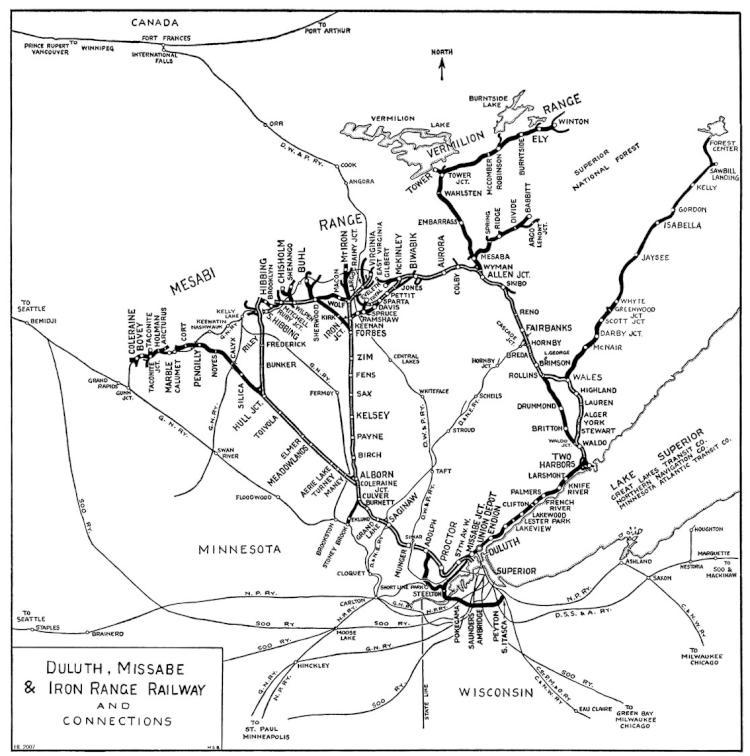
DM&N and D&IR remained separate until January 1, 1930, when the DM&N leased the D&IR and consolidated operations. Then on July 1, 1937, the DM&N merged with the Spirit Lake Transfer to form the Duluth, Missabe & Iron Range Railway. DM&IR then acquired ownership of D&IR and Interstate Transfer, and they became part of the new corporation on March 22, 1938. Reminders of the two big predecessors remained in the DM&IR’s two operating divisions, named Iron Range and Missabe, made up primarily of the predecessors’ tracks.

The Great Depression drastically reduced ore traffic. In 1932, not a single all-ore train was run — the small amount of ore that had to be shipped was carried in mixed freights. World War II reversed the road’s fortunes, of course, and the postwar boom resulted in an even higher demand for ore, with an all-time tonnage record being set in 1953.

Missabe had minimal passenger service. Into the 1950s, handsome Pacifics pulled heavyweight steel RPOs and coaches, two with solarium observation sections. At the end of World War II, the Missabe still provided service between Duluth and Ely (Winton), and Duluth and Hibbing, with the Hibbing train connecting with one from Iron Junction to Virginia.

Duluth, Missabe & Iron Range M-3 locomotive no. 227.
Photo by “GavinTheGazelle” via Wikimedia Commons.

U.S. Steel spun off the DM&IR and its other ore railroads and shipping companies to subsidiary Transtar in 1988, selling majority control to the Blackstone Group. In 2001, DM&IR and other holdings were moved from Transtar to Great Lakes Transportation, fully owned by Blackstone, so for the first time in a century, DM&IR was no longer associated with U.S. Steel. On October 20, 2003, Canadian National announced it would buy Great Lakes Transportation, which also owned Bessemer & Lake Erie, Pittsburgh & Conneaut Dock Co. in Ohio, and Great Lakes Fleet, Inc. The purchase was finalized on May 10, 2004, and the independent Missabe Road vanished.

CN retired all but 10 of the SD40-3s, most of the SD38s, and all the rebuilt SD9s and 18s. Major locomotive work shifted from Proctor to other shops, and train dispatchers moved to Wisconsin, then Illinois. CN invested in new ore cars for the Missabe, gradually replacing those that dated to when steam still ruled the railroad. DM&IR existed on paper until December 31, 2011, when CN merged subsidiaries DM&IR and Duluth, Winnipeg & Pacific into Wisconsin Central.


The Weird Years of The Simpsons (1989-1994)

Filed under: Humour, Media, USA — Tags: , , , — Nicholas @ 02:00

J.J. McCullough
Published 2 Jan 2021

The show struggled for five years to figure out what kind of show it wanted to be, and how to treat its characters. It could have been much weirder than it was.

FOLLOW ME:

🇨🇦Support me on Patreon! https://www.patreon.com/jjmccullough
🤖Join my Discord! https://discord.gg/3X64ww7
🇺🇸Follow me on Instagram! https://www.instagram.com/jjmccullough/
🇨🇦Read my latest Washington Post columns: https://www.washingtonpost.com/people…
🇨🇦Visit my Canada Website http://thecanadaguide.com

HASHTAGS: #tv #animation

QotD: Thomas Hobbes and his “state of nature”

Filed under: History, Liberty, Quotations — Tags: , , , — Nicholas @ 01:00

One reason I had such a hard time teaching this stuff to undergraduates back in my ivory tower days was that, ironically, we can imagine a much more “realistic” State of Nature than Hobbes could. We even had a TV show about it: Lost (in which, I’m told, one of the characters was actually named “John Locke”). A large group of strangers, unrelated by blood or affinity, would never be shipwrecked on a deserted island in Hobbes’s day, but we Postmoderns have no problem imagining a large international flight going down. Assume everyone survives the crash, and there’s your State of Nature – a much better one than Hobbes’s.

Under those very specific conditions, something like what Hobbes says might come to pass. In reality, of course, we seem to be much likelier to pull together in a disaster than to immediately go full retard, but let’s envision the most apocalyptic scenario, in which every guy who can bench press his body weight (assuming such still exist on international flights) immediately tries to lord it over everyone else on the island. There, and only there, the stuff Hobbes says about equality is true – the strong guy can beat up the weak guy, and enslave him, but the strong guy has to sleep sometime …

… so pretty soon there are no more strong guys, only various flavors of weak, clever guys, and now they have to band together, because you need three or four of them to accomplish the physical labor that one strong guy could’ve before they murdered him in his bed. And so on, you get the point, eventually everyone grudgingly lays down his arms and starts working together for mutual survival.

At this point, I need to point out something fundamental about Thomas Hobbes, that y’all probably don’t know. Hobbes always considered himself first and foremost a mathematician. But he wasn’t a very good mathematician. He’d thought he’d discovered a way to “square the circle,” for instance, and that’s not a metaphor – that was really a thing back then, and Hobbes’s attempt got ripped to shreds by real mathematicians, who thought they were thereby discrediting his metaphysics and, by implication, his political philosophy …

… fun stuff, but irrelevant, the point is, Hobbes was a bad mathematician. So bad, in fact, that even I, a former History professor who needs to pull off a sock every time I have to count past ten, can see the glaring flaw in his “geometrical” political theory: IF it’s based on “the State of Nature,” and we legitimize the Leviathan because that’s what gets us out of the State of Nature, then once we are free of the State of Nature, what’s the point of the Leviathan?

Hobbes didn’t see it that way, of course. He thought that we really did revert to “the war of all against all” the minute the social contract was broken, and in his context – the English Civil Wars, recall – that’s not unreasonable. But what about all the periods of “normal” government? You know, those periods of peace we created the Leviathan specifically to secure? If we get those – and there’s no point to the exercise otherwise – then we seem to have created an all-powerful government that, while it CAN do everything, really shouldn’t do anything.

Severian, “Hobbes (II)”, Founding Questions, 2020-12-11.

April 7, 2021

Hitler and Stalin’s Child Soldiers: The Hitler Youth and KOMSOMOL – WW2 – On the Homefront 008

Filed under: Germany, History, Italy, Military, Russia, WW2 — Tags: , , , , — Nicholas @ 04:00

World War Two
Published 6 Apr 2021

Patriotism and war enthusiasm sweeps through the totalitarian countries in the run-up to the Second World War. This doesn’t leave out children either, who are supposed to become the prime soldiers of the future.

Join us on Patreon: https://www.patreon.com/TimeGhostHistory
Or join The TimeGhost Army directly at: https://timeghost.tv

Follow WW2 day by day on Instagram @ww2_day_by_day – https://www.instagram.com/ww2_day_by_day
Between 2 Wars: https://www.youtube.com/playlist?list…
Source list: http://bit.ly/WW2sources

Hosted by: Anna Deinhard
Written by: Fiona Rachel & Spartacus Olsson
Director: Astrid Deinhard
Producers: Astrid Deinhard and Spartacus Olsson
Executive Producers: Astrid Deinhard, Indy Neidell, Spartacus Olsson, Bodo Rittenauer
Creative Producer: Maria Kyhle
Post-Production Director: Wieke Kapteijns
Research by: Fiona Rachel
Edited by: Karolina Dołega
Sound design: Marek Kamiński

Colorizations by:
– Mikołaj Uchman
– Daniel Weiss

Sources:
– Bundesarchiv
– Library of Congress
– RIAN NOVOSTI: 25358
– Narodowe Archiwum Cyfrowe NAC
– Yad Vashem: 6884/13, 6884/14, 6884/5
– National Archives NARA
– Picture of Boy Scouts at a Campsite courtesy of Springfield College, Archives and Special Collections
– English children at school in 1920s courtesy of pellethepoet from Flickr – https://tinyurl.com/yerg47hn​
– Fortepan: 5660, 1371, 32045, 55755,
– Picture of the League of German Girls with children courtesy of Facing History and Ourselves & Hoover Institution Archives – https://tinyurl.com/yzrfozas

Soundtracks from Epidemic Sounds:
– “The Inspector 4” – Johannes Bornlöf|
– “Weapon of Choice” – Fabien Tell
– “Remembrance” – Fabien Tell
– “Moving to Disturbia” – Experia
– “Break Free” – Fabien Tell

Archive by Screenocean/Reuters https://www.screenocean.com​.

A TimeGhost chronological documentary produced by OnLion Entertainment GmbH.

From the comments:

World War Two
3 hours ago (edited)
When thinking of people who have been affected by the horrors of war, children are not usually the first group to pop into one’s mind. Of course, fathers away at the front and wartime propaganda bring the war closer to children’s homes, but with state-controlled youth organizations in totalitarian countries, we have yet another topic at our hands, how the war crept into children’s lives. Even though with the end of the war this dark chapter of youth movements in Europe mostly got to an end, clubs and associations are still an important part of youth culture to network and emancipate oneself. Have you been part of a club or other youth organizations in your childhood? Please let us know in the comments.

Cheers, Fiona

Bring back the … guillotine?

Filed under: France, History, Law, USA — Tags: — Nicholas @ 03:00

I’d always generally assumed that Colby Cosh was a libertarian-leaning chap, but here he is banging on the table for executing criminals with that revolutionary French device, the guillotine:

A double guillotine
Musée de la Révolution française via Wikimedia Commons.

The history of the death penalty in the English-speaking world looks extremely bizarre from any vantage point in the year 2021. The electric chair, now abolished throughout the United States, has always been a stupid, barbarous idea: it sprouted from a time when electricity was a fashionable new technology, and then just kind of stuck around for a century. Gas chamber arrangements came and went.

Hanging, which is still employed in Japan, has centuries of technique behind it, but is recognizably a holdover from a period when the risk of prolonged death was considered a feature, not a bug. Now the U.S. depends on lethal injection methods, some of them antiquated or illogical, that are very capable of being screwed up.

And in the meantime, the guillotine had its foolproof two-century run in France. The famous Dr. Joseph-Ignace Guillotin was a revolutionary opponent of capital punishment who advocated for the device as being more humane than existing methods. Can this be argued against even now? Measurement of the suffering involved with various methods of execution (or euthanasia) involves more uncertainty than anyone likes to admit, but patients receiving lethal injection, whether at their own request or the law’s, do receive sedation before actually being administered a fatal substance. The maximum duration of suffering in a beheading is a matter of seconds, not minutes; and if you believe in capital punishment without cruelty, there is no reason a person with a guillotine appointment should not be permitted to load up in advance on drugs of their own choosing.

The guillotine’s last use in France, and anywhere else in the world, took place on Sept. 10, 1977. It is associated in Anglo-Saxon minds with everything from French revolutionary terror to the Gestapo and the Stasi. There are good reasons to be reluctant to introduce mechanization of any kind into the process of executing murderers. Perhaps it makes the fatal step toward killing mere political enemies a little easier.

But, again, Americans used the electric chair without noticeable shame for more than 100 years: it came into use on a wave of passion for modernity before anyone even knew exactly how electricity kills you. Beheading’s principal problem, assuming one is willing to contemplate the taking of a human life by the state, is janitorial.

Britain’s First Standard Trainer: the No 2 Mk IV*

Filed under: Britain, History, Military, Weapons — Tags: , , , — Nicholas @ 02:00

Forgotten Weapons
Published 6 Jun 2018

http://www.forgottenweapons.com/brita…

http://www.patreon.com/ForgottenWeapons

Cool Forgotten Weapons merch! http://shop.bbtv.com/collections/forg…

The British military started using training rifles in 1883, with the .297/.230 Morris cartridge in adapted Martini rifles. This would give way to the .22 rimfire cartridge for training shortly after the Boer War, and a substantial variety of rifles converted to .22 rimfire. Standardization would take until 1921, when the “Rifle, short, .22 inch, RF, Mk IV” was formally adopted – a conversion of the No1 MkIII SMLE to a single shot .22 rimfire weapon. This was modified to Mk IV* in 1925, when an empty magazine body was added to the rifle, to act as a brass catcher.

Just to make things more confusing, the nomenclature system was retroactively changed in 1926, and the designation became Rifle, No2 Mk IV*. This rifle is a very simple conversion. It used a standard bolt body, with the striker and bolt head modified for a rimfire type firing pin and .22 caliber extractor. The sight was not even changed; instead a conversion chart was issued with the rifles to specify the proper sight settings for .22 rimfire shooting (ie, set sight to 300yd for shooting at 25yd). These rifles would be used into the 1950s, particularly by India and Australia, who did not produce No4 rifles and thus did not produce No4 trainer conversions either.

If you enjoy Forgotten Weapons, check out its sister channel, InRangeTV! http://www.youtube.com/InRangeTVShow

Contact:
Forgotten Weapons
6281 N Oracle #36270
Tucson, AZ 85704

QotD: The G-[pick-a-number] meetings

There are far too many of these “summits,” far too undistinguishedly attended, expensive to organize, and conducted in public in ways that attract swarms of hooligans who vandalize shops, beat up bystanders, and provoke the police. Canada spent $400 million on three days of photo-ops at La Malbaie, to achieve practically nothing. For the first nearly 30 years of summiting, there were only nine such meetings; Roosevelt, Churchill and Stalin at Tehran and Yalta (1943 and 1945), Stalin, Truman and Attlee at Potsdam (1945), Eisenhower and the divided Russians and Anthony Eden and Edgar Faure at Geneva (1955), Eisenhower, Khrushchev, Macmillan and de Gaulle at Paris (1960), Kennedy and Khrushchev at Vienna (1961), Lyndon Johnson and Alexei Kosygin at Glassboro (1967), and Richard Nixon and Leonid Brezhnev at Moscow and San Clemente, Calif. (1972, 1973).

The first three were essential to plan for victory and peace, though many of their key provisions, especially for the liberation of Eastern Europe, were ignored by Stalin. The first Nixon-Brezhnev meeting was substantive and a couple of the later Reagan-Gorbachev meetings were very productive. These were intense business meetings between people who really were at the summit of world power and influence. The only matter agreed to in meetings between Soviet and American leaders between 1945 and 1972 was in the “kitchen debate” between then vice-president Nixon and Khrushchev in Moscow in 1959, when (forgive my coarseness in the interests of historical accuracy), Khrushchev accused Nixon of uttering “Horse shit, no, it is cow shit, and nothing is fouler than that” to which Nixon replied, “You don’t recognize the truth, and incidentally, pig shit is fouler than cow shit.” Khrushchev conceded the second point.

Conrad Black, “Take heed Canada: the U.S. would win a true trade war”, Conrad Black, 2018-06-16.

April 6, 2021

Tank Chats #102 | Crossley Armoured Car | The Tank Museum

Filed under: Britain, History, Military, Weapons — Tags: , , , — Nicholas @ 02:00

The Tank Museum
Published 8 May 2020

David Fletcher looks at the Crossley Armoured Car, an inter-war vehicle. Only five were built and sent to Egypt, where they were unable to cope with the sand.

Support the work of The Tank Museum on Patreon: ► https://www.patreon.com/tankmuseum
Visit The Tank Museum SHOP & become a Friend: ► tankmuseumshop.org

Twitter: ► https://twitter.com/TankMuseum
Instagram: ► https://www.instagram.com/tankmuseum/
Tiger Tank Blog: ► http://blog.tiger-tank.com/
Tank 100 First World War Centenary Blog: ► http://tank100.com/
#tankmuseum #tanks

QotD: Rap music

Filed under: Humour, Media, Quotations — Tags: , — Nicholas @ 01:00

I would like to think that nothing human is alien to me (as the Roman playwright and former slave Terence put it), but it is not quite true. I draw the line, for example, at rap music, which always puts me in mind of experiments I witnessed during physiology classes fifty years ago, in which electrodes were placed in the amygdala of cats and stimulation of which caused a reaction of insensate and undirected rage (in the cat). To change the analogy slightly, rap music is the noise that hornets, if they could vociferate, would make when their nest was disturbed.

Theodore Dalrymple, “Liars and Maligners”, Taki’s Magazine, 2020-11-13.

April 5, 2021

Did the Trojan War Really Happen?

Kings and Generals
Published 13 Aug 2020

Kings and Generals’ historical animated documentary series continues with a video on the Trojan War, as we talk about the historicity of the conflict between Trojans and the Greeks depicted in the immortal Iliad of Homer. We also cover the Mycenaean and Hittite civilizations. How did this story come to be? Is it just a myth or is there historical proof that it happened? What does archeology tell us about the conflict at the end of the Bronze age? Were Hector, Achilles, Helen and Paris even real?

Support us on Patreon: http://www.patreon.com/KingsandGenerals​ or Paypal: http://paypal.me/kingsandgenerals​​ We are grateful to our patrons and sponsors, who made this video possible: https://docs.google.com/document/d/1o…​

Art and animation: Oğuz Tunç http://bit.ly/2H6oRjw​
Script: Leo Stone
Narration: Officially Devin (https://www.youtube.com/user/OfficiallyDevin​)

✔ Merch store ► teespring.com/stores/kingsandgenerals​
✔ Podcast ► Google Play: http://bit.ly/2QDF7y0​ iTunes: https://apple.co/2QTuMNG​
✔ Twitter ► https://twitter.com/KingsGenerals
✔ Instagram ► http://www.instagram.com/Kings_Generals​

Production Music courtesy of Epidemic Sound: http://www.epidemicsound.com

#Documentary​ #Troy​ #Greece

The Ahuman obsession

Filed under: Books, Politics — Tags: , , , — Nicholas @ 03:00

Theodore Dalrymple considers the work of an English professor who advocates for the extinction of the human race:

Professor MacCormack’s main idea seems to be that the only way to save the planet from destruction is for humanity not to reproduce itself and thereby to die out within a generation or two. She wants to make the world safe for the worms and the wasps, though her scheme would be hard luck on those species that parasitize only Man. They would have to die out too. But, as the Reverend Charles Caleb Colton put it in 1821, “Let no man presume to think that he can devise any plan of extensive good, unalloyed with evil.” If Man dies out, so too will Wuchereria bancrofti, one of the filarial parasites that cause elephantiasis, along with other such species, but I suppose that this is but a small price to pay for the immense benefit overall wrought by the extinction of Mankind.

Naturally, I sent for her latest book, The Ahuman Manifesto: Activism for the End of the Anthropocene. Thanks to the epidemic all the libraries were shut, though in other respects the virus’ efforts to end the Anthropocene were, from the professor’s rather special point of view, feeble or pathetic, with only 2,000,000 deaths so far and 6,998,000,000 to go. If I wanted to read the book, I would have to buy it.

I am an obsessional reader; that is to say, when I start a book I feel obliged to read it through from cover to cover. Moreover, I would rather read anything than nothing at all. Once in Los Angeles I was stuck in a hotel bedroom with nothing to read but the yellow pages (there were still telephone directories in those days), from which I learned a humiliating lesson. Books have long been at the center of my life, but I discovered how unimportant they are in the lives of most people. There was about half a page devoted in the yellow pages to bookshops, but scores to private detectives. No wonder Philip Marlowe chose Los Angeles as his place of work.

But Professor MacCormack’s book defeated me, not only sapping my will to read further but inducing a state almost of catatonia. It certainly cured me, at least temporarily, of my obsessional desire to finish any book that I have started. Her style made The Critique of Pure Reason seem as light and witty as The Importance of Being Earnest. She appears to think that the English plural of manifesto is manifesti rather than manifestos; I admit that it conjured up in my mind a new Italian dish, gnocchi manifesti.

Open the book at any page and you will find passages that startle by their polysyllabic meaninglessness combined with the utmost crudity. By chance, I opened the book to page 144 and my eye fell on the following:

    The multiplicity of becoming-cunt as an assemblage reassembles the tensors upon which it expresses force and by which force is expressed upon its various planes and dimensions.

I have known deteriorated schizophrenic patients to speak more sensibly and coherently than this.

The 1919 Red Scare – the craziest year in American history

The Cynical Historian
Published 19 May 2016

Many people have heard of the first Red Scare, but we should look at the year of 1919 more thoroughly. It’s probably the craziest one in American history.

Ann Hagedorn, Savage Peace: Hope and Fear in America, 1919 (New York: Simon & Schuster Paperbacks, 2007). https://amzn.to/2NHIcaT
————————————————————
contribute to my Patreon:
https://www.patreon.com/CynicalHistorian

LET’S CONNECT:
https://twitter.com/Cynical_History
————————————————————
wiki:
The First Red Scare was a period during the early 20th-century history of the United States marked by a widespread fear of Bolshevism and anarchism, due to real and imagined events; real events included those such as the Russian Revolution. At its height in 1919–1920, concerns over the effects of radical political agitation in American society and the alleged spread of communism and anarchism in the American labor movement fueled a general sense of paranoia.

The Scare had its origins in the hyper-nationalism of World War I as well as the Russian Revolution. At the war’s end, following the October Revolution, American authorities saw the threat of Communist revolution in the actions of organized labor, including such disparate cases as the Seattle General Strike and the Boston Police Strike and then in the bombing campaign directed by anarchist groups at political and business leaders. Fueled by labor unrest and the anarchist bombings, and then spurred on by United States Attorney General A. Mitchell Palmer’s attempt to suppress radical organizations, it was characterized by exaggerated rhetoric, illegal search and seizures, unwarranted arrests and detentions, and the deportation of several hundred suspected radicals and anarchists. In addition, the growing anti-immigration nativism movement among Americans viewed increasing immigration from Southern Europe and Eastern Europe as a threat to American political and social stability.

Bolshevism and the threat of a Communist-inspired revolution in the U.S. became the overriding explanation for challenges to the social order, even such largely unrelated events as incidents of interracial violence. Fear of radicalism was used to explain the suppression of freedom of expression in form of display of certain flags and banners. The First Red Scare effectively ended in mid-1920, after Attorney General Palmer forecast a massive radical uprising on May Day and the day passed without incident.
————————————————————
Hashtags: #History #1919 #RedScare #SpanishFlu #Bolshevism #BlackSox #strikes #WoodrowWilson #LeagueOfNations #prohibition #suffrage

[Note: this was filmed in 2016 … I think 2020 has now taken the mantle of “craziest year”. Unless 2021 doubles down all the weirdness of 2020.]

QotD: NYC goes out of its way to “afflict the comfortable”

Filed under: Government, Humour, Media, Quotations, USA — Tags: , , , , — Nicholas @ 01:00

In July, the city moved 700 homeless single men into hotels on the densely populated and famously tolerant Upper West Side, purportedly as a response to the pandemic. Residents were stunned to find their neighborhood turned overnight into a skid row, with nonstop open drug sales and drug use, public sex acts, and rampant street harassment of women and girls. During a contentious local community board Zoom meeting about the issue, Erin Drinkwater, a deputy commissioner of intergovernmental and legislative affairs at the Department of Social Services, spoke blandly about the need for “compassion” and implied that the concerned neighbors were racist for opposing the city’s move. Following the meeting, Drinkwater tweeted “Comfort the afflicted; afflict the comfortable.” When asked what she meant by this, she said that it was a quotation from the Bible’s Book of James, and that it spoke to her sense of mission.

One might ask why a social-services functionary in New York City would cite the Bible in defense of public policy — except that the quotation is not even from the Bible. In fact, it is from Finley Peter Dunne, a popular Chicago columnist from the 1890s who invented a humorous character named “Mr. Dooley,” an Irish bartender who delivered his wisdom in dialect.

The original quotation, in which Mr. Dooley described the function of the newspaper: “Th’ newspaper does ivrything f’r us. It runs th’ polis foorce an’ th’ banks, commands th’ milishy, controls th’ ligislachure, baptizes th’ young, marries th’ foolish, comforts th’ afflicted, afflicts th’ comfortable, buries th’ dead an’ roasts thim aftherward.” Somehow, in a bizarre game of “cultural telephone,” this mock-sonorous fiddle-faddle has gathered the effulgence of holy writ for progressives, who take it as descriptive of their “joyous responsibility.”

On the one hand, it’s comical that this scrap of tabloid wit is taken so gravely by self-righteous officials. Properly speaking, isn’t it their job to make people more comfortable, not to diminish comfort? But on the other hand, it’s frightening to consider that New York is now run by progressive militants who appear to believe that their vocation is to “afflict” their constituents by disrupting their undeserved calm and comfort. Mass immiseration is not a side effect of bad policy; it is the policy.

Seth Barron, “The Politics of Affliction”, City Journal, 2020-12-17.

April 4, 2021

The Carpet Bombing of Germany begins – WW2 – 136 – April 3, 1942

World War Two
Published 3 Apr 2021

Britain’s campaign to firebomb the old towns of Germany where civilians reside begins in earnest this week. The British also destroy the port at St. Nazaire in commando action. In the Indian Ocean, however, they are avoiding contact with the Japanese, even while on land the Japanese advance in both Burma and New Guinea.

Check out Indy’s Tie Barn to get your own tie right here: https://www.youtube.com/c/IndysTieBar…

Join us on Patreon: https://www.patreon.com/TimeGhostHistory
Or join The TimeGhost Army directly at: https://timeghost.tv

Follow WW2 day by day on Instagram @ww2_day_by_day – https://www.instagram.com/ww2_day_by_day
Between 2 Wars: https://www.youtube.com/playlist?list…
Source list: http://bit.ly/WW2sources

Written and Hosted by: Indy Neidell
Director: Astrid Deinhard
Producers: Astrid Deinhard and Spartacus Olsson
Executive Producers: Astrid Deinhard, Indy Neidell, Spartacus Olsson, Bodo Rittenauer
Creative Producer: Maria Kyhle
Post-Production Director: Wieke Kapteijns
Research by: Indy Neidell
Edited by: Iryna Dulka
Sound design: Marek Kamiński
Map animations: Eastory (https://www.youtube.com/c/eastory​)

Colorizations by:
– Daniel Weiss
– Carlos Ortega Pereira, BlauColorizations – https://www.instagram.com/blaucolorizations
– Election1960 from Wiki Commons

Sources:
– Bundesarchiv – 101II-MW-3722-03
– IWM C 2351, A 11787, H_018753_1, R 1827

Soundtracks from the Epidemic Sound:
– Rannar Sillard – “Easy Target”
– Edward Karl Hanson – “Spellbound”
– Phoenix Tail – “At the Front”
– Jo Wandrini – “Dragon King”
– Phoenix Tail – “Last Minute Reaction”
– Craft Case – “Secret Cargo”
– Fabien Tell – “Last Point of Safe Return”
– Howard Harper-Barnes – “Underlying Truth”
– Flouw – “A Far Cry”
– Fabien Tell – “Break Free”
– Wendel Scherer – “Time to Face Them”

Archive by Screenocean/Reuters https://www.screenocean.com​.

A TimeGhost chronological documentary produced by OnLion Entertainment GmbH.

« Newer PostsOlder Posts »

Powered by WordPress