Quotulatiousness

April 4, 2021

German railway logistical problems after Operation Barbarossa began

Filed under: Europe, Germany, History, Military, Railways, Russia, WW2 — Tags: , , — Nicholas @ 03:00

I was involved in a discussion on the TimeGhost Army forum on the reasons the Wehrmacht didn’t get as much use out of the existing Soviet railway system to support their forces. I ended up writing enough that I thought it’d be worth pulling together into a blog post. The original question was why didn’t the Germans build new rail lines in Poland to the Russian gauge — which was different enough from the standard 4′ 8 1/2″ gauge used in most of the rest of Europe to help supply their armies.
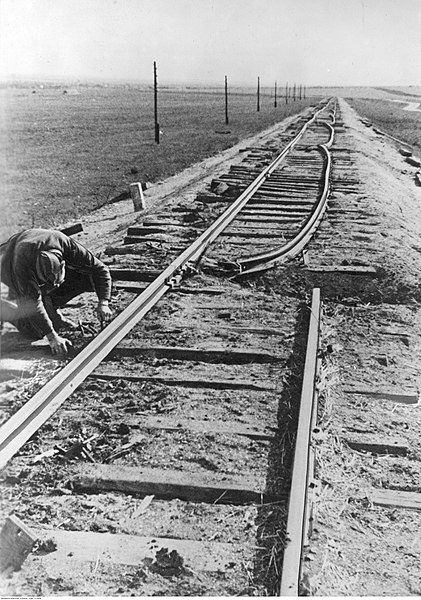
Example of the damage to Soviet railway lines conducted during the Soviet retreat in 1941.
This photo originally from Wydawnictwo Prasowe Kraków-Warszawa via Wikimedia Commons.

In Christian Wolmar’s Engines of War: How Wars Were Won and Lost on the Railways, he outlines the troubles the Germans faced after launching Operation Barbarossa with regard to logistics on the railway network. Each of the main Germany axes of advance had only one Soviet rail line to provide the bulk of the transport, but the Soviets had successfully withdrawn or destroyed the majority of the locomotives and rolling stock. German industry could have been assigned the task of producing new locomotives to fit the Russian gauge, but re-gauging the existing track was significantly faster.

This meant a significant labour requirement to unload incoming German trains at the furthest point of conversion and re-loading onto the few Russian trains that were able to be put back into service. This was a major task for the German army even before Partisan activity began in earnest. The available coal to fuel the engines in Russia was of inferior thermal quality to the coal the German locomotives were designed to use, so in addition to all the military supplies that had to be carried, the Germans also had to supplement the Russian coal with significant amounts of better coal from elsewhere in Europe.

The next problem didn’t show up until late in 1941, but it was the same problem the fighting troops had to contend with: the Russian winter. Russian railway locomotives were engineered to operate throughout the year, but German locomotives almost never faced the low temperatures that happen in Russia, so any German locomotive allowed to freeze was almost certainly lost to permanent mechanical failure (the locomotive’s entire boiler would need to be replaced, which was not a repair that could be made in the field).

Compounding the problems for the Germany railway troops was that the military planners failed to give the railway troops any priority for supplies and reinforcements, which meant that the higher priority troops (the front-line soldiers) often had to wait longer and/or receive less because the railways weren’t able to repair damaged track or rolling stock or increase the speed of re-gauging the Russian railways.

Somone agreed that these were significant problems for the Wehrmacht, but weren’t they at least somewhat taken into consideration in the planning process:

You’re quite correct that the military planners must have been aware of these issues and a rational army staff would have taken them fully into account in their war plans. It’s possible that they expected to capture a much larger proportion of the Russian locomotives and rolling stock in the initial attacks, but they should have made contingency plans that didn’t absolutely depend on all of them falling into German hands … which is what appears to have been their “plan”.

I agree that it would have been a sensible thing to take into consideration that even if everything went off perfectly – and it never does in wartime – large parts of the German military were going to be staying in Russia for a very long time. Russian winter is, thanks to the historical experiences of Charles XII and Napoleon, proverbial. Hitler’s interventions in the planning process can only account for so much of the irrational optimism: the rest is clearly staff failure at many different levels.

Historical changes of gauge in peacetime have been achieved in amazingly short periods of time … but that was with the advantage of advance planning and having vast numbers of workers available on a tight timetable to get it done. My personal sense (not derived from Christian Wolmar’s book) is that the German military as a whole put too much emphasis on the “teeth” and no where near enough on the “tail” for anything other than a “short, victorious war”.

Railways in North America had certainly tried to adopt as many mechanical aids to track maintenance as they could afford, but I’m not sure if that was equally true of European railways at that time. I recall watching a late 1940s promotional film by one of the “Big Four” British railways showing the innovative way they were now doing track work, and even with some quite modern mechanical aids, there were still dozens of workers clustered around the work (in that time period, not wearing any of what we’d now consider essential safety gear), because labour was still relatively cheap and plentiful.

[…]

There’s a hoary old saying about amateurs plan strategy, but professionals plan logistics. Despite having the benefit of basically inventing the modern military staff system, German plans in WW2 appear in hindsight to be very amateurish once you get to the strategic scale. […] Given the constraints, I think the Germans did far better than they should have done to get as close to Moscow as they did. […] Human psychology plays a large part in explaining both the Germans’ incredible over-confidence (what the Japanese termed “Victory disease”) and Stalin’s willing self-delusion that the Germans wouldn’t attack him while his forces weren’t ready.


The Good Idea Fairy Strikes: American Trowel Bayonets

Filed under: History, Military, USA, Weapons — Tags: , , , , — Nicholas @ 02:00

Forgotten Weapons
Published 13 Nov 2017

The United States first experimented with a combination trowel and bayonet in 1868, producing 200 experimental examples made from standard socket bayonets. This was immediately followed by an additional 500 Model 1869 trowel bayonets made new. These were distributed to a few companies of the infantry to test in the field. Remarkably, the trials reports were overwhelmingly positive.

The US infantryman at that time did not carry any sort of entrenching tool, and so even an awkward combination tool was an improvement over a canteen cup or other ad hoc tool for digging. The bayonet was seen by some officers as becoming obsolete with the introduction of breechloading rifles, so the reduced effectiveness of the new item as a bayonet was not a substantial concern. The intended use of these tools was not to dig elaborate trenches, but rather to hastily construct a shallow ditch and embankment which would provide just enough cover to shelter a prone soldier.

With the trials reports in, the government purchased 10,000 of the improved 1873 pattern trowel bayonet, which featured a stronger blade and a much more comfortable handle for digging. These were issued and used in the field (and in several combat engagements), but the developmental direction turned towards combination knife trowels instead of bayonets, and there would be no further development or issue of these tools after the 1870s.

See the full trials report here: https://books.google.com/books?id=qUE…

http://www.patreon.com/ForgottenWeapons

Cool Forgotten Weapons merch! http://shop.bbtv.com/collections/forg…

If you enjoy Forgotten Weapons, check out its sister channel, InRangeTV! http://www.youtube.com/InRangeTVShow

QotD: Revolution and civil war

Filed under: Europe, History, Military, Quotations, USA — Tags: , , , , , , — Nicholas @ 01:00

I was a crew chief on Blackhawks, in an air assault company. Our job was to fly the infantry troops around and put them where they needed to be. A lot of the time, we would fly through the hills north of [Camp] Bondsteel. When we went that way, we usually flew over a mass grave. One morning, Serb gunmen showed up in a little Albanian village in the hills. They drove everyone out of their homes, forced them to dig their own graves, and then murdered them. Men, women and children. Fathers, mothers, sons, daughters, grandparents.

There was a little memorial with flowers.

Whenever someone starts talking about maybe voting is useless and perhaps other means are necessary to take back our country, I think of Kosovo. That EXACT rhetoric was part and parcel with the disintegration of the Balkans. The rhetoric I see people casually bandying about, we need to confront them everywhere and they deserve no peace, this is the rhetoric and the justification the Serbs used on their way to killing a quarter of a million people in the Balkans. Their former neighbors; often literally.

It’s worth considering whether all those who killed people in Kosovo started with killing in mind, or were they merely trying to right the wrongs that the other side had perpetrated against them? Civilization is a millimeters thin veneer on top an ocean of violence a billion years of evolution deep. If you think it’s acceptable to use violence for political gain, or if you fantasize for revolution, you’re a monster.

Revolution is not what you think it is. Revolution is civil war. Civil war is driving your neighbors from their homes and forcing them to dig their own graves. It is leaving your grandmother behind because she cannot move fast enough to escape the gunmen; and they won’t stop. Yes, there are monsters in places of power, but you are not absolved of your obligations to humanity because of it. That others have foresworn theirs is no excuse. You fetishize misery you cannot fathom. You are in good company, we are all monsters in civilized clothes; do not be insulted or ashamed.

Endeavor to be more.

Again.

Please.

John Chmelir (@JohnChmelir), Twitter (part of a 20-tweet thread), 2018-10-20.

April 3, 2021

Metallica – “Nothing Else Matters” – Medieval Style – Bardcore

Filed under: Media — Tags: , , — Nicholas @ 02:00

Algal the Bard
Published 19 Jun 2020

Song composed by James Hetfield & Lars Ulrich
Spotify: https://open.spotify.com/artist/6AU6D…
iTunes: https://music.apple.com/us/artist/alg…
Google Play: https://play.google.com/store/music/a…
Twitter: http://twitter.com/Alvariu
Instagram: https://www.instagram.com/alvariu360
Instruments: Lute-guitar, Irish bouzouki, Low whistle (D), Drums.

QotD: When governments try to “help” small businesses

Filed under: Bureaucracy, Business, Government, Quotations, USA — Tags: , , — Nicholas @ 01:00

In 1961, economist Benjamin Chinitz argued that New York was more resilient than Pittsburgh because New York possessed a culture of entrepreneurship, originally inculcated by the garment industry, where anyone with a good idea and a couple of sewing machines could start a business. By contrast, gritty cities like Pittsburgh, dominated by large smokestack industries that tended to snuff out small-scale entrepreneurial activity, eventually faced a crisis when those industries grew less profitable, and the local economy struggled to adjust.

Love for small business is one of the few universals in American politics. In a 2018 Gallup poll, just 56 percent of Americans viewed capitalism positively; but 92 percent had a positive view of small business, and 86 percent viewed entrepreneurs positively. Government at all levels has policies intended to help small businesses, but there’s little evidence that these programs are effective — and even when bureaucrats try to help, they impede small-business creation by imposing new regulations. The New York City Business License and Permit index presents a daunting compendium of licenses and certifications that can be required to start a business in the city — such as the Esthetics License (needed if you want to “conduct beauty treatment”) and the Certificate of Fitness for Fire and Emergency Drill Instructor (necessary to “lead fire drills in buildings that do not require a Fire Safety Director”).

Such overregulation represents a second way that the deck gets stacked in the American economy against outsiders. The decline of American entrepreneurship is a discouraging trend of the last 30 years. In 2015, economist John Haltiwanger documented numerous signs of diminished business dynamism in the United States. In the early 1980s, he noted, America’s startup rate exceeded 13 percent, which meant that about one-eighth of all firms had just begun. The startup share fell to 10 percent near the end of the Clinton years and below 8 percent during the Great Recession. While no consensus exists about the causes of this dramatic drop, expanding business regulation is a plausible candidate.

Edward L. Glaeser, “How to Fix American Capitalism”, City Journal, 2020-12-13.

April 2, 2021

Victory at any Cost? – Allied Censorship – WW2 Special

Filed under: Britain, History, Military, USA, WW2 — Tags: , , — Nicholas @ 04:00

World War Two
Published 1 Apr 2021

Censorship was not just a practice in totalitarian regimes. During World War Two, democratic liberties in Allied countries often clashed with propaganda and restrictions of the press.

Join us on Patreon: https://www.patreon.com/TimeGhostHistory
Or join The TimeGhost Army directly at: https://timeghost.tv

Follow WW2 day by day on Instagram @ww2_day_by_day – https://www.instagram.com/ww2_day_by_day
Between 2 Wars: https://www.youtube.com/playlist?list…
Source list: http://bit.ly/WW2sources

Hosted by: Spartacus Olsson
Written by: Joram Appel
Director: Astrid Deinhard
Producers: Astrid Deinhard and Spartacus Olsson
Executive Producers: Astrid Deinhard, Indy Neidell, Spartacus Olsson, Bodo Rittenauer
Creative Producer: Maria Kyhle
Post-Production Director: Wieke Kapteijns
Research by: Joram Appel
Edited by: Miki Cackowski
Sound design: Marek Kamiński
Map animations: Eastory (https://www.youtube.com/c/eastory​)

Colorizations by:
Adrien Fillon – https://www.instagram.com/adrien.colo…​

Sources:
Dutch National Archives
IWM D 20472
Bundesarchiv
from the Noun Project: Map by BaristaIcon, strategy by Fran Couto, weather by Yoyon Pujiyono, building by Made, Government by lathiif studio, documents by Geovani Almeid, Pen by Caesar Rizky Kurniawan
The True Cost of Petrol, courtesy of www.mirrorpix.com

Soundtracks from the Epidemic Sound:
Johannes Bornlof – “The Inspector 4”
Fabien Tell – “Last Point of Safe Return”
Johan Hynynen – “Dark Beginning”
Reynard Seidel – “Deflection”
Phoenix Tail – “At the Front”
Johannes Bornlof – “Deviation In Time”
Max Anson – “Maze Heist”
Wendel Scherer – “Out the Window”

Archive by Screenocean/Reuters https://www.screenocean.com​.

A TimeGhost chronological documentary produced by OnLion Entertainment GmbH.

From the comments:

World War Two
2 days ago
Censorship is a phenomenon of all ages. Those in power sometimes don’t want certain voices to be heard for a variety of reasons. While this episode is about political and military censorship, we ourselves are still dealing with another kind of censorship today. Economic, political and PR reasons to demonetize or age-restrict our videos are being conflated with “safety” and “harm” of “certain audiences”. We adamantly object to the restriction of fact-based history for the sake of business and public image. This is why it’s so important that we’re able to remain independent. We have full editorial control of our content, and we won’t surrender our mission to publish factual, unbiased and unsanitized documentaries. Our TimeGhost Army is the main reason why we have been able to remain independent and unwavering. Join the TGA at www.patreon.com/timeghosthistory or https://timeghost.tv

Cheers,
Joram

The science must bow to the political narrative yet again

Filed under: Americas, Cancon, History, Science — Tags: , , , , , — Nicholas @ 03:00

In Quillette, Bruce Bourque outlines some fascinating archaeological discoveries on Canada’s east coast and how the scientific findings are being actively blocked to avoid offending First Nations people for undermining or even contradicting their beliefs:

One of the major North American archaeological discoveries of the 20th century was made in 1967 by a bulldozer crew preparing a site for a movie theater in the small fishing village of Port au Choix (PAC), on Newfoundland’s Northern Peninsula. It was a vast, 4,000-year-old cemetery created by a complex maritime culture known among researchers as the Maritime Archaic. The graves contained beautifully preserved skeletons covered in a brilliant red powder called red ocher (powdered specular hematite). Buried with the skeletons were many finely crafted artifacts. A few similar ones had previously turned up in earlier field surveys on the island, but no archaeologist had suspected that such a large and magnificent ceremonial site existed in the North American subarctic.

Had the discovery been made only a few years earlier, it is likely that no trained archaeologist would have taken over from the bulldozer crew. But fortunately, Memorial University in St. Johns had just added archaeologist James (“Jim”) Tuck (1940–2019) to its faculty. The American-born scholar set out to explore the cemetery, eventually excavating more than 150 graves spread over three clusters (which he referred to as loci).

[…]

In regard to the Red Paint People, Reich’s lab at Harvard Medical School analyzed material from the Nevin site in Blue Hill, Maine — the only known Red Paint cemetery that is likely ever to produce well-preserved human remains. Reich’s analysis was not confined to mDNA (which, unlike nuclear DNA, is transmitted through the maternal line, and so cannot address paternal ancestry), and focused instead on autosomal DNA (aDNA) found in cell nuclei, thereby adding information on the paternal line. (This addition can be critically important because, as Reich’s lab had demonstrated, a population can be founded by males and females with very different origins.) The Reich team has yet to publish comprehensive results of its Nevin site analysis. But from what I have heard, their work will confirm the existence of genetic discontinuities between the Red Paint People and later populations in the region, much as with Duggan’s work in regard to the Maritime Archaic.

But this is where events took a strange turn: It was when Duggan’s group announced that they’d gained the capacity to analyze aDNA, and made known their plans to apply this technology to the male genome of their Labrador/Newfoundland skeletal sample, that a sense of apprehension seemed to spread through some quarters of the paleogenetic community.

During the summer of 2020, amid the COVID-19 pandemic and Black Lives Matter protests, Duggan’s project went noticeably quiet. I inquired among team members with whom I regularly communicated, but received oblique and evasive responses about the pace of research and publication. Suspecting that this might be related to sensitivities surrounding Indigenous populations (a topic that has consumed Canadian academia in recent years), I contacted Duggan directly, expressing concern that her valuable work might not be published.

[…]

When the Maritime Archaic tradition vanished, it was replaced, as noted earlier, by unrelated Paleoeskimos, an Arctic people who had then recently derived from Siberia. Following their own disappearance, more recently arrived inhabitants migrated from Labrador, these probably being ancestors of the historic Beothuk, who still lived in the region when Europeans arrived. The last surviving Beothuk, a woman named Shanawdithit, died of tuberculosis in 1829. And since that time, there has been no descendant Beothuk community with whom Duggan, or anyone else, could engage in the “discussions and agreements” she’d described to me.

And even if there were, moreover, Duggan’s own research has demonstrated that the Beothuk were not descended from the Maritime Archaic people of Port au Choix. The only community Duggan might be referring to is the (genealogically unrelated) Newfoundland Mi’kmaq community, whose ancestors arrived on Newfoundland from Nova Scotia in the 18th century, several hundred years after the arrival of Europeans.

10 Quick Woodworking Tips (03) | Paul Sellers

Filed under: Tools, Woodworking — Tags: , — Nicholas @ 02:00

Paul Sellers
Published 22 Dec 2020

Paul is back again bringing you another 10 Quick Woodworking Tips!

Every Tuesday Paul uploads a quick 15 second “Tuesday Tip” to his Instagram stories. You can join Paul on Instagram here: https://www.instagram.com/paul.a.j.se…

Let us know your favourite tip in the comments!
——————–

Want to learn more about woodworking?

Go to Woodworking Masterclasses for weekly project episodes: http://bit.ly/2JeH3a9

Go to Common Woodworking for step-by-step beginner guides and courses: http://bit.ly/35VQV2o

http://bit.ly/2BXmuei for Paul’s latest ventures on his blog

——————–

Instagram: http://bit.ly/2oWpy7W

Twitter: http://bit.ly/33S7RFa

Pinterest: http://bit.ly/35X5uTf

QotD: Sex and the grad student lifestyle

Filed under: Education, Humour, Quotations, USA — Tags: , , , — Nicholas @ 01:00

For normal women, getting laid is a two-step process:

  • Show up; and
  • Bring beer.

For 75-90% of women under 40, step 2 is optional. It would’ve been for Chloe. Especially in a bar full of grad students, who despite their extensive academic training on “the rhetorics of hegemony” and whatnot, still aren’t quite sure how the naughty bits fit together. She might’ve had to draw the guy a map, but surely that’s no problem for someone so assertively in control of her own sexuality as was Chloe …

And that’s just normal people, who know what pronouns to use and never hesitate when choosing a public restroom. The real freakazoids actually have it much easier, since loudly proclaiming a deviant sexuality is a status symbol in the ivory tower. Perhaps your deepest, most secret fetish involves cocktail onions and a Shop-Vac … and let me stop you right there, I do NOT wanna know, I’m only bringing this up to say that hey, I sympathize, love is real and you’re having a hard time finding yours.
You should consider academia, my friend, where not only are such things not shameful, but they’re positively celebrated. If you’ve actually got video of yourself doing the nasty under those conditions, they’ll pretty much hand you a PhD in Performance Art on the spot …

… and yet, nobody does.

I’m not saying people don’t have sex in grad school. If I myself wasn’t getting my ashes hauled every day in the ivory tower, I assure you it wasn’t for lack of trying. What I am saying is that academia is the only place on earth where not only is your fetish — whatever it is — not shameful, but easily satisfied. Those of us who actually enjoy the missionary position with committed partners of the opposite-sex used to joke that ours was the only sexual deviancy so perverse, you’d be shunned by all your colleagues if you admitted to it. These people, on the other hand, talk like their gonads rule their lives, but they never actually do anything about it.

I have no idea why, but finding out would tell us a lot about the psychology of the average Leftist.

Severian, “Gettin’ Busy in College Town”, Rotten Chestnuts, 2020-12-04.

April 1, 2021

How to Make Preserved Lemons in the Workshop

Filed under: Food, Humour, Tools, Woodworking — Tags: , , , — Nicholas @ 02:00

Uri Tuchman
Published 12 Jul 2019

Preserved lemon recipe:
For the lemons:
– 6 lemons
– 300 gram salt
Cutting board:
– 40x25x1.5 cm cherry wood
Knife:
– 20x5x0.2 cm O1 steel
– 10x3x2 cm Maple wood
– 4x3x2 cm walnut wood
Airtight container:
– 14x14x1.5 cm cherry wood x2
– 10x14x1.5 cm cherry wood x4
– brass screw rod x8
– brass thumb nut x8
Serving board
– 20x6x1.5 cm beech wood
– 6x1x0.5 cm walnut
Fork:
– 6x1x0.2 cm brass plate
– 1cm brass tube
– 10 wooden handle from some nice burl

Mix everything in a bowl and you’re golden!

Patreon: https://www.patreon.com/urituchman
Instagram: https://www.instagram.com/urituchman/

Music:
Acid Trumpet
Kevin MacLeod
incompetech.com)
Licensed under Creative Commons: By Attribution 3.0 License
http://creativecommons.org/licenses/b…

QotD: Mistakes

Filed under: Humour, Quotations — Tags: — Nicholas @ 01:00

Show us a man who never makes a mistake and we will show a man who never makes anything. The capacity for occasional blundering is inseparable from the capacity to bring things to pass.

Herman Lincoln Wayland

March 31, 2021

British Commandos – Men of the Hunter Class – WW2 Special

Filed under: Britain, History, Military, WW2 — Tags: , — Nicholas @ 04:00

World War Two
Published 30 Mar 2021

After the German take over continental Europe, the British invent the commando, a new soldier type to raid and harass German installations in occupied Europe.

Join us on Patreon: https://www.patreon.com/TimeGhostHistory
Or join The TimeGhost Army directly at: https://timeghost.tv

Follow WW2 day by day on Instagram @ww2_day_by_day – https://www.instagram.com/ww2_day_by_day
Between 2 Wars: https://www.youtube.com/playlist?list…
Source list: http://bit.ly/WW2sources

Hosted by: Indy Neidell
Written by: Joram Appel
Director: Astrid Deinhard
Producers: Astrid Deinhard and Spartacus Olsson
Executive Producers: Astrid Deinhard, Indy Neidell, Spartacus Olsson, Bodo Rittenauer
Creative Producer: Maria Kyhle
Post-Production Director: Wieke Kapteijns
Research by: Joram Appel
Edited by: Karolina Dołęga
Sound design: Marek Kamiński
Map animations: Eastory (https://www.youtube.com/c/eastory​)

Colorizations by:
– Daniel Weiss

Sources:
– Imperial War Museums: N 3, HU41240, A 26238, H17472, B 5203, H 19272, CH 10705, H 17489, D 8893, H 39031, A 17763, H 17502, TR1425, E 6390,E 6404, H 31439, TR1230, ADM 5072, H39029, H 17485, H 17347, H 022592, H 17511,H 22588, H 019284, H19269, NA 12466, N 530, NA12469, H18957, H 22604, A 27469, NA 379 A,N397 1941, C2352,H 17364, 023574,H 039033
– Bundesarchiv
– National Archives NARA
– National Military Museum
– Icons from the Noun Project: barge by Seb Chmiel, soldier by Wonmo Kang,
– Crickets sound courtesy of damonmensch
– Slide projector courtesy of hpebley3

Soundtracks from the EpidemicSound:
– “London” – Howard Harper-Barnes
– “March Of The Brave 10” – Rannar Sillard
– “Rememberance” – Fabien Tell
– “The Inspector 4” – Johannes Bornlöf

Archive by Screenocean/Reuters https://www.screenocean.com​.

A TimeGhost chronological documentary produced by OnLion Entertainment GmbH.

“Rosalie”: Trench Art SMLE with a Most Improbable Story

Filed under: Cancon, History, Military, Weapons, WW1 — Tags: , , , , , — Nicholas @ 02:00

Forgotten Weapons
Published 21 Dec 2020

http://www.patreon.com/ForgottenWeapons

https://www.floatplane.com/channel/Fo…

Cool Forgotten Weapons merch! http://shop.bbtv.com/collections/forg…

Henri Lecorre was a French immigrant to Canada who enlisted in the 22nd Regiment of the Canadian Army in April, 1915. He had a knack for carving things in his rifles, which he started right in basic training, with a Ross rifle he named “Josephine”. That got him sternly rebuked by his Colonel, but he would take up the habit again in 1916 when he arrived in France and began to see combat. At this point the Canadians were issuing SMLE rifles, and Lecorre named his “Rosalie”, after the French bayonet’s nickname.

Lecorre served through 14 major campaigns, and carved each name into his rifle as the years of the war dragged on. He was twice caught and punished for destruction of government property and fined for the cost of the rifle, although he managed to avoid more serious punishment both times. He only embellished the left side of Rosalie, so that his work would be hidden against his leg when standing at attention. By the summer of 1918, Rosalie’s service record included Vimy, Kemmel, St. Eloi, Hoodge, Zellebeck, Courcelette, Bully Grenay, Neuvilles Vaade, Mericour, Lievin, Lens, Cote 70, Passchendaele and Arras.

Fate eventually caught up to Private Lecorre, and in mid-1918 he was seriously wounded in an attack, and woke up in a military hospital in Dieppe. Rosalie was long gone, and Lecorre did not return to combat again.

The story is far from over, however. Rosalie was recovered from the battlefield, and sent back to Enfield with a batch of damaged rifles for refurbishment and reissue. Someone in the factory noticed the carving on it, and it was set aside. The arsenal commander took a liking to it, and it was hung in his office — where it remained for some 30 years. A Canadian officer from the 22nd Regiment noticed it at Enfield — thanks to Lecorre carving his unit’s name into it — during the Second World War, and thought it would be appropriate to return it to the unit’s home town, where the Citadelle Museum was established in 1950, with Rosalie as one of its original exhibits.

In 1956, Lecorre himself happened to visit an exhibition near Quebec City where the museum had set up, and was shocked to see his own Rosalie on display. After some understandable difficulty convincing the officer on duty that it was actually *his* rifle (which Lecorre did by reciting back its serial number unseen), a remarkable reunion took place. The rifle remained with the museum, but now with its full story known. It remains there to this day, on permanent display.

The Citadelle Museum commissioned a reproduction of Rosalie to be used for demonstrations, and it is this rifle which was graciously made available to me for filming, as the original is inaccessible on short notice because of its display case. Many thanks to the Citadelle for the opportunity to present it to you! If you are in Quebec City, make sure to take time to visit them:

https://www.lacitadelle.qc.ca/en/

Contact:
Forgotten Weapons
6281 N. Oracle #36270
Tucson, AZ 85740

QotD: The first and only “inalienable” right

Filed under: Government, History, Liberty, Quotations — Tags: , , , , — Nicholas @ 01:00

Oversimplifying a bit for clarity, “republican” political philosophy after Hobbes is an attempt to use Hobbes’s tools and methods without arriving at his conclusions. That baloney about “inalienable rights” in the US Declaration of Independence is the most famous of these attempts. If you want to know how we got from there to here – from the Founders to the Tyranny of the Intersectional Genderfluids – just recall what those supposedly “inalienable” rights are: Life, Liberty, the Pursuit of Happiness.

It would’ve been far better to have kept the trio in Locke’s original words – life, liberty, and property – but even that wouldn’t have saved us, because the proposition is flawed from the beginning. The full quote is:

    We hold these truths to be self-evident, that all men are created equal, that they are endowed by their Creator with certain unalienable Rights, that among these are Life, Liberty and the pursuit of Happiness …

… and pretty much all of that is wrong.

As we’ve seen, it was a major part of Hobbes’s project to prove that men do in fact have such rights, because it’s not at all “self-evident.” That was the whole point of the Wars of Religion – heretics have NO rights, because they have put themselves beyond the pale of the human community. For the Wars of Religion to end, political legitimacy had to be secularized.

That was Hobbes’s goal. That’s what the “State of Nature” thought experiment was about. Does man has any rights in himself, that flow only from his existence as a human being? In other words, does he have rights NOT endowed by his Creator?

Hobbes argued that we DO have such rights, of course … but, crucially, we only have the full exercise of them in the State of Nature. For Hobbes, all rights are, at bottom, the right to self-defense. Getting out of the State of Nature involves laying at least part of that right down – “alienating” it, in the Latinate English of the 17th century – creating in the process a “corporate person” who “represents” us all. Far from being “inalienable,” then, Life and Liberty, at least, have to be alienated, at least to some degree, if civilization is to exist at all …

… at least according to Hobbes, and do you see what I mean about people trying to adopt his terms while dumping his conclusions?
Hobbes had plenty of examples to hand, writing as he was in the last, nastiest phase of the Wars of Religion. According to Hobbes, the Leviathan – who, let’s recall, can be a Senate or something just as easily as a monarch – absolutely has the right to your life and liberty, since your voluntary surrender of them is what creates the Leviathan in the first place. How else could wars be fought in the gunpowder age? A medieval king leading his personal affinity into battle didn’t have to worry about political theory. An Early Modern king, fielding armies of tens of thousands, did. Without an animating ideology, they’re just mercenaries – ask Machiavelli how that works out.

We’ll skip over that “pursuit of happiness” crap, since that’s probably just Jefferson’s noodle-headed way of alluding to Classical political theory, and circle back to the start: “all men are created equal.” As we’ve seen, this was central to Hobbes’s “State of Nature” thought experiment … but, as is obvious to anyone with real-world experience, it only applies there.

Severian, “Hobbes (II)”, Founding Questions, 2020-12-11.

March 30, 2021

Caesar in Britain II: There and Back Again (54 B.C.E.)

Historia Civilis
Published 21 Mar 2017

Patreon | http://historiacivilis.com/patreon​
Donate | http://historiacivilis.com/donate​
Merch | http://historiacivilis.com/merch
Mailing List | http://historiacivilis.com/mailinglist​
Twitter | http://historiacivilis.com/twitter​
Website | http://historiacivilis.com​

Music is:
“Day Bird,” by Broke For Free
“Drums of the Deep,” by Kevin MacLeod
“Flood,” by Jahzzar

« Newer PostsOlder Posts »

Powered by WordPress