
spiked
Published 27 Jan 2023Tom Slater, Fraser Myers and Ella Whelan discuss the World Economic Forum, men in women’s prisons and Facebook’s unbanning of Donald Trump. Plus, Timandra Harkness explains the dangers of the UK’s Online Safety Bill.
(more…)
January 30, 2023
Eff the WEF | The spiked podcast
Comments Off on Eff the WEF | The spiked podcast
“… say what you want about the good old Bulletin of the Atomic Scientists, but at least its crappy clock is behaving like a clock these days”
Colby Cosh congratulates the Bulletin of the Atomic Scientists for at least getting their clock moving in the normal direction once again:

Atomic cloud over Hiroshima, taken from “Enola Gay” flying over Matsuyama, Shikoku, 6 August, 1945.
US Army Air Force photo via Wikimedia Commons.
On Tuesday, the Bulletin of the Atomic Scientists (really a foundation that publishes a famous magazine by that name) announced that it would be scooching the minute hand of its renowned “Doomsday Clock” forward. The clock will now read 11:58:30 p.m., midnight minus 90 seconds. The Bulletin does this once a year — at a time, by pure coincidence, when newspaper editors are notoriously starved for copy.
The Doomsday Clock was originally (in 1947) a one-off magazine cover design by Martyl Langsdorf (1917-2013), a landscape artist who was married to one of the Manhattan Project physicists. She happened to set the clock at about seven minutes to midnight, but the visual metaphor was irresistible. As the arms race and nuclear proliferation began, the editors of the Bulletin started rearranging Langsdorf’s clock face as an index of the danger from nuclear exchange.
Even by saying this much I am intruding somewhat on the turf of a colleague, Tristin Hopper, who is eternally preoccupied with the pure stupidity of the Doomsday Clock. As T-Hop never tires of pointing out, you have really lost track of the clock metaphor if you manually wiggle the minute hand backward or forward annually.
Moreover, the face of the clock can at best be considered a lagging indicator. The year 1947 was probably the moment at which the danger of a pre-emptive nuclear strike was greatest. Intellectuals and strategists needed a few years to think through the implications of nuclear weapons: the logic of a first strike was compelling, and might have won the argument in any country that developed nukes until the equilibrium of mutually assured destruction was both established and theorized.
The Bulletin of the Atomic Scientists moved the clock closer to midnight as the world was learning to live with nukes and nuclear proliferation. Eventually the hand was moved backward in 1960 — practically in time for the frightening Cuban Missile Crisis.
Comments Off on “… say what you want about the good old Bulletin of the Atomic Scientists, but at least its crappy clock is behaving like a clock these days”
The Royal Marines at War: Rough Weather Landing
Royal Marines
Published 31 Aug 2012Rough Weather Landing is a secret film recording of “an experiment by No4 Commando” demonstrating their ability to launch a surprise attack on a seemingly impregnable coastline.
From the comments:
ogdiver
8 years ago
“That’s right lad, you’re going to land from a boat with all the reserve buoyancy of a digestive biscuit onto a rocky shore, in a pounding surf, with a 3″ mortar base plate strapped to your back and tackety boots for swimming. But don’t worry, we’ll give you the the inflated inner tube off an Austin 7 to cling to and we’ll be doing it in daylight for the cameras.” Those blokes were nails.
Comments Off on The Royal Marines at War: Rough Weather Landing
QotD: Teaching … back in the day
There’s so much truth to this. The “authority figure” thing is especially interesting. As I started in “education” fairly late, I was conspicuously older than most of my graduate school cohort. They had discipline problems in their classes; I never did. This was because I at least looked like an adult, and dressed like one, too. Every other TA was all of three months removed from undergrad, and tried to show up to teach wearing backwards hats and ratty school apparel. The one kid who took my advice and switched to teaching in “business casual” didn’t have a single discipline problem afterward (poor bastard, he no doubt got killed by his peers for “ageism” or something).
Of course, this was so long ago that students used to be unsure how to address me. Most professors had gone “hip” and had students call them by first name, but there were enough crusty old codgers around who insisted on “Dr. So-and-So” that they didn’t assume. After which I started telling them “you can call me whatever you want, but as a general rule life runs smoother if we respect each other’s station. If you know someone has a title, it’s best to use it unless they specifically tell you otherwise, and it’s always good to respect the social distance between yourself and someone who has something you want. So, choose accordingly.” 20 years ago, most of them got it, and addressed me by my title. 15 years ago, I started getting lots of puzzled puppy dog looks (“what’s a ‘social station’?”). 10 years ago, they all just assumed first names were fine, and before I retired I counted myself lucky if I got so much as a “hey dude”.
Meanwhile, as far as the students were concerned, my job went from “trying to teach them something” to “the annoying meat puppet whose presence we have to tolerate until he puts the A+ in the gradebook for record-keeping purposes”.
Severian, responding to a comment on “Movies Made On Mars”, Rotten Chestnuts, 2019-02-04.
Comments Off on QotD: Teaching … back in the day
January 29, 2023
“That is what Westerners like about Dubai: the indentured servitude. And the weather.”
Tanya Gold at The Free Press:

“Royal Atlantis Resort hotel under construction, Palm Jumeirah, Dubai” by Jpbowen is licensed under CC BY-SA 4.0 

 .
.
I went to Dubai once. It is where tyranny meets hyper-capitalism, and it is as awful as it sounds.
I was helping a journalist friend research an article. I spent my days admiring an undersea bedroom in a lagoon and a ski slope inside a mall. At night I would meet trafficked maids, or a woman imprisoned for adultery. I asked an ancient British tourist why he came here for his holidays. He said, “The staff will hold your dick if you ask them.” That is what Westerners like about Dubai: the indentured servitude. And the weather.
Last week, at the grand opening of Atlantis The Royal, Dubai’s newest luxury hotel, Beyoncé gave her first live performance in five years. This gig featured a 48-person all-female orchestra — how feminist — a Lebanese dance troupe, and her daughter. She was reportedly paid $24 million for the occasion.
Her latest album, Renaissance, is, among other things, an homage to black queer culture. She performed no songs from it; how could she in a country where homosexuality is punishable by death? So she sang her back catalog for the equivalent of ten Bugatti Chirons. Oil-rich tyrannies have generous marketing budgets; they’re selling tyranny itself.
What Beyoncé does or doesn’t do for money wouldn’t matter but for the trend of celebrity activism, which insinuates that morality travels with a star like her wardrobe. Beyoncé acolytes say that just by arriving in Dubai she made the city gayer, a kind of subtle protest. Perhaps so subtle that even Dubai’s ruler Sheikh Mohammed bin Rashid — accused of abducting two of his daughters for noncompliance with his wishes, one from England, and another from a ship as she tried to flee Dubai — wouldn’t notice. Did his enforcers reconsider their stance on gayness as they sang along to “Drunk in Love”? Or are they laughing themselves stupid at the PR coup of persuading an until-now gay ally to perform at the opening of a hotel in a country that hates gays?
Dubai, along with Saudi Arabia, wants to reinvent itself as a tourist destination for when the oil runs out. There is nothing understated there — the Burj Khalifa, which is the tallest building in the world; the Palm Jumeirah, a man-made archipelago in the shape of a palm tree. Everything is vast and highly colored, a distraction. It has to be: To enjoy yourself in Dubai, you must close your eyes to suffering. Almost 90 percent of Dubai’s residents are migrant workers, and many of them live in conditions amounting to indentured slavery.
Comments Off on “That is what Westerners like about Dubai: the indentured servitude. And the weather.”
Anzio Begins – Allies Already Pinned Down – Week 231 – January 28, 1944
World War Two
Published 28 Jan 2023Some big news is the Allies amphibious offensive to hit the Germans behind their lines at Anzio in Italy, some other big news is that after nearly two and a half years, the Soviets have broken the siege of Leningrad and their twin northern offensives keep pushing back the enemy. Yet more big news is that the Soviets have managed to surround and cut off over 50,000 Axis troops near Korsun. This is one big week of action!
(more…)
Comments Off on Anzio Begins – Allies Already Pinned Down – Week 231 – January 28, 1944
D.C. Public Schools – “if this were a corporation, it would be in liquidation. If it were a house, it would be condemned”
Andrew Sullivan on the latest PR campaign by the disaster that is the DC Public School system:
In my web-reading this week, I stumbled across two statistics that made me sit up straight. The first came from a devastating story last September about my home city’s public schools. I had just watched a slick new video from DC Public Schools about their new “equity” push, which aims to go “beyond students’ academics” and “call out inequities”. The video is full of vague-sounding pabulum — they never define what they mean by “equity”, for example, apart from invoking Ibram X Kendi’s term “antiracism” — but the message is very clear: “equity” is now the central focus of the school district. And it’s a bright new day!
Now check out the data on how the DC Public School system is faring. A key metric is what they call “proficiency rates” — a test of whether the kids are passing the essentials of reading and math at every stage of their education. Overall, only 31 percent of DC students have proficiency in reading and just 19 percent have proficiency in math. Drill down further in the racial demographics and the picture is even worse: among African-American kids, the numbers are 20 percent and 9 percent, respectively. Among black boys, it’s 15 percent and 9 percent. Which means to say that DC Public Schools graduate kids who are overwhelmingly unable to do the most basic reading and math that any employer would need.
This is not a function of money. In the most recent federal analysis: DC spends far more per student — $30,000 a year — than any other state, double the amount in many states across the country.
Let’s put it this way: if this were a corporation, it would be in liquidation. If it were a house, it would be condemned. But since it’s a public school system, it can avoid this catastrophic failure by emphasizing “equity”!
Call this the woke dodge. As they fail to educate kids in the very basics, they brandish a shiny object over there — “Diversity! Equity! Inclusion!” — to distract us. Or they claim that these scores are caused by “white supremacy” or “systemic racism”. Or they argue that now, they are educating “the whole child”. From the DCPS video: “The racial equity lens is a critical component of ‘whole child’ for us because being a whole child means thinking about all of your identities, but certainly the racial identity is a gap in what we’re discussing as a country.” Anything but do the basic job of teaching math and reading as they are supposed to do.
The truth is: they obviously can’t teach those subjects successfully. I’m sure many are good teachers doing their best, and some manage to rescue some of these kids, who often face terrible trauma in their homes and neighborhoods. But the data overall are damning. Imagine spending $30K a year on a student, any kid, in any country, and after 12 years, he still can’t spell or do basic math. It must be really hard to pull that off. And as a reward, you get a shitload of money from the city and the feds to keep it up. Criticize them? You’re a “white supremacist”.
Then there’s the other stat that blew my mind — on the post-BLM surge in murders of African-Americans, including many children. The rise in homicide has cooled off somewhat, as Robert Verbruggen notes. But check this out:
Between the 2018–2019 and 2020–2021 periods, the black homicide rate went up by about 40 percent and the white one by 15 percent — already a glaring disparity. But since the black homicide rate started out so much higher than the white one, this translated to an increase of just 0.4 per 100,000 for whites and 9.7 per 100,000 for blacks — nearly 25 times as large. The increase in the black homicide rate was greater than the total homicide rate for the nation as a whole.
Read that last sentence again.
Comments Off on D.C. Public Schools – “if this were a corporation, it would be in liquidation. If it were a house, it would be condemned”
France’s Ultimate WW1 Selfloading Rifle: The RSC-1918
Forgotten Weapons
Published 14 Sept 2017The French RSC-1917 semiauto rifle was a major step forward in arms technology during World War One, offering a reliable and effective self-loading rifle for issue to squad leaders, expert marksmen, and other particularly experienced and effective troops. No other military was able to field a semiauto combat shoulder rifle during this was in anything but very limited numbers. However, the RSC-1917 definitely had some shortcomings:
– It was just too long, at the same size as the Lebel
– The specialized clip was a logistical problem
– The gas system was fragile and difficult to clean or disassemble
– The magazine cover was easily damagedThese issues were all addressed in the Model 1918 upgrade of the rifle, although it was too late to see active service in the Great War. The new pattern was substantially shorter (both the stock and barrel), it used the standard Berthier 5-round clip, it had a substantially strengthened magazine cover, and a much improved gas system.
Today, we will compare the various features of the 1917 and 1918 rifles, and disassemble the 1918 gas system to show how it worked.
(more…)
Comments Off on France’s Ultimate WW1 Selfloading Rifle: The RSC-1918
QotD: Questions from the Malleus Maleficarum – “Why would a perfectly just God allow witches to exist?”
The answer probably has something to with the Devil. And you can probably get part of the way by saying that God has a principled commitment to let the Devil meddle in human affairs until the End of Days. But then you get another issue: the Devil was once the brightest of angels. He’s really really powerful. Completely unrestrained, he can probably sink continents and stuff. So why does he futz around helping elderly women kill their neighbors’ cattle?
Put a different way, there’s a very narrow band between “God restrains the Devil so much that witchcraft can’t exist” and “God restrains the Devil so little that witches have already taken over the world”. Prima facie, we wouldn’t expect the amount God restrains the Devil to fall into this little band. But in order to defend the existence of witchcraft, Kramer has to argue that it does.
His arguments ring hollow to modern ears, and honestly neither God nor the Devil comes out looking very good. God isn’t trying to maximize a 21st century utilitarian view of the Good, He’s trying to maximize His own glory. Allowing some evil helps with this, because then He can justly punish it (and being just is glorious) or mercifully forgive it (and being merciful is also glorious). But, if God let the Devil kill everyone in the world, then there would be no one left to praise God’s glory, plus people might falsely think God couldn’t have stopped the Devil if he’d wanted to. So the glory-maximizing option is to give the Devil some power, but not too much.
Meanwhile, the Devil isn’t trying to maximize 21st century utilitarian evil. He’s trying to turn souls away from God. So although he could curse people directly, what he actually wants is for humans to sell their soul to him in exchange for curse powers. So whenever possible he prefers to act through witches.
Scott Alexander, “Book Review: Malleus Maleficarum“, Astral Codex Ten, 2022-10-27.
Comments Off on QotD: Questions from the Malleus Maleficarum – “Why would a perfectly just God allow witches to exist?”
January 28, 2023
What made the Queen so good at her job?
Lindybeige
Published 24 Sept 2022Queen Elizabeth II of England (I of Scotland) was very good at her job, but why was this? What are the ideal qualities of a modern constitutional monarch? I stand in a dark shirt and talk.
End photograph by Jazzy Lemon.
It has been pointed out to me that the officers who attempted a coup in Spain in 1981 were ‘Civil Guard’ and not ‘army’ as I said. This is a distinction which exists in Spain but not in Britain.
(more…)
Comments Off on What made the Queen so good at her job?
QotD: Allied anti-semitism in WW2
The following leaflet (printed) was passed to an acquaintance of mine in a pub:
LONG LIVE THE IRISH!The first American soldier to kill a Jap was Mike Murphy.
The first American pilot to sink a Jap battleship was Colin Kelly.
The first American family to lose five sons in one action and have a naval vessel named after them were the Sullivans.
The first American to shoot a Jap plane was Dutch O’Hara.
The first coastguardsman to spot a German spy was John Conlan.
The first American soldier to be decorated by the President was Pat Powers.
The first American admiral to be killed leading his ship into battle was Dan Callahan.
The first American son-of-a-bitch to get four new tyres from the Ration Board was Abie Goldstein.The origin of this thing might just possibly be Irish, but it is much likelier to be American. There is nothing to indicate where it was printed, but it probably comes from the printing-shop of some American organization in this country. If any further manifestos of the same kind turn up, I shall be interested to hear of them.
George Orwell, “As I Please”, Tribune, 1944-12-08.
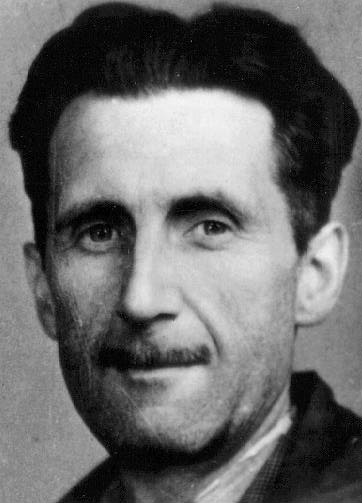
Orwell’s press card portrait, 1943
Comments Off on QotD: Allied anti-semitism in WW2
January 27, 2023
The return of the revenge of the bride of the Doomsday Clock
It’s amazing how much free publicity you can get by pulling out the hoary old Cold War propaganda tools, as Andrew Potter explains with the re-re-re-introduction of the Doomsday Clock bullshit:

Earlier this week, the Bulletin of the Atomic Scientists moved the hands of its Doomsday Clock ahead by ten seconds, to 90 seconds to midnight. This is the closest the clock has ever been to midnight, and, according to the press release announcing the move: “Never in the Doomsday Clock’s 76-year history have we been so close to global catastrophe.”
If you’re under, say, 40 years of age or so, that paragraph is probably pure gobbledygook, the written equivalent of the squawk of a 2400 baud modem going through its handshaking protocols. But for those of us in the ever-dwindling cohorts of Gen-Xers and Baby Boomers, hearing about the movement of the Doomsday Clock is to be jerked back into a time marked by both profound moral clarity and deep existential anxiety.
A bit of background on the Doomsday Clock might help. It was a creature of the Cold War, founded in 1947 by some of the scientists who had worked on the Manhattan Project to raise public awareness of the threat of nuclear weapons. As the Bulletin puts it, the clock uses “the imagery of apocalypse (midnight) and the contemporary idiom of nuclear explosion (countdown to zero) to convey threats to humanity and the planet”. The decision to move or leave the minute hand of the Clock in place is made each year by the various trustees of the Bulletin, based on their evaluation of the world’s vulnerability to catastrophe.
The clock was initially set at a nice and relaxed seven minutes to midnight, and over the following few decades it was moved closer in response to clear nuclear threats, things like ramped-up testing of new bombs, nuclear proliferation, or rising Cold War tensions. During periods of detente or after the signing of arms reductions treaties, the minute hand would retreat. In 1991, it was moved back to 17 minutes to midnight after the dissolution of the Soviet Union.
For most of the second half of the 20th century, the Doomsday Clock was a healthy reminder of the most salient geopolitical fact of the era, which is that two superpowers were pointing thousands of nuclear weapons at one another.
But like many Cold War relics, the demise of the U.S.S.R. left it scrambling for a raison d’etre. In a bit of clever PR entrepreneurialism, the executive of the Bulletin of the Atomic Scientists turned the clock into a more generalized warning against war, climate change and other ecological or technological threats. The nadir of this shift in mission came on January 23rd 2020, when the Bulletin moved the clock’s hands to 100 seconds to midnight.
As the press release accompanying the ticking of the clock noted at the time, this put humanity “closer than ever” to catastrophe. Given that the clock had kept watch over our drive for self-destruction through the Suez Crisis, the Cuban Missile Crisis, the sabre-rattling Reagan administration, and the terrorist attacks of September 11, 2001, it makes one wonder just what happened in early 2020 to merit such a fearful move.
Comments Off on The return of the revenge of the bride of the Doomsday Clock
Canada’s worsening refugee problem
Paul Wells discusses some of the frustrations being aired on the French-language Radio-Canada news channel about the increasing, possibly record-breaking flow of asylum seekers entering Canada at the Roxham Road pedestrian border crossing from Champlain, New York:
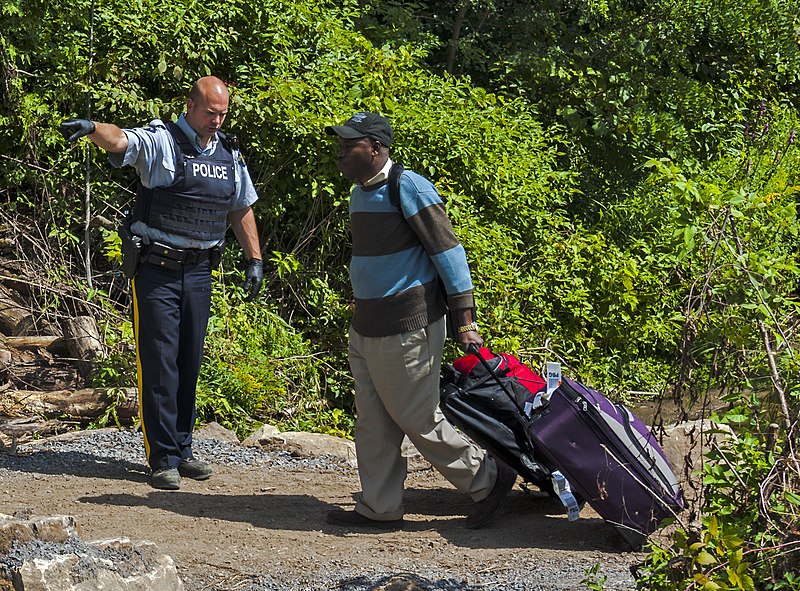
An asylum seeker, crossing the US-Canadian border illegally from the end of Roxham Road in Champlain, NY, is directed to the nearby processing center by a Mountie on 14 August, 2017.
Photo by Daniel Case via Wikimedia Commons.
The issue at hand is Roxham Road, a pedestrian border crossing between small-town Quebec and upstate New York, 45 minutes’ drive from Montreal City Hall. Thousands of people walk into Canada there every month and demand asylum. Caring for them and processing their claims takes money and work. Along comes [former Parti Québécois leader Jean-François] Lisée with a suggestion.
If Justin Trudeau can’t get changes to the bilateral Safe Third Country Agreement to slow this human traffic — and colleagues report that he can’t — then, Lisée says, Quebec should make the newcomers the rest of Canada’s problem.
Within 24 hours after somebody walks across Roxham Road, Lisée says, “We’ll sort them, we’ll keep all the francophones and those who have immediate family in Quebec. And the others, we’ll put them in a nice air-conditioned bus and we’ll take them to Immigration Canada in Ottawa.”
I should emphasize a few things here, to salvage any hope of a civil discussion.
(1) What Lisée is suggesting won’t happen. In particular, it won’t happen because the party he used to lead has three seats out of 125 in Quebec’s National Assembly.
(2) The very suggestion made the other panelists uncomfortable. They took turns criticizing Lisée.
(3) The panel show’s host, Sébastien Bovet, immediately drew the obvious parallel: This is what governors in the U.S. south do. “Ron DeSantis charters flights and buses to send migrants north”, Bovet said, and indeed it is true. We shall see whether there are legal repercussions for DeSantis’ lurid stunt.
(4) Finally, I don’t think asylum seekers should be sorted by language ability and sent packing if they fail either. What’s going on at Roxham Road is a policy crisis, but it’s also a human drama. Lisée spoke during the same week as the funeral for a Haitian man who died trying to cross back into the US after his claims in Canada got hung up in procedural limbo.
Having said all of that, perhaps we can notice the scale of what’s happening at Roxham Road, and ponder how it fits into a generalized sense of Canadian bewilderment.
If you’re wondering why so many in Quebec are freaking out about a single pedestrian border crossing, it may be because the numbers are a bit breathtaking. This chart shows that 39,171 asylum claimants were intercepted by the RCMP between regular ports of entry in Quebec in 2022, compared to 369 in the entire rest of the country combined. So if asylum claims are a problem — and whatever else they are, they’re at least an administrative challenge — then 99.1% of the challenge is in Quebec.
That figure of 39,171, or 107 people a day, is more than twice as many as in any previous year in the last decade and, I’d guess without having statistics dating back further, the most in any province in any year in Canada’s history. (Much of this statistical background was covered in a column by the Toronto Sun‘s Brian Lilley earlier this week.)
Comments Off on Canada’s worsening refugee problem
Post-pandemic travelling on the TTC: ride the Red Rocket … cautiously
Matt Gurney posted a series of tweets about his recent subway experiences in Toronto:

I rode the TTC three times today. Once to downtown from my home in midtown. Once within downtown to a different place. And then home from downtown.
On two of those three rides, there was someone having a very obvious mental-health crisis on the vehicle with us.
The first one was a young man who clapped his hands over his ears and shrieked incoherently at random intervals. And then he got off.
The second, an older man sat in a chair and screamed nonsense constantly for ten stops. Maybe more. That’s just when I got off.
I’m working on a bigger piece for later so I’ll save any complex thoughts and big conclusions for then. But there was something interesting I noticed today. I’m a regular TTC rider. Not daily but frequent. And for the first time today, I’m noticing gallows humour and planning.
“Good luck to everyone,” cracked one guy. There was laughter. Everyone knew what he meant.
But I’m also seeing little groups of strangers agreeing to each keep watch on one direction or another. Sometimes also joking about it.
None of this is funny, but my gut tells me that if Torotonians are now so thoroughly convinced that riding the TTC is so risky that it’s worth a dark joke, any politician who reacts to the next unprovoked attack or murder with a proposal for a national summit is gonna get smoked.
I like the TTC. I have great access to it. It’s super convenient and affordable. It’s a huge asset for me. I have token cufflinks. I’m a fan, is what I’m saying.
I’m now at the point where I’d think twice before taking my kids on it. And we used to ride it just to kill the time.
My son used to stand on the couch in our living room looking out the window counting buses as they went by, loudly shouting to announce each one. Getting to go on a bus or subway or a streetcar was an event for him. My daughter, maybe a bit less excited. Still loved it.
Ah man.
Anyway. I hope tomorrow is better.

Update: You might think the increased concern over using the TTC might be merely a bit of confirmation bias informed by recent reporting, but apparently the situation is serious enough that Toronto Police will be stepping up their presence on the system.
Comments Off on Post-pandemic travelling on the TTC: ride the Red Rocket … cautiously


