
Rex Krueger
Published 1 Feb 2023Simple steps lead to great progress, the same is true in your woodworking.
(more…)
February 2, 2023
Stop FAILING in your woodwork. Use these strategies instead.
Comments Off on Stop FAILING in your woodwork. Use these strategies instead.
Gerry Rafferty’s “Baker Street” lyrics
When I first subscribed to Ted Gioia’s Honest Broker substack, I figured I’d find one or two posts a month that I found interesting enough to share on the blog … I have to be careful not to link to several of his posts every week. He writes a lot about the music industry, so when this popped up in my inbox, I assumed it was Ted and got to the point of scheduling it before I realized it was Jon Miltimore instead:

I was recently in a bar having dinner with a friend when Gerry Rafferty’s hit 1978 song “Baker Street” came on. When my friend mentioned that he loved the song, I agreed and noted the song’s powerful lyrics.
“Really?” he responded. “I never paid much attention to the lyrics.”
Most people, of course, remember “Baker Street” for its wailing saxophone, and my friend was no different. Nor was I, for many years. But at some point—I don’t know when—I began to pay attention to the song’s lyrics. They go like this:
Winding your way down on Baker Street
Light in your head and dead on your feet
Well, another crazy day
You’ll drink the night away
And forget about everythingThis city desert makes you feel so cold
It’s got so many people, but it’s got no soul
And it’s taken you so long
To find out you were wrong
When you thought it held everythingYou used to think that it was so easy
You used to say that it was so easy
But you’re trying, you’re trying now
Another year and then you’d be happy
Just one more year and then you’d be happy
But you’re crying, you’re crying nowWay down the street there’s a light in his place
He opens the door, he’s got that look on his face
And he asks you where you’ve been
You tell him who you’ve seen
And you talk about anythingHe’s got this dream about buying some land
He’s gonna give up the booze and the one-night stands
And then he’ll settle down
In some quiet little town
And forget about everythingBut you know he’ll always keep moving
You know he’s never gonna stop moving
‘Cause he’s rolling, he’s the rolling stone
And when you wake up, it’s a new morning
The sun is shining, it’s a new morning
And you’re going, you’re going homeThe lyrics — in contrast to the seductive sax and upbeat strings and keyboard — are rather dark. It’s not your typical rock/pop song about finding or losing love.
I’ve never heard “Baker Street” explained, but my take on the song is this: It’s about two lonely people in a city. They find comfort in booze, chemicals, and (occasionally) each other. The relationship is probably dysfunctional, but they are struggling to change. Struggling to grow. Struggling to find meaning.
“Baker Street” peaked at #3 in the UK and held the #2 spot in the U.S. for six consecutive weeks. I think part of the reason the song was such a success is because the lyrics touched on something a little deeper than most rock tunes, something that resonated with audiences. And though the song is 40 years old now, I have a hunch it resonates even more now than it did then.
MAC Model 1947 Prototype SMGs
Forgotten Weapons
Published 12 Oct 2022Immediately upon the liberation of France in 1944, the French military began a process of developing a whole new suite of small arms. As it applied to SMGs, the desire was for a design in 9mm Parabellum (no more 7.65mm French Long), with an emphasis on something light, handy, and foldable. All three of the French state arsenals (MAC, MAS, and MAT) developed designs to meet the requirement, and today we are looking at the first pair of offerings from Chatellerault (MAC). These are the 1947 pattern, a very light lever-delayed system with (frankly) terrible ergonomics.
Many thanks to the French IRCGN (Criminal Research Institute of the National Gendarmerie) for generously giving me access to film these unique specimens for you!
Today’s video — and many others — have been made possible in part by my friend Shéhérazade (Shazzi) Samimi-Hoflack. She is a real estate agent in Paris who specializes in working with English-speakers, and she has helped me arrange places to stay while I’m filming in France. I know that exchange rates make this a good time for Americans to invest in Europe, and if you are interested in Parisian real estate I would highly recommend her. She can be reached at: samimiconsulting@gmail.com
(Note: she did not pay for this endorsement)
(more…)
Comments Off on MAC Model 1947 Prototype SMGs
QotD: “Selfies”
I do not take selfies, but (if I am to tell the truth) it is not because I am appalled at the vacuity doing so seems to require, or at least to call forth: Sheep in a field are more like Rodin’s Thinker than are people who hold their phones on those ridiculous sticks before their faces. No, the problem is that, where the camera and I are concerned, it is not that it never lies, but that it never tells the truth.
I am always appalled by its results. I do not look like that when I glance in the mirror: I look far younger, less bald, wrinkled, ugly in short. I conclude, of course, that I lack that mysterious quality that only some lucky people have: I am not photogenic. If the camera never lied, if it showed me as I truly am, I would come out much better in photos.
I think it was the French-Romanian writer Emil Cioran who said that if a man knew that someone would one day write a biography of him, he would cease to live; in other words, it would paralyze him. In like fashion, if I thought that people would photograph me, I would stay indoors — the millions of spy cameras everywhere don’t count, no one looks at what they have recorded until there has been a murder or a terrorist attack (and then everyone is mostly unrecognizable).
I conclude, therefore, that most people who take selfies are at least minimally satisfied with their appearance, however they may appear to others. But in fact it hardly requires reflection on the selfie as a social, or antisocial, phenomenon to know that very large numbers of people have no idea what they look like to others. Or perhaps it is simply that they don’t care.
Theodore Dalrymple, “Suit Yourselfie”, Taki’s Magazine, 2017-09-16.
Comments Off on QotD: “Selfies”
February 1, 2023
Changing views of Gandhi
In UnHerd, Pratinav Anil recounts some of the changes to Gandhi’s reputation and place in Indian public memory:
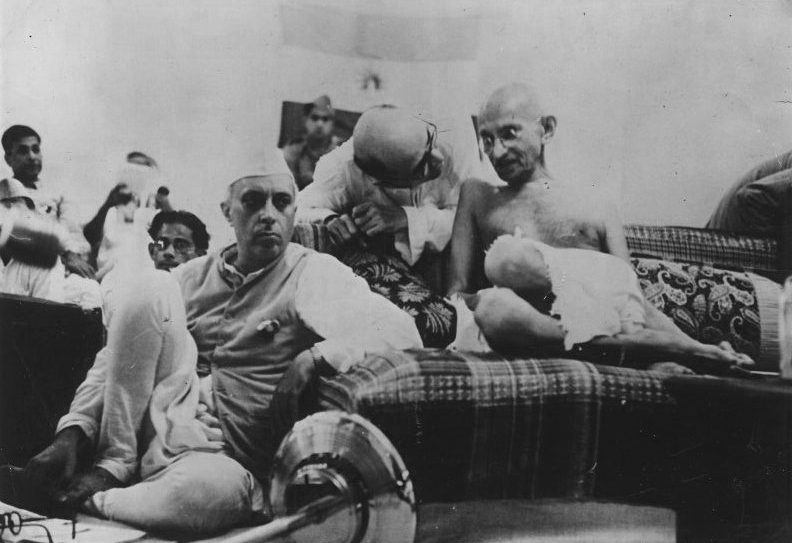
Nehru with Gandhi, August 1942.
Photographer unknown, public domain image via Wikimedia Commons.
Gandhi, poor fellow, had his ashes stolen on the 150th anniversary of his birth. “Traitor”, scrawled the Hindu supremacist malcontents on a life-size cut-out of the Mahatma at the mausoleum. That was a couple of years ago, but it’s a sentiment that’s grown shriller since. Unsurprisingly. In government as in schools, in newsrooms as on social media, the founding father’s defenders are being put out of business by his detractors. His Congress Party, after 50 years of near-uninterrupted rule since independence in 1947, is now in ruins, upstaged by the Bharatiya Janata Party. Hindu supremacists have stolen the show, while India’s Muslims, Christians, and Dalits are persecuted. With the changing of the guard, Gandhi’s extravagant ideal — unity in diversity — has gone the way of his ashes.
His reputation, too, is in tatters. Last year, the National Theatre staged a play about his assassination. But The Father and the Assassin centred not on Gandhi but Godse, the man who killed him 75 years ago this week. Here is a tender portrait of a tortured soul, a blushing boy raised as a girl to propitiate the gods who had taken away his three brothers, who becomes radicalised and blames Gandhi for betraying Hindus and mollycoddling Muslims, so causing Partition. It is no accident that Godse was a card-carrying Hindu supremacist, a member of the parent organisation of the BJP, to which India’s new ruler Narendra Modi belongs. Today, statues of Godse are going up across the country just as statues of Gandhi are being pulled down across the world.
Needless to say, this is a most disturbing development. Yet the reaction of liberals, Indian as well as Western, has been no less troubling. An unthinking anti-imperialism of old has joined up with an unthinking anti-Hindu supremacism of new to beget a bastardised Gandhi. What we have is not a creature of flesh and blood, possibly a great if also flawed man, but rather a deified hero. This is the Gandhi with a saintly halo around him who greets you from Indian billboards, grins at you from rupee notes, stares down at you from his plinth on Westminster’s Parliament Square, and, in Ben Kingsley’s portrayal of him, slathered in a thick impasto of fake tan, moves you to a standing ovation.
This is the easily comestible fortune-cookie Gandhi you encounter in airport bestsellers such as Ramachandra Guha’s double-decker hagiography, and also the sartorial icon whose wire-rim glasses were emulated by Steve Jobs. There is the Gandhi of the gags, most famous for a retort he probably never made: asked what he thought of Western civilisation, the Mahatma is reported to have replied: “I think it would be a good idea.” Ba-dum ching! Then there’s the Christological Gandhi, a modern messiah turning the other cheek: “An eye for an eye leaves the whole world blind.” There’s also Gandhi the self-help guru: “Be the change that you wish to see in the world.” One could go on.
Here’s where the historian in me says, would that it were so simple. Gandhi was no liberal. And if those who sing his praises today knew a little more about Gandhi the man, rather than Gandhi the saint, their adulation would very quickly dry up. The fact is that the Mahatma hasn’t aged well. He detested democracy, defended the caste system, and had a deeply disturbing relationship with sex.
None of this should surprise us. Unlike some of the more cerebral thinkers of his cohort, figures such as Ambedkar and Periyar, Gandhi possessed a shallow mind. The product of a rather parochial education, admittedly the best that could be bought in turn-of-the-century western India, he struggled to juggle academic and conjugal demands. His precocious marriage to Kasturbai at 13 was a misalliance, perennially troubled by his suspicions of her infidelity. Not the sharpest knife in the drawer, he dropped out of Samaldas College. It was only in London, where he went to read law, that his horizons widened.
Then again, not for the better.
Comments Off on Changing views of Gandhi
Surviving on Leather
Tasting History with Max Miller
Published 31 Jan 2023
(more…)
Comments Off on Surviving on Leather
It’s the job of the music critic to be loudly and confidently wrong as often as possible
Ted Gioia points out that a lot of musical criticism does not pass the test of time … and sometimes it’s shown to be wrong before the ink is dry:
When I was in my twenties, I embarked on writing an in-depth history of West Coast jazz. At that juncture in my life, it was the biggest project I’d ever tackled. Just gathering the research materials took several years.
There was no Internet back then, and so I had to spend weeks and months in various libraries going through old newspapers and magazines — sometimes on microfilm (a cursed format I hope has disappeared from the face of the earth), and occasionally with physical copies.
At one juncture, I went page-by-page through hundreds of old issues of Downbeat magazine, the leading American jazz periodical founded back in 1934. And I couldn’t believe what I was reading. Again and again, the most important jazz recordings — cherished classics nowadays — were savagely attacked or smugly dismissed at the time of their initial release.
The opinions not only were wrong-headed, but they repeatedly served up exactly the opposite opinion of posterity.
Back in my twenties, I was dumbfounded by this.
I considered music critics as experts, and hoped to learn from them. But now I saw how often they got things wrong — and not just by a wee bit. They were completely off the mark.
Nowadays, this doesn’t surprise me at all. I’m painfully aware of all the compromised agendas at work in reviews — writers trying to please an editor, or impress other critics, or take a fashionable pose, or curry favor with the tenure committee, or whatever. But there is also something deeper at play in these huge historical mistakes in critical judgments, and I want to get to the bottom of it.
Let’s consider the case of the Beatles.
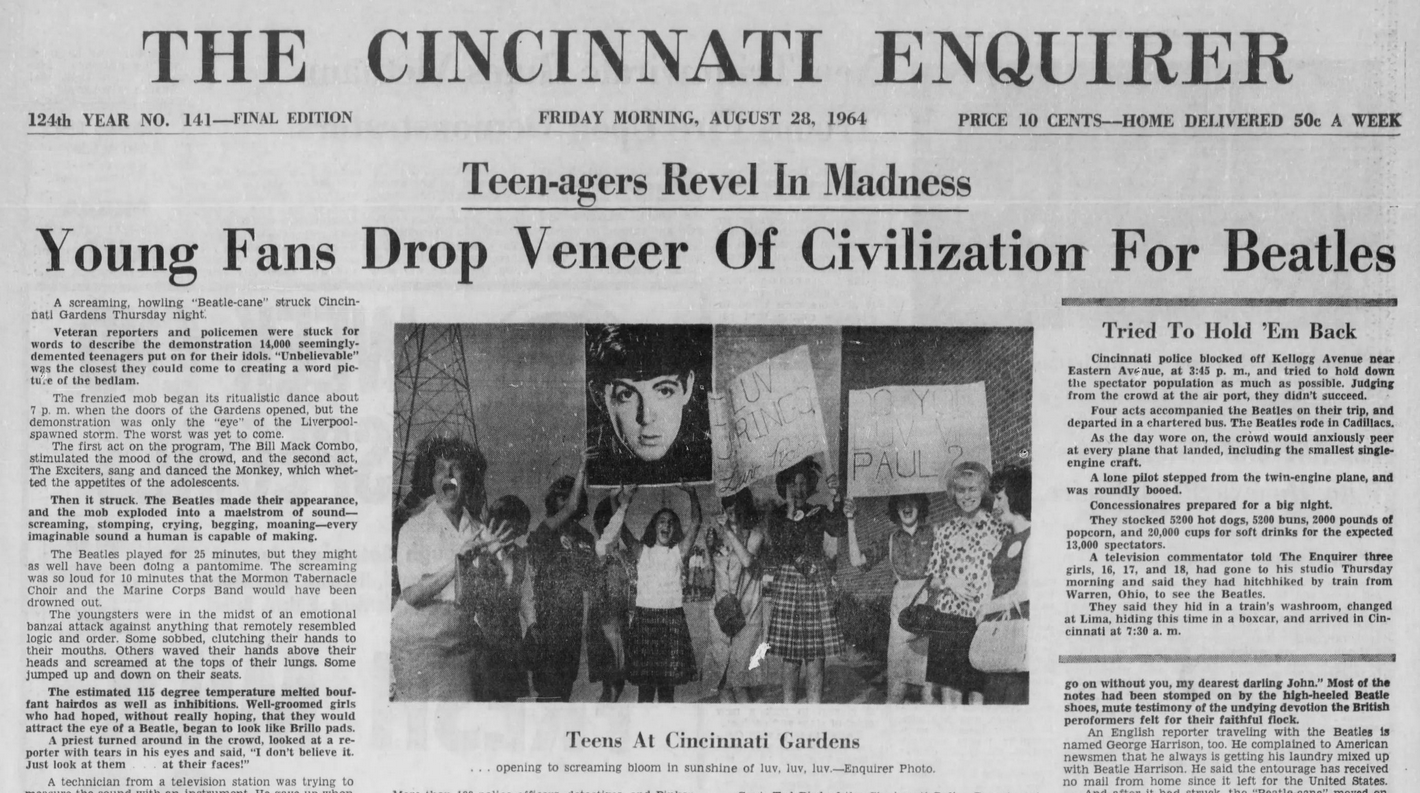
When the Beatles went on the road, stories like this followed them everywhere
On the 50th anniversary of Sgt. Pepper’s Lonely Hearts Club Band, the New York Times bravely reprinted the original review that ran in the newspaper on June 18, 1967. I commend the courage of the decision-makers who were willing to make Gray Lady look so silly. But it was a wise move — if only because readers deserve a reminder of how wrong critics can be.
“Like an over-attended child, ‘Sergeant Pepper’ is spoiled,” critic Richard Goldstein announced. And he had a long list of complaints. The album was just a pastiche, and “reeks of horns and harps, harmonica quartets, assorted animal noises and a 91-piece orchestra”. He mocks the lyrics as “dismal and dull”. Above all the album fails due to an “obsession with production, coupled with a surprising shoddiness in composition”. This flaw doesn’t just destroy the occasional song, but “permeates the entire album”.
Goldstein has many other criticisms — he gripes about dissonance, reverb, echo, electronic meandering, etc. He concludes by branding the entire record as an “undistinguished collection of work”, and even attacks the famous Sgt. Pepper’s cover — lauded today as one of the most creative album designs of all time — as “busy, hip, and cluttered”.
The bottom line, according to the newspaper of record: “There is nothing beautiful on ‘Sergeant Pepper’. Nothing is real and there is nothing to get hung about.”
How could he get it so wrong?
Comments Off on It’s the job of the music critic to be loudly and confidently wrong as often as possible
What’s the Greatest Machine of the 1980s … the FV107 Scimitar?
Engine Porn
Published 19 Jan 2015Light, agile and very fast on all types of terrain, the fabulous Scimitar FV107 armoured reconnaissance vehicle was developed by car manufacturer Alvis, who were asked to build a fast military vehicle that was light enough to be airdropped — simply not an option for full sized battle tanks at the time, which averaged around 13 tonnes. [NR: I think they mean “light tanks” here, as MBTs of the era would have been more like 50+ tons.]
Alvis got the weight down to under 8 tonnes by using a new type of aluminium alloy and minimising armour rating in favour of speed. They built the Scimitar around a 220 horsepower, six cylinder, 4.2 litre Jaguar sports car engine with ground-breaking transmission that allowed differential power to each set of tracks. The result was a sports car of the the military world that might not be the toughest in the field, but could race its way out of trouble at speeds of up to 70 miles an hour.
What makes it great: A revolutionary armoured vehicle that brought the very best of British sports car performance to the battlefield.
Time Warp: The Scimitar was the only armoured vehicle to be used by the British Army in the Falklands War.
This short film features Chris Barrie taking the Scimitar for a spin.
(more…)
Comments Off on What’s the Greatest Machine of the 1980s … the FV107 Scimitar?
QotD: Creating a hostile working environment
Anecdote is not data, of course; but ask any ordinary working woman* whether she’d prefer to work with men, or in a female-only workplace. The response may surprise you.
* This definition would exclude gender careerists and almost all rabid feministicals.
Kim du Toit, “Just Sayin'”, Splendid Isolation, 2022-10-26.
Comments Off on QotD: Creating a hostile working environment
January 31, 2023
The Allied Flying Aces of World War Two – Documentary Special
World War Two
Published 30 Jan 2023Young, daring, and handsome, the Allied fighter aces of World War Two have captivated the public with their thrilling exploits. Join us as we take a look at the top scorers! Thanks to Curiosity Stream for sponsoring today’s video.
(more…)
Comments Off on The Allied Flying Aces of World War Two – Documentary Special
“Thorstein Veblen’s famous ‘leisure class’ has evolved into the ‘luxury belief class'”
Rob Henderson had a particularly difficult childhood, but thanks to his own efforts ended up going to Yale after leaving the military. He discovered a very different world when he began his studies:

I was bewildered when I encountered a new social class at Yale four years ago: the luxury belief class. My confusion wasn’t surprising given my unusual background. When I was three years old, my mother was addicted to drugs and my father abandoned us. I grew up in multiple foster homes, was then adopted into a series of broken homes, and then experienced a series of family tragedies. Later, after a few years in the military, I went to Yale on the GI Bill. On campus, I realized that luxury beliefs have become fashionable status symbols. Luxury beliefs are ideas and opinions that confer status on the rich at very little cost, while taking a toll on the lower class.
In the past, people displayed their membership in the upper class with their material accoutrements. But today, luxury goods are more affordable than before. And people are less likely to receive validation for the material items they display. This is a problem for the affluent, who still want to broadcast their high social position. But they have come up with a clever solution. The affluent have decoupled social status from goods, and re-attached it to beliefs.
[…]
You might think that rich students at elite universities would be happy because they are in the top 1% of income earners. But remember, they’re surrounded by other members of the 1%. Their social circle, their Dunbar number, consists of 150 baby millionaires. Jordan Peterson has discussed this phenomenon. Citing figures from his experience teaching at Harvard in the 1990s, Peterson noted that a substantial proportion of Ivy League graduates go on to obtain a net worth of a million dollars or more by age 40. And yet this isn’t enough for them. Not only do top university graduates want to be millionaires-in-the-making, they also want the image of moral righteousness. Elite graduates desire high status not only financially, but morally as well.
For our affluent social strivers, luxury beliefs offer them a new way to gain status.
Thorstein Veblen’s famous “leisure class” has evolved into the “luxury belief class”. Veblen, an economist and sociologist, made his observations about social class in the late nineteenth century. He compiled his observations in his classic work, The Theory of the Leisure Class. A key idea is that because we can’t be certain of the financial standing of other people, a good way to size up their means is to see whether they can afford to waste money on goods and leisure. This explains why status symbols are so often difficult to obtain and costly to purchase. These include goods such as delicate and restrictive clothing, like tuxedos and evening gowns, or expensive and time-consuming hobbies like golf or beagling. Such goods and leisurely activities could only be purchased or performed by those who did not live the life of a manual laborer and could spend time learning something with no practical utility. Veblen even goes so far as to say, “The chief use of servants is the evidence they afford of the master’s ability to pay.” For Veblen, butlers are status symbols, too.
Converging on these sociological observations, the biologist Amotz Zahavi proposed that animals evolve certain displays because they are so costly. The most famous example is the peacock’s tail. Only a healthy bird is capable of growing such plumage while managing to evade predators. This idea might extend to humans, too. More recently, the anthropologist and historian Jared Diamond has suggested that one reason why humans engage in displays such as drinking, smoking, drug use, and other physically costly behaviors, is because they serve as fitness indicators. The message is “I’m so healthy that I can afford to poison my body and continue to function.” Get hammered while playing a round of golf with your butler, and you will be the highest status person around.
Comments Off on “Thorstein Veblen’s famous ‘leisure class’ has evolved into the ‘luxury belief class'”
Workshop Tour | Paul Sellers
Paul Sellers
Published 23 Sept 2022Many of you would have seen Paul go from working in a castle to reducing his workspace and ending up working in a single-car garage. This workshop has evolved over the years and is constantly adapting to Paul’s way of working.
Come and look around the workshop as Paul shows you what his shop entails and how it all aids him with his hand tool woodworking.
——————
(more…)
Comments Off on Workshop Tour | Paul Sellers
QotD: Religious rituals
We tend to have an almost anthropological view of rituals, even ones we still practice: we see them in terms of their social function or psychological impact. Frank Herbert’s Children of Dune (the Sci-fi miniseries; I can’t find the quote in the text, but then it’s a lot of text) put it wonderfully, “Ritual is the whip by which men are enlightened.” That is, ritual’s primary effect is the change that takes place in our minds, rather than in the spiritual world. This is the same line of thinking whereby a Church service is justified because it “creates a sense of community” or “brings believers together”. We view rituals often like plays or concerts, experiences without any broader consequences beyond the experience of participation or viewing itself.
This is not how polytheism (ancient or modern) works (indeed, it is not how most modern Christianity works: the sacraments are supposed to be spiritually effective; that is, if properly carried out, they do things beyond just making us feel better. You can see this articulated clearly in some traditional prayers, like the Prayer of Humble Access or Luther’s Flood Prayer).
Instead, religious rituals are meant to have (and will have, so the believer believes, if everything is done properly) real effects in both the spiritual world and the physical world. That is, your ritual will first effect a change in the god (making them better disposed to you) and second that will effect a change in the physical world we inhabit (as the god’s power is deployed in your favor).
But to reiterate, because this is key: the purpose of ritual (in ancient, polytheistic religious systems) is to produce a concrete, earthly result. It is not to improve our mood or morals, but to make crops grow, rain fall, armies win battles, business deals turn out well, ships sail, winds blow. While some rituals in these religions do concern themselves with the afterlife or other seemingly purely spiritual concerns (the lines between earthly and spiritual in those cases are – as we’ll see, somewhat blurrier in these religions than we often think them to be now), the great majority of rituals are squarely focused on what is happening around us, and are performed because they do something.
This is the practical side of practical knowledge; the ritual in polytheistic religion does not (usually) alter you in some way – it alters the world (spiritual and physical) around you in some way. Consequently, ritual is employed as a tool – this problem is solved by a wrench, that problem by a hammer, and this other problem by a ritual. Some rituals are preventative maintenance (say, we regularly observe this ritual so this god is always well disposed to us, so that they do X, Y, and Z on the regular), others are a response to crisis, but they are all tools to shape the world (again, physical and spiritual) around us. If a ritual carries a moral duty, it is only because (we’ll get to this a bit more later) other people in your community are counting on you to do it; it is a moral duty the same way that, as an accountant, not embezzling money is a moral duty. Failure lets other people (not yourself and not even really the gods) down.
Bret Devereaux, “Collections: Practical Polytheism, Part II: Practice”, A Collection of Unmitigated Pedantry, 2019-11-01.
Comments Off on QotD: Religious rituals
January 30, 2023
Crime on Toronto’s public transit system is merely a symptom of a wider social problem
As posted the other day, Matt Gurney’s dispiriting experiences on an ordinary ride on the TTC are perhaps leading indicators of much wider issues in all of western society:

“Toronto subway new train” by BeyondDC is licensed under CC BY-NC-ND 2.0 


 .
.
Caveats abound. Toronto is, relatively speaking, still a safe city. The TTC moves many millions of people a week; a large percentage of whom are not being knifed, shot or burnt alive. And so on. We at The Line also suspect that whatever is happening in Toronto isn’t happening only in Toronto, but Toronto’s scale (and the huge scope of the TTC specifically) might be gathering in one place a series of incidents that would be reported as unconnected random crimes in any other city. A few muggings in Montreal or Winnipeg above the usual baseline for such crimes won’t fit the media’s love of patterns as much as a similar number of incidents on a streetcar or subway line.
Fair enough, duly noted, and all that jazz.
But what is happening out there?
Your Line editors have theories, and we’ve never hesitated to share them before: we think the pandemic has driven a portion of the population bonkers. We’d go further and say that we think it has left all of us, every last one, less stable, less patient, less calm and less empathetic. For the vast majority of us, this will manifest itself in many unpleasant but ultimately harmless ways. We’ll be more short-tempered. Less jovial at a party. Less patient with strangers, or even with loved ones. Maybe a bit more reclusive.
But what about the relatively small majority of us that were, pre-2020, already on the edge of deeper, more serious problems? What about those who were already experiencing mental-health issues, or living on the edge of real, grinding poverty?
It’s not like the overall societal situation has really improved, right? COVID-19 itself killed tens of thousands, and took a physical toll on many more, but we all suffered the stress and fear not just of the plague, but of the steps taken to mitigate it. (Lockdowns may have been necessary early in the pandemic, but they were never fun or easy, and that societal bill may be coming due.) Since COVID began to abate, rather than a chance to chill out, we’ve had convoys, a war, renewed plausible risk of nuclear war, and now a punishing period of inflation and interest-rate hikes that are putting many into real financial distress. We are coping with all of this while still processing our COVID-era stress and anxiety.
The timing isn’t great, is what we’re saying.
And on the other side of the coin, basically all our societal institutions that we’d turn to to cope with these issues — hospitals, social services, homeless shelters, police forces, private charities, even personal or family support networks — are fried. Just maxed out. We have financial, supply chain and, most critically, human-resource deficits everywhere. The people we have left on the job are exhausted and at their wits’ end.
This leaves us, on balance, less able to handle challenges than we were in 2020, due to literal exhaustion of both institutions and individuals. Meanwhile, against the backdrop of this erosion of our capacity, our challenges have all gotten worse!
It’s not hard to do the mental math on this, friends. It seems to us that in 2020, the policy of Canadian governments from coast to coast to coast, and at every level, was to basically keep a lid on problems like crime, homelessness, housing prices and shortages, mental health and health-care system dysfunction, and probably others we could add. One politician might put a bit more emphasis on some of these issues than others, in line with their partisan priors, but overall, the pre-2020 status quo in Canada was pretty good, and our political class, writ large, basically self-identified as guardians of that status quo, while maybe tinkering a bit at the margins (and declaring themselves progressive heroes for the trouble of the tinkering).
But then COVID-19 happens, and all our problems get worse. And all our ways of dealing with those problems get less effective. It doesn’t have to be by much. Just enough to bend all those flatlined (or maybe slightly improving) trendlines down. Instead of homelessness being kind of frozen in place in the big cities, it starts getting worse, bit at a time, month after month. The mental-health-care and homeless shelter systems that weren’t really doing a great job in 2020, but were more or less keeping big crises at a manageable level, started seeing a few more people fall through the cracks each month, month after month. Those people are just gone, baby, gone.
The health-care system that used to function well enough to keep people reasonably content, if not happy, locks up, and waitlists balloon, and soon we can’t even get kids needed surgeries on time.
The housing shortage goes insane, and prices somehow survive the pandemic basically untouched.
The court system locks up, meaning more and more violent criminals get bail and then re-offend, even killing cops when they should be behind bars.
None of these swings were dramatic. They were all just enough to set us on a course to this, a moment in time where the problems have had years to compound themselves and are now compounding each other.
Here’s the rub, folks. The Line doesn’t believe or accept that any of the problems we face today, alone or in combination, are automatically fatal. We can fix them all. But we need leaders, including both elected officials and bureaucrats, who fundamentally see themselves as problem fixers, and who understand right down deep in their bones that that is what their jobs are, and that they are no longer what they’ve been able to be for generations: hands-off middle managers of stable prosperity.
Comments Off on Crime on Toronto’s public transit system is merely a symptom of a wider social problem
Eff the WEF | The spiked podcast
spiked
Published 27 Jan 2023Tom Slater, Fraser Myers and Ella Whelan discuss the World Economic Forum, men in women’s prisons and Facebook’s unbanning of Donald Trump. Plus, Timandra Harkness explains the dangers of the UK’s Online Safety Bill.
(more…)
Comments Off on Eff the WEF | The spiked podcast


