
It’s a Southern Thing
Published 19 Jan 2021Just keep nodding and try to hang in there.
(more…)
April 20, 2023
When You Get Distracted Easily
Comments Off on When You Get Distracted Easily
QotD: Food fascism
I think the liberal elite – which you don’t see bellying up to a creepy-crawly buffet – just likes the idea of not only nagging us but seeing how much they can make us humiliate ourselves by bending to their will. I can see a bunch of kale grazers in Brooklyn sitting around giggling about how they convinced those stupid rubes in gun/Jesusland to start chewing cicadas.
But the diet dictatorship craze is a real thing. You’ve seen the war on beef by the likes of Alexandria Ocasio-Genius, who runs her oversized novelty mouth about how we have to stop cooking cows because doing so displeases the great and terrible climate goddess Gaia. See, cows may contribute to the world being slightly warmer in a century, so stop doing something you enjoy. Consider not eating beef as a sacrifice made on behalf of the weird weather cult.
Here’s a locust. Now, don’t you feel better about your slightly reduced carbon footprint?
What do you think the chances are that the di Caprios and the Gores and the rest of the climate hucksters won’t be dining on filet mignon in their private jets flying from their mansions to Davos to save the planet from your carbon crimes, while you pedal your bike in the rain back to your unheated 500 square foot apartment to gnaw on a dinner of arugula and raw moths?
Remember, food fascism is for your own good, since you are evidently unable to make decisions about what you put in your mouth for yourself. You see, if you are allowed to make your own choices about your body you might make the wrong ones – with “wrong” being defined as choices Michael Bloomberg or the other members of Team Helper would not make.
Kurt Schlicter, “Tell The Nags To Go Pound Sand”, Townhall.com, 2019-11-19.
Comments Off on QotD: Food fascism
April 19, 2023
The USMC finds a new mission after WW1
Another excerpt from John Sayen’s Battalion: An Organizational Study of United States Infantry (unpublished, but serialized on Bruce Gudmundsson’s Tactical Notebook:

The 1919 demobilization was nearly as traumatic for the Marines as it was for the Army. Their numbers fell from a peak of 75,000 to about 1,000 officers and 16,000 enlisted in 1920. Authorized strength was 17,400. The 15 Marine regiments and at least three, probably four, machinegun battalions existing at the end of November 1918 had withered away to only five regiments and a couple of separate battalions (one artillery and one infantry) by the following August.
Marine commitments, however, remained heavy. The brigades in both Haiti and the Dominican Republic had their hands full suppressing new rebellions. Guard detachments were still needed for Navy bases and Navy ships. The number of men required for the latter duty had fallen by only 10% since 1918. The Marines also had to staff their own bases at Quantico, Parris Island, and San Diego and they had to find men to rebuild the advance base force as well. When these facts were brought to the attention of Congress in 1920 the latter increased the Marine Corps’ authorized strength to 1,093 officers and 27,400 enlisted but then approved funding for only 20,000.
[…]
The bulk of the Corps’ operating forces were still engaged in colonial police work in the Caribbean. However, the new Commandant, Major General John A. Lejeune, was prescient enough to realize that this would not last and that a much more permanent mission would be needed to secure his service’s future. Instead, Lejeune and his advisors concluded that the real mission of the Marine Corps was “readiness”. While this concept might seem trite, one should consider that the United States was and is primarily an insular power. Its standing army in 1920 served primarily as a garrison force and cadre for a much larger wartime citizen army. Little or none of it would be available for immediate use upon the outbreak of a major war beyond the troops already deployed to major US overseas possessions like the Philippines, Hawaii, or the Panama Canal.
Although the Army of 1920 seemed to have little idea about who its future adversaries were likely to be, the Navy had already fingered Japan as its most likely future opponent. Japan had the most powerful navy after the United States and Great Britain and Japanese-American animosity was growing. The Japanese resented the treatment of Japanese immigrants in California. Americans resented Japan’s high handed actions in China. The Japanese saw American criticism of Japan’s China policy as interference in Japan’s rightful sphere of influence. Any war fought against Japan would be primarily naval in character. However, post war disarmament treaties forbade improvements to any American fortresses west of Hawaii. The League of Nations had also mandated most of the central Pacific islands to Japanese control.
If it was to successfully engage the Japanese fleet, or to threaten Japan itself, the United States Navy would need bases in those central Pacific islands. Hawaii was too far away to be useful and the Philippines were too vulnerable to Japanese attack. Only an expeditionary force could seize and hold the central Pacific islands that the Navy needed and that expeditionary force would have to be ready to move whenever and wherever the Navy did. By staying “ready”, requiring only limited reserve augmentation and, being already under the Navy’s control, the Marine Corps would be much better positioned than the Army to provide this expeditionary force, at least during the critical early stages of the next war.*
* Heinl op cit pp. 253-254; Moskin op cit pp. 219-222; and Clifford op cit pp. 25-29 and 61-64.
Comments Off on The USMC finds a new mission after WW1
World War 2 Ice Cream of the US NAVY
Tasting History with Max Miller
Published 18 Apr 2023
(more…)
Comments Off on World War 2 Ice Cream of the US NAVY
Time to remove US nuclear weapons from Europe?
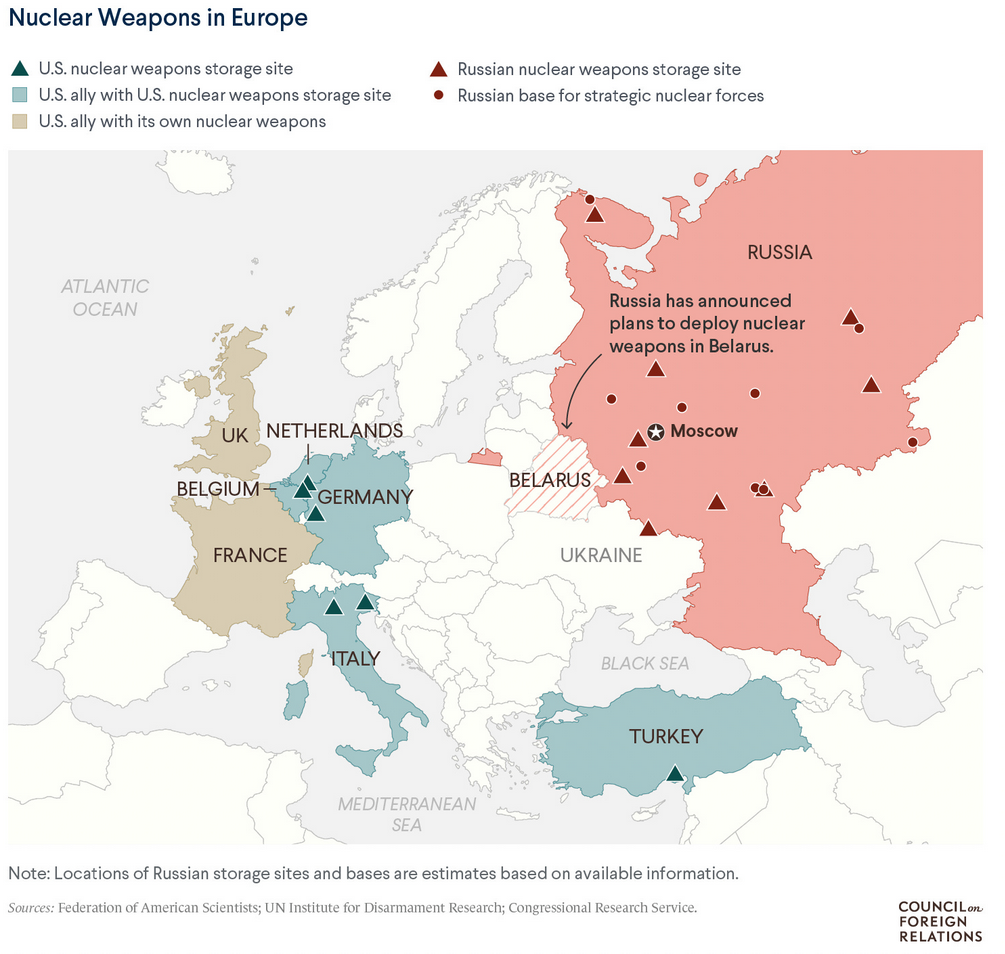
CDR Salamander has long advocated getting the final few American “tactical” nuclear weapons off European soil and makes the case for doing it now:
It may seem like a strange thing to propose while there is the largest land war in Europe since 1945 going on, but as it is something I’ve been a supporter of for a few decades I might as well be consistent: we are long overdue to remove American nuclear weapons from Europe.
It is 2023. Just look at this map.
[…]
The Soviet Union stopped existing over three decades ago.
Even though we’ve decreased from 7,000 warheads down to 100 … there really is no reason to keep what remains in Europe.
- Gravity bombs on continental Europe – that require tactical aircraft to deliver them – are the least survivable, reliable, or timely way to deliver a nuclear weapon.
- There is no such thing as a tactical nuclear weapon. I don’t care what some theorist proposes to defend their pet theories, you lob one nuke an order of magnitude larger than the Hiroshima bomb and only a foolish nation would let their strategic nuclear forces stay unused and in danger.
- Gravity bombs are not a first strike weapon and are a poor second strike weapon. As such, you have to consider that the the time gap from approval to flash-boom would be so long the war would be over before your F-XX pickled their nuke over their target – even if the aircraft made it off the ground.
- If they are NATO weapons, you not only have to get NATO to approve their use, but host nation to as well … in addition to the USA. Do you really think the Russians would not leverage their influence with the useful idiots in the Euro-Green parties, former communists, and general black-block anti-nuke activists to politically of physically stop the use of the nukes, especially in BEL, NLD, DEU, and ITA? Add that to point 3 above.
- Especially with the weapons in Turkey – the risk of these bombs having a bad day due to human or natural causes is non-zero. In the days of mutually assured destruction, those non-zero odds were manageable, but there is no reasonable person in the third decade of the 21st Century who can with a straight face explain to you why any tactical, operational, or strategic use justify their presence. They deter no enemy, but puts every friend in danger.
- Look again at the map above. Exactly what target set are you going to “service” at that range (non-refueled)?
- If things go nuclear in Europe then the right weapons are either British, French, and if they must be American are sitting in a silo in CONUS, a SSBN in the Atlantic, or a B-2 in Missouri.
Comments Off on Time to remove US nuclear weapons from Europe?
Philip II of Macedon (359 to 336 B.C.E.)
Historia Civilis
Published 24 May 2017
(more…)
Comments Off on Philip II of Macedon (359 to 336 B.C.E.)
QotD: Transsexuals before Trans* politicization
But that’s the point: Even those far closer to them than I was weren’t aware — because back then the object of having a “sex change” (also as we used to say) was to change from being a man to being a woman. There were still only two teams and you were simply crossing over to bat for the other side. The trans-life had little in common with “gay pride” — because the object wasn’t to come out of the closet, but to blend into it so smoothly no one would know you hadn’t always been there. Before their outing, the two ladies in question were more lady-ier than thou: both used to show up once a month with a box of Tampax “discreetly” poking out from the top of their handbags — even though, as we all understood in retrospect, they had no need of it. But they had chosen to live as women, and so they wished to be as other women. And they were mortified when they were exposed.
This was the conventional view as late as the Nineties, when Armistead Maupin’s celebration of the gay life, Tales Of The City, became must-see TV for sophisticated liberals on Britain’s Channel 4 and America’s PBS. The big plot point was the matriarch Mrs Madrigal (Olympia Dukakis) “revealing” her “secret” — that she was not born a woman.
To be sure, as the chromosomocentrists argue, one cannot, biologically, “change sex”. But I’ll skip that argument, because, as usual, conservatives are fighting over ground the left has already scorched and moved on from for new conquests. I have no great objection to a grown man who “identifies” as a woman and wishes to live as one. Guys have been doing that, to one degree or another, throughout history, and all that’s happened is that cosmetic surgery has caught up with their desires. If half the women in California can walk around with breast implants, I don’t see why the chaps can’t.
But the chromosomocentrists are missing the point. The left’s saying, “Yeah, XY chromosomes, big deal. You’re right, but so what? No one’s saying she’s a woman. We’re saying she’s a transwoman — a new, separate and way more glamorous category that’s taking its seat at the American table and demanding public affirmation. This isn’t your father’s sex change. Changing from man to woman is so last century.”
Mark Steyn, “Birth of the New”, Steyn Online, 2015-06-05.
Comments Off on QotD: Transsexuals before Trans* politicization
April 18, 2023
“Here it is then. This is The Hill.”
Simon Evans rightfully decides that fighting the bowdlerization of P.G. Wodehouse is the hill to die on:
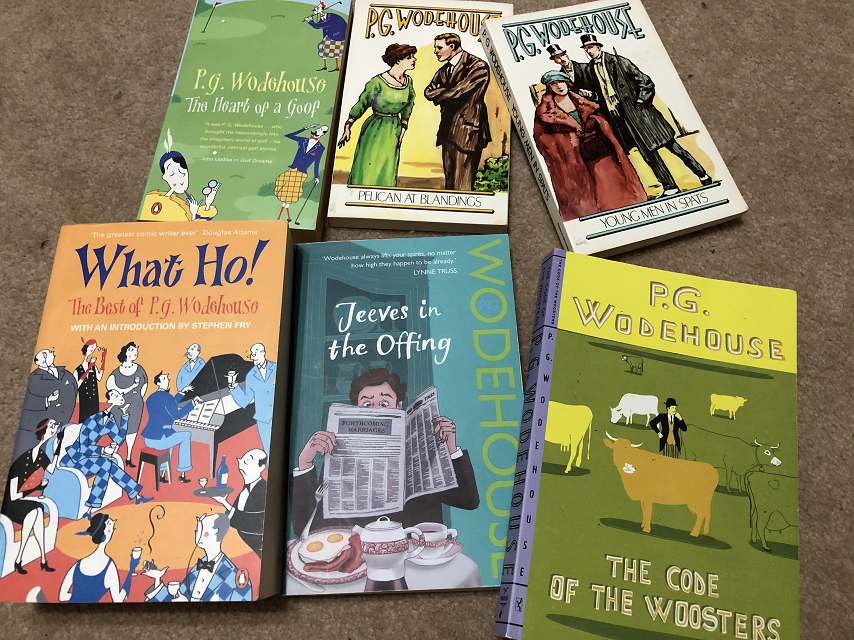
PG Wodehouse has become the latest author to fall victim to the “sensitivity readers”. Passages have been purged and words have been altered for the new editions of his Jeeves and Wooster novels, including Thank You, Jeeves and Right Ho, Jeeves. According to Penguin, the publishers, some of the racial language and themes of these 1930s novels are “outdated” and “unacceptable”. This includes the use of the n-word.
When I saw the news, my tweet sort of fell out of me before I’d consciously drafted it: “Here it is then. This is The Hill.”
There is an interesting contrast here. We live in a time when every much-loved and out-of-copyright literary artefact that is brought to the screens is being stiffened, like an old Christmas pudding recipe that clearly needs more brandy, with swearing and novel scenes of sexual deviation never imagined in the original. Just think of the BBC’s recent modernising and coarsening of Charles Dickens, Agatha Christie et al, which have rendered them all but unwatchable for millions. So it is more than a little odd that Wodehouse, the mildest, most weightless comedy of the last century, should suddenly seem deserving of the nit comb.Yes, it is true that Wodehouse uses the n-word. And no other word is now, or arguably ever has been, quite so radioactive, so sui generis in its capacity for offence. It is not that I want to defend this word. Rather, the hill on which I will die is the pristine perfection of Wodehouse’s prose, and its right to remain so. He is – and by an extraordinary degree of consensus, in a field that is almost maddeningly subjective – the Bach of comic literature. And I’m sorry, but you just don’t tinker with Bach.
Though a fan, Christopher Hitchens, in a review of a Wodehouse biography, wrote of the tiresome habit of certain people in referring to Wodehouse as “The Master”, so I will try to avoid that unctuous, fulsome tone. But one of the very few writers of my lifetime who approached him for touch (though sadly not in output) was Douglas Adams, who often referred to Wodehouse as just that: “He’s up in the stratosphere of what the human mind can do, above tragedy and strenuous thought, where you will find Bach, Mozart, Einstein, Feynman and Louis Armstrong, in the realms of pure, creative playfulness.”
The point is not that the presence of the odd unfortunate archaic usage, which might indeed jolt the casual reader into a brief awareness that they are reading something older than their grandfather, is necessarily a good thing. It is simply, who the hell do the sensitivity readers think they are, to decide what stays and what goes?
Comments Off on “Here it is then. This is The Hill.”
Canada’s Prime Minister was never supposed to be like a US or French President
In The Line, Mitch Heimpel shows a few of the “presidential” accretions to the Canadian political system that really don’t belong in a Parliamentary system like ours:
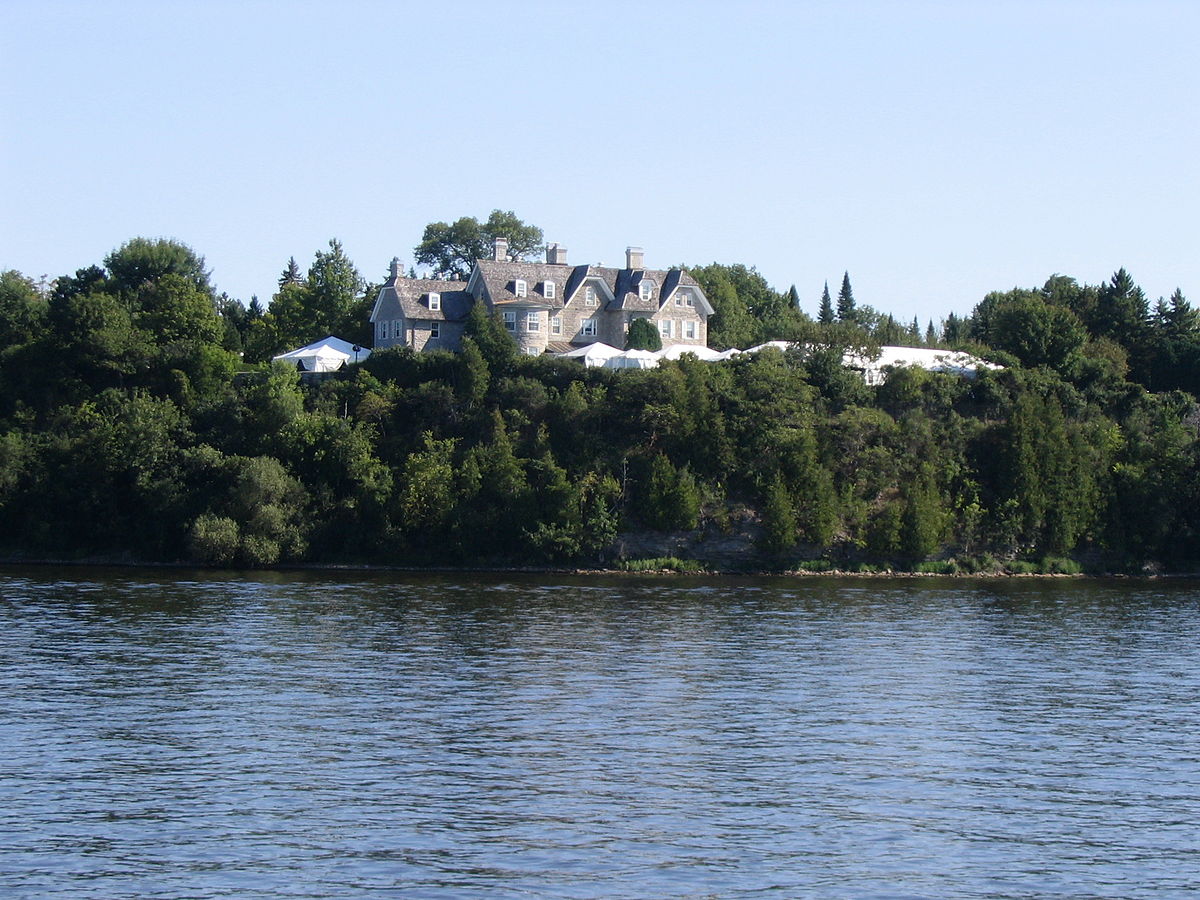
The official residence of the Prime Minister of Canada, 24 Sussex Drive, as seen from the Ottawa River. Ottawa, Ontario, Canada. (La résidence officielle du Premier ministre du Canada 24, promenade Sussex vu de la rivière des Outaouais).
Photo by sookie via Wikimedia Commons.
A couple of recent news stories, first about the Prime Minister’s Chief of Staff appearing (again) before a parliamentary committee, and the second about the level of decay of the official residence at 24 Sussex, have led me to realize how thoroughly we have presidentialised Canadian politics, and how thoroughly it has been to our detriment.
Parliamentary systems are not supposed to operate as presidential systems. They are intended to be far more managerial and transitory. They are intended to handle the affairs of state, without embodying the state. That distance is supposed to allow us all to access to a degree of patriotism without allowing partisanship to evolve into some kind of invasive cyst. This is why the weird, presidential appendages that have evolved in our own system over the years have proven so awkward and, ultimately, unwelcome. And unhealthy.
Let’s start with the easier target, 24 Sussex Drive, and get this out of the way off the top. The prime minister of a G7 nation should not live in squalor. Rat infestations, like the ones that recently contributed to the full closure of the prime minister’s ostensible home, are not acceptable. Official residences in various states of disrepair are a poor reflection on the nation, if for no other reason than it shows that we can’t even get basic carpentry and maintenance correct.
But the official residences of prime ministers are not supposed to be grand palaces either. They are supposed to emphasize the temporary nature of the occupant. The change of a prime minister, even without an election, should be a regular occurrence — and not just in Australia. Something that functions as a secure and defensible site with pleasant family home while also including the ability to host cabinet meetings or small events and maybe some staff as a working residence seems more than adequate.
It should not be the White House. It should not be the Elysée Palace. Nor should it attempt to compete with them. That’s not the job, or at least it’s not supposed to be. It should never be the subject of all this controversy and scrutiny, because it shouldn’t symbolize anything. It should be a secure place where the head of government and their family sleep until replaced by the next head of government and family.
Our fixation on it, and the fear every PM has of being seen spending a penny on its upkeep and repair, is a small but telling sign of how we’ve invested too much importance and symbolism in one person.
Comments Off on Canada’s Prime Minister was never supposed to be like a US or French President
“People who pivot this quickly need to make sure their pants are securely buckled”
We’ve apparently reached the “Republicans Pounce” stage of yet another progressive crusade:
The memo has gone out, and the pivot has arrived.
Ten days ago, you may remember, the suddenly high-profile Nebraska Senator Machaela Cavanaugh went on NPR to play make-believe, expressing consternation over this weird new focus on transgender issues over on the political right: “I don’t know why, as a nation, as policymakers, there is this newfound focus on trans children… And all of the sudden, there is a decision by policymakers that we need to do something about them. It doesn’t make any sense to me.” It’s the why are you guys so obsessed with this DARVO maneuver, spun with bald-faced shamelessness by people who’ve been talking for years about the thing that they suddenly want you to know it’s creepy to talk about.
Now the New York Times explains the same thing in a similar way, writing that transgender issues have suddenly become a big deal in America because scheming right-wingers decided to cook it up as a fake wedge issue:
“The religious right went searching for an issue.” To get donors to write some checks, see. They just made it up, in a cynical act of invention. A bunch of social conservatives were sitting around the office, lamenting how no one gives them money anymore because everybody stopped hating the gays, so they decided, tactically, to pretend that transgender rights was a thing, now, so that they could trick people into giving them money again. Completely out of left field! Trans rights was just sitting there watching some Netflix with a tub of Cherry Garcia when suddenly the doorbell rang.
There’s no pouncing, but you’ve heard this descriptive maneuver before:
Nadine Smith, the executive director of Equality Florida, a group that fights discrimination against L.G.B.T.Q. people, said there was a direct line from the right’s focus on transgender children to other issues it has seized on in the name of “parents’ rights” — such as banning books and curriculums that teach about racism.
“Seized on”. The story also says that the issue of men participating in women’s sports “was accelerated by a few influential Republican governors who seized on the issue early”. There’s a lot of seizing on, and it’s all mysterious. Why did the seizers seize the seized thing? Dunno. They just suddenly, for no apparent reason at all, seized on the issue of women’s sports. Weird. Similarly, that paragraph about “banning books” and forbidding “curriculums that teach about racism” is presented as a given, not as a thing that requires explanation or illustration. It’s tactical murk: half-accusations as smoke and chaff, designed to leave you with the general outlines of a thing that it’s convenient to have you believe. The right-wingers are something something something, and it’s scary.

Comments Off on “People who pivot this quickly need to make sure their pants are securely buckled”
Canada Council for the (decolonized) Arts
In the latest SHuSH newsletter, Kenneth Whyte follows up on an earlier report on the mission of the Canada Council for the Arts, as outlined by Simon Brault:

… the founders of the Canada Council felt so strongly about the dangers of bureaucratic and political impositions on the arts — officials using federal money to force artistic and cultural activities in one direction or another — that they built checks and balances into its founding legislation.
The checks and balances haven’t checked or balanced. The Canada Council is now fully dedicated to teaching, censoring, and directing artistic endeavour.
The occasion for last year’s piece was a decision by Simon Brault, chief executive of the Canada Council, to halt funding for any “activity involving the participation of Russian or Belarusian artists or arts organizations … This includes partnerships, direct and indirect financing of tours, co-productions, participation in festivals or other events held in Russia.”
The outcome of Brault’s edict was that Canadians last summer weren’t able to enjoy a variety of planned tours by performers who had the misfortune to be born in Moscow, even if they loathed Putin like the rest of us.
It wasn’t the extremity of Brault’s position that set me off — he reserved to himself the right to ban artistic interaction with artists from any country whose government was involved in a conflict he considered unjust — so much as his implication that the arts community was too stupid to have noticed what was happening in Ukraine or to have known how to respond without his guidance.
A few months ago, Brault upped the ante, speaking at the council’s annual general meeting of his “vision for a decolonized future of the arts”.
To actualize this vision, we must also decolonize the Council itself by questioning our own assumptions and convictions.
It is important to acknowledge that decolonization is a complex, evolving, and open concept and journey.
There’s no definitive guide on how to undertake this work.
And it has different implications for different organizations and sectors in our society.
So far, our understanding is that to decolonize the Council, we must agree to reframe our understanding of what constitutes art, which is a big thing for an arts council.
We need also to question the notion of professionalism and artistic disciplines, which are deeply rooted in a very specific time in history, mostly Eurocentric, and often from a very colonialist perspective.
So, we need to challenge the notion of “artistic excellence”, again a concept that upholds hierarchies of good taste and values that confirm and perpetuate the status of the dominant culture.
We also need to move beyond limited notions of artistic expertise because those notions are often the direct product of an education system built to reproduce power relations and safeguard the privilege of a dominant colonial discourse on arts and culture.
There you have it. Brault committed the leading funding agency for the arts in Canada to “challenging” the prevailing understandings of art, artistic professionalism, artistic disciplines, artistic excellence, good taste, artistic values, and artistic expertise.
He’s not quite clear on what he’s going to replace it all with — he’s just sure that the way you think about art is wrong and that Keynes statement that the work of the artist is by nature individual and free, undisciplined, unregimented, uncontrolled, etc., is colonialist claptrap.
Let the regimentation and control begin.
Comments Off on Canada Council for the (decolonized) Arts
Guadalcanal’s Red Beach Landing: America’s First Offensive in WW2
Forgotten Weapons
Published 24 Dec 2022After (formally) joining World War Two in the wake of Pearl Harbor, the United States endured a series of defeats at the hands of the Japanese. The Philippines garrison fell, Wake Island fell, Guam fell. British possessions in Southeast Asia teetered and fell as well — the campaign was not going well for the Allies.
The first American offensive of the war would come on August 7th, 1942 with the landing of the 1st and 5th Marines at Red Beach on Guadalcanal. Part of a multi-prong assault (the nearby Japanese bases on Tulagi and Gavutu/Tanambogo were also captured at the same time), the attack on Guadalcanal was made to secure the airstrip under Japanese construction there. If the island became an operational Japanese air base, Allied supply shipping to Australia would come under threat, and this could imperil the whole area of operations.
Fortunately for the Marines, US intelligence massively overestimated the Japanese force on Guadalcanal. It was in fact only a few hundred infantry, leading a work force of about 3,000 laborers (mostly Koreans). They thought the US landings were just a small raid, and dispersed into the jungle to wait for the US departure. Instead, the Marines were there to take the airfield and hold it. They were not, however, very well prepared. The Navy suffered a massive defeat in the waters off Guadalcanal the very next night, and would pull out of the area August 9th, leaving the Marines with dangerously low supplies of food, ammunition, and other essentials.
(more…)
Comments Off on Guadalcanal’s Red Beach Landing: America’s First Offensive in WW2
QotD: The worldview of the fanatic
Obviously none of those hold in Current Year America, since they were all invented by the Pale Penis People, and even if they weren’t, they can’t matter to atheists anyway — one only defends one’s dignity and honor if one believes he’ll be called to account for them, and who’s going to do the accounting? There is no God, and as for the bar of History, what could that possibly matter to a cultural marxist? To them, as to their Puritan forbears, “history” is really soteriology. The past is nothing but a catalog of freely chosen error. For the fanatic, “history” begins anew each dawn, because why study endless iterations of Error when you already have the Truth?
Severian, “The Stakeholder State”, Rotten Chestnuts, 2020-01-22.
Comments Off on QotD: The worldview of the fanatic
April 17, 2023
“… capitalism is a ‘virus’ composed of ‘systems that oppress’ …”
In Quillette, Jonathan Kay tells the story of a civil servant in British Columbia who objected to the content of a “Gender Workshop”:
If you’re a white-collar Canadian, chances are good that you’ve received workplace lectures on the subject of “decolonization” — a vaguely defined project aimed at “deconstructing colonial ideologies of the superiority and privilege of Western thought”. It’s a decidedly cultish pedagogical genre that I’ve come to know well, because exasperated workers often send me screenshots and recordings from their training sessions. Since raising complaints about these materials internally would risk career-threatening accusations of “white fragility” and such, leaking them to journalists is seen by many employees as the only viable option.
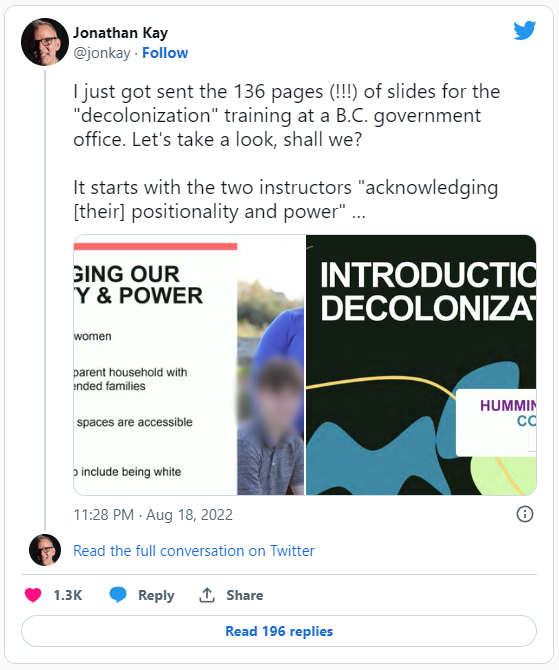
One notable specimen I received last year was a 136-page module titled Introduction to Decolonization, which had been presented earlier that year by the Hummingbirds Rising consultancy to staff at British Columbia’s Office of the Ombudsperson (an entity self-described as “B.C.’s independent voice for fairness and accountability, [working] to make sure public sector organizations are treating people fairly and following the rules”). The roughly 100 attendees were told by the trainers that this would be a “brave space”, in which those who had concerns about decolonization could “be bold and brave [with their] questions and comments”. (According to a Deputy Ombudsperson, attendance at the organization’s all-staff Diversity & Inclusion events is typically listed as optional. In practice, staff told me, almost everyone feels that they are expected to attend.)
Much of the historical material presented in that session was perfectly accurate — including descriptions of the injustices associated with Canada’s system of Indigenous reserves. But as the presentation wore on, the content began to raise eyebrows. A section on economics declared flatly that capitalism is a “virus” composed of “systems that oppress”. A capsule lesson on spirituality presented Western values as inherently narcissistic, in contradistinction to Indigenous peoples’ quest for universal harmony. An array of listed terms that the presenters evidently associate with “white supremacy” included “being on time”, “manners”, and “perfectionism”. Most scandalously (as it would turn out), one slide indicated that the Nazi slaughter of six million European Jews had been directly inspired by the Canadian Constitution. Even more bizarrely, the slide was illustrated with a screen grab from an episode of Mr. Bean, a madcap 1990s-era British comedy show.
(When asked about the presentation, the Office of the Ombudsperson’s Communications Lead told Quillette that Hummingbirds Rising had been listed on the BC Public Service’s public pre-qualified supply list, and that prior vetting of the presentation had not been conducted by office staff. The Communications Lead added that the training was part of the Office’s “commitment to reconciliation with Indigenous people. Staff knowledge of cultural safety and the impacts of colonization on Indigenous people is an important component of the office’s Indigenous Communities Services Plan. We recognize that there may be some people who find some of the content of the Hummingbirds presentation controversial. We want to underscore, however, the value for our staff to fully understand the plurality of Indigenous perspectives in our province.”)
Slides from Introduction to Decolonization
After sharing these images on Twitter, I was contacted by the Vancouver office of a prominent Jewish organization, whose leadership (understandably) found the Mr. Bean/Holocaust slide to be in extremely poor taste. Thanks to their efforts, the issue was reportedly taken up internally by BC’s provincial government. And in the months that followed, I later learned, managers at the Office of the Ombudsperson took pains to find out who’d leaked the materials.
If the goal was to prevent more leaks, it didn’t work: Earlier this year, I received more documents pertaining to the Office of the Ombudsperson, the most interesting of which involved another over-the-top all-staff Diversity and Inclusion (D&I) workshop—this one on the topic of “challenges facing transgender and gender non-conforming people.” The presenter, Vancouver lawyer Adrienne Smith, is a well-known activist in this area, having helped lead the campaign to strip public funding from a local women’s shelter on the basis of its refusal to let biological males work as rape-crisis counsellors.

Comments Off on “… capitalism is a ‘virus’ composed of ‘systems that oppress’ …”
Orwell’s The Road to Wigan Pier
Daniel Nuccio on one of George Orwell’s early works that prefigured the bestsellers he is best known for today:
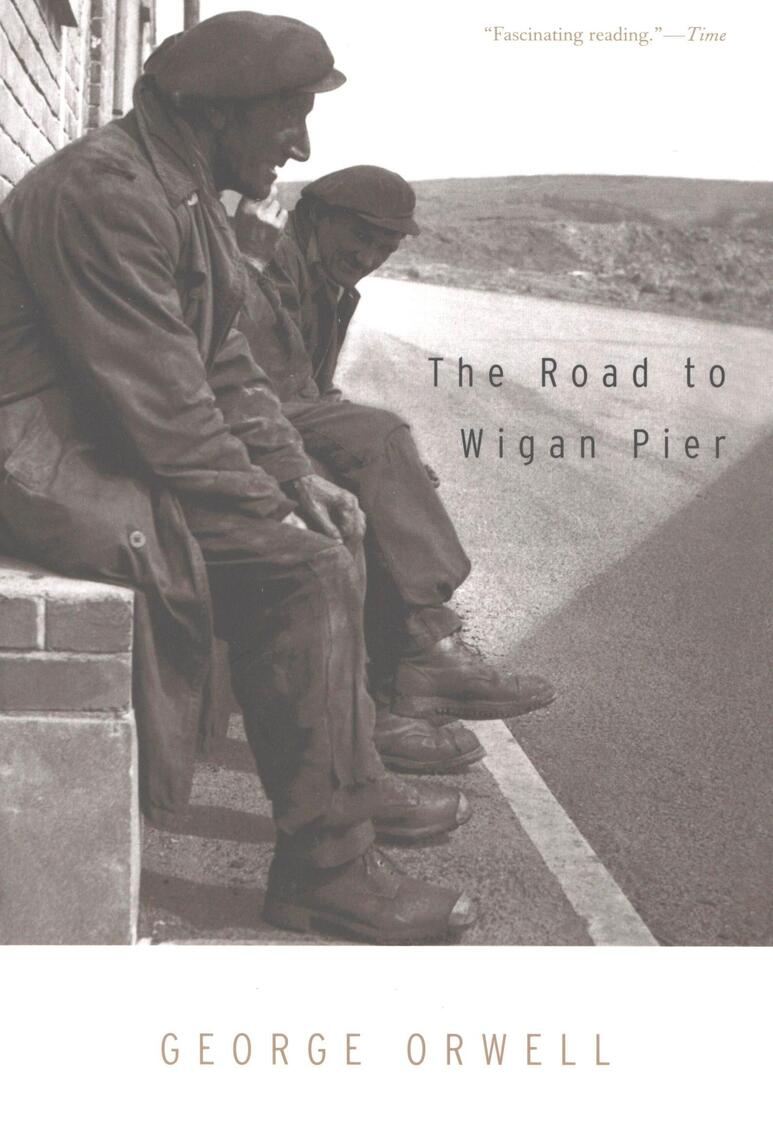
Written for a group of British socialists known as the Left Book Club, the oeuvre is part documentation of the life of Britain’s impoverished working class with particular focus on the dignity and importance of coal miners and part autobiographical account of Orwell overcoming his own class prejudices, united by themes developed throughout regarding the economic commonalities of and social distinctions between Britain’s low-level bourgeoisie and working class, as well as the downside of industrialization and hypocrisy of fashionable socialism.
By Orwell’s account, Britain’s class system at the time, partly based on economic stratification, partly in an unofficial caste system, fostered a seemingly contradictory world in which middle-class bourgeoisie and the working class might experience little difference in income, but drastic differences in their respective places in British society. Yet, even as unemployment and poverty festered and spread, with the middle class eventually “feeling the pinch”, social distinctions, Orwell reported, naturally won out over the narrowing economic gap between classes. Lower-level middle class Brits, despite being working class by any objective economic metric, still chose to identify as bourgeoisie.
Rampant industrialism likely exacerbated these problems as it fundamentally transformed Britain into a machine society, likely to its detriment, according to Orwell’s description. Consequently, these and other factors, Orwell argued, positioned Britain at a crossroads at which the country and its people inevitably would be forced to choose between socialism and fascism.
From his depiction of 1930s British society, it would seem fascism was perhaps going to win out (and perhaps would have if not for later events unbeknownst to Orwell at the time). His prescribed antidote was socialism. Yet, Orwell claimed, the hypocrisy, offensiveness, and buffoonish self-satirizing nature of many socialists tended to drive most normal people away.
Reading The Road to Wigan Pier as an American more than eighty years after its publication, the world Orwell depicts in some ways seems foreign. In many others it is amusingly, if not unsettlingly familiar.
Although not as ingrained as in Britain, the United States maintains its own version of a class system in the form of a superficial yet meaningful distinction between middle class and working class that many Americans yoke to personal character and economic reality.
Nowhere is this more obvious than America’s approach to higher education and the jobs afforded to those with a college degree versus those without. Attaining a degree from a four-year college or university, at least to many members of the American middle class, is seen as something of a sacrament that affirms one’s position in the American middle class. Receiving the sacrament of higher education signals one’s position along with one’s sophistication, respectability, and intelligence. It saves one from the indignity of blue-collar work and the impecunious state with which such work is associated.
Comments Off on Orwell’s The Road to Wigan Pier


