Quotulatiousness

April 17, 2023

The lingering pandemic of fear

Filed under: Government, Health, Media — Tags: , , , , , — Nicholas @ 03:00

Liz Hodgkinson on the pattern of fear that the state, media, and public health messaging instilled into so many people during the Wuhan Coronavirus pandemic:

“Covid 19 Masks” by baldeaglebluff is licensed under CC BY-SA 2.0

The Stoics of ancient times believed that in many cases it was possible to control pain by thought alone. To achieve this, they stoically, as it were, accepted painful or unpleasant sensations, viewing them with studied indifference. As such, the pain often went away of its own accord, although to be fair they did use a painkiller known as theriac, which contained opium.

The opposite is also true, in that you can induce pain or disease by thought alone, causing acute and sometimes lasting physical symptoms. Although ancient and tribal societies understood that the power of suggestion can be so strong that it may make people well or ill, this seems to have been forgotten in modern, mechanistic medicine with its insistence on tests, scans, screens and so on.

Because of this, I am now wondering whether as many people would have gone down with Covid (or what passed for it) if, instead of a flu-like illness being ramped up as the worst and most dangerous disease ever to affect humankind, it had been ignored.

As it was, around 80 per cent – and it may have been more – of the world’s population were gripped by such a fear of the bug that they actually thought themselves into illness. Once the PCR test was introduced, people began testing themselves, sometimes hourly, and if the test showed positive they waited for symptoms to appear. More often than not, they obliged.

Then people became terrified to step out of the house without wearing a mask, even though all the evidence showed that these muzzles were more or less ineffective and that even the surgical-quality ones lasted only a couple of hours, at most. People were also nervous of getting close to anybody else, edging away if somebody came within a few feet of them. Only the other day, as I was in a queue waiting to pay for an item, a masked woman in front of me turned round and said crossly: “Do you mind not standing so close to me?” I wondered about making a quick riposte but decided that there was no way I could penetrate this kind of stupidity.

There was also the handwashing ritual where shops, doctors’ surgeries, solicitors’ and estate agents’ offices, for instance, forced hand sanitiser on to you, and sometimes took your temperature as you walked in.

The cleaning nonsense went even further, with hotels, gyms and other places where people gathered announcing “enhanced cleaning”. This may or may not have halted the virus in its tracks but it certainly increased fear. I still see people in the gym furiously scrubbing down bikes, treadmills and other equipment in case a germ from a previous user has had the audacity to linger on the machine.

Tank Chats Reloaded | Panzer IV | The Tank Museum

Filed under: Germany, History, Military, Weapons, WW2 — Tags: , , — Nicholas @ 02:00

The Tank Museum
Published 30 Dec 2022

Let’s go inside Panzer IV with another episode of Tank Chats Reloaded. Chris Copson takes a detailed look inside the tank which was considered the backbone of the Wehrmacht‘s Panzer force, uncovering the reality of what it might’ve been like to serve as a Panzer crew member in WW2.
(more…)

QotD: Tenant-farming (aka “sharecropping”) in pre-modern societies

Filed under: Economics, Europe, History, Quotations — Tags: , , , , , , — Nicholas @ 01:00

Tenant labor of one form or another may be the single most common form of labor we see on big estates and it could fill both the fixed labor component and the flexible one. Typically tenant labor (also sometimes called sharecropping) meant dividing up some portion of the estate into subsistence-style small farms (although with the labor perhaps more evenly distributed); while the largest share of the crop would go to the tenant or sharecropper, some of it was extracted by the landlord as rent. How much went each way could vary a lot, depending on which party was providing seed, labor, animals and so on, but 50/50 splits are not uncommon. As you might imagine, that extreme split (compared to the often standard c. 10-20% extraction frequent in taxation or 1/11 or 1/17ths that appear frequently in medieval documents for serfs) compels the tenants to more completely utilize household labor (which is to say “farm more land”). At the same time, setting up a bunch of subsistence tenant farms like this creates a rural small-farmer labor pool for the periods of maximum demand, so any spare labor can be soaked up by the main estate (or by other tenant farmers on the same estate). That is, the high rents force the tenants to have to do more labor – more labor that, conveniently, their landlord, charging them the high rents is prepared to profit from by offering them the opportunity to also work on the estate proper.

In many cases, small freeholders might also work as tenants on a nearby large estate as well. There are many good reasons for a small free-holding peasant to want this sort of arrangement […]. So a given area of countryside might have free-holding subsistence farmers who do flexible sharecropping labor on the big estate from time to time alongside full-time tenants who worked land entirely or almost entirely owned by the large landholder. Now, as you might imagine, the situation of tenants – open to eviction and owing their landlords considerable rent – makes them very vulnerable to the landlord compared to neighboring freeholders.

That said, tenants in this sense were generally considered free persons who had the right to leave (even if, as a matter of survival, it was rarely an option, leaving them under the control of their landlords), in contrast to non-free laborers, an umbrella-category covering a wide range of individuals and statuses. I should be clear on one point: nearly every pre-modern complex agrarian society had some form of non-free labor, though the specifics of those systems varied significantly from place to place. Slavery of some form tends to be the rule, rather than the exception for these pre-modern agrarian societies. Two of the largest categories of note here are chattel slavery and debt bondage (also called “debt-peonage”), which in some cases could also shade into each other, but were often considered separate (many ancient societies abolished debt bondage but not chattel slavery for instance and debt-bondsmen often couldn’t be freely sold, unlike chattel slaves). Chattel slaves could be bought, sold and freely traded by their slave masters. In many societies these people were enslaved through warfare with captured soldiers and civilians alike reduced to bondage; the heritability of that status varies quite a lot from one society to the next, as does the likelihood of manumission (that is, becoming free).

Under debt bondage, people who fell into debt might sell (or be forced to sell) dependent family members (selling children is fairly common) or their own person to repay the debt; that bonded status might be permanent, or might hold only till the debt is repaid. In the later case, as remains true in a depressing amount of the world, it was often trivially easy for powerful landlord/slave-holders to ensure that the debt was never paid and in some systems this debt-peon status was heritable. Needless to say, the situation of both of these groups could be and often was quite terrible. The abolition of debt-bondage in Athens and Rome in the sixth and fourth centuries B.C. respectively is generally taken as a strong marker of the rising importance and political influence of the class of rural, poorer citizens and you can readily see why this is a reform they would press for.

Bret Devereaux, “Collections: Bread, How Did They Make It? Part II: Big Farms”, A Collection of Unmitigated Pedantry, 2020-07-31.

April 16, 2023

The short-term mindset in architecture

Filed under: Architecture, Britain, History, Technology — Tags: — Nicholas @ 06:00

Our house was built in the first half of the 19th century, although we’re not sure exactly when. We know it was here in the early 1840s but it could be 20 years older than that … in the first half of the 1800s, you didn’t need to get a building permit in Upper Canada before you started, and there was minimal government record-keeping at the time. Our house isn’t anything special architecturally, but it was built extremely solidly. It was intended to stand the test of time. This is not at all true for most of what we build today:

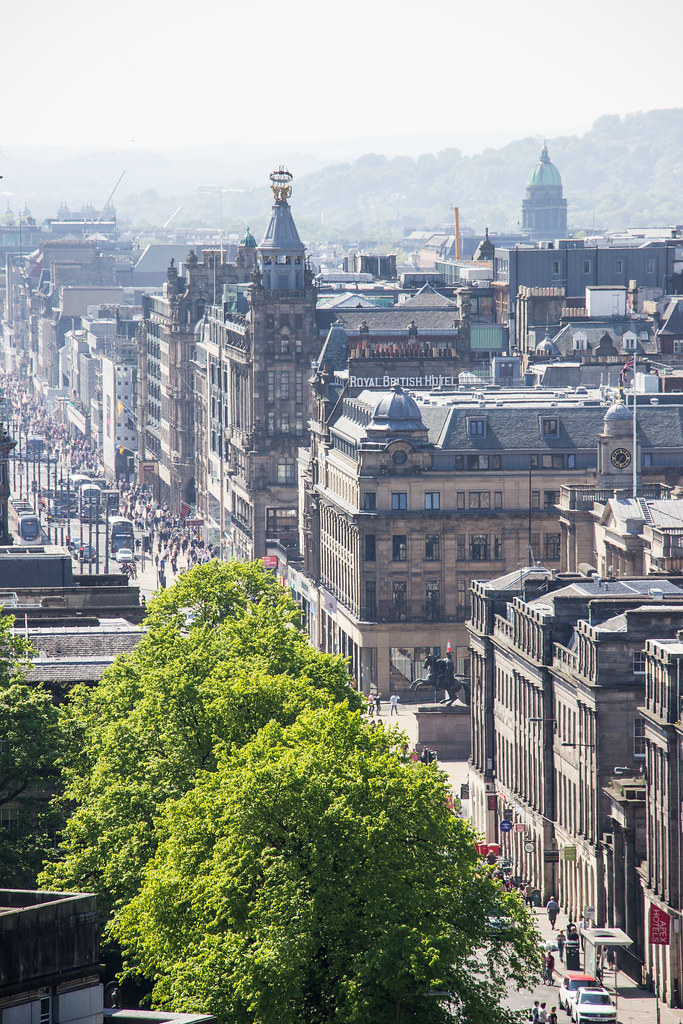
“Princes Street, New Town, Edinburgh, Scotland” by Billy Wilson Photography is licensed under CC BY-NC 2.0 .

I have had some work done on my house recently. For context, it’s an Edwardian terrace with a rear extension built sometime in the 1980s. Oddly fascinating for me was the sheer difference in build quality between the original section of the property and the newer part at the back. The older part of the house is sturdy, solid and lauded by the workmen as a “proper building”. The newer section has been a huge source of ridicule and contempt: shoddy timber placement, wobbly floors, dangerous electrical wiring, crumbling cement and poor brickwork plague it.

The tradesmen’s comments had me thinking a lot about the general quality of our infrastructure, both national and local, and how we sometimes take for granted the fact that a huge portion of what we use every day is so old. Not only that, but a lot of it is almost universally considered very beautiful and important to our shared cultural heritage.

Take a stroll through any city in Great Britain, and you are more than likely to at some point come across the “old town”. Despite the Luftwaffe’s (and post war town planner’s) best efforts, a lot of pre-war buildings still inhabit the centres of our towns and cities. These prove to be fine examples of the world we used to live in. Even in the poorest of cities, my own town of Hull for example, there exists a great plethora of dramatic and beautiful buildings which were constructed, almost exclusively, by the late Georgians, Victorians and Edwardians. Take a trip to London, Edinburgh, central Durham and a number of other places, and you will see that even the lampposts are adorned gorgeously, with striking and intricate ironwork.

Why is this? Why did they bother to do such a good job? Why do we still heavily rely on their work for our own sense of cultural identity and our basic infrastructural needs? Why can’t our own contemporary efforts compete, despite great advances in the field of civil engineering and construction materials? I think the answer boils down to one thing: civic pride.

The Victorians were building for eternity; we build for temporary needs in a utilitarian fashion. They knew their “mission”, and they saw it an absolute necessity to make everything they did permanent; we do not. They designed buildings to be functional and beautiful; we seek to make buildings which will be functional for 50 years before they are “recycled”.

Speak to a modern student of architecture about their course, and you will find that very few opportunities exist for those who want to pursue a path for traditional design techniques. Their learning aim is to make things which can be used temporarily, then pulled down for something else. This is an attitude which would be totally alien to the Victorians who designed and built the lecture halls these students now learn in.

Raising the minimum retirement age may be necessary, but it will never be politically popular

Filed under: France, Government, Politics — Tags: , , , , , , — Nicholas @ 05:00

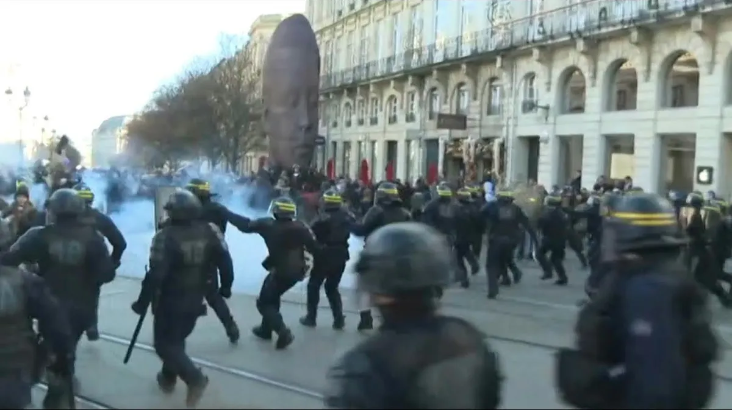
As protests and riots continue against the French government’s attempt to raise the minimum retirement age from 62 to 64, Theodore Dalrymple explains why he finds sympathy with the working poor who will be most directly hurt by the change:

Riot police on the streets of Bordeaux as violent protests against French government plans to raise the retirement age continue.
YouTube screen capture from an AFP report.

As I hope to be able to work till my dying day, I am perhaps not the right person to animadvert on the present disturbances in France about the raising of the retirement age from 62 to 64. My work has always been pleasing to me, and it remains so; I even manage to delude myself sometimes that it is important.

I am forced to recognize, however, that not everyone is in the same happy position as I. I am sure that if I had been a dustman all my life, I should not hope to be emptying dustbins at my present age (73), let alone at the age of 85. While my work remains work, and in a certain sense occasionally even hard work, especially when I have to think, what I do is not physically demanding. No one ever got arthritis or fibrosis of the lung by writing a few articles.

The reform of the pension system in France, from my limited understanding of it, is rather unfair. It is true that some reform is necessary: There are ever fewer workers to fund the pensions of ever more pensioners (the system being entirely unfunded by investment). On the other hand, it is those who do the most unpleasant and unremunerative jobs who have to work the longest, and the reform only increases this unfairness. As the old cockney song has it, it’s the rich what gets the pleasure.

Nevertheless, the extreme opposition to the reform, which is hardly a radical one, strikes most foreigners as rather strange. In a way it is also sad, for it implies that a long retirement is the main aim of all that precedes it, which in turn implies that all the work done for several decades before retirement has been an unpleasant imposition rather than something of value in itself. That the quid pro quo for a longer life expectancy is a greater number of years spent working seems not to strike anyone with force.

The demonstrators probably think, no doubt correctly, that the reform is the thin end of a wedge: If it is allowed to pass without a fuss, there will be further such reforms until the retirement age will be 70, 80, or never, depending on life expectancy. As for the younger demonstrators, they do not seem to worry much that it is they who will be paying for the people older than themselves to retire early, the distant prospect of early retirement being more real to them than the far more proximate high rates of taxation.

4,000 German teens trapped in Tarnopol – WW2 – Week 242 – April 15, 1944

Filed under: Britain, China, Germany, History, India, Japan, Military, Russia, WW2 — Tags: , , , , — Nicholas @ 04:00

World War Two
Published 15 Apr 2023

Thousands of German soldiers, mostly new teenage recruits, are obeying Hitler’s “Fortress Directive” and are surrounded in Tarnopol; it does not go well for them. German forces in Ukraine manage to all pull back across the Dniester, but they are under serious pressure in the Crimea. Meanwhile, in India, the Japanese siege of Kohima continues, and in China they are poised to launch a gigantic offensive.
(more…)

Do Foucault and Derrida deserve the blame for PoMo excesses?

Filed under: Books, France, History, Media, Politics, USA — Tags: , , , , — Nicholas @ 03:00

In Spiked, Patrick West says that it’s a misunderstanding of Foucault and Derrida to blame them for the rise of wokeness:

Michel Foucault speaking at the Hospital das Clínicas of the State University of Guanabara in Brazil, 1974.
Public domain image from the Arquivo Nacional Collection via Wikimedia Commons.

It has become common to blame wokeness on its supposed philosophical parent: postmodernism. As the standard narrative goes, postmodernism is the ideology that entrenched itself in Anglophone universities in the 1980s and 1990s. It talked of relativism, of the absence of objective truth, of the spectre of a pervasive, invisible power, and it was generally anti-Western. A whole generation of professors, writers, journalists and a fair few activists have subsequently been raised on this diet of postmodern thinking. And the result is a cultural elite that is wedded to wokeness.

[…]

For these critics of woke, Foucault’s influence, in particular, is seemingly everywhere. According to [Douglas] Murray [in The War on The West], it’s through the “anti-colonial” philosophy popularised by the Foucault-inspired scholar, Edward Said, that Foucault and therefore postmodernism have filtered down into woke philosophy, which holds that Western society is uniquely racist and to blame for all of today’s ills. Equally, right-wing critics of wokeness will claim that the trans movement has sprung from the postmodern contention that sexuality and gender are entirely socially constructed and therefore plastic and malleable.

If Foucault is regarded as the father of wokeness then 19th-century philosopher Friedrich Nietzsche tends to be regarded as the grandfather. After all, Foucault was profoundly influenced by Nietzsche and even proudly declared himself to be “Nietzchean”. Nietzsche, like Foucault, also saw all human behaviour stemming from the desire for power. And he conceived of morality – good and evil, right and wrong – as the mere manifestation of the will to power. As he wrote of the “origin of knowledge”, in The Joyous Science (1883): “Gradually, the human brain became full of such judgements and convictions, and a ferment, a struggle, and lust for power developed in this tangle. Not only utility and delight but every kind of impulse took sides in this fight about ‘truths’.” One can see this Nietzschean sentiment at work in Foucault’s Discipline and Punish (1975): “Power produces knowledge … power and knowledge directly imply one another.”

So, according to this largely right-wing narrative, wokeness is the product of a 20th-century philosophical assault on truth, objectivity and the West. And it was inspired by Nietzsche and led by several “cultural Marxist” thinkers.

There are several problems with this rather neat story. The first error is to use the phrase “cultural Marxism” to talk of postmodernism or wokeness. This term doesn’t really make sense. Marx himself conceived of his work as a historical materialism. It was focussed on class and the means of production, not on culture. Yes, in the 1940s and 1950s, some Frankfurt School thinkers, who sometimes presented themselves as Marxist, did focus on culture rather than class. But as Joanna Williams writes in How Woke Won (2022), their thinking “represented less a continuation of Marxism and more a break with Marx”.

Moreover, postmodern thinkers were broadly opposed to Marxism. Many may have been signed-up Communists in their youth (the French Communist Party dominated left-wing politics at the time), but by the 1960s they had become highly critical of Marxist politics. They rejected the idea that history was progressing “dialectically” towards a communist future, or “telos”. And they were often hostile to the scientific objectivity and “Enlightenment” values so central to Marxism. Foucault wrote that history was not the story of progress; it was but a series of non-linear discontinuities and contingencies. And Jean-François Lyotard (1924-1998), in his highly-influential The Postmodern Condition (1979), announced and celebrated the end of “grand narratives”, and with it the end of the Marxist “grand narrative” of progress. Lyotard’s writings from the 1970s onwards were violently antithetical to Marxism, especially its claims to objective truth.

As for wokeness itself, it has nothing to do with Marxism. With their myopic focus on race and gender, woke activists are utterly blind to the material, class-structure of society. Today, bizarrely, it’s often conservatives who are more attuned to the plight of the working class than woke “radicals”. As Williams writes, “critics who insist that woke is simply Marxism in disguise are wide of the mark”.

Coopering a 36 gallon beer barrel with hand tools

Filed under: History, Tools, Woodworking — Tags: , , — Nicholas @ 02:00

Jamestown Cooperage
Published 28 Jun 2021

I am a practicing traditional cooper who makes barrels, buckets, washtubs, and butter churns by hand. I use mostly traditional skills and handtools to build round, conical wooden vessels for history museums, national parks, and collectors.

(more…)

QotD: Homo electronicus and the permanent caloric surplus

Filed under: Britain, Food, Health, History, Quotations, USA, WW1 — Tags: , , , , — Nicholas @ 01:00

Finally, I suggest that the permanent caloric surplus that has obtained in the West since about 1950 has done more than anything to speciate us Postmoderns. It would take someone who Fucking Loves Science™ way more than I do to assert that the vast, obvious changes in the human race in the 20th century were merely physical. Consider the oft-remarked fact (at the time, at least) that British officers on the Western Front were a full head taller than their men. Then consider (ditto) the more-or-less open secret that a lot of those tall subalterns were gay. Correlation is not causation — growing up in the infamous English public schools probably had a lot to do with it, as Robert Graves himself says — but … there’s a pretty strong correlation.

Excess fat cranks up estrogen levels. You don’t need to be House MD to interpret this finding:

    In males with increasing obesity there is increased aromatase activity, which irreversibly converts testosterone to estradiol resulting in decreased testosterone and elevated estrogen levels.

Or this one:

    A study supports the link between excess weight and higher hormone levels. The study found that estrogen and testosterone levels dropped quite a bit when overweight and obese women lost weight.

This is not to say those swishy subalterns were fat — indeed, they were comically scrawny compared to Postmodern people. But a little goes a long way when it comes to hormones, especially in a world where “intermittent fasting” wasn’t a fad diet, but a way of life. Any one of us would keel over from hunger if we were forced to eat the kind of diet George Orwell described as his public school’s standard fare.

Follow that trend out to the Current Year, when pretty much everyone is grossly obese compared to even the Silent Generation. Heartiste and other “game” bloggers loved pointing out that the average modern woman weighs as much as the average man did in the 1960s. And while I think that’s overblown — we’re also several inches taller, on average, than 1960s people — there’s definitely something to it, especially when you consider how far the bell curve has shifted to the fat end. Not only do people weigh a lot more on average, the people who weigh more than average now weigh a hell of a lot more than heavier-than-average people did back when. See, for example, the ballooning weight of offensive linemen, who are professionally fat — in 2011 a quarterback, Cam Newton, weighed more than the average offensive lineman in the 1960s.

Put the two trends together and you have, on average, a hormone cocktail way, way different than even 50 years ago … and that’s before you add in things like all-but-universal hormonal contraception, lots of which ends up in municipal drinking water.

Severian, “Recent Evolution”, Rotten Chestnuts, 2020-09-28.

April 15, 2023

Do the Germans Know About Operation Overlord?

Filed under: Britain, Germany, History, Military, WW2 — Tags: , , , , — Nicholas @ 04:00

World War Two
Published 14 Apr 2023

We are getting closer and closer to D-Day and the potential liberation of Nazi Europe. But how much do the Germans know about this? Is the leak inside the British Embassy in Ankara enough to thwart the efforts of Operation Bodyguard, Operation Fortitude, and everything else the Allies are doing to deceive Adolf Hitler? Let’s find out. This is the story of Cicero.
(more…)

Type 68 North Korean Tokarev/High Power Hybrid

Filed under: Asia, History, Military, Russia, Weapons — Tags: , , , , , , — Nicholas @ 02:00

Forgotten Weapons
Published 18 May 2020

The Type 68 is a North Korean hybrid of the Tokarev and the High Power, used as a military service pistol until replaced by the Beak-Du-San copy of the CZ75. The general outline of the gun is a copy of the Tokarev, with a modular removable fire control group, lack of manual safety, and tall thin sights. It is chambered for 7.62x25mm, and uses a magazine identical to the standard Tokarev except for not having a magazine catch cut, as the Type 68 has a heel magazine release.

Internally, the High Power elements include a detent-retained barrel pin, use of a solid barrel cam instead of a 1911/Tokarev swinging link, and a fixed barrel bushing. Two patterns of markings exist, one with a date and North Korean marking, and one (like this example) with only a serial number.

North Korean guns of all types are very rare in the United States. A very small number of Type 68s have come into the US, generally through Central America (probably via Cuba) and South Africa (via Rhodesia/Zimbabwe).

Update: It appears that the original design work for these was done by an independent engineering firm in Yugoslavia. The design (a TT33 with High Power type locking and angled slide serrations) was not completed in time for the trials that would lead to adoption of the Yugoslav M57, and the drawings were transferred to “another country” — probably North Korea.
(more…)

QotD: When the pick-up artist became “coded right”

Filed under: Books, Health, Media, USA — Tags: , , , , , , — Nicholas @ 01:00

When did pickup artistry become criminal? Relying on online sex gurus for advice on persuading women into bed used to be seen as a fallback for introverted, physically unprepossessing “beta males”. And for this reason, in the 2000s, the discipline was promoted by the mainstream media as a way of instilling confidence in sexually-frustrated nerds. MTV’s The Pickup Artist shamelessly broadcast its tactics, with dating coaches encouraging young men to prey upon reluctant women, hoping to “neg” and “kino escalate” them into “number closes“. Contestants advanced through women of increasing difficulty (picking-up a stripper was regarded as “the ultimate challenge”) with the most-skilled “winning” the show.

Today, the global face of pickup artistry is Andrew Tate: sculpted former kickboxing champion, self-described “misogynist”, and, now, alleged human trafficker. Whatever results from the current allegations, his fall is a defining moment in the cultural history of the now inseparable worlds of the political manosphere and pickup artistry, and provides an opportunity to reflect upon their entangled history.

Pickup artistry burst onto the scene in the 2000s, propelled by the success of Neil Strauss’s best-selling book The Game. More a page-turning potboiler cataloguing the mostly empty lives of pickup artists (PUAs) than a how-to guide (though Strauss wrote one of those too), the methods in the book had been developed through years of research shared on internet forums. The “seduction underground”, as the large online community of people doing this research was called, then became the subject of widespread media attention. Through pickup artistry, the aggressive, formulaic predation of women was normalised as esteem boosting, and men such as those described in Strauss’s The Game could be viewed in a positive light: they had transformed from zero to hero and taken what was rightfully theirs.

The emergence of PUAs generated a swift backlash. The feminist blogs of the mid-to-late 2000s internet, of which publications like Jezebel still survive as living fossils, rushed to pillory them. The attacks weren’t without justification, but the world of PUAs during this period, much like the similarly wild-and-woolly bodybuilding forums, had no obvious political dimension beyond some sort of generic libertarianism. It was only after these initial critiques that it began to be coded as Right-wing by those on the Left. Duly labelled, PUAs and other associated manosphere figures drifted in that direction. MTV’s dating coaches were not part of the political landscape, merely feckless goofballs and low-level conmen capable of entertaining the masses. But their successors would be overtly political actors.

Oliver Bateman, “Why pick-up artists joined the Online Right”, UnHerd, 2023-01-08.

April 14, 2023

The trust deficit is getting worse every day

Filed under: Media, Politics, Technology, USA — Tags: , , , , , — Nicholas @ 05:00

Ted Gioia provides more evidence that the scarcest thing in the world today is getting ever more scarce:

Here are some news stories from recent days. Can you tell me what they have in common?

  • Scammers clone a teenage girl’s voice with AI — then use it to call her mother and demand a $1 million ransom.
  • Millions of people see a photo of Pope Francis wearing a goofy white Balenciaga puffer jacket, and think it’s real. But after the image goes viral, news media report that it was created by a construction worker in Chicago with deepfake technology.
  • Twitter changes requirements for verification checks. What was once a sign that you could trust somebody’s identity gets turned into a status symbol, sold to anybody willing to pay for it. Within hours, the platform is flooded with bogus checked accounts.
  • Officials go on TV and tell people they can trust the banking system—but depositors don’t believe them. High profile bank failures from Silicon Valley to Switzerland have them spooked. Over the course of just a few days, depositors move $100 billion from their accounts.
  • ChatGPT falsely accuses a professor of sexual harassment — and cites an article that doesn’t exist as its source. Adding to the fiasco, AI claims the abuse happened on a trip to Alaska, but the professor has never traveled to that state with students.
  • The Department of Justice launches an investigation into China’s use of TikTok to spy on users. Another popular Chinese app allegedly can bypass users’ security to “monitor activities on other apps, check notifications, read private messages and change settings.”
  • The FBI tells travelers to avoid public phone charging stations at airports, hotels and other locations. “Bad actors have figured out ways to use public USB ports to introduce malware and monitoring software onto devices,” they warn.

The missing ingredient in each of these stories is trust.

Everybody is trying to kill it — criminals, technocrats, politicians, you name it. Not long ago, Disney was the only company selling a Fantasyland, but now that’s the ambition of every tech empire.

The trust crisis could hardly be more intense.

But it’s hidden from view because there’s so much information out there. We are living in a culture of abundance, especially in the digital world. So it’s hard to believe than anything in the information economy is scarce.

Whatever you want, you can get — and usually for free. You can have free news, free music, free videos, free everything. But you get what you pay for, as the saying goes. And it was never truer than right now — when all this free stuff is starting to collapse in a fog of fakery and phoniness.

    Tell me what source you trust, and I’ll tell you why you’re a fool. As B.B. King once said: “Nobody loves me but my mother — and she could be jivin’ too.”

Years ago, technology made things more trustworthy. You could believe something because it was validated by photos, videos, recordings, databases and other trusted sources of information.

Seeing was believing — but not anymore. Until very recently, if you doubted something, you could look it up in an encyclopedia or other book. But even these get changed retroactively nowadays.

For example, people who consult Wikipedia to understand the economy might be surprised to learn that the platform’s write-up on “recession” kept changing in recent months — as political operatives and spinmeisters fought over the very meaning of the word. It got so bad that the site was forced to block edits on the entry.

There’s an ominous recurring theme here: The very technologies we use to determine what’s trustworthy are the ones most under attack.

Trust used to be a given in most western countries … it was a key part of what made us all WEIRD. Mass immigration from non-WEIRD countries dented it, but conscious perversion of trust relationships by government, media, public health, and education authorities has caused far more — and longer lasting — damage to our culture. Trust used to be given freely, but now must be earned. And that’s difficult for organizations that have proven repeatedly that they can’t be trusted.

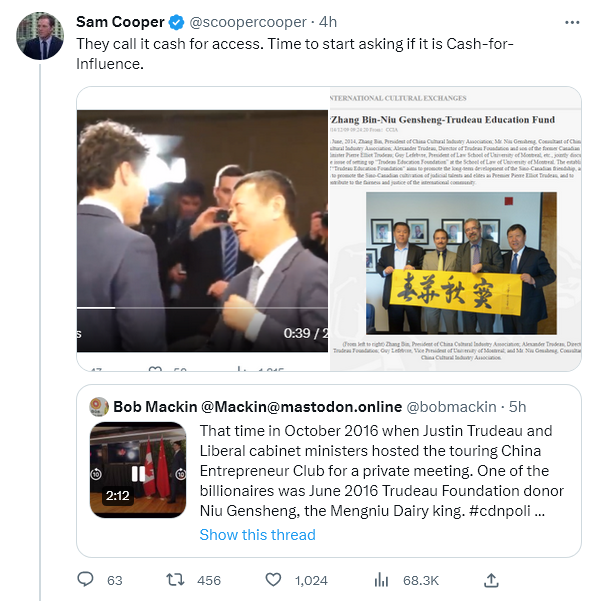
From “cash for access” it’s a very short step to “cash for influence”

Filed under: Cancon, China, Government, Media, Politics — Tags: , , , , — Nicholas @ 04:00

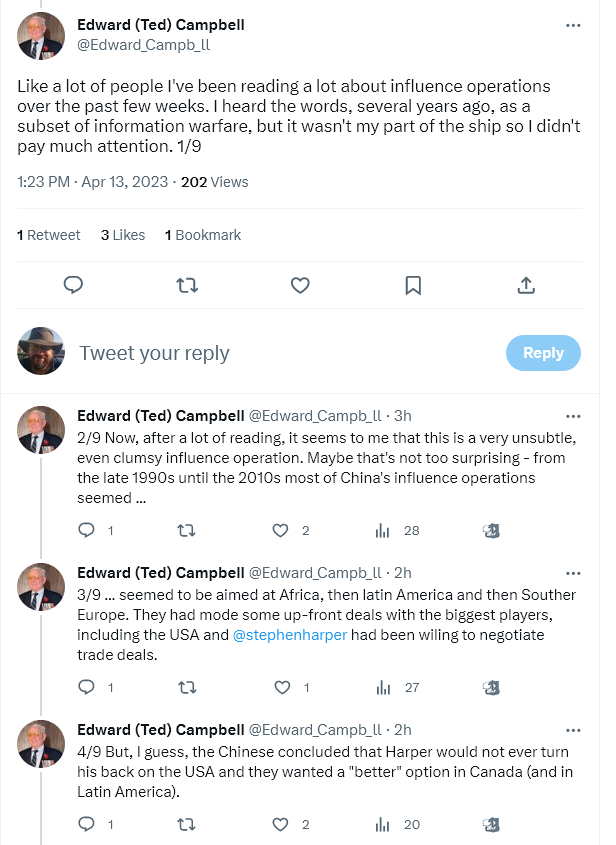
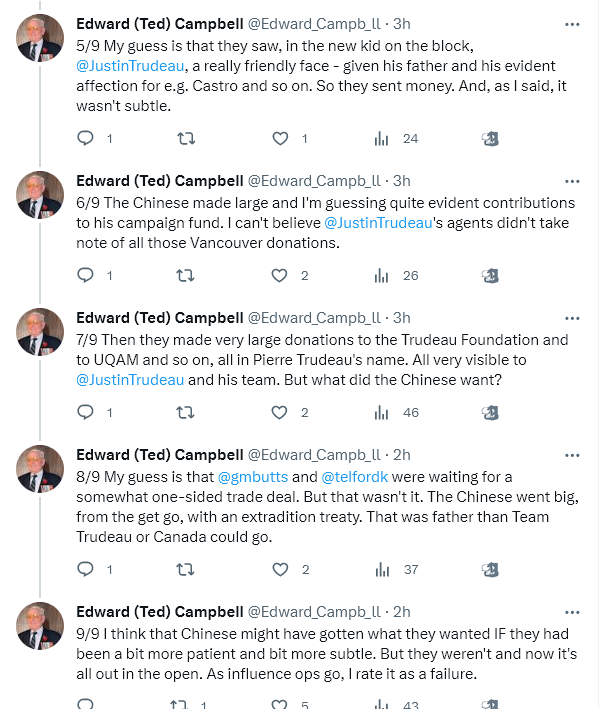
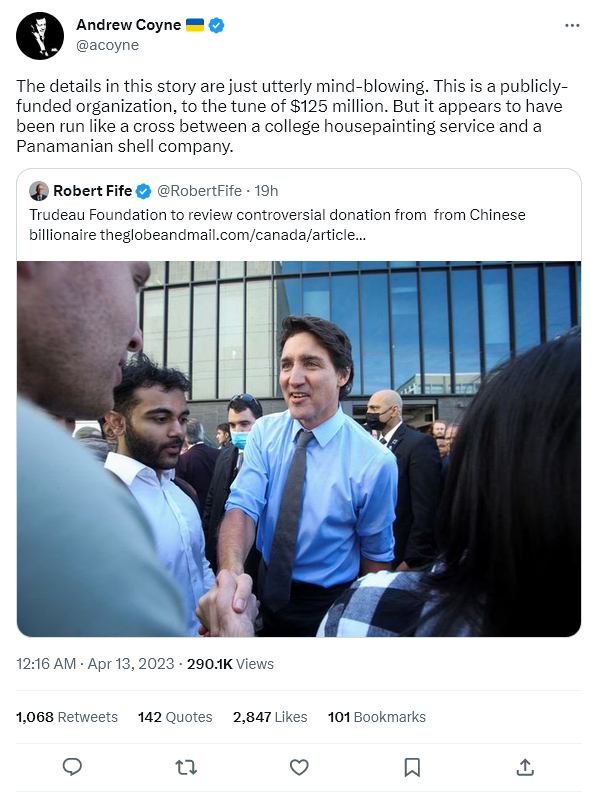
Ted Campbell shut down his blog some time ago — unfortunately for those of us interested in Canadian military affairs — but he’s still active on Twitter. Here he responds to a tweet from Sam Cooper of Global News:

Andrew Coyne highlights some of the boggling details in this thread:

Twists and turns in the “Twitter Files” narrative

Filed under: Business, Government, Media, Politics, Technology, USA — Tags: , , , , — Nicholas @ 03:00

Matt Taibbi recounts how he got involved in the “Twitter Files” in the first place through the hysterical and hypocritical responses of so many mainstream media outlets up to the most recent twist as Twitter owner Elon Musk burns off so much of the credit he got for exposing the information in the first place:

I was amazed at this story’s coverage. From the Guardian last November: “Elon Musk’s Twitter is fast proving that free speech at all costs is a dangerous fantasy.” From the Washington Post: “Musk’s ‘free speech’ agenda dismantles safety work at Twitter, insiders say.” The Post story was about the “troubling” decision to re-instate the Babylon Bee, and numerous stories like it implied the world would end if this “‘free speech’ agenda” was imposed.

I didn’t have to know any of the particulars of the intramural Twitter dispute to think anyone who wanted to censor the Babylon Bee was crazy. To paraphrase Kurt Vonnegut, going to war against a satire site was like dressing up in a suit of armor to attack a hot fudge sundae. This was an obvious moral panic and the very real consternation at papers like the Washington Post and sites like Slate over these issues seemed to offer the new owners of Twitter a huge opening. With critics this obnoxious, even a step in the direction of free speech values would likely win back audiences that saw the platform as a humorless garrison of authoritarian attitudes.

This was the context under which I met Musk and the circle of adjutants who would become the go-betweens delivering the material that came to be known as the Twitter Files. I would have accepted such an invitation from Hannibal Lecter, but I actually liked Musk. His distaste for the blue-check thought police who’d spent more than a half-year working themselves into hysterics at the thought of him buying Twitter — which had become the private playground of entitled mainstream journalists — appeared rooted in more than just personal animus. He talked about wanting to restore transparency, but also seemed to think his purchase was funny, which I also did (spending $44 billion with a laugh as even a partial motive was hard not to admire).

Moreover the decision to release the company’s dirty laundry for the world to see was a potentially historic act. To this day I think he did something incredibly important by opening up these communications for the public.

Taibbi and the other Twitter File journalists were, of course, damned by the majority of the establishment media outlets and accused of every variant of mopery, dopery, and gross malfeasance by the blue check myrmidons. Some of that must have been anticipated, but a lot of it seems to have surprised even Taibbi and company for its blatant hypocrisy and incandescent rage.

But all was not well between the Twitter Files team and the new owner of Twitter:

We were never on the same side as Musk exactly, but there was a clear confluence of interests rooted in the fact that the same institutional villains who wanted to suppress the info in the Files also wanted to bankrupt Musk. That’s what makes the developments of the last week so disappointing. There was a natural opening to push back on the worst actors with significant public support if Musk could hold it together and at least look like he was delivering on the implied promise to return Twitter to its “free speech wing of the free speech party” roots. Instead, he stepped into another optics Punji Trap, censoring the same Twitter Files reports that initially made him a transparency folk hero.

Even more bizarre, the triggering incident revolved around Substack, a relatively small company that’s nonetheless one of the few oases of independent media and free speech left in America. In my wildest imagination I couldn’t have scripted these developments, especially my own very involuntary role.

I first found out there was a problem between Twitter and Substack early last Friday, in the morning hours just after imploding under Mehdi Hasan’s Andrey Vyshinsky Jr. act on MSNBC. As that joyous experience included scenes of me refusing on camera to perform on-demand ritual criticism of Elon Musk, I first thought I was being pranked by news of Substack URLs being suppressed by him. “No way,” I thought, but other Substack writers insisted it was true: their articles were indeed being labeled, and likes and retweets of Substack pages were being prohibited.

« Newer PostsOlder Posts »

Powered by WordPress