
Paul Sellers
Published 25 Nov 2022Two things Paul has always noticed to be intimidating to woodworkers are recessed or mortised hinge setting and applying finish. The smaller the hinge and the project, the more flaws show.
Following these steps will give you the confidence and success you want, and the hinges will align the box lid perfectly every time. We cover distances and the layout patterns, hinge sizing, and so on throughout this episode, along with how to apply shellac using a 1″ hake brush.
The result is a perfect box. Enjoy yourself!
——————– (more…)
April 14, 2023
How to Make a Shaker Candle Box | Episode 3
Comments Off on How to Make a Shaker Candle Box | Episode 3
QotD: The three great strategic sins
The first sin is the sin of of not having a strategy in the first place, what we might call “emotive” strategy. As Clausewitz notes, policy (again, note above how what we’re calling strategy is closest to policy in Clausewitz’ sense) is “subject to reason alone” whereas the “primordial violence, hatred and enmity” is provided for in another part of the trinity (“will” or “passion”). To replace policy with passion is to invert their proper relationship and court destruction.
The second sin is the elevation of operational concerns over strategic ones, the usurpation of strategy with operations, which we have discussed before. This is, by the by, also an error in managing the relationship of the trinity, allowing the general’s role in managing friction to usurp the state’s role in managing politics.
Perhaps the greatest example of this is the Japanese attack on Pearl Harbor; an operational consideration (the destruction of the US Pacific Fleet) and even the tactics necessary to achieve that operational objective, were elevated above the strategic consideration of “should Japan, in the midst of an endless, probably unwinnable war against a third-rate power (the Republic of China) also go to war with a first-rate power (the United States) in order to free up oil-supplies for the first war”. Hara Tadaichi’s pithy summary is always worth quoting, “We won a great tactical victory at Pearl Harbor and thereby lost the war.”
How does this error happen? It tends to come from two main sources. First, it usually occurs most dramatically in military systems where the military leadership – which has been trained for operations and tactics, not strategy, which you will recall is the province of kings, ministers and presidents – usurps the leadership of the state. Second, it tends to occur when those military leaders – influenced by their operational training – take the operational conditions of their planning as assumed constants. “What do we do if we go to war with the United States” becomes “What do we do when we go to war with the United States” which elides out the strategic question “should we go to war with the United States?” entirely – and catastrophically, as for Imperial Japan, the answer to that unasked question of should we do this was clearly Oh my, NO.
(Bibliography note: It would hardly be fitting for me to declare these errors common and not provide examples. Two of the best case-studies I have read in this kind of strategic-thinking-failure-as-organizational-culture-failure are I. Hull, Absolute Destruction: Military Culture and the Practices of War in Imperial Germany (2005) and Parshall and Tully, Shattered Sword: The Untold Story of the Battle of Midway (2005). Also worth checking out, Daddis, “Chasing the Austerlitz Ideal: The Enduring Quest for Decisive Battle” in Armed Forces Journal (2006): 38-41. The same themes naturally come up in Daddis, Withdrawal: Reassessing America’s Final Years in Vietnam (2017)).
The third and final sin is easy to understand: a failure to update the strategy as conditions change. Quite often this happens in conjunction with the second sin, as once those operational concerns take over the place of strategy, it becomes difficult for leaders to consider new strategy as opposed to simply new operations in the pursuit of strategic goals which are often already lost beyond all retrieval. But this can happen without a subordination failure, due to sunk-costs and the different incentives faced by the state and its leaders. The classic example being functionally every major power in the First World War: by 1915 or 1916, it ought to have been obvious that no gains made as a result of the war could possibly be worth its continuance. Yet it was continued, both because having lost so much it seemed wrong to give up without “victory” and also because, for the politicians who had initially supported the war, to admit it was a useless waste was political suicide.
Bret Devereaux, “Collections: The Battle of Helm’s Deep, Part VIII: The Mind of Saruman”, A Collection of Unmitigated Pedantry, 2020-06-19.
Comments Off on QotD: The three great strategic sins
April 13, 2023
Old and tired – “Conspiracy Theories”. The new hotness – “Coming Features”
Kim du Toit rounds up some not-at-all random bits of current events:

So Government — our own and furriners’ both — have all sorts of rules they wish to impose on us (and from here on I’m going to use “they” to describe them, just for reasons of brevity and laziness — but we all know who “they” are). Let’s start with one, pretty much picked at random.
They want to end sales of vehicles powered by internal combustion engines, and make us all switch to electric-powered ones. Leaving aside the fact that as far as the trucking industry is concerned, this can never happen no matter how massive the regulation, we all know that this is not going to happen (explanation, as if any were needed, is here). But to add to the idiocy, they have imposed all sorts of unrealistic, nonsensical and impossible deadline to all of this, because:
There isn’t enough electricity — and won’t be enough electricity, ever — to power their future of universal electric car usage. Why is that? Well, for one thing, they hate nuclear power (based on outdated 1970s-era fears), are closing existing ones and will not allow new ones to be built by dint of strangling environmental regulation (passed because of said 1970s-era fears). Then, to add to that, they have forced the existing electricity supply to become unstable by insisting on unreliable and variable generation sources such as solar and wind power. Of course, existing fuel sources such as oil. coal and natural gas are also being phased out because they are “dirty” (they aren’t, in the case of natgas, and as far as oil and coal are concerned, much much less so than in decades past) — but as with nuclear power, the rules are being drawn up as though old technologies are still being used (they aren’t, except in the Third World / China — which is another whole essay in itself). And if people want to generate their own electricity? Silly rabbits: US Agency Advances New Rule Targeting Portable Gas-Powered Generators. (It’s a poxy paywall, but the headline says it all, really.)
So how is this
pixie dust“new” electricity to be stored? Why, in batteries, of course — to be specific, in lithium batteries which are so far the most efficient storage medium. The only problem, of course, is that lithium needs to be mined (a really dirty industry) and even assuming there are vast reserves of lithium, the number of batteries needed to power a universe of cars is exponentially larger than the small number of batteries available — but that means MOAR MINING which means MOAR DIRTY. And given how dirty mining is, that would be a problem, yes?No. Because — wait for it — they will limit lithium mining, also by regulation, by enforcing recycling (where have we heard this before?) and by reducing battery size.
Now take all the above into consideration, and see where this is going. Reduced power supply, reduced power consumption, reduced fuel supply: a tightening spiral, which leads to my final question:
JUST HOW DO THEY THINK THIS IS ALL GOING TO END?
If there’s one thing we know, it’s that increased pressure without escape mechanisms will eventually cause explosion. It’s true in physics, it’s true in nature and it’s true, lest we forget, in humanity.
Of course, as friend-of-the-blog Severian often points out, these people think Twitter is real life. Of course there’ll be enough pixie dust to sprinkle over all their preferred solutions to make them come true. Reality is just a social construct — they learned that in college, and believe it wholeheartedly.
Comments Off on Old and tired – “Conspiracy Theories”. The new hotness – “Coming Features”
Build the Moravian Stool with Sliding Dovetail Joinery
Rex Krueger
Published 12 Apr 2023
(more…)
Comments Off on Build the Moravian Stool with Sliding Dovetail Joinery
Beeching plus 60
In The Critic, Peter Caddick-Adams notes that it’s just past 60 years since one of the most controversial documents the British government published during the latter half of the 20th century: The Beeching Report.
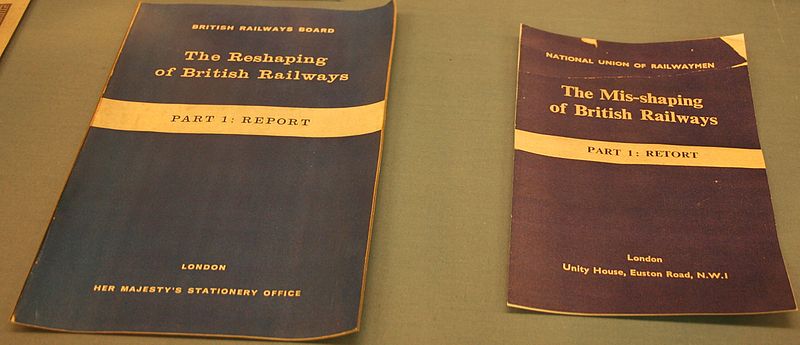
The British Railways Board’s publication The Reshaping of British Railways, Part 1: Report, Beeching’s first report, which famously recommended the closure of many uneconomic British railway lines. Many of the closures were implemented. This copy is displayed at the National Railway Museum in York beside a copy of the National Union of Railwaymen’s published response, The Mis-shaping of British Railways, Part 1: Retort.
Photo by RobertG via Wikimedia Commons.
Wednesday, 27 March 1963 marked the day when a civil servant with a doctorate in physics, seconded from ICI, proudly flourished a report he had written. That man was Dr Richard Beeching, and the result of his recommendations contained in The Reshaping of British Railways are with us to this day.
Beeching identified many unprofitable rail services and suggested the widespread elimination of a huge number of routes. He identified 2,363 stations for closure, along with 6,000 miles of track — a third of the existing network — with the loss of 67,700 jobs. His stated aim was to prune the railway system back into a profitable concern. Behind Beeching, seconded to the newly-established British Railways Board, stood the figure of the publisher-turned-Prime Minister, Harold Macmillan. He knew a thing or two about railways, having been a pre-nationalisation director of the Great Western Railway. It put him in the delightful position of never having to pay for a train ticket.
Macmillan observed from a shareholder’s point of view, “you can pour all in money you want, but you can never make the damned things pay for themselves”. In his view, the railway network and infrastructure of wagon works, tiny branch lines, cottages for signallers, crossings keepers and station masters, with most halts staffed 18 hours a day, amounted to a social service, albeit an expensive one. It had made the prosperity of Victorian Britain possible and was sustaining it still. From nationalisation in 1948, the railways themselves had attempted to make savings, closing 3,000 miles of track and reducing staff from 648,000 to 474,000. That famous Ealing comedy film of 1953, The Titfield Thunderbolt, about a group of villagers trying to keep their branch line operating after British Railways decided to close it, already reflected concern and railway nostalgia.
Britain’s literary and celluloid love affair with iron rails and steam began as long ago as 1905 with the publication of Edith Nesbit’s The Railway Children, a success which peaked when the book was made into a highly successful movie in 1970. Meanwhile, professional sleuths and loafers like Sherlock Holmes, Bulldog Drummond, Lord Peter Wimsey, Hercule Poirot and Bertie Wooster capitalised on the branch line network in their methodology of moving swiftly about pastoral England in their hunts for miscreants. It was the success of The Lady Vanishes, a 1938 mystery thriller set on a continental train, that launched Alfred Hitchcock as a world-class director. David Lean’s Brief Encounter of 1945, based on Noël Coward’s earlier one-act play, Still Life, attached deep romance to station platforms and waiting rooms, reminiscent of so much heartache in the recently fought world war. It is still regarded as one of the greatest of all British-made films. None of this mattered to Beeching, the man who was “Britain’s most-hated civil servant” at his death in 1985, a moniker still used today.
There’s an argument that Beeching was deliberately set up as a patsy for the real villains, Ernest Marples and Harold MacMillan:
The cold, dispassionate Beeching was absolutely the wrong man for the job. As he told the Daily Mirror at the time, “I have no experience of railways, except as a passenger. So, I am not a practical railwayman. But I am a very practical man.” John Betjeman, writing persuasively and eloquently in the Daily Telegraph each week, and later Ian Hislop, hit the right note in observing that Beeching, and all he stood for were technocrats. They “weren’t open to arguments of romantic notions of rural England, or the warp-and-weft of the train in our national identity. They didn’t buy any of that, and went for a straightforward profit and loss approach, from which we are still reeling today”.
However, it has also been argued that Beeching was the unwitting fall-guy for the Minister of Transport of the day, Ernest Marples. He was a self-made businessman who “got things done”, but he retained an air of shadiness about him. Macmillan should have known better. Marples had been managing director of Marples Ridgway, awarded contracts to build the first motorways. When challenged about a conflict of interest, he sold his 80 per cent shareholding to his wife. Elevated to the peerage, Marples fled to Monaco in 1975 to avoid prosecution for tax fraud. So, in some ways, the thing was a stitch-up. Marples directly benefited from the widespread cuts advocated by his subordinate, Beeching. Macmillan had his eye off the ball and was already considering retirement, hastened by an operation for prostate cancer six months after Beeching’s report.
The Prime Minister was astute enough to ensure the press presented the cuts in a positive way, however. From the Cabinet papers of the day, we now know the day before the publication of The Reshaping of British Railways, Beeching’s findings were rewritten to suggest the cuts were the first phase of a co-ordinated national transport policy, with advanced plans to replace the axed rail networks with improved minor roads and local bus services. In reality this was political fantasy (my inner lawyer cautions against more extremist language), for the bus-road subsidy would have cost more than that already paid to the railways. The promise of replacement bus services should have come with a guarantee of remaining in place for at least 10-15 years, because most were withdrawn after two, forcing more motor traffic onto an already inadequate road network.
Comments Off on Beeching plus 60
A Brief History of Gin
No Nonsense Gin Drinking
Published 21 Jul 2019Pay attention class! No running, shouting or talking at the back! It’s time to learn all about gin!
(more…)
Comments Off on A Brief History of Gin
QotD: The real purpose of modern-day official commissions
Official enquiries these days do not impress me, certainly not by comparison with those of our Victorian forefathers. No one who reads the Blue Books of Victorian Britain, for example, can fail to be impressed by the sheer intellectual honesty of them, their complete absence of any attempt to disguise an often appalling reality by means of euphemistic language, and their diligence in collecting the most disturbing information. (Marx himself paid tribute to the compilers of these reports.)
I was once asked to join an enquiry myself. It was into an unusual spate of disasters in a hospital. It was clear to me that, although they had all been caused differently, there was an underlying unity to them: they were all caused by the laziness or stupidity of the staff, or both. By the time the report was written, however (and not by me), my findings were so wrapped in opaque verbiage that they were quite invisible. You could have read the report without realising that the staff of the hospital had been lazy and stupid; in fact, the report would have left you none the wiser as to what had actually happened, and therefore what to do to ensure that it never happened again. The purpose of the report was not, as I had naively supposed, to find the truth and express it clearly, but to deflect curiosity and incisive criticism in which it might have resulted if translated into plain language.
Theodore Dalrymple, “It’s a riot”, New English Review, 2012-04.
Comments Off on QotD: The real purpose of modern-day official commissions
April 12, 2023
Institutional Review Boards … trying to balance harm vs health, allegedly
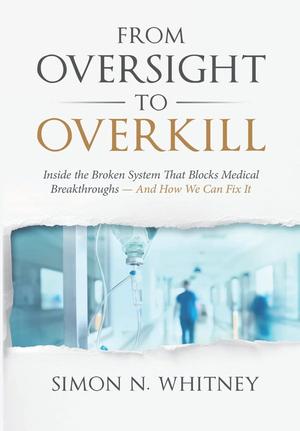
At Astral Codex Ten Scott Alexander reviews From Oversight to Overkill by Simon N. Whitley, in light of his own experience with an Institutional Review Board’s demands:
Dr. Rob Knight studies how skin bacteria jump from person to person. In one 2009 study, meant to simulate human contact, he used a Q-tip to cotton swab first one subject’s mouth (or skin), then another’s, to see how many bacteria traveled over. On the consent forms, he said risks were near zero — it was the equivalent of kissing another person’s hand.
His IRB — ie Institutional Review Board, the committee charged with keeping experiments ethical — disagreed. They worried the study would give patients AIDS. Dr. Knight tried to explain that you can’t get AIDS from skin contact. The IRB refused to listen. Finally Dr. Knight found some kind of diversity coordinator person who offered to explain that claiming you can get AIDS from skin contact is offensive. The IRB backed down, and Dr. Knight completed his study successfully.
Just kidding! The IRB demanded that he give his patients consent forms warning that they could get smallpox. Dr. Knight tried to explain that smallpox had been extinct in the wild since the 1970s, the only remaining samples in US and Russian biosecurity labs. Here there was no diversity coordinator to swoop in and save him, although after months of delay and argument he did eventually get his study approved.
Most IRB experiences aren’t this bad, right? Mine was worse. When I worked in a psych ward, we used to use a short questionnaire to screen for bipolar disorder. I suspected the questionnaire didn’t work, and wanted to record how often the questionnaire’s opinion matched that of expert doctors. This didn’t require doing anything different — it just required keeping records of what we were already doing. “Of people who the questionnaire said had bipolar, 25%/50%/whatever later got full bipolar diagnoses” — that kind of thing. But because we were recording data, it qualified as a study; because it qualified as a study, we needed to go through the IRB. After about fifty hours of training, paperwork, and back and forth arguments — including one where the IRB demanded patients sign consent forms in pen (not pencil) but the psychiatric ward would only allow patients to have pencils (not pen) — what had originally been intended as a quick record-keeping had expanded into an additional part-time job for a team of ~4 doctors. We made a tiny bit of progress over a few months before the IRB decided to re-evaluate all projects including ours and told us to change twenty-seven things, including re-litigating the pen vs. pencil issue (they also told us that our project was unusually good; most got >27 demands). Our team of four doctors considered the hundreds of hours it would take to document compliance and agreed to give up. As far as I know that hospital is still using the same bipolar questionnaire. They still don’t know if it works.
Most IRB experiences can’t be that bad, right? Maybe not, but a lot of people have horror stories. A survey of how researchers feel about IRBs did include one person who said “I hope all those at OHRP [the bureaucracy in charge of IRBs] and the ethicists die of diseases that we could have made significant progress on if we had [the research materials IRBs are banning us from using]”.
Dr. Simon Whitney, author of From Oversight To Overkill, doesn’t wish death upon IRBs. He’s a former Stanford IRB member himself, with impeccable research-ethicist credentials — MD + JD, bioethics fellowship, served on the Stanford IRB for two years. He thought he was doing good work at Stanford; he did do good work. Still, his worldview gradually started to crack:
In 1999, I moved to Houston and joined the faculty at Baylor College of Medicine, where my new colleagues were scientists. I began going to medical conferences, where people in the hallways told stories about IRBs they considered arrogant that were abusing scientists who were powerless. As I listened, I knew the defenses the IRBs themselves would offer: Scientists cannot judge their own research objectively, and there is no better second opinion than a thoughtful committee of their peers. But these rationales began to feel flimsy as I gradually discovered how often IRB review hobbles low-risk research. I saw how IRBs inflate the hazards of research in bizarre ways, and how they insist on consent processes that appear designed to help the institution dodge liability or litigation. The committees’ admirable goals, in short, have become disconnected from their actual operations. A system that began as a noble defense of the vulnerable is now an ignoble defense of the powerful.
So Oversight is a mix of attacking and defending IRBs. It attacks them insofar as it admits they do a bad job; the stricter IRB system in place since the ‘90s probably only prevents a single-digit number of deaths per decade, but causes tens of thousands more by preventing life-saving studies. It defends them insofar as it argues this isn’t the fault of the board members themselves. They’re caught up in a network of lawyers, regulators, cynical Congressmen, sensationalist reporters, and hospital administrators gone out of control. Oversight is Whitney’s attempt to demystify this network, explain how we got here, and plan our escape.
Comments Off on Institutional Review Boards … trying to balance harm vs health, allegedly
“Stunning and brave” or “deliberately constructed misogyny”?
In The Critic, Jean Hatchet points out how well Dylan Mulvaney’s act is working to both maximize Mulvaney’s career and to actively denigrate women:

If a man seeks to humiliate a woman he encounters, nothing is easier than reducing her appearance to a mere caricature. Men do this directly in front of the woman they are targeting: lifting their voice to a squeak, exaggerating hand gestures, pushing out pretend breasts, wiggling their bum, pouting and fiddling with their hair. Most of these men confine the taunt to the woman in front of them, and the woman often feels and displays a righteous rage. However, when it comes to Dylan Mulvaney, the Tik Tok user who has become famous for his grotesque parody of women, women are not supposed to react critically. They are seen as cruel or “transphobic” if they express annoyance at being so grossly insulted.
In March 2022 Dylan Mulvaney saw a way to take his barely-concealed disdain for women up a level, with predictable success. After his career as a musical actor had stalled due to the Covid pandemic, with people finding solace daily on Tik Tok, wily Dylan invented a new role that guaranteed his future wealth and success. He announced he was embarking on a journey of “being a girl” and began a series of videos documenting this ludicrous notion.
Shortly before this year-long, very public “transition”, Mulvaney performed a pilot video for his current lucrative act. In it he told the viewer that he “had trouble finding roles” so a friend had invented one for him, a “femme character”. His character wears a pink dress and pearls, white gloves and ankle socks. At this point Mulvaney must have been delighted to glimpse a potential new career path. It was a very savvy move for him to extend and develop this caricature of a 1950s woman. Now, just over a year later, Dylan Mulvaney has highly paid “partnerships” with a number of companies including Budweiser, Kate Spade and — during the past week, to great objection — the Sportwear giant Nike.
In an inflammatory paid partnership video with Nike, an inanely grinning, barefoot Mulvaney wears a Nike sports bra and leggings. He performs a series of ridiculous moves including comedic side stretches, a theatrical run kicking his heels up nonsensically and failed chorus-line high kicks. He almost runs backwards into a hedge at one point and pulls a comedy expression of shock. It all looks ridiculous and slapstick. It mocks women by suggesting they exercise trivially and ineffectively, but smiling throughout.
The media seems unwilling to focus on the actual reasons many women are angry about this. It has focused instead on stating that objections to the sponsorship are because Dylan is trans. This is not why women are outraged. When a man “performs woman” in front of women to such a humiliating degree, when he waggles and jiggles and implies that weakness and silliness are inherent to being a woman who plays sport, women appropriately see this for the deliberately constructed misogyny it is. Ria Chapman, a London PE teacher, told me why she finds this act so irritating and offensive:
Girls are still routinely bullied and mocked for being sporty and or breaking stereotypes, their achievements and ambitions not being celebrated and valued like those of their male peers. For a sports company the size of Nike to use a male performing a parody of what he believes women behave like during sport only adds to the ammunition that boys will use to put girls down.
Utilising female stereotypes is the foundation of Mulvaney’s role. On his “Day 1 of being a girl” video debut, he said:
I’ve already cried three times, written a scathing email I didn’t send, ordered dresses online that I couldn’t afford and when someone asked me how I was, I said “I’m fine” but I wasn’t fine. How did I do, ladies?
All of this encapsulates the stereotype of women as emotionally fragile, frivolous spendthrifts, imprudent around clothes and financially inept. In the stereotype Dylan performs, women routinely suppress our emotions and focus on being polite at all times. It is an archaic depiction of requisite female behaviour which was seared into women’s consciousness over decades in the past. This view of “girlhood” took further decades for feminist women to dismantle. Dylan Mulvaney is building it back up before our eyes and we refuse to stay quiet about it.
Bud Light’s latest brand ambassador, Dylan Mulvaney

Comments Off on “Stunning and brave” or “deliberately constructed misogyny”?
French Onion Soup from 1651
Tasting History with Max Miller
Published 11 Apr 2023
(more…)
Comments Off on French Onion Soup from 1651
Omnipolitization, the scourge of the western world
Theophilus Chilton, reposting from 2018 (!), explains why the inexorable spread of government everywhere in the west has led us to a situation where every election is “the most important election in history”, and every government decision can infringe upon or even ruin the lives of millions of people as mere side-effect:

The western front of the United States Capitol. The Neoclassical style building is located in Washington, D.C., on top of Capitol Hill at the east end of the National Mall. The Capitol was designated a National Historic Landmark in 1960.
Photo via Wikimedia Commons.
Politics in the United States have become an all-encompassing nightmare from which the average American cannot hope to escape. As American democracy (you know, the “freedom” form of government) expands the reach of the managerial state into every area of modern life, the stakes involved in the political process have mushroomed, with control over the lives of hundreds of millions of people hanging in the balance. It’s little surprise that each election season stretches out over a year, and (as Florida and Georgia recently showed us) doesn’t end once the voting is “officially” over.
It’s reached the point where literally everything is involved in some way with politics. Your choice of restaurant now signals your political inclinations, and thus who will harass you while eating there. Businesses themselves feel compelled to virtue signal, usually in a leftward direction, lest they bring upon themselves threats of boycott, bad publicity, or worse. It has escalated to the point where being the public face of the “wrong” side earns you harassment and menace to your physical health, as Tucker Carlson and several Republican members of Congress have found out. Expressing the “wrong” opinions in the workplace or online can get you reprimanded or fired.
How did we reach that point?
It hearkens back to something I wrote about earlier concerning the tyranny of the technical society. In our particular case, we are seeing a situation playing out in real time whereby “political techniques” first pioneered by Lenin in establishing and maintaining Soviet control over Russia are being used to bring every facet of modern life into the political realm. Every action and attitude has a political ramification which can affect your employment, your access to social amenities, and even (eventually) your freedom from the gulag.
This omnipolitisation leads inevitably into a dichotomy between formal and informal power in the US governing system. Formal power is exactly as it sounds – the “constitutional” (written or otherwise) distribution of decision and policy-making authority in a government, i.e. which entity or body gets to legally do what. This usually involves theoretical limits on the roles or extent of governing authority, which sets it in opposition to the principle of omnipolitics. Conversely, informal power is also exactly as it sounds – it is power wielded extra-constitutionally (yet in a very real sense) by those who “shouldn’t” be exercising it, but nevertheless are.
Comments Off on Omnipolitization, the scourge of the western world
Miniature Railway (1959)
British Pathé
Published 13 Apr 2014Romney, Kent.
L/S of a lovely looking train locomotive. A man stands next to it and one realises how small the train is. It is one third of an ordinary train size — says voiceover. However, this is not a toy but a regular public railway, smallest in the world. It is officially known as the Romney Hythe and Dymchurch Railway, it runs between Romney and Dungeness and its passengers are children. This tiny railway must conform to the same Ministry of Transport regulations as any other trains. M/S of a driver Mr Bill Hart, checking the train. C/U shot of a plaque reading “Winston Churchill”. This is the engine’s name. Several shots of Mr Hart checking the train. Mr Hart enters his cabin and starts shovelling coal into the boiler. C/U shot of the coal being thrown in and a little door closed. This train takes one third of the coal needed for a regular size train. The train starts moving.
L/S of the two men turning locomotive on turntable to place it on rails. M/S of a woman cleaning windows along the train. Children arrive and station master, Reg Marsh, directs them to their coaches. M/S of the group of girls entering the train. M/S of the station master Mr Marsh blowing a whistle as a sign that train leaves the station. M/S of an elderly man looking at a huge pocket watch on a chain, and afterwards, in direction of the train. He is Captain Howey, a man responsible for having the line built. C/U shot of the watch — Roman numerals. M/S of Mr Howey as he puts the watch in his pocket. C/U shot of Mr Howey’s face.
M/S of the little train moving. C/U shot of its little chimney with a smoke coming out. M/S of the Rose family from Sanderstead, Surrey with their dog Trixie enjoying the ride C/U shot of driver’s face with the smoke covering it up to the point it becomes invisible. Another little train passes it going in different direction. Several shots of the two little trains moving. A car stops to wait for the train to pass. L/S of the little train as it approaches the station.
Note: Another driver appearing in the film is Peter Catt. Combined print for this story is missing.
(more…)
Comments Off on Miniature Railway (1959)
QotD: Karen
self-propelled lifestyle accessorieskids while she gets exalted at hot yoga and the nail salon, now that school’s out. Give her a week without Starbucks, I said, locked in her house with Kayden, Brayden, Jayden, and Khaleesi, and she’ll demand we never mention the word “flu” again.In other words, I misunderstood the essence of Karen. Karen is — first, foremost, and always — a victim. I of all people should’ve known better, because I was surrounded by Karens all the time in my personal and professional life. I’ve mentioned this story before, but bear with a quick repeat: At one of my first teaching gigs, at the big directional tech that makes up a lot of “Flyover State”, the department’s women got it into their vapid little heads that they — women — were being systematically excluded from positions of power. The fact that the department chair was a woman, and in fact the whole department, emeritus through first year grad student, was something like 65% female should’ve been their first clue, but nevertheless, they persisted. They got together a blue-ribbon commission, as one does, and studied the shit out of the problem. The much-ballyhooed report revealed …
… that all the positions of authority in the department, every blessed one, was held by a female. At which point, without missing a single fucking beat, they started complaining that being forced to hold all these positions of authority was keeping them from making adequate career progress.
I shit you not.
That’s Karen, my friends.
Severian, “The Civil War That Wasn’t”, Rotten Chestnuts, 2020-09-09.
Comments Off on QotD: Karen
April 11, 2023
Canada’s colonial past
Peter Shawn Taylor talks to Nigel Biggar, author of the recent book Colonialism: A Moral Reckoning:

C2C Journal: Explain what you mean by a “moral reckoning” for colonialism – and how does that differ from the now-standard historians’ view that it was a shameful era characterized by exploitation, racism and violence?
Nigel Biggar: My first degree from Oxford is in history but professionally I am a theologian and ethicist. An ethicist is in the business of thinking about rights and wrongs and complicated moral issues. As I have previously written about the morality of war, I wanted to bring that ethical expertise to the very complicated historical phenomenon of empire.
And while my critics claim I am not an historian, they are not ethicists. My book is not a chronology. Each chapter deals with a different moral issue: motives, violence, racism, slavery, et cetera. Then I try to bring it to a conclusion with an overall view of the record of British imperialism, morally speaking. There are the evils of the British Empire, and there are its benefits as well.
[…]
C2C: One of your chapters takes a close look at Canada’s Indian Residential Schools. Take us through an ethicist’s view of a topic that has come to be considered this country’s greatest sin.
NB: The motivation for establishing residential schools was basically humanitarian. That is, they were meant to enable pupils to survive in a world that was changing radically. Notwithstanding any abuses and deficiencies that may have come later, we have to deal with the fact that native Canadians were asking for these schools in the beginning. They lobbied for them in treaties. And this was because they recognized that for their people to survive, they needed to adapt. They wanted their young people to learn English or French and how to farm. They recognized that the old ways could not be sustained any longer.
A lot of people today have a hard time coming to grips with the fact that the past was a very different place. For most people, the 19th century was pretty damn brutal. When we consider the conditions in residential schools today, we are horrified. But what is horrifying are the conditions in which most people of that time had to live. It is true mortality among native kids in these schools was generally higher and conditions were poorer. Sexual abuse was also a problem, but mostly by fellow pupils. I don’t want to sweep any of that under the table. Maybe the Canadian government should have spent more money on residential schools. But to make that case you need to identify what the government of the day should have spent less on. And I haven’t seen that argument made anywhere.
The Truth and Reconciliation Commission has many lurid tales about kids being seized from their parents. No doubt that, after education became compulsory in the 1920s, some children were distressed at being taken away. But this too has to be understood in light of the fact that the idea all children must have a certain level of education was gaining tremendous traction in Canada, Britain and throughout Europe at this time. So compulsory education for native children must be considered in that regard. And what might people say today if the Government of Canada had refused to educate Indigenous children?
Again, I don’t want to downplay the defects of residential schools. But we need to provide context in order to understand these things in proportion. It must also be considered significant that since the early 1990s, Canadian media have declined to give voice to many natives who want to offer positive expressions of residential schools, as J.R. Miller points out in his authoritative history of the residential school system, Shingwauk’s Vision. According to Miller, the verdict for the schools must be given in “muted and equivocal terms”. The wholesale damnation of residential schools is overwrought and unfair.
Comments Off on Canada’s colonial past
The amplifier may have been the key technological innovation that let vocalists and guitarists become stars
Chris Dalla Riva, guest-posting at Ted Gioia’s Honest Broker, considers how instrumental hits used to be far more popular before (among other factors) microphone technology let vocalists compete with orchestras and guitar amplifiers let the strings dominate the pop music market:
Clarinet players aren’t sex symbols. I say this with no disrespect for those that play the single-reeded woodwind. But if you asked a random person on the street to name a clarinet player, I suspect most people couldn’t come up with one, let alone one known for their good looks. Then again, this isn’t a particular indictment of clarinetists. If you asked that same person to name a sexy musician, I’d bet a large sum of money they’d name a vocalist.
This wasn’t always the case, though. In Kelly Schrum’s book Some Wore Bobby Sox: The Emergence of Teenage Girls’ Culture, 1920-1945, she notes that in high school yearbooks in the 1930s some students expressed a passion for “Benny Goodman while other girls had a ‘weakness’ for Artie Shaw or were classified as Glenn Miller ‘fanatics’, faithful fans of Tommy Dorsey, or ‘Happy while listening to Kay Kyser’. Cab Calloway, Xavier Cugat, and Harry James were also popular favorites.” Of those musicians, only Calloway was a singer. Goodman, Shaw, and Kyser played the clarinet. Miller and Dorsey played the trombone. Cugat played violin. James played trumpet.
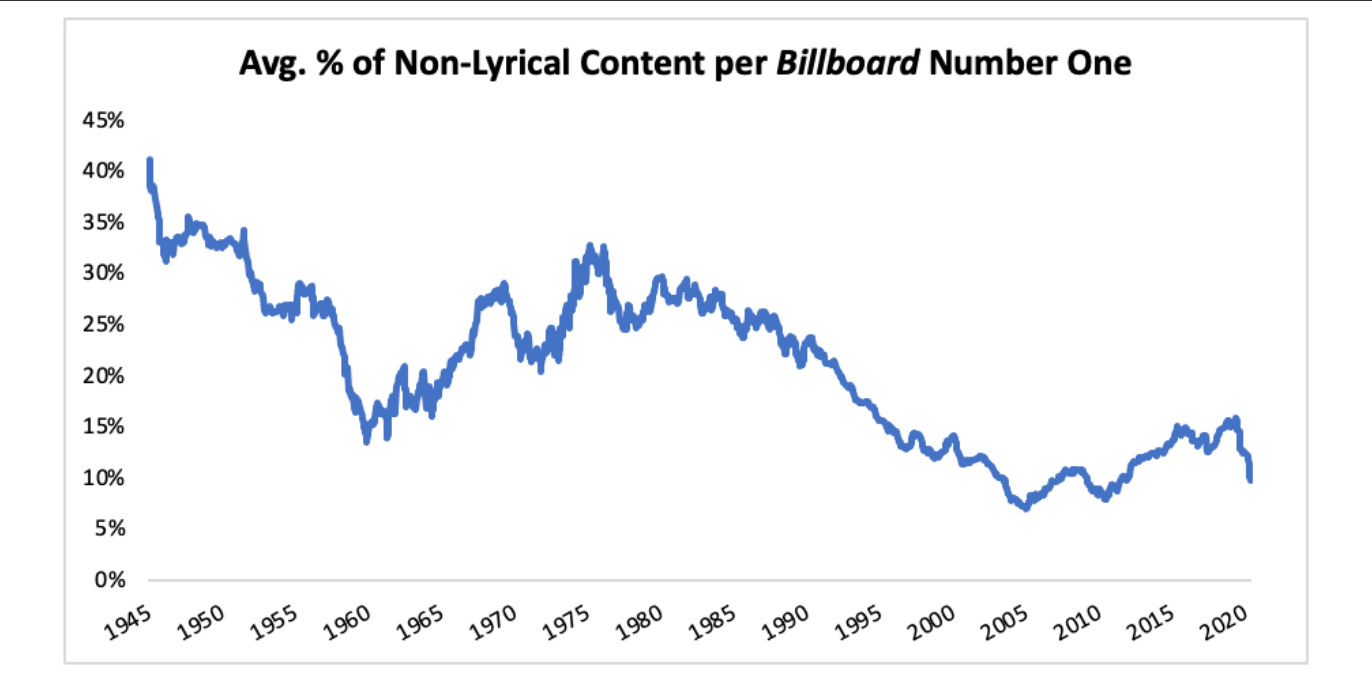
Given that our contemporary musical world is dominated by vocalists, this seems bizarre. It feels like if you have a musical group it must be centered around the vocalist. If we measure the average percent of instrumental content per Billboard number hit between 1940 and 2021, we see demonstrable evidence for not just the decline of the instrumental superstar but the instrumentalist generally, with the sharpest declines beginning in the 1950s and the 1990s.
NOTE: Data from July 1940 to August 1958 comes from Billboard‘s Best Sellers in Stores chart. After August 1958, Billboard deprecated that chart in favor of the Hot 100, which initially aggregated sales, jukebox, and radio data. The Hot 100 remains the premiere pop chart, though it has come to include many more sources, like streams and digital downloads. The above displays a 50-song rolling average.
What’s going on here? How could throngs of high schoolers long for the clarinet-wielding Artie Shaw 80 years ago when most teenagers today would struggle to name a musician who isn’t also a singer. I believe it comes down to four factors: improved technology, the 1942 musicians’ strike, WWII, television, and hip-hop.
Improved Technology
In the VH1-produced documentary The Brian Setzer Orchestra Story, Dave Kaplan, Setzer’s manager, recounts a conversation he had with Setzer before assembling a guitar-fronted big band in the 1990s: “Nobody had ever fronted a big band with an electric guitar … I asked Brian, ‘Why wouldn’t somebody have tried it?’ [Setzer replied,] ‘Well there weren’t amps.'” Albeit a simplification, Setzer’s quip is pretty accurate.
While there were some famous guitar players among the big bands of the first half of the 20th century, we don’t see the guitar become a driving force in popular music until amplification improved. This was not only a boon for the guitarists but also vocalists. Unlike brass and wind instruments, you can sing while you play the guitar. Thus, it’s not shocking that the rise of the guitar coincided with the rise of the vocalist.
But it wasn’t just guitar amplification technology that was vital. It was also microphone technology. Again, microphones had to improve so vocalists could compete with the cacophony of a loud band. On top of this, recording had to change to capture more subtlety in the human voice.
Comments Off on The amplifier may have been the key technological innovation that let vocalists and guitarists become stars


