
The Korean War by Indy Neidell
Published 25 Feb 2025Operation Killer begins this week, and its objective is what the name implies, to destroy as much of the enemy as possible rather than just trying to merely take territory. But once again, UN Commander Douglas MacArthur threatens to telegraph it before it starts. The offensive itself, though, is stymied its first few days by the weather. Meanwhile in China, Peng Dehuai meets with Mao Zedong to clear the air.
(more…)
February 26, 2025
The Korean War 036 – MacArthur Gets Dumber Every Week – February 25, 1951
Comments Off on The Korean War 036 – MacArthur Gets Dumber Every Week – February 25, 1951
QotD: The banality of crime
When I was still in grad school, there was a big pot bust in College Town. Big enough to merit statewide notice, anyway — a couple hundred pounds, something like that, obviously not El Chapo level but enough to where some kind of actual, organized smuggling was involved.
Cynical bastard that I am, I immediately wondered just how they’d managed this feat of law enforcement. College Town being, well, a college town, it had a surprisingly large police force, but the cops dealt overwhelmingly with quality-of-life stuff. I doubt they had more than one or two full time detectives (if that) chasing burglars; I don’t recall College Town ever having a homicide. They certainly didn’t have narcs on the force, is what I’m getting at, so how on earth did they disrupt this small-time, amateurish, yet still legit (on volume alone) drug smuggling operation?
I forget the details, but as you’d surmise from this story taking place in Clown World, they were fake and gay. I’m slightly fictionalizing, and slightly exaggerating, but it really was on the level of “A prowl car saw a guy driving erratically and pulled him over, at which point smoke started billowing out of the windows. The cop looked in and found a felony amount of pot sitting in a garbage bag on the front seat, and the driver copped a plea — he ratted out his supplier, and when the cops showed up with a warrant, that knucklehead, too, had his bales of marijuana sitting out in plain view on the living room couch.”
Most crime works like that, as it turns out. Even in the big cities, where police departments have bigger budgets and more combat power than a lot of European armies. Homicides, for instance, are 99% paperwork, I’m told. Everyone knows that Peanut shot Ray Ray over a pair of sneakers, not least because Peanut is walking around in the damn things, and probably still has the gun shoved in the waistband of his track suit, too. “Solving” the homicide is just a matter of putting the paperwork through. Stone cold whodunits, like big sophisticated undercover narcotics operations, are vanishingly rare, because the cost of enforcement, let’s call it, is extremely high.
I know, I know, The Wire was a tv show, but people I know who really do work in law enforcement say it’s close enough to the real thing for our purposes. Drug dealers down in the ‘hood aren’t nearly as smart and sophisticated and above all self-disciplined as the Barksdale Crew, but the basic principle is the same: Since the low-level people are inevitably going to get busted, make sure that the low-level people don’t have anything on the guys one level higher, and your drug dealing operation is more or less safe. Just as Peanut could probably get away with blasting Ray Ray in broad daylight if he were smart enough not to wear the shoes around, so the pot dealers in College Town could’ve gotten away with their operation more or less forever, provided they weren’t stupid enough to be driving around high on their own supply, with said supply in plain view in the passenger seat.
Severian, “The Cost of Enforcement”, Founding Questions, 2021-09-29.
Comments Off on QotD: The banality of crime
February 25, 2025
Argentina’s experience of life with high tariffs
Marcos Falcone explains how Argentina’s unusually high tariff barriers distort ordinary economic activity for Argentines every day:

When Argentines go abroad, they usually go shopping. Many of the products they want cannot be bought at home, ranging from clothes to smartphones and all kinds of home appliances. Because of this, it has become a tradition to return from a trip with one or two extra suitcases filled with smuggled goods. Did you know that it is more expensive to buy an outdated iPhone in Argentina than it is to fly from Buenos Aires to Miami, stay for three days, and get the newest one?
[…]
Tariffs do not just make it difficult to get phones at home — they can make life dangerous as well. Argentina’s most sold car, which is artificially expensive because of protectionist measures, got 0 (zero) stars on one of Latin America’s most renowned safety tests. Cars in Argentina are not only more expensive than elsewhere in the region, but also markedly less safe.
To achieve these terrible results, the only thing Argentina had to do was enact tariffs, and now the US seems to be heading in the same direction. But in the past, protectionism has caused the same damage in the north as it caused in the south. Back in the first Trump administration, protecting the steel-production industry saved some jobs, but eliminated many more. Tariffs have also hurt businesses that rely on imports within the US and can continue to do so in a world of globally integrated supply chains. More generally, the 1933 Buy American Act, which forces the government to pay more for US-made goods, has been proven to be both ineffective and costly.
There is no escaping the negative effects of blocking outside competition. The more barriers a country enacts, the more damage it causes to itself. If we, as individuals, acted in a protectionist way, we should aim to grow our own food, build our own house, or make our own cars. But how does that make any sense? Economist Robert Solow once said, “I have a chronic deficit with my barber, who doesn’t buy a darned thing from me”. He meant it as a joke, but he had a point: What matters is to create wealth, which can be done both by selling and buying from others.
The revival of protectionism in the US is worrisome. To avoid it, Americans should take a look at the enormous destruction of wealth that tariffs have caused in other countries. Despite President Milei’s recent efforts to lift tariffs and take Argentina out of the “prison” in which it exists, the fact that the country shot itself in the foot decades ago has put it in a very delicate economic position. The US should not follow its path.
Likely trajectories of the victims of DOGE
Bruce Ivar Godmundsson identifies the most probably career dislocations of civil servants winkled out of their expected life sinecures by the minions of Elon:
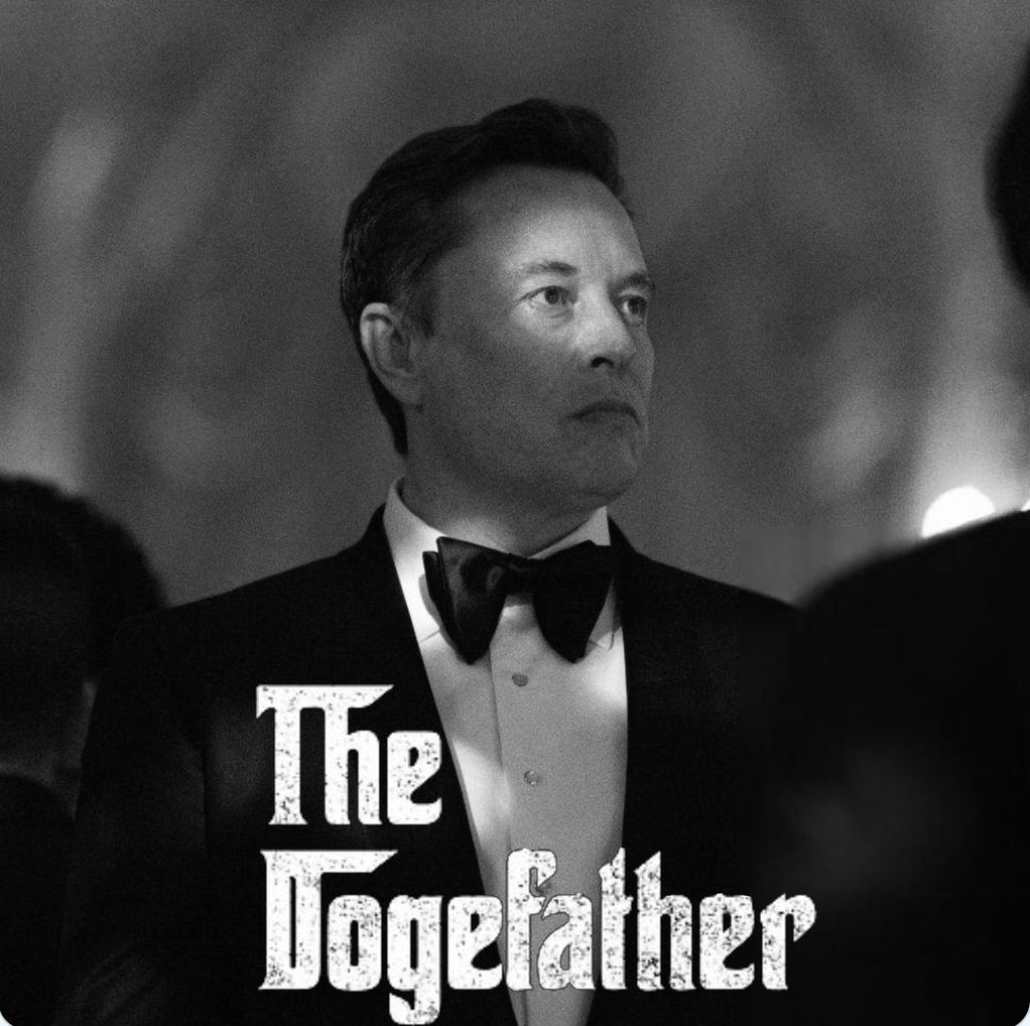
To put things another way, the status deprivation experienced by erstwhile feeders at the Federal trough will eventually lead to a great deal of radicalization. After all, if history is any guide, it is not the victims of sustained oppression who raise the banner of revolt, but those who lost advantages that they had earlier expected to enjoy for the rest of their days. (It was not, after all, agricultural laborers, let alone vagabonds, who enlisted in the machine-smashing armies of General Ludd, but practitioners of “decent trades” who had previously occupied lucrative bottlenecks in supply chains.)
As they LARP as extras in the street fighting scene of Les Misérables, the outcasts will find, standing beside them on the barricades, youngsters who, as recently as the autumn of 2024, had expected to parley their ability to paraphrase (or, at the very least, parrot) the Party Line into an internship with an agency, a poorly paid (but prestigious) place in an NGO, or, for those especially adept at symbolic manipulation, a job with a name-brand consulting firm.
Leaving aside the cinematic metaphors, some of the dispossessed will, no doubt, resort to rioting. More will ride the protest circuit, which will do for them what comic-book conventions do for fancy-dressed fans of manga and anime. Most, however, will do little more than haunt the margins of the middle class, muttering about their masters degrees in public policy as they wait for the next command to appear on the screens above their grills.
Repeated encounters with the fallen may drive the final nail into the coffin of the assumption, once central to the world view of so many Americans, that possession of a sheepskin entitled its holder to a desk job. No longer will parents dining at McDonalds whisper to their children “if you don’t go to college, you’ll end up like that”. Rather, they will point to the technician repairing a self-service kiosk and say “that’s the sort of thing that you want to do”.
Comments Off on Likely trajectories of the victims of DOGE
February 24, 2025
Rule by bureaucrat, believe it or not, was once considered a better form of government
In the 19th century, the Americans switched from a system where one of the major outcomes of a presidential election was the wholesale replacement of government employees to one where the civil service was “professionalized” to the point that only the very top levels were subject to presidential replacement (Trump 2.0 may mark a significant change in this). Fans of the professional bureaucracy would sometimes gesture toward the venerable Chinese model, which had been run in this way for a very long time until the 20th century. Lorenzo Warby considers the actual performance of these kinds of systems:

Excerpt from the handscroll Viewing the Pass List. Imperial examination candidates gather around the wall where results had been posted. Traditionally attributed to Qiu Ying, but now suspected to be the work of a late-Ming painter with Qiu Ling’s name added.
National Palace Museum via Wikimedia Commons.
Over the course of the C19th, Western states adopted the Chinese notion of appointment by examination for their government bureaucracies. Such appointment-by-merit did have the effect — for about a century and a half — of creating effective and responsive bureaucracies. So much so, that Western democracies gave more and more tasks to such bureaucracies.
This replicates the early stage of the Chinese dynastic cycle — the actual one (see below), rather than the traditional version — where, early in a Dynasty, rule through the bureaucracy is quite effective, even efficient. In modern Western democracies, the legitimacy of democratic action — the demon-in-democracy problem, where the all-trumping legitimacy of the democratic principle tends to overwhelm other ways of doing things — aided the massive expansion in government action, and so in the ambit of government bureaucracy.
The trouble with adopting the Chinese model of appointment-by-merit bureaucracy — including selection-by-examinations — is that folk failed to take a good hard look at the patterns of Chinese government. This despite the fact that the keju, the imperial examination, was introduced under Emperor Wen of Sui (r.581-604) and was not abolished until 1905, so there was quite a lot of history to consider.
The patterns of Chinese government are much less encouraging, because the quite effective, quite efficient, stage of bureaucratic administration does not last. The problem with appointment-by-merit is that it selects for capacity, but not character. Confucianism tries to encourage good character, but it repeatedly turned out to be a weak reed compared to incentive structures. (Almost everything is a weak reed, compared to incentive structures.)
The actual dynastic cycle was:
- Population expands due to peace and prosperity in a unified China. This pushes against resources — mainly arable land — creating mass immiseration, an expanding underclass with no marriage prospects, peasant revolts and falling state revenues.
- The number of elite aspirants expand — a process aggravated by elite polygyny — but elite positions do not, leading to disgruntled would-be elites who provide organising capacity for peasant revolts (including through sects and cults).1
- Bureaucratic pathologies multiply, leading to a more corrupt, less responsive, less functional state apparatus, eroding state capacity and increasing pathocracy (rule by the morally disordered). Late-dynasty imperial bureaucracies could be astonishingly corrupt and dysfunctional.
In contemporary Western societies, mass migration interacting with restrictive land use, and other regulation (e.g. “net zero”), so that:
- housing supply is blocked from fully responding to demand for housing—thereby driving up rents and house prices; while also
- inhibiting infrastructure supply from responding to demand—increasing congestion and other (notably energy) costs
is creating immiseration pressures. Figures about the “macro” health of the US economy, for instance, are misleading as much of the growth is either not reaching people further down the income scale or is failing to compensate for rising rents.
Western commercial societies are sufficiently dynamic that elite over-supply is much less of a problem than in pre-industrial societies. There is, however, very much a problem of toxic parasitism — the entire (Diversity Equity Inclusion) DEI/EDI apparatus to start with. What we might call malign elite employment or bureaucratic parasitism.
1. NR: I’ve read that the Taiping Rebellion in China was led by a man who’d failed the Imperial Examination and raised the banner against the entire system as a form of revenge. By the time the rebellion was quashed, somewhere up to 30 million people were killed in the fighting or as an indirect result of the conflict. (Traditional note of caution about any statistics from pre-20th century China … well, any Chinese statistics at all, really.)
Update: Fixed broken link.
Comments Off on Rule by bureaucrat, believe it or not, was once considered a better form of government
Dawn of the Atomic Age – W2W 007
TimeGhost History
Published 23 Feb 2025In 1946, the world’s fate is rewritten in fire. The first peacetime nuclear tests shake the Pacific, while Stalin accelerates the Soviet push for the bomb. With the power to destroy the entire world now a reality, global leaders face a defining choice — will the bomb usher in the peace of our time, or lead to nuclear doom? The arms race has begun, and there’s no turning back.
(more…)
Comments Off on Dawn of the Atomic Age – W2W 007
The Third Triumvirate?
On the social media platform formerly known as Twitter, John Carter posted an amusing thread (unrolled here courtesy of the @threadreaderapp):

JD Vance as Julius Caesar
AI image by Grok
Trump, Musk, Vance: the new triumvirate, bringing a window of stability to the troubled Republic.
Trump: the old warhorse, beloved of the people, a part of the establishment but with an uneasy relationship to it. Trump is Pompey.
Musk: the richest man in the world. Musk is Crassus.
Vance: the charismatic young upstart. Vance is Caesar.
So how does this play out?
Musk’s ambition is to go to Mars, just as Crassus wanted to conquer Parthia. Musk harnesses his wealth, launches the expedition to great fanfare. Things go horribly wrong after their arrival. Contact with the colony is lost. Musk’s grave is never found.
At the head of a private military corporation equipped with letters of marque, Vance is sent into the badlands of South America to crush the cartels and secure the Panama Canal. The war takes longer than expected. By the end of it, Vance hasn’t merely crushed the cartels – he’s conquered the entirety of Central America.
At home, Vance is beset by his enemies in the Senate, who mistrust his ambitions and intentions. It is whispered that he wishes to make himself king.
Vance’s enemies whisper in Trump’s ears. Were you not the one who built the wall? If Vance brings the Central American republics into the Union, what then of immigration? Of your life’s work? Vance will destroy it all.
And do the people, after all, not love you first and most? Are you not their hero? Why then should you fear this upstart?
With Trump’s blessing, Vance is recalled by the Senate, to face charges of corruption.
But throughout this time Vance has been building auctoritas with the people, going directly to them with his poasts, showing them his victories and their fruits. The people have come to love him more than they love Trump — for he has sent great wealth back to them, and crushed their enemies abroad.
And so the fateful day comes in which Vance returns, as summoned … but he does not demobilize his mercenary army when it crosses the Rio Grande. His forces — which now include former cartel soldiers, some of whom he has won to his side — drive straight to Washington in a blitzkrieg attack.
Washington empties out in panic.
Trump and the Senate flee to New York City, where they rally their forces. There are still many who are loyal to Trump, particularly within the military … but it turns out that Trump’s base is much older than Vance’s … and there are many, more than expected, who declare for Vance.
And so the Union cracks apart into the Civil War that was deferred when the triumvirate first seized power, so many years ago.
But this is not first and foremost a war of ideology, as it would have been — a showdown between right and left.
It is a war of personalities and personal loyalty, a war to determine a single question: who is to be king?
Obviously none of this is going to happen. History never repeats itself so precisely.
But it’s fun to think about Vance rampaging around Central America at the head of a PMC.
February 23, 2025
How WW2 Changed Espionage Forever
World War Two
Published 22 Feb 2025In their struggle to defeat German and Japanese espionage efforts, the Allied intelligence agencies of the KGB, CIA, MI6 and DGSE are all transformed into modern, global, espionage forces. But even as East and West work together to defeat the Axis, they are fighting the first underground battles of a new Cold War against one another.
(more…)
Comments Off on How WW2 Changed Espionage Forever
February 22, 2025
Trump’s movement is not the same old GOP
Lots of comments by and for Canadians in the last few weeks have been of the “running around with hair on fire” school of journalism. Donald Trump has transmogrified from the butt of jokes to the embodiment of everything technocratic Canadian “elites” fear:
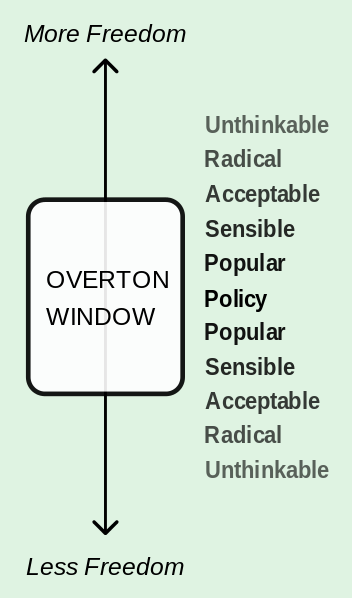
Diagram of the “Overton Window”, based on a concept promoted by Joseph P. Overton (1960–2003), former director of the Mackinac Center for Public Policy. The term “Overton Window” was coined by colleagues of Joe Overton after his death. In the political theory of the Overton Window, new ideas fall into a range of acceptability to the public, at the edges of which an elected official risks being voted out of office.
Illustration by Hydrargyrum via Wikimedia Commons
The re-election of Donald Trump has masked a growing and profound shift in American politics, and ushered in a new era of Republicanism in the United States. Trump’s return is seen by many to be an isolated incident, an aberration from previous conventional norms and one that will resolve once the man himself is gone from power or from this earth.
For these people, the issue is Trump and Trump alone.
I believe that this is a profound misunderstanding of what is happening in America today, and what the future holds.
The old Republican party is gone. In its place is a movement that is built on the foundations of 19th century expansionism; strength and self-interest. It is motivated to settle grievances against the post-war consensus conservatism that it blames — more than it even blames the left — for the decline of the once-mighty American empire. For the New Republican, Ronald Reagan and George W. Bush were as much responsible as Bill Clinton and Barack Obama in ushering in America’s decline.
Donald Trump is the transitionary vessel to carry that movement forward. He is the tip of the spear whose job is to crack open the institutions that the New Republican believes poisoned America for decades. Overton’s Window is wide open for the New Republican now.
It is useful to start with describing the New Republican movement. It is not the previous Republican movement of lower taxes, less state intervention or smaller government. These things may also be part of Trump’s movement, or at least a slice of it, but those are the beliefs of yesterday’s Republicans. Today’s ideology happens to dovetail well into the libertarian beliefs of the tech bros led by Elon Musk. Trump and Musk’s bromance is premised on some shared affection for each other as strong businessmen and leaders. But the alliance is shaky. Libertarian Republicans are only being tolerated by the larger movement because it’s useful in tearing down the structures the New Republican wishes to rebuild.
[…]
The New Republican is a value proposition. He rejects the very notion of normative values, that some countries may have values that are different, and which are to be tolerated even though they may be counter to American interests. There is no space for these values for the New Republican. The New Republican believes American values are superior and should be exported to the world. These values include family, fortitude, hard work, God, self-interest, the proper roles of the (two) sexes and especially, strength. That these values are the “right” values is self-evident to the New Republican, who believes that they should also be for everyone else.
Who are the New Republicans? One should look to Trump’s choices for cabinet — J.D. Vance, Marco Rubio and Howard Lutnick are good places to start. They all figure to be around — and in control of the party apparatus — once Trump is gone.
Elon Musk is not one of these people. Like Trump, he is the pointy end of a spear, and when the falling out between him and the New Republicans happens, it will not be pretty.
Finally, the New Republican is a lot of Americans. More than many would like to believe.
Comments Off on Trump’s movement is not the same old GOP
How the US Turned Iran Into a Dictatorship
Real Time History
Published 4 Oct 2024In 1953, Iran is at a crossroads. After decades of interference by foreign powers eager to exploit its oil reserves, the government decides it will throw them out and take control of the country’s wealth. But with the super powers’ Cold War paranoia and thirst for oil, it won’t be easy – especially once the CIA gets involved.
(more…)
Comments Off on How the US Turned Iran Into a Dictatorship
QotD: Modern journalism
They may all be lousy journalists, but damn it, they are also lousy at other jobs that they didn’t even pretend to train to do.
It’s awesome to see people with zero life experience in any relevant field weighing in as if we shouldn’t just laugh in their pimply faces. Here’s the typical resume of one of these hacks:
- Went to high school, and never went to parties
- Went to college, majored in journalism, and never went to parties
- Went to journalism grad school, and never went to parties
- Works in the media, and goes to Manhattan/Georgetown cocktail parties
This apparently qualifies them to explain to people like us who have actually done something in our lives how stuff is supposed to work.
Kurt Schlicter, “Our Super Smart Elite Shines During This Pandemic!”, TownHall.com, 2020-04-02.
Comments Off on QotD: Modern journalism
February 21, 2025
“… a sea change in American foreign policy priorities”
Theophilus Chilton on how the markedly changed US foreign policies under Donald Trump are roiling the old certainties of so many western “transnational” elites:

Last Friday, an event occurred which represents a sea change in American foreign policy priorities, but the importance of which may have been missed by many. Vice-President Vance gave a speech at the Munich Security Conference. In this speech, he basically pulled no punches, calling out the various Western European governments for their support for mass immigration, their opposition to free speech, and the erosion of democratic functions within their governments. The speech itself presented a stark contrast between the new American administration and the “leadership” that currently exists in most European countries. It represents a decisive rupture between an American executive which is in the process of refuting the influence of a globalist transnational “elite” over its country and European governments which are still firmly ensconced in that elite’s thrall.
The thing is, Vance was pretty much right about everything he said. Mass immigration, especially that part of it coming from Africa and the Muslim world, is absolutely destroying the social fabric of every European nation as well as dragging down their standards of living toward third world levels. Euro governments, in fact, do absolutely hate freedom of speech and apply strictures that medieval monarchies would never have dreamed of instituting. For all their talk about the importance of democracy and the “threat” to it represented by Trump and his administration, Euro countries make an absolute mockery out of the entire concept. Those European slaves of the globalists can grumble and sit there aghast at Vance’s words, but the simple fact of the matter is that he was right in every way in the criticisms he leveled against them.
After all, these are the people who overturn Romanian elections because actual Romanians voted for the wrong person — all to “defend democracy”. These are the people who ban political parties to “defend democracy”. These are the people who let “migrants” stab little girls to death to “defend democracy”. These are the people who arrest Christians for singing hymns on a public street to “defend democracy”. These are the people who do armed midnight raids and throw people into prison for sharing memes on social media to “defend democracy”. You get the picture. Populism and popular sovereignty are such a threat to these regimes because their democracy is a sham, a foil used to give a pretended legitimacy to globalist policies which are destroying the actual people of these various countries.
For all the breathless hyperventilating about Russia “invading Europe” (which it is in no position to do, LOL), the fact is that there is nothing that the Russians could do to the people of Europe that would be worse than what their own governments already subject them to.
What makes this all the more amusing is the excited “nationalism” we’ve been seeing from the lefties and globalists in several of the countries that have been in the Trump/Vance crosshairs over the past month. A good example would be in Canada, in response to the tariff threats that Trump made to try to push the Canadian government into being a little more proactive about securing their side of the border from the fentanyl and illegal aliens that enter the USA. Watching the Canadian government fall all over itself trying to fake an exuberant pride in their Canadian-ness, even as they continue to turn their country into an Indian colony and treat their own White Canadian population like a bunch of expendable paypigs has been enlightening, to say the least. Obviously, what’s driving the reaction is not a genuine love of country or people, but loyalty to the transnational elite that is piqued at recently being disempowered in the USA.
In all of this, it’s important to remember that the enemies here, the people who deserve our ire and derision, are not the peoples of Canada, the UK, the European countries. It is the transnational clique and their progressive Left hangers-on, the same people who were until very recently doing the exact same things to the American people, too. We need to be very clear that regular, everyday Americans and regular, everyday Frenchmen, Germans, Canadians, Italians, and all the rest are on the same side here. We have the same enemy. The European and other peoples are victims of their own governments, first and foremost. I mean, their own governments are now formally making them eat the bugs as part of their anti-human green agenda, just to give one example.
Comments Off on “… a sea change in American foreign policy priorities”
February 20, 2025
The Space Race Begins – W2W 006
TimeGhost History
Published 19 Feb 2025The Space Race has begun. As Stalin’s USSR and Truman’s U.S. compete for technological dominance, the Pentagon prepares for a future of missile warfare. Project Diana shatters barriers by bouncing radar off the Moon, proving space can be conquered — whether for exploration or war.
(more…)
Comments Off on The Space Race Begins – W2W 006
February 19, 2025
Europe’s moral leaders stand strong against grotesque American fascism
You have to hand it to the great and the good of Europe … they sure can find every. last. rake. to step on as they hysterically react to the slightest hint of disagreement or contradiction:
Germany is right. Opposition parties must be forbidden or firewalled. Political criticism must be criminalized. The public sphere must be firmly controlled by government, with guardrails against disagreement and heterodoxy. If we don’t do these things, we might descend into authoritarianism.
Margaret Brennan’s bizarre response to JD Vance’s speech in Munich — free speech? but that’s the weapon the Nazis used to commit the Holocaust! — wasn’t mere ignorance or accident. It’s a maneuver. You’re going to see more of it, in an urgent wave of moral inversion. Case in point, from the New Republic today:
Remember that Vance said things like this:
The good news is that I happen to think your democracies are substantially less brittle than many people apparently fear.
And I really do believe that allowing our citizens to speak their mind will make them stronger still. Which, of course, brings us back to Munich, where the organisers of this very conference have banned lawmakers representing populist parties on both the left and the right from participating in these conversations. Now, again, we don’t have to agree with everything or anything that people say. But when political leaders represent an important constituency, it is incumbent upon us to at least participate in dialogue with them …
I believe deeply that there is no security if you are afraid of the voices, the opinions and the conscience that guide your very own people.
So governments should live in dialogue with the populations they govern; citizens should speak freely; banning or limiting political parties makes society less free and less open. From start to finish, Vance spoke for liberty and openness, for free expression and societies organized through unfettered debate.
The calculated response — the calculated response, a deliberate deflection — is: Oh no, he’s saying we should turn into Nazis! Look at the subhed to the thing in the New Republic: arguing for freedom is aligning ourselves with international fascism.
Openness is genocide. Freedom is fascism. Speech is violence. Free societies arrest people for saying the wrong thing. Free speech — you mean like ADOLF HITLER!?!?
Read the piece in the New Republic, and look closely at Michael Tomasky’s language, which is full of Stasi-adjacent framing: “The Alternative fur Deutschland (AfD) has been declared a ‘suspected extremist’ organization by the German domestic intelligence agency.”
Comments Off on Europe’s moral leaders stand strong against grotesque American fascism
The Korean War 035 – The Battle of Chipyong-ni – February 18th, 1951
The Korean War by Indy Neidell
Published 18 Feb 2025Chinese Commander Peng Dehuai has launched his 4th Phase Offensive, pushing the UN forces back in the center of Korea, and should his forces take Chipyong-ni, they will compromise the entire UN position. Chipyong-ni must hold!
Chapters
00:00 Intro
00:50 Recap
01:21 4th Phase Offensive
03:07 Retreat from Hoengsong
06:27 Chipyong-Ni Must Hold!
08:50 First Relief Attempt
10:22 The Battle of Chipyong-Ni
15:34 Battle Side Notes
17:36 29th Brigade
19:36 Summary
19:59 Conclusion
(more…)
Comments Off on The Korean War 035 – The Battle of Chipyong-ni – February 18th, 1951


