Quotulatiousness

April 30, 2020

CITIZENS! Report any non-socially-distanced deviationist behaviour to this number immediately!

Filed under: Cancon, Government, Health, Liberty — Tags: , , , , , — Nicholas @ 03:00

In Maclean’s, Jen Gerson admits that she has not (yet) reported any of her neighbours for their failure to obediently follow the rules of social distancing. She must be reported to the appropriate state authorities!

Commemorative badges of the German Democratic Republic’s Ministry of State Security (Stasi).
Wikimedia Commons.

Look, I know I’m going to get flak for this, but someone needs to say it: think twice before you narc on your neighbours.

Snitching may work, but the downsides to citizen-policing are grim — to say nothing of the historical antecedents.

Firstly, “you can play havoc with somebody just by snitching on them with an anonymous snitch line,” noted Sharon Polsky, the president of the Privacy and Access Council of Canada. In addition to the risk of malicious reports, if people of colour aren’t disproportionately subject to snitching, I’d be shocked.

Totalitarian states turned neighbour against neighbour and family against family, in order to maintain the illusion of social cohesion.

Authoritarians use this tactic because there are never enough police or soldiers to force compliance upon an entire population, not unless everyone consents to become an agent of his or her own mutual oppression.

The term “fascism” has an innocent history. It comes from the Roman term “fasces,” which means a bundle of sticks bound together. One stick breaks, but the fasces remains strong. It’s another term for unity. That’s what makes it so seductive, especially in times of uncertainty and mortal dread. We’re all in this together. Nary a stick shall stray.

“We are now living amid the very tactics that the West [once] criticized,” Polsky added. “With state controls on commerce, industry, speech, and media.”

The federal government, for example, is already considering legislation that would bar the spreading of misinformation about COVID-19 online.

“Extraordinary times require extraordinary measures and it is about protecting the public,” Privy Council President Dominic LeBlanc told reporters with a line that should give any student of history the creeps.

“This is not a question of freedom of speech. This is a question of people who are actually actively working to spread disinformation, whether it’s through troll bot farms, whether [it’s] state operators or whether it’s really conspiracy theorist cranks who seem to get their kicks out of creating havoc.”

No doubt LeBlanc et al are operating under the noblest of intentions. But repressive measures buy conformity at a terrible price. Snitch lines turn us against one another. They teach us to fear the people we need to survive, thus making us more dependent on the apparatus of the state.

April 29, 2020

“The war on ultraviolet radiation because it might help Trump is an educational moment”

Arthur Chrenkoff on the sudden decision that the World Health Organization is the ultimate arbiter of what we’re allowed to say on social media platforms like Twitter and YouTube:

There is of course no evidence that the video represents any disinformation. It relates to legitimate scientific research by a medical company conducted in association with a respected hospital to develop a novel treatment of possibly crucial importance in the current conditions and into the future. The only problem with the video is that is indirectly supports Trump’s flight of fancy speculation about using light and chemicals to “disinfect” the body. Ergo, according to a NYT journalist it represents a problem and YouTube agrees. YouTube now has a standing policy of removing COVID information that goes against the World Health Organisation’s guidelines. Putting aside the question of the WHO’s credibility in the wake of the pandemic, we are not talking here about some guy in a tinfoil hat talking about 5G towers spreading the virus; this is a video relating to ongoing, respectable scientific research. Will it work? Probably not. But perhaps neither will any of the 150 or so COVID-19 vaccines being currently developed around the world. We won’t know until we know. But in the meantime, scientific news should not be censored, period.

[…]

Goldsmith and Woods are correct in pointing out not only the greater role that governments have been playing in regulating speech but more importantly how much of that effort has been embraced and driven by the big tech — and by the private individuals enabled and encouraged by the big tech — what I have previously called the “democratised censorship”. The difference is that people like Goldsmith and Woods think that’s a good thing.

The dirty little secret is that a great number of leftists, progressives and even centrist technocrats and activists look at China, with its authoritarian government, social credit score system, ubiquitous surveillance, and the ability to “get things done” and done quickly and supposedly efficiently (in China, bullet trains run on time, I hear), and pine for such a system to be applied in their own countries — as long as, of course, they are the ones in power and decide what is right, important and valuable. The left’s objections are rarely against authoritarianism and its means and methods per se, just with the possibility that someone else — like Trump — is the one behind the wheel, implementing their, not the left’s, agenda.

The war on ultraviolet radiation because it might help Trump is an educational moment. One could say, first they came for crazy conspiracy theorists and I said nothing because I’m not an anti-vaxxer or anti-5G activist — and so on. The problem with censorship is that it keeps creeping up on everyone else. And those who do the censoring — who decide what the ignorant masses should and shouldn’t be allowed to read — are not some detached and impartial spiritual beings but people with political agendas. People who think that ideas and beliefs of one half of the society are harmful and offensive. People who will censor news that doesn’t fit the agenda and support the narrative.

And then they came for ultraviolet radiation… You have been warned.

“If it saves just one life…”

Filed under: Economics, Government, Health, Liberty — Tags: , , — Nicholas @ 03:00

Antony Davies and James R. Harrigan on the rallying cry of the Karens of all genders:

In times of crisis, politicians want to look like they’re doing something, and don’t want to hear about limits on their authority. In times of crisis, people want someone to do something, and don’t want to hear about tradeoffs. This is the breeding ground for grand policies driven by the mantra, “if it saves just one life.” New York Governor Andrew Cuomo invoked the mantra to defend his closure policies. The mantra has echoed across the country from county councils to mayors to school boards to police to clergy as justification for closures, curfews, and enforced social distancing.

Rational people understand this isn’t how the world works. Regardless of whether we acknowledge them, tradeoffs exist. And acknowledging tradeoffs is an important part of constructing sound policy. Unfortunately, even mentioning tradeoffs in a time of crisis brings the accusation that only heartless beasts would balance human lives against dollars. But each one of us balances human lives against dollars, and any number of other things, every day.

Five-thousand Americans die each year from choking on solid food. We could save every one of those lives by mandating that all meals be pureed. Pureed food isn’t appetizing, but if it saves just one life, it must be worth doing. Your chance of dying while driving a car is almost double your chance of dying while driving an SUV. We could save lives by mandating that everyone drive bigger cars. SUVs are more expensive and worse for the environment, but if it saves just one life, it must be worth doing. Heart disease kills almost 650,000 Americans each year. We could reduce the incidence of heart disease by 14 percent by mandating that everyone exercise daily. Many won’t want to exercise every day, but if it saves just one life, it must be worth doing.

Legislating any of these things would be ridiculous, and most sane people know as much. How do we know? Because each of us makes choices like these every day that increase the chances of our dying. We do so because there are limits on what we’re willing to give up to improve our chances of staying alive. Our daily actions prove that none of us believes that “if it saves just one life” is a reasonable basis for making decisions. Yet, when a threat like the coronavirus emerges, we go looking for an imaginary cure that will save lives without tradeoffs.

QotD: “Ethical” ways to prevent scientific progress

Filed under: Bureaucracy, Health, Politics, Quotations, Science — Tags: , , , — Nicholas @ 01:00

The stigmatization of science is also jeopardizing the progress of science itself. Today anyone who wants to do research on human beings, even an interview on political opinions or a questionnaire about irregular verbs, must prove to a committee that he or she is not Josef Mengele. Though research subjects obviously must be protected from exploitation and harm, the institutional-review bureaucracy has swollen far beyond this mission. Its critics have pointed out that it has become a menace to free speech, a weapon that fanatics can use to shut up people whose opinions they don’t like, and a red-tape dispenser that bogs down research while failing to protect, and sometimes harming, patients and research subjects. Jonathan Moss, a medical researcher who had developed a new class of drugs and was drafted into chairing the research-review board at the University of Chicago, said in a convocation address, “I ask you to consider three medical miracles we take for granted: X-rays, cardiac catheterization, and general anesthesia. I contend all three would be stillborn if we tried to deliver them in 2005.” The same observation has been made about insulin, burn treatments, and other lifesavers.

The hobbling of research is not just a symptom of bureaucratic mission creep. It is actually rationalized by many bioethicists. These theoreticians think up reasons that informed and consenting adults should be forbidden to take part in treatments that help them and others while harming no one. They use nebulous rubrics like “dignity,” “sacredness,” and “social justice.” They try to sow panic about advances in biomedical research with far-fetched analogies to nuclear weapons and Nazi atrocities, science-fiction dystopias like Brave New World and Gattaca, and freak-show scenarios like armies of cloned Hitlers, people selling their eyeballs on eBay, and warehouses of zombies to supply people with spare organs. The University of Oxford philosopher Julian Savulescu has exposed the low standards of reasoning behind these arguments and has pointed out why “bioethical” obstructionism can be unethical: “To delay by 1 year the development of a treatment that cures a lethal disease that kills 100,000 people per year is to be responsible for the deaths of those 100,000 people, even if you never see them.”

Steven Pinker, “The Intellectual War on Science”, Chronicle of Higher Education, 2018-02-13.

April 26, 2020

“If it saves just one life…”

Filed under: Economics, Government, Health, Liberty — Tags: , , , , — Nicholas @ 03:00

Hector Drummond illustrates the moral failure of falling back on the “if it saves just one life” trope as a justification for any and all restrictions on free people:

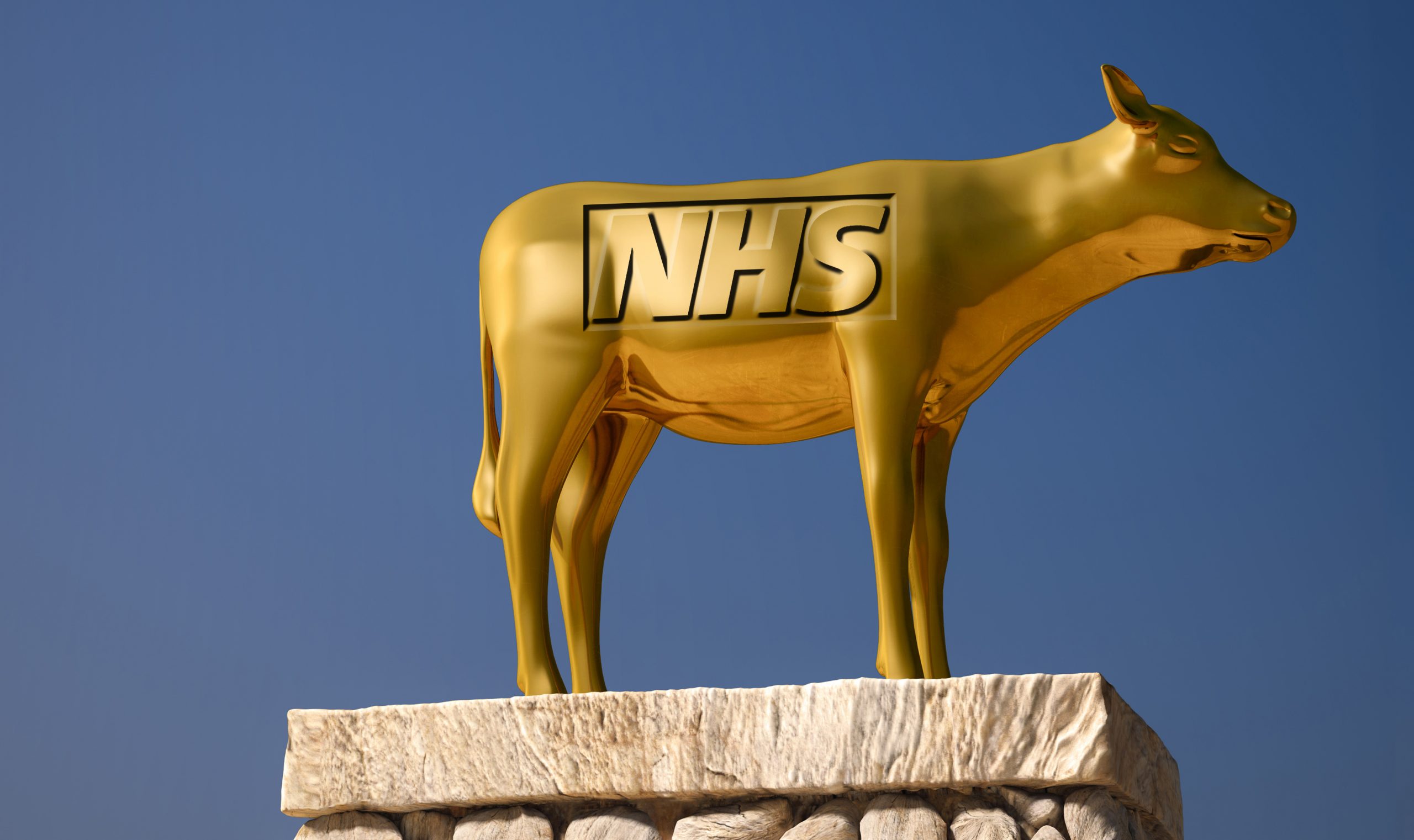
Not actually the official symbol of Britain’s National Health Services … probably.

Let me ask you a question. Would you give up your job, your savings, your kids’ economic future, your pension, your parents’ current pension, your house, and your mental health, if I told you that doing so may possibly extend my old, sick grandfather’s life by a year or two? I don’t suppose you’d be too keen, would you? In fact, even the most mild-mannered of people is likely to get angry at the sheer effrontery of such a request.

What if I told the world the same thing? What if I told the world that if everyone in every country gave up their wordly possessions, and spent the rest of their lives in grinding poverty, then it’s possible that my grandfather might get to see Christmas? And suppose that there was some bare plausibility to this, based on a computer model developed by scientists at Imperial College. What do you think the world is likely to say to me? The polite response would be, “Sorry to hear about your grandfather, but we’re not going to do this”. The less polite response would be more like … well, just incredulous laughter, and slammed doors.

The reason I bring up these hypothetical scenarios, though, is that all over social media we are hearing about the Covid-19 lockdown being “worth it if it saves just one life”. But would the people saying this really be willing to give up, say, their own house, car and possessions and teenage daughter to someone who is suicidally depressed over their lack of prospects in life? No. Would they be prepared to serve ten years in jail if it saved the life of someone at risk of being killed by gangsters? No. Would they be happy with having the government forcibly remove a kidney from them to extend the life of someone with failing kidneys? No. Economic ruin and loss of liberty is not something we generally regard as a fair trade for a stranger’s life. Generally even the bleeding hearts among us will say, and rightfully so, “I’m sorry for this person, but they are not entitled to this, and I will not damage my life to any great extent for them”. Charitable donations are one thing. So is volunteer service. But that’s it.

Another thing I am seeing is people who say, “Anything is worth it if it saves lives”. Anything? Really? Shall we ban alcohol then? Because some people die from alcohol. Cars? Paracetamol? Steak knives? Shall we ban mobile phones, because terrorists might use them to communicate with? Shall we lock up for life anyone convicted of a minor juvenile crime, in case they turn out to be a killer? The whole idea is too ridiculous for words, yet all over the world there are fearful people hiding in their homes and posting such thoughts. It is one thing to feel sorry for them, but their stupid ideas shouldn’t pass unchallenged.

April 25, 2020

Professor Neil Ferguson – “I wrote the code (thousands of lines of undocumented C) 13+ years ago to model flu pandemics…”

Filed under: Britain, Government, Health — Tags: , , , — Nicholas @ 03:00

An anonymous guest post at Hector Drummond’s blog pivots on the disturbing quote in the headline from one of the key advisors to the British government on the Wuhan Coronavirus epidemic:

To say I was gobsmacked at his admission is an understatement. He’s one of the experts advising the government about the Covid-19 pandemic, and was consulted in previous health crises such as Foot & Mouth disease. Like the approach to combating that, we’re seeing a kind of scorched earth approach to containing another transmissible disease.

Even though the “C” programming language that Ferguson used is nearly 50 years old, the language chosen isn’t the problem. Undocumented means that modules and other code fragments are not commented, so their purpose may be unclear to someone unfamiliar with the code. In the worst case it means that modules and variables don’t have self-documenting names. For example, an accounting program could have the variables BalanceBroughtForward and BalanceCarriedForward, but a sloppy programmer might call them B1 and B2 instead – a sure recipe for confusion.

The “C” language is good to work with but has some inherent issues which can lead to subtle bugs affecting the output without causing an error. A common problem is the conditional which uses two equals signs rather than one.

To compare variables A and B for equality you would write this: if (A == B). However, it’s easy to accidentally write this: if (A = B). The latter always returns true and assigns the value of variable B to A. I have no idea whether Ferguson’s code contains any bugs, this is just one minor example of the need for strict testing.

The reason for commenting code extensively and properly is so that the programmer himself, and anyone else who maintains it, can understand what it does and how it works, reduce the chance of mistakes and avoid unnecessary effort. During my IT career I would have terminated the contract of any contractor working for me who wrote thousands of lines of undocumented code. Not only is such code a nightmare for others to work on, it can be difficult for the original programmer to maintain if coming back to it after a long time. Sloppiness in the coding raises the worry of a concomitant lack of rigour in testing, although that’s not to assert Ferguson’s code isn’t working as intended and/or wasn’t tested.

April 21, 2020

One of the few good things happening during the Wuhan Coronavirus epidemic – deregulation

Filed under: Bureaucracy, Government, Health, USA — Tags: , , , , — Nicholas @ 03:00

Patrick McLaughlin, Matthew D. Mitchell, and Adam Thierer on the benefits of suspending many existing regulations during the ongoing epidemic:

As the COVID-19 crisis intensified, policymakers at the federal, state, and local levels started suspending or rescinding laws and regulations that hindered sensible, speedy responses to the pandemic. These “rule departures” raised many questions. Were the paused rules undermining public health and welfare even before the crisis? Even if the rules were well intentioned or once possibly served a compelling interest, had they grown unnecessary or counterproductive? If so, why did they persist? How will the suspended rules be dealt with after the crisis? Are there other rules on the books that might transform from merely unnecessary to actively harmful in future crises?

In many cases, rule departures or partial deregulations undertaken during the crisis are tantamount to an admission by policymakers that some policies that were intended to serve the public interest fail to do so. “The explanation for many of these problems is that outdated 20th-century rules stymie 21st-century innovation,” noted former Florida Governor Jeb Bush in a recent Wall Street Journal editorial. “In an emergency, many of those rules can be waived by executive order. After the crisis, there will be momentum to challenge the stale rules that hindered our response. This is likely to go well beyond dealing with pandemics,” he argued. Similarly, lawyer and commentator Philip K. Howard has asserted that “the same kind of energy and resourcefulness will be needed to get America’s schools, businesses, government agencies and nonprofits up and running again” and has suggested the need for a “temporary Recovery Authority with a broad mandate to identify and waive unnecessary bureaucratic hurdles to recovery.” In addition, Wall Street Journal columnist and Brookings Institution Senior Fellow William A. Galston has called for a “Coronavirus 9/11 Commission” to study the governance failures witnessed during the crisis, arguing that “the immediate effects of Covid-19 are bad enough. Failing to learn from it would be criminal negligence for which future generations won’t forgive us.”

The crisis has been a stress test for American institutions. It has laid bare the outdated, overlapping, and often contradictory morass of rules that make it difficult for public and private organizations to respond to changing circumstances. In many cases, these rules persist not because they protect the public from danger but because they protect organized interest groups from new competition. Rules also persist because agencies rarely prioritize retrospective reviews aimed at eliminating unnecessary or potentially harmful rules. On the contrary, agencies typically have a vested interest in maintaining regulations that often took years to generate. Agency employees who have developed expertise in those rules, just like their counterparts in the private sector, have a financial interest in preserving these rules. In this way, “Agencies are stakeholders with respect to their own regulations.”

Once the COVID-19 crisis subsides, there is likely to be considerable momentum to review the rules that have slowed down the response. Some of those rules should probably be permanently repealed and others amended to allow for more flexible responses in the future.

April 20, 2020

“New York City subways were ‘a major disseminator — if not the principal transmission vehicle — of coronavirus infection'”

Filed under: Government, Health, Politics, Railways, USA — Tags: , , , , , — Nicholas @ 05:00

Randal O’Toole wonders why the lone sacred cow of mass transit is still running, despite its potential role in spreading disease:

MTA NYC Subway 1 trains at 125th St., 14 May, 2018.
Photo by Mtattrain via Wikimedia Commons.

Sit‐​down restaurants and bars have been shut down. Public officials are discouraging or even forbidding people from doing “unnecessary travel,” even if it is to visit a second home where they might be able to socially distance themselves better than in their first, more urban home. All sorts of other rules are being passed, all supposedly for our own good.

So why are urban transit systems still running? A 2018 study found that “mass transportation systems offer an effective way of accelerating the spread of infectious diseases.” A 2011 study found that people who use mass transit were nearly six times more likely to have acute respiratory infections than those who don’t. Not surprisingly, a study published a few days ago found that New York City subways were “a major disseminator — if not the principal transmission vehicle — of coronavirus infection.”

Transit agencies say they are helping “essential workers” go about their business. But if they are so essential, isn’t it important to find them a safe way of getting to work? If we truly cared about people’s safety, then transit services should have shut down at the same time we closed other non‐​essential businesses and asked people to stay at home.

[…]

Unfortunately, the transit lobby has successfully turned government‐​subsidized transit into a sacred cow. Transit is supposedly greener than driving when in fact it’s an energy hog. Transit is supposedly needed to help poor people get to work when in fact the people most likely to commute by transit are those earning more than $75,000 a year.

When the pandemic took away most of transit’s customers, instead of shutting down, which would have been the responsible thing to do, transit agencies demanded that Congress give them $25 billion, tripling federal support to transit this year. Thanks to transit’s sacred cow status, Congress agreed without any serious debate.

Effectively, Congress rewarded the agencies for spreading disease. It would have been better to use that money to help transit‐​dependent essential workers buy a car so they could have a safe way of getting to work.

New York City subway system.
Image by Jake Berman (maps.complutense.org) based on information from the MTA, via Wikimedia Commons.

April 19, 2020

In healthcare matters, Confederation is working as intended

Filed under: Cancon, Europe, Government, Health — Tags: , , — Nicholas @ 03:00

Chris Selley on the viewing-with-alarm concerns that we don’t have a single nation-wide standard of care, and why the Swedish approach to the Wuhan Coronavirus epidemic is worth observing closely:

Front view of Toronto General Hospital in 2005. The new wing, as shown in the photograph, was completed in 2002.
Photo via Wikimedia Commons.

Last week, Maclean’s reported on a group of University of Ottawa researchers who had found, to their consternation, that each province offers different advice to people who think they might be showing coronavirus symptoms. “Even in a cross-Canada pandemic as devastating as this, there is not a single, evidence-based Canadian standard of care simply for self-assessment,” the researchers wrote.

It’s strange how many Canadians seem uncomfortable with the most basic design of their country, which is that of a federation. What the U of O researchers find alarming is not just a matter of Canada operating as it was intended to operate, but also a good example of the benefits. Provinces and territories can shape their responses to the needs of their populations. They can learn from each other what works. It’s a living laboratory.

In the same vein, assuming things don’t go catastrophically wrong, we should be thankful that Sweden is sticking to its guns in avoiding a total lockdown. That, too, will provide very useful data in preparation for COVID-the-next.

It is important to realize that lockdowns take a human toll, sometimes fatal, just like coronaviruses (though probably not on the same scale). Emergency room doctors are worried about their lack of business nowadays, the National Post‘s Richard Warnica reported Friday. “Doctors believe … patients who are afraid of contracting COVID-19 are just waiting (to seek treatment) and getting sicker,” Warnica reported. The head of a Vancouver ER department noted that opioid overdose deaths are up, even as his hospital treats far fewer. Are they overdosing alone, whereas before they might have been saved? When we postmortem this pandemic, we will hear about sexual and domestic assaults, suicides and other isolation-related harms. They will need to be weighed against the risks inherent in a less draconian approach.

Sweden’s strategy has been somewhat caricatured. High schools and universities closed; people aged 70 or older were advised to self-isolate; large gatherings ceased. Easter travel was down a reported 90 per cent. More Swedes have reportedly filed for unemployment benefits than during 2008 crash. Restaurants, pubs and cafés remain open, which seems unfathomable to a Canadian. But “it’s a myth that it’s business as usual,” as Sweden’s deputy prime minister Isabella Lovin told the Financial Times this week.

April 18, 2020

Chairman Xi, the Wuhan Coronavirus, and the “Mandate of Heaven”

Filed under: China, Government, Health, Politics — Tags: , , , — Nicholas @ 03:00

David Warren:

It is a little-known fact that no government can do anything, without the cooperation of its victims. Of course that cooperation may be obtained by force and falsehood, but there will always be a few people who won’t play along. This creates a “technical problem” for the tyrant, which can also be solved by violence and deceit, but in the heart of every dictatorship there must be calculations. At what point do so many people want us dead, that they will actually kill us?

This is a political calculation, and it can turn even a genocidal maniac into a thoughtful politician. A monstrously evil country, such as Red China, can be moderated in this way. Superficially, it may sometimes come to resemble a bourgeois, Westernized, rule-of-law state, like Japan, Taiwan, South Korea. It may, indeed must in its own interest, pretend to be benign. But under sufficient pressure it has only two choices. One is to be openly monstrous, with all the risks that entails; and the other is to disintegrate.

My interest has been piqued as a China-watcher. Recent events have been bringing that kettle back to the boil. That the Peking politburo has been making serious mistakes, we may observe. It could not possibly have intended the Batflu crisis, which its own malign incompetence brought about. But as it tries to manage the crisis, for its own purposes, the mistakes multiply. Even the people it had diligently bought — such as our progressive journalists, politicians, and businessmen — are turning against it.

Within China itself, the unthinking default loyalty of the masses, has been disturbed. “Narratives” which conflict with the official ones are circulating, along with the virus — and even among those who “test negative,” as it were. These are people who would never rebel, but they become sympathetic to rebels. Moreover, the state’s image of invincibility — the Mao/Xi portrait, a hundred feet tall — is cracking. Imagined lines of contempt appear in the plaster. Chairman Mao, of course, is dead, but Chairman Xi must be sensing his mortality.

As the Soviet Union was collapsing from within, progressive Westerners tried to ignore it. This wasn’t something they wanted to look at, which is why they were all taken by surprise. The fall of the Berlin Wall inwardly distressed everyone on the Left. For a few years their confidence was shaken, slowing their efforts to regroup around “environmentalism,” or some alternative leftwing cause, that wasn’t in shambles like socialism. But eventually their smugness recovered, and those revealed to have been absolutely wrong about everything they had ever told us, were able to resume their status as “experts.”

From Wikipedia‘s entry on the Mandate of Heaven:

The Mandate of Heaven (Chinese: 天命; pinyin: Tiānmìng; Wade–Giles: T’ien-ming, literally “Heaven’s will”) is a Chinese political and religious teaching used since ancient times to justify the rule of the King or Emperor of China. According to this belief, Heaven (天, Tian) — which embodies the natural order and will of the universe — bestows the mandate on a just ruler of China, the “Son of Heaven” of the “Celestial Empire”. If a ruler was overthrown, this was interpreted as an indication that the ruler was unworthy, and had lost the mandate. It was also a common belief that natural disasters such as famine and flood were divine retributions bearing signs of Heaven’s displeasure with the ruler, so there would often be revolts following major disasters as the people saw these calamities as signs that the Mandate of Heaven had been withdrawn.

[…] The Mandate of Heaven was often invoked by philosophers and scholars in China as a way to curtail the abuse of power by the ruler, in a system that had few other checks. Chinese historians interpreted a successful revolt as evidence that Heaven had withdrawn its mandate from the ruler. Throughout Chinese history, times of poverty and natural disasters were often taken as signs that heaven considered the incumbent ruler unjust and thus in need of replacement.

April 17, 2020

Chris Selley – “… if John Q. Bylaw is hassling you just for taking a walk, for heaven’s sake get your smart phone out and make a righteous stink”

Our proto-surveillance society is moving rapidly toward all-surveillance, all the time and the current justification is to fight the Wuhan Coronavirus epidemic:

For civil libertarians, these are alarming times — but less alarming than they might be. During a pandemic, when everyone agrees life cannot go on as normal, people who place maximum value on individual freedom are liable to look rather selfish. “Trust our leaders” types get a big boost.

But if Canadian officialdom has not botched its response to this crisis, neither has it excelled. Theresa Tam’s defenders are right that official advice will naturally change over the course of a pandemic — but nothing justifies her proactive downplaying of the COVID-19 risk at a time when several Canadian governments were, we now know, woefully unprepared. The pandemic doesn’t care that Prime Minister Justin Trudeau went to Harrington Lake, against advice from three governments including his own to stay away from any second homes — but it would have been so bloody easy for him not to go, to set an example. It’s equally inconsequential that Andrew Scheer added six more human beings than necessary to a government charter flight from Regina to Ottawa — and it would have been equally easy for him not to bring his family along.

Meanwhile, certain big Canadian cities have so obviously overstepped the mark, by cracking down on perfectly safe behaviours — walking in parks, notably — as to highlight the value of some don’t-tread-on-me pushback. An unscientific survey of social media suggests not a single real human being supports the City of Ottawa’s latest ridiculousness: Days after its bylaw officers threatened a father and son for kicking a ball around [noted here], fined a man $880 for walking his dog, and allegedly assaulted a man questioning his eviction from a park — none of which seems to be supported by the provincial emergency act they were ostensibly enforcing — a public health official now advises against exchanging properly distanced outdoor pleasantries with one’s neighbours lest it “turn into a parking lot or backyard party.” (Don’t laugh: Studio 54 was a cozy little jazz bar before Mick Jagger and Debbie Harry showed up one night with some records and a pound of blow.)

For civil libertarians who remember life before smart phones, meanwhile, the plan Google and Apple are working on to help governments control COVID-19 might as well be custom-designed to induce heebie-jeebies. The basic idea is that your phone’s operating system would reach out to other phones via Bluetooth and record the date, time, duration and location of the meeting. No personal information need be attached to those data points, just the identity of the device. When someone reports a COVID-19 diagnosis on an app, using a code provided by their public health department, devices that had been nearby would receive a warning that their owners might have been exposed, and should take such measures as local authorities advise.

It could be the stuff of dystopian sci-fi. You can just see the guy with the giant translucent computer screen shouting “magnify! Enhance!” Really, though, this comes down to a simple question: Whom do you least distrust? A co-production between Google, which is not at all known for respecting users’ privacy, and Apple, which at least seems to make an effort? Or governments?

April 16, 2020

Canada’s temporary foreign workers

Filed under: Business, Cancon, Economics, Government, Health — Tags: , , , , — Nicholas @ 03:00

Chris Selley points out some of the weirdness of Canada’s claimed dependence on temporary foreign workers because “Canadians still need to eat.”:

Temporary foreign workers picking fruit in a Canadian orchard.
Image from http://www.yorkfeed.com/apple-picking-urgently-canada/

If all goes as it should at Canada’s airports, temporary foreign workers will be informed of their responsibilities. They should be made aware of their employers’ responsibilities as well. And there’s no particular epidemiological reason to worry about them more than anyone else landing on a Canadian runway from abroad — or domestically, for that matter. The vast majority of temporary foreign workers are from Mexico, Jamaica or Guatemala, which have reported 39, 25 and nine COVID-19 cases per million residents. Canada’s tally works out to 713 per million.

But the official advice to employers provides little comfort. It doesn’t prohibit putting people up in shared accommodations; it merely says residents must be able to keep two metres from each other at all times. We know the limitations of such measures from experience in seniors’ homes and homeless shelters. It’s not necessarily “the state’s duty” to quarantine arriving temporary foreign workers, as Bloc Québécois leader Yves-François Blanchet argued this week. But the state could certainly do far more than it is.

For one thing, the cities in which workers typically first arrive are much better suited to proper self-isolation — i.e., in a hotel or motel room — compared to the farm country they are eventually headed for. Sourcing 45,000 hotel rooms is a huge job even in cities — that’s roughly how many rooms there are in the entire Greater Toronto Area — but it will never be easier than right now. It would prevent any bad-actor employers from breaking the rules. It would be much more reassuring than a government cheque for what works out to less than $80 per worker per day of isolation.

The whole situation is completely bizarre, though — one of several longstanding, bizarre and sometimes embarrassing Canadian situations that COVID-19 has highlighted. Economically speaking, the idea of temporary foreign workers essentially amounts to cheating. It reaches peak absurdity when businesses like Tim Hortons outlets claim to need them — that is, when they’re being brought in to do work that Canadians are demonstrably willing to do. It’s just a skeevy way to artificially depress wages and the price of fast food. People seemed to sense that back in 2014, when the government tightened the rules.

In agriculture, however, the idea seems thoroughly entrenched. Perhaps it’s a case of out of sight, out of mind. But it’s the same absurdity: If you can identify a group of 45,000 people without whose labour we literally wouldn’t be able to feed ourselves — or so we are told — then on what possible grounds are we denying them a path to Canadian citizenship? In 2017, the Toronto Star profiled a 66-year-old Saint Lucian man who had busted his hump on Canadian farms for 37 years in a row, with his paycheques deducted for income tax, EI and CPP, but who had no claim to stay. The highly skilled and educated immigrants we compete to attract bring many important things to Canada’s table; they don’t bring anything more important than food. And food is something COVID-19 has very much taught us not to take for granted. Who would have thought supermarket checkout clerks would achieve hero status?

April 14, 2020

The role of disease and climate change in the fall of the western Roman Empire

Filed under: Books, Environment, Europe, Health, History — Tags: , , — Nicholas @ 03:00

In Quillette, Jaspreet Singh Boparai reviews a new book by Kyle Harper that tries to incorporate what we have learned about epidemics and climate change into the narrative on the decline of Rome:

Why did the Roman Empire fall? The classic answer is given by Edward Gibbon (1737 — 1794), in chapter 38 of the third volume of The History of the Fall and Decline of the Roman Empire (1776 — 1789):

    The decline of Rome was the natural and inevitable effect of immoderate greatness. Prosperity ripened the principle of decay; the causes of destruction multiplied with the extent of conquest; and as soon as time or accident had removed the artificial supports, the stupendous fabric yielded to the pressure of its own weight.

Kyle Harper, Senior Vice President and Provost of the University of Oklahoma, seeks to complement Gibbon’s account by emphasising the role of nature, and specifically climate change and infectious disease, in the fall of Rome in his provocative, exceptionally well-written book The Fate of Rome: Climate, Disease and the End of an Empire. Is Harper correct? Were plagues and climate events fatal for Rome?

Harper accepts the conventional view that Rome’s civilizational collapse began in the later second century AD, accelerated amidst chaos and bloodshed during the third century, and culminated in the humiliations of the fifth century, when Rome was famously sacked by barbarians, and the last, weak, insignificant Roman Emperor was pushed off the throne in AD 476.

[…]

Harper begins The Fate of Rome with a description of Rome as it advertised itself in AD 400. Contemporary inventories record: 28 libraries, 19 aqueducts, two circuses, 37 gates, 423 neighborhoods, 46,602 blocks of flats, 1,790 grand houses, 290 granaries, 856 public baths, 1,352 cisterns, 254 bakeries, 46 brothels, and 144 public latrines. The population is estimated at 700,000 or so. This figure diminished rapidly after August 24th, AD 410, when Rome was sacked by an army of Goths.

The traditional date of Rome’s fall is September 4th, AD 476, when the 16-year-old Emperor Romulus Augustus, the son of a former secretary to Attila the Hun, was forced to abdicate the throne by a barbarian warlord, and dismissed to spend the rest of his days at a seaside villa near Naples. His date of death is not recorded; he was too unimportant to fear assassination. At this point, the city of Rome’s population was still as high as 400,000.

Rome was invaded and sacked a few times over the centuries; more and more of it was abandoned; by the 10th century it was a suburb to nowhere surrounded by malarial swamps, and may have had only 9,000 inhabitants. Most of the economy was related to religious pilgrimages; the city was controlled by gangsters and petty warlords. What was left amidst the ruins was sacked again in AD 1084 by an army that outnumbered residents by as much as three to one.

“The Course of Empire – Desolation” by Thomas Cole, one of a series of five paintings created between 1833 and 1836.
Wikimedia Commons.

April 13, 2020

QotD: Foucault’s “Ship of Fools”

Filed under: Books, Europe, Health, History, Quotations — Tags: , , , , — Nicholas @ 01:00

And so, Foucault tells us, in the fifteenth century there is a sudden emergence of a complex of artistic and philosophical themes linking madmen, the sea, and the terrible mysteries of the world. These culminate in the “Ship Of Fools”:

    Renaissance men developed a delightful, yet horrible way of dealing with their mad denizens: they were put on a ship and entrusted to mariners because folly, water, and sea, as everyone then knew, had an affinity for each other. Thus, “Ships of Fools” crisscrossed the seas and canals of Europe with their comic and pathetic cargo of souls. Some of them found pleasure and even a cure in the changing surroundings, in the isolation of being cast off, while others withdrew further, became worse, or died alone and away from their families. The cities and villages which had thus rid themselves of their crazed and crazy, could now take pleasure in watching the exciting sideshow when a ship full of foreign lunatics would dock at their harbors.

This was such a great piece of historical trivia that I was shocked I’d never heard it before. Some quick research revealed the reason: it is completely, 100% false. Apparently Foucault looked at an allegorical painting by Hieronymus Bosch, decided it definitely existed in real life, and concocted the rest from his imagination.

Foucault apologists try to rescue this, say that he was just being poetic in some way. He wasn’t. Page 8 in my copy: “Of all these romantic or satiric vessels, the Narrenschiff [Ship Of Fools] is the only one that had a real existence — for they did exist, these boats that conveyed their insane cargo from town to town.” He really, really doubled down on this point. As far as I can tell, this is just as bad a failing of scholarship as it sounds – and surprising, since everything else about the book gives the impression of Foucault as an incredibly knowledgeable and wide-ranging scholar.

Scott Alexander, “Book review: Madness and Civilization”, Slate Star Codex, 2018-01-04.

April 12, 2020

Minimum alcohol pricing – a policy so good you have to lie about it

Filed under: Britain, Economics, Government, Health, Wine — Tags: , , , , , — Nicholas @ 05:00

Scotland has had legal minimum prices for alcoholic beverages since mid-2018. If you read a random selection of mainstream media coverage, you’d know that it’s been a huge success, with vastly improved public health results at a price to consumers measured in mere pennies. As with all propaganda efforts, if you tell the lies often enough, people may believe you:

There has been all sorts of rubbish written about minimum pricing since it was introduced in Scotland in May 2018. Nicola Sturgeon has lied about in the Scottish Parliament. The BBC has gone to extraordinary lengths to spin the policy as a success. The public have been told that alcohol-related hospital admissions have gone down when they have gone up. We have seen the media fall for blatant cherry-picking. We have been told that rates of problem drinking have gone down when we don’t have any evidence either way.

One of the few solid facts — that there were more alcohol-related deaths recorded in Scotland in 2018 than in 2017 — has been sidelined. Instead, the media have focused on a disputed, and relatively small, decline in alcohol sales as if that were an end in itself. Any port in a storm (fortified wine sales have definitely benefited from minimum pricing).

Figures from the calendar year of 2018 are of limited use because minimum pricing didn’t begin until May 1st. Today, for the first time, I can reveal the monthly mortality figures for Scotland, England and Wales. They show that there was no difference between the change in annual death rates from alcohol-related causes, regardless of whether the country had minimum pricing in place. Both England/Wales and Scotland saw a decline between May and December of seven per cent (compared to the previous year).

This graph is published in a new briefing paper I have written for the IEA. It summarises all the evidence gathered to date on deaths, hospitalisations and sales, plus exclusive new data.

Importantly, it contains estimates of the costs to consumers. Among the more outlandish claims made by the Sheffield modellers was the idea that moderate and low income consumers would be barely affected by minimum pricing. They predicted that a low income moderate drinker would only pay an extra 4p a year! This was never realistic, not least because it was based on the minimum price being set at 45p and they defined a moderate drinker as someone consuming the equivalent of just two pints of lager a week, but it worked from a PR perspective because it quelled politicians’ fears about the policy being regressive.

« Newer PostsOlder Posts »

Powered by WordPress