Quotulatiousness

July 10, 2023

“De-banking” is the financial world’s version of cancelling someone

At the Free Life blog, Alan Bickley considers the recently reported rash of prominent (and not-so-prominent) critics of the British government being refused service by their banks and further refused permission to open new accounts with any other chartered bank. Being “cancelled” by social media companies is bad, but being “de-banked” in a modern economy is worse than being declared a “non-person” by a totalitarian regime:
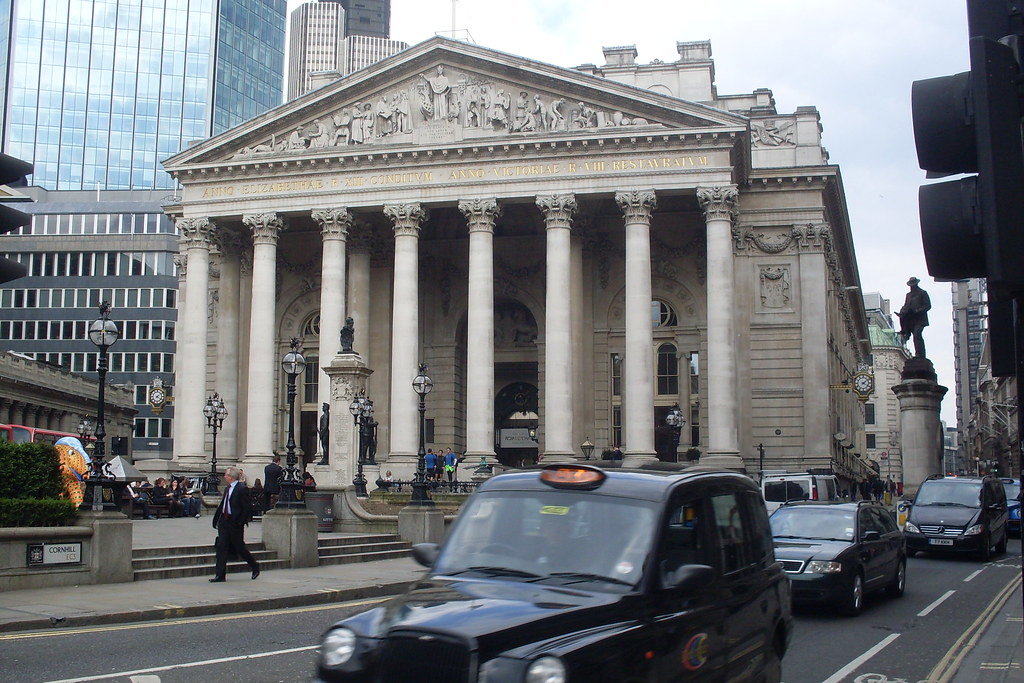
In the past month, we have heard that various rich and well-connected people have had their bank accounts closed, seemingly because of their dissident political opinions. The same has happened to other people who are much poorer and without connections. Twenty years ago, the same happened to the British National Party. There is a simple libertarian response to this.

No one has the right to coerced association with anyone else. If someone comes to me and asks me to provide him with services, I have an absolute right to say yes or no. If I am uncharitable enough to dislike the colour of his face or what he does in bed, so much the worse. I may lose valuable business. But it is my time, and it is my choice. If anyone starts a whine about the horrors of discrimination, he should be ignored. We have an absolute right to discriminate against others for any reason whatever.

This being said, the position becomes less clear when state power of some kind is involved. Banks in this country require a licence from the State to operate. This protects them from open competition. It also gives them access to services and information from the State that are not given to other persons or businesses. If a bank finds itself in serious financial difficulties, it has at least a greater chance than other large businesses of being saved by the State – by a coordination of support by others or by direct financial help. The State has also made it illegal for many transactions to be made in cash. If I try to buy a car with £20,000 in cash, the car dealership is obliged to refuse my business, or to make so many enquiries that accepting my business is too much trouble. In effect, anyone who wants to spend more than a few thousand pounds in cash is obliged by various actual and shadow laws to use a bank account.

So we have privileged corporations and an effective legal obligation for people to do business with them. This entirely changes the libertarian indifference to commercial discrimination. The banks are a privileged oligopoly. The banks compete for custom among a public that is free to choose one bank rather than another, but that is compelled to choose some bank. For this reason, since the relevant laws will not be repealed, it is legitimate to demand another law to offset some of the effects of the others. Banks should be legally obliged to accept the business of any person or group of persons without question. Limitations on what services are provided must be justified on the grounds of previous financial misconduct as reasonably defined. For example, it should be permitted for a bank to refuse an overdraft to someone who is or has recently been bankrupt, or whose spending habits are obviously reckless. Perhaps it should be permitted for a bank to refuse to lend money for purposes it regards as scandalous as well as commercially unviable. Therefore, a representative of the White Persons’ Supremacy Foundation, or the Vladimir Putin Appreciation Society, should be able to walk into any bank and open an account – with no questions asked. If an account is refused, there should be a legal obligation on the bank to provide a full explanation of the refusal. If the refusal is not made on valid commercial grounds, there should be a right of appeal before a tribunal which does not award costs, and this tribunal should have the power to grant punitive damages against any bank found to be discriminating on any grounds but the validly commercial.

The refusal of banking services is only the beginning of a new and sophisticated totalitarianism. What the banks can do can also be done by supermarkets, by Internet service providers, by hotel chains, by airlines and railway companies, and by utility providers. There is indeed a good case for insisting on a law forbidding any organisation that has the privilege of limited liability from any but obviously commercial discrimination.

“… the Western world is failing — culturally and economically — because the government now has a hand in so much of society”

The Armchair General would almost certainly agree with my frequent lament that the more the government tries to do, the less well it does everything:

There is a famous quote by American journalist and satirist H.L. Menken, which has been deployed by many political writers over the years:

    The whole aim of practical politics is to keep the populace alarmed (and hence clamorous to be led to safety) by an endless series of hobgoblins, most of them imaginary.

It is an enduring quote because it has the ring of truth1, and it certainly fits with the Machiavellian aspect of politics. This attitude was, without doubt, deployed by governments across the world during Covid (and, to some extent, still is).

Your jaundiced2 General would like to propose a related, alternative and rather more plausible soundbite that, I believe, more adequately describes the Western world in the twenty-first century:

    The whole consequence of practical politics is the keep the ignorant populace alarmed (and hence clamorous to be kept in comfort) by an endless series of colossal fuck-ups, labelled as crises, caused entirely by the government.3

Every time that you see the media whipping up a frenzy about a “crisis“, you can be 99% sure that the issue in question has been caused by the state — and that the real solution is to remove the government intervention. And that is never, ever the action actually proposed.

Crises of Government Origin
Your jaundiced General refers to these phenomena as “Crises of Government Origin” (COGO), and will form the back-bone of a series of posts titled with that acronym. Many of the issues are interlinked, and most are absolutely critical if we are ever to confront the economic and social issues facing us today.

These include (but are not limited to):

  • the energy crisis;
  • the Climate Warming / Change / Heating crisis;
  • the housing crisis;
  • the NHS staffing crisis;
  • the police shortage crisis;
  • the obesity crisis;
  • the education crisis;
  • the pandemic crisis;
  • the productivity crisis;
  • the activist “charity” crisis;
  • the drugs crisis (Scottish edition);
  • the rape gang crisis;
  • the intersectional and gender crisis;
  • just about any other “crisis” you can think of.

To be sure, the UK government is not the worst in some of these areas — but, since it is in UK that my comfy leather armchair is situated, it is the rampant stupidity of our own governments that I shall concentrate on. And no, not all of these posts will include reminding people that Grant Schapps is a prick.

I can promise that every one of them will include illustrations demonstrating the mind-gargling incompetence of our governments (of all persuasions) and “Rolls Royce” civil service4.

The law is a blunt instrument, and the government is really inefficient at doing anything at all.

Fundamentally, the Western world is failing — culturally and economically — because the government now has a hand in so much of society. And the UK is in the vanguard of this malaise as Sharon White, at the time Permanent Secretary to the Treasury (and currently fucking things up in typically Rolls Royce civil servant fashion at John Lewis), said (in a rare example of her being right) in 2015 at the Institute for Government:

    The UK is “almost the most centralised developed country in the world”.

Indeed it has been observed that, by some measures, the UK is more centralised than Soviet Russia. This is why we are failing.

The Crises Of Government Origin (COGO) series aims to examine some of these failures — large and small. For starters, let’s have a look at Hate Speech laws and why they are so dangerous.


    1. The same applies to Menken’s definition of Puritanism: “The haunting fear that someone, somewhere, may be happy”.

    2. Caused less by poor mood than incipient liver failure. Now pass the port, would you, old chap. No, to the left, you fool!

    3. Yes, yes — I realise that it needs honing, but it will do for now. Feel free to submit more elegant versions in the comments.

    4. Snork.

Barbara Kay – “[M]any Canadians [suffer] from highly contagious, patriotism-suppressive Post National Syndrome”

Canadians are deluged with messages that imply — or explicitly demand — that they should be ashamed of Canada and of being Canadians. That there is nothing to celebrate in our history or cultural achievements and instead we should humbly beseech forgiveness for our many, many, many sins. Barbara Kay disagrees:

On Canada Day, near St. Sauveur, Quebec, we were treated to torrential rain, hail, nearby tornado warnings, and continually flickering power. Not a day for fireworks. Just as well, since fireworks are the last thing one craves when one suffers, as many Canadians do, from highly contagious, patriotism-suppressive Post Nationalism Syndrome.

This scourge cannot yet be cured, since it was intentionally cultivated and released into the environment by the current government. Only herd immunity can end it. However, the symptoms of Post Nationalism Syndrome can be alleviated by certain traditional antivirals, like National Postism. Last Saturday’s NP featured several commentaries that buoyed my spirits, in particular Michael Higgins’s misery-loves-company column, “Stop shaming and start celebrating Canada”.

Higgins enumerates recent examples from a tiresome litany of complaints by our elites that “want to turn us into a nation of self-flagellating penitents”. The National Gallery of Canada insinuates that Canada’s iconic artists, the Group of Seven, are linked to white supremacy; a parliamentary motion endorses the residential school system as “genocide”; the attorney general actively considers legal sanctions against “denialism” — dissent from genocide as a proper descriptor (including me); and the erasure of Sir John A. Macdonald’s name from the eponymous Parkway.

In a nearby feature, the false claim that Macdonald was a guilty party in the alleged schools genocide was handily demolished by lawyer Greg Piasetzki, titled, “John A. Macdonald saved more indigenous lives than any other prime minister”. This evidence-based rejoinder to sticky defamatory myths about Macdonald is an excerpt from a new book of essays by 20 writers, The 1867 Project: Why Canada Should be Cherished — Not Cancelled, published by the Aristotle Foundation, and edited by its founder and president, Mark Milke. 

Piasetzki’s essay mirrors the 19 others in its forthright challenge of our culture’s reigning anti-western dogmas, which brand Canada as a failed nation. Every author encourages the pride in being Canadian that has not dared to speak its name since Justin Trudeau came to power. I highly recommend it. If enough Canadians read it, we might arrive at herd immunity to Post Nationalism Syndrome.

QotD: Liberal and conservative views on innovation

Filed under: History, Liberty, Politics, Quotations, Technology — Tags: , , , , — Nicholas @ 01:00

Liberals and conservatives don’t just vote for different parties — they are different kinds of people. They differ psychologically in ways that are consistent across geography and culture. For example, liberals measure higher on traits like “openness to new experience” and seek out novelty. Conservatives prefer order and predictability. Their attachment to the status quo is an impediment to the re-ordering of society around new technology. Meanwhile, the technologists of Silicon Valley, while suspicious of government regulation, are still some of the most liberal people in the country. Not all liberals are techno-optimists, but virtually all techno-optimists are liberals.

A debate on the merits of change between these two psychological profiles helps guarantee that change benefits society instead of ruining it. Conservatives act as gatekeepers enforcing quality control on the ideas of progressives, ultimately letting in the good ones (like democracy) and keeping out the bad ones (like Marxism). Conservatives have often been wrong in their opposition to good ideas, but the need to win over a critical mass of them ensures that only the best-supported changes are implemented. Curiously, when the change in question is technological rather than social, this debate process is neutered. Instead, we get “inevitablism” — the insistence that opposition to technological change is illegitimate because it will happen regardless of what we want, as if we were captives of history instead of its shapers.

This attitude is all the more bizarre because it hasn’t always been true. When nuclear technology threatened Armageddon, we did what was necessary to limit it to the best of our ability. It may be that AI or automation causes social Armageddon. No one really knows — but if the pessimists are right, will we still have it in us to respond accordingly? It seems like the command of the optimists to lay back and “trust our history” has the upper hand.

Conservative critics of change have often been comically wrong — just like optimists. That’s ultimately not so interesting, because humans can’t predict the future. More interesting have been the times when the predictions of the critics actually came true. The Luddites were skilled artisans who feared that industrial technology would destroy their way of life and replace their high-status craft with factory drudgery. They were right. Twentieth century moralists feared that the automobile would facilitate dating and casual sex. They were right. They erred not in their predictions, but in their belief that the predicted effects were incompatible with a good society. That requires us to have a debate on the merits — about the meaning of the good life.

Nicholas Phillips, “The Fallacy of Techno-Optimism”, Quillette, 2019-06-06.

July 9, 2023

“… corporations sit in the late adopter phase of the marketing curve”

Filed under: Business, Media, Politics, USA — Tags: , , , , , — Nicholas @ 03:00

Elizabeth Nickson reminds us that the mass media corporate messaging is trailing edge, not leading edge:

Now everything is filtered through a warped looking glass, a Mad Hatter tea party of nonsense, run by the grimmest socialist operatives who ever lived, backed by buckets and wheelbarrows of stupid corporatist/fascist money. They are running a demoralization program on us.

It’s not working.

Never forget that corporations sit in the late adopter phase of the marketing curve, which is to say the lifeless part, the raking-in-the-money-from-stupid-women part. Women too, as a class, are part of the late adopter curve, because as Jordan Peterson once pointed out, women instinctively see humans as helpless babies needing protection and SAFETY FIRST. We are easily manipulated by our compassion, as is clear from the fact that only women and those who want to be, support the left now. The left traffics faux compassion and it is a killer drug. Included of course are beta males, hornswoggled by mommy, the wet diaper babies of Antifa and BLM. And of course, the paid operatives of the stinking cabal, the truly horrid public sector unions, the vicious thugs at AFL-CIO and the humanity-hating environmental movement.

The people the left cultivated so carefully over several generations have all fled to populism and eventually their vicious operatives won’t even be able to steal the votes they need. How big is it? Imagine 2000 Trump rallies. And then ten times that. And then quadruple it. Double and double and double again. And they are having the best time, more fun than you can imagine, working away in obscurity, asserting their human right to determine their own future.

[…]

Normals have turned, all of them. They are not available to the Trudeaus, Macrons and Rishi Sunaks of the world. They are wised up. Some of them know more than me about the filth at the heart of “environmentalism” and I know a lot. They are not Russian serfs or Chinese peasants. There is no way they are going to be corralled in 15 minute cities. They are going to bring the house down.

They/we are the people that Richard Haas, when resigning from the Council of Foreign Relations, a nest of nasty neo-liberal, neo-con oppressors if there ever was one, warned against when he said the greatest threat facing the world is American populists. Sure, buddy.

One of the those dreadful people (as they call us) is Kevin Fernandes82 on Instagram. Probably not his real name, but he is not aiming for public recognition. What he does, methodically, every day many times, is chronicle the slow crumbling of the old regime. I am using a lot of his reporting and as he shows, we are beating the pants off them every single day.

Their jobs are untenable. People are resigning from every safe berth in the world or being fired from plush jobs because the world the neo-liberal hegemon has created is counter-rational, so chaotic, it is unstable. It is unstable because we know it is stupid. We are opposed. And our opposition is slowly slowly bringing it down.

This is long. You don’t have to read it all to get the point, but give it to the despairing, keep it for when you despair. All these wins happened in the last two weeks. People, judges and administrators and politicians within the system, are starting to dance to the populist tune. Many of the worst are running as fast as they can.

We are the future.

Time to start thinking about what we want the new world to look like.

Herewith:

The Sound of Freedom has outsold the new Indiana Jones film, on 2,000 fewer screens and with no PR, against the full force of the Hollywood machine.

The Dutch government has reportedly fallen over asylum policy. Farms confiscation is wildly unpopular. Mark Rutte, architect of the prosecution of farmers has resigned.

The decoupling of the BRICS from the dollar means the death of the neo-liberal hegemon. Mark Wauk and Tom Luongo do a neat job of wrapping up this particular mess. As they say: there are no neo-liberals in a multi-polar, decoupled world.

The BRICS are set to introduce a new currency backed by gold, against the US backed dollar which depreciates in value every day because of inflation caused by choking energy supply and crazed overspending by governments.

EU laws that let banks shut accounts over political views to be scrapped.

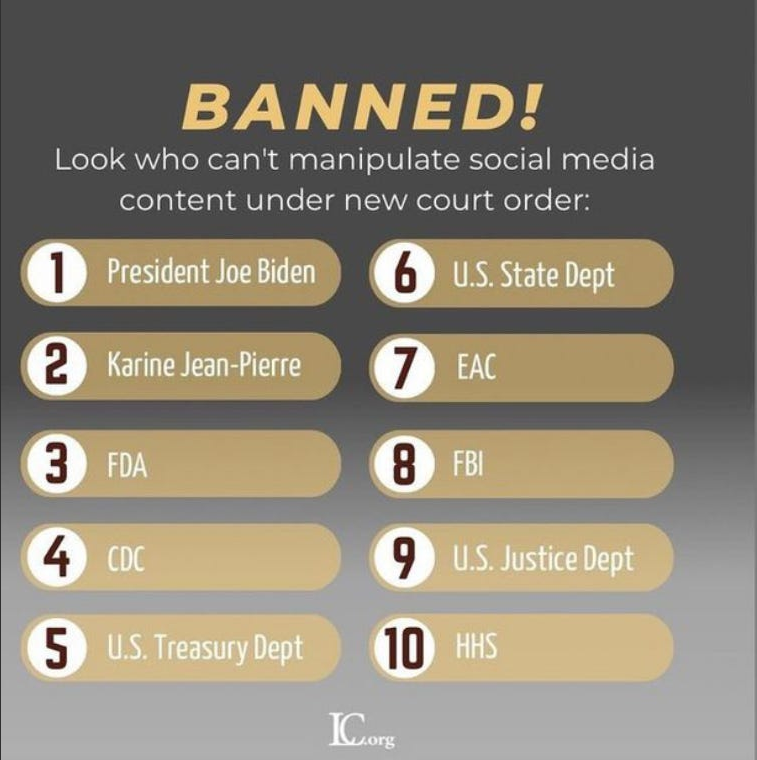
Federal judge in Louisiana prohibits DHS, FBI and DOJ from working with Big Tech to censor posts.

The list goes on for quite a lot longer…

July 8, 2023

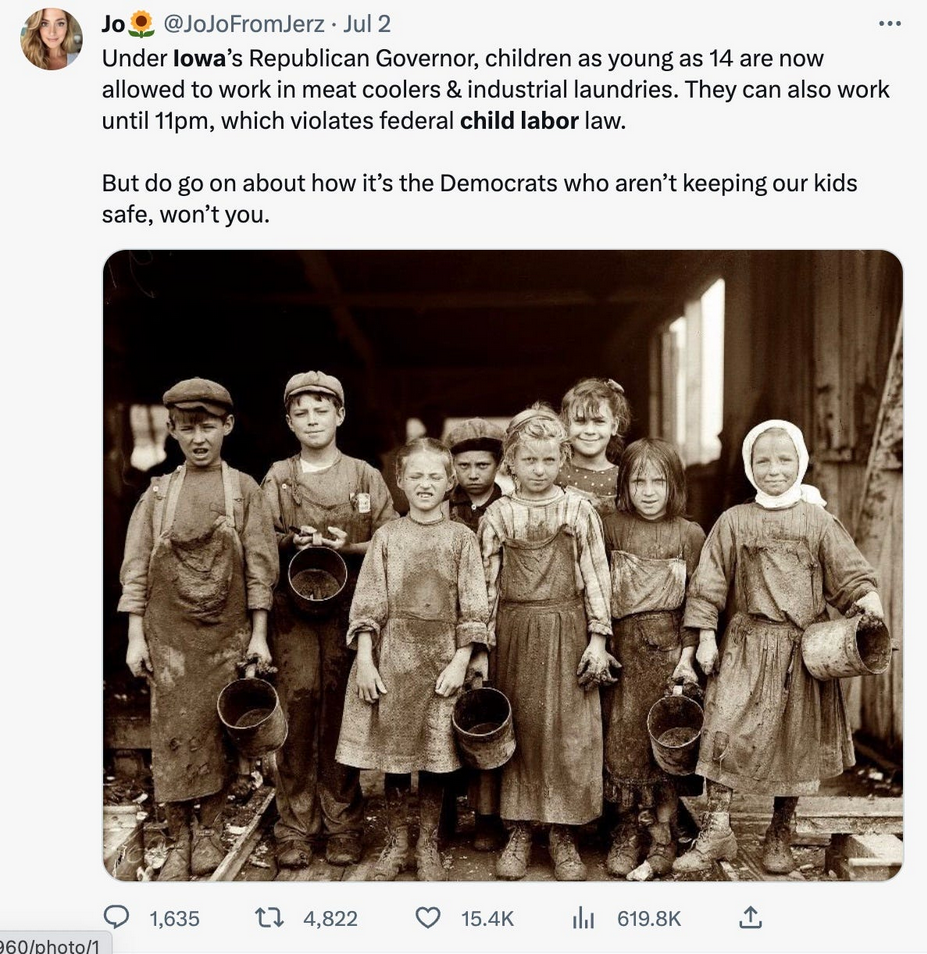
Iowa votes to re-impose child labour in ways that violate federal labour laws

Filed under: Business, Government, Law, Politics, USA — Tags: , , , — Nicholas @ 05:00

Chris Bray covers the breathless excitement of national media covering recent changes to Iowa labour laws:

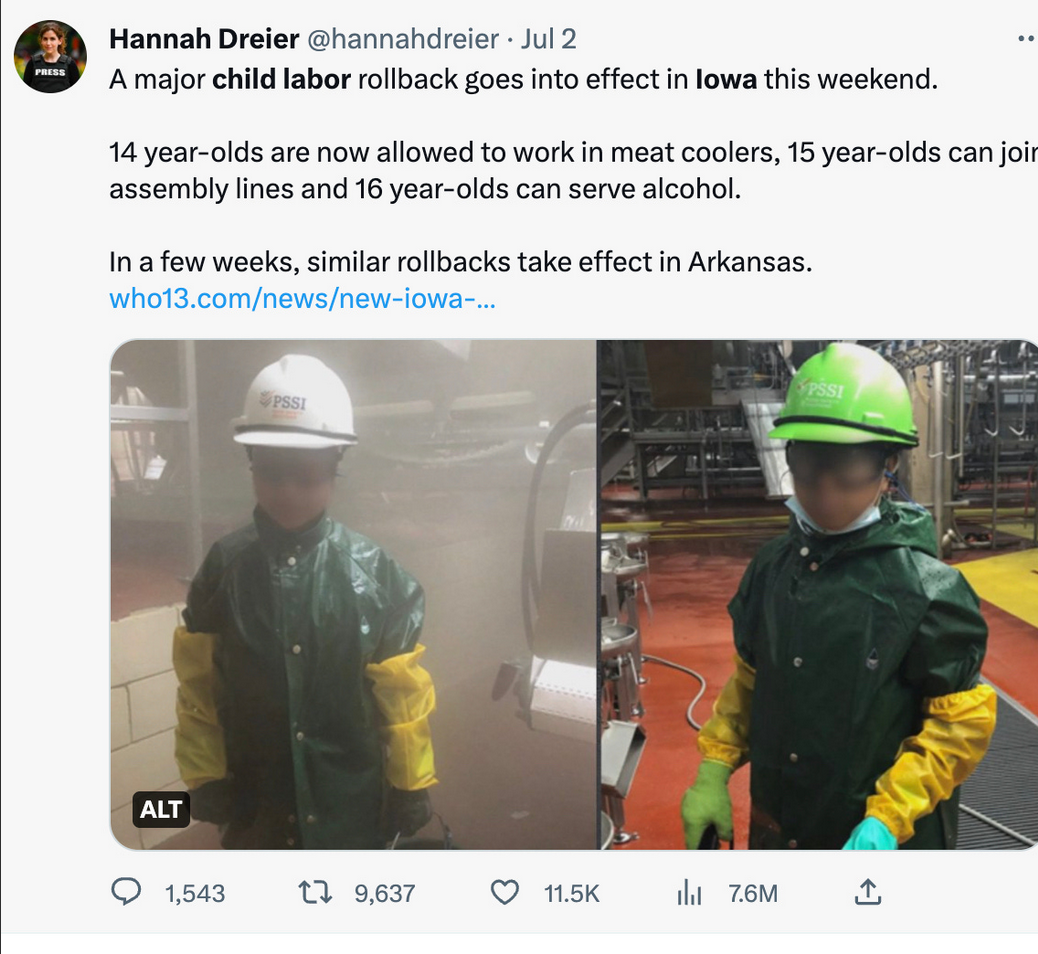
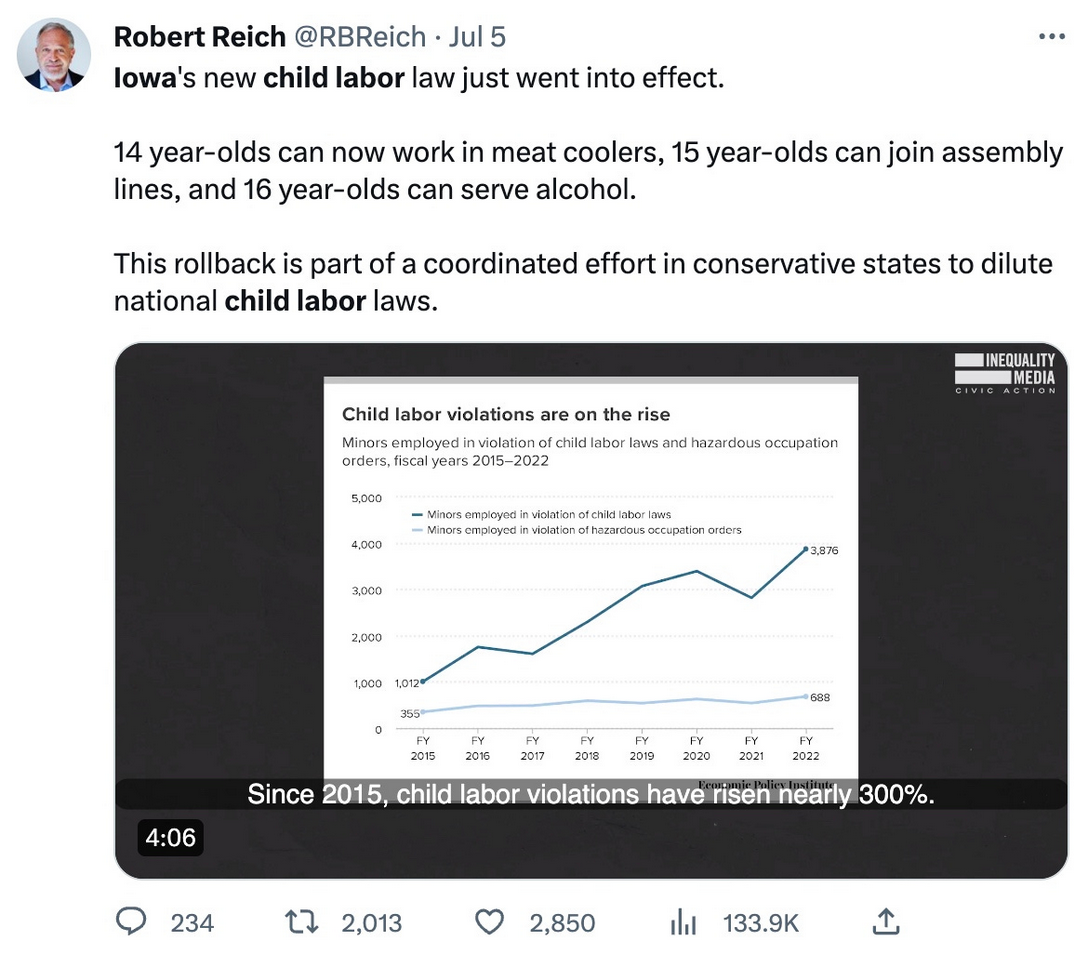
Suddenly, though, this message is all over social media:

These messages are not exactly false, and not entirely true. They take note of a real development, but strip away all the limits and caveats to fake up the creation of a 21st-century Upton Sinclair novel. But the effects of this successful legislation — this is where it gets complicated.

Start here (or here) with Iowa Senate File 542: signed into law in May, took effect on July 1. A bunch of the first-glance shocking details are more complicated than the outrage-farming Twitter takes suggest: 16 year-olds can serve alcohol in restaurants, with at least two adults to supervise, but not in bars; 15 year-olds can work on assembly lines in school-based work training programs, with parental permission; teenagers can work until 11 p.m. in the summer, but not during the school year. Allowing a 16 year-old coffee shop waitress to bring you a beer strikes me as … not the end of the world?

But all of those details aside, the new Iowa law expands child labor (while ending some earlier measures allowing even younger workers to do a few jobs like migrant farm labor), and will, in fact, put 14 year-olds to work in what will look a great deal like adult settings. So red state legislatures are expanding child labor at the moment they’re banning gender mutila— uh, gender-affirming medical care for teenagers, and making that latter choice on the highly defensible grounds that teenagers lack the maturity to make decisions like that. So a 15 year-old working in a factory lacks the maturity to make adult decisions, is where we end up when we put all of this together.

July 7, 2023

Justin Trudeau says that Canada is merely defending itself from the “attack” by Facebook

Filed under: Business, Cancon, Government, Law, Media, Politics — Tags: , , , , — Nicholas @ 03:00

Prime Minister Justin Trudeau has never faced a situation he couldn’t get histrionic about:

The government escalated the battle over Bill C-18 yesterday, announcing that it was suspending advertising on Meta’s Facebook and Instagram platforms due the company’s decision to comply with the bill by blocking news sharing and its reluctance to engage in further negotiations on the issue. While the ad ban applies to federal government advertising, Liberal party officials confirmed they plan to continue political advertising on the social networks, suggesting that principled opposition ends when there might be a political cost involved. At issue is roughly $11 million in annual advertising by the federal government, a sum that pales in comparison to the Parliamentary Budget Officer’s estimate of at least $100 million in payments in Canada for news links from Meta alone.

In addition to raising the economic cost to Meta for stopping news sharing, Prime Minister Justin Trudeau increased the rhetoric, describing Canada as having been “attacked” by Meta and likening the government’s fight over the bill to defending democracy in Ukraine or during the Second World War [at 13:30]:

    Facebook decided that Canada was a small country, small enough that they could reject our asks. They made the wrong choice by deciding to attack Canada. We want to defend democracy. This is what we’re doing across the world, such as supporting Ukraine. This is what we did during the Second World War. This is what we’re doing every single day in the United Nations.

There are strongly held views on both sides of the Bill C-18 debate, but the suggestion that stopping sharing news links on a social network is in any way comparable to World War 2 is embarrassingly hyperbolic and gives the sense of a government that has lost perspective on the issue. Canadian Heritage Minister Pablo Rodriguez has repeatedly described the manner of compliance with Bill C-18 as a business choice for the Internet companies, yet the Prime Minister now calls that choice an attack on the country.

If it were truly comparable to a world war, then surely the Liberal Party (joined by the NDP) would not continue to advertise on the platform. Yet since the 2021 election call, the party alone has run approximately 11,000 ads on Facebook and Instagram. That is separate from individual MPs, who have also run hundreds of ads. The Meta Ad Library provides ample evidence of how reliant the party has been on social media. For example, since the start of the year, Anna Gainey ran over 500 ads as part of her by-election campaign in Quebec. David Hilderley, who was a candidate in the Oxford by-election, ran approximately 180 ads on Facebook during the same timeframe.

July 5, 2023

Intersectionality showdown

Filed under: Education, Media, Politics, USA — Tags: , , , , , — Nicholas @ 04:00

Chris Bray on the major break in progressive solidarity caused by non-white American Muslims’, Ethiopian Christians’, and Peruvian Catholics’ unexpected reaction to woke teachers wanting to sexually indoctrinate their children:

We’re wading through this culture war sewage because we have a political class that’s deliberately pumping it into the culture to keep us from noticing that, how can I put this in a sophisticated way, they suck.

But this really tedious maneuver is increasingly leading to moments like this — and Twitter still won’t let Substack writers embed tweets, so click to watch video, but here’s the substance of the thing:

The fake conflict is increasingly likely to be a dozen sanpaku-eyed AWFL’s against a thousand genuinely multicultural parents, battling over insane questions like the “book bans” that remove highly explicit sexual content from elementary school libraries. In 2023, the culture war is rapidly cooking down to STOP PREVENTING US FROM TALKING TO YOUR EIGHT YEAR-OLDS ABOUT SUCKING DICK, YOU NAZIS.

If you’ve never read what I wrote about Jim Jones and the Peoples Temple, please take a moment to go read this. About 900 people died at Jonestown in 1978, but Jones started in Indianapolis in the 1950s. He moved his church to a rural property in California, and then to Guyana, by constantly telling his parishioners that they were threatened by hostile forces outside the church that were maneuvering to destroy them. The frequent recourse to invented threats is a sign of a sick movement, not a sign of something the grows and flourishes.

That’s where we are. We’re watching a sick thing die. The question, now, is how long it takes to die, and how much damage it does in its death throes. But the increasingly hysterical tone, against an increasingly matter-of-fact response — a thousand parents saying calmly that no, we won’t let you inflict this curriculum on our children — suggests that the inflection point is getting closer.

July 4, 2023

QotD: The (arguments over the) founding of America

Filed under: History, Liberty, Politics, Quotations, USA — Tags: , , , , — Nicholas @ 01:00

You could of course say that the ideals of universal equality and individual liberty in the Declaration of Independence were belied and contradicted in 1776 by the unconscionable fact of widespread slavery, but that’s very different than saying that the ideals themselves were false. (They were, in fact, the most revolutionary leap forward for human freedom in history.) You could say the ideals, though admirable and true, were not realized fully in fact at the time, and that it took centuries and an insanely bloody civil war to bring about their fruition. But that would be conventional wisdom — or simply the central theme of President Barack Obama’s vision of the arc of justice in the unfolding of the United States.

No, in its ambitious and often excellent 1619 Project, the New York Times wants to do more than that. So it insists that the very ideals were false from the get-go — and tells us this before anything else. Even though those ideals eventually led to the emancipation of slaves and the slow, uneven and incomplete attempt to realize racial equality over the succeeding centuries, they were still “false when they were written”. America was not founded in defense of liberty and equality against monarchy, while hypocritically ignoring the massive question of slavery. It was founded in defense of slavery and white supremacy, which was masked by highfalutin’ rhetoric about universal freedom. That’s the subtext of the entire project, and often, also, the actual text.

Hence the replacing of 1776 (or even 1620 when the pilgrims first showed up) with 1619 as the “true” founding. “True” is a strong word. 1776, the authors imply, is a smoke-screen to distract you from the overwhelming reality of white supremacy as America’s “true” identity. “We may never have revolted against Britain if the founders had not understood that slavery empowered them to do so; nor if they had not believed that independence was required in order to ensure that slavery would continue. It is not incidental that 10 of this nation’s first 12 presidents were enslavers, and some might argue that this nation was founded not as a democracy but as a slavocracy,” Hannah-Jones writes. That’s a nice little displacement there: “some might argue”. In fact, Nikole Hannah-Jones is arguing it, almost every essay in the project assumes it — and the New York Times is emphatically and institutionally endorsing it.

Hence the insistence that everything about America today is related to that same slavocracy — biased medicine, brutal economics, confounding traffic, destructive financial crises, the 2016 election, and even our expanding waistlines! Am I exaggerating? The NYT editorializes: “No aspect of the country that would be formed here has been untouched by the years of slavery that followed … it is finally time to tell our story truthfully”. Finally! All previous accounts of American history have essentially been white lies, the NYT tells us, literally and figuratively. All that rhetoric about liberty, progress, prosperity, toleration was a distraction in order to perpetrate those lies, and make white people feel better about themselves.

Andrew Sullivan, “The New York Times Has Abandoned Liberalism for Activism”, New York, 2019-09-13.

June 28, 2023

QotD: Freud and modern Feminism

Filed under: Health, Politics, Quotations — Tags: , , , , — Nicholas @ 01:00

I recently came across an article about Sigmund Freud’s theory of female psycho-sexual development, in which Taylor Kubota described penis envy as follows: “Women become envious of penises at a young age, when they realize boys derive more sexual pleasure from their penises than girls do from their own sexual organs. Freud said this penis envy grows over time.” This idea, which I had long disregarded and which didn’t correspond to my own experience (as a child I never saw or thought of boys’ penises; as a young woman I had no sense of lack) makes sense now in light of feminism’s decades-long attack on male sexuality. The attack is based, as feminists’ own words and policies indicate, on a febrile mix of resentment, envy, and projection in which the belief that men enjoy sex more than women (and that the enjoyment hurts women, in the typical zero-sum thinking of feminism) has fueled ever-more frenzied attempts at male neutering.

Serious psychotherapists or students of Freud should probably stop reading right now, as I am not attempting a genuine psychoanalytic analysis of feminism or indeed of penis envy, which has been widely dismissed as sexist or justified as women’s accurate recognition of men’s power. My theory — if it deserves that name — stems from the recognition that anti-sex feminism, involving the continual projection onto men of female sexual anxieties and discontents, has a far more extensive pedigree than most people realize, and that much feminist discussion and activism today take for granted that law and public policy are rightly directed towards “equalizing” not only rights or opportunities but also sexual experience itself, by prioritizing female pleasure and diminishing male.

It’s no revelation that many feminist-influenced women are hyper-alert to male advantage while being willfully blind to male disadvantage. In the arena of sexuality, where male and female most intimately and yet mysteriously interact, the irrational ferocity of feminist grievance-mongering reveals itself tellingly. Unwilling and unable to extend sympathetic understanding to male sexual difference, feminist ideology authorizes an envy-fueled anger that far surpasses legitimate caution.

A word about that legitimate caution. Throughout history, well-functioning societies have recognized the threat to civil order — and to women’s safety in particular — of male lust, and have passed laws and constructed codes of behavior to contain and direct it. Fathers and husbands have always been interested in protecting their womenfolk from sexual violence. Feminists, however, while exalting female sexuality as benign and beautiful, have repeatedly refused to recognize any manifestation of male sexuality as good. A mere glance at prominent feminist claims and policy initiatives highlights their continual misrepresentations.

Janice Fiamengo, “Do Feminists Suffer From Penis Envy?”, The Fiamengo File, 2023-03-26.

June 27, 2023

“People’s patience in the face of the daily elitist provocations of Just Stop Oil is nothing short of Herculean”

The virtue-signalling lunatics of the various Extinction Rebellion sub-groups depend far more than they realize on the patience and tolerance of ordinary Britons who are just trying to get on with their daily lives. Wealthy, highly educated, privileged scions of the well-connected may very quickly learn that the well of tolerance they’re drawing from can run dry extremely quickly. Brendan O’Neill says even some of the movers and shakers of the donor class are starting realize the dangers their protest foot soldiers are running:

“Just Stop Oil Courtauld Gallery 30062022” by Just Stop Oil is licensed under CC BY-SA 4.0 .

So even one of Just Stop Oil’s wealthy donors is tiring of its classist stunts. Trevor Neilson, a co-founder of the Climate Emergency Fund, which has pumped money into Just Stop Oil, says the eco-irritants’ funereal, road-blocking marches for Mother Earth increasingly come off as “disruption for the sake of disruption“. You have “working people that are trying to get to their job, get their kid dropped off at school [and] survive a brutal cost-of-living crisis”, he says, and then along comes a “pink-haired, tattooed and pierced protester standing in front of their car”. It pisses people off, he said.

He’s not wrong. Anyone with eyes in their head can see that Just Stop Oil, and its mother movement Extinction Rebellion, is riling the workers of Britain. Imagine you’re trying to get to work to earn a crust in tough times and up pops a privately educated, possibly non-binary loon with multi-coloured hair to tell you in a voice breaking with juvenile emotion that Judgement Day is coming. The fainthearts of the liberal media are always aghast when an angry scaffolder or stressed trucker drags one of the green hysterics off the road, but I’m blown away by the restraint of the British public. People’s patience in the face of the daily elitist provocations of Just Stop Oil is nothing short of Herculean.

It is “counterproductive”, says Mr Neilson, to have pink-haired sons and daughters of privilege inconveniencing workers during a “brutal” economic downturn. Again, he’s not wrong. The class-war streak in eco-activism is undeniable. Many Extinction Rebellion types are descendants of money. Writer Harry Mount calls them “Econians”, a green twist on “Etonians”. They’re the “public-school boys and girls who rule the wokerati world”. A survey of 6,000 XR activists who brought London to a halt in April 2019 found they were “overwhelmingly middle-class [and] highly educated”. Anyone who walked through London that month will have heard “Cut carbon emissions!” being cried in cut-glass tones and understood right away that our great city was under siege by vengeful aristocrats still smarting from the Industrial Revolution.

Adam Kinzinger seems to admit that the “Patriot Front” are really federal agents

Filed under: Media, Politics, USA — Tags: , , — Nicholas @ 04:00

Tom Knighton on the weird MAGA-versus-“MAGA” confrontation:

A while back, a group calling itself Patriot Front showed up. Dressed in dark shirts and khaki pants, with ball caps and masks hiding their face, Patriot Front started engaging in some very … questionable behavior.

Almost immediately, they were labeled as feds.

Virtually no one believed they were who they claimed to be. They were openly Nazi-like, even providing the Hitler salute, all without the usual trappings of the neo-Nazis we typically see.

Well, recently, the Proud Boys clashed with Patriot Front.

The Proud Boys have been accused of being all kinds of things, too, including racists, yet it’s clear from the video shown that the Proud Boys aren’t fans of Patriot Front. Instead, you hear jeers calling them “racists” and “Nazis”.

The altercation got physical and a couple of the Patriot Front members were unmasked.

Enter former Congressman Adam Kinzinger, who offered up this hot take:

The video shown there is, in fact, the video in question, and Kinzinger’s comments have riled a lot of people up.

After all, he’s basically admitting that Patriot Front is a federal law enforcement operation.

Is it?

Probably, though I’m not sure Kinzinger would be read in on such an operation.

QotD: Nelson Mandela, Thabo Mbeki, and the ANC

Needless to say, this is not the story that Western media was telling me about South Africa in the late 90s. Rather they were focused on the dashing and heroic figure of Nelson Mandela. Speaking of which, where exactly was Mandela while all this was going on? Flying around Europe and America getting fêted by celebrities, mostly, and getting sidelined by his much nastier but more effective comrades, including his wife (soon to be ex-wife) Winnie. Mandela may have been president, but he barely had control over his own cabinet, let alone the country. As one of his comrades from the Robben Island prison put it: “there is something very simple and childlike about him. His moral authority, the strength of his principles and his generosity of spirit are all derived from that simplicity. But he will be easily manipulated by those who are quicker, more subtle, and more sophisticated.”

The impression Johnson gives is very much that of a man in way over his head, and when Mandela did try to assert himself, the results were usually buffoonish:

    He declared that the solution to continuing violence in KwaZulu-Natal was for everyone to join the ANC … In 1995 he told a May Day rally that if the IFP continued to resist the ANC he would cut off all funding to KwaZulu-Natal, the most populous province. This was a completely unconstitutional threat which had to be quickly retracted. Similarly, when he dismissed Winnie from government he failed to read the constitution and thus had to reappoint her and later dismiss her again. Visiting Tanzania, he announced that: “We are going to sideline and even crush all dissident forces in our country.”

Mandela also made a lot of genuinely very big-hearted speeches pitching a “rainbow nation” vision of South Africa and begging whites not to flee the country, but every time the interests of justice conflicted with those of the ANC, he showed himself to be a party man first and foremost. The most revolting examples of this are two incidents in which independent prosecutors were investigating ANC atrocities (in one case a massacre of dozens of protestors, the other case an incident where some Zulus were kept in a cage inside a local ANC party HQ and tortured for months), and Mandela staked the full power of his moral authority on blocking the inquiries. In the case of the massacre, Mandela went so far as to declare that he had ordered the gunmen to shoot, which everybody knew to be a lie, but which meant that any attempt to pursue the coverup would mean taking down Mandela too. Nobody had the stomach to face that prospect, so the prosecutors dropped the case.

If Mandela was a figurehead, then who was really in charge? The answer is the main character of this book: Thabo Mbeki, the deputy president. Mbeki is a villain of almost Shakespearean proportions — paranoid, controlling, obsessive, bad with crowds yet charming in person. Even before Mandela was out of prison, he was already angling for the number two spot, shaping the narrative, quietly interposing himself between the charismatic Nobel peace prize winner and the true levers of power.

This was bad news for South Africa, because in contrast to Mandela’s “rainbow nation” optimism, Mbeki was a committed black nationalist who immediately set about purging whites from the government and looting white wealth, with little regard for whether this might kill the goose that lays the golden eggs. Johnson ascribes a psychological motivation to all this, asserting that Mbeki suffered from a crushing inferiority complex vis-a-vis the white elites, and quoting several truly bizarre and unhinged public speeches in support of his diagnosis. A more prosaic explanation would just be that like many tyrants in the making, Mbeki sought to create and elevate “new men”, men who owed him everything and whose loyalty could thereby be assured.

Whatever the case, Mbeki quickly began to insist that South Africa’s military, corporations, and government agencies bring their racial proportions into exact alignment with the demographic breakdown of the country as a whole. But as Johnson points out, this kind of affirmative action has very different effects in a country like South Africa where 75% of the population is eligible than it does in a country like the United States where only 13% of the population gets a boost. Crudely, an organization can cope with a small percentage of its staff being underqualified, or even dead weight. Sinecures are found for these people, roles where they look important but can’t do too much harm. The overall drag on efficiency is manageable, especially if every other company is working under the same constraints.

John Psmith, “REVIEW: South Africa’s Brave New World, by R.W. Johnson”, Mr. and Mrs. Psmith’s Bookshelf, 2023-03-20.

June 26, 2023

America can’t build anything these days and “it’s all Ralph Nader’s fault”

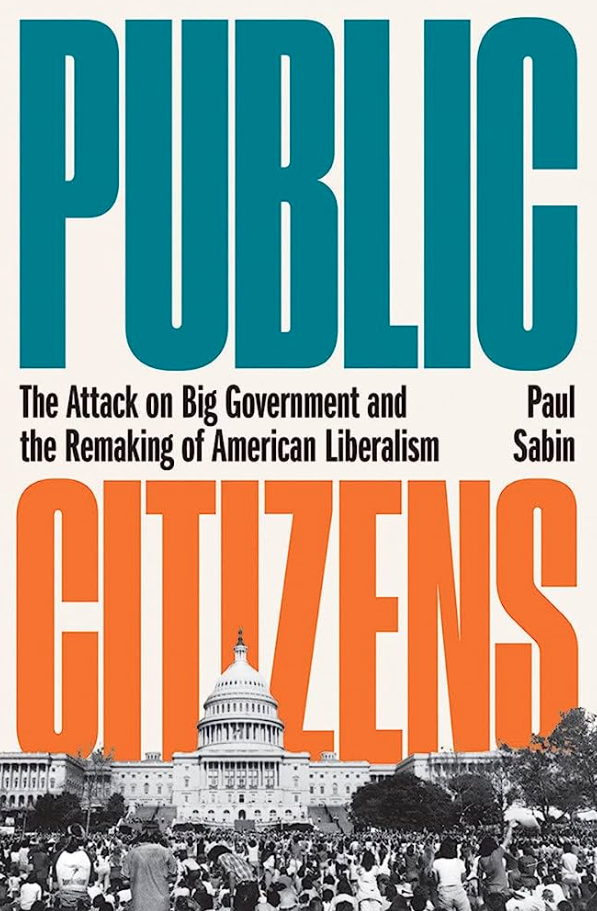
One of the readers of Scott Alexander’s Astral Codex Ten has contributed a review of Public Citizens: The Attack on Big Government and the Remaking of American Liberalism by Paul Sabin. This is one of perhaps a dozen or so anonymous reviews that Scott publishes every year with the readers voting for the best review and the names of the contributors withheld until after the voting is finished:

Today, pundits across the political spectrum bemoan America’s inability to build.

Across the country, NIMBYs and status-quo defenders exploit procedural rules to block new development, giving us a world where it takes longer to get approval for a single new building in San Francisco than it did to build the entire Empire State Building, where so-called “environmental review” is weaponized to block even obviously green initiatives like solar panels, and where new public works projects are completed years late and billions over budget — or, like California’s incredible shrinking high-speed rail, may never be completed at all.

Inevitably, such a complex set of dysfunctions must have an equally complex set of causes. It took us decades to get into this mess, and just as there’s no one simple fix, there’s no one simple inflection point in our history on which we can place all the blame.

But what if there was? What if there was, in fact, a single person we could blame for this entire state of affairs, a patsy from the past at whom we could all point our censorious fingers and shout, “It’s that guy’s fault!”

There is such a person, suggests history professor Paul Sabin in his new book Public Citizens: The Attack on Big Government and the Remaking of American Liberalism. And he isn’t isn’t a mustache-twirling villain — he’s a liberal intellectual. If you know him for anything, it’s probably for being the reason you know what a hanging chad is.

That’s right: it’s all Ralph Nader’s fault.

How’d he do it? By creating what’s now called the public interest movement: a new form of activism through which citizens force change — or, more often, block change — by suing the government. Though it was begun with the best of intentions and achieved some real good along the way, this political innovation led to the constipated governance we all complain about today.

How did a movement launched by an unassuming 30-year-old lawyer become the dominant form of activism in the country, and completely change the way our government operates?

To find out, we have to go back to a time before Ralph Nader had even hit puberty — the era of the New Deal.

[…]

It is the inherent nature of politics that no reform works forever, because the next generation of political entrepreneurs will inevitably discover new ways to bend the process to their will. Eventually, there will always be another Dick Fosbury revealing a way to work the system that no one saw coming.

Still, I do think some of the blame for the way this all panned out can be laid on Nader’s particular personal idiosyncrasies. His ironclad black-and-white view of the world, combined with his near-pathological aversion to dealmaking and compromise, made him uniquely suited to a form of activism that focused on regulatory and legal action rather than coalition-building and electoral politics. Nader was infamously rigid and inflexible, so it’s no surprise that his movement was too. But a less rules-oriented movement might have created fewer of the bureaucratic barriers that have now become a hindrance to progressive action.

Much like the movement whose story it tells, Public Citizens the book is a worthwhile project that nonetheless suffers from significant flaws. The main problem is that it can’t decide if it’s a historical narrative or a work of political theory. As a work of political theory, it doesn’t take nearly a strong enough stand — I’ve made explicit a lot of claims that are only lightly implied in the book. I think we’re making the same argument, but the book makes its argument with such a delicate touch that it’s hard to be 100% sure.

As a historical narrative, Public Citizens has a much simpler problem: it’s boring. The author writes like an academic (which, to be fair, he is), and the book is quite light on colorful details. The uncreative chapter titles (chapter three is called “Creating Public Interest Firms”) give you a taste of what the writing is like. One particularly egregious issue is how little biographical information is provided about Nader, even though the majority of the book is about him. For someone who apparently subscribes to the Great Man theory of history, the author includes surprisingly little information about the Great Men themselves. Any interesting biographical fact you read in this review — even something as basic as the fact that Nader never married—is almost certainly something I found through other sources.

Paradoxically, this book manages to be simultaneously boring and too concise. It’s over in less than 200 generously-spaced pages, and I frequently had to look stuff up on the internet to get a full understanding of what was going on. I get the sense that the author is trying to give this book mass appeal, but come on: anyone who’s willing to read a nerdy book like this is willing to read an additional hundred pages or so. Besides, Robert Caro and Ron Chernow have proven that people will read thousand-page tomes if the story is compelling and the details are juicy.

Basically, my critique of Public Citizens is like that old Catskills joke about the restaurant where the food is terrible — and the portions are too small.

The struggle for equal rights turned into the struggle to oppress others so gradually, most people didn’t notice

Filed under: Media, Politics, USA — Tags: , , , , — Nicholas @ 03:00

From the most recent Weekly Dish by Andrew Sullivan:

Many, many moons ago, when I was a marriage equality pioneer and not a total pariah among the gays, I was asked to speak at the Human Rights Campaign Fund, as it was then called. Determined as ever not to read the room, I said (paraphrasing from memory): “The goal of any civil rights movement should be to shut itself down one day. And once we get marriage equality and military service, those of us in the gay rights movement should throw a party, end the movement, and get on with our lives.”

You can imagine how well that went down. And, sure enough, 30 years later, with marriage, military service and trans equality enshrined in the law, the HRC building now has a massive, six-story high poster hanging on it: “BLACK LIVES MATTER. TRANS BLACK LIVES MATTER.”

That tells us a bit about where we are today, and how we got here.

The point I was making in the early 1990s was that liberalism knows limits. A liberal politics does not seek to impose meaning on everyone; it creates the space for individuals to choose that for themselves. It doesn’t seek to deliver the truth about anything either; it merely provides the mechanisms for the open-ended pursuit of truth. A liberal politics will seek formal equality for members of minorities; but not substantive equality — what is now called “equity”. It would not require us to come to one, single understanding of reality; it would always allow diversity of opinion and encourage free debate. Live and let live. Remember that?

Technically speaking, that makes me a liberal conservative: accepting the reality of liberal modernity (even, in my own case, being happily at home in it), while seeking to limit its illiberal overreach and utopian ambitions. And that was what I tried to sketch out in Virtually Normal. It’s a book less about homosexuality than about politics itself. It’s about a politics of going this far — and no farther. From the NYT review in 1995:

    Mr. Sullivan offers his own prescription for a “politics of homosexuality” that reconciles “the best arguments of liberals and conservatives”. It is a liberal stand, Mr. Sullivan argues, in that it puts a premium on individual liberty and equality before the law, but its requirements would apply only to government policies on homosexuality, avoiding “the regulation of people’s minds and actions” in the private sphere.

Homosexual citizens absolutely deserved equal rights, but the question of homosexuality itself would — and should — always be open to dispute and debate. Since a liberal society contains both fundamentalist preachers as well as lesbian atheists, it cannot resolve the core question. So it shouldn’t try. And it should celebrate, not bemoan, this ideological diversity.

I can see why the religious fundamentalists are queasy with the settlement that came from this. They have to live in a society that accepts civil marriages for couples of the same sex. The deal is that in return, they are free to deny the morality of such marriages, to reserve religious marriage to heterosexual couples, and not be forced to participate in any way. I can also see why queer theorists are queasy as well. They don’t like the heteronormativity of civil marriage, or the respectability politics that goes with it. But they in turn are free to live their lives as “queerly” as they want in society, to create culture that seeks to subvert and radicalize.

This, in the end, is my response to all the “slippery slope” arguments about gay marriage now being raised again on the right. There is no slope in the case I made. There is a clear line: formal legal equality alongside cultural and social freedom on all sides. From my liberal conservative perspective, the gay rights movement should have shut down in 2015 after Obergefell; and the trans rights movement should have shut down in 2020 after Bostock. Once gay men and lesbians and trans people achieved legal and constitutional equality, the fight was over.

But in the movement I was once a part of, many, of course, were not liberals, let alone liberal conservatives — but radicals, who reluctantly went along with marriage equality, but itched to transform society far more comprehensively. And these radicals now control everything in the hollowed-out gay rights apparatus. Their main ticket item is a law that would replace biological sex with gender in the law, and remove protections for religious liberty: smashing the liberal settlement. Combine that with acute polarization in the Trump era, and information silos, so that many gays get their sense of reality from MSNBC and Elton John, and you can see how the spiral into illiberal madness began.

« Newer PostsOlder Posts »

Powered by WordPress