Quotulatiousness

July 15, 2013

Expensive military gear to become piles of scrap

Filed under: Economics, Military, USA — Tags: , , — Nicholas @ 00:01

Strategy Page explains why billions of dollars in military equipment will be scrapped in Afghanistan:

It’s going to cost some $14 billion to deal with $26 billion worth of American equipment in Afghanistan. Half that cost will be for shipping gear out, but the other $7 billion will be the cost of equipment not worth shipping home and either destroyed or donated to the Afghans. About 78,000 tons of gear will be destroyed, including over 2,000 armored vehicles. Some has to be moved, given to the Afghan security forces, sold locally or destroyed. About 9,000 MRAPs will be sent back to the United States.

Unlike Iraq, where heavy stuff, like armored vehicles and trucks, could simply drive to a nearby port and put on a ship, Afghanistan has no ports. The nearest ones are in Pakistan and the road trip is expensive and dangerous because of the theft and the threat of attacks (by terrorists or gangsters seeking “protection” fees). So a lot more gear will be flown out of Afghanistan, which is quite expensive. The current plan calls for 28,000 vehicles and 20,000 shipping containers of gear are to be moved by the end of 2014.

The U.S. and NATO supplies coming in (or going out) via railroad from Western Europe, go through Ukraine, Belarus, Russia, Kazakhstan and Uzbekistan, to Afghanistan. This approach costs $400 a ton to move material to or from Afghanistan, versus three times that to truck it in from Pakistani ports, or $14,000 a ton to fly stuff in, or $10,000 a ton if you just fly material in from a friendly (Persian Gulf) port. For example, $600,000 MRAPs (Mine Resistant Ambush Protected) cost $140,000 to fly in from the Gulf. Some 2,000 of these MRAPs in Afghanistan are no longer needed by the United States or the Afghan forces so are being cut up for scrap in Afghanistan.

July 14, 2013

“The very definition of grand strategy is holding ends and means in balance to promote the security and interests of the state”

Filed under: Middle East, Military, USA — Tags: , , , — Nicholas @ 11:18

At the Anti-War blog, John Glaser looks at the ongoing costs of empire:

In Foreign Affairs, Michael O’Hanlon and Bruce Riedel suggest a cost-saving measure for America’s empire in the Middle East: opening more U.S. military bases in the region. Instead of relying as it has on expensive “aircraft carriers in and near the Persian Gulf,” the U.S. should move its military presence back onto land in at least three different Gulf states.

The primary purpose of having U.S. military bases peppered throughout the Middle East has traditionally been to exert control over geo-politically vital oil-rich countries and to allow for a rapid and coordinated use of military force at Washington’s command. As a Top Secret National Security Council briefing put it in 1954, “the Near East is of great strategic, political, and economic importance,” as it “contains the greatest petroleum resources in the world” as well as “essential locations for strategic military bases in any world conflict.”

O’Hanlon and Riedel don’t even consider the legitimacy of America’s military presence in the Middle East; for them, it is a natural law that can’t be questioned. So when faced with strained budgets that can’t support a sprawling, costly, and unwarranted empire, they try to figure minor cost cutting measures around the edges instead of reevaluating our military postures as a whole.

A CSIS report last year took a different tack, arguing that “disappearing finances; rising alternative power centers; declining US military predominance; lack of efficacy of key non-military instruments of power; and reduced domestic patience for global adventures,” all require a rethinking of U.S. grand strategy with an eye towards roll-back.

    The very definition of grand strategy is holding ends and means in balance to promote the security and interests of the state. Yet, the post-war US approach to strategy is rapidly becoming insolvent and unsustainable – not only because Washington can no longer afford it but also, crucially, because it presumes an American relationship with friends, allies, and rivals that is the hallmark of a bygone era. If Washington continues to cling to its existing role on the premise that the international order depends upon it, the result will be increasing resistance, economic ruin, and strategic failure.

That first sentence there is one of the most honest you’ll ever see from an elite DC foreign policy think tank. U.S. foreign policy is ultimately promoting “the security and interests of the state.” It isn’t for your sake. It benefits the government and the private interests aligned with it.

July 12, 2013

Mapping the latest British defence “disgrace”

Filed under: Britain, Germany, Military — Tags: , , — Nicholas @ 14:06

Sir Humphrey on the mapping uproar:

Several UK newspapers reported this week the findings of the UK Parliaments Intelligence & Security Committee report that during OP ELLAMY, the UK had relied on Germany to provide mapping for the RAF to conduct its missions. This was apparently a disgraceful sign of a nation in decline and that we should all be jolly ashamed of ourselves.

The reality (as ever!) is a little different and one worth thinking about. Maps are something that we all take for granted in our daily lives, and they are an utterly indispensable part of modern military operations (even in the hands of a newly appointed young officer). We perhaps take for granted the information on them, without considering how it is obtained. In the UK the Ordnance Survey has over many hundreds of years done a phenomenal job of providing accurate information almost down to the last manhole cover about what lies where. At sea the Hydrographic Service has similarly spent many hundreds of years charting the oceans and waters of the planet — it is not an exaggeration to say that in some of the more remote parts of the globe, the only charts in use date back to the surveys done by Captain Cook or other explorers. As a national asset the Hydrographic Office in particular is absolutely priceless — very few nations run credible hydrographic programmes beyond the UK, US, Russia and China. The Royal Navy, with its extremely effective and very hard worked survey fleet has been able to become a global leader in providing accurate chart information to the world — indeed many countries are enormously reliant on the UK for providing charts for their warships.

But, to put a map or chart together is an enormously complicated piece of work which takes a lot of time and effort. No country on earth currently has the resources to provide a truly global and accurate mapping capability of all the nations and areas that it may need military mapping for. Its not just a case of putting down some generic top level mapping and hoping that’s enough — modern military operations require a lot of detail, and to be able to work effectively, mapping is needed at a very high level of detail. When it comes to targeting, knowing whether a particular target is located at grid reference 123456, or 12345678 can make a huge difference — precision weapons nowadays mean that the chances of hitting the intended spot are much higher than ever before. This means you can destroy a critical node or facility without necessarily doing much in the way of wider damage, which makes rebuilding efforts easier, and also reduces the risk of civilian casualties.

[. . .]

The irony is that amidst the anguish over using German maps, the article skims over the wider point that Defence Intelligence appears to be losing several hundred posts. It is not commonly realised that the DI is responsible for the provision of geographic information to the military, currently via the Defence Geographic Centre in Feltham (for more information see LINK HERE). This sort of service is crucial to help the MOD maintain an edge on operations — it isn’t just about having a good set of weapons, but the ability to know where you are, where you are going and how you can have the best possible military effect that matters. Ironically the papers that got the most irate about the news the UK was relying on the Germans were also the same papers that call the most loudly for ever more civil servants to be fired. The problem is that the people working at the DGC are exactly the sort of civil servants who are not pen pushers, who make a massive, near immeasurable difference to UK security, and who face considerable uncertainty in the future. We perhaps forget at our peril that just because someone doesn’t wear uniform, it doesn’t mean that they don’t play a major role in helping the defence of the UK.

July 10, 2013

Operation Husky, 1943

Filed under: Britain, Cancon, History, Italy, Military, USA, WW2 — Tags: , — Nicholas @ 09:11

Was the invasion of Sicily by the allies in 1943 a strategic error?

Seventy years ago this week, U.S. and British Commonwealth troops began Operation Husky, the invasion of Sicily. Foreshadowing D-Day 1944, Gen. Dwight Eisenhower served as overall Allied commander. Like D-Day, Allied airborne soldiers led the Husky assault by parachuting (on the night of July 9, 1943) into olive groves and rock-strewn fields along the island’s southeastern shores. On July 10, seven divisions — three U.S., three British and the 1st Canadian Infantry Division — launched an amphibious attack on a 100-mile long front. Despite several successful Axis air attacks on ships and a brazen Italian tank attack on U.S. positions near Gela, by midnight July 10 all seven divisions were ashore.

Putting seven divisions ashore so swiftly was an extraordinary coup. Oh, grievous errors occurred as the buildup proceeded, the most notorious being the July 11 downing of 23 U.S. transports by Allied anti-aircraft fire. The planes were ferrying paratroop reinforcements. Yet in its initial phases Husky demonstrated that the Anglo-American team had learned a great deal since the Operation Torch landings in November 1942. Planning and coordination had improved. North African combat had honed the skills of American forces.

[. . .]

The Sicily campaign placed Allied troops less than 10 miles (the strait’s width) from mainland Italy.

The oh-so-close proximity of large Allied forces to Italy was enticing. And that enticement leads to the biggest historical question tagging Operation Husky: Was taking Sicily the best strategic choice, since it made an invasion of Italy inevitable? From south of Naples to the Po Valley, Italy’s rugged and rocky terrain is a defender’s delight and attacker’s sorrow.

Winston Churchill had sold Sicily as the next logical step. Sicily was the classical route to Rome from North Africa, and knocking fascist Italy out of the war would deal Adolf Hitler’s Axis a heavy political loss.

Sicily geographically dominates the central Mediterranean. Husky’s advocates noted that for three millennia the island served as the stepping stone of to-and-fro commerce and war between North Africa and Europe.

American military leaders were not convinced. The decisive route to Berlin goes through France — make the all-out effort there. Churchill also claimed Europe had a “soft underbelly.” Italian and Balkan terrain is not soft. Several senior U.S. planners thought Churchill was really trying to defend British imperial interests.

Axis-controlled Sicily had served as a big aircraft carrier for attacking Allied shipping. Under Allied control, those bases would extend air cover to northern Italy and Sardinia. U.S. planners agreed that Husky made operational sense if the goal was securing air bases. But can we stop there, at the strait? Sicily’s hard slog was costly. A strategic thrust up Italy’s mountainous spine will be as just slow and deadly.

And indeed it was.

July 9, 2013

Does Britain need a “big army”?

Filed under: Britain, Military — Tags: , — Nicholas @ 09:58

Sir Humphrey refutes the call for a bigger army in the United Kingdom:

Humphrey has a very personal view that when people call for the military to be changed, it usually involves change to try and make it reflect the military that they served in. For decades people have been complaining bitterly that the UK military doesn’t do what we want it to do, and that only deep change can possibly solve the problem. Meanwhile the British Armed Forces carry on deploying and succeeding on their missions, despite this lack of a ‘wonder weapon ORBAT’. It is very easy to look at an order of battle and decide that somehow the UK lacks a real army – indeed anything can be proved with statistics, and it’s easy to say that because the UK plans a relatively small force with only limited numbers of equipment relative to other powers, it somehow lacks a real army. The problem with such a simplistic argument is that it ignores several issues.

[. . .]

So, when we hear demands that the UK has to have a ‘real army’ the question must be ‘what does a real army look like’? We cling to a view that somehow because the British Army doesn’t possess thousands of tanks and legions of artillery batteries it somehow doesn’t have the same impact as other nations which possess much larger military forces. But to the authors mind there are two very different types of armed force out there – those which exist on paper, and those which have genuine capability to meet their missions. One only has to look across the world to see a plethora of nations who on paper possess large reserves of troops, weapons and equipment which theoretically place them at the top of whatever table one looks at. The problem is though that they are often poorly trained, funded and their equipment lacks support or maintenance – the ‘shiny toy in the shop window’ syndrome. When one reads accounts of large armies, it is often striking how they are in reality unable to deploy and effectively use more than a small fraction of their overall strength, or deploy at any distance. The author still shudders when he hears tales of various UN peacekeeping forces where nations with statistically large militaries deployed sizable contingents, only for them to arrive with next to no equipment, logistics or food, and then to have next to no effect on the job at hand. The other category of army is the one that is funded and equipped properly to do the job at hand. This is a much smaller category of nations, and the UK firmly falls into this category. It involves providing a force which may not be numerically large, but where the equipment – both first line and support, is of a good quality, and which works well together.

[. . .]

The reality for the British Army is that it is a force which does not have a likely opponent, nor an existential threat to defeat. It is all very well calling for it to grow, but at a time of very constrained budgets, and ever more expensive equipment, the question is where is the money to support this? The challenge for the UK in the next SDSR and beyond is perhaps to better justify why it warrants a regular British Army of 82,000 people at all – an island nation with no existential threats, and any likely deployments to be small in nature, perhaps the question is whether we need an Army that large in the first place? Given the Royal Navy and RAF are better suited for the type of expeditionary warfare that is so in vogue at present, does the Army warrant being the size it does? To the author at least the answer is a qualified ‘yes’. The current force provides sufficient personnel to be able to support coalition operations (for we are highly unlikely to deploy an armoured force in isolation), and to meet all likely outputs required of it. But, it is not just about numbers – the UK could do what the French does and pay smaller salaries, invest in front line equipment to the detriment of support equipment and put a numerically larger force in the field which struggles to support itself. This would not be sensible – rather the current structure means that the UK can afford some very useful ‘enabling capabilities’ which mean it seen as being an ally of value to other nations. Investing in ISTAR, in logistics and in other key but ‘unsexy’ assets makes the UK well placed to be able to maintain a force which other nations want to work with – one of the so-called benefits of soft power, as nations seek UK troops for training and support.

In conclusion then, Humphrey remains confused as to what exactly the benefit would be of the UK changing course and trying to fund a vastly larger army. The money doesn’t exist for such a course of action, and the infrastructure to support such a force no longer exists (even in BAOR days the majority of the Army wasn’t based in the UK, so we’d need to build it from scratch), and the costs associated with recruiting and equipping a large force are enormous. Given the lack of existential threats, and the reality that there is no real desire for sustained overseas operations for at least the next few years, it is hard to escape the view that the UK not only possesses a reasonably sized army proportionate to its current strategic position, but that by keeping it relatively small, it retains the funds to keep it well trained and well equipped, and in turn enabling it to punch above its weight as a partner of choice for other nations.

July 8, 2013

Canadian Army to return to historical designations and rank insignia

Filed under: Cancon, History, Military — Tags: , — Nicholas @ 14:40

Oh, good: now nobody in the journalistic world will ever be able to figure out what the assemblage of items on a Canadian Army officer’s shoulder strap actually translates to in spoken English.

Traditional Insignia for Officers

In line with the formalization of historical rank names for non-commissioned members, the traditional army officer rank insignia – with the stars, or “pips,” and crowns – are being restored. This ranking system is more than a hundred years old and continues to be used by armies the world over. Historically, the variations of the stars and crown were used to delineate rank so that officers could recognize each other on the battlefield. Canadian Army colonels and general officers will also wear the traditional gorget patches.

A quick search didn’t turn up any new graphics showing the rank insignia, but it’s similar to what the British army uses:

British army officer insignia

Divisional Nomenclature and Patches

Land Force Areas will be renamed as divisions and Canadian Army personnel will wear appropriate division patches. Formations will be renamed as follows:

  • Land Force Quebec Area will be referred to as “2nd Canadian Division”;
  • Land Force Western Area will be referred to as “3rd Canadian Division”;
  • Land Force Central Area will be referred to as “4th Canadian Division”;
  • Land Force Atlantic Area will be referred to as “5th Canadian Division”; and
  • Land Force Doctrine and Training System will be referred to as “Canadian Army Doctrine and Training Centre”.

There will be no change to 1st Canadian Division Headquarters.

Update 24 July: No wonder the official website didn’t have any updated graphics for the re-instated rank insignia … “The CA was not apprised of this announcement until days before the MND made it. It was announced less than 2 weeks ago so we can only offer preliminary information.

It is not generally understood how our Army came to wear the current Navy rank. This SITREP will hopefully allow you to dispel wrong information.

Key Talking Points

a. ‘Stars and Crowns’ is not British. The officers of almost 100% of the armies on every continent of the world including China, Russia, Finland, Colombia, and including the Salvation Army and RCMP wear a system of two identifiers: (i) a star, and (ii) a national symbol…it is an international convention and customary practice so an officer from any country can negotiate on the battlefield or work in coalitions like the UN or NATO and with civilian agencies. Canada’s Army used this international customary practice from 1885, officially recognized it in 1903, but lost it in 1968.

b. The CA lost stars and crowns as rank insignia in 1968 when the CA and RCAF plus the RCN were directed to put-up Merchant Navy rank. The RCN successfully got their ‘fighting-Navy’ executive curl back for their 100th anniversary. Now, the CA will return to Army vice Navy rank in time for the 100th anniversary of WWI and the 75th anniversary of WWII.

c. Cheaper. It costs $33.00 to tailor an officer’s DEU sleeve rank every time they get a new jacket or are promoted. It costs $5-6.00s for a pair of crowns or stars. The CA will save 80% of the costs and pay-off the initial project in just over 4 years. ‘Stars and crowns’ is going to save money for the CA not cost money.

This is what we can share now and will continue to share more in next Friday’s SITREP.

• Date of Implementation. Stars and Crowns cannot be implemented until a meeting off the National Defence Clothing and Dress Committee endorses the design for wear on DEU uniform. The CA will likely announce two dates: (i) the date that crowns and stars are available from each officer’s Logistik Unicorp account, and (ii) the date they need to be put-up.
• The full implementation may take considerable time to fully introduce because we were unaware of the change and there is no current stock of crowns or stars in the supply system.
• The CA will introduce the traditional rank system of WW II as found in Figure 14 of the 1953 CA Dress Regulations. We have already met with DHH and DSSPM for purchase discussions.
• DEU. The CA will buy and issue one pattern of star and crown at public expense based on one national CA/DHH approved pattern. The crowns and stars will be push pin like the NCM rank badges so the uniform is not damaged.
• Rifle and Guards Regiments. The CA will respect the traditional prerogative of rifle regiments and Regiments of Guards to purchase their alternate colours and patterns of stars and crowns respectively on DEU, patrol, ceremonial, and mess dress. For DEU, the CA HQ has requested public funding but the outcome is not known. For DEU, rifle regiments must still apply to the chain of command and submit their alternative designs for approval by the CCA and DHH. Rifle regiments may contact the G1 Heritage Pat Bryden at 613 415 7707 for additional guidance.
• CADPAT. There is a new high visibility CADPAT rank slip on/velcro project running as we speak. The project will change all CADPAT rank to higher visibility thread. This project will introduce stars and crowns for officers prior to mass production. Thanks to this project, there will be no new cost to put crowns and stars onto CADPAT slip-ons.
• DEU Slip-ons. The CA with DHH will also approve patterns for the officers’ slip-on for the CA. Decisions are now being made on the extent of patterns and the extent of public funding support. Vendors are already offering rank badges and insignia to units. Some units might lean forward and we suggest Divisions advise units to not proceed until key decisions are made on (a) permissible public and non-public purchasing, (b) the extent to which units will be permitted to deviate from the CA patterns, and (c) the CA date to implement new DEU rank is announced in a CANARMYGEN. All regiments can trust that our CA HQ is working in the interest of regimental identity and speed to meet the MND intent.
• Mess Dress. It is recognized that a substantial number of our CA units still informally use stars and crowns on their mess dress. The current CA recommendation will be that officers with Navy bars on their mess dress will only be required to put-up stars and crowns voluntarily (grandfathered) but it will be mandatory if/when the officer is promoted. This will be further developed.

Update, 11 June, 2014. While I wasn’t paying attention, the Canadian Army Insignia page was updated with the current rank insignia. For your inconvenience, I’ve bodged the officer shoulder insignia into one image:

Canadian Army Officer Rank Insignia 2014

July 7, 2013

More details on US Army’s re-organization plans

Filed under: Military, USA — Tags: , — Nicholas @ 11:50

Strategy Page updates the headline news about the US Army disbanding over a dozen combat brigades in the most recent military cutbacks:

The U.S. Army recently announced its plan to reduce its 45 combat brigades to 32 but to retain most of the combat capabilities of the 45 brigade force. This will be done by transferring many of the troops and equipment from the disbanded brigades to the 32 that will remain in service. This will increase most brigades to 4,500 troops. Each new brigade will have three infantry or armor battalions (instead of two, as most now do) 18 (instead of 16) 155mm self-propelled artillery vehicles (organized into three batteries instead of two) and more engineer troops (the equivalent of a battalion) for each brigade. The new BCTs (Brigade Combat Teams) will initially consist of 14 infantry (two infantry and one tank battalion), 12 tank (two tank and one infantry battalion) and seven Stryker battalions. Three of these 35 brigades will be disbanded over the next few years, but which ones has not been decided yet. By late 2017 the army expects to reduce personnel strength ten percent (to 490,000 troops from the current 547,000).

All this shrinking is due to the fact that the army is facing some hefty budget cuts (at least 5-10 percent over the next decade). Linked with growing costs (for equipment, supplies and wages) makes this cut even larger. For example, over the next decade, defense spending will decline from 3.6 percent to 2.8 percent of GDP. Several years ago the army did the math and concluded that it would have to cut manpower up to 80,000 by the end of the next decade, and reduce combat brigades to as few as 32 (from the current 45) and total strength of 490,000 troops. Without the cuts training would have to be cut to the point where the troops would be unprepared for combat. The recent announcement simply confirms the initial army estimates.

These cuts are nothing new, as army leaders have seen it coming for some time. Four years ago, despite major combat operations in Iraq and Afghanistan, the U.S. Army went through a major reorganization. The end result was the increase in the number of combat brigades from 33 to 48 (soon reduced to 45 because of budget cuts). This required the transfer of over 40,000 people from combat-support jobs to the combat brigades. In doing this, the army got some experience in reducing personnel strength without losing capability. Most of this reset was completed, with all the new brigades ready for service, by 2010.

July 5, 2013

The secret army of monitors who fed Enigma signals to Bletchley Park

Filed under: Britain, Germany, History, Italy, Military, WW2 — Tags: — Nicholas @ 08:20

The BBC remembers the volunteer radio tinkerers who helped win the intelligence war in Europe:

One day, towards the start of World War II, a captain wearing the Royal Signals uniform knocked on a British teenager’s door.

The 16-year-old was called Bob King. When he went to greet the visitor, he had no idea that soon he would become one of Britain’s so-called “voluntary interceptors” — some 1,500 radio amateurs recruited to intercept secret codes broadcast by the Nazis and their allies during the war.

“The captain asked me if I would be willing to help out with some secret work for the government,” remembers Mr King, now 89. “He wouldn’t tell me any more than that.

“He knew that I could read Morse code – that was the essential thing.”

[. . .]

By mid-1941, the new base, Arkley View, was receiving about 10,000 message sheets a day from its recruits.

“I worked for five years scrutinising the logs that came in from the other amateurs — thousands of log sheets with the signals which we knew were wanted, and you could only know it from experience,” remembers Mr King.

“We knew it wasn’t Allied army air force, we knew it was German or Italian — various things gave that away, but it was disguised in such a form that it looked a bit like a radio amateur transmission.

“We knew it was highly important, everything was marked ‘top secret,’ but only many years later we discovered that it was German secret service we were listening to.

“Of course you didn’t ask questions in those days, otherwise you’d be in real trouble.”

Encoded messages were transmitted to Bletchley Park in Buckinghamshire, the UK’s former top-secret code-cracking centre.

Once decoded, the data was sent to the Allied Commanders and the UK Prime Minister, Winston Churchill.

July 2, 2013

Russia’s French amphibious ships

Filed under: Europe, France, Military, Russia — Tags: , — Nicholas @ 08:42

As reported a few months back, the Russian navy will be getting a pair of amphibious ships from France. The deal isn’t going quite as smoothly as the Russians had hoped:

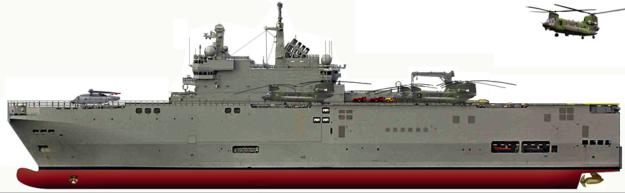
Russia recently bought two French Mistral class amphibious ships. Russia has not bought foreign warships for a long time, but this purchase was largely because of an eagerness to acquire Western shipbuilding technology and construction skills. This has already paid off, although not exactly how the Russians had planned. This became evident when a Russian official recently announced that the first Mistral would be built entirely in France. It had earlier been decided to have Russian shipyards build some sections of the first Mistral. It was quickly discovered that the Russian shipyard was not capable of building to the French specifications or do it according to the French timetable. The Russians expected to learn some valuable lessons from the French and, while embarrassing, this was one very valuable lesson. Russian shipyard officials have had their faces rubbed in the embarrassment of not being able to compete the way using their current practices. Russian experts on Western production methods and techniques have long complained of the antiquated and inefficient methods still favored by Russian shipbuilders. Navy leaders have been complaining for decades about the poor quality of work coming out of Russian shipyards. The Mistral purchase was to put this to the test.

BPC "Bâtiment de Projection et de Commandement" Tonnerre. Photograph by  Yannick Le Bris

The Mistral class BPC “Bâtiment de Projection et de Commandement” Tonnerre. Photograph by Yannick Le Bris

One thing American marines and sailors notice about the Mistral is the wider and higher corridors. This came about because the ship designers surveyed marines and asked what ship design improvements they could use. It was noted that in older amphibious ships, the standard size (narrow) corridors were a problem when fully equipped troops were moving out. That, plus the smaller crew size, makes the Mistrals appear kind of empty but very roomy. That, plus larger living accommodations (made possible by the smaller ship’s crew and marine complement), make the Mistrals a lot more comfortable. The French ships can be rigged to accommodate up to 700 people for short periods, as when being used to evacuate civilians from a war zone.

After the first two, additional Mistrals for the French Navy are being built using more commercial techniques and are expected to cost closer to $500 million each. France has three Mistrals with several more on order. Russia says it plans to base some of its Mistrals in the Far East, where there is an ongoing dispute with Japan over Japanese islands Russia occupied after World War II and never gave back. The Mistrals will probably show up elsewhere, because the Russian fleet is again patrolling the high seas and showing up wherever its government needs some muscle.

The Russians will name their two Mistrals the Vladivostok (initially planned to be based in its namesake city) and the Sevastopol (to be based at Novorossiysk).

June 29, 2013

QotD: Orwell on nationalism and the world state

Filed under: Germany, History, Military, Quotations, Russia, WW2 — Tags: , , , , — Nicholas @ 00:01

What is the use of pointing out that a World State is desirable? What matters is that not one of the five great military powers would think of submitting to such a thing. All sensible men for decades past have been substantially in agreement with what Mr. Wells says; but the sensible men have no power and, in too many cases, no disposition to sacrifice themselves. Hitler is a criminal lunatic, and Hitler has an army of millions of men, aeroplanes in thousands, tanks in tens of thousands. For his sake a great nation has been willing to overwork itself for six years and then to fight for two years more, whereas for the common-sense, essentially hedonistic world-view which Mr. Wells puts forward, hardly a human creature is willing to shed a pint of blood. Before you can even talk of world reconstruction, or even of peace, you have got to eliminate Hitler, which means bringing into being a dynamic not necessarily the same as that of the Nazis, but probably quite as unacceptable to ‘enlightened’ and hedonistic people. What has kept England on its feet during the past year? In part, no doubt, some vague idea about a better future, but chiefly the atavistic emotion of patriotism, the ingrained feeling of the English-speaking peoples that they are superior to foreigners. For the last twenty years the main object of English left-wing intellectuals has been to break this feeling down, and if they had succeeded, we might be watching the S.S. men patrolling the London streets at this moment. Similarly, why are the Russians fighting like tigers against the German invasion? In part, perhaps, for some half-remembered ideal of Utopian Socialism, but chiefly in defence of Holy Russia (the ‘sacred soil of the Fatherland’, etc. etc.), which Stalin has revived in an only slightly altered from. The energy that actually shapes the world springs from emotions — racial pride, leader-worship, religious belief, love of war — which liberal intellectuals mechanically write off as anachronisms, and which they have usually destroyed so completely in themselves as to have lost all power of action.

[. . .]

Mr. Wells, like Dickens, belongs to the non-military middle class. The thunder of guns, the jingle of spurs, the catch in the throat when the old flag goes by, leave him manifestly cold. He has an invincible hatred of the fighting, hunting, swashbuckling side of life, symbolised in all his early books by a violent propaganda against horses. The principal villain of his Outline of History is the military adventurer, Napoleon. If one looks through nearly any book that he has written in the last forty years one finds the same idea constantly recurring: the supposed antithesis between the man of science who is working towards a planned World State and the reactionary who is trying to restore a disorderly past. In novels, Utopias, essays, films, pamphlets, the antithesis crops up, always more or less the same. On the one side science, order, progress, internationalism, aeroplanes, steel, concrete, hygiene: on the other side war, nationalism, religion, monarchy, peasants, Greek professors, poets, horses. History as he sees it is a series of victories won by the scientific man over the romantic man. Now, he is probably right in assuming that a ‘reasonable,’ planned form of society, with scientists rather than witch-doctors in control, will prevail sooner or later, but that is a different matter from assuming that it is just round the corner. There survives somewhere or other an interesting controversy which took place between Wells and Churchill at the time of the Russian Revolution. Wells accuses Churchill of not really believing his own propaganda about the Bolsheviks being monsters dripping with blood, etc., but of merely fearing that they were going to introduce an era of common sense and scientific control, in which flag-wavers like Churchill himself would have no place. Churchill’s estimate of the Bolsheviks, however, was nearer the mark than Wells’s. The early Bolsheviks may have been angels or demons, according as one chooses to regard them, but at any rate they were not sensible men. They were not introducing a Wellsian Utopia but a Rule of the Saints, which like the English Rule of the Saints, was a military despotism enlivened by witchcraft trials. The same misconception reappears in an inverted form in Wells’s attitude to the Nazis. Hitler is all the war-lords and witch-doctors in history rolled into one. Therefore, argues Wells, he is an absurdity, a ghost from the past, a creature doomed to disappear almost immediately. But unfortunately the equation of science with common sense does not really hold good. The aeroplane, which was looked forward to as a civilising influence but in practice has hardly been used except for dropping bombs, is the symbol of that fact. Modern Germany is far more scientific than England, and far more barbarous. Much of what Wells has imagined and worked for is physically there in Nazi Germany. The order, the planning, the State encouragement of science, the steel, the concrete, the aeroplanes, are all there, but all in the service of ideas appropriate to the Stone Age. Science is fighting on the side of superstition. But obviously it is impossible for Wells to accept this. It would contradict the world-view on which his own works are based. The war-lords and the witch-doctors must fail, the common-sense World State, as seen by a nineteenth-century Liberal whose heart does not leap at the sound of bugles, must triumph. Treachery and defeatism apart, Hitler cannot be a danger. That he should finally win would be an impossible reversal of history, like a Jacobite restoration.

George Orwell, “Wells, Hitler and the World State”, Horizon, 1941.

June 28, 2013

The real reasons for problems with Canada’s submarine fleet

Filed under: Cancon, History, Military — Tags: , , , — Nicholas @ 11:01

An interesting post at the Laurier Centre for Military, Strategic, and Disarmament Studies looks at the real reasons the Royal Canadian Navy has had such a rough time with the current class of submarines:

Submarines are perhaps the most misunderstood weapon system in the Canadian Forces. Few Canadians, even those well-versed in military matters, understand their role in Canada’s defence. Worse, the technical issues that have afflicted the Victoria class submarines have dominated the media narrative for a decade, convincing many that they really are a set of lemons put upon us by the crafty British. In actuality, the navy had relatively few options to replace its aging Oberons in the 1990s. It was the decisions made then, rather than any inherent technical shortcomings, which created many of the problems experienced after these vessels entered active service. Yet, the choices for the navy were stark. Faced with a government that was essentially hostile to the idea of submarines, and limited in what it could spend, the used, but highly modern Upholders were the only option open to the RCN: it was either that or the end of the Submarine Service.

[. . .]

However, submarines were politically unpopular within the Chretien government. The former foreign minister called them “un-Canadian” in nature, and Chretien himself dithered on the decision. Sensing that the window was about to slam shut, the navy lobbied hard for their acquisition in what was called the deal of a century – four slightly used subs for $750 million. The old supply vessel HMCS Provider would be paid off early and planned refits for the O-boats foregone.

But the navy had to live within the tight limits that had been established by that $750 million figure. As such, much of the spare parts the RN had warehoused for the submarines were not purchased, nor was some of the technical information concerning the engineering of the submarine’ systems acquired from VSEL (later BAE Systems). In addition, a series of technical problems were discovered in the submarines as they began to be reactivated by the Royal Navy. Many of these were fixed before the boats were delivered to Canada, but several expensive fixes remained after they were acquired. The heavy demands made on the navy at the beginning of the War on Terror in 2003, just as the submarines were arriving in Halifax, also limited the ability to move quickly in resolving these issues.

In many ways, the problems experienced by the subs represent an “own goal” on the part of the navy. The decisions that were made at the time in order to get the boat were to come back to haunt the navy years later. The failure to acquire sufficient spares or establish supplier relationships resulted in many of the significant delays in making the subs operational as the navy worked to create its own network of industrial relationships to manufacture the specialized equipment found on no other naval system. It is this fallout from the procurement process, rather than the frequent argument that the subs were poorly constructed, that is responsible for the delays and technical setbacks in the programme. Given the constraints under which the navy had to operate in the mid-1990s there really were no other alternatives if the service was to be preserved. Despite the problems that came with the boats, it really was the deal of the century!

June 21, 2013

Duffelblog will probably get a lot of the “Onion article mistaken for real news” action today

Filed under: Gaming, Humour, Middle East, Military — Tags: , , — Nicholas @ 11:15

It’s guaranteed to get on a lot of thin-skinned people’s radar:

Duffelblog - Call of JihadAmidst cries of outrage and controversy, Activision unveiled the latest addition to the Call of Duty franchise at the Electronic Entertainment Expo (E3) last week, entitled Call of Jihad: Scourge of the Infidels. The first-person shooter, developed in conjunction with some of al-Qaeda’s top field experts, will be launched for both Xbox 360 and PlayStation 3 for release on September 11, 2013.

Like previous titles in the series, Call of Jihad will feature campaign, online multiplayer and a “Suicide” mode — reminiscent of “Survival” in Modern Warfare 3 — with the objective being to slaughter as many innocents as possible before a quick-reaction force arrives.

The campaign takes place in an alternate reality where infamous al-Qaeda operatives like Osama bin Laden and Abu Musab al-Zarqawi are still alive and Khalid Sheik Mohammed is a free man. The opening mission of the campaign, displayed as part of a teaser trailer at E3, takes place in the Pakistani compound raided by SEAL Team Six. The player must single-handedly dispatch the American commandos as Bin Laden escapes on a camel before time elapses.

Game developers also confirmed the martyrdom perk would always be turned on.

“It’s fucking sick!” squealed die-hard gamer Bryan Campbell, 17, of Manhattan, New York. “I give it two severed heads up!”

June 18, 2013

“Call it Jihadi sushi”

Filed under: Middle East, Military, Russia — Tags: , , , — Nicholas @ 09:00

The difficulty of choosing the right side in the Syrian civil war is that there may not be one:

At his awkward press conference with David Cameron on Sunday, Vladimir Putin made an astonishing claim — the Syrian rebels eat people. It happens to be true. Putin was presumably referring to Abu Sakkar, a rebel leader who videoed himself eating a combatant’s lung. Sakkar explained that he did it in revenge for footage he found on the dead man’s phone of the government soldier raping women. “I swear to God we will eat your hearts and your livers, you soldiers of Bashar the dog!” cried Sakkar. For some Islamists, dedicating such an act to God is not as sacrilegious as it sounds. Students at Al Ahzar University in Cairo — an educational institution once graced by Obama’s presence — have access to a textbook that teaches it’s okay to eat apostates so long as the meat is not cooked. Call it Jihadi sushi.

The story underlines how difficult it is to choose the side of good in Syria: Assad’s men are rapists, the rebels are cannibals. When deciding what to do, the West has to avoid two templates of disaster. We don’t want another Rwanda, when the West stood aside and tolerated a genocide and we don’t want another Iraq, when the West got involved and stayed involved almost for a decade.

What Britain, France and America have decided to do is something in-between. Ignore the hyperbole about intervention from some in the press: at this stage all the alliance is threatening is to give logistical support to the rebels through non-military aid and a no-fly zone. Of course, this could escalate. But no Western leader wants to put boots on the ground and the goal of the sabre-rattling is actually to prod Russia into dragging Assad to the negotiating table at the proposed conference in Geneva (by the way, Putin might deliver on that but it’s far less likely that we’ll get the rebels to play ball on our side). We are deliberately internationalising the conflict, turning it into a giant game of chicken between America and Russia in the hope that they will resolve the war on behalf of the Syrian combatants.

June 14, 2013

Nostalgia for a far-distant imperial era

Filed under: Britain, History, Military — Tags: — Nicholas @ 00:01

At the Thin Pinstriped Line, Sir Humphrey pours cold water on the calls to re-establish the Royal Navy’s former fleet and base organizations overseas:

Humphrey has a certain pet hate on some internet sites, and this is the trend to ‘fantasy fleet’ creation. While the merits of discussing possible courses of action are interesting, in recent years these sort of threads have routinely become an excuse to wishlist large numbers of ships, aircraft and vessels in an almost fantasian order of battle which bears no resemblance to any current reality. Almost without exception these threads prove immensely dull to read, and rarely achieve more than listing different types of impressive ships in arbitrary ‘fleets’.

The concept of these so-called ‘fleets’ has often puzzled the author — it is something to which many posters cling to — the notion that the Royal Navy should somehow hark back to its imagined glory days and establish a ‘Far East Fleet’, a Med Fleet and south Atlantic squadrons, along with the supporting bases and dockyards. These impressive sounding titles are bandied around without really thinking what this means. Ironically, those who most loudly advocate the creation of these fleets are the ones who also demand that the MOD cuts the numbers of officials and Admirals to pay for it — as if adding an additional layer of command is going to somehow reduce officialdom.

For this post, Humphrey wants to consider why foreign dockyards and the concept of ‘Fleets’ is perhaps less relevant than ever to the Royal Navy of today, and considers that what may have worked in the past is not necessarily the model of the future fleet structure.

[. . .]

The other point which often crops up in Fantasy Fleet discussions is the keen desire for the RN to establish a network of overseas dockyards which will house whole squadrons of warships (presumably under the command of a newly re-established Fleet HQ). While it is wonderful to look back in history and see where the RN used to have permanent bases, it is hugely misleading to do so.

The author has a very personal view that the RN is in the business of sending warships to sea, and not the business of managing an unnecessarily large property portfolio. Every penny spent on building and sustaining shore infrastructure is a penny not being spent on a warship. While there is a very clear case for a well maintained and modern infrastructure, this does come at a cost. The RN already probably has a surplus of real estate relative to its fleet size, and much of this is buildings that are decades (and in some cases centuries) old, which require updating, refurbishment and refitting.

Historically overseas dockyards made perfect sense — in the early 20th century when communications were slow, it made immense sense to ensure that local dockyards could repair vessels on station, ensuring they were available in short order, rather than waiting weeks or months for spare parts to be sent out. The presence of coal or oil in the days before the RFA was a strategic necessity, while ammunition depots could easily store shells for use. Similarly, the reliance on troopships rather than trooping flights meant that long drafts for overseas personnel made sense — it wasn’t feasible to keep moving people around unless there was good reason to do so. Hence maintaining a strategic network of dockyards and accommodation facilities made enormous sense.

June 6, 2013

D-Day 1942 or 1943

Filed under: Britain, Cancon, France, Germany, History, Military, USA, WW2 — Tags: , , , — Nicholas @ 10:17

At Military History Now, there’s a look at a few of the allied plans for invading France before the actual June 6, 1944 operation:

IKE’S SLEDGEHAMMER
Almost as soon as America entered the war with Nazi Germany, generals Dwight Eisenhower and George Marshall were both lobbying for a strike across the English Channel into France. One plan foresaw a joint British and American assault on either of the French port cities of Cherbourg or Brest as early as the fall of 1942. The operation, codenamed Sledgehammer, would see a force of just six divisions attack, capture and hold either one of the two strategically-vital, deep-water harbours. The force, which likely would have totalled no more than 60,000 men, would have been expected to withstand the inevitable Nazi counterattacks until spring when more reinforcements could arrive. Despite the fact that the Germans would have been free to throw as many as 30 divisions at the invaders, the U.S. Joint Chiefs (as well as the Soviets) endorsed Sledgehammer wholeheartedly. The American commanders seemed to favour any plan that would bring U.S. forces into action in Europe quickly, while Stalin was thrilled at the prospect of an Allied offensive in Western Europe — anything to divert German forces away from the Russian front. Oddly enough, while the mission called for the heavy use of American air and sea power, at the time there was still only a handful of combat-ready U.S. Army units in England. As such, the ground portion of the invasion would be left entirely up to the British military. Cooler heads, namely Prime Minister Churchill, convinced Eisenhower to shelve Sledgehammer – Britain was already stretched thin in Egypt and America still had yet to fully mobilize for the war in Europe. An invasion of France would simply have to wait.

OPERATION ROUNDUP
Later in 1942, the Allies roughed out a second plan to put troops ashore in Western Europe the following spring. This operation, dubbed Roundup, called for 18 British and 30 American divisions to hit a series of landing zones along a 200 km stretch of coastline between Boulogne-sur-Mer near Calais and the port of Le Harve. Overhead, more than 5,700 Allied aircraft were to sweep the skies of the Luftwaffe clearing the way for a series of airborne drops. D-Day was set for some time in April or May of 1943. The British, already strained by three years of total war against the Axis, were understandably reluctant to throw their army headlong into the teeth of Germany’s Channel fortifications. They pushed instead to attack Sicily and Italy – what Churchill called the “soft underbelly of Europe” — by way of North Africa. A sober appraisal of British and American fleet strength, air assets and manpower ultimately convinced the Allied high command that no invasion could be mounted until 1944 at the earliest. For one thing, American factories had yet to manufacture enough of the landing craft needed for such a massive undertaking. Washington and London turned their attention instead towards a late 1942 invasion of Tunisia – Operation Torch. The rest is, as they say, history.

As any Canadian military historian would probably have said to either of these proposals … I have two words: Operation Jubilee.

The Dieppe Raid, also known as the Battle of Dieppe, Operation Rutter and, later, Operation Jubilee, was a Second World War Allied attack on the German-occupied port of Dieppe. The raid took place on the northern coast of France on 19 August 1942. The assault began at 5:00 a.m. and by 10:50 a.m. the Allied commanders were forced to call a retreat. Over 6,000 infantrymen, predominantly Canadian, were supported by a Canadian Armoured regiment and a strong force of Royal Navy and smaller Royal Air Force landing contingents.

The objective of the raid was discussed by Winston Churchill in his war memoirs:

    “I thought it most important that a large-scale operation should take place this summer, and military opinion seemed unanimous that until an operation on that scale was undertaken, no responsible general would take the responsibility of planning the main invasion…

    In discussion with Admiral Mountbatten it became clear that time did not permit a new large-scale operation to be mounted during the summer (after Rutter had been cancelled), but that Dieppe could be remounted (with the new code-name “Jubilee”) within a month, provided extraordinary steps were taken to ensure secrecy. For this reason no records were kept but, after the Canadian authorities and the Chiefs of Staff had given their approval, I personally went through the plans with the C.I.G.S., Admiral Mountbatten, and the Naval Force Commander, Captain J. Hughes-Hallett.”

Objectives included seizing and holding a major port for a short period, both to prove it was possible and to gather intelligence from prisoners and captured materials, including naval intelligence in a hotel in town and a radar installation on the cliffs above it. Although the primary objective was not met and secondary successes were relatively few, some knowledge was gained while assessing the German responses. The Allies also wanted to destroy coastal defences, port structures and all strategic buildings. Due to the failure to secure Dieppe this objective was not met in any systematic sense. The raid had the added objective of providing a morale boost to the troops, Resistance, and general public, while assuring the Soviet Union of the commitment of the United Kingdom and the United States.

A total of 3,623 of the 6,086 men (almost 60%) who made it ashore were either killed, wounded, or captured. The Royal Air Force failed to lure the Luftwaffe into open battle, and lost 96 aircraft (at least 32 to flak or accidents), compared to 48 lost by the Luftwaffe.[2] The Royal Navy lost 33 landing craft and one destroyer. The events at Dieppe later influenced preparations for the North African (Operation Torch) and Normandy landings (Operation Overlord).

Operation Jubilee clearly showed that the plans for both Sledgehammer and Roundup would have been bloody failures.

« Newer PostsOlder Posts »

Powered by WordPress