Polyus
Published 6 Jun 2026 #aviationlovers #canadianaerospace #PolyusStudiosCanadians themselves were largely opposed to nuclear weapons but their utility in a full out conflict was impossible to ignore. And so up until fairly recently the Canadian government’s position on the matter was deliberately ambiguous. Promoting peace while supplying the means of war. Now with the luxury of hindsight we can see the true extent to which these weapons played a central role in the defense of this country during the Cold War.
Like it or not, Canada was a threatening and potent nuclear-armed force during a 9 year period between 1963 and 1972. The posturing was offensive in Europe, and defensive on Canadian soil. The last defensive weapons were relinquished in 1984. Nuclear weapons were adopted as part of its network of alliances, when it became obvious that the Soviet missile threat could only be defeated by deterrence. Politically the nuclear question was a hot potato, John Diefenbaker tried to keep the weapons out, Lester Pearson let them in, and Pierre Trudeau kicked them back out again.
This video was made without the use of Artificial Intelligence (No AI). Long live people power!
0:00 Introduction
1:20 Uranium mining in the North
2:31 Tube Alloys and the Manhattan Project
4:10 Post war fears of Soviet army and Canadian build up in Europe
6:04 Air threat from Soviet bombers
8:05 The case for nuclear weapons
9:28 Cancellation of the Arrow in favour of nuclear weapons
10:55 Defensive nukes
13:39 Offensive nukes
16:15 Nuclear capable platforms
16:59 Types and numbers of deployed weapons
18:30 Legacy and impact of these weapons
19:55 ConclusionSupport me on Patreon – / polyusstudios
Music:
Denmark – Portland Cello Project
Your Suggestions – Unicorn Heads
June 8, 2026
A Brief History of Nuclear Weapons in Canada
How Red Dot Sights Work (What is a Collimator?)
Forgotten Weapons
Published 16 Jan 2026A whole lot of people have used red dot sights, but how many actually understand how they work? Let’s see if we can fix that today …
(more…)
June 7, 2026
Are “Dad books” in trouble?
In the latest SHuSH newsletter, Ken Whyte views with (mild) alarm a recent Wall Street Journal article claiming that “Dad books” — the kind of books thoughtful kids give their fathers as gifts — are in steep decline:
The Wall Street Journal ran a piece last month on the death of Dad books, the Father’s Day specials — books about “some little-known chapter of World War II, the sweeping narrative of a shipwreck, perhaps the latest presidential biography”.
Here’s what it gave for evidence. Nonfiction book sales have declined for four years, including an 8 percent drop this year up to May 9.
Sales of Books about politics and current affairs are down 19 percent in those same four months and nine days in 2026. The article quotes, among others, former Simon & Schuster publisher Jonathan Karp saying that “this is a sea change and people should wake up and realize we’re living in a new world”.
The new world is one with “an endless supply of Substack newsletters, Netflix documentaries, YouTube videos and podcasts that offer the kind of fresh reporting, sharp analysis and historical perspective once limited doorstop-size books”.
Jonathan Burnham of Harper Group adds that all these alternatives to books make “the idea of sitting down with a 700-page Ron Chernow book less appealing. You’ve scratched that itch.”
The WSJ noted that Chernow’s recent biography of Mark Twain, published last spring, is underperforming his 2017 biography of Ulysses S. Grant.
There was an obligatory quote from Barnes & Noble CEO James Daunt, who attributed the decline in serious nonfiction sales to the fact that everyday events are all-consuming: “The world is exceptionally interesting right now and when that happens the nonfiction reader is reading the news instead.”
As someone who publishes a lot of Dad books, i.e., serious researched nonfiction, histories and biographies, that sort of thing, I read the article with concern. In fact, I read it twice.
I felt much better after the second reading.
Let’s start with the chart. The first four months and 9 days of 2026 are doing all the work here. A decline of 1 to 2 percent in the years 2023 to 2025 is statistical noise. Circana BookScan numbers don’t include audiobooks, which have been rising steadily in popularity. The very slight decline in sales for the first three years might be entirely attributable to format shifting, hardcopy to digital audio. The 8 percent decline in the first four months of 2026 looks more ominous, but book sales figures are always lumpy, never a straight line. A four-month sample tells you nothing.
The greater problem with the chart is that it is counting adult nonfiction book sales, not Dad books. There are any number of ways to cut Circana BookScan data, but the broad adult nonfiction category contains a vast array of books. Books for men, books for women, books for everybody. Not only serious researched nonfiction, but self-help, how-to, study guides, business and personal finance, psychology and religion books, health and fitness books, parenting books, food and travel books, true crime, sports, military, essays, crafts and hobbies, memoirs, etc. There is no data cut for Dad books. So the story is backing its thesis for the death of apples with stats about oranges.
The report of a 19 percent drop in the narrower category of politics and current affairs also looks ominous, but this is one of the most notoriously cyclical genres in existence. And, again, we’re discussing a short period of four months and nine days. The new Trump era was less than a year old at the start of that period. It generally takes longer than a year to get new books from commission to sale. Ten days after the end of the period under discussion, Andrew Weissmann released Liar’s Kingdom: How to Stop Trump’s Deceit and Save America. It was an instant number-one New York Times bestseller. In so specialized a category as this, Liar’s Kingdom alone might have been sufficient to right the ship.
The only other evidence presented to support the decline in Dad books is poor Ron Chernow’s journey. His Mark Twain, with 119,259 hardcover sales, is underperforming his Ulysses S. Grant, with 381,604 sales.
I don’t know where to start. The Grant book has been out for almost a decade, Twain for a year. Not surprising that it has sold less. Also, you can’t compare major political biographies to major cultural biographies. David McCullough’s biographies of Truman and Adams far outsold his book about American artists and writers in Paris. And while I’m a fan of Chernow, his Twain book isn’t his best work. He received polite and generally positive reviews, but they noted that the book is overly long — the word “exhaustive” surfaces repeatedly — and that he doesn’t entirely succeed in bringing Twain to life. Grant is a superior book, and the more enjoyable read, too, if customer reviews are anything to go by. The Twain sales prove nothing.
So we don’t really have any evidence at all that Dad books are in trouble, that they’re getting swamped by podcasts or current events, and certainly not that there’s been “a sea change” and that we’re living “in a new world”.
Amusingly, the literary world was flooded with hot new Dad books coincident with the WSJ‘s declaration of their death.

How Hitler Tested His Next War in Spain – Death of Democracy 18 – Q2 1937
World War Two and Spartacus Olsson
Published 6 Jun 2026Berlin, June 30, 1937. Hitler has not staged a major diplomatic shock this quarter — but beneath the surface, Nazi Germany is preparing for war.
In Spain, the Condor Legion helps Franco’s Nationalists and the bombing of Guernica gives the world a terrifying preview of modern aerial terror. At home, the regime escalates its assault on the Catholic Church, begins the purge of “degenerate art”, tightens the link between courts and concentration camps, and hides rearmament behind spectacles of economic success.
This episode of Death of Democracy looks at Q2 1937: the quarter when Nazi Germany normalized aggression abroad while deepening tyranny at home.
00:00 Berlin, June 30, 1937
00:05 No Hitler Surprise — But War Preparations Continue
00:51 The Hindenburg and the Shadow of Modern War
01:50 The “Give Me Four Years” Exhibition
02:25 Guernica and the Condor Legion
02:55 The Bombardment of Almería
03:11 Case Green and Case Otto
03:54 Degenerate Art and Cultural Cleansing
04:22 The Judiciary and the Concentration Camps
05:13 The Nazi Assault on the Catholic Church
06:07 Goebbels, Propaganda, and the Morality Trials
07:45 Autarky, Rearmament, and Hidden Austerity
08:52 Mood Inside the Nazi Leadership
09:48 Ordinary Germans and Apathy
12:15 Analysis: War Abroad, Tyranny at Home
14:19 Conclusion: Nazi Double-Talk
June 6, 2026
D-Day landings on Sword, Gold, and Juno Beaches
Imperial War Museums
Published 5 Jun 2020On 6 June 1944, Sergeant Ian Grant was among the thousands of men landing on Sword Beach in Normandy on D Day, armed only with a revolver and a cine camera. He was part of the Army Film and Photographic Unit (AFPU) and captured this incredible mute footage of the landings. Fewer than a dozen men filmed the D Day landings and this extraordinary record is now held exclusively by the Imperial War Museum. Film curator Michelle Kirby introduces us to this film.
(more…)
QotD: Richard Nixon – more sinned against than sinning?
Fifty yards from Richard Nixon’s grave, which sits not quite in the shadow of the modest home where he was born, a series of exhibits at his presidential library describe him as a psychologically unbalanced fool.
The Nixon White House, museum display panels announce, was consumed by “a climate of deep suspicion”. The infamous Plumbers took action against “perceived political opponents within the Federal Government”. A video display allows visitors to choose clips on the theme of Nixon’s “Conspiracy Thinking”. Paranoid, the president mindlessly lashed out at enemies that he hallucinated. This is still the official history, in museum exhibits curated by the National Archives and Records Administration.
On Friday morning, the consistently pro-Nixon docents hadn’t heard about the important Feb. 8 story in The New York Times that describes a plot within the government to spy on the Nixon White House, with Navy Yeoman Charles Radford stealing documents and sending them to the Pentagon as insurance against budget and policy meddling from the person serving as the president of the United States.
The revelation from a newly declassified document, longtime journalist James Rosen concluded, “bears directly on allegations by President Trump and his supporters about the existence of what was once called the permanent bureaucracy, better known today as the ‘deep state’. … Nixon proved to a team of federal prosecutors and grand jurors not only that such a beast existed but also that he, guilty as he was in Watergate, had been its victim.”
Chris Bray, “The Nixon Library Is Wrong About Nixon And The Deep State”, The Federalist, 2026-02-13.
June 5, 2026
The First Ever British SLR: Serial Number One L1A1 Explained
Royal Armouries
Published Jan 14, 2026The L1A1 Self-Loading Rifle is one of the most iconic service rifles in British military history and on this week’s episode we have the very first one ever produced.
Next week: an original Royal Small Arms Factory archive film found by our archive team showing how the L1A1 was made.
0:00 Intro
0:46 Serial Number One Explained (UE57 Alpha 1)
1:40 Factory Plaque, Proof Marks & Enfield Details
4:26 Condition, Finish & Standard Configuration
5:17 Distinctive British L1A1 Features
7:08 Controls, Ergonomics & Fire Selector Choices
10:35 Why the L1A1 Won & Closing ThoughtsThis week’s object’s collections online page: https://royalarmouries.org/collection…
(more…)
June 3, 2026
China’s pirate fishing fleets
John Carter was really impressed with a recent self-published novel by Frank Kidd, and takes the time to set up the real-life situation the novel imagines being kinetically addressed:
A few years ago a photograph taken by a pilot over the Pacific went viral. It showed a mysterious red glow spreading ominously out over the water.
Initially people thought it was aliens, and to be fair, they weren’t far off. The glow belonged to the closest thing humanity has yet invented to a Tyranid hive fleet: a Chinese fishing fleet raping the seas in search of seafood. The glow is from huge banks of LEDs, which the ships use to draw marine life to the surface, where they trawl it up with nets. Much, maybe even most of the indiscriminate catch is discarded.
China has over half a million fishing vessels. Their vast fleets comprise thousands of ships, and can often be seen from orbit.
The triangular lights inside the red circle are a Chinese fishing fleet.
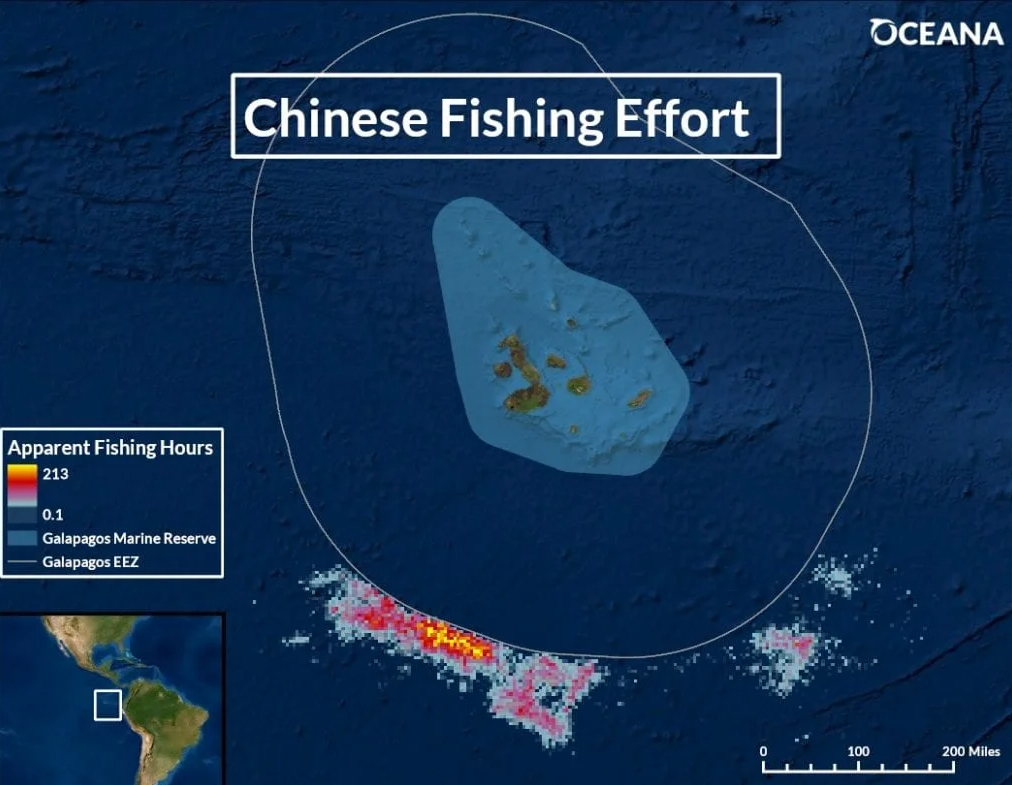
China has long since eaten its way through its own territorial waters, and therefore sends its fleets out into the rest of the world’s oceans. As a rule marine life is much more abundant close to the shore, since this is where most of the nutrients are. Fishing in another country’s territorial waters is illegal under international law. The Chinese do not care. Their fleets park just on the edge of a country’s Economic Exclusion Zone, and then turn off their Automatic Identification System transponders so that they can sneak inside and poach. Turning off an AIS transponder is also illegal: maritime law requires these to be activated at all times, for collision avoidance and search and rescue. Organizations which track this regularly observe Chinese ships on EEZ borders disappearing from the AIS network, and reappearing a few hours later on the right side of the border.
Here we see the scum pillaging the ocean around the Galapagos. Yeah. I know. Billions must die.
The consequences for local fishermen are disastrous: the Chinese scoop up all the fish, and lead the local fisheries towards ecosystem collapse. When they’re done pillaging they just move on, leaving an oceanic wasteland in their wake.
Environmental groups generally don’t seem very bothered about this, perhaps because the ocean is a CO2 sink whether or not there are fish in it, and the only thing that matters about the environment is how much carbon is in the air. National governments are reluctant to take action, because they are often dependent upon Chinese investment for their economic growth. The only people who really seem to care are fishermen and Internet racists.
This is the set-up for Frank Kidd‘s immensely satisfying debut mercenary novel, Once Upon A Time In Argentina.



The Korean War Week 102 – American Bioweapons on Korean Soil? – June 2, 1952
The Korean War by Indy Neidell
Published 2 Jun 2026The Chinese continue their campaign of accusing the US of practicing germ warfare in North Korea and Manchuria. Meanwhile in South Korea, Syngman Rhee has declared martial law in Pusan as part of his campaign to remain in power.
00:00 Intro
00:50 Recap
01:23 Germ Warfare Charges
11:17 Bull Boatner
15:34 Holding POWs
17:58 Summary
18:13 Conclusion
19:21 Call to Action
June 2, 2026
Rare & Unique Sightings From 100 French FR-F2 Sniper Rifles
Forgotten Weapons
Published Jan 12, 2026Today I had a chance to dig through no less than one hundred FR-F2 snipers brought in by Navy Arms. I found a number of interesting and unusual things in the process, including a number of three-digit serial numbered very early production examples and some renumbered guns. We’ll also be looking at the Scrome J8, the modern picatinny scope mounts for the FR-F2, and things like depot refurbishment markings.
(more…)
May 31, 2026
The Battle Of Jutland: How Britain Should Have “ANNIHILATED” Germany’s Fleet & Won EASILY
History Undone with James Hanson
Published 13 Dec 2024James Hanson is joined by Rear Admiral Dr Chris Parry and the YouTuber and naval historian @Drachinifel to discuss the Battle of Jutland. It was the largest naval battle of the First World War and the only time the British and German fleets went head to head.
So just how significant was it and should it have ended differently? This is History Undone.
May 30, 2026
“Bullying”
I was bullied as a kid. I hated it. Most kids experience it, and either hate it or embrace it as “how things are done” (most likely both). This is basic human nature across all cultures. It’s how we learn how to conform, or appear to conform, to cultural expectations. In a pre-urban environment, the community could only handle so many non-conformists — that is: close to zero — so nipping it in the bud with the children was a pro-survival/pro-communitarian mechanism. In modern urban environments, bullying still happens because it’s part of human nature rather than being how children learn how to cope with social situations.
We’ve even migrated the notion of suppressing “bullying” to the military, as InfantryDort explains:
Any man who thinks bullying is ubiquitously inappropriate has the survival instincts of a deer gazing longingly at headlights.
For most of human history, communities had weak formal institutions. Public ridicule, shaming, and ostracism were used to enforce norms.
Examples:
> Villages mocking chronic thieves.
> Military units humiliating cowards.
> Tradesmen ridiculing apprentices who refused to learn.The positive effect was often:
> Greater conformity to community standards.
> Faster correction of disruptive behavior.
> Stronger group cohesion.It hardens individuals to harsh environments when properly applied. And enforces societal norms we want and dissuades the ones we don’t.
The lack of bullying is how people grow up to adulthood and say things like “I’m gonna kill you and your whole family” at some political protest. And have it come out of their mouth as normal as breathing.
Because nobody ever stood them down in their formative years.
You’re a JAG. You think every problem has a legal solution. It doesn’t. You don’t understand the way the world works outside of the one the law has carefully curated for you. Made possible by people who’ve been using strength to coerce others for all of human history.
Let me spank the kids while you do the dishes.
May 29, 2026
Julius Caesar: the final verdict
Adrian Goldsworthy. Historian and Novelist
Published 29 Oct 2025This week the questions are all about Julius Caesar, and in particular:
What were his motives? Did he aim at reform/revolution from the start?
Also, how was he viewed by the wider population after the Ides of March?
QotD: What is volley fire and what is it for?
Volley fire can cover for the slow reload rate of guns or crossbows in two ways. The first are volley fire drills designed to ensure a continuous curtain of fire; the most famous of these is the “counter-march”, a drill where arquebuses or muskets are deployed several ranks deep (as many as six). The front rank fires a volley (that is, they all fire together) and then rush to the back of their file to begin reloading, allowing the next rank to fire, and so on. By the time the last rank has fired, the whole formation has moved backwards slightly (thus “counter” march) and the first rank has finished reloading and is ready to fire. The problem this is solving is the danger of an enemy, especially cavalry, crossing the entire effective range of the weapon in the long gap between shots. This, by the by, was the volley fire tactic that was being used in China with crossbows before gunpowder; I don’t know that anyone ever did volley-and-charge with crossbows, which lack the lethality of muskets.
The other classic use is volley-and-charge. Because firearms are very lethal but slow to reload, it could be very effective to march in close order right up to an enemy, dump a single volley by the entire unit into them to cause mass casualties and confusion and then immediately charge with pikes or bayonets to try to capitalize on the enemy being demoralized and confused. You can see variations on this tactic in things like the 17th century Highland Charge or the contemporary Swedish Gå–På (“go on”). By charging rather than waiting to reload, the attacker could take advantage of the high lethality of firearms without suffering the drawback of long reload times.
Crucially, note that volley-and-charge works because it compresses a lot of lethality into a very short time, which I suspect is why we don’t see it with bows or crossbows (but do see it with javelins, which may have shorter range and far fewer projectiles, but seem to have had higher lethality per projectile). As we’re going to see in a moment, the lethality of bows or crossbows against armored, shielded infantry – even in close order – was pretty low at any given moment and needed to add up over an extended period of shooting. By contrast, muskets were powerful enough to defeat most armor and thus to disable or kill basically anyone they hit, limited of course by reload time: with a reload time of as much as 30 seconds for earlier matchlocks, a line of musketeers might only be able to fire a few times at an advancing infantry unit (which might take two or three minutes to walk through effective range) and given the limited accuracy of smoothbore muskets, only the last shots would hit at a high level. By contrast, a unit doing volley-and-charge is compressing probably close to 50% of the lethality of sustained shooting, devastating moment and then immediately charging.
Putting that much lethality into a singular instant was valuable from a morale perspective and of course it enabled a unit to quick march through the enemy’s effective range, stopping only briefly to fire and charge, limiting losses from steady enemy fire. But as we’re going to see, the lethality of bows (and, to a significant extent, crossbows) was much lower and so couldn’t be effectively compressed into that single, devastating, confusing moment.2
Bret Devereaux, “Collections: Why Archers Didn’t Volley Fire”, A Collection of Unmitigated Pedantry, 2005-05-02.
- On drill and in particular, counter-march volley fire with crossbows, see Andrade, The Gunpowder Age (2016), 149-160.
- It also didn’t generate a smokescreen to help with the final rushing charge, whereas a musket-and-bayonet unit might benefit significantly from firing and then charging through and out of its own obscuring smoke into a terrified and confused enemy.
May 28, 2026
“Seamen tend to be wary of authority, unless it is wisely exercised”
In UnHerd, Peter Hitchens considers the plight of the Royal Navy, much diminished from its years (centuries, actually) of greatness:

Our own Royal Navy is famous for its mutinies, in HMS Bounty in 1789, at Spithead and the Nore in 1797, and most recently at Invergordon in 1931. It is a curious organisation, its hammocks once filled by the cruel Press Gangs kidnapping innocent men and forcing them to sea and possible death, its discipline for many years enforced by the cruel cat o’ nine tails and the occasional shooting of an admiral to encourage the others. But it stood between us and the world, without trying to take over the state, and it was very beautiful, and many of us loved it. In London and the big seaport cities, bluejackets in their Edwardian uniforms were still a common sight in my childhood. They were reassuring, not overbearing. Since 1901, when horses failed at the task, Navy men have pulled the gun carriage on which Royal coffins (and Churchill’s) have rested at state funerals, an extraordinarily moving sight. These were our defenders, upon whom, as Charles II’s Articles of War first proclaimed, “under the Good Providence of God, the safety, honour and welfare of this realm do chiefly depend”.
In an era when soldiers were often despised, or even feared, sailors were not. Think of Kipling’s 1890 poem “Tommy”, intended to change the drunken delinquent reputation of Queen Victoria’s redcoats:
For it’s “Tommy this, an’ Tommy that, an’ Chuck him out, the brute!”
But it’s “Saviour of ‘is country” when the guns begin to shoot.In George Orwell’s perfect novel Coming Up for Air, Edwardian civilians are appalled when a young man signs up for the Army: “‘Well now! Listed for a soldier! Just think of it! A fine young fellow like that!’ It just shocked them. Listing for a soldier, in their eyes, was the exact equivalent of a girl’s going on the streets.”
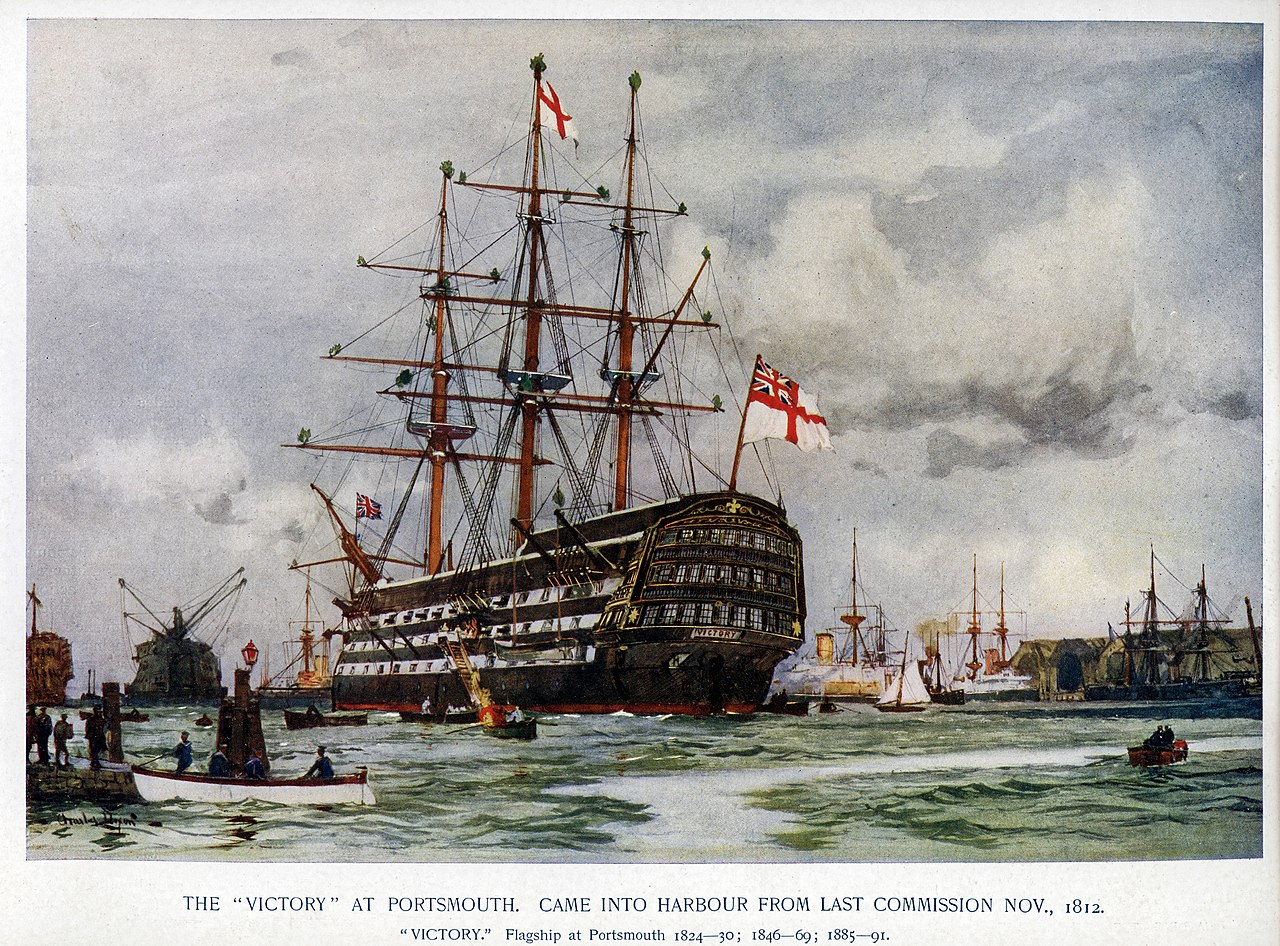
“HMS Victory in Portsmouth Harbour”
Painting by Charles Edward Dixon (1872-1934) via Wikimedia Commons.But sailors, possibly because they were at sea so much, were idealised as “hearts of oak” manning the wooden walls (and later the steel walls) of England. And the same was true for officers, credited above all with the great victory at Trafalgar in 1805, which secured national safety and prosperity for the rest of that century. They had a reputation for taciturnity and bluffness, which never does anyone any harm, and they often lived up to it. The fictional Jack Aubrey, in Patrick O’Brian’s witty and clever books about the Napoleonic wars, is a perfect rendering of this type. They tell terrible jokes. They don’t say much, just “Kiss me, Hardy” (Nelson as he died); “There seems to be something wrong with our bloody ships today, Chatfield” (Beatty at Jutland, as British warships repeatedly blew up under German fire); and “Continue to engage the enemy” (Warburton-Lee at Narvik, dying on his bridge after smashing up Hitler’s destroyer fleet and so making a cross-Channel invasion impossible).
And so the word “Navy” had, for many years, a useful commercial magic if you were selling something a bit manly and bluff, such as Navy Cut tobacco and Navy Rum, or even Senior Service cigarettes. But it did not have the yelling, martinet character of the Army. I have never yet seen a naval officer’s uniform that fits properly, and when sailors are marched aboard their ships (does this still happen?), the drill is far from pernickety. Close contact with the Navy — both my parents were in it, and so were most of their friends, some of my schoolteachers and many of the parents of my schoolfellows — revealed a dry, faintly sarcastic view of the outside world which had never been to sea. Even my mother, an ocean-going snob who would die of shame if she heard me use the word “toilet”, had mastered the sarcasm of the fleet. More than once I jumped with surprise when I heard her icily remarking about some inadequate if feeble attempt at recompense. “Well, that’s damned nice of him”, she’d say, which, for a Fifties married middle-class woman in a respectable suburb, was going it a bit.