
World War Two
Published 2 Nov 2024May 1930 brings political upheaval to the Weimar Republic, with the French deciding to leave the Rhineland, violent clashes between Communists and Nazis, and a surprising alliance that dissolves Saxony’s government. See how these events unfold and shape Germany’s current political landscape.
(more…)
November 3, 2024
Unholy Alliance topples Saxony – Rise of Hitler 05, May 1930
Comments Off on Unholy Alliance topples Saxony – Rise of Hitler 05, May 1930
Kemi Badenoch replaces Rishi Sunak as UK Conservative leader
In the National Post, Michael Murphy discusses the new British Tory leader and why she could be a viable challenger to Two-tier Keir’s Labour government:
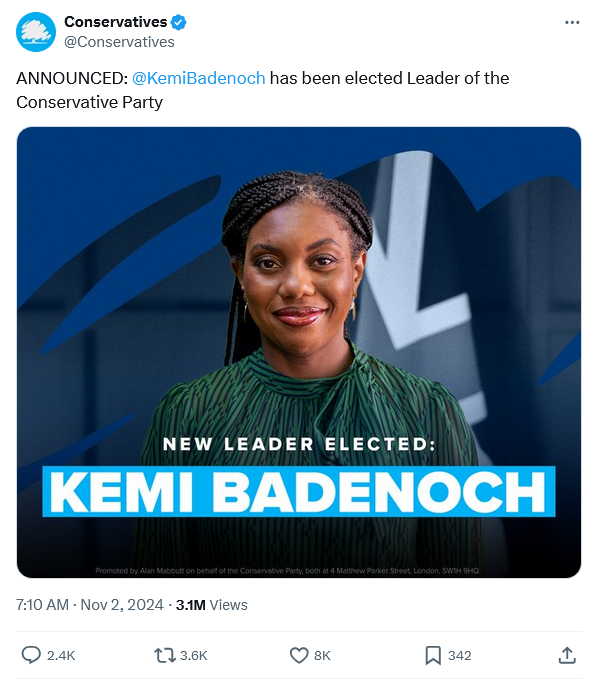
… in July, the Tories were ousted by Labour after 14 years in power, limping on with only 121 seats in the 650 seat House of Commons. But the honeymoon period for Sir Keir Starmer’s Labour government ended almost immediately, as its popularity plummeted faster than that of any administration in recent memory. This has made the Tories interesting once again at precisely the moment when they’ve chosen a new leader: Kemi Badenoch.
The Nigerian-raised mother of three, elected today to lead the Conservative party, threatens to be kryptonite for a Labour party wedded to identity politics. A black, female immigrant at the dispatch box is apt to leave Labour frontbenchers — particularly Sir Keir, a one-time BLM kneeler — somewhat stumped. To make matters worse, Badenoch is a persuasive speaker, commanding a charisma and eloquence that Sir Keir — a dull, po-faced lawyer — does not possess.
These qualities have given Badenoch cross-party appeal within the Tories, rallying endorsements from both the left and right. By endorsing her, however, the party has effectively signed a blank cheque, as Badenoch, unlike her opponents, has made few specific pledges. She has chosen instead to reflect on the election loss and the party’s ideological roots; she is prepared to play the long game, hoping this will allow the Tories to “earn back trust”.
On some issues, though, Badenoch is clear. “The government is doing far too much and it is not doing any of it well — and it is growing and growing,” she declared recently. “The state is too big; we need to make sure there is more personal responsibility.” These ideas are common fare among Conservatives, especially in bloated welfare states like Britain — but her zeal for them evokes, for many, memories of Margaret Thatcher. As the political commentator Simon Heffer wrote, “Mrs Badenoch is the politician who most reminds me of Mrs Thatcher since I last saw Mrs Thatcher”. He noted both women’s hard-mindedness, “deep principles”, and grasp of the “art of the possible”.
Badenoch’s Conservatism can be traced, as the writer Tom Mctague has argued elsewhere, to her beginnings in Africa. Having fled Nigeria during a 1996 military coup, she has a keen, outsider’s appreciation for Britain’s core ideals — not least the rule of law and policing by consent. She is therefore a champion of Britain, of both “the good” and “bad” of its former empire, at a time when it is fashionable to denigrate it, precisely because of her first hand experience that these norms are rare and fragile.
Like Thatcher, Badenoch studied a hard science (computing), marking them out in a Parliament filled with lawyers and humanities graduates. And the swift rise of both women, from modest beginnings through the ranks of the Conservative party, suggests that the “art of the possible” is indeed etched into their stars.
The Armchair General has a few suggestions for Badenoch’s agenda to turn the British economy around:

The new leader of the Conservative Party (image: www.kemibadenoch.org.uk)
My one reservation [about Badenoch] was that, being a software engineer, instead of espousing liberty or slashing laws and regulations, Kemi might reach for more tinkering technocratic solutions — and your humble General is surely not alone in his opinion that we have had quite enough, thank you, of technocratic governments.
However, the more that I consider the severe problems that afflict this country, the more I believe that a process-driven leader, who can focus on the details, might make the biggest difference in the short to medium term.
The immigration issue
As we know, uncontrolled immigration has seized the public imagination greatly — and, indeed, Jenrick centred his campaign around leaving the European Convention on Human Rights (ECHR). We should almost certainly do this anyway — simply because, like the Americans, we should refuse to sign any treaties that raises foreign courts above our own Parliament.
But leaving that aside, the stated problems with mass immigration can largely be divided into two halves:
- cultural differences — these are not insignificant, and it is claimed that they lead to an increase in crime (especially sexual crimes) and an undermining of our high-trust society;
- economic issues — the evidence shows that a massive net influx of low-skilled immigrants depresses wages at the lower end, puts a strain on public services (which cannot expand swiftly enough to accommodate the increase in demand), raises the demand for houses (of which there is a shortage) and thus pushes up prices, and, ultimately, only increases nominal GDP whilst per capita GDP has barely shifted in a decade and a half.
For the purposes of this post, I shall address only the latter issue; given where we are right now, the former is a much thornier problem — at least politically — and probably cannot be solved without radical (and some might say “authoritarian”) action.
The second problem is easier to solve because it is caused, essentially, by the single biggest drag on our economy — our planning system.
[…]
Planning: the Conservatives’ political agenda
The core of the new Conservative manifesto must be a growth agenda; it needs to set out the following core principles:
- if we carry on the current trajectory, the British government will be effectively bankrupt in the next 50 years — so something needs to change;
- therefore, in order to pay for all the goodies that we have promised ourselves (now and in the future), we need to massively accelerate economic growth;
- unless we can build the roads, railways, power stations, research labs, data centres, and homes that we need, then our economy will not grow at the required rate — and spending will need to be cut to the bone;
- given the above, the only way to grow is to reform planning laws;
- removing the barriers to building will lead to greater investment, lower energy prices (leading to even greater investment), greater social mobility, regeneration of all the regions (so-called “levelling up”), and vast increases in per capita GDP;
- where the state invests in infrastructure, then it will cost considerably less than it does currently — meaning that not only will those projects undertaken provide more value for money, but also that many more projects will be viable;
- this prosperity and increased mobility will remove even the perceived need for immigrants to perform low-wage jobs (including in our public services), and remove the economic pressures of those that we have already taken in;1
- if we do it right, then we will also be able to cut taxes without drastically cutting the size of the state.2
The argument needs to be as stark and inevitable as that.
What this means is that the Conservatives need not stand on a platform of slashing state spending — thus addressing the huge numbers of people in this country who, incredibly, still believe in the benevolent state.
Except for one caveat, there really is no downside to adopting Foundations [discussed here], in full, as the core of the next Conservative manifesto (although it should not be the full extent of said manifesto — there are many other areas that need to be addressed, which I shall write about later).
1. As I say, the cultural issues are for another time.
2. Obviously, as a classical liberal, I believe that the size of the state should be drastically cut — but this is not a popular argument in a country that has been raised and educated on socialist doctrine for decades.
Comments Off on Kemi Badenoch replaces Rishi Sunak as UK Conservative leader
Ancient Sparta Historian Breaks Down 300 Movie | Deep Dives
History Hit
Published Jul 8, 2024Ancient Greek historian Roel Konijnendijk takes a deep dive into the historical accuracy of one of the most iconic and ridiculous depictions of the Spartans – 300 (2006).
00:00 Introduction
00:33 Spartan Society and Customs
02:34 Xerxes’ Messenger
06:56 The Ephors, the Oracle and the Carneia
10:30 The 300
15:39 The Persian Fleet
16:14 Thermopylae, the “Hot Gates”
17:17 Spartan Battle Technique
19:12 The Persian Army
24:42 Xerxes
28:28 Ephialtes
32:01 Dilios – Why Did the Spartans Stay?
34:18 The Final Stand
38:44 Aftermath of Thermopylae and Delios
40:53 Movie Quotes: Fact or Fiction?
(more…)
Comments Off on Ancient Sparta Historian Breaks Down 300 Movie | Deep Dives
November 2, 2024
Maxime Bernier on Canada’s immigration crisis
This article has been posted at the Telegraph in the UK and mailed out by the PPC here in Canada, so I guess it’s okay to share it here:
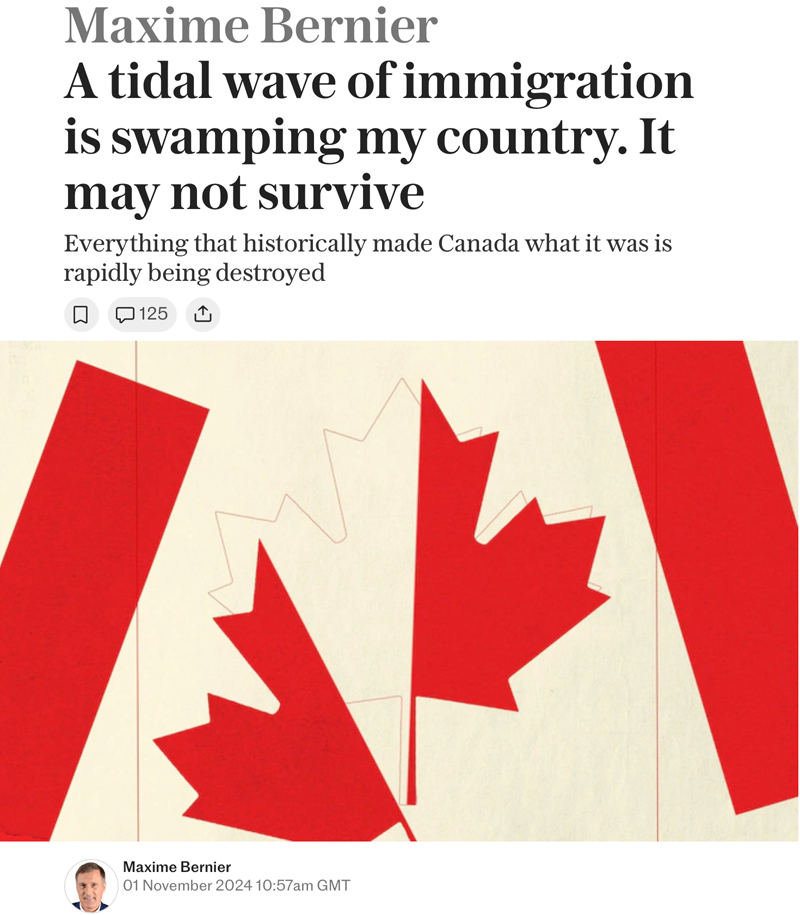
Newsflash: Canada is in the process of falling apart.
No, it’s not because Quebec is once again threatening to hold a referendum on separation, although this may happen again in the coming years.
Our country is experiencing a series of crises because of the deliberate policy of mass immigration instigated by Justin Trudeau’s Liberal government soon after its election in 2015.
Last year, Canada’s population increased by almost 1.3 million people, or 3.2 per cent. This was the fastest annual population growth rate since the post-war years. The difference however is that this was not caused by a baby boom, since 97 per cent of the growth was due to international migration, mostly from Asia and Africa.
This includes not only immigrants per se – or “permanent residents” – but also so-called temporary foreign workers, foreign students, and asylum seekers. Although supposed to be temporary, the last categories have in fact become pathways to seek permanent residency.
Because of this, housing in Canada has now become completely unaffordable. Young couples who want to have children just cannot afford to buy a home with a nice backyard where they can raise them any more, with the result that our birth rate has dropped dramatically.
Our hospitals, social services, and infrastructures are being overburdened by this massive demographic tsunami.
Immigration is often justified by its supposed positive impact on the economy. But productivity and wages have been stagnant for a decade in Canada, as cheap immigrant labour is favoured by employers over capital investment and automation.
Canadian politics has been mired for months in scandals over foreign interference, in particular China and India. India has been the largest source of immigrants to Canada for several years. Last week, Canada and India expelled diplomats over allegations by the Trudeau government that Indian diplomats have been involved in attacks against Khalistani militants in our country, including the murder last year of one that India considers a terrorist.
Because of mass immigration, Canadian politics is more and more focused not on actual Canadian issues, but on ethnic, religious, and foreign issues and wars, with establishment politicians spending an extraordinary amount of time courting the votes of minority ethnic groups in suburban marginal ridings.
The third most important national party, the New Democratic Party that has kept the Trudeau minority government in power, is headed by Jagmeet Singh. A Sikh by background, he initially declined to condemn Talwinder Singh Parmar, the mastermind responsible for the 1985 bombing of an Air India plane in which hundreds of Canadians were killed. However Singh did change his stance when a Canadian inquiry concluded that Parmar was definitely behind the outrage.
For his part, the leader of the Conservative Party and very likely our next prime minister, Pierre Poilievre, is known for donning national or religious dress as he panders to members of various communities.
In 2018, as a then Conservative Member of Parliament, I posted a series of tweets that denounced what I called Trudeau’s “cult of diversity” which, I contended, would lead to the Balkanisation of Canadian society, and potentially to violence.
Almost daily scenes of Muslims attacking Jewish institutions, Sikhs burning the Indian flag, and Ethiopian factions fighting each other in the streets of our cities, have proven me right.
Publicly attacking these woke dogmas wasn’t allowed at the time in Canada though, and it provoked a huge outcry. Even my leader and colleagues in the Conservative Party denounced me, which led me to resign and launch a populist right-wing party which is broadly the Canadian equivalent of Nigel Farage’s Reform Party.
If you believe that more diversity is always good and always enriches your society, then it’s logical and inevitable that you will end up importing lots of people with incompatible values and attitudes from around the world, including religious fanatics and even terrorists, who can’t possibly integrate in a country with a European, secular Christian heritage.
That’s what we’ve been doing for years, and that’s why everything that historically made Canada what it was is rapidly being destroyed. I know there has been a similar trend in the UK and other European countries, but Canada went way further down this road.
Canada’s demise started when what was already a very diverse country (with Indigenous, French and British founding peoples, and many different regional cultures) fell for this radical version of multiculturalism instead of tempering it with a focus on shared values and attitudes, pride in our history, and in the achievements of Western civilisation.
Now, not only are our democratic institutions, our economy, and our social peace and cohesion, falling apart, but so are our very identity and reason to exist as a country.
All these trends are so overwhelming that, unable to deny the reality any more, the Trudeau government finally announced last week that they would be gradually lowering their immigration targets in the coming years instead of continuing to increase them.
Although this is a massive U-turn for this government, it is far from being a sufficient reduction, and a lot more will need to be done to repair the damage. Otherwise, I don’t believe Canada will survive the 21st century.
Comments Off on Maxime Bernier on Canada’s immigration crisis
November 1, 2024
End of typical US political discussion – “I can’t even talk to you about this stuff — you’re so irrational!”
Chris Bray on the widespread phenomenon of progressives who “can’t even” their way out of political discussions that don’t confirm their priors:
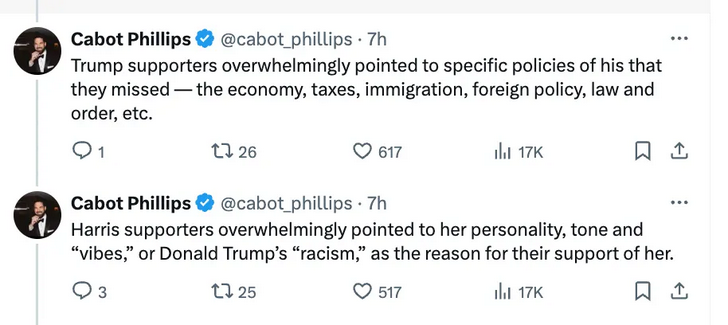
In a long thread on his many discussions over the last year with Trump and Harris supporters, a Daily Wire editor drops this contrast down in the middle:
I live in a deep blue zone, and I have these vibes-and-racism conversations several times a week. I learned today, face-to-face, that Donald Trump hates everyone who isn’t white. I mean, he despises them. All of them. These conversations go like this:
A: Trump is SUCH a fucking racist, man, he hates everyone who isn’t white, how can you even support someone like that?
B: Why is he racist?
A: Are you being serious right now? C’mon, man!
B: No, but why is he racist?
A: I can’t believe you’re defending him!
B: Okay, look: Donald Trump has already been the president for four years. What would you say were the top three racist policies he implemented?
A: You know what, I’m done with this discussion.
B: I’d settle for one really good one. What big racist policy did he implement?
A: I can’t even talk to you about this stuff — you’re so irrational!
Over and over and over and over again, these conversations hit the “I can’t even talk to you about this stuff” moment, the hard shutdown.
- What evidence can you offer for that view?
- [cognitive program shuts down]
Certain trigger terms warn you that the shutdown is moments away: conspiracy theory, disinformation, “what are you even talking about?” This personal observation about social interaction applies equally well to CNN panel discussions, by the way.
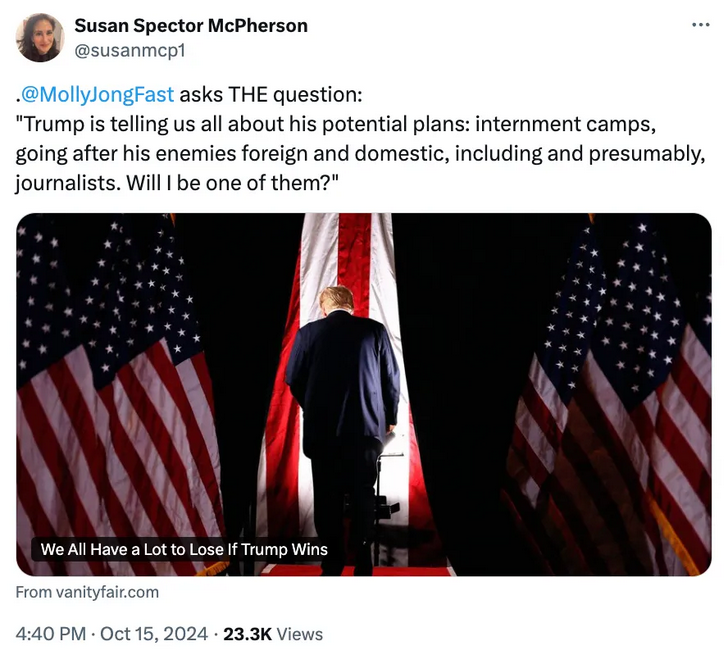
I’ve written before that I had a conversation just after the 2016 election in which I was asked how I could support someone who was going to put my own friends and family in the camps, man, he’s gonna put us in the fucking camps!
Eight years later, and after four years of a Trump presidency in which no one went to the camps, Trump can’t be allowed to return to the White House because, guess what, he’ll send us all to the camps:
QotD: J.D. Vance, a Führer for the rest of us
Expert: JD Vance’s selection as Trump’s running mate marks the end of Republican conservatism
Quoted for the lulz. Ol’ JD, a Führer for the rest of us.
But since we’re here … a fascinating footnote in Jaynes informs us that schizophrenics, who Jaynes thinks might be throwbacks to the “bicameral mind”, have no problem with “diffused identity” or whatever the term was. Jaynes hypothesizes that ancient, preconscious peoples didn’t see images of their gods in cult objects; they saw the actual, physical gods. We unicameral people can’t wrap our heads around it, since there are lots of statues and they can’t ALL be god — even if we grant that the biggest statue in the best temple can be god, or if we allow that the black meteorite or whatever is really god to them, still, god can’t be diffused like that: Either your statue is god or mine is; or neither of them are, but they can’t both be.
Schizophrenics, at least according to Jaynes, would be down with that. He notes that you can put two guys who think they’re Napoleon in the same padded cell, and you don’t get a schizo bum fight, you get complete agreement: They’re both Napoleon, somehow. The law of the excluded middle, personal identity version, simply doesn’t apply.
And since my hypothesis is that smartphones are re-decameralizing (it’s a word) us at Ludicrous Speed, well … here you go. Donald Trump is Hitler, but J.D. Vance is somehow also Hitler. It’s not like the real, historical Hitler lacked for shitty, evil underlings — J.D could easily be Heinrich Himmler or somebody. But no, he’s gotta be Hitler, the same way Trump has to be Hitler, and if that means they’re somehow both Hitler, well … there it is. Bicamerality for the win.
Severian, “Catching Up With the Crazies”, Founding Questions, 2024-07-29.
Comments Off on QotD: J.D. Vance, a Führer for the rest of us
October 31, 2024
The US federal election goes into garbage time
Lauren Smith on the latest attempt by Joe Biden to suck the oxygen out of the room (Kamala Harris was also speaking while Biden’s “gaffe” grabbed the media’s full attention):
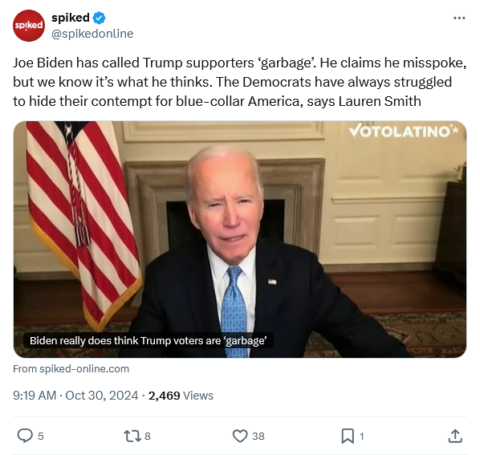
US president Joe Biden has re-emerged from wherever he was being hidden to hand Donald Trump an incredible, accidental boost. In a rare public appearance, he branded Trump’s supporters “garbage“.
For some reason, the president decided to wade into the row over a joke made by comedian Tony Hinchcliffe at a Trump rally in Madison Square Garden last weekend. Hinchcliffe described Puerto Rico as a “floating island of garbage”, sparking some confected outrage among those pretending not to know he was joking. In response, while speaking to Hispanic advocacy group Voto Latino, Biden said: “The only garbage I see floating out here is [Trump’s] supporters”.
The Republicans have understandably seized on the remark. Trump’s running mate, JD Vance, slammed it as “disgusting”. Florida senator Marco Rubio repeated the smear to Trump supporters at a rally in Allentown, Pennsylvania last night, to furious boos from the crowd.
The White House then rushed to try to retract the comments. Today, in a statement on X, Biden claimed that he was actually talking about the “hateful rhetoric” being “spewed” at the rally, not about Trump’s supporters themselves. That, he says, is “all I meant to say”.
But that is plainly not what he said. And everyone can guess it’s probably not what he meant, either. As Trump pointed out at the Allentown rally yesterday, Biden’s “garbage” gaffe is highly reminiscent of Hillary Clinton’s infamous “deplorables” outburst. During her 2016 presidential campaign, she described “half” of Trump’s supporters as “racist, sexist, xenophobic, Islamophobic”, saying they all belonged in a “basket of deplorables”. It was a blunder that many, including Clinton herself, believe cost her the election.
Jim Treacher investigates what he calls “the Case of the Planted Apostrophe” as the bulk of the legacy media rallied to try to cover up, mitigate, or explain away Biden’s “garbage” comment:
I think I heard something about MSNBC intercutting footage from the ’39 rally with the Trump rally? I haven’t watched that network since they fired Olbermann, but it sounds like something they’d do.
Little did they all know what a gift they were about to be handed. One of the speakers at the rally was comedian and Kill Tony podcast host Tony Hinchcliffe, and everybody lost their minds about this joke:
Perfect. The headline wrote itself: TRUMP RALLY BASHES PUERTO RICANS!!!
If Trump wanted to convince everyone he’s not a bigot, Hinchcliffe certainly didn’t do him any favors. Even though, as a few lonesome bloggers shouted into the wilderness, it was a joke.1
The entire journalism industry then spent 48 solid hours pouncing and seizing on Hinchcliffe’s unfortunate wisecrack. “See? Do you see how racist they are? They’re just so … so … racist!!”
Oh, they were so happy.
But they forgot one thing: Grandpa Joe is still around.
And he wants to help.
Emphasis mine:
The Puerto Rican that I know, or Puerto Rico where I’m, in my home state of Delaware, they’re good, decent, honorable people. The only garbage I see floating out there is his supporters. His, his demonization of Latinos is unconscionable.
Oops.
Yes, Joe Biden just called Trump supporters “garbage”. It’s the only clear sentence in that whole paragraph of gibberish.
There are maybe six million Puerto Ricans in America. In 2020, there were something like 75 million Trump voters. I’m no mathematician, but that’s a lot more. If alienating the first group is bad, then alienating the second group is much, much worse.
No matter how much Joe Scarborough hates them.
If a dumb joke by a podcast host matters, then so does the sitting president of the United States telling tens of millions of voters that they’re “garbage”.
1. The journos are now digging into Hinchcliffe’s voting history. They’re investigating a comedian for telling a joke. And they wonder why we hate them.

Comments Off on The US federal election goes into garbage time
October 30, 2024
Less than a week of increasingly desperate measures left to go …
I’m referring to the antics of the major US political parties as the formal date of the US election heaves into sight. On the one hand, Theophilus Chilton characterizes the Democrats as “cornered animals”:

“Polling Place Vote Here” by Scott Beale is licensed under CC BY-NC-ND 2.0 


 .
.
With just about a week left before Election Day, things have definitely been heating up. At this point, it’s pretty apparent that all of the indicators are in Trump’s favour — and this is driving the Democrats absolutely nuts (even more than they usually are). A month ago, one could have definitely made the case that Kamala Harris had a good chance of winning. Now, that seems pretty far-fetched outside of the Democrats figuring out a way to fraud the vote so hard that they can overcome their ever-worsening situation in basically every swing state. As we enter this final week, Trump definitely has the momentum and is conducting an upbeat, optimistic campaign. Meanwhile, Kamala and her surrogates seem palpably despondent, screaming at their microphones and rolling out one ill-conceived “October surprise” after another at an increasingly frenetic pace.
That this is the case seems to find a lot of varying data points to support it. Public-facing polling is always subject to a healthy dose of skepticism (“… gonna need to see some internals there, bub”), but even that seems to have moved in the direction of a possible outright Trumpian popular vote victory. It’s obvious where both campaigns’ internal polling is trending, as Trump heads to states like New Mexico and Virginia to expand the slate of contested states while Kamala does damage control in bright Blue urban centres where her party’s early voting numbers have collapsed. Republicans have been overperforming bigly in every swing state’s early voting. Newspapers like the Washington Post and techbros like Jeff Bezos (with access to tons of relevant Big Data) are starting to make nice with Trump because their information is pointing them in that direction. At a demotic level, Trump supporters appear loud and energised in all sorts of places where Trump support has not been traditionally robust, while Kamala’s supporters seem dejected and subdued — when they’re not angrily screaming at small children. On and on, the “non-traditional” indicators keep pointing in the same direction.
At this point, it’s pretty obvious that there is a preference cascade that is moving in Trump’s direction.
Now, if we were dealing with normal people, getting the kind of feedback that an electoral loss like this represents would cause the Left to step back and reassess what they’re doing. They’d take a moment to “look in the mirror”, so to speak. But understand that we are not dealing with normal people. Losing elections (or at least losing the actual voting, the “election” is a different matter altogether) does not send them the same message it sends to everyone else. Instead of introspection, it merely generates anger. It tells them that they need to screech harder, steal harder, and smash harder. After all, these people are on the Right Side of History and anyone who opposes them is a “fascist” and a Nazi (their actual closing argument this week, by the way). And as we all know, heroes like Indiana Jones punch Nazis. If the election is lost, it’s not because the Democrats ran an absolutely clueless, tone-deaf campaign that basically only appealed to wine aunts, gay men, and twenty-something sluts. It’s because Trump is a Russian asset and his supporters accessed a secret reservoir of racism, sexism, and transphobia like it was some kind of evil superpower that allowed them to scurrilously subvert the Good People in America. In other words, the Left will only double down on their own intrinsic madness.
I mean, this isn’t just a theory — we’re already starting to see this pattern of behaviour take place even though Harris hasn’t even lost yet. Celebrities are already starting up with their bidecadal threats to leave the country if their candidate loses. Keith Olbermann wants Elon Musk to be arrested and lose all of his government contracts for the crime of not suppressing oppositional speech on X like it used to be censored back in the old days. The ever-amusing Will Stancil is gloompilling and appears to be on the verge of either suicide or a murder spree. These people are not well. Not at all.
On the other hand, Trump is not only Hitler, Mussolini and Stalin re-incarnated with his red-hatted brownshirts terrorizing the land … he’s literally the Devil:
My current prediction — based on the average of the Trump v Harris opinion polls at Real Clear Politics — is that President Trump will win both the popular vote and the Electoral College in the 2024 election. This prediction is not only based on President Trump now effectively tying with Vice-President Harris in the average of polls, but even more on that VP Harris has never polled as well as Secretary Clinton did at the relevant points in the 2016 campaign.
What reading this Substack Note brought out very clearly was how very different this US Presidential election seems to folk on the two sides of a deeply politically polarised polity.
On the VP Harris side, the salient view is some version of “how can you even consider voting for That Man!?” This is usually attached to a whole list of sins and other claims, of varying accuracy. This is the Trump-The-Devil view. The election is all about Trump and how appalling he is, both as a person and as a political figure. Sure there are other issues (e.g. climate change, abortion) but the lead and focus is how awful Trump is.
To deal with the reality that President Trump has already been President, there is regularly extra focus on his personal Devilness plus various claims about how a second Trump Presidency would be so much worse, for whatever reasons.
Back in the 2016 campaign, it was noted that Trump’s supporters treated what he said seriously but not literally, while his opponents treated his words literally but not seriously. That is, his opponents focused on Trump’s erratic connection to accuracy in his statements but did not take the political pressure points he mobilised anywhere near as seriously. Those were simply ignored and/or dropped into “the bigotry, so ignore” box. Conversely, his supporters were being mobilised by precisely those political pressure points.
The focus on President Trump’s willingness to say things for their rhetorical effect rather than their accuracy loses some of its moral high ground, given how willing President Trump’s opponents have been willing to make statements about him for rhetorical effect, rather than accuracy.

Zuckerberg’s bad bet on Virtual Reality
Ted Gioia notes the anniversary of Mark Zuckerberg’s worst financial decision — the plunge into virtual reality:
A big birthday happens tomorrow. But don’t expect a celebration.
There will be no party, no disco. There will be no cake, no clown, no bouncy house for the kids. No Marilyn Monroe cooing the birthday song.
Just dead silence. But make no mistake — this is a very expensive birthday.
Exactly three years ago, Mark Zuckerberg placed a huge bet on virtual reality. On October 28, 2021, he even changed the name of his company — from Facebook to Meta.
A new company was born. But that’s now a huge embarrassment.
The name Meta is a lasting reminder of the most foolish decision Zuck ever made — even worse than Facemash or those ugly T-shirts.
Of course, that’s not how he saw things three years ago.
“Meta’s focus will be to bring the metaverse to life,” the company announced. “In the metaverse,” Zuckerberg bragged, “you’ll be able to do almost anything you can imagine.”
There was a catch — the tech billionaire needed to convince millions of people to wear virtual reality headsets.
But they looked ridiculous — you literally had to wear blinders if you wanted to enter Mr. Zucker’s neighborhood.
The very next day, I declared that “Meta is for losers”.
“This will never be cool.”
Zuckerberg was “making the wrong bet”, I warned — and gave my reasons:
The interface looks goofy and cartoonish. Instead of entering the gritty, exciting world of Blade Runner, you’re trapped inside a bad episode of Family Guy …
And users will look creepy too. You need to lock yourself into a headset to get the full benefit of the metaverse — and there’s no way that Zuckerberg can make that look cool. The people who spend hour after hour in his metaverse will be the subject of jokes and mockery …
They will be nerds and incels and the most disgruntled members of society, each desperate for escape.
Mark Zuckerberg eventually figured this out. But the company lost more than $20 billion over the next two years in a desperate attempt to convince normal people to abandon reality and enter his fake world.
Even as consumers resisted, Meta refused to admit it had made such a colossal mistake. Just last year, Zuckerberg still denied that he was abandoning virtual reality.
“A narrative has developed that we’re somehow moving away from focusing on the metaverse,” he told shareholders. “So I just want to say upfront that that’s not accurate.”
Then he did exactly that — retreating from the metaverse he had spent so much money building.
Fortune warned three months ago that Mr. Z’s metaverse “may finally be running out of cash”. Then in August, Meta cancelled the development of a next generation VR headset.

Comments Off on Zuckerberg’s bad bet on Virtual Reality
October 28, 2024
QotD: Democracy as theatre
The world does not have much experience with democracy. What we know of it comes from the century or so the West been tinkering with it and, of course, what can be learned from the ancient Greek experiment with it. Unlike monarchy or various forms of despotism, democracy has had a relatively short run. We have more real world experience with various types of totalitarianism than we do democracy, so it stands to reason that we are just coming to understand its benefits and liabilities.
One thing we are learning about modern democracy is that it is a myth. The people are not in charge. They get to vote on things and select representatives, but those representative don’t actually represent the interests of the people, who voted them into their positions. The office holders in a modern democracy represent the interests of the money-men who sponsored them. Politicians in a democracy are like prize fighters, in that they are controlled by a management team.
Like a prize fighter, one of the demands placed upon a modern politician is that he must at all times seek the attention of the public. Much of what we see in our modern democracies is false drama, designed to gain attention. This is why women have proven to be so successful as politicians. Women are naturally gifted with the ability to get attention, especially through false drama. It turns out that democracy is a form of governance modelled on the beauty pageant.
This is the point of the impeachment fiasco. The Democrats are the party of girls and gay men, so they naturally seek drama. Trump’s great sin is that he is a great showman, so he gets all the attention. Impeachment allows the vagina party to one-up him and force him to pay attention to them. If you look at the people celebrating in the streets, it’s lesbians and middle-aged woman. They are not celebrating because they hate Trump. They are happy someone is noticing them.
The Z Man, “Impeaching Democracy”, The Z Blog, 2019-12-19.
Comments Off on QotD: Democracy as theatre
October 26, 2024
Thank goodness somebody finally had the courage to say that Trump is a fascist
I mean it’s been obvious since his supporters have been goose-stepping around the Reichstag the White House in their brown shirts, red armbands, and constant chanting of the “Horst Wessel Lied“. How have the mainstream media managed to avoid seeing the clear inspiration of Trump’s Kampf and reporting it to credulous flyover state cretins Americans?

This week Kamala Harris described Donald Trump as a “fascist” who seeks “unchecked power”. Conservative commentators have expressed outrage at this absurd strategy, one which will doubtless backfire. And yet they appear to have forgotten that Trump has repeatedly referred to Harris as a “fascist” and, one on occasion, called her a “Marxist, communist, fascist, socialist”.
We have grown accustomed to the tactics of social media, the online crèche where those who bawl the loudest are rewarded with treats. What has become known as “Godwin’s Law” states that the longer an online discussion continues, the higher the probability that a comparison with the Nazis or Hitler will take place. Even Godwin has succumb to Godwin’s Law, penning an article for the Washington Post last December with the headline: “Yes, it’s okay to compare Trump to Hitler. Don’t let me stop you.”
If this election is going to be reduced to each candidate shouting “fascist” at the other, we may as well give up hope. I have never been more convinced of the growing infantilism of political discourse than in the last few weeks, or that the US is now divided – perhaps irreparably – between two groups who see the world in entirely incommensurable ways. With sensible discussion now seemingly impossible, the election has descended into a battle of memes.
Harris’s campaign team, for instance, gleefully embraced the “Brat” identity bestowed upon their candidate by Charli XCX. I must confess that I have no idea who Charli XCX might be. Her surname in Roman numerals means 100 – 10 + 10, so I can only assume she’s a classical scholar making a sardonic point about the philosophical principle of eternal recurrence.
Likewise, Trump’s now infamous reference to the eating of cats and dogs in Springfield, Ohio, has been remixed multiple times and shared more widely than any campaign statement. All of which is very funny, but one might be forgiven for yearning that the election of the leader of the free world should be a generally humourless affair. International conflicts are not best resolved through a series of “yo momma” jokes.
This week I wrote a piece for the Washington Post about George Orwell’s essays, and the lessons that might still be gleaned from them. Specifically, I pointed out that Orwell continually cautioned against tribal thinking, and is still despised today in certain left-wing circles for reminding his readers that authoritarianism can occur on both sides of the political aisle. I quoted Orwell’s essay “Notes on Nationalism” (1945), in which he identified “the habit of identifying oneself with a single nation or unit, placing it beyond good and evil and recognizing no other duty than that of advancing its interests.” I also quoted his dismay that the word “fascist” is so commonly misused. The piece can be read here.
I don’t often read the comments under my articles (except for here on Substack, of course), but I was interested to see how the overwhelmingly Democrat-supporting readership of the Washington Post might react. The comments are extremely revealing, given that most of those wading in seem determined to prove my point. I have rarely seen such unthinking and flagrant tribalism on display. Apparently, Trump is a literal “fascist”, and Orwell would have been the first to identify him as such. Orwell, of course, took up arms against actual fascists in Spain and was shot in the throat for his troubles. Would these commentators argue that if Orwell were alive today he would have packed up his gun and headed for the US in the run-up to this election? If not, why not?
Comments Off on Thank goodness somebody finally had the courage to say that Trump is a fascist
Our solar energy future – “In September alone, Germany paid 2.6 billion Euro to renewables producers for electricity that had a market value of a mere 145 million Euro”
Checking in with what’s been happening in Germany, eugyppius explains why solar power is far from the cost-free energy source that politicians and scam artists try to claim:
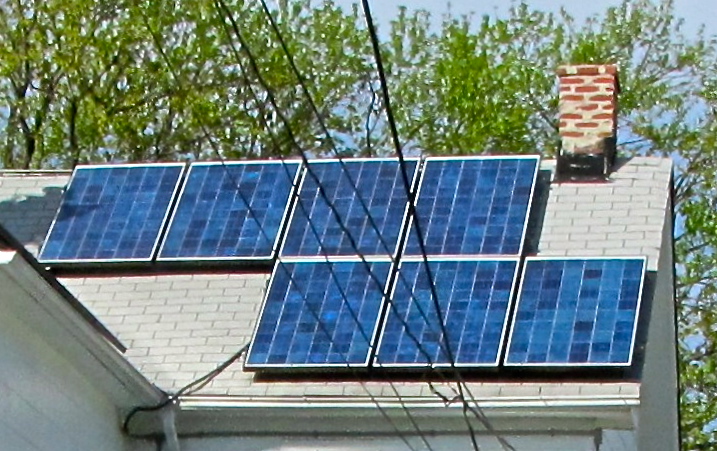
Photovoltaic panels on a roof, 28 April, 2015.
Photo by Antonio Chaves, via Wikimedia Commons.
Climatism in Germany is attended by all manner of naive ideas and bright pink fairytale slogans. Among the latter is a dubious proverb proclaiming that “The sun doesn’t send any bills” (in German: “Die Sonne schickt keine Rechnung“). Such proverbs always seem initially plausible (is there anything freer and more democratic than sunshine?) while proving to be basically the opposite of the truth. In fact, the energy transition has landed German taxpayers in the position of paying billions of Euros for the sun to shine. It is becoming an unmitigated disaster, and what is worse, the more we expand solar capacity, the more we will have to pay. For something that does not send any bills, sunshine has sure become very expensive here in the Federal Republic.
Welt calls it “the solar trap,” and it works like this: Our Renewable Energy Sources Act (EEG) pledges to pay renewables producers fixed tariffs for every kilowatt hour of electricity their installations feed into the grid. Whether you are an ordinary climate-conscious person with solar panels on your house or you run massive solar farms, the EEG entitles you to receive these fixed “feed-in tariffs” for a period of twenty years. The EEG also requires grid operators to accept your electricity regardless of demand and to sell it on the electricity exchange.
Now the sun, although it may not charge for its services, turns out to have this naughty habit of shining in many places all at once. When this happens, electricity supply often exceeds electricity demand and exchange prices fall. They can fall all the way to zero, or in extreme situations of excessive sunshine they can even go negative. Negative prices mean that you have to actually pay “buyers” to take the excess power off your hands. Whether the prices are merely very low, or zero, or negative, the German taxpayer has obligated himself, via the EEG, to pay these producers of unwanted if extremely green and climate-friendly electricity their fixed feed-in tariffs anyway. That is, we are on the hook for the difference between the actual exchange value of excess electricity and the feed-in tariffs promised to producers. In this way we have ended up literally paying for the sun to shine.
In September alone, Germany paid 2.6 billion Euro to renewables producers for electricity that had a market value of a mere 145 million Euro. Our sunny autumn is destroying our already-fragile government budget. Federal number-crunchers had originally allocated 10.6 billion Euros for feed-in tariffs in 2024, but already the government owes 15 billion and the year is not yet over. Scholz’s cabinet are thus trying to allocate an additional 8.8 billion Euro for the rest of the year. The parliament have yet to approve the additional funds, though, and also the damned sun will just not stop fucking shining, and so probably even this supplementary allocation won’t be enough. We’re bleeding money, all for a sun that doesn’t send any bills.
This problem will get worse before it gets better. The more solar panels we install, the greater oversupply we’ll face when the sun shines, and the larger the spread between the fixed feed-in tariffs and the actual market value of this green electricity. In 2024, as I said, the government projected that feed-in tariffs would cost 10.6 billion Euros, but they’ll probably end up costing 20 billion at least. Next year, the costs are projected to be even higher, and the year after that, they will be higher still. As Welt report, the German government plans to triple our solar capacity to 215 gigawatts over the next six years – “the equivalent of 215 nuclear power plants” every time the sun emerges from behind a blessed cloud.
The energy transitioners know they messed up. The new plan is to change the rules for solar subsidies. When prices go negative, larger producers won’t receive their fixed tariffs, and they’ll also have to sell their electricity themselves. In this way, they will become newly sensitive to market demand and stop overproducing electricity when nobody wants it. It is almost like creating a blind system totally oblivious to market incentives was a bad idea. Unfortunately, the new rules will apply only to new solar installations. The German government will still have to honour its insane agreement to pay the operators of older solar plants for years to come. We will light billions on fire for nothing.
Comments Off on Our solar energy future – “In September alone, Germany paid 2.6 billion Euro to renewables producers for electricity that had a market value of a mere 145 million Euro”
The coming Hundred Days (?)
In spite of everything, I still lean toward optimism, so I can’t say that I agree with Kulak’s take here:

January 6th, 2021 — A protest that got out of hand or the worst act of insurrection since 1861, depending on your political preference.
There are decades when weeks happens, and weeks in which decades happen
– Variously attributed to Marx, Lenin, Stalin, Robespierre, Napoleon, and Steve BannonAs of writing it is 18 days to the election on Nov 5th, and 94 days to Inauguration Day on Jan 20th.
Maybe the most knowledgeable meta-historian/Commentator alive today, whatifalthist, has predicted a civil conflict in which over 1000 Americans die will begin in this period …
And I’d put the odds of “A Conflict” in which over 1 million die involving the US overlapping with this period at something like 70-80%. If it doesn’t happen then Biden will have somehow played the perfect drunken master and embodied the Trifecta of God favouring “fools, drunkards, and the United States of America”.
That is a major American conflict: beginning, continuing, or dramatically ending within this period.
Civil War or “Troubles” is still slightly below a 50% likelihood … But that’s because I think The Ukraine or Israel wars going nuclear, a hot war with Iran, A Chinese move towards Taiwan, or what’s increasingly looking like a possible foreign backed Cartel-War on US soil (see Aurora) … might suck the oxygen out of a final domestic reckoning between America’s two political factions (Trump and Swamp) … at least until 2028 or 2032.
However America’s domestic instability is what’s driving the risk of escalation, miscalculation and uncertainty everywhere else and that will be the focus of this piece …
I am unprepared for what I think is coming … I’ve maybe thought about such an outcome for a decade now, I lived through 2020 and the Canadian Lockdowns with outrage and totalitarian anxiety (remember Canada was the testing ground for what they wanted to everywhere else, we got what Alex Jones only prophesied), and I’ve been a amateur and semi-professional war and preparedness commentator for 2 and a half years now … and it’s hit me how unprepared I am.
I’m more prepared than most, but, setting aside the political implications, I would trade A LOT for another 4 year election cycle of 2023 conditions to make money, network, buy kit, develop skills, read books, write articles, prepare, plot …
I’m doubtful I’ll get it.
I’m also painfully aware that a very large percentage of people and institutions would not financially or morally survive a long Biden “normalcy” … and that that desperation is driving a lot of the instability.
But ya, I’m already starting to intuitively anticipate/feel that hard times — things moving too fast — reactive loss of initiative feeling that I’ve only really felt when a relationship was imploding, during that one very rough exam season in Uni, at the height of the 2020 election-2021 Canadian Lockdowns, or those months when the doctors discussed amputation as an possibility …
And depending on who you are and your personal situation, you’re either keenly feeling that as well or blissfully unaware.
Comments Off on The coming Hundred Days (?)
October 25, 2024
The “party of youth” is led by decrepit, doddering wrecks and time-serving political hacks
You can tell a lot about a political party by looking not at its current leadership but at its “bench” … the next couple of generations of potential leaders. In the United States, the Republicans actually don’t look too bad for future leaders, but the Democrats are facing a bench of already-too-old and never-will-be-ready-for-primetime hacks, as the “groovy fossils” have been clinging on to power right to the bitter end and drive away competent potential successors:
Thirty years ago, Democratic politicians were people you disagreed with, but they were from and of the body of the people. They were us, our brothers and sisters who saw things differently. I lived in California when Jerry Brown was the governor, twice, and I liked him. He was a brilliant crank, colorful and interesting. Whatever else he was, he was never dumb. If you remember the 1992 Democratic primaries — yes, this is a deep reach — the campaign season was full of distinctly likeable people, with the exception of the one who prevailed. Paul Tsongas used to say, often, that he was socially liberal but absolutely certain that federal transfer payments were on an unsustainable trajectory. His best line in the primaries was, “I’m not Santa Claus.” He was an unorthodox Democrat, when it was still possible to be one of those.
The current cultural model of the Democratic Party has produced a generation of politicians who are nakedly stupid and empty.
I’ve compared the Biden years to the Brezhnev years, with the army of handlers covering up the decline of the old party hack who’s been elevated beyond his ability. What we’re seeing now is the generation of dismal, time-serving party hacks that comes after the old decaying party hack. Democrats have credentialed their leaders on their ability to fit themselves tightly to the ritual grooves carved into the discourse. When asked about transgender issues, they say, “Trans women are women”. They have the whole list of correct slogans available for the moments when the machine is expected to push those slogans through the slot. Hate has no home here! (applause) They above all do not say things that are not the slogans. It’s time for the billionaires to pay their fair share!
And so we get Kamala Harris, and holy cow please help me. This may be the first person in the history of the world who has never answered a question. She seems programmed in her core functions to turn away from the actual substance of anything that anyone might ever ask, like she was brainwashed after that one combat patrol that ended vaguely.
[…]
This isn’t an accident. A generation of Democratic politicians have been culturally trained into a deflective and hollow discourse. It’s fascinating to watch them sort JD Vance, who talks like a person, into the category of “weird”.
Comments Off on The “party of youth” is led by decrepit, doddering wrecks and time-serving political hacks
QotD: The treason of the music critics
Freddie deBoer, “A Few Indisputable Points About Poptimism and Then I Give Up”, Freddie deBoer, 2024-07-22.
Comments Off on QotD: The treason of the music critics


