Remember The Matrix? It spawned a zillion pop-academic books with titles like The Matrix and Philosophy, and for once it wasn’t just a marketing gimmick. I doubt the filmmakers intended this — given that at least one of the Wachowski Brothers is now a trannie, I suppose their intended message was “let your freak flag fly, because that makes you Secret Jesus” — but all that Baudrillard stuff that inevitably attaches itself to a movie about virtual reality was actually kinda true.
Consider that if we really do live in a computer simulation, then everything the #wokesters are always going on about is actually true. Everything really IS a “social construction”, because “society” was literally constructed. All that stuff about “systemic racism” is true, too, because again, we’re dealing with a design. Nothing evolves organically inside The Matrix, because there’s nothing organic in there at all. It’s ALL on purpose …
… and you, #wokester, are the only one who can see it. Unlike Karl Marx, who was able to see beyond his class situation enough to say that no one can see beyond his class situation, because reasons, you, #wokester, can do it because you’re Neo. That, too, is built into the system. It’s an endless recursion … but one that entails that you, and you alone, are special, on purpose.
That, kameraden, was the 1990s. Even those movies our author mentioned — Beverly Hills Cop III, Lethal Weapons 3 and 4 — weren’t just copies of copies, they were ironic, snarky commentaries on copies of copies. See also Scream, which was a “deconstruction” of every slasher picture ever made. If you can’t beat ’em, join ’em … but since both beating ’em and joining ’em entail making a sincere effort and sincerity is forbidden, all you can do is mock ’em. That’s what “deconstruction” is, one long polysyllabic mockery of the very idea of excellence. It’s the perfect philosophy for people who know themselves to be mediocre but have been told from day one that they’re special.
See also the tv show Friends, where five ludicrously attractive people and David Schwimmer all pretend to be just normal folks (who happen to live in 3,000 square foot apartments in Manhattan) — each episode is “the one that’s just like The Brady Bunch, but snarky”. Or Seinfeld, which was deliberately designed to be a grating mockery of stuff like The Odd Couple. All snarky mockeries of the very concept of sincerity.
See what I mean? That’s normal now, which is why the 90s must be dragged into an alley and shot, for Western Civ’s sake.
Severian, “Why the 90s Was the Worst Decade Ever”, Rotten Chestnuts, 2021-07-04.
November 13, 2024
QotD: The 1990s
November 12, 2024
John Carter – “We can all sense the vibe shift”
At Postcards From Barsoom, John Carter tries to explain the “vibe shift” in western culture:
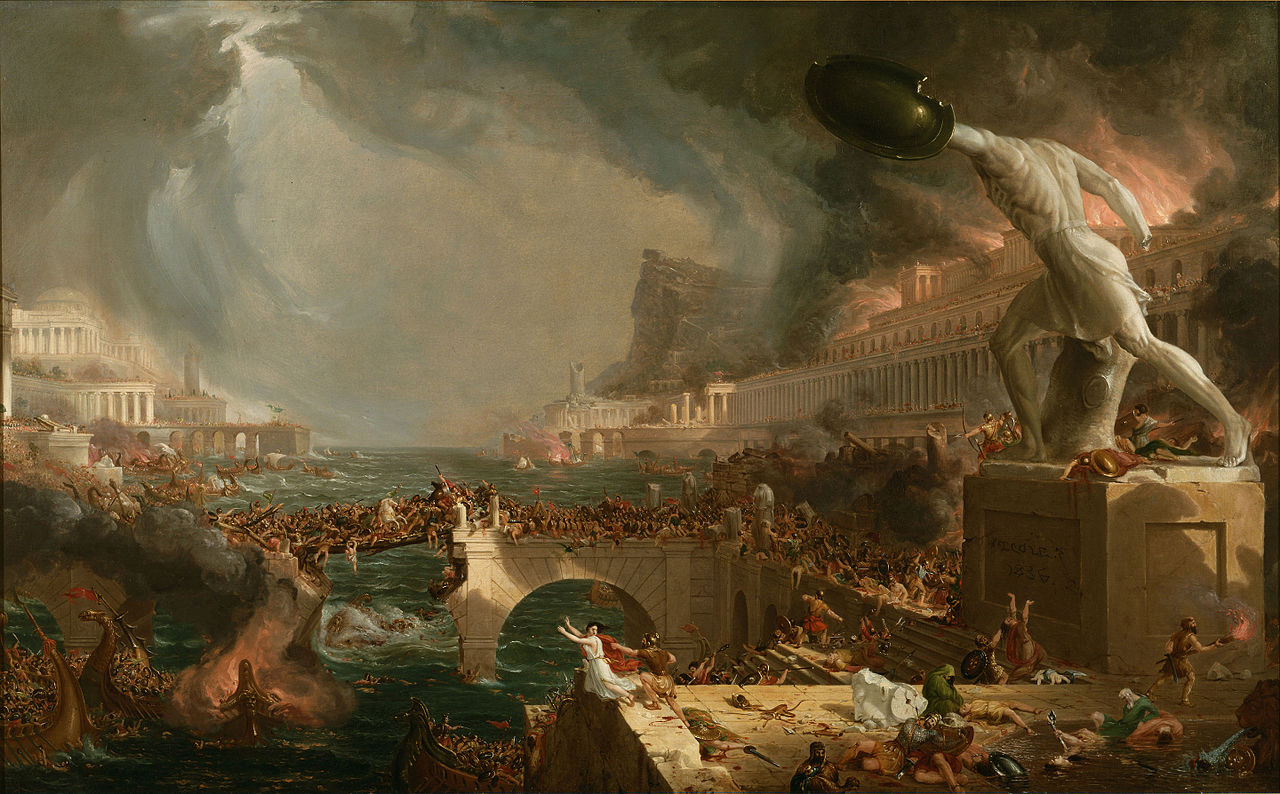
The Course of Empire – Destruction by Thomas Cole, 1836.
From the New York Historical Society collection via Wikimedia Commons.
Underneath the medical tyranny of COVID, the stolen elections, the Internet censorship, the inflation, the hypermigration, the gender psychosis, the polarized rancor of sexual politics, and all of the rest of the symptoms of our decaying mismanagerial order, a countercurrent has flowed through the deep and hidden places of our collective psyche, hot and slow, like a chthonic river of magma rising implacably to the surface.
It isn’t just frustration with the intolerable imposition of Woke into every aspect of our lives, as though we could reset the clock to 90s liberalism and get fresh again with the Prince of Bel Air. It isn’t just anger at the invasion of our countries by the third world, nor is it limited to impatient disgust with the glossolalic babble of an incompetocracy comprised of credentialed midwits who seem to feel that word-shaped noises confer all the legitimacy they need to misrule our countries into oblivion.
It isn’t purely negative.
There’s a sense, somehow, of hope.
Hope, that after decades in which it seemed that history has stalled, that the culture has been frozen in permafrost, that nothing new could ever really be done again, that Nothing Ever Happens, that the only thing we can look forward to is a long, cold decline into technocratic surveillance, demographic implosion, green energy poverty, and final, irrecoverable collapse … hope that maybe this insipid fate isn’t so inevitable as we thought. Hope, that the building tectonic pressure of those buried psychological forces might finally break through and crack the shell of a dead future.
The sudden birth of artificial intelligence and the renewed enthusiasm for the conquest of space are two very obvious signs of this abrupt return of novelty. This is not a purely positive thing – AI is regarded with anxiety by almost everyone, but it is the raw fact of its sudden transition from science fiction to mundane tool of everyday life that is significant here.
There are other signs of this sense of renewal. The proliferation of self-improvement culture amongst many of the youth, particularly on the Very Online Right. The rise of the digital nomad, a modern re-enactment of the Romantic wanderjahr. The quiet birth of the network state, for instance in the form of Praxis. The renaissance of thoughtful, long-form essays right here on Substack. Surging interest in the religious traditions of our ancestors, whether in the form of Orthodox Christianity or paganism. The transformation of warfare by drones, promising a revolution in military affairs every bit as epochal as the firearm. The rise of a contradictorily global sense of national particularism. The steady refinement of 3D printing technologies.
Trump’s victory in 2024 seems a sure sign of this vibe shift. In a plot arc that could have been lifted straight from the original Star Wars trilogy, Trump brought A New Hope to America – and the world – in 2016; his forces were shattered and scattered to the winds in 2020 when The Empire Struck Back; only for the rebel forces, tempered by the lessons learned in defeat and strengthened with the assistance of new allies, to Return With the Jedi in 2024 and once again blow up the Death Star. This time around, Trump represents not simply the desperate holding action of an underground resistance to granny state totalitarianism, but the coalescence of a new and vigorous counter-elite, as embodied most of all by the ambitious hectobillionaire space lord who built auctoritas by buying the digital public square out from under the Empire so he could shitpoast in peace with the chuds.
Each of these has their good and bad aspects – the point, again, is not to dwell on whether any given development will be to our benefit or our detriment. As always, the ramification of second and third-order effects through the social order will result in both advantage and disadvantage. The point is simply that things are changing, that we can all feel it, and that this fuels a sense of nervous excitement that permeates the atmosphere like electrical buzz of a high-tension wire. Perhaps there will be disaster, and we shall drive ourselves to ruin and extinction; perhaps our descendants will walk the stars as near-gods. Either way, we are here, now, at this most interesting of nexus points in the unfolding history of our species. Would you rather be anywhen else?
The pessimism of recent years naturally generated an interest in cyclical theories of history – the empirical Strauss-Howe model of generational turnings, Turchin’s mechanical cliodynamics with its elite overproduction and wealth pumps, Spengler’s mythopoetic conception of cultures as vast organisms whose lifecycles progress through predictable seasons. Hard times make strong men; strong men make good times; good times make weak men; weak men make hard times. Whichever model one favours, the invariable conclusion is that Western civilization is in its terminal winter – fragile, ossified, decadent, corrupt, exhausted, and doomed. Desolation awaits.
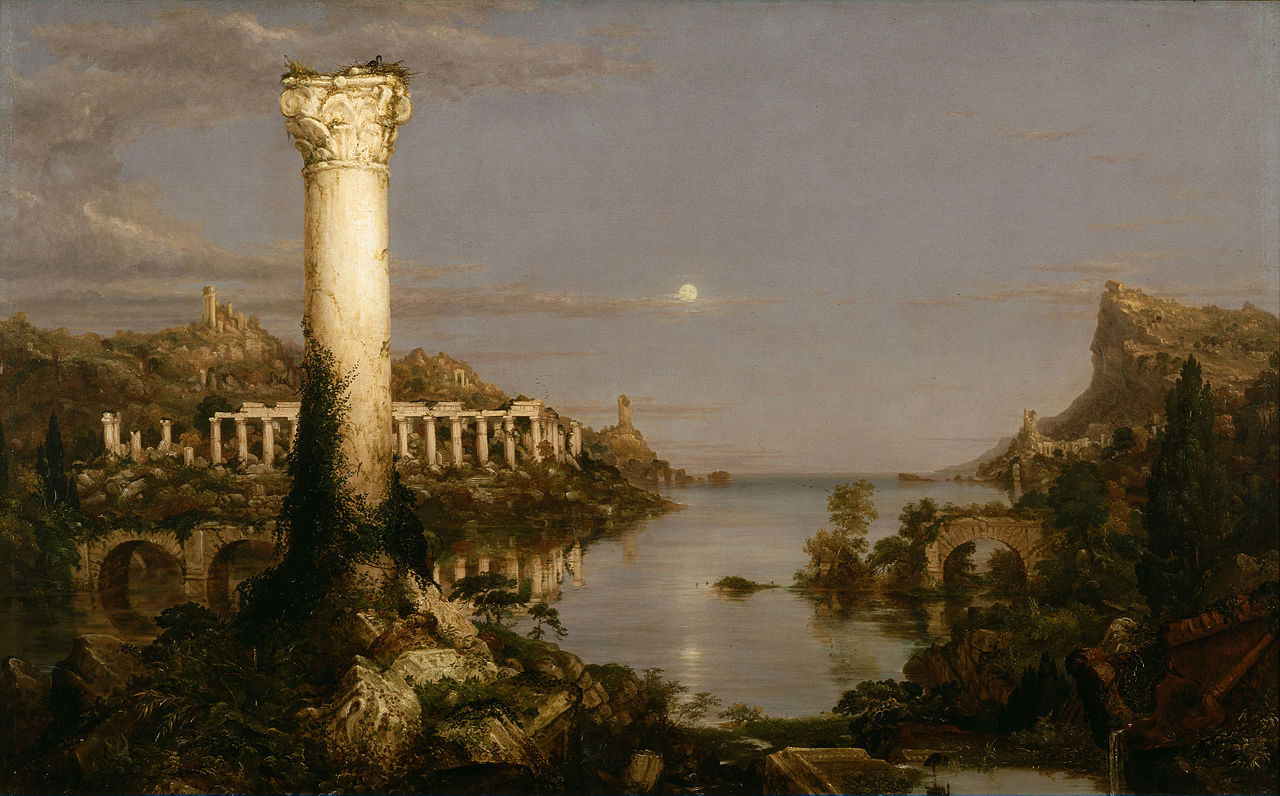
“The Course of Empire – Desolation” by Thomas Cole, one of a series of five paintings created between 1833 and 1836.
Wikimedia Commons.Yet a cycle is not defined by its final product, no more than a symphony is defined by its concluding note, a life by its last moment, a wheel by a single turn, or a circle by a single point. Viewed from another angle, the death of Faustian civilization is also the birth of a new civilization … and even as we are here to live through the death of one, we plant the seeds for the other. With the tempo of history moving faster than ever before due to the global interconnectivity of instantaneous telecommunications and high-speed travel, it may be that our children will live in the savage springtime of that new civilization … perhaps one animated by the Aenean rather than the Faustian soul, which “will go Mars, not because it is hard, but because it is necessary”. You should read the essay at that last link, by the way. It isn’t long, it’s extremely interesting, and it’s new.
“Nice business ya got there, Patreon. Wouldn’t want anything to happen to it …”
Above the paywall, Ted Gioia discusses Apple’s latest attempt to cut itself a nice big middleman’s slice of the indy creator market by putting the thumbscrews to Patreon:

Can Apple really charge a 30% tax on indie creators?
What Apple is now doing to indie creators is pure evil — but this story has received very little coverage. Journalists should pay attention, because they are under threat themselves.
Apple is now putting the squeeze on Patreon, a platform that supports more than a quarter of a million creators — artists, writers, musicians, podcasters, videographers, etc.
These freelancers rely on the support of more than 8 million patrons through Patreon, which charges a small 8-12% fee. Many of these supporters pay via Patreon’s iPhone app.
Earlier this year, Apple insisted that Patreon must pay them a 30% commission on all new subscriptions made with the app. In other words, Apple wants to take away close to a third of the income for indie creators — almost quadrupling their transaction fees.
This is the new business model from Cupertino, and it feels like a Mafia shakedown. Apple will make more from Patreon than Patreon does itself.
The only way for indies to avoid this surcharge is by convincing supporters to pay in some other way, and not use an iPhone or Apple tablet.
This is what happens when Apple decides to treat a transaction as an “in app payment” — as if an artist’s entire vocation is no different than a make-believe token in a fantasy video game.
But you can easily imagine how almost anything you do with your phone could be subject to similar demands.
I’ve been very critical of Apple in recent months. But this is the most shameful thing they have ever done to the creative community. A company that once bragged how it supported artistry now actively works to punish it.
Canada in the news … for all the wrong reasons
In the National Post, Tristin Hopper explains why your non-Canadian friends may be finding their opinions on the dysfunctional Dominion getting more and more sour in recent years:
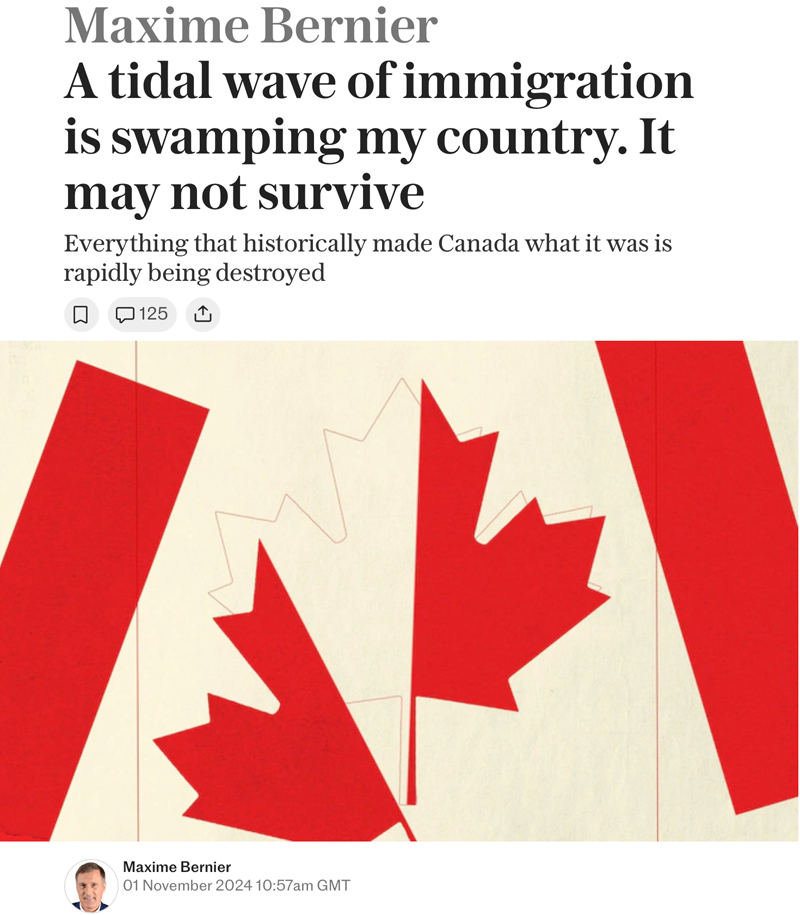
… within just the last few years, multiple foreign outlets have profiled Canada for the singular purpose of asking what happened to it, and worrying if Canada’s ills will soon be their own. What’s more, these articles are not limited to a single topic; so much is going sideways in Canada right now that everything from our assisted-suicide regime to our economy to our internet legislation is attracting overseas notice like never before.
Below, a cursory guide to some of them. If you’re noticing that your non-Canadian friends suddenly have a darker picture of your home country than they used to, here’s a clue as to why.
“Justin Trudeau is killing Canada’s liberal dream”
Ever since the 2019 federal election, The Economist‘s coverage of Prime Minister Justin Trudeau has usually followed a general theme of noting that the bloom is off the rose of his photogenic ascendancy to power in 2015. But in a trio of articles published last month, the publication laid into the Canadian leader as an icon of what not to do.
Justin Trudeau is killing Canada’s liberal dream, published on Oct. 14. Canada’s Trudeau trap, published on Oct. 17. And then, just for good measure, Justin Trudeau is paying for solar panels in the cold, dark Arctic.
[…]
“Canada Is Disintegrating”
The Telegraph in the U.K. ran an entire series of essays last week on the topic of Canada taking it to the limit on progressive laws covering everything from drugs to national identity.
[…]
“Canada’s Extremist Attack on Free Speech”
The June tabling of the Online Harms Act prompted a wave of foreign coverage unlike few pieces of Canadian legislation. Although virtually every non-U.S. country has legislated controls on extreme speech, the Online Harms Act went noticeably farther than its peer countries in two respects: It prescribes a life sentence for the speech crime of “advocating or promoting genocide”, and it authorizes pre-emptive custody for anyone suspected of committing hate speech in future.
QotD: Roger Scruton, terroiriste
>Good wine is a “somewhere”, not an “anywhere”. It is stamped with a place and a year. Rooted, literally. The fancy French word for this is terroir, referring to the way in which environment — soil, geology, even the history of a place — is all responsible for a wine’s character. Terroir is a sense of place in a glass. Roger Scruton often referred to himself as a “terroiriste“. And this could describe his political philosophy as much as his philosophy of wine. From 2001 to 2009, Scruton wrote a wine column in the New Statesman, enabling him to smuggle into that otherwise exclusively Left-wing journal, all sorts of reactionary political ideas: about God, about fox-hunting, about beauty, about his love of the countryside.
Wine, for Scruton, was never just about the taste, never a merely aesthetic sensation. Indeed, he was extremely sniffy about all those “blind tastings” — the ones where we delight when an expert fails to spot the difference between plonk and Premiere Cru. They miss the point, says Scruton. Blind tasting, he explained, is like blind kissing — not a good way to distinguish, for example, between someone who is sexy and someone who is not. Indeed, if the experiment on Love Island is anything to go by, it’s not even a good way to distinguish who your own girlfriend is.
That’s because sexual chemistry, like wine, is a great deal more than some momentary sensation on the lips. It’s a great deal more than a message sent by taste receptors to the brain. It is all about the terroir. And this is not just a comment about wine but about aesthetic experience in general. When we encounter a work of art, we bring a whole hinterland of knowledge that makes sense of that specific experience and gives it its character as art. Music is more than a vibration of the air and its reception by the ear and the brain. So too with wine and taste.
Giles Fraser, “Raise your glass to Roger Scruton, the terroiriste“, UnHerd, 2020-01-15.
November 11, 2024
QotD: Military glamour
In the 19th century, warfare was one of the first contexts in which English speakers used the term glamour in its modern metaphorical sense. (The word originally meant a literal magic spell that made people see things that weren’t there.) “Military heroes who give up their lives in the flush and excitement and glamour of battle”, opined a U.S. congressman in 1885, “are sustained in the discharge of duty by the rush and conflict of physical forces, the hope of earthly glory and renown”.
Even people who hated military life could feel the attraction. Writing after the briefest of conscriptions (a single night in the barracks), D.H. Lawrence in 1916 lamented “this terrible glamour of camaraderie, which is the glamour of Homer and of all militarism”.
The slaughter and apparent futility of the Great War changed all that. Peace activists and bitter veterans now saw the “glamour of battle” as a dangerous delusion rather than a valuable inspiration. “Are you going to tell your children the truth about what you endured,” an American challenged fellow veterans in 1921, “or gild your reminiscences with glamour that will make them want to have a merry war experience of their own?” In 1919, the British painter Paul Nash wrote that the purpose of The Menin Road, his bleak portrait of a desolate and blasted landscape, was “to rob war of the last shred of glory, the last shine of glamour.”
Virginia Postrel, “Casualty of War”, Virginia’s Newsletter, 2023-08-10.
November 10, 2024
Post-election thoughts from Andrew Sullivan
Given how … anguished … Andrew Sullivan seemed to be during the run-up to voting day, he’s either calmed down dramatically or he’s renounced the over-the-top hysterics for the moment:
You can always spot a fool, for he is the man who will tell you he knows who is going to win an election. But an election is a living thing — you might almost say, the most vigorously alive thing there is — with thousands upon thousands of brains and limbs and eyes and thoughts and desires, and it will wriggle and turn and run off in directions no one ever predicted, sometimes just for the joy of proving the wiseacres wrong
Robert Harris in his novel Imperium (2006).This last decade or so, we’ve heard an awful lot about the new fragility of American democracy. So it bears noting that, after much angst, we somehow pulled this election off. Kudos to the election workers. Kudos to the voters for providing a clear and decisive result. Kudos to Harris for the graceful concession (in stark contrast to Trump in 2020). We have not lurched into another crisis of democratic legitimacy. No windows are being smashed; no statues are being torn down.
And there is, yes, a mandate. When one party wins the presidency, Senate, and probably the House, that’s usually the case. But this year, the policy divides were particularly clear, and the shift so clear and in one direction everywhere. Americans have voted for much tighter control of immigration, fewer wars, more protectionism, lower taxes, and an emphatic repudiation of identity politics. In the immortal words of Mencken: “Democracy is the theory that the common people know what they want, and deserve to get it good and hard.” We’ll soon see how that pans out.
But the good news is that we have become less tribal. The president whom Ta-Nehisi Coates derided as whiteness personified just won more non-white votes than any Republican since Nixon. The allegedly xenophobic campaigner against illegal immigration gained massively among various Spanish-speaking constituencies and many legal immigrants, especially men. The champion of rural whites somehow also made his biggest electoral gains in the big, non-white cities, and among Hispanic voters in Texas border counties. A Republican whom the left and the legacy media called a “white supremacist” won about 24 percent of the black male vote and 47 percent of the Latino male vote.
What about the huge impact of enraged women we were told about, especially in the wake of the Selzer poll in Iowa? Again: a nothingburger. Biden won women by 12 points; Harris — a woman candidate after the end of Roe — won by only 7 points. Ruy Teixeira runs through the other demos here. Gen Z? Biden won women under 30 by 32 points, and Harris by a mere 18. Meanwhile, men under 30 went from +15 for Biden to +14 for Trump — a truly staggering swing! Trump gained among Jews and Muslims! Harris was the candidate of the Upper West Side. The Bronx moved massively to Trump.
How could an entire left-liberal worldview be more comprehensibly dismantled by reality? And yet, the primary response among my own liberal friends was rage at the electorate. They texted me to insist that Harris lost because of white people — white women, in particular, their favorite bêtes blanches. The NYT’s resident race-baiter, Nikole Hannah-Jones, made her usual point:
Since this nation’s inception large swaths of white Americans — including white women — have claimed a belief in democracy while actually enforcing a white ethnocracy.
In fact, among the few demos where Harris did better than Biden were white people earning over $100,000 a year, white women, white men, and “LGBT” voters — most of whom are now young, bi, white women in straight relationships. Warming to her racism, NHJ went after “the anti-Blackness … in Latino cultures as well.” Here’s how Joan Walsh put it:
[Biden]’s got a couple things that my girl Kamala didn’t have. A penis, and that nice white skin.
But more whites went for Kamala than Biden! If you want proof that critical race, gender and queer theory is unfalsifiable, you just got it. The Dems and most of the legacy media have literally no frame of reference outside “white-bad/black-and-brown-good” and “men-bad/women-good”.
And no, Harris did not run a “flawless campaign“. Please. She ran one with no coherent message. She picked a woke weirdo as veep. She embraced neocons like Liz Cheney while never breaking decisively with Biden or the left. She had no credible answers on immigration and inflation. She had nothing coherent to say on foreign policy. She thought Cardi B and Stephen Colbert were arguments.
On Trump as a potential dictator, Americans keep telling us they don’t really buy it. They may be wrong … and maybe they are. But if you are going to respect democracy, you also need to respect their judgment, and honor their choice. I suspect they think he will throw his weight around, but will be constrained as he was last time around by the ability of the American system to stymie most radical moves. But they want him to end mass illegal immigration, and I suspect they will give him some leeway to get there. The Dems had their chance to enforce the border and instead chose to open the floodgates. What Trump now does is therefore their responsibility too.
The 1896 US Presidential election
In the latest SHuSH newsletter, Ken Whyte looks back to the 1896 contest between William McKinley and William Jennings Bryan:
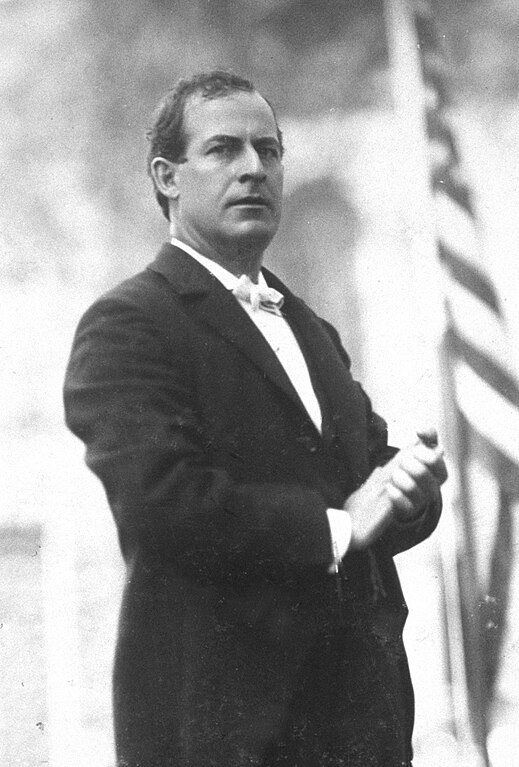
William Jennings Bryan, Democratic party presidential candidate, standing on stage next to American flag, 3 October 1896.
LOC photo LC-USZC2-6259 via Wikimedia Commons.
The 1880s and 1890s saw an enormous expansion in the number of newspapers in America. New printing technologies had drastically reduced barriers to entry in the newspaper field, while the emergence of consumer advertising was making the business more lucrative. By the election of 1896, there were forty-eight daily newspapers in New York (Brooklyn had several more), each vying for the attention of some portion of the city’s three million souls. The major papers routinely produced three or four editions a day, and as many as a dozen on a hot news day, making for a 24/7 news environment long before the term was coined. The individual newspapers were distinguished by their politics, ethnic, and class orientations. They advocated vigorously, often shamelessly, and occasionally dishonestly for the interests of their readers. Similar dynamics were afoot everywhere. America, in the 1890s, was noisy as hell.
Republican nominee William McKinley was the respectable candidate in 1896, heavily favoured. He had a state-of-the-art organization, buckets of money, and vast newspaper support, even among important Democratic publishers such as Joseph Pulitzer. The Democrats fielded William Jennings Bryan, who looked to be the weak link in his own campaign. He was a relatively unknown and untested ex-congressman from Nebraska, just thirty-six-years-old, a messianic populist with a mesmerizing voice and radical views. A last-minute candidate, he was selected on the convention floor over Richard P. Bland, against the protests of the party establishment.
Bryan broke all the norms of politics in 1896. At the time, it was believed that the dignified approach to campaigning was to sit on one’s porch and let party professionals speak on one’s behalf. Grover Cleveland had made eight speeches and journeyed 312 miles in his three presidential campaigns (1884, 1888, 1892). Bryan spent almost his entire campaign on the rails, holding rallies in town after town. He travelled 18,000 miles and talked to as many as five million Americans. He unabashedly championed the indigent and oppressed against Wall Street and Washington elites.
Inflation was the central issue of the 1896 campaign. The US was on the gold standard at the time, meaning that the amount of money in circulation was limited by the amount of gold held by the treasury. Gold happened to be scarce, resulting in an extended period of deflation, a central factor in the major economic depression of the early 1890s. The effects were felt disproportionately by the poor and working class. Bryan advocated the monetization of silver (in addition to gold) as a means of increasing the money supply and reflating the economy. This was viewed by the establishment as an economic heresy (not so much today). Bryan was viewed as a saviour by his followers, and that’s certainly how he saw himself.
The New York Sun heard among the Democrats “the murmur of the assailants of existing institutions, the shriek of the wild-eyed”. The New York Herald warned that Bryan’s supporters, disproportionately in the west and south, represented “populism and Communism” and “crimes against the nation” on par with secession. The New York Tribune warned that the Democrats’ “burn-down-your-cities platform” would lead to pillage and riot and “deform the human soul”. The New York Times asked, in all sincerity, “Is Mr. Bryan Crazy?” and spoke to a prominent alienist who was convinced that the election of the Democrat would put “a madman in the White House”. That Bryan’s support was especially strong among new Americans — the nation was amid an unprecedented wave of immigration — was especially disconcerting to the establishment. His followers were a “freaky”, “howling”, “aggregation of aliens”, according to the Times.
The only major New York newspaper to support the Democrats that season was Hearst’s New York Journal, a new, inexpensive, and wildly popular daily. I wrote about this in The Uncrowned King: The Sensational Rise of William Randolph Hearst. Loathed by the afore-mentioned respectable sheets, the Journal became the de facto publicity arm of the Bryan campaign and Hearst became the Elon Musk of his time.
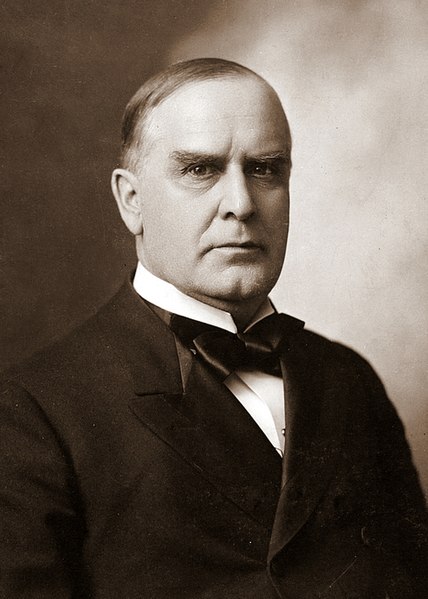
William McKinley, 1896.
Photo by the Courtney Art Studio via Wikimedia Commons.The unobjectionable McKinley didn’t offer Democrats much of a target, but his campaign was being managed and funded by Ohio shipping and steel magnate Mark Hanna. The Journal had learned that Hanna and a syndicate of wealthy Republicans had previously bailed out McKinley from a failed business venture. Hearst’s cartoonists portrayed Hanna as a rapacious plutocratic brute (accessorized with bulging sacks of money or the white skulls of laborers) and McKinley as his trained monkey or puppet: “No one reaches the McKinley eye or speaks one word to the McKinley ear without the password of Hanna. He has McKinley in his clutch as ever did hawk have chicken … Hanna and his syndicate are breaking and buying and begging and bullying a road for McKinley to the White House. And when he’s there, Hanna and the others will shuffle him and deal him like a deck of cards.” The cartoons were criticized as cruel, distorted, and perverted. They were hugely effective.
Caught off guard by Bryan’s tactics, but unwilling to put McKinley on the road, Hanna instead arranged for 750,000 people from thirty states to visit Canton, Ohio and see McKinley speak from his front porch. He meanwhile made some of the most audacious fundraising pitches Wall Street had ever heard. Instead of asking for donations, he “levied” banks and insurers a percentage of their assets, demanding the Carnegies, Rockefellers, and Morgans pay to defend the American way from democratic monetary lunatics. Standard Oil alone coughed up $250,000 (the entire Bryan campaign spent about $350,000). Hanna printed and distributed a mind-boggling 250 million documents to a US population of about 70 million (the mails were the social media of the day), and fielded 1,400 speakers to spread the Republican gospel from town to town. All of this was unprecedented.
The Republicans generated their own conspiracy theories to counter the stories about Hanna’s controlling syndicate. Pulitzer’s New York World published a series of articles on The Great Silver Trust Conspiracy — “the richest, the most powerful and the most rapacious trust in the United States”. Bryan was said to be a puppet of this “secret silver society”, for which the World had no evidence beyond that the candidate was popular in silver mining states.
There were violent motifs throughout the campaign. The Republicans accused the Democrats of fostering division and rebellion, threatening national unity by pitting the south and the west against the east and the Mid-West. This was charged language with the Civil War still in living memory. Hanna funded a Patriotic Heroes’ Battalion comprising Union army generals who held 276 meetings in the last months of the campaign. They would ride out in full uniforms to a bugle call, advising the old soldiers who came out to see them to “vote as they shot”. Said one of their number: “The rebellion grew out of sectionalism … We cannot tolerate, will not tolerate, any man representing any party who attempts again to disregard the solemn admonitions of Washington to frown down upon any attempt to set one portion of the country against another.” Senior New York Republicans vowed that if the Democrats were elected, “we will not abide the decision”. These belligerent tactics were cheered by the majority of New York papers.
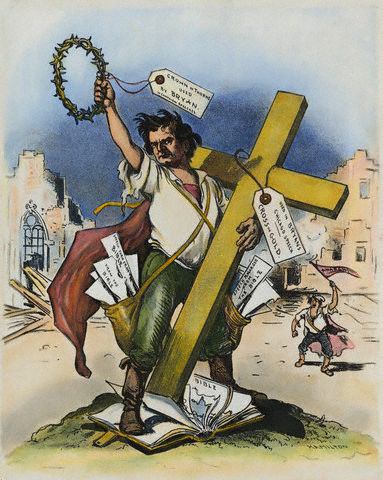
Democratic and populist leader William Jennings Bryan, climaxed his career when when he gave his famous “Cross of Gold” speech which won him the nomination at the age of 36.
Grant Hamilton cartoon for Judge magazine, 1896 via Wikimedia Commons.Bryan did nothing to cool tempers by claiming, in his famous “cross of gold” speech, that he and working-class Americans were being crucified by financial and political elites.
On it went. There were many echoes of 1896 in 2024. The polarized electorate, the last-minute candidate, record spending, unprecedented campaign tactics, populism and personal charisma, relentless ad hominem attacks, class and culture and regional warfare, inflation, immigration, racism, misinformation and conspiracy theories, comedians and plutocrats, threats of authoritarianism and violence and revolution, all of it massively amplified, and sometimes generated, by messy new media.
Of course, some of the echoes are coincidental, and there are also many contrasts. It was a different electorate. The alignment of the parties bore little resemblance to what we see today. Bryan, aside from his megalomania and zealotry, was as personally decent as Trump isn’t. And Bryan lost the campaign.
My point is I don’t think it’s an accident that the likes of Bryan and Trump — mavericks who thoroughly dominate their parties (both thrice nominated) through a direct and unshakeable bond with their followers — surface when the public sphere is most chaotic. New media environments, by their nature, are amateurish, turbulent, unsettling. There are fewer guardrails, which is a major reason outsiders and their followers gravitate to them. They see a way to change the rules and end-run established media (establishment candidates are naturally more comfortable using established channels to reach voters). New forms of political communication develop, contributing to new political norms, tactics, and strategies, and long-lasting political realignments.
For better or worse.
November 7, 2024
Kemi Badenoch portrayed by the left as “the most prominent member of white supremacy’s black collaborator class”
The left likes to think themselves the faction of racial equality, yet they often reveal themselves to be anything but when someone steps out of line (from their point of view) and chooses a different political worldview:
For centuries, Britain was ruled by an aristocracy. In recent decades, however, this concept has become rather passé, and we have been doing away with it — most recently with the vote to abolish hereditary peers in the House of Lords.
Yet, as the old guard fades, a new elite has taken its place. Inherited traits — particularly skin colour and sex — now grant special dispensations. Utterances that would be unthinkable for most are allowed, and positions incommensurate to talent are dispensed.
This is because the new aristocracy is flush, often through little toil of its own, with moral authority — a valuable currency wielded by what we might call the Patricians of Victimhood.
Their power rests on the idea that Britain is a fundamentally racist country, brimming with other nasty “isms” that can be contained only by them. To deny this is heresy — but to disprove it is a crime for which no punishment is too great.
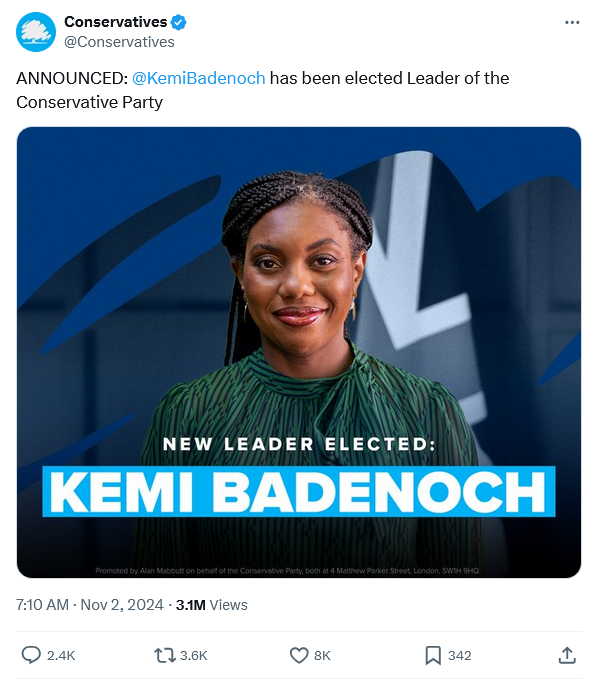
This was evident when Kemi Badenoch, a black woman, was elected Saturday to lead the Conservative Party. This historic first for Britain might have been expected to please those preoccupied with combating racism, perhaps even chalked up as a win.
Instead, Badenoch was lambasted by politicians who have built careers campaigning about racism. Dawn Butler, a Labour MP, shared a post accusing Badenoch of representing “white supremacy in blackface” — an insult so improbable that it conjures only an image of a face-painted Justin Trudeau.
The post, now removed from Butler’s X account, read: “Today the most prominent member of white supremacy’s black collaborator class (in Britain) is likely to be made leader of the Conservative Party. Here are some handy tips for surviving the immediate surge of Badenochism (i.e. white supremacy in blackface).”
Another Labour MP, Zara Sultana, said Badenoch was “one of the most nasty & divisive figures in British politics”, for, among other things, “downplaying racism”.
Badenoch is opposed to identity politics. She believes in meritocracy and that Britain — as she told her children recently — “is the best country in the world to be black”. Badenoch’s optimism is well founded: a 2023 World Values Survey found that Britain is indeed one of the least racist countries in the world.
Donald Trump II: The Trumpening
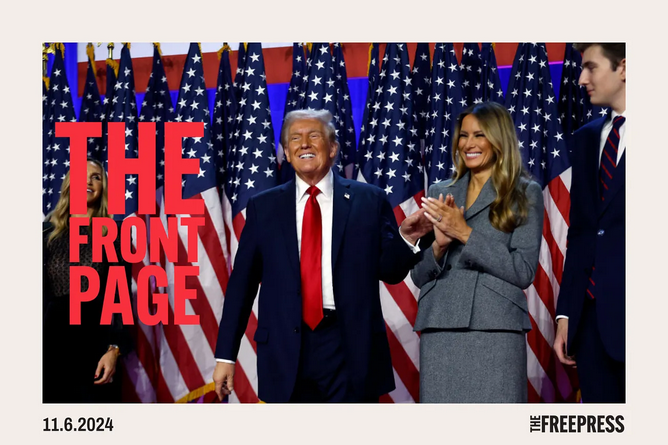
I went to bed on Tuesday night with assurances from several sources that the election was still very close and that it might take many more hours to determine the winner — if any — of the 2024 US federal election. Roughly an hour later, it was apparently all over but the crying:
We’re sitting down to write this at 2 a.m., and by now it’s clear: Donald Trump is set to be the 47th president of the United States, and on track to win the electoral college and the popular vote. It is a stunning comeback.
The red wave that wasn’t in 2022 came crashing down tonight. Republicans have retaken control of the Senate. Control of Congress is still in the balance.
Going into tonight, Nate Silver ran 80,000 simulations of what could happen. In 40,012 of them, Kamala Harris won. Every pollster and pundit said the same: It was gonna be a squeaker. Too close to call. We wouldn’t know for days, maybe even weeks!
That’s not how it went down. Not at all.
Trump had won Pennsylvania before the night was out. And by 2:30 in the morning, he was onstage, surrounded by his family and Dana White, delivering his victory speech in West Palm Beach.
Tonight at our election party, the British historian Simon Sebag Montefiore said he hadn’t seen a comeback like this since Charles de Gaulle. But perhaps the only American echo of tonight is Richard Nixon. As Commentary editor John Podhoretz wrote on Twitter: “This is the most staggering political comeback in American history. Period. Nixon has held the comeback trophy for nearly 60 years. No longer.”
Why Trump won so convincingly — and why Kamala lost so fully — are themes we’ll cover over the coming weeks. But for now, enough from us.
In the same Front Page summary:
This race was the Democrats’ to lose. And they blew it. Badly. As of 2 a.m., there wasn’t a single county in the country in which Harris outperformed Joe Biden. What went wrong? Peter Savodnik has some ideas.
“They didn’t lose because they didn’t spend enough money,” writes Peter. “They didn’t lose because they failed to trot out enough celebrity influencers. They lost because they were consumed by their own self-flattery, their own sense of self-importance.”
And above all else, they lost because they lied. “They seemed to think that Americans wouldn’t mind that they had pretended Joe Biden was ‘sharp as a tack’, that they actually orchestrated a behind-the-scenes switcheroo, that the party that portrayed itself as the nation’s answer to fascism nominated its standard-bearer without consulting a single voter.”
Last night, the truth caught up with them.
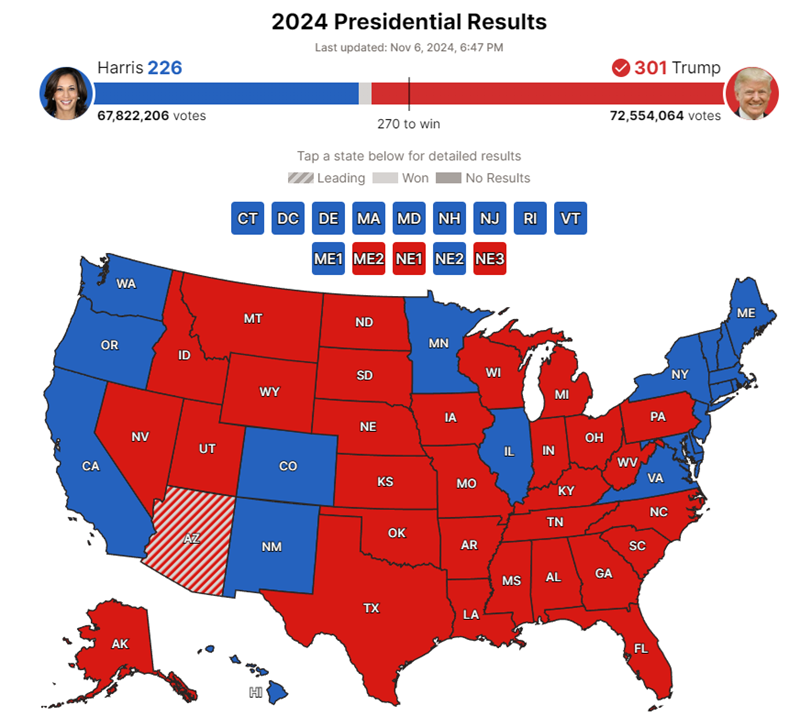
Kamala Harris failed to retain Joe Biden’s record 81 million Democratic voters, falling back to about the same level of support (67 million) as Hillary Clinton in 2016 and Barack Obama in 2012. Weird.
Freddie deBoer wonders what the Democrats will end up blaming this loss on:
You can’t blame losing the popular vote and all seven swing states on Jill Stein.
You can’t blame losing the popular vote and all seven swing states on Putin and the Russians.
You can’t blame losing the popular vote and all seven swing states on Bernie Sanders and his supporters.
You can’t blame losing the popular vote and all seven swing states on Joe Rogan.
You can’t blame losing the popular vote and all seven swing states on Glenn Greenwald and The Young Turks.
You can’t blame losing the popular vote and all seven swing states on the decision to run with Tim Walz.
You can’t blame losing the popular vote and all seven swing states on the New York Times and its occasional Democrat-skeptical opinion pieces.
You can’t blame losing the popular vote and all seven swing states on Joe Biden for getting out of the race too late.
You can’t pull all the usual Democrat tricks. You have to actually figure out what’s wrong with your party, root and branch. Because you called the guy a fascist, again, and he walked right through that insult to the Oval Office, again. And the eternal question presents itself: what are you going to do about it?
Of course, some Trump supporters can’t help but get a little triumphal:
Donald J Trump has been elevated to the purple by the prince-electors at Aachen, and coronated in Rome by the Pope, so that he is now Imperator of the Holy Roman Empire, and of the Empire of Man, Rex Quondam et Rexque Futurum.
All Glory to God and to his anointed!
The Tribune Assembly of the Commoners in America, who retain a quaint custom of confirming the Electoral determination by local ballot, have also granted His Imperial Majesty the Mandate of the Commons.
[…]
JD Vance will be Executive-for-Life, and Elon the first Transhuman Immortal of the Noosphere. So far, so good.
Purple haired girls will no longer be allowed to twirk and grind in public, as show in the first scene, and modest dress codes will be decreed by the National Census Office. No more tattoos nor face piercings.
Also, involuntary concubinage will ensure a reverse of the demographic decline, the return to the fertility levels needed to colonize Mars.

November 6, 2024
Running out of minerals means we’re all going to dieeeeeeeeee!!
Tim Worstall responds to another pants-wetting panic attack that we’re running out of atoms and that means we’re all going to die unless we do this thing I wanted you to do anyway:

“Artisanal cobalt miners in the Democratic Republic of Congo” by The International Institute for Environment and Development is licensed under CC BY 2.5 
 .
.
There’s a guy working up in Finland who keeps trying to tell us that we’re all about to run out of lovely metals. Therefore — as with the Club of Rome beforehand, Blueprint for Survival and all those guys — we’re all gonna die.
Aiee, eh?
Now it is possible to work through all his assumptions and nip at them in detail. For example, he assumes we need about 20 million tonnes of lithium in order to replace the global internal combustion engine fleet with battery powered. Not a bad assumption. The Tesla Master Plan 3 comes to the same answer. But if we want to have weeks and weeks of battery power for the whole of society we’re going to need much more than that. Which is a problem, mineral resources are only around 90 million tonnes, so, we’re stuffed.
And, well. Here’s the problem. We’re all — including Michaux — using United States Geological Survey Numbers. In 2023 lithium:
Owing to continuing exploration, identified lithium resources have increased substantially worldwide and total about 98 million tons.
Owing to continuing exploration, measured and indicated lithium resources have increased substantially worldwide and total about 105 million tons.
Wait, what? We can get more mineral resources if we go looking for them? Well, if that’s true then the size of mineral resources cannot be the limitation on how much is out there, right?
This then brings us to the basic mistake that has been made here. We’ve been through this here a number of times.
Figures 28 & 29 shows the needed quantity of metal to phase out fossil fuels (assuming all four power storage buffer capacities) is compared against the total metal content in the whole planetary environment, including the deep ocean polymetallic nodules under sea resources (Hein et al. 2020). So, Figure 28 shows reported mineral reserves plus estimated mineral resources on land plus estimated undersea mineral resources. This is the summation of mineral reserves, resources, on land and under the sea, in the planetary environment. Even with this extreme summation of conventional and unconventional sources, there was not enough copper, nickel, lithium, cobalt, or vanadium to manufacture even just the first generation of renewable technology to replace the existing fossil fuel industrial system.
That’s on page 240 and yes, I had to read (OK, speed read/skim) to get to his simple statement of his mistake. You owe me guys, 239 pages worth.
He’s right that mineral resources can be converted into mineral reserves by the application of time and effort — capital, really. But he thinks that mineral resources are the definition of the mineral deposits that exist. Which just ain’t true — mineral resources are mineral deposits that people have applied time and effort — capital really — to defining. That’s how mineral resources, as defined by our common source at USGS, can increase year on year.
November 5, 2024
It’s not really about Peanut and Fred
Tom Knighton explains that the online furor isn’t really about poor Peanut the Squirrel and Fred the Raccoon … but they’ve become a trigger for a lot of simmering anger over the abuse of power and the unequal application of justice:

By now, you’ve probably already heard about Peanut the Squirrel and Fred the Raccoon. If you haven’t, then your blood pressure is probably thankful.
The short version is a man from New York rescued a baby squirrel, named him Peanut, and raised him. The squirrel became an Instagram star, apparently, thanks to cute pictures of him wearing cowboy hats and so on.
A woman from Texas, apparently, reported the man for having Peanut and a raccoon named Fred. Anonymously, at the time.
As a result, state officials stormed the house, took Peanut and Fred from their home, interrogated the man and his wife as if they were terrorists, tossed the house like officials were raiding a drug kingpin’s house, questioned the wife’s immigrant status (she’s from Germany), then euthanized both animals, supposedly to test for rabies.
And as a result, a lot of people are pissed.
I’m pissed.
Now, I’m someone who has put meat in the freezer by my own hand. I have no delusions about where meat comes from and I’m not some crazed animal rights activist that thinks animal lives are the same as human lives.
But that doesn’t matter because none of the outrage is really about the squirrel.
No, it’s about justice.
See, the issue with Peanut here is the uneven application of the law.
For Peanut, the letter of the law had to be applied. An animal raised inside of a home with other animals raised inside of the same home, none of which showed even an inkling of being diseased were taken from their loving owners because of some BS regulation that shouldn’t have applied in this case.
This after four years of more uneven application of the law.
For example, we’ve seen George Soros-backed district attorneys vow not to prosecute people for some crimes. Some of those are victimless crimes, which doesn’t bother me, but it also includes things like shoplifting, which is anything but victimless. As a result, shoplifting got so bad and brazen in some places that many chains just shuttered locations because they couldn’t make a profit.
It wasn’t all that long ago that we were locked in our homes and told we couldn’t go to church, to school, to visit our dying family in the hospital, to do anything except for approved activities, and even then, there were rules we were forced to follow.
All of that went out the window when a career criminal died at the hands of a police officer and mobs throughout the nation set fire to entire neighborhoods. At that point, the deadly virus that was akin to ebola and the Black Death really wasn’t that bad and people should totally be fine with rioters destroying communities.
Very few of them were arrested and even fewer were convicted over their actions during those riots.
[…]
See, on every level, our nation of laws has been corrupted so that only some people get a pass while others don’t. Peanut and Fred didn’t have to be seized like they were. While the law is the law, anyone could see that there was no threat to people or the animals. There was absolutely no reason for any of it, but the law was suddenly the law whereas New York is notorious for giving certain parties a pass when it comes to the law.
Then we have them questioning the wife’s immigration status, whereas they turn illegal immigrants back out onto the streets after committing actual crimes. It’s rank hypocrisy at best.
But the truth is that while the law itself provides equal protection, the application of that law is anything but equal. There, some animals are more equal than others, and so Peanut and Fred were murdered by the state.
We love our pets. We cherish them. We understand the sense of loss when people lose a pet.
“… in an effort at harm reduction, I selected the proven authoritarian over the aspiring totalitarian”
In the National Post, J.D. Tuccille explains why he voted for “literally Hitler” instead of “the historic first woman president” in today’s US election:
“Polling Place Vote Here” by Scott Beale is licensed under CC BY-NC-ND 2.0 
 .
.
For me and millions of other Americans, the 2024 U.S. election is already effectively over. Like most Arizonans, I mailed in my ballot and it awaits the count. Now, I suffer through the remaining days of hectoring political ads and finger-waggers nagging me about how I should have voted. This country doesn’t lack strong opinions about two of the worst candidates to ever grace a presidential race. Unfortunately, I felt obliged to vote for one of them, and in an effort at harm reduction, I selected the proven authoritarian over the aspiring totalitarian; I marked my ballot for Donald Trump.
There’s no doubt that Trump is a thin-skinned narcissist. Legendarily intolerant of criticism or even disagreement, he wants broadcast licenses pulled from news networks that he thinks have been mean to him and called for government to crack down on cable operations that aren’t actually subject to government regulation. The man needs perspective as much as he needs a social studies class.
This is, many Democrats and their media supporters will eagerly tell you, evidence of “fascism“. But, as John Bolton, Trump’s former national security adviser, told The New York Times, “Trump isn’t capable of philosophical thought”. Trump’s authoritarianism isn’t an ideology; it’s a personality disorder.
That should be enough to disqualify a candidate for president. You’d think that, in a nation of 330 million people, if one major party chooses to run a profoundly problematic and authoritarian nominee for president, the other could find somebody more qualified. But you’d be wrong. In Kamala Harris, Democrats picked a vacuous sociopath uninterested in policy, but willing to serve as a vehicle for those around her who have tried their hands at totalitarian speech controls, and who are increasingly hostile to Israel, the only majority-Jewish state on the planet, and to Jews as a people.
In 2021, The Washington Post reported that former staffers for Vice President Harris complained she “would refuse to wade into briefing materials prepared by staff members, then berate employees when she appeared unprepared”. That failure to prepare for responsibilities and public appearances feeds her propensity for word salads, leaving the impression she’s reciting the results of a dropped Scrabble board.
In a Biden-Harris administration already lacking for adult supervision — President Joe Biden’s failing mental faculties are now a matter of record, as is his inability to make decisions — that suggests a potential President Harris would have no firmer hand on the wheel. That would leave the relatively faceless minions around her free to continue to exercise their instincts. And their instincts are terrible.
November 4, 2024
Ujjal Dosanjh blames Justin Trudeau for the rise of Sikh extremism in Canada
The Liberal Party normally manages to avoid having any internal differences come to public attention, so having a former Liberal cabinet minister come out and directly criticize Prime Minister Justin Trudeau is rather noteworthy:
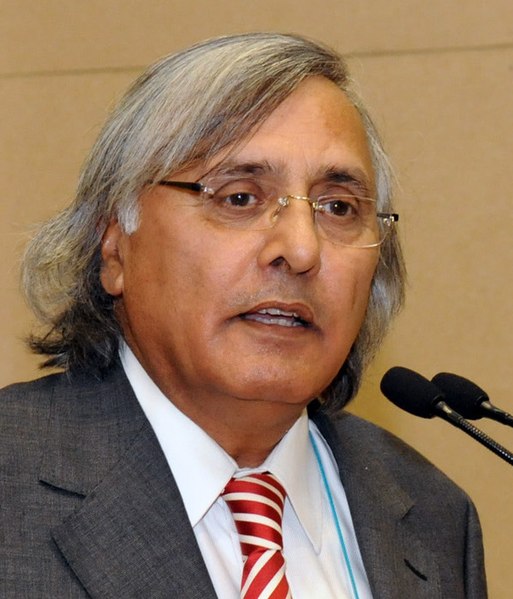
Ujjal Dosanjh speaking at the 12th Pravasi Bharatiya Divas – Engaging Diaspora Connecting Across Generation, in New Delhi on January 08, 2014.
Photo by the Ministry of Overseas Indian Affairs (GODL-India) via Wikimedia Commons.
“A silent majority of the Sikhs do not want to have anything to do with Khalistan. They just don’t speak out because they’re afraid of violence and violent repercussions,” reports Ujjal Dosanjh, as a Sikh living in Vancouver, B.C.
The call for a separate Sikh homeland in Punjab, India — to be called Khalistan — has been brewing since the 1930s, when British rule in India was nearing its end. Although the movement now has marginal support in India, it has taken wings in Canada and escalated into the present derailing of relations between two friendly Commonwealth democracies, India and Canada.
Unlike many of his Sikh peers in Canada, Ujjal — a former NDP premier of British Columbia and a former federal cabinet minister under Liberal prime minister Paul Martin — isn’t afraid to speak out. He’s been extremely vocal, especially since 1985; that’s when the bombing of Air India Flight 182 by Khalistani extremists, killing 329 people, brought the separatist movement to Canada.
Ujjal, now 78, has faced death threats from extremists but remains unwavering in his determination to convince fellow Canadians that the overwhelming majority of the nearly 800,000 Sikhs in Canada do not support the Khalistani movement. “I’d say less than five per cent, less than five per cent,” he emphasizes.
[…]
While accountability for this violence is an imperative, the purpose of my conversation with Uijal is not to sift through the evidence and intelligence. What I want to understand is how we got to this place where Canada’s Sikh population, the largest Sikh diaspora in the world, has in effect been co-opted by the Khalistanis to the point where this obscure separatist movement has become a Canadian problem.
Without hesitation, Ujjal points to Prime Minister Justin Trudeau.
For two reasons, Ujjal blames Trudeau: “One, he’s never really understood the vast majority of Sikhs are quite secular in their outlook, despite the fact that they go to the temple,” he says. And the second reason: “Khalistanis are not a majority, and the fact nobody speaks against them is out of fear”. Through intimidation, Ujjal elaborates, Khalistani supporters control many of the temples in Canada. And it’s Trudeau’s fault, he asserts, “that Canadians now equate Khalistanis with Sikhs, as if we are all Khalistanis if we’re Sikhs”.
November 3, 2024
The end of the “cheap streaming era” is at hand
Ted Gioia explains why your streaming services are going to be jacking up their prices — if they haven’t already done so:
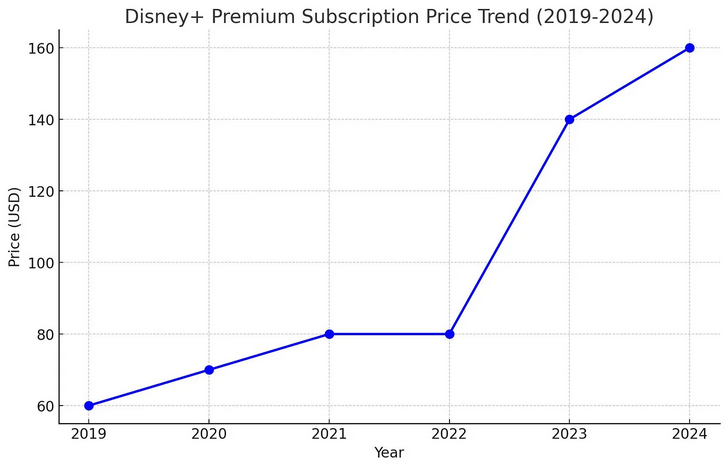
I got a request to explain why streaming subscription prices are so damned high — and getting higher.
This came in response to a chart I shared two days ago:
And it’s not just Disney.
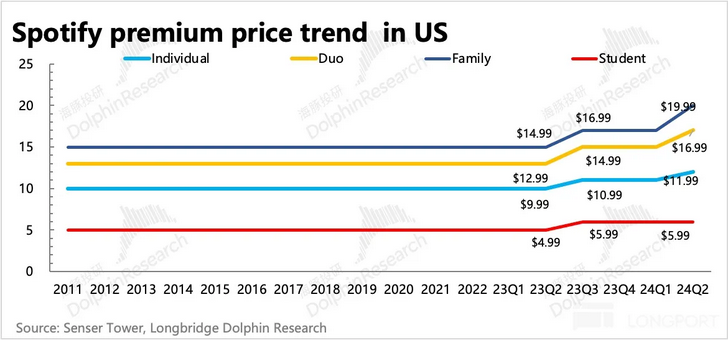
All the streaming platforms are jacking up prices. I still subscribe to five different streaming services—down from six previously. Every one of them raised prices this year, and always by more than the inflation rate.
Here’s what Spotify is doing:
What’s going on? And will it continue?
I recently described this as an “endgame strategy” — but that might be confusing to readers.
Endgame is a term drawn from chess, where it refers to a body of wisdom about the final moves on the board. But business is like chess, so I frequently analyzed endgame situations back in my days at the Boston Consulting Group and McKinsey.
I now see these endgame strategies getting implemented in various media, entertainment, and streaming businesses. But almost nobody inside those businesses wants to talk about it.
So let me lay it out for you.
The Entertainment Industry Is Adopting an Endgame Mindset
You pursue an “endgame” strategy when demand for your business hits a wall, and it’s hard to attract new customers. The most typical endgame strategy is to cut back investment into new products and services, while raising prices sharply.
You’re willing to accept some loss of customers, because you’re now squeezing more profit-per-user out of your remaining consumers — who stick with you out of loyalty or habit or inertia.
These are your sheep, ready to be shorn.
Profit per customer is now the key metric driving your business. It’s more important than innovation or growth or artistry or any of those old fashioned ideas.
That’s why, for example, Netflix won’t share data on the number of subscribers anymore. They claim this is no longer relevant to their business model — and they aren’t lying.
Price increases are now the engine of their business.