
Quotulatiousness

August 31, 2012

Where would London be without the Tube?

Filed under: Books, Britain, Media, Railways — Tags: , — Nicholas @ 09:27

At sp!ked, Neil Davenport reviews a new book about London’s iconic underground:

The closing ceremony of the 2012 London Olympics was notable for its groaning reliance on tourist-shop icons — all black cabs, bowler hats, Houses of Parliament, red pillar-boxes and Mini Coopers. In a dreary way, what could we expect? A tourist-shop portrayal of Britain is still internationally recognisable and, for the organisers, safe enough to avoid party-pooping controversy. Curiously, though, one famous figure of the capital was noticeable by its absence: the London Underground. With its roundel logo, distinctive trains and elegantly functional map, few landmarks of London are as richly iconic as this. Indeed, as a character player in umpteen films, novels and pop songs, no London setting would be complete without the Underground.

Throughout the network’s history, though, Londoners’ relationship with the Tube has often been uneasy and aggravating: overcrowding, delays, cancellations, the fare’s dent on the wallet and, for the middle classes, striking tube workers and their ‘inflated’ salary. Nevertheless, it is only when the Tube is not working properly that we become aware of its magnitude. Unlike Tower Bridge or Beefeaters, the Tube isn’t a remote or mythical symbol of London. It’s the living, working and organic lifeblood of the capital. It is the way in which millions of Londoners are able to work and play and thus, unlike Parliament, has meaning to ordinary people’s lives.

The boons and banes of the tube for Londoners (and visitors) are warmly captured in Andrew Martin’s Underground, Overground: A Passenger’s History of the Tube. A novelist and former ‘Tube Talk’ columnist for the London Evening Standard, Yorkshireman Martin pithily combines an authoritative history of the network’s development with personal reflections on his daily journeys. People can say they have become Londoners when they can navigate the vast system and reflect on its highs and lows, quirks and anomalies. Whether we admit it or not, Londoners will have their favourite stations and lines (the author’s is the Central line, mine the Victoria). They will notice the art décor splendour of Arnos Grove station or the beautifully rich tiles at Baker Street. They will curse themselves for falling asleep on the last tube (it’s that gentle rocking motion that sends you off to the Land of Nod) and waking up, as I have on numerous occasions, in High Barnet.

August 30, 2012

Exaggerating your points to make them seem more important than they are

Filed under: Economics, Environment, Food, Media — Tags: , , , — Nicholas @ 11:05

Geoff Chambers does a bit of Google searching to track down a few of the claims made in Stephen Emmot’s critically acclaimed one-man show “Ten Billion”:

The reviews were full of superlatives. The Times’ critic calls it “utterly gripping, terrifyingly lucid”; Time Out: “monumentally sobering”; Billington in the Guardian: “one of the most disturbing evenings I have ever spent in a theatre”; the Financial Times: “one of the most disturbing shows I have seen on a stage”; the Mail on Sunday “certainly the most scary show in London”. Almost all of them cite Emmott’s conclusion: “We’re f*cked”.

Here are some of the key “facts” (or “f*cts”) cited by Emmott and picked up by critics. (It is of course impossible to check whether the critics have quoted Emmott correctly, since no record of what he says exists):

1) A google search uses as much electricity as boiling a kettle.

2) It takes 3,000 litres of water to make a hamburger, (that’s 10 trillion litres of water annually to sustain the UK’s burger industry).

3) It takes 27,000 litres of water to make a bar of chocolate

4) Animal species are currently going extinct at a rate 1,000 times their natural level.

5) Bangladesh will be under water by the end of the century.

TL;DR for those who don’t feel up to reading the whole thing: 1) false, by a factor of 100. 2) true-ish, but massively misleading. 3) false, or Emmott eats humongous chocolate bars. 4) false, even though Wikipedia thinks it’s true. 5) false, the land area of Bangladesh has actually grown over the last 50 years thanks to land reclamation projects.

It’s hip to hate on TED

Filed under: Media, USA — Tags: , — Nicholas @ 10:47

Pascal-Emmanuel Gobry swims against the critical tide to praise TED:

TED, the “Davos of Silicon Valley”, which has refashioned itself into a global media company selling ideas in many forms, can often seem like it’s caught in an endless cycle of pretension and self-regard; an echo chamber in which people suckle polished platitudes from each other and call it deep thought. It’s also an echo chamber that – let’s face it – many people with soapboxes not-so-secretly wish they’d been invited to.

Evgeny Morozov, internet-famous hectorer of optimists, was pushing at an open door when earlier this month he published a long article in The New Republic hectoring TED for intellectual vapidity and pretension, peppering his piece with highfalutin’ philosophical allusions. The piece duly went viral, and thus it became official: contempt of TED is now hip, even de rigueur. Like owning an iPhone, or being enthusiastic about TED three years ago.

But hang on a second. Is TED noxiously pretentious? Yes. Is TED superficial? Of course. Does TED peddle a slightly messianic ideology even as it claims to be above ideology? Sure. But none of those things should obscure the things that are truly great about TED. Because TED is great. No, hear me out.

21st century problems: who inherits your digital property?

Filed under: Books, Law, Media, Technology — Tags: , , , , — Nicholas @ 08:37

Unless medical science has a solution up their collective sleeves, we’re all going to die (eventually). It may be an individual shock, but humans have been dying forever — it’s the unwelcome end of the trip. As a result, we’ve evolved ways to redistribute the property of deceased members of our families and communities. When the issues were as simple as who got Uncle Grog’s club and who got his loincloth, we came up with solutions.

Fast forward to our becoming-ever-more-digital age, and not all of our property is tangible: we’re becoming “owners” of digital property that may be as valuable as our physical possessions. What happens to our music libraries, e-book collections, social media accounts, and all the other non-physical things we’ve bought and used during our lives?

Someone who owned 10,000 hardcover books and the same number of vinyl records could bequeath them to descendants, but legal experts say passing on iTunes and Kindle libraries would be much more complicated.

And one’s heirs stand to lose huge sums of money. “I find it hard to imagine a situation where a family would be OK with losing a collection of 10,000 books and songs,” says Evan Carroll, co-author of “Your Digital Afterlife.” “Legally dividing one account among several heirs would also be extremely difficult.”

Part of the problem is that with digital content, one doesn’t have the same rights as with print books and CDs. Customers own a license to use the digital files — but they don’t actually own them.

[. . .]

Most digital content exists in a legal black hole. “The law is light years away from catching up with the types of assets we have in the 21st Century,” says Wheatley-Liss. In recent years, Connecticut, Rhode Island, Indiana, Oklahoma and Idaho passed laws to allow executors and relatives access to email and social networking accounts of those who’ve died, but the regulations don’t cover digital files purchased.

Apple and Amazon did not respond to requests for comment.

August 29, 2012

QotD: Government funding for the arts “stinks in God’s nostrils”

Filed under: Books, Government, Media, Politics, Quotations — Tags: , , , , — Nicholas @ 15:14

There’s at least a third reason to stop state funding of the arts, and it’s the one I take most seriously as a literary scholar and writer. In the 17th century, a great religious dissenter, Roger Williams (educated at Cambridge, exiled from the Massachusetts Bay Colony), wrote the first case for total separation of church and state in the English language. Forced worship, said Williams, “stinks in God’s nostrils” as an affront to individual liberty and autonomy; worse still, it subjugated theology to politics.

Something similar holds true with painting, music, writing, video and all other forms of creative expression. Forced funding of the arts — in whatever trivial amounts and indirect ways — implicates citizens in culture they might openly despise or blissfully ignore. And such mandatory tithing effectively turns creators and institutions lucky enough to win momentary favour from bureaucrats into either well-trained dogs or witting instruments of the powerful and well-connected. Independence works quite well for churches and the press. It works even more wonderfully in the arts.

Nick Gillespie, featured guest for “Economist Debates: Arts Funding”, The Economist, 2012-08-29

August 27, 2012

Restarting the age of space

Filed under: Media, Space, Technology — Tags: , , , , , — Nicholas @ 09:24

sp!ked reposted an older article by James Woudhuysen on the long-term importance of space exploration and the stay-at-home attitudes that oppose further development of the “final frontier”:

One thing unites the critics of lunar exploration. Forty years after man first landed on the moon — on 20 July 1969 — they share a disdain for the grandeur of extra-terrestrial endeavour; for the scale of human ambition involved; for the very idea that human beings should climb into space, as up a mountain, ‘because it is there’.

I have no special preference for size, thrust during lift-off, or the traverse across vast distances. The development of the integrated circuit in the late 1950s, so important to the Apollo programme, was a tribute to miniaturisation rather than to high energy or physical scale. No, my admiration for both Saturn boosters and tiny electronics grows from a respect for open-ended curiosity, for human achievement, and for taking risks. With space travel, a lot of bravery was also at stake. And with both space and the development of semiconductors, there is much teamwork to celebrate — teamwork that, in the case of Apollo, involved not just three astronauts, but the efforts of hundreds of thousands of people.

[. . .]

(more…)

US presidential election: one from column A or one from column B

Filed under: Media, Politics, USA — Tags: , , — Nicholas @ 09:00

Jesse Kline explains the lack of excitement among independent voters (those not formally registered as Democrats or Republicans) — they really aren’t being offered much of a choice between the top two candidates:

It would, of course, be unfair to blame Obama for a mess that has been created over decades by both political parties. Ronald Reagan and George W. Bush presided over massive spending increases; Clinton and Bush II also increased regulation; while Congress has substantially increased the of new laws it passes on an annual basis since the early 1980s.

But Obama’s record in his first term is still dismal. For all his talk about creating jobs and improving the economy, Obama’s policies have only served to increase the cost of doing business and divert money from productive sectors of the economy to increase government spending. The only question is whether the Republicans can fix the fiscal mess they helped create.

To his credit, Mitt Romney has at least been talking about the regulatory burden the American economy faces. Paul Ryan is, likewise, one of the few politicians talking about entitlement reform.

But Romney has explicitly stated he will not use the Ryan budget as a template for his own economic policies — which he has left incredibly vague. And even the Ryan budget does little to cut real spending in the short term, partially because it does not cut military spending, which is arguably as big an issue as entitlement spending.

Not only are policy makers stuck in a catch-22 over how to prevent the economy from falling back into recession while staving off a looming debt crisis, the American people are also facing a similar conundrum in choosing the next president: Neither party has a track record to suggest it is willing and able to address the country’s serious economic issues, and neither is willing to work co-operatively in a political environment that is entrenched along partisan and ideological lines.

In spite of the way the term is hurled around, the common accusation of “racism” for anyone who doesn’t support Barack Obama has a slight kernel of truth about it: on the policy side, Obama and Romney are not very far apart at all. The two men are much more similar than different … except for race.

August 23, 2012

Al Stewart live: “A Child’s View of the Eisenhower Years”

Filed under: History, Media, USA — Tags: , , , — Nicholas @ 11:34

“I am, as a reporter in the Capitol, lied to every day, all day”

Filed under: Government, Media, Politics, USA — Tags: , , — Nicholas @ 11:09

At Politico, the story of a former NPR congressional reporter who finally had enough of the political lies:

After 14 years at National Public Radio, Andrea Seabrook left in July and, to hear her talk about her experience covering Capitol Hill, it’s clear that she had one takeaway: It’s damn frustrating.

“I realized that there is a part of covering Congress, if you’re doing daily coverage, that is actually sort of colluding with the politicians themselves because so much of what I was doing was actually recording and playing what they say or repeating what they say,” Seabrook told POLITICO. “And I feel like the real story of Congress right now is very much removed from any of that, from the sort of theater of the policy debate in Congress, and it has become such a complete theater that none of it is real. … I feel like I am, as a reporter in the Capitol, lied to every day, all day. There is so little genuine discussion going on with the reporters. … To me, as a reporter, everything is spin.”

If you’ve had any contact with politicians, you very quickly learn that they are always trying to spin: it’s just that some of them are naturally better at it than others, and some get help from the media to make them seem better at it.

The historical “locavore” diet: seasonal gruel and mush

Filed under: Environment, Food, Health, History, Media — Tags: , — Nicholas @ 09:40

sp!ked has an article by authors Pierre Desrochers and Hiroko Shimizu, on the disadvantages of the true locavore diet:

Perhaps the most ludicrous claim made by some ‘locavores’ — activists who argue that food produced near final consumers is superior in a myriad of ways to distant imports — is that the globalised food-supply chain is guilty of crimes against seasonality. Limiting our intake of fresh produce to whatever can be obtained locally at certain times of the year (and preserving the surplus for the remainder), we are told, will not only help atone for agri-business’ fossil fuel-driven ways and constrain us to live within regional ecological limits, but it will also make fresh local food more enjoyable when it is available. As one locavore puts it, ‘deprivation leads to greater appreciation’.

The emphasis on local seasonality by food activists, however, is problematic on several counts. For instance, why do militant locavores limit themselves to local seasonality when they could further insist on truly ‘native’ produce and livestock? Seen in this light, North American agriculture should be essentially limited to turkeys, farmed salmon and a few other fish and shellfish, sunflowers, blueberries, cranberries, Jerusalem artichokes and some varieties of squashes. (Though the really hardcore North American locavore could go even further by reverting to problematic native crops such as sumpweed, goosefoot, knotweed, maygrass and little barley that were replaced about one thousand years ago by Mexican imports such as corn and beans.)

Basic logic aside, limiting our food intake to local productions is a one-way ticket to chronic famines and malnutrition. Having in most cases no direct experience with massive crop failures, locavores typically ignore the historical and contemporary toll taken by factors ranging from droughts, floods, heavy rains and frost to hail, windstorms, earthquakes and tsunamis, to say nothing of insect pests, rodents, soil erosion and plant and animal diseases. Yet, the historical evidence on the issue is unequivocal. It was only the development of cost-effective long-distance transportation (primarily the railroad and the steamship) that finally eradicated famines through the large-scale movement of foodstuff from regions that had experienced good harvests to those that had struggled with mediocre ones.

Quebec election: why is Pauline Marois getting a free pass for xenophobia?

Jonathan Kay wonders why the English language media in the “rest of Canada” are being so careful to avoid calling out PQ leader Pauline Marois for far greater sins than any Alberta politician committed during the recent Alberta election:

Given the close scrutiny that surrounded the recent Alberta election, it is somewhat surprising that more attention is not being paid to the genuinely alarming things coming out of the mouth of Parti Québécois leader Pauline Marois.

During the Alberta campaign, every gaffe committed by a member of the right-wing Wildrose Party became a national news item. The Toronto media, in particular, lapped it up — because it played to our outdated stereotype of Alberta as a land of rural hicks. Yet nothing that was said in the Alberta campaign can compare to the declarations of Ms. Marois, who has easily established herself as the most xenophobic major-party leader in all of Canada.

So why has there been comparatively little uproar over Ms. Marois? It is as if Canadians in the rest of the country have become so accustomed to watching Quebec nationalists bottom-feed for votes that we no longer are shocked by it. But Quebec is, after all, part of Canada. And Ms. Marois might become the province’s next premier on Sept. 4. Surely, it is worth rousing ourselves to pay attention to the fact that this woman is proposing policies that are unconstitutional and even bigoted.

August 22, 2012

Nash the (gay, conservative) Slash

Filed under: Cancon, Media, Politics — Tags: , , — Nicholas @ 10:16

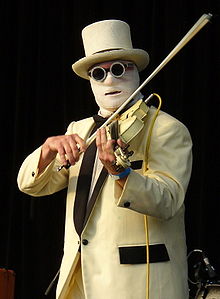
I’ve always liked the music of Nash the Slash, but I didn’t know much about him — but that’s not uncommon when the artist performs his music while wrapped in bandages so you can’t see his face. Apparently he’s that rarest of creatures: a gay Canadian conservative:

The music industry has been dominated by left-leaning causes since the days of Woody Guthrie and Pete Seeger, not to mention the countless artists who’ve been influenced by Bob Dylan and Neil Young. In Canada, rock stars came out in droves for the funeral of NDP leader Jack Layton, but it’s hard to find one musician who would openly admit to supporting Stephen Harper. While country star Paul Brandt performed at the 2008 Conservative convention and Nova Scotia’s The Trews have a song called Highway of Heroes that’s been adopted by the Tories, neither would agree to an interview about their political views.

“I feel that conservatives are pragmatic and more fiscally responsible [than the Liberals],” says Nash the Slash, the late-’70s-era experimental Canadian artist who has recorded with Neil Young’s famed producer, Daniel Lanois. “I think the left is more carved into stone in some of their intractability and I may get flack for that, but I don’t care. You never see conservatives out there parading at the G20 summit — we tend to be less demonstrative.”

Politically, Nash the Slash’s career tells an interesting story, as he’s also an outspoken gay musician who lives in Leslieville (a Toronto neighbourhood often painted as left-leaning) and used to hoist the occasional beer with Layton. Still, the musician voted for the conservative-minded Rob Ford over gay liberal candidate George Smitherman in Toronto’s 2010 mayoral election, and isn’t afraid to flaunt his right-wing leanings.

“I voted for Rob Ford because I believe in fiscal responsibility and you can call him a bumbling fool, but guess what? We’re not going to have any money to support the gay Pride parade unless we get our books straight,” he says. “If we don’t conserve our money, eventually, we’re all going to turn into Greece.”

It’s not surprising that outspoken right-wing rockers such as Nash the Slash are hard to find, though. Even when conservative politicians reach out to the music world, they tend to find their hands slapped back.

Wikipedia entry for Nash the Slash.

Since 1979 Nash has always performed with surgical bandages covering his face. “During a gig at The Edge in the late ’70s to raise awareness of the threat from the Three Mile Island disaster, he walked on stage wearing bandages dipped in phosphorus paint and exclaimed: “look, this is what happens to you”. The bandages became his trademark.” Prior to 1979, Nash performed three times on TV Ontario’s Nightmusic Concert, first as a solo artist (a live broadcast which was never re-aired), then with FM (Nash and Cameron Hawkins), then again as a solo artist. In all of these appearances Nash wore his typical black tuxedo, top hat, and dark sunglasses, but wore no bandages.

Born Jeff Plewman (as given in copyright depositions at the Library of Congress), he has attempted to keep his true identity the subject of some speculation. In a 1981 interview with the UK magazine Smash Hits, Nash’s response to a question about his real name was “Nashville Thebodiah Slasher”. By never officially confirming or denying his name, some fans came to believe Nash to be an alter ego of Ben Mink, who replaced him as FM’s violinist in 1978. This is a common misconception but he has been photographed onstage with Ben Mink.

Kicking the Baby Boomers while they’re down

Filed under: Media, Technology, USA — Tags: , , — Nicholas @ 09:49

P.J. O’Rourke laments the America that was, before the Baby Boomers came along and ruined everything:

The United States has set itself on a course of willful self-diminishment. Seventy-four years ago the perfect American was Superman, who happened to have been, like many of our forefathers, an undocumented alien. If Superman arrived today — assuming he could get past the INS and Homeland Security — he would be faster than the postal service, more powerful than a New York Times blogger, and able to ascend tall buildings in a single elevator.

[. . .]

America has had plenty of reasons to abdicate the crown of accomplishment and marry the Wallis Simpson of homely domestic concerns. Received wisdom tells us that, in the matter of great works and vast mechanisms, all is vanity. The Nurek Dam probably endangers some species of Nurek newt and will one day come crashing down in a manner that will make the aftermath of Japan’s Fukushima tsunami look like an overwatered lawn. And we have better things to spend our country’s money on, like putting a Starbucks on every city block. But I suspect there’s a sadder reason for America’s post-eminence in things tremendous, overwhelming, and awesome.

My sad generation of baby boomers can be blamed. We were born into an America where material needs were fulfilled to a degree unprecedented in history. We were a demographic benison, cherished and taught to be self-cherishing. We were cosseted by a lush economy and spoiled by a society grown permissive in its fatigue with the strictures of depression and war. The child being father to the man, and necessity being the mother of invention, we wound up as the orphans of effort and ingenuity. And pleased to be so. Sixty-six years of us would be enough to take the starch out of any nation.

The baby boom was skeptical about America’s inventive triumphalism. We took a lot of it for granted: light bulb, telephone, television, telegraph, phonograph, photographic film, skyscraper, airplane, air conditioning, movies. Many of our country’s creations seemed boring and square: cotton gin, combine harvester, cash register, electric stove, dishwasher, can opener, clothes hanger, paper bag, toilet paper roll, ear muffs, mass-produced automobiles. Some we regarded as sinister: revolver, repeating rifle, machine gun, atomic bomb, electric chair, assembly line. And, ouch, those Salk vaccine polio shots hurt.

The Soviet Union’s 1957 launch of Sputnik caused a blip in chauvinistic tech enthusiasm among those of us who were in grade school at the time. But then we learned that the math and science excellence being urged upon us meant more long division and multiplying fractions.

H/T to Jon, my former virtual landlord, for the link.

“The good old days” were actually pretty crappy for most

Filed under: Books, Economics, Environment, Food, Health, History, Media — Tags: — Nicholas @ 09:22

An excerpt from The Locavore’s Dilemma by Pierre Desrochers and Hiroko Shimizu in the National Post:

To a locavore, food in the future should be created pretty much like it was in the not-so-distant past: produce and animals raised lovingly in urban backyards, turning domestic waste into hearty dishes. Farmers’ markets in every small town and city neighbourhood, where people rediscover the joys of real food and get reacquainted with one another. The rebuilding of small-scale slaughterhouses and canning factories to serve area producers and foster the preservation of local food items for consumption in the off-season.

Ideally, this local system would also be built on seeds saved from the previous harvest rather than purchased from giant corporate seed producers; ancient “heirloom” cultivars developed before synthetic fertilizers and pesticides became available and that, as a result, are better able to seek nutrients in the soil, don’t require any chemicals and are naturally resilient to drought and pests (“If it’s old seed, it’s good seed!”); and “heritage” animal breeds better able to withstand diseases and harsh environments and grow fat and happy on pastureland alone. Pest control would be achieved through traditional “natural” products based on plants and minerals; manual labour, such as crushing or picking bugs and larvae off foliage or removing weeds by hands; and biological control methods, such as introducing exotic animals, insects and bacteria that feed on invasive pests. Finally, factory-made fertilizers would be replaced by animal manure and rotating fodder crops, such as clover and alfalfa.

[. . .]

Isn’t it possible that crushing bugs and removing weeds by hands were neither very effective nor the most productive use of one’s time? That seeds purchased from commercial suppliers offered access to superior genetic material, were not mixed up with unwanted material and were readily available when needed? That “natural” manure has always been dirty, smelly, chock-full of pathogens and requires several months of composting? That the “slow release” of nutrients from green manures and organic compost could never be as adequately controlled to match crop demands with nutrient supply as is now possible with synthetic fertilizers? Further, that old mineral (including arsenic) and plant-based pesticides were less harmful to plant pests (and thereby more likely to promote insect resistance) and more problematic to human health than more recent offerings? That introducing nonnative insects, mammals and bacteria in a new ecosystem often had unintended, broader and longer-lasting negative consequences for nontargeted species? And that, unlike chemical pesticides that typically do not persist in an ecosystem once application has ceased, exotic insects who have successfully adapted to a new environment are practically impossible to eradicate and do not remain confined to one geographical location? In the end, why are modern agricultural producers willing to purchase costly synthetic inputs, hormonal growth promoters, antibiotics and genetically modified seeds when the methods agri-intellectuals prefer are either completely free (such as giving up on the use of these inputs and on equipment such as poultry housing) or seemingly much cheaper (such as feeding cattle entirely on pastureland and saving one’s seeds instead of relying on those marketed by specialized producers)?

Ontario’s ban on a large number of pesticides and herbicides for domestic use is re-acquainting many home owners with the joys of hand-weeding their lawns. It’s getting to the point that Ontario’s provincial flower might as well be the dandelion, as they’re everywhere. There’s a reason your ancestors couldn’t wait to get off the farm…

August 21, 2012

The critical message of this election cycle

Filed under: Humour, Media, Politics, USA — Tags: , , , — Nicholas @ 00:08

A. Barton Hinkle distills all the campaign wisdom down into one easy-to-understand message: The Wrong Side Absolutely Must Not Win:

The past several weeks have made one thing crystal-clear: Our country faces unmitigated disaster if the Other Side wins.

No reasonably intelligent person can deny this. All you have to do is look at the way the Other Side has been running its campaign. Instead of focusing on the big issues that are important to the American People, it has fired a relentlessly negative barrage of distortions, misrepresentations, and flat-out lies.

Just look at the Other Side’s latest commercial, which take a perfectly reasonable statement by the candidate for My Side completely out of context to make it seem as if he is saying something nefarious. This just shows you how desperate the Other Side is and how willing it is to mislead the American People.

The Other Side also has been hammering away at My Side to release certain documents that have nothing to do with anything, and making all sorts of outrageous accusations about what might be in them. Meanwhile, the Other Side has stonewalled perfectly reasonable requests to release its own documents that would expose some very embarrassing details if anybody ever found out what was in them. This just shows you what a bunch of hypocrites they are.

Rinse, repeat.

« Newer PostsOlder Posts »

Powered by WordPress

