
It is now about fourteen months since, after receiving my second death threat, I started carrying a firearm almost constantly. This experience has taught me a few truths, some merely amusing but others with larger implications.
[…]
And about that security plan: carrying a firearm is nearly useless without very specific kinds of mental preparation. It’s not just that you have to think through large ethical issues about when to draw and when to fire (equivalently, when to threaten lethal force and when to use it). You also need good defensive habits of mind. Carrying a firearm is no good if an adversary wins the engagement before you have time to draw.
The most basic good habit of mind is maintaining awareness of your tactical environment. From what directions could you be attacked? Is there a way for an assailant to come up behind you for a hand-to-hand assault, or to line up a shooting position from beyond hand-to-hand range where you couldn’t see it? Are you exposed through nearby windows?
One advantage I had going in was reading Robert Heinlein as a child. This meant I soaked up some basic tactical doctrine through my pores. Like: when you go to a restaurant, sit with your back to a wall, preferably in a corner, in a place with good sightlines but not near a window. When you sit down, think about possible threat axes and which direction to bail out in if you have to.
Advice I’ve gotten from people with counterterrorism training includes this lesson: watch your environment and trust your instincts. Terrorists, criminals, and crazies don’t tend to blend in well even when they’re trying. If someone nearby looks or feels out of place in your surroundings, or behaves in a way not appropriate to the setting, pay attention to that; check your escape routes and make sure you can reach your weapons quickly.
How careful you have to be depends on the threat model you’re planning against. I’m not going to talk about mine in detail, because that might compromise my security by telling bad guys what expectations to game against. But I will say that it assigns a vanishingly small probability to professionals with scoped rifles; the background culture of both Iranian terrorists and their Arab proxies makes it extremely difficult for them to train or recruit snipers, and I am reliably informed that the Iranians couldn’t run professional hit teams in the U.S. anyway – too difficult to exfiltrate them, among other problems.
This, along with some other aspects of the threat model I won’t discuss, narrows the range of plausible threats to something an armed and trained individual with good backup from law enforcement has a reasonable hope to be able to counter. And the good backup from law enforcement is not a trivial detail; real life is not a Soldier of Fortune story or a running-man thriller, and a sane security plan uses all the resources available from your connections to the society around you.
Eric S. Raymond, “Fourteen months of carrying”, Armed and Dangerous, 2010-09-21.
April 11, 2023
QotD: Being the target of a death threat
April 10, 2023
1970: Welcome to SEALAND | Nationwide | Voice of the People | BBC Archive
BBC Archive
Published 18 Dec 2022Nationwide‘s Bob Wellings is winched up to meet the Bates, the first family of the Principality of Sealand.
Formerly HM Fort Roughs, Sealand is a concrete and iron platform in the North Sea about seven miles off the Suffolk coast. What has drawn the family to this remote place? How does living in such an unusual environment effect their day-to-day life? What are their plans for it?
Originally broadcast 19 March, 1970.
(more…)
April 8, 2023
“The evidences of history and human nature are very clear: the Enlightenment was a tremendously bad idea”
Theophilus Chilton tries to persuade conservatives and libertarians that Classical Liberalism has failed:
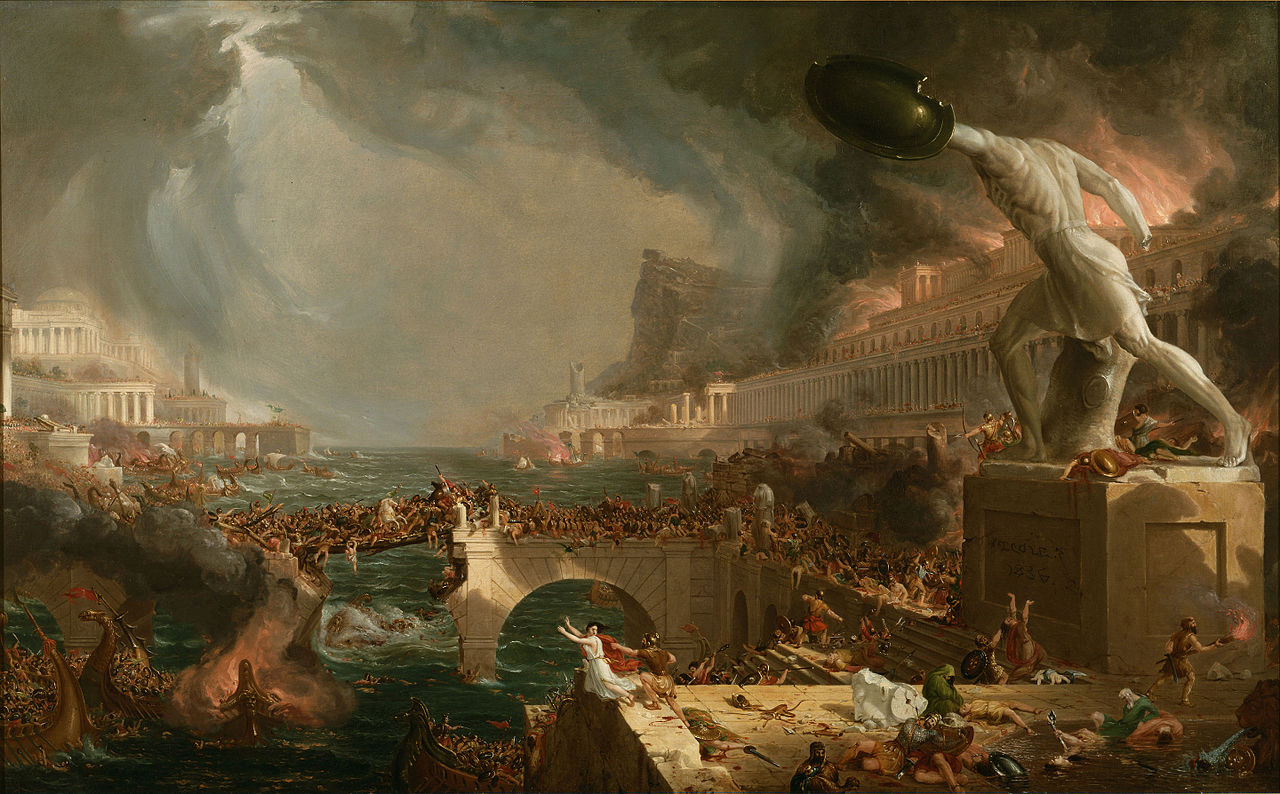
The Course of Empire – Destruction by Thomas Cole, 1836.
From the New York Historical Society collection via Wikimedia Commons.
The premise for this article might seem surprising to many who are used to believing that the Fukuyaman “end of history”, with its proposed ultimate victory of liberal democracy and market capitalism, is a done deal. After all, we look around the world and see the spread of democracy (even if by military force) taking place, as well as seeing the world seemingly integrated into a global economy characterized by complete fungibility of capital, resources, and labour. Yet, while this may be the façade which we are presented, it is manifestly obvious that most of what is called “democracy” is a sham and most of what is called “capitalism” is merely a cover for cronyism at the highest levels. This is the case even in the United States. We can no longer call our system “liberal” in any sort of classical sense when you can be jailed for referring to someone with the “wrong” pronoun and where the supposedly “free” press is effectively only the propaganda arm of one political party.
All over the world, classical liberalism is being supplanted by socialism and progressivism. This is obvious. What is even more obvious is that classical liberalism has been completely unable to prevent this from occurring. While there are some places where the tide is at least being slowed, this is due to the efforts of nationalists and others calling for stronger government along reactionary and traditional lines, not by those advocating for Reaganism, Thatcherism, or other manifestations of modern classical liberalism. Indeed, the two primary expressions of modern classical liberalism – libertarianism and American-style conservatism – are basically failures in every way. Libertarianism has devolved into a clown show of competing virtue signals, while conservatism (which has yet to actually conserve anything) has fastened onto itself the straitjacket of ideological dogmatism dictated to it by neo-conservatives and K-Street lobbyists.
We should not be surprised, however, that this has been the case. Classical liberalism itself was doomed from its inception. The reason for this is that classical liberalism derived directly from the sort of shoddy and shallow philosophies that drove the so-called “Enlightenment”. The Enlightenment – which we were all told was a good thing by our publik skoolz – represented a marked departure by Western civilisation from traditional realities upon which successful Western cultures were built. In contrast to the traditional values of the West, Enlightenment values represented a very skewed, unrealistic form of wishful thinking. Once these departures began to be codified into practice at the national level, it was only a matter of time before the leftward drift affected even the most morally well-insulated nations.
Below, I would like to discuss four basic areas where classical liberalism as an Enlightenment philosophy was set up for failure from the beginning.
On a somewhat less polemic level, Andrew Potter wonders if the sense of civilizational decline and dissolution many of us are feeling is down to the lack of community:
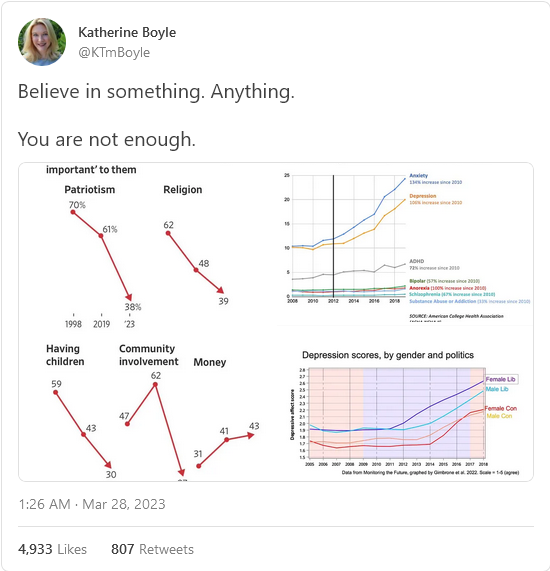
Here are some charts that were going around the social media the other day:
Boyle — a partner at Andreessen Horowitz — paired these charts with links to a series of reports and studies connecting these declines to a clutch of modern day problems, in particular rising levels of anxiety and depression, despair, most notably amongst the young.
As the boomers used to say, you don’t need a weatherman to know which way the wind is blowing. The Western world is in a bit of a funk.
Our political systems have become impossibly polarized, our economies stagger from one crisis to the next, and the welfare state is bumping up against the limits imposed by escalating costs and diminishing state capacity. All of this comes as people are losing faith in the institutions that have served for decades as the building blocks of a cohesive society. Our reserves of social capital are depleted as numerous countries report falling levels of patriotism, religiosity, and community-mindedness. Everyone’s more or less given up on having kids, while close to a third of men aged 18-30 haven’t had sex in the past year.
These stats vary from country to country, and some places are obviously doing better than others. But the trends are grim across the board; there’s no question that, in general, people in the West are in a bad way. The debate revolves around the cause or causes of these phenomena. Is it social media? The pandemic? Housing prices, debt and precarious employment?
One possibility is that the problem lies with the modern world itself. That the basket of rights-based political individualism and consumer-driven economic capitalism might provide us with all manner of creature comforts and technological wonders, but it doesn’t give us meaning. At the dark heart of liberalism lies nihilism.
This is not a new charge, it has been around as long as there has been liberalism. Yet there’s a bit of disagreement over exactly where the problem lies. For some, from Dostoevsky to the existentialists, the worry was deeply metaphysical: that in the absence of a god, or some comparable external source of absolute morality, the only alternative is raw moral relativism.
For other critics, the complaint is more aesthetic. The consumer goods and individualistic values that liberalism promotes are seen as terribly shallow and narcissistic, with the vulgar virtues of television and cheeseburgers supplanting the higher arts of opera and the terroir.
But there’s another argument, that sort of splits the difference between the metaphysical and the aesthetic worries. This is the idea that for all its promotion of radical pluralism, liberalism is actually hostile to true difference and diversity, of the sort that permits the flourishing of distinct communities. This was the central complaint of the Canadian philosopher George Grant, whose anti-American nationalism was based not on any sense that Canada was intrinsically worthwhile, but that its more collective approach to public life would foster a communitarianism that was not possible in the United States.
March 20, 2023
“It amounts to nothing less than a declaration of all-out war between the government and the Big Tech companies”
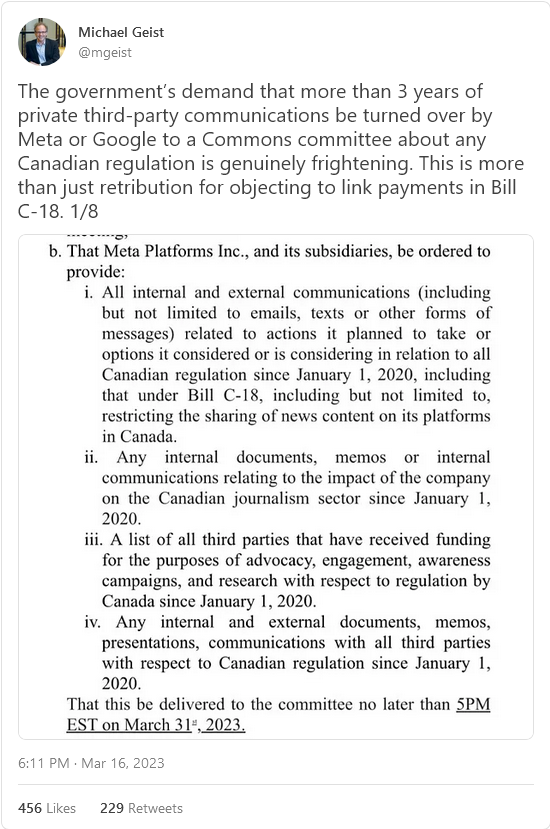
The editors of The Line have strong opinions on the federal government’s decision to batter Google, Facebook, and other online “giants” over their opposition to the proposed internet legislation in bills C-11 and C-18:
As a result of C-18, both Google and Meta have considered dropping news distribution from their platforms, or have outright promised to do so. To which we have responded: “Well, no shit, Sherlocks.” We have, in fact, warned all of the parties involved with this misguided bill that that’s exactly what was going to happen.
Nonetheless, the dim-witted government officials and corporate media barons who have pinned their hopes of survival to the apparent money spigot of Big Tech didn’t believe us. So when Meta came right out and said it would drop news last week, the ashen-faced Minister of Heritage accused them of using “intimidation and subversion” tactics. And, thus, these demands for private correspondence appear to have been drafted.
It amounts to nothing less than a declaration of all-out war between the government and the Big Tech companies — and, by extension, the many independent media creators like ourselves.
Well. Okey Dokey then.
*cracks knuckles*
Let’s start with two very obvious points: firstly, we at The Line don’t object to forcing these tech companies to disclose funding to third parties for the purpose of opposing C-18 et al. That is perfectly reasonable, in our minds. Further, if these companies are being accused of anything illegal, by all means, investigate away — after you get a warrant.
The rest of these demands are nothing short of banana crackers; it’s an extraordinary interpretation of the committee’s mandate. It’s the kind of overbroad dragnet that will necessarily create privacy breaches for the unknown numbers of ordinary citizens, dissidents and journalists who have corresponded with these companies about these bills.
We will remind the government that private citizens and private companies do not owe the government a full accounting of their private business or communications. The government is subject to this kind of transparency and disclosure because the government works for us. Not the other way around.
We will also point out the irony. The government is demanding years worth of correspondence from private entities within a very short time frame: this is a level of transparency that no government department would subject itself to. Don’t believe us? Just try to draft a similar ATIP request to any ministry; it would take years to get such a request fulfilled, and half if it would come back redacted.
March 19, 2023
Disagree with the Canadian government’s attempt to take over significant parts of the internet? Get ready for administrative punishment, citizens!
Michael Geist, who often seems like the only person paying close attention to the Canadian government’s growing authoritarian attitudes to Canadians’ internet usage, shows the utter hypocrisy of the feds demanding access to a vast array of private and corporate information on a two-week deadline, when it can take literally years for them to respond to a request for access to government information:
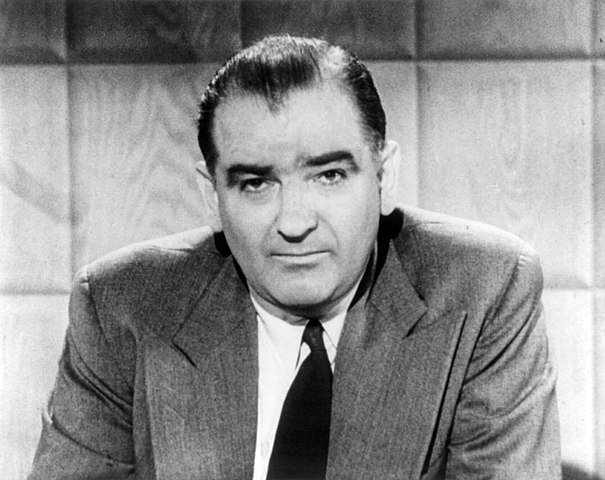
Senator Joe McCarthy would be in awe of the Canadian government’s audacious power grab.
Library of Congress photo via Wikimedia Commons.
The government plans to introduce a motion next week requiring Google and Facebook to turn over years of private third-party communication involving any Canadian regulation. The move represents more than just a remarkable escalation of its battle against the two tech companies for opposing Bill C-18 and considering blocking news sharing or linking in light of demands for hundreds of millions in payments. The motion – to be introduced by the Parliamentary Secretary to the Minister of Canadian Heritage (yes, that guy) – calls for a series of hearings on what it describes as “current and ongoing use of intimidation and subversion tactics to avoid regulation in Canada”. In the context of Bill C-18, those tactics amount to little more than making the business choice that Heritage Minister Pablo Rodriguez made clear was a function of his bill: if you link to content, you fall within the scope of the law and must pay. If you don’t link, you are out of scope.
While the same committee initially blocked Facebook from even appearing on Bill C-18 (Liberal MP Anthony Housefather said he was ready for clause-by-clause review after just four hearings and no Facebook invitation), bringing the companies to committee to investigate the implications of their plans is a reasonable approach. But the motion isn’t just about calling executives before committee to answer questions from what will no doubt be a hostile group of MPs. The same motion sweeps in the private communications of thousands of Canadians, which is a stunning disregard for privacy and which could have a dangerous chilling effect on public participation. Indeed, the intent seems fairly clear: guilt by association for anyone who dares to communicate with these companies with an attempt to undermine critics by casting doubt on their motivations. Note that this approach is only aimed at those that criticize government legislation. There has been a painfully obvious lobbying campaign in support of the bill within some Canadian media outlets, but there are no efforts to uncover potential bias or funding for those that speak out in favour of Bill C-18, Bill C-11, or other digital policy initiatives.
It is hard to overstate the broad scope of the disclosure demands. Canadian digital creators concerned with Bill C-11 who wrote to Youtube would find their correspondence disclosed to the committee. So would researchers who sought access to data from Google or Facebook on issues such as police access to social media records or anti-hate groups who contacted Facebook regarding the government’s online harms proposal for automated reports to law enforcement. Privacy advocates focused on how Google administers the right to be forgotten in Canada would ironically find their correspondence disclosed as would independent media sites that wrote to Facebook about the implications of Bill C-18.
March 16, 2023
Once it was possible to be a fully fledged techno-optimist … but things have changed for the worse
Glenn Reynolds on how he “lost his religion” about the bright, shiny techno-future so many of us looked forward to:
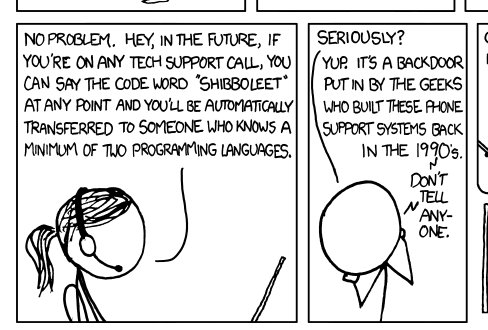
Okay, there’s optimism and then there’s totally unrealistic techno-utopianism…
Listening to that song reminded me of how much more overtly optimistic I was about technology and the future at the turn of the millennium. I realized that I’m somewhat less so now. But why? In truth, I think my more negative attitude has to do with people more than with the machines that Embrace the Machine characterizes as “children of our minds”. (I stole that line from Hans Moravec. Er, I mean it’s a “homage”.) But maybe there’s a connection there, between creators and creations.
It was easy to be optimistic in the 90s and at the turn of the millennium. The Soviet Union lost the Cold War, the Berlin Wall fell, and freedom and democracy and prosperity were on the march almost everywhere. Personal technology was booming, and its dark sides were not yet very apparent. (And the darker sides, like social media and smartphones, basically didn’t exist.)
And the tech companies, then, were run by people who looked very different from the people who run them now – even when, as in the case of Bill Gates, they were the same people. It’s easy to forget that Gates was once a rather libertarian figure, who boasted that Microsoft didn’t even have an office in Washington, DC. The Justice Department, via its Antitrust Division, punished him for that, and he has long since lost any libertarian inclinations, to put it mildly.
It’s a different world now. In the 1990s it seemed plausible that the work force of tech companies would rise up in revolt if their products were used for repression. In the 2020s, they rise up in revolt if they aren’t. Commercial tech products spy on you, censor you, and even stop you from doing things they disapprove of. Apple nowadays looks more like Big Brother than like a tool to smash Big Brother as presented in its famous 1984 commercial.
Silicon Valley itself is now a bastion of privilege, full of second- and third-generation tech people, rich Stanford alumni, and VC scions. It’s not a place that strives to open up society, but a place that wants to lock in the hierarchy, with itself on top. They’re pulling up the ladders just as fast as they can.

March 6, 2023
Britain’s Free Speech Union at three
Earlier this month, Toby Young’s Free Speech Union celebrated its third birthday:

Toby Young founded the Free Speech Union in early 2020, and on Wednesday, 1 March a party was thrown to celebrate the organisation’s third birthday. The delicate baby born just before the Covid-19 lockdowns has grown into a boisterous, disruptive toddler that stomps about the political scene breaking things.
Over 100 people came to the In and Out on St James’s Square to enjoy the FSU’s success, including Professor Nigel Biggar, whose book Colonialism was effectively cancelled by Bloomsbury when the publisher’s executives decided that “public feeling” was against its publication. The legal profession was well-represented — Francis Hoar acted as counsel in various legal challenges for those damaged by the government’s lockdowns. He was heard to complain that the Covid-19 inquiry under Lady Hallett had granted core participant status to various bereaved family groups and those suffering from long Covid, but had denied it to the hospitality and other businesses which had been pushed into bankruptcy. Other attendees included Matthew Elliott, who led Vote Leave; Matt Ridley, the author of The Rational Optimist; and Adam Afriye MP. The FSU has been remarkably successful in raising funds, and there was a good turn out of donors like Lady Bell, the widow of Bell Pottinger founder Lord Bell of Belgravia.
Young told the room what his creation had achieved in its short life so far — a paying membership of 11,000; more than 2,000 cases taken on; a staff of 16 including eight full time employees — and talked about his political campaigns. Currently in his crosshairs is the Worker Protection (Amendment of Equality Act) Bill, which has been tabled by Vera Hobhouse MP and is supported by the government. The Equality Act already imposes a duty on employers to stop their workers from being harassed by other employees in relation to a protected characteristic such as sexual orientation, disability or age. Hobhouse’s bill will extend that duty so companies can be liable for third parties’ harassing actions, unless the employer has taken “all reasonable steps” to protect them.
It is almost certain to have a chilling effect on free speech in the workplace, as well as creating additional costs which will have to be passed on to consumers — perhaps good news for HR departments, probably bad news for everyone else. The FSU hopes to see amendments proposed to the bill which will need to have public consultation, thereby delaying its parliamentary progress. It is hoped that the delay will prove fatal.
How the powers-that-be got drunk on (practically unlimited) power with the pandemic lockdowns
Brendan O’Neill on the revelations from the release of British government officials’ informal chats on WhatsApp as the initial lockdowns were imposed:

“Covid 19 Masks” by baldeaglebluff is licensed under CC BY-SA 2.0


They were laughing at us. They didn’t only lock us down. They didn’t only suspend virtually every one of our civil liberties, including a right none of us ever expected to lose: the right to leave our own homes. They didn’t only spy on us with drones, and encourage us to snitch on that neighbour going for a sneaky second jog, and fine teenagers life-ruining sums of money for holding house parties. They also chuckled about it. It was funny to them. In one of the most startling WhatsApp chats revealed in the Daily Telegraph‘s Lockdown Files, a senior civil servant says the following about Brits returning from trips abroad who were forced to quarantine in a stuffy hotel room for 10 days: “Hilarious“.
It was Simon Case, the UK’s top mandarin. In February 2021 he had a breezy virtual chat with Matt Hancock, the then health secretary. A policy had just been introduced stipulating that any Briton returning from a “red list” country – which eventually included 50 states around the world, including India and vast swathes of Africa – would have to quarantine in a hotel at a cost of £1,750 per person, later rising to £2,285. A total of 200,000 British citizens and residents endured this painful, expensive quarantine. To Hancock and his civil-service pals it was all a big laugh. “I just want to see some of the faces of people coming out of first class and into a premier inn shoe box”, chortled Mr Case. He later asked Hancock: “Any idea how many people we locked up in hotels yesterday?” Locked up in hotels. Hancock replied that 149 people “are now in Quarantine Hotels due to their own free will!”. “Hilarious”, said Case.
Hilarious? Tell that to the people whose lives were ruined by this policy. The idea that it was just reckless rich folk jetting off to exotic destinations that were on the “red list” is ridiculous, as academic Aleksandra Jolkina has explained. Consider the NHS worker who travelled to Ethiopia to visit his dying uncle and look after his sick mother. While he was there Ethiopia was added to the “red list”, meaning he could not return to the UK; he couldn’t afford to. Or the Briton who travelled to Pakistan to visit his terminally ill father. He was forced to raid the family savings to pay the return quarantine fee. As a result, his “family’s ability to survive financially” was put “at risk”. Or think about the many Brits who did not go abroad, to one of those supposedly toxic countries, because they didn’t have the funds for that stay in a “premier inn shoe box”. People who, as Jolkina describes it, could not “visit their ill relatives or wish them a final farewell”. Hilarious, right?
The sinister cruelty of lockdown is laid bare in this grotesque vision of officials laughing over a policy that caused so much heartache and hardship among often low-earning Brits whose only crime is that their families live overseas. You couldn’t have asked for a better snapshot of the feudalistic authoritarianism that underpinned the ideology of lockdown. Civil servants working from their plush homes having a giggle about a policy that inflicted severe financial pain on the diverse working classes. A health secretary breaking his own guidelines to snog his mistress while sending snide WhatsApp messages about a policy that prevented poorer citizens from kissing the cheek of a dying relative. For me, this is the most important thing about the Lockdown Files – their revelation of just how morally cavalier and even inhuman the political elites can become when they are drunk on power, when they are liberated from democratic accountability to pursue whatever extreme policies they like.
The Telegraph‘s Lockdown Files are based on more than 100,000 WhatsApp messages sent and received by Matt Hancock in the pandemic years. Hancock gave the messages to Isabel Oakeshott when she was co-writing his book, Pandemic Diaries, and now Ms Oakeshott has given them to the Telegraph. They provide only a partial insight into the machinations of lockdown, of course. Hancock is not the centre of the universe, whatever he might think to the contrary. And he says some of the messages are being taken out of context. Perhaps. Nonetheless, the Lockdown Files represent our first serious reckoning with lockdown, our first glimpse at what was happening behind the scenes of this unprecedented exercise in social control. And it’s not a pretty picture.
March 3, 2023
Progressives have steadily transitioned to the movement that denies that any personal conduct rules should apply
Freddie deBoer challenges his fellow leftists to identify who were the theorists that introduced the notion that personal responsibility is an anti-socialist position:
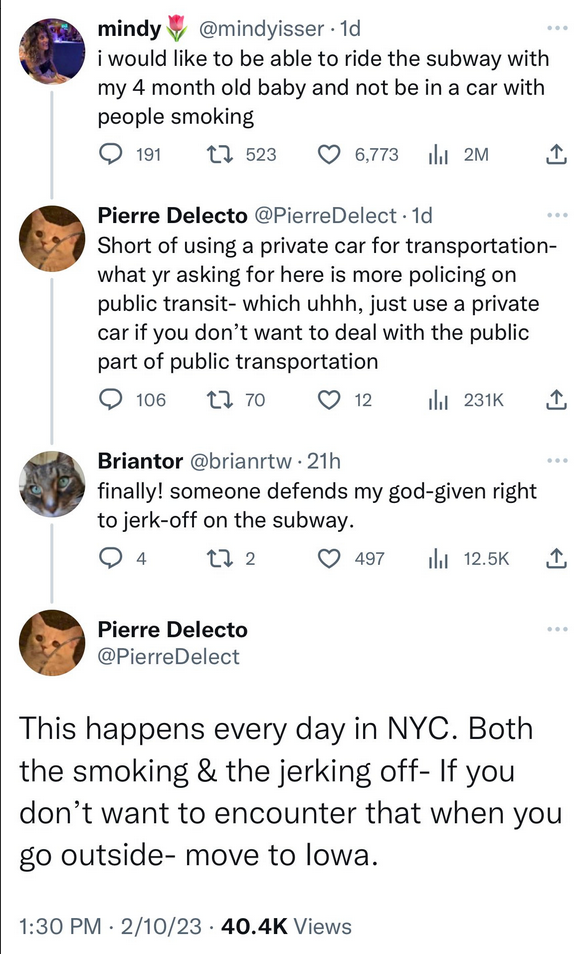
The woman whose account appears at the top of this picture started a Twitter storm, somehow, by publicly wishing that she could take her child onto the subway without exposing them to secondhand smoke. She was beset by a certain online species of ostensible leftist who is against ever trying to enforce any kind of rule, anywhere, ever. See, rules are the hand of oppression, or something, and since most of society’s rules are meant to be enforced by the police, trying to enforce them (merely wishing that they be enforced) is an endorsement of the police and their violence …
I find this attitude has become inescapable. It’s not just the attitude that the enforcement of societal rules and norms is bad, but that this is the default assumption of all right-thinking people — it’s not just a left-wing perspective but the left-wing perspective. Like so much else in contemporary left-of-center discourse, it demonstrates the total ideological poverty we’re working with. Nobody has read anything, so nobody knows anything, so you’re constantly getting yelled at by self-described radicals who have no solid footing in any systematic approach to left politics at all. Like I said before, we’re living in definitional collapse; the struggle right now is not merely that socialism can’t win but that so many self-described socialists have no deeper ideological moorings than whatever they’ve absorbed from Tumblr and “breadtube”. They think that to be a socialist means to disdain all rules because there is no substance to their socialism at all.
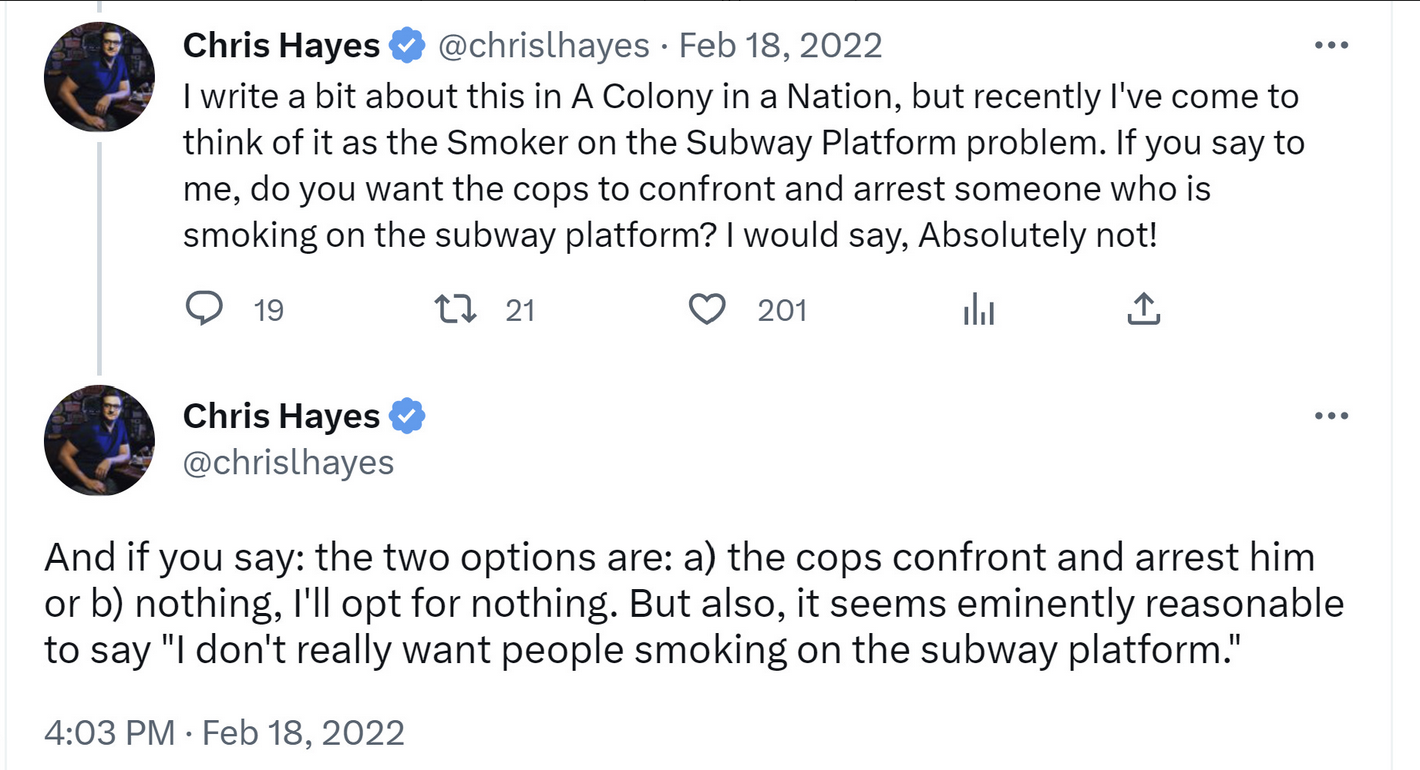
Chris Hayes considered the subway smoking problem last year.
Conceptually, I don’t think these problems are hard at all: the left, the socialist left, has never advocated for a system in which there are literally no expectations on personal behavior. It’s quite bizarre to suggest that this was ever a thing! Only certain extreme forms of anarchism have ever implied that society should have no rules. Go back through the history of socialist theorists and number all of the ones who believed that there should be no laws and no police to enforce them. You won’t find many! Instead you’ll find people who believed in the need for both laws that govern human behavior and constabulary forces to enforce those laws. That’s the solution to the conundrum, my friends — you have rules and you have police that enforce those rules. The belief, and the hope, is that a socialist society is one with far less need for aggressive policing, thanks to far greater economic equality, and maybe someday, after the end of material need, we can consider a policeless society. But not having any social rules or people who enforce those rules is not a socialist concept and never has been. What I would ask Chris Hayes and people like him is … what is the leftist tradition that you’re drawing from that implies that there should be no enforcement of behavioral norms? What thinker? What book? What philosophy? Or, could it be that you’ve developed this totally substance-free approach to basic order because you’ve been habituated to talking this way through exposure to people on social media who know nothing about anything in particular?
Of course, there’s big problems with American policing. Very big problems indeed. So what we do is reform policing. (I address this at length in my next book, coming this fall from Simon & Schuster.) Alternatively, if you’re really committed to this “no rules, no enforcement” thing, you become an anarchist of a very particular stripe — most versions of anarchism have both rules and enforcement mechanisms for them — and you and your compatriots can try to change the system. All twelve of you. In the house your wealthy parents bought for you.
March 1, 2023
If the Freedom Convoy “actually was what it has often been portrayed as on social media — a horde of thousands of literal Nazis and Confederates set on violently overthrowing our democratically elected government — then [we’d] be living in the Confederate Republic of Nazi Canada by now”
In The Line, Matt Gurney explains how going through Justice Paul Rouleau’s Public Order Emergency Commission report in detail leads to some uncomfortable realizations about Canadian goverment and policing — at all three levels — failed to meet minimal expectations of competency and capacity:

A screenshot from a YouTube video showing the protest in front of Parliament in Ottawa on 30 January, 2022.
Photo via Wikimedia Commons.
The convoy crisis — and I’m mostly speaking here about the events in Ottawa, though the situation at the border crossings fit the same general pattern — forced Canadian police and political leaders to respond quickly to evolving circumstances. And Rouleau’s report is just a relentlessly brutal catalogue of the ways they failed.
Is it really necessary at this point to recap the failure of the Ottawa police? We at The Line have long maintained that the complete failure of the Ottawa police to plan for and control the protest not only allowed the convoy to entrench itself, but also established the psychological paradigm that would define the crisis for weeks: the convoyers held the initiative (not to mention the capital) and the Canadian state was befuddled and adrift. From that, a national crisis was born. Rouleau is just devastating. “The OPS [Ottawa Police Service]’s planning challenges,” he notes on page 56 of the first volume, “were compounded by a general breakdown of command and control.” Super.
He’s even more brutal on page 185 of the second volume: “The influx of Freedom Convoy vehicles and the disruptive behaviour by some protesters threw the OPS operational command at the NCRCC [a command centre] into a state of dysfunction. OPS Inspector Lucas described the atmosphere at the NCRCC as chaotic and explained that he and his team had neither the capacity to process the incoming information nor the resources to respond to the needs it was facing. In the late afternoon of January 29, the OPP’s [Ontario Provincial Police] representative at the NCRCC, Inspector Dawn Ferguson, reported to OPP Superintendent Abrams that OPS members in the NCRCC were panicked and were swearing and yelling orders at each other and at partner agencies.”
Huh.
Moving up a level of government, much has already been written about the cowardice of the Ford government. If any agency performed semi-well, it was the Ontario Provincial Police. The OPP was the force that was generating most of the critical intelligence used (or ignored) during the crisis. It was quick to realize that command-and-control had collapsed in Ottawa (see above), and to begin working with the RCMP on a plan — eventually a series of plans — to restore order. You can’t read POEC and conclude the OPP performed perfectly. Far from it. It was probably the best we had, though, but because Ford took a gander at the mess in Ottawa and decided to mosey on off to the cottage, it couldn’t do much.
Huh.
And that leaves us with the feds. I have maintained since last year that the federal government hasn’t received nearly enough attention in our understanding of what the hell went wrong last year. This has caused a fair degree of pushback, especially from Liberal supporters who read any reference to the “federal government” as “our beloved prime minister”. But no — while I don’t think the prime minister or the federal cabinet did particularly well during the crisis, the real federal failures were in the officials that supported the PM and his ministers.
Among the many other failures, the inability of the various government and police organizations to organize and properly share the information they were handling is perhaps the most disturbing:
If you want to see it yourself, check out pages 38 and 39 of the third volume. For those in a hurry, though, it turns out that even within the government, the flow of information was so bad that the clerk of the privy council, and the prime minister, noted that staff were learning about the convoy not via internal reports, but social media. The federal government had, as Juneau and Rigby have noted, “intelligence gaps” that “hampered the government’s ability to understand, anticipate, and respond to the situation, and to reconcile conflicting information such as contradictory reports about the size of the convoy”. The federal government didn’t have the software to process and analyze online posts, even public ones.
And then there was this (my emphasis added):
[National Security and Intelligence Advisor] Thomas also described an information-sharing gap between law enforcement and government. Assistant Secretary to the Cabinet, Security and Intelligence, Michael MacDonald recalled a significant delay in receiving updates from the RCMP, due to the RCMP’s obligation to consult with each intelligence agency that has provided the RCMP with information prior to sharing that information further (known as the “third party rule”). The NSIA’s office did not receive situation reports, project reports, or other forms of information, such as Project Hendon reports, that the RCMP obtained from other law enforcement agencies. Prior to the events of the convoy, the NSIA was not aware of Project Hendon. …
NSIA Thomas further stated that it was sometimes difficult to know how to interact with law enforcement agencies. She recognized that government must not interfere in operational matters, but thought that there was nonetheless useful information that could have been provided to decision makers without encroaching upon police independence. However, senior officials were uncertain how to obtain that information, and were concerned about “crossing the line” both in requesting information and in discussing solutions.
… huh.
And that doesn’t even cover our now-outgoing national commissioner of the RCMP being so clueless she decided to just not mention germane information during a critical meeting because … well, we never really got a good explanation for that one. Oh well. Enjoy your retirement, Commissioner Lucki!
February 19, 2023
“Enjoy the report”
When the Canadian federal government invoked the Emergencies Act in February 2022, it began a legal timer for the government to set up a formal inquiry into the situation that triggered the use of the act which was intended to provide some clarity on whether the government was justified to do so. This inquiry had no legal powers to punish wrongdoing, but was merely supposed to uncover what went on both in public and behind the scenes at this time last year. The head of the commision, Paul Rouleau, was a long-time Liberal who’d once worked for former Liberal Prime Minister John Turner and had been appointed to the judiciary during Jean Chrétien’s premiership. It was perhaps too much to hope that he might return a report that made Trudeau or his government look bad.
Donna Laframboise started the Thank You, Truckers! Substack to record the events of the Freedom Convoy and the reports of participants, supporters, and opponents of the protests. She clearly wasn’t surprised at this outcome from the commission:
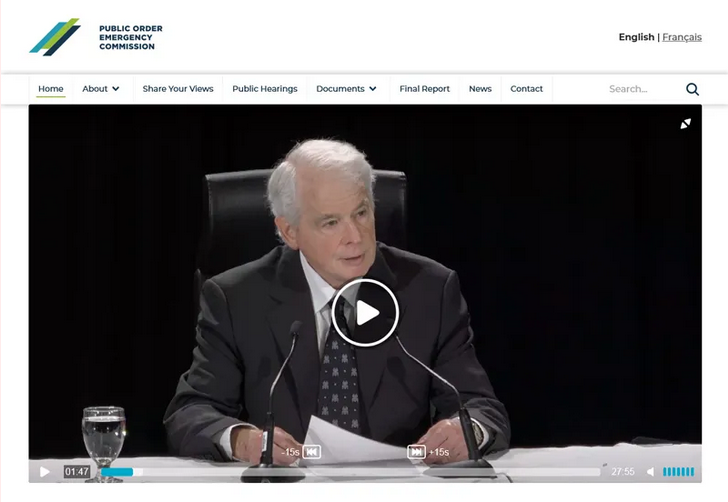
“Enjoy the report”. Those were the last words Commissioner Paul Rouleau uttered before rising and leaving the room yesterday. The room in which he cheerfully announced that the Canadian government was justified when it invoked the Emergencies Act against festive, peaceful, working class protesters a year ago.
Which part did he imagine we’d enjoy? The knowledge that there’s absolutely no accountability in our political system? The knowledge that a vast network of supposed checks and balances (funded year in and year out by the sweat of working Canadians) offers us no protection from tyrannical, rogue politicians?
Three months ago I wrote: Let us fervently hope Commissioner Rouleau is a man of integrity. One who understands that this is his moment. History will judge him by what he does here.
[…]
Given the opportunity to help resuscitate the limp, battered carcass of public trust, this gentleman instead extended every benefit of the doubt to the government, to the establishment, to police goons who crossed lines that should never, ever be crossed.
This is very bad news. Because, as Martin Luther King Jr observed 60 years ago, when peaceful protests get shut down some individuals
will seek expression through violence; this is not a threat but a fact of history.
Many Canadians predicted this result. They had few expectations. They said Commissioner Rouleau was hopelessly compromised by long association with the Liberal Party of Canada. They said that, because the Liberal government had sole discretion to select its own judge, real accountability was never on the table.
The cynics were correct.
In the preview to The Line‘s weekly dispatch, the editors take a less pessimistic view of their initial sampling of the report:
Justice Paul Rouleau’s report on the federal government’s decision to invoke the Emergencies Act was published Friday. It is thousands of pages long. We have not read it all yet. But we have tackled parts of it, with an eye to answering two questions, for ourselves and for our readers. What the hell happened last year — what went wrong? And: do we agree with Justice Rouleau’s decision that that the federal government’s decision to invoke the act was indeed appropriate?
We’ll get to those questions, but let’s say a few things first.
First: if you sat down to read the Rouleau report to find evidence for what you’d already decided, you’ll find it. We believe that Justice Rouleau has written a fair and balanced report. He is clearly struggling, as we were a year ago, to accurately describe and probably even to fully perceive and understand just what “the convoy” was. Line editor Gurney, in reading Rouleau’s efforts to describe how the protest was both a largely peaceful and lawful assembly and also a meeting place for radical extremists, including some dangerous ones, found himself nodding along in recognition of Rouleau’s thought process. This nuance and complexity was precisely what he tried to convey from Ottawa last year.
Second: the same very much applies to political blame. There’s some for everyone here, folks. The federal government comes in for less than some others, but we don’t see in that any bias, but instead a recognition that none of this should have been the federal government’s problem. If the convoy protests had been effectively handled by local and provincial officials, it wouldn’t have been a federal issue at all. This has long been The Line‘s position, but we have also been critical the Trudeau government’s nasty habit of seeing in moments of crisis not a threat to be defused, but instead, a wedge to be eagerly seized upon and exploited. Justice Rouleau is kinder to the Liberals than we are. Perhaps he is simply less cynical. But he did make a point of criticizing Justin Trudeau for inflammatory language, and we were glad of that.
[…]
Third: Justice Rouleau’s finding that the federal government acted appropriately is more conditional and guarded than we think the overall tone of the report, and much of the attendant media coverage, suggests. We’ll get into this in more detail in a minute, but we wanted this front and centre before we start doing the heavy lifting: Rouleau does indeed side with the government, but it’s a pretty nuanced and cautious alignment. A win is a win, and the Liberals got their win here, but Rouleau’s report isn’t an endorsement of how the feds handled anything last year. It would be better for literally all of us if we tried to remember that.
The legacy media’s ability to sway public opinion has waned, but it still has some strength and this was especially so during the lockdowns where people had less opportunity to see for themselves or to talk with others outside the curated gardens of sites like Facebook. If the media had given the Freedom Convoy coverage the same credibility it chose to give to the violent riots, uh, I mean “mostly peacful protests” after the death of George Floyd, the federal government would not have treated the convoy participants and supporters as cavalierly as they did.
Only one federal political party dared to show any significant support for the protest, and the other day PPC leader Maxime Bernier posted a retrospective on the Freedom Convoy to YouTube:
Individual Conservative MPs may have expressed a bit of timid support but were noteworthy by their unwillingness or inability to do anything in Parliament to force the government to at least talk to the protest leaders or give them any benefit of the doubt.
February 14, 2023
Are you not a PATRIOT? Do you hate FREEDOM?
I sometimes wonder if any bill ever gets passed in the United States without a catchy acronym anymore. Rob Henderson notes the anti-patriotic PATRIOT act and the anti-freedom FREEDOM act as examples of bills named in a way to almost exactly invert the true purpose of the legislation:
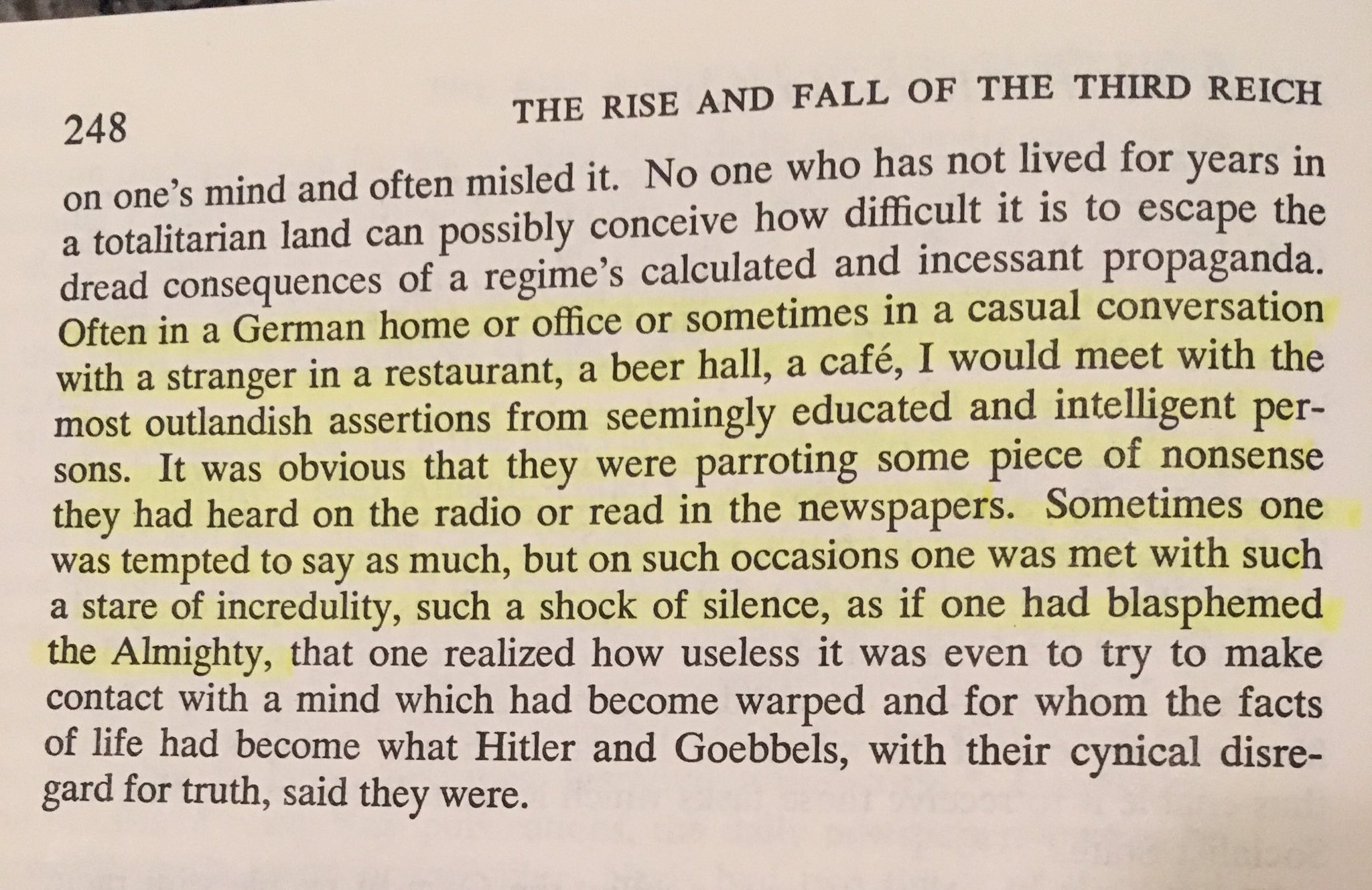
Many fully-grown adults have never developed the ability to think beyond words. Others are keenly aware of how easily people fall for this language game. And tactically exploit this mental weakness.
This isn’t a new phenomenon. William Shirer, the American journalist and author of The Rise and Fall of the Third Reich, described his experiences as a war correspondent in Nazi Germany:
The strangest variant of this way of thinking is the belief that just because a word or a term sounds good, the reality behind it is also unquestionably good.
In October of 2001, the Bush Administration famously decided to expand state surveillance. This allowed federal agencies to monitor domestic telephone conversations, online activity, email, and financial records, among other intrusions, without a court order.
And what did they call this decision? The Uniting and Strengthening America by Providing Appropriate Tools Required to Intercept and Obstruct Terrorism Act.
USA PATRIOT Act.
Better known as the PATRIOT Act. And if you were against it, what did supporters say that your criticisms implied?
In June of 2015, the PATRIOT Act expired. The Obama Administration then restored most of the provisions under the title Uniting and Strengthening America by Fulfilling Rights and Ensuring Effective Discipline Over Monitoring Act.
USA FREEDOM.
Better known as the FREEDOM Act. And if you were against it, what did supporters say that your criticisms implied?
There’s a country in which the first three names are “Democratic”, “People’s”, and “Republic”. The first and third words essentially mean the same as the middle — this state belongs to the people, and represents them.
In the modern era, government legitimacy is derived from this concept — representation of the people.
So the name of this particular country basically begins: “Legitimate Legitimate Legitimate”. Officially it known as the Democratic People’s Republic of Korea (DPRK). Sounds like a lovely place. It’s more commonly known as North Korea.
The Soviet Union was officially the Union of Soviet Socialist Republics.
China today is officially known as the “People’s Republic of China”.
Who could be against entities with names containing words like Republic, Democratic, People’s, and Union? They sound so nice. Even socialist is cleverly named — who could be against anything with the word “social” in it?
There’s a violent organization that calls themselves Antifa. Short for antifascist.
There are people who will say with a straight face that if you criticize Antifa, then you are a fascist. Or they will imply that you harbor fascist sympathies.
Interestingly, as William Shirer notes in the book referenced above, Antifa collaborated with the Nazis to help elect Adolf Hitler. Antifa has its origins in Germany, and, as a communist organization, their primary goal was to accelerate the forces of history. Antifa in the 1930s aimed to bring forth the revolution. They partnered with the Nazis to overthrow the Social Democrats who controlled the Weimar Republic. Antifa supporters believed that a fascist regime was a necessary step to end capitalism and usher in a communist utopia.
During this period, fascist was used as an epithet against capitalist society and anyone opposed to communism. They used this term to describe the center-left party in control of the Weimar Republic. As Stalin put it, “Fascism and social democracy are twin brothers, social democracy is only a wing of fascism.”
January 23, 2023
Who was John Wilkes?
Lawrence W. Reed on the life of John Wilkes, a British parliamentarian in the reign of George III:
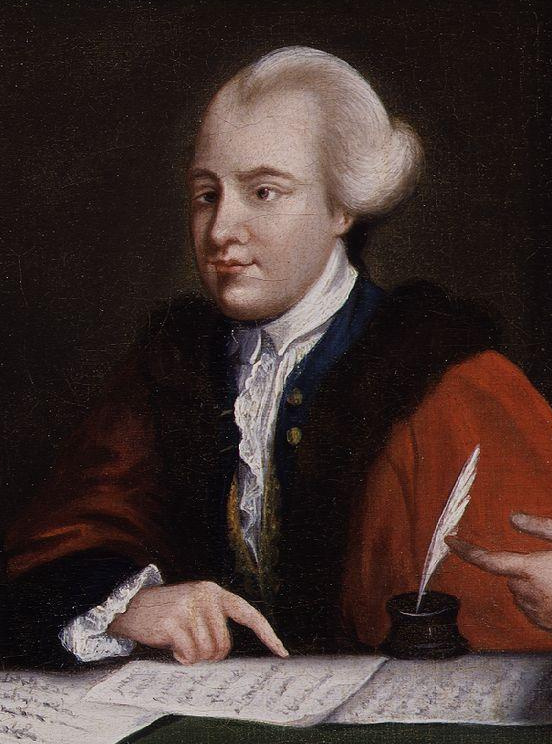
John Wilkes (1725-1797)
Cropped from a larger painting entitled “John Glynn, John Wilkes and John Horne Tooke” in the National Portrait Gallery via Wikimedia Commons.
In the long history of memorably scintillating exchanges between British parliamentarians, one ranks as my personal favorite. Though attribution is sometimes disputed, it seems most likely that the principals were John Montagu, 4th Earl of Sandwich, and the member from Middlesex, John Wilkes.
Montagu: Sir, I do not know whether you will die on the gallows or of the pox.
Wilkes: That depends, my lord, on whether I embrace your lordship’s principles or your mistress.
Repartee doesn’t get much better than that. And it certainly fits the style and reputation of Wilkes. Once when a constituent told him he would rather vote for the devil, Wilkes famously responded, “Naturally. And if your friend decides against standing, can I count on your vote?”
Wilkes deserves applause for his rapier wit, but also for something much more important: challenging the arrogance of power. He was known in his day as a “radical” on the matter. Today, we might label him “libertarian” in principles and policy and perhaps even “libertine” in personal habits (he was a notorious womanizer). His pugnacious quarrels with a King and a Prime Minister are my focus in this essay.
Born in London in 1725, Wilkes in his adult life was cursed with bad looks. Widely known as “the ugliest man in England”, he countered his unattractive countenance with eloquence, humor, and an eagerness to assault the powers-that-be with truth as he saw it. Fortunately, the voters in Middlesex appreciated his boldness more than his appearance. He charmed his way into election to the House of Commons as a devotee of William Pitt the Elder and, like Pitt, became a vociferous opponent of King George III’s war against the American colonies.
Pitt’s successor as PM in 1762, Lord Bute of Scotland, earned the wrath of Wilkes for the whole of his brief premiership. Bute negotiated the treaty that ended the Seven Years War (known in America as the French & Indian War), which Wilkes thought gave too many concessions to the French. Wilkes also opposed Bute’s plan to tax the Americans to pay for the war.
[…]
George III took it personally. He ordered the arrest of Wilkes and dozens of his followers on charges of seditious libel. For most of the nearly thousand years of British monarchy, kings would have remanded foes like Wilkes to the gallows forthwith. But as a measure of the steady progress of British liberty (from Magna Carta in 1215 through the English Bill of Rights in 1689), the case went to the courts.
Wilkes argued that as a member of Parliament, he was exempt from libel charges against the monarch. The Lord Chief Justice agreed. Wilkes was released and took his seat again in the House of Commons. He resumed his attacks on the government, Bute’s successor George Grenville in particular.
January 22, 2023
One year later
Last year, the Freedom Convoy 2022 from all parts of Canada began to assemble and move toward Mordor, er, I mean Ottawa. Patrick Carroll remembers:

Posted to Twitter by @KatherineZupan https://twitter.com/KatherineZupan/status/1486164240364814337/photo/1
It’s hard to believe, but the one-year anniversary of the Canadian Freedom Convoy is upon us. It was January 22, 2022 when the convoy began to form across the country. Over the following week, thousands of trucks made their way to Ottawa, and on January 29 they arrived in the nation’s capital, loud and determined as ever.
The following month was one of the most tumultuous times in modern Canadian history. Downtown Ottawa was completely gridlocked, bridges were blocked, and politicians along with the media took every opportunity to smear the protesters.
Four weeks later, it ended quite a bit faster than most people expected. Armed with special powers from the never-before-invoked Emergencies Act, the government successfully dismantled the protest in a matter of days.
In hindsight, the practical effect of the protest on legislation is difficult to detect. Some Covid policies were probably relaxed a few months earlier than they otherwise would have been, but for the Convoy organizers, this was far from a decisive victory.
A debate has been raging in Canada ever since: were the protestors within their rights to do what they did? Those who support the convoy argue that they were, since the Canadian Charter of Rights and Freedoms guarantees the right to freedom of expression and freedom of peaceful assembly. Those who oppose the convoy largely agree with these freedoms, but argue that such freedoms should be subject to certain reasonable restrictions. Major obstructions to traffic, and especially obstructions to critical infrastructure such as bridges, are simply going too far in their view. Is the government supposed to stand by and let a group of hooligans bring the country to its knees?
That’s certainly the line the governments (city, provincial, and federal) generally chose to take and the media were almost chanting the governments’ line in unison. Of course, the governments were not all that well synchronized, which led to some blatant examples of deliberate misinformation/disinformation/gaslighting from one or another level, as Donna Laframboise points out:
During the inquiry into the use of the Emergencies Act, witnesses talked about misinformation as if it were a problem confined to contrarians on social media. But the Closing Submission of former Ottawa police chief Peter Sloly shows that government officials are, themselves, a fertile source of misinformation.
If someone in our federal government had demonstrated genuine leadership by going out and talking to the truckers, the protesters would likely have dispersed after the first weekend. Instead, a government that meets with professional lobbyists on 24,000 occasions a year refused to have a single meeting with working people who’d driven thousands of miles to the nation’s capital. Rather than being a grownup, the Prime Minister called them names. Rather than negotiating with the protesters, he told police to get rid of them.
According to Chief Sloly, the Ottawa force was understaffed at the best of times. Even after cancelling vacations and days off, there still weren’t enough personnel to deal with a significant, extended protest on top of normal duties.
From the beginning, the media failed to behave responsibly. It whipped up hysteria. It smeared and sneered. It sowed suspicion and fear of small town Canada, of those who see the world differently, of people who’d reached their breaking point. Big surprise a portion of the public did, in fact, become hysterical. As the protest dragged on, the pressure became intense. In lieu of pursuing a political resolution to what were clearly political grievances, slimy politicians pointed fingers at the Ottawa police. While simultaneously hamstringing them behind the scenes.
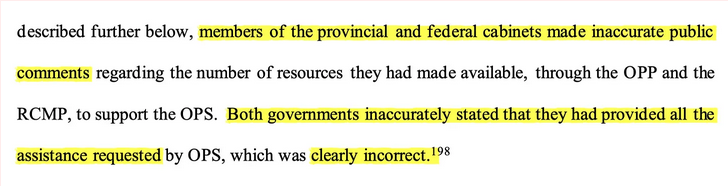
Page 43 of Chief Sloly’s Closing Submission says federal Public Safety Minister Marco Mendicino falsely told the world — on February 3rd — that the Royal Canadian Mounted Police (RCMP) had provided all the resources the Ottawa police had asked for. Four days later — on February 7th — he insisted 250 RCMP officers had been dispatched to Ottawa.
But the reality was quite different. Until mid-February, say his lawyers, the maximum number of RCMP officers available to the Ottawa force on any given day was 60 — far less than the number required.
It was the same story with the Ontario Provincial Police (OPP). On February 6th, Ontario’s Solicitor General Sylvia Jones falsely stated in an official document that “more than 1,500” OPP personnel had already been sent to Ottawa. In the words of Chief Sloly’s lawyers, this was “grossly inaccurate” (pages 80, 107).
Government ministers at both the provincial and federal level, they insist, made misleading statements about the degree of assistance Ottawa police had received. Statements that were “clearly incorrect” (page 53).
Which means Cabinet ministers were spreading misinformation. Misinformation that just happened to deflect blame away from themselves. That just happened to make the Ottawa Police Service look incompetent while turning the chief into a scapegoat. Ottawa’s first black police chief, a Jamaican immigrant, got thrown under the bus.

January 20, 2023
“… any association with Davos should put an individual or organization under notice of suspicion”
CDR Salamander wants to sign up — like so many of us — for a post-Davos world:
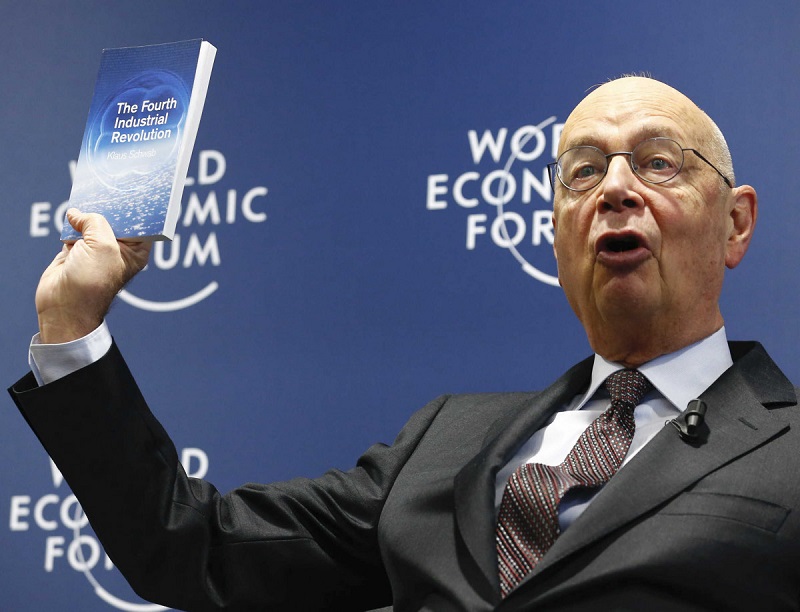
The whole World Economic Forum/Davos experience is one part Bond villain parody, one part clout seeking billionaires, one part megalomania, a heaping cup of greed, and a dash of rent seeking.
In 2023 things have reached the point where any association with Davos should put an individual or organization under notice of suspicion. Amazing to see people who claim to be American conservatives or lovers of liberty attending in an non-ironic, non-protesting capacity.
This wannabee gaggle of quasi-oligarchs and autocrat throne sniffers represents everything that is wrong with the human desire for control, power, and to crush the individual for fun and profit.
They pretend to be the world government in waiting that no one asked for, no one wants, and trust me on this — no one wants to live under. Being unaccountable to the people is their ideal state.
If you don’t know what I am referring to above, shame on you. Google it yourself, but I couldn’t help but giggle when I read the title from this article by Gideon Rachman at The Financial Times; Geopolitics threatens to destroy the world Davos made.
Really? It is? Then by all means let’s have MOAR!
…the 2023 WEF — the first to take place in its regular winter location since the pandemic began — could be seen as signalling a return to normalcy. However, China’s sudden abandonment of its zero-Covid policy has raised fears that a new wave of variants could emerge.
And, even if a fresh pandemic phase is avoided, Covid has left its mark on the way governments and businesses think about globalisation. The assumption that goods and commodities can always be shipped easily around the world has been shattered.
Except for the mentally fragile few and those who leverage power through them, the world is over COVID like it is over the flu. The last three years has been a clarifying event bringing in to stark relief those autocracy worshipers and hypocrites who hold individual rights in contempt. It also helped us see the existential danger a free people can face when they put themselves at the mercy of governments who see a crisis opening a door for an easy grasp at additional powers they will never want to give back.
The past the Davos set desired failed the future that is our present, but that doesn’t give pause to any of them. The Davos view of the future where everyone (except for those at the top) lives in a pod, eats bugs, owns nothing but is “happy” is at best dystopian, at worst justifies at some point if they are not stopped, open global revolt against the ruling class with all the violence and blood that comes with it.
[…]
Simply unacceptable in democratic nations that the will of the people might promote change in political leadership. Next thing you know, they might want even more free speech and redress of grievances.
Those world leaders who are present might do well to take the funicular up to the Schatzalp Hotel, which served as Mann’s model for the sanatorium in The Magic Mountain. The hotel’s view is the best in Davos — it may offer a chance for quiet reflection on how to prevent war and natural disaster from once again engulfing the global economy
Unspoofable.
Perhaps they should reflect on how they encouraged Russian aggression and European vulnerability to hydrocarbon blackmail? Should they take a moment to see how they look the other way as the PRC engages in wholesale oppression of their Muslim minority? Are they proud of their dividends derived from almost unimaginable levels of air and water pollution flowing out of PRC’s slave labor run factories?
Unlikely — they might miss out on the next party.
A post-Davos world?
How do we bring it here faster?


