
H/T to Richard Gray who says “Unless you have a good grasp of languages, it can be hard to grasp the words when listening to someone from another country speak. But have you ever thought about how you might sound to them?”
March 14, 2014
March 9, 2014
QotD: Puritan art
The saddest thing that I have ever heard in the concert hall is Herbert K. Hadley’s overture, “In Bohemia.” The title is a magnificent piece of profound, if unconscious irony. One looks, at least, for a leg flung in the air, a girl kissed, a cork popped, a flash of drawer-ruffles. What one encounters is a meeting of the Lake Mohonk Conference. Such prosy correctness and hollowness, in music, is almost inconceivable. It is as if the most voluptuous of the arts were suddenly converted into an abstract and austere science, like comparative grammar or astro-physics. Who’s Who in America says that Hadley was born in Somerville, Mass., and “studied violin and other branches in Vienna.” A prodigy thus unfolds itself: here is a man who lived in Vienna, and yet never heard a Strauss waltz! This, indeed, is an even greater feat than being born an artist in Somerville.
H.L. Mencken, “The Allied Arts: The Puritan as Artist”, Prejudices: Second Series, 1920.
Comments Off on QotD: Puritan art
March 8, 2014
MMO Female Armour Bingo card
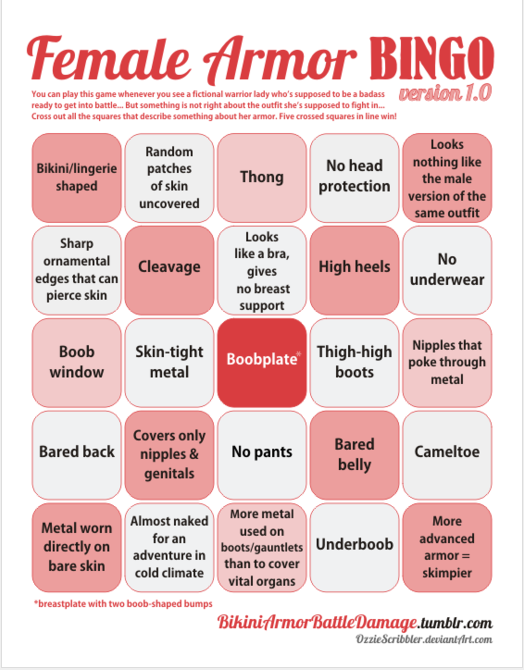
At Bikini Armour Battle Damage, a handy Bingo card for your MMO:
Click to download the PDF version
As a special present for Bikini Armor Battle Damage first anniversary, I present to you: Female Armor BINGO!
Feel free to use as a reference to quantify how ridiculous any female armor is.
edit: Updated the link into downloadable PDF!
Breakdown of all the squares under the cut.
For the record: the game refers to the context of wearing skimpy “armors” for battle (any other context, like cosplay, is excluded)
Update: There are a couple of follow-ups that deserve your attention, too: Let’s address the controversy, shall we? and Female Armor BINGO Rhetoric Edition.
Comments Off on MMO Female Armour Bingo card
March 5, 2014
QotD: “Truthiness” and the First Amendment
In modern times, “truthiness” — a “truth” asserted “from the gut” or because “it feels right,” without regard to evidence or logic5 — is also a key part of political discourse. It is difficult to imagine life without it, and our political discourse is weakened by Orwellian laws that try to prohibit it.
After all, where would we be without the knowledge that Democrats are pinko-communist flag-burners who want to tax churches and use the money to fund abortions so they can use the fetal stem cells to create pot-smoking lesbian ATF agents who will steal all the guns and invite the UN to take over America? Voters have to decide whether we’d be better off electing Republicans, those hateful, assault-weapon-wielding maniacs who believe that George Washington and Jesus Christ incorporated the nation after a Gettysburg reenactment and that the only thing wrong with the death penalty is that it isn’t administered quickly enough to secular-humanist professors of Chicano studies.
Everybody knows that the economy is better off under [Republican/Democratic]6 presidents — who control it directly with big levers in the Oval Office — and that:
President Obama is a Muslim.
President Obama is a Communist.
President Obama was born in Kenya.
Nearly half of Americans pay no taxes.7
One percent of Americans control 99 percent of the world’s wealth.
Obamacare will create death panels.
Republicans oppose immigration reform because they’re racists.
The Supreme Court is a purely political body that is evangelically [liberal/conservative].8All of the above statements could be considered “truthy,” yet all contribute to our political discourse.
5. Wikipedia.com, Truthiness, http://en.wikipedia.org/wiki/Truthiness (last visited Feb. 28, 2014) (describing the term’s coinage by Stephen Colbert during the pilot of his show in October 2005). See also Dictionary.com, Truthiness, http://dictionary.reference.com/browse/truthiness (last visited Feb. 28, 2014).
6. Circle as appropriate.
7. 47 percent to be exact, though it may be higher by now.
8. Again, pick your truth.Ilya Shapiro and P.J. O’Rourke, BRIEF OF AMICI CURIAE CATO INSTITUTE AND P.J. O’ROURKE IN SUPPORT OF PETITIONERS, Susan B. Anthony List v. Driehaus [PDF], 2014-02-28
Comments Off on QotD: “Truthiness” and the First Amendment
March 4, 2014
“Comedy turned inward and became domesticated [and] smaller”
In the New York Post, Kyle Smith discusses the comedians of the 1970s and their modern day successors:
As Chevy Chase might have put it on Saturday Night Live, Harold Ramis is still dead. And with him has gone the finest era of comedy: The ’70s kind.
Ramis was as close to the king of comedy as it gets, as a writer, director and occasional sidekick for Animal House, Meatballs, Caddyshack, Stripes, Ghostbusters, Back to School, National Lampoon’s Vacation and Groundhog Day.
[…]
Taking off with the movie M*A*S*H in 1970 — a huge hit that grossed $450 million in today’s dollars — and its spinoff sitcom, ’70s comedy ruled from an anti-throne of contempt for authority in all shapes. College deans, student body presidents, Army sergeants and officers, country-club swells, snooty professors and the EPA: Anyone who made it his life’s work to lord it over others got taken down with wit.
When the smoke bombs cleared and the anarchy died, comedy turned inward and became domesticated. It also became smaller.
The Cosby Show and Jerry Seinfeld didn’t seek to ridicule those in power. Instead they gave us comfy couch comedy — riffs on family and etiquette and people’s odd little habits.
Now, in the Judd Apatow era, comedy is increasingly marked by two worrying trends: One is a knee-jerk belief, held even by many of the most brilliant comedy writers, that coming up with the biggest, most outlandish gross-out gags is their highest calling.
H/T to Kathy Shaidle for the link.
Comments Off on “Comedy turned inward and became domesticated [and] smaller”
March 3, 2014
What doesn’t kill you makes you stronger – bacon and booze
At The Register, Lester Haines fights the killjoys in public health journalism to bring forth the revolutionary booze-and-bacon diet:
“Bacon is particularly problematic,” doomwatched the Daily Mail, a noted proponent of the “if it’s tasty it’ll kill you” school of scientific killjoyery.
It gets worse. Scientists have indicated that bacon also reduces fertility, while a daily consumption of of more than 20g of processed meat in general — “equivalent to one meagre rasher of bacon” — is a surefire shortcut to the hereafter.
Or so they’d have you believe. Among the amazing powers of bacon is its ability to cure hangovers. The negative effects of excessive alcohol consumption are well known — impotence, cirrhosis of the liver, maudlin pub musings, alcopop-fuelled teen pregnancies, the Saturday-night reduction of British city centres to vomit-spattered warzones, and so forth — but booze too has extraordinary properties.
In fact, it benefits cardiovascular health, fights asthma, provides immunity to Mike Tyson and, critically, wards off dementia and makes you clever.
So, here’s the thing: if bacon can be used to combat the negatives effects of alcohol, while alcohol can prevent you from losing your marbles as a result using bacon to counter the downside of alcohol (something we have dubbed the “Baco-Booze Harmonious Feedback Loop”), then you are in a position to exploit the increased intelligence alcohol confers.
Comments Off on What doesn’t kill you makes you stronger – bacon and booze
March 1, 2014
QotD: Male vanity
Let us go back. Why did I waste two hours, or maybe three, reading those idiotic manuscripts? Why, in the first place, did I answer her opening request the request, so inherently absurd, that I meet her in her father’s office? For a very plain reason: she accompanied it with flattery. What she said, in effect, was that she regarded me as a critic of the highest talents, and this ludicrous cajolery sound, I dare say, in substance, but reduced to naught by her obvious obscurity and stupidity was quite enough to fetch me. In brief, she assumed that, being a man, I was vain to the point of imbecility, and this assumption was correct, as it always is. To help out, there was the concept of romantic adventure vaguely floating in my mind. Her voice, as I heard it by telephone, was agreeable; her appearance, since she seemed eager to show herself, I probably judged (subconsciously) to be at least not revolting. Thus curiosity got on its legs, and vanity in another form. Am I fat and half decrepit, a man seldom noticed by cuties? Then so much the more reason why I should respond. The novelty of an apparently comely and respectable woman desiring to witness me finished what the primary (and very crude) appeal to my vanity had begun. I was, in brief, not only the literary popinjay but also the eternal male and hard at the immemorial folly of the order.
H.L. Mencken, “Scientific Examination of a Popular Virtue”, Prejudices: Second Series, 1920.
Comments Off on QotD: Male vanity
February 25, 2014
QotD: The power of the right accent
We assign 20 extra IQ points to anyone who speaks with a British accent, redistributing them from the people who speak with Southern accents.
Dave Weigel, “Shut Up, Piers: Thank goodness Piers Morgan Live is dead. Finally.”, Slate, 2014-02-24
Comments Off on QotD: The power of the right accent
February 23, 2014
QotD: Gratitude
What is one to think of a man so asinine that he looks for gratitude in this world, or so puerilely egotistical that he enjoys it when found? The truth is that the sentiment itself is not human but doggish, and that the man who demands it in payment for his doings is precisely the sort of man who feels noble and distinguished when a dog licks his hand. What a man says when he expresses gratitude is simply this: “You did something for me that I could not have done myself. Ergo, you are my superior. Hail, Durchlaucht!” Such a confession, whether true or not, is degrading to the confessor, and so it is very hard to make, at all events for a man of self-respect. That is why such a man always makes it clumsily and with many blushes and hesitations. It is hard for him to put so embarrassing a doctrine into plain words. And that is why the business is equally uncomfortable to the party of the other part. It distresses him to see a human being of decent instincts standing before him in so ignominious a position. He is as flustered as if the fellow came in handcuffs, or in rags, or wearing the stripes of a felon. Moreover, his confusion is helped out by his inward knowledge very clear if he is introspective, and plain enough even if he is not that he really deserves no such tribute to his high mightiness; that the altruism for which he is being praised was really bogus; that he did the thing behind the gratitude which now assails him, not for any grand and lofty reason, but for a purely selfish and inferior reason, to wit, for the reason that it pleases all of us to show what we can do when an appreciative audience is present; that we delight to exercise our will to power when it is safe and profitable. This is the primary cause of the benefits which inspire gratitude, real and pretended. This is the fact at the bottom of altruism. Find me a man who is always doing favors for people and I will show you a man of petty vanity, forever trying to get fuel for it in the cheapest way. And find me a man who is notoriously grateful in habit and I’ll show you a man who is essentially third rate and who is conscious of it at the bottom of his heart. The man of genuine self-respect which means the man who is more or less accurately aware, not only of his own value, but also and more importantly, of his own limitations tries to avoid entering either class. He hesitates to demonstrate his superiority by such banal means, and he shrinks from confessing an inferiority that he doesn’t believe in.
H.L. Mencken, “Scientific Examination of a Popular Virtue”, Prejudices: Second Series, 1920.
Comments Off on QotD: Gratitude
February 17, 2014
QotD: Not a hipster
I listen to the strangest assortment of music.
No, I’m not trying to tell you I’m a hipster, bustin’ a moby at the table saw while only listening to totally deck obscure artisanal free-range amazeballs beats. That would be so midtown. I just find myself interested in odd things.
Sippican Cottage, “I Like Puddles Pity Party’s Early Stuff. You Probably Haven’t Heard Of Them”, Sippican Cottage, 2014-02-16
Comments Off on QotD: Not a hipster
A creative way to get rid of unwanted callers
Unwanted telephone canvassers are a pain, and there aren’t many ways to end the unwelcome interruption without being rude. Amy Alkon has a new method she’s been trying out: I don’t think I’d have the nerve to pull this off, but it seems to be working for her:
I have a new tactic, and it’s fun. I turn it into a sex call. I started out asking the woman, “Are you wearing any panties” and then got into whether or not she was bucking the trend to go back to the full bush.
Click!
Comments Off on A creative way to get rid of unwanted callers
February 16, 2014
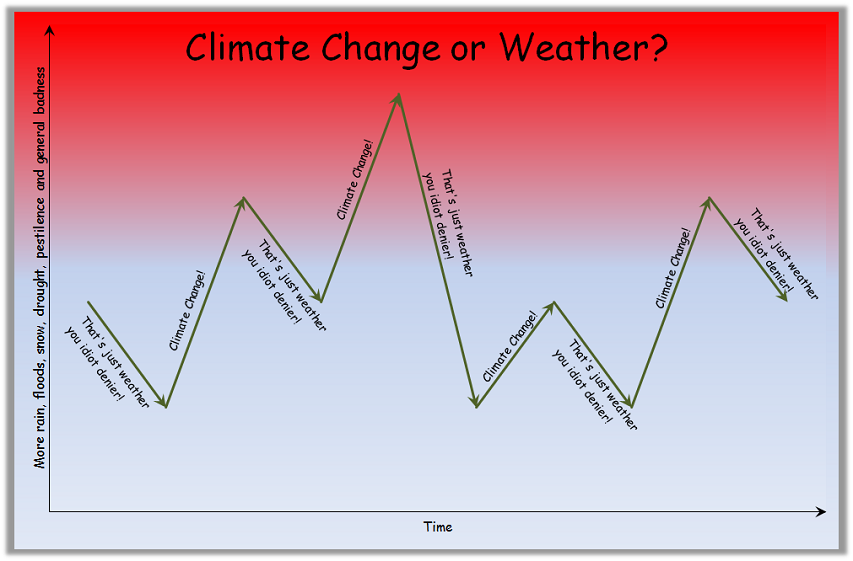
Is it climate change or is it just weather?
Ant O’Fearghail has developed a useful model to help you determine if a particular situation is caused by climate change or if it’s just ordinary weather:
Comments Off on Is it climate change or is it just weather?
February 15, 2014
What is your threat level?

H/T to Cory Doctorow for the link.
Comments Off on What is your threat level?
QotD: Cheese with range and striking power
I remember a friend of mine, buying a couple of cheeses at Liverpool. Splendid cheeses they were, ripe and mellow, and with a two hundred horse-power scent about them that might have been warranted to carry three miles, and knock a man over at two hundred yards. I was in Liverpool at the time, and my friend said that if I didn’t mind he would get me to take them back with me to London, as he should not be coming up for a day or two himself, and he did not think the cheeses ought to be kept much longer.
“Oh, with pleasure, dear boy,” I replied, “with pleasure.”
I called for the cheeses, and took them away in a cab. It was a ramshackle affair, dragged along by a knock-kneed, broken-winded somnambulist, which his owner, in a moment of enthusiasm, during conversation, referred to as a horse. I put the cheeses on the top, and we started off at a shamble that would have done credit to the swiftest steam-roller ever built, and all went merry as a funeral bell, until we turned the corner. There, the wind carried a whiff from the cheeses full on to our steed. It woke him up, and, with a snort of terror, he dashed off at three miles an hour. The wind still blew in his direction, and before we reached the end of the street he was laying himself out at the rate of nearly four miles an hour, leaving the cripples and stout old ladies simply nowhere.
It took two porters as well as the driver to hold him in at the station; and I do not think they would have done it, even then, had not one of the men had the presence of mind to put a handkerchief over his nose, and to light a bit of brown paper.
[…]
From Crewe I had the compartment to myself, though the train was crowded. As we drew up at the different stations, the people, seeing my empty carriage, would rush for it. “Here y’ are, Maria; come along, plenty of room.” “All right, Tom; we’ll get in here,” they would shout. And they would run along, carrying heavy bags, and fight round the door to get in first. And one would open the door and mount the steps, and stagger back into the arms of the man behind him; and they would all come and have a sniff, and then drop off and squeeze into other carriages, or pay the difference and go first.
Jerome K. Jerome, Three Men in a Boat (to say nothing of the dog), 1889.
Comments Off on QotD: Cheese with range and striking power
February 14, 2014
QotD: Anthropology
Readers who are all too familiar with popular works on anthropology may be interested to learn that some recent investigations have involved a completely novel approach. The ordinary anthropologist is one who spends six weeks or six months (or even sometimes six years) among, say, the Boreyu tribe at their settlement on the Upper Teedyas River, Darndreeryland. He then returns to civilization with his photographs, tape recorders, and notebooks, eager to write his book about sex life and superstition. For tribes such as the Boreyu, life is made intolerable by all this peering and prying. They often become converts to Presbyterianism in the belief that they will thereupon cease to be of interest to anthropologists; nor in fact has this device been known to fail. But enough primitive people remain for the purposes of science. Books continue to multiply, and when the last tribe has resorted to the singing of hymns in self-defense, there are still the poor of the backstreets. These are perpetually pursued by questionnaire, camera, and phonograph; and the written results are familiar to us all.
C. Northcote Parkinson, “Palm Thatch To Packard Or A Formula For Success”, Parkinson’s Law (and other studies in administration), 1957.
Comments Off on QotD: Anthropology


