
Sabaton History
Published 22 Oct 2024Today’s episode is about a song that is not a Sabaton original, but a cover they did of Stan Ridgway’s “Camouflage” from 1986. The story itself is easy enough to understand if you follow the lyrics, but it inspired us to do an episode not about the song, but about camouflage itself; its history, how it works, how it’s supposed to work, and even its limitations.
(more…)
February 24, 2025
“Camouflage” – and a History of Military Deception – Sabaton History 129 [Official]
Comments Off on “Camouflage” – and a History of Military Deception – Sabaton History 129 [Official]
QotD: Great Men when it’s time to do x
Pascal-Emmanuel Gobry @pegobry_en
This is obvious, but: Elon breaks libs’ brains because he is the living vindication of the Great Man theory of history. Literally nothing he built would have existed without him, and without him clearly exhibiting superior intelligence and indomitable will.Not so fast.
I’m here to tell you, because I lived it, that the experience of being the “Great Man” who changed history can feel very different from the inside.
I’m not going to try to speak for Elon. Maybe he feels like a colossus out of Thomas Carlyle. I’ll just say that I didn’t feel like that when I was doing my thing, and I’m doubtful that he does more than a small part of the time.
Somebody was going to take the concept of “open source” to the mainstream fairly soon after general access to the Internet started to happen in the mid-1990s. But it didn’t have to be me; you get steam-engines when it’s steam-engine time, and it was time. Dennard scaling and cheap wide-area networking were the underlying drivers. Conditions like that generate ESR-equivalents.
Now it’s time for rockets to Mars. The drivers include extremely cheap and powerful computing, 3-D printing, and advances in both metallurgy and combustion chemistry. Conditions like this generate Elon-equivalents.
It is more than possible to look like the Great Man from the outside but to feel like — to know — that you are almost at the mercy of currents of change much larger than yourself. Yes, you have some ability to shape outcomes. And you can fail, leaving the role to the next person to notice the possibilities.
If Elon is like me, he sometimes plays the autonomous Great Man in order to get the mission done, because he knows that the most effective way to sell ideas is to be a charismatic prophet of them. But if he’s like me, he also feels like the mission created him to make itself happen, and if he fails or breaks the mission will raise up another prophet by and by.
I’m not claiming the Great Man theory is entirely wrong — it takes some exceptional qualities to be an Elon, or even a lesser prophet like me — but it’s incomplete. Great Men don’t entirely create themselves, they are thrust upwards and energized by missions that are ready to happen.
ESR, Twitter, 2024-10-31.
Comments Off on QotD: Great Men when it’s time to do x
February 23, 2025
How WW2 Changed Espionage Forever
World War Two
Published 22 Feb 2025In their struggle to defeat German and Japanese espionage efforts, the Allied intelligence agencies of the KGB, CIA, MI6 and DGSE are all transformed into modern, global, espionage forces. But even as East and West work together to defeat the Axis, they are fighting the first underground battles of a new Cold War against one another.
(more…)
Comments Off on How WW2 Changed Espionage Forever
Portuguese Navy Lugers: Model m/910 from DWM and Mauser
Forgotten Weapons
Published 2 Nov 2024Following Portuguese Army adoption in 1908, the Portuguese Navy adopted the Luger in 1909 as the m/910. The pattern they chose was a “new model” Luger in 9x19mm, with a 100mm / 4″ barrel. A total of 650 were ordered in late 1909 and delivered between 1910 and 1912. The guns had Portuguese-language safety and extractor markings (“Seguranca” and “Carregada“) and included grip safeties. They were in a dedicated serial number range of 1 to 650. The first 350 were delivered under the reign of Portuguese King Manuel II and had crown-over-anchor chamber crests. With the establishment of a Republic in Portugal, that marking was changed to “R.P.” over an anchor, which was used on the remaining guns (351-650).
In the mid 1930s, the Navy ordered another 156 m/910 Luger pistols, this time from the Mauser company. These had the same Portuguese markings, but without any special crest — just blank chambers. They were numbered in Mauser’s export/commercial serial number range, and are in the “v” block of numbers. A few more very small orders were placed in 1941 and 1942, but these were filled with basically straight German P08 pistols.
(more…)
Comments Off on Portuguese Navy Lugers: Model m/910 from DWM and Mauser
QotD: The Hellenistic army system as a whole
I should note here at the outset that we’re not going to be quite done with the system here – when we start looking at the third and second century battle record, we’re going to come back to the system to look at some innovations we see in that period (particularly the deployment of an enallax or “articulated” phalanx). But we should see the normal function of the components first.
No battle is a perfect “model” battle, but the Battle of Raphia (217BC) is handy for this because we have the two most powerful Hellenistic states (the Ptolemies and Seleucids) both bringing their A-game with very large field armies and deploying in a fairly standard pattern. That said, there are some quirks to note immediately: Raphia is our only really good order of battle of the Ptolemies, but as our sources note there is an oddity here, specifically the mass deployment of Egyptians in the phalanx. As I noted last time, there had always been some ethnic Egyptians (legal “Persians”) in the phalanx, but the scale here is new. In addition, as we’ll see, the position of Ptolemy IV himself is odd, on the left wing matched directly against Antiochus III, rather than on his own right wing as would have been normal. But this is mostly a fairly normal setup and Polybius gives us a passably good description (better for Ptolemy than Antiochus, much like the battle itself).
We can start with the Seleucid Army and the tactical intent of the layout is immediately understandable. Antiochus III is modestly outnumbered – he is, after all, operating far from home at the southern end of the Levant (Raphia is modern-day Rafah at the southern end of Gaza), and so is more limited in the force he can bring. His best bet is to make his cavalry and elephant superiority count and that means a victory on one of the wings – the right wing being the standard choice. So Antiochus stacks up a 4,000 heavy cavalry hammer on his flank behind 60 elephants – Polybius doesn’t break down which cavalry, but we can assume that the 2,000 with Antiochus on the extreme right flank are probably the cavalry agema and the Companions, deployed around the king, supported by another 2,000 probably Macedonian heavy cavalry. He then uses his Greek mercenary infantry (probably thureophoroi or perhaps some are thorakitai) to connect that force to the phalanx, supported by his best light skirmish infantry: Cretans and a mix of tough hill folks from Cilicia and Caramania (S. Central Iran) and the Dahae (a steppe people from around the Caspian Sea).
His left wing, in turn, seems to be much lighter and mostly Iranian in character apart from the large detachment of Arab auxiliaries, with 2,000 more cavalry (perhaps lighter Persian-style cavalry?) holding the flank. This is a clearly weaker force, intended to stall on its wing while Antiochus wins to the battle on the right. And of course in the middle [is] the Seleucid phalanx, which was quite capable, but here is badly outnumbered both because of how full-out Ptolemy IV has gone in recruiting for his “Macedonian” phalanx and also because of the massive infusion of Egyptians.
But note the theory of victory Antiochus III has: he is going to initiate the battle on his right, while not advancing his left at all (so as to give them an easier time stalling), and hope to win decisively on the right before his left comes under strain. This is, at most, a modest alteration of Alexander-Battle.
Meanwhile, Ptolemy IV seems to have anticipated exactly this plan and is trying to counter it. He’s stacked his left rather than his right with his best troops, including his elite infantry (the agema and peltasts, who, while lighter, are more elite) and his best cavalry, supported by his best (and only) light infantry, the Cretans.1 Interestingly, Polybius notes that Echecrates, Ptolemy’s right-wing commander waits to see the outcome of the fight on the far side of the army (Polyb. 6.85.1) which I find odd and suggests to me Ptolemy still carried some hope of actually winning on the left (which was not to be). In any case, Echecrates, realizing that sure isn’t happening, assaults the Seleucid left.
I think the theory of victory for Ptolemy is somewhat unconventional: hold back Antiochus’ decisive initial cavalry attack and then win by dint of having more and heavier infantry. Indeed, once things on the Ptolemaic right wing go bad, Ptolemy moves to the center and pushes his phalanx forward to salvage the battle, and doing that in the chaos of battle suggests to me he always thought that the matter might be decided that way.
In the event, for those unfamiliar with the battle: Antiochus III’s right wing crumples the Ptolemaic left wing, but then begins pursuing them off of the battlefield (a mistake he will repeat at Magnesia in 190). On the other side, the Gauls and Thracians occupy the front face of the Seleucid force while the Greek and Mercenary cavalry get around the side of the Seleucid cavalry there and then the Seleucid left begins rolling up, with the Greek mercenary infantry hitting the Arab and Persian formations and beating them back. Finally, Ptolemy, having escaped the catastrophe on his left wing, shows up in the center and drives his phalanx forward, where it wins for what seem like obvious reasons against an isolated Seleucid phalanx it outnumbers almost 2-to-1.
But there are a few structural features I want to note here. First, flanking this army is really hard. On the one hand, these armies are massive and so simply getting around the side of them is going to be difficult (if they’re not anchored on rivers, mountains or other barriers, as they often are). Unlike a Total War game, the edge of the army isn’t a short 15-second gallop from the center, but likely to be something like a mile (or more!) away. Moreover, you have a lot of troops covering the flanks of the main phalanx. That results, in this case, in a situation where despite both wings having decisive actions, the two phalanxes seem to be largely intact when they finally meet (note that it isn’t necessarily that they’re slow; they seem to have been kept on “stand by” until Ptolemy shows up in the center and orders a charge). If your plan is to flank this army, you need to pick a flank and stack a ton of extra combat power there, and then find a way to hold the center long enough for it to matter.
Second, this army is actually quite resistive to Alexander-Battle: if you tried to run the Issus or Gaugamela playbook on one of these armies, you’d probably lose. Sure, placing Alexander’s Companion Cavalry between the Ptolemaic thureophoroi and Gallic mercenaries (about where he’d normally go) would have him slam into the Persian and Medean light infantry and probably break through. But that would be happening at the same time as Antiochus’ massive 4,000-horse, 60-elephant hammer demolished Ptolemaic-Alexander’s left flank and moments before the 2,000 cavalry left-wing struck Alexander himself in his flank as he advanced. The Ptolemaic army is actually an even worse problem, because its infantry wings are heavier, making that key initial cavalry breakthrough harder to achieve. Those chunky heavy-cavalry wings ensure that an effort to break through at the juncture of the center and the wing is foolhardy precisely because it leaves the breakthrough force with heavy cavalry to one side and heavy infantry to the other.
I know this is going to cause howls of pain and confusion, but I do not think Alexander could have reliably beaten either army deployed at Raphia; with a bit of luck, perhaps, but on the regular? No. Not only because he’d be badly outnumbered (Alexander’s army at Gaugamela is only 40,000 infantry and 7,000 cavalry) but because these armies were adapted to precisely the sort of army he’d have and the tactics he’d use. Even without the elephants (and elephants gave Alexander a hell of a time at the Hydaspes), these armies can match Alexander’s heavy infantry core punch-for-punch while having enough force to smash at least one of his flanks, probably quite quickly. Note that the Seleucid Army – the smaller one at Raphia – has almost exactly as much heavy infantry at Raphia as Alexander at Gaugamela (30,000 to 31,000), and close to as much cavalry (6,000 to 7,000), but of course also has a hundred and two elephants, another 5,000 more “medium” infantry and massive superiority in light infantry (27,000 to 9,000). Darius III may have had no good answer to the Macedonian phalanx, but Antiochus III has a Macedonian phalanx and then essentially an entire second Persian-style army besides (and his army at Magnesia is actually more powerful than his army at Raphia).
This is not a degraded form of Alexander’s army, but a pretty fearsome creature of its own, which supplements an Alexander-style core with larger amounts of light and medium troops (and elephants), without sacrificing much, if any, in terms of heavy infantry and cavalry. The tactics are modest adjustments to Alexander-Battle which adapt the military system for symmetrical engagements against peer armies. The Hellenistic Army is a hard nut to crack, which is why the kingdoms that used them were so successful during the third century, to the point that, until the Romans show up, just about the only thing which could beat a Hellenistic army was another Hellenistic army.
Bret Devereaux, “Collections: Phalanx’s Twilight, Legion’s Triumph, Part Ib: Subjects of the Successors”, A Collection of Unmitigated Pedantry, 2024-01-26.
1. You can tell how much those Cretans are valued, given that they get placed in key positions in both armies.
Comments Off on QotD: The Hellenistic army system as a whole
February 22, 2025
The Grim Fate of the Chinese Army – a Korean War Special
The Korean War by Indy Neidell
Published 21 Feb 2025Millions of Chinese served in the Korean War, but until very recently the People’s Liberation Army was by no means the only army in China. A lot has changed in this country in a very short time, with tens of millions of deaths in World War Two, and a brutal civil war that has raged both before and afterwards. How did the PLA become what it is today, and what became of Mao Zedong’s old adversaries?
(more…)
Comments Off on The Grim Fate of the Chinese Army – a Korean War Special
How the US Turned Iran Into a Dictatorship
Real Time History
Published 4 Oct 2024In 1953, Iran is at a crossroads. After decades of interference by foreign powers eager to exploit its oil reserves, the government decides it will throw them out and take control of the country’s wealth. But with the super powers’ Cold War paranoia and thirst for oil, it won’t be easy – especially once the CIA gets involved.
(more…)
Comments Off on How the US Turned Iran Into a Dictatorship
February 21, 2025
Berlin ’45: City of Spies
World War Two
Published 20 Feb 2025In 1945, Berlin is a city in ruins — but for the world’s spies, it’s a goldmine. As the Soviets, Americans, British, and French carve up the capital, they scramble to seize Nazi secrets, recruit informants, and outmaneuver each other in an intelligence war that will define the Cold War. From stolen blueprints to fabricated reports, Berlin becomes the world’s first battleground of espionage.
(more…)
Comments Off on Berlin ’45: City of Spies
Firefly and the End of Serenity
Feral Historian
Published 29 Mar 2023Serenity did an admirable job of wrapping up Firefly after the series was cancelled. But the ending, which depends on the idea that exposing government misdeeds forces change, doesn’t work today. Serenity‘s ending is premised on the idea that “sunshine is the best disinfectant” but the last few years have illustrated that we’re dealing with sunlight-resistant corruption these days.
00:00 Intro
00:24 Backstory
01:27 Chimerica
02:08 Unification
03:37 Secrets
05:12 Serenity‘s Ending
Comments Off on Firefly and the End of Serenity
February 20, 2025
The Space Race Begins – W2W 006
TimeGhost History
Published 19 Feb 2025The Space Race has begun. As Stalin’s USSR and Truman’s U.S. compete for technological dominance, the Pentagon prepares for a future of missile warfare. Project Diana shatters barriers by bouncing radar off the Moon, proving space can be conquered — whether for exploration or war.
(more…)
Comments Off on The Space Race Begins – W2W 006
Retaking Burma with the Fourteenth Army in 1945
Dr. Robert Lyman discusses the start of the campaign to reconquer Burma from the Japanese led by Lieutenant General Bill Slim and the Fourteenth Army:
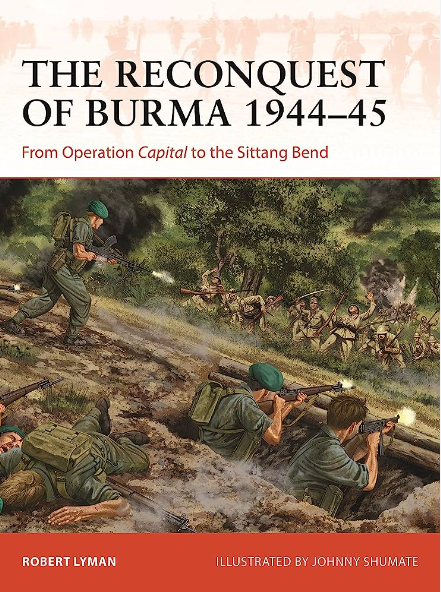
Why Burma? Because in Burma in 1945 a series of marvellous military miracles (is there a synonym starting with “m” for concatenation?) engineered by General Bill Slim and his mighty 14th Army, broke the back of the Japanese Burma Area Army and smashed forever Tokyo’s dreams of an empire in South East Asia. 1945 is worth celebrating!
Even today, few people are aware of just how dramatic these events were, and just how spectacular was the victory wrought by the Indian, British, African, US and Chinese forces in the country.
Indeed, at the start of 1945 few people would have predicted the extraordinary outcome of the developing campaign. If Lieutenant General Sir Bill Slim (he had been knighted by General Archibald Wavell, the Viceroy, the previous October, at Imphal) had been asked in January 1945 to describe the situation in Burma at the onset of the next monsoon period in May, I do not believe that in his wildest imaginings he could have conceived that the whole of Burma was about to fall into his hands. After all, his army wasn’t yet fully across the Chindwin. Nearly 800 miles of tough country with few roads lay before him, not the least the entire Burma Area Army under a new commander, General Kimura. The Arakanese coastline needed to be captured too, to allow aircraft to use the vital airfields at Akyab as a stepping stone to Rangoon. Likewise, I’m not sure that he would have imagined that a primary reason for the success of his Army was the work of 12,000 native levies from the Karen Hills, under the leadership of SOE, whose guerrilla activities prevented the Japanese from reaching, reinforcing and defending the key town of Toungoo on the Sittang river. It was the loss of this town, more than any other, which handed Burma to Slim on a plate, and it was SOE and their native Karen guerrillas which made it all possible.
Crossing the Irrawaddy
(Victoria State Archives)The potential of a Karenni-based resistance raised the possibility, long argued by old Burma hands, of a British armed and trained fifth column operating behind Japanese lines for the purpose of gathering battlefield intelligence and undertaking limited guerrilla action. Slim had long complained about the poor quality of the battlefield intelligence (as opposed to the signals intelligence, about which he was well provided) that he and his Corps commanders received. He was concerned, among other things, about knowing “what was on the other side of the hill”, the product of information provided – where it existed – by effective combat (ground and air) reconnaissance. There was no shortage of organisations attempting to assist in this task – at least twelve – but their coordination was poor and most reported to SEAC or parts of India Command, rather than to 14 Army. Slim dismissed most of these as “private armies” which offered no real help to the task of defeating the enemy on the battlefield. One of the groups, part of Force 136 (i.e. Special Operations Executive, or SOE), which had operated in front of 20 Indian Division along the Chindwin between 1943 and early 1944 under Major Edgar Peacock (and thus known as “P Force”) did sterling work with local Burmese and Karen agents reporting on Japanese activity facing 4 Corps. Persuaded that similar groups working among the Karens in Burma’s eastern hills – an area known as the Karenni States – could achieve significant support for a land offensive in Burma, Slim (to whom Mountbatten transferred responsibility for Force 136 in late 1944 for this purpose) authorised an operation to the Karens. Its task was not merely to undertake intelligence missions watching the road and railways between Mandalay and Rangoon, but to determine whether they would fight. If the Karens were prepared to do so, SOE would be responsible for training and organising them as armed groups able to deliver battlefield intelligence directly in support of the advancing 14 Army. The resulting operation – Character – was so spectacularly successful that it far outweighed what had been achieved by Operation Thursday the previous year in terms of its impact on the course of military operations in pursuit of the strategy to defeat the Japanese in the whole of Burma. It has been strangely forgotten, or ignored, by most historians ever since, drowned out perhaps by the noise made by the drama and heroism of Operation Thursday, the second Chindit expedition. Over the course of Operation Extended Capital some 2,000 British, Indian and Burmese officers and soldiers, along with 1,430 tons of supplies, were dropped into Burma for the purposes of providing intelligence about the Japanese that would be useful for the fighting formations of 14th Army, as well as undertaking limited guerrilla operations. As historian Richard Duckett has observed, this found SOE operating not merely as intelligence gatherers in the traditional sense, but as Special Forces with a defined military mission as part of conventional operations linked directly to a strategic outcome. For Operation Character specifically, about 110 British officers and NCOs and over 100 men of all Burmese ethnicities, dominated interestingly by Burmans (which now also included 3-man Jedburgh Teams) mobilised as many as 12,000 Karens over an area of 7,000 square miles to the anti-Japanese cause. Some 3,000 weapons were dropped into the Karenni States. Operating in five distinct groups (“Walrus”, “Ferret”, “Otter”, “Mongoose” and “Hyena”) the Karen irregulars trained and led by Force 136, waited the moment when 14 Army instructed them to attack.

Comments Off on Retaking Burma with the Fourteenth Army in 1945
Enfield MkII: Better Than the MkI, I Guess
Forgotten Weapons
Published 1 Nov 2024The Enfield MkI had only been in service for two years when the MkII was adopted in March 1882 to resolve some of its problems (and reduce its cost). At the same time, a new cartridge was adopted (the MkIII) with a heeled .477” bullet — also in hopes of resolving some of the problems with the Enfield revolver.
The Enfield used a selective ejection system that was intended to dump empty cases but retain unfired live cartridges. It was a bit finicky, with the live rounds often moving during the ejection process and jamming the system up. The larger heeled bullets were hoped to help stop that — and they were also thought to provide better accuracy in the gun’s Henry type rifling.
Simplifications to reduce cost of the gun included:
Unchecked grips
Smooth holster guides
Simplified geometry on the lower frame and top strap
Semicircular front sightFinally, a number of mechanical changes were made. Small elements were added to the clockwork to prevent cylinder rotation when not firing, and to lock the trigger and hammer when the loading gate was open. A second side plate screw was added to ease disassembly, and the grip attachment redesigned to use the lanyard ring as a screw to hold them in place. A fatal accident with an Enfield led to design of a hammer block safety that was intended to be universally retrofitted to guns in service, but many of the guns already sent out to far corners of the planet were never returned for this work.
In total, 13,102 MkII Enfield revolvers were made between 1882 and 1885, plus one gun each in 1886 and 1887. In 1887, the Webley MkI revolver was adopted to replace it, presumably much to the relief of Ordnance officers across the Empire.
(more…)
Comments Off on Enfield MkII: Better Than the MkI, I Guess
QotD: Those memorable quotes from history
I still don’t know how those people felt, but let me do the Robot Historians of 2334 a solid. In this particular case, guys: It feels stupid. Really, really stupid. Any sane person, watching this, can only marvel at how fucking fake and gay it all is. I wish I could say something more quotable about it (that’s a dirty trick of the History biz, by the way — often the quotes you see are quoted just because some crank had a good turn of phrase. The other sadly common reason is “because the quoted person’s letters are the only ones with handwriting you can read”). But I can’t, so … there it is.
Severian, “We Hold Erection For King!”, Founding Questions, 2024-11-05.
Comments Off on QotD: Those memorable quotes from history
February 19, 2025
The Korean War 035 – The Battle of Chipyong-ni – February 18th, 1951
The Korean War by Indy Neidell
Published 18 Feb 2025Chinese Commander Peng Dehuai has launched his 4th Phase Offensive, pushing the UN forces back in the center of Korea, and should his forces take Chipyong-ni, they will compromise the entire UN position. Chipyong-ni must hold!
Chapters
00:00 Intro
00:50 Recap
01:21 4th Phase Offensive
03:07 Retreat from Hoengsong
06:27 Chipyong-Ni Must Hold!
08:50 First Relief Attempt
10:22 The Battle of Chipyong-Ni
15:34 Battle Side Notes
17:36 29th Brigade
19:36 Summary
19:59 Conclusion
(more…)
Comments Off on The Korean War 035 – The Battle of Chipyong-ni – February 18th, 1951
A brief nod to the shade of Missouri Representative James Beauchamp “Champ” Clark
I was aware that the greatest Liberal Prime Minister in Canadian history, Sir Wilfred Laurier, had lost an election on the basis of a negotiated free trade deal with the United States, but I was not aware of exactly how that happened. Colby Cosh provides the gory details that got Laurier out of office for good:

Funny thing I noticed: Friday marked the anniversary of the 20th century’s most remarkable explosion in Canadian-American relations, which took place on the floor of the U.S. House of Representatives in 1911. On that day, Feb. 14, Missouri Democratic congressman James Beauchamp “Champ” Clark gave a short speech in defence of a free-trade agreement that had been hammered out between the (Republican) Taft administration and Wilfrid Laurier’s Liberal government.
Clark, a progressive and witty westerner who had already been chosen to become Speaker of the House in April, was widely expected to be the Democratic nominee for president in 1912. He was, in other words, a man who counted. And on the floor of the House, he advocated passage of the free-trade deal on grounds that eventually doomed it: namely, that it was a conscious step toward total American absorption of the Dominion of Canada.
When Clark’s remarks hit the newspapers up north — and no news story hit harder between 1900 and the dawn of the Great War — there was a spasm of anti-American and pro-Empire feeling throughout the country. As any schoolbook will tell you, this helped lead to the defeat of Laurier and the ruin of the trade deal in September 1911’s general election. This gaffe is indeed now what Clark is best remembered for, along with his eventual fumbling away of the 1912 presidential nomination to an unassuming professor named Woodrow Wilson.
When I was an undergraduate, we all had to have it explicitly explained to us that back in Edwardian days, the Liberals were the party of free trade, and the Conservatives the great defenders of tariff protection (although Sir John A. had sometimes sought without success to kick-stark “reciprocity” negotiations with the U.S.). Perhaps the most confusing feature of the 1911 controversy to students of today will be Champ Clark’s idea that the U.S. government would want to lower trade barriers to facilitate eventual annexation of Canada, rather than raising them to mutually punitive levels as a matter of crude antagonism.
Between Confederation and Champ’s time, Americans often just assumed as a matter of course that Canada would fall into their laps without any need for aggression or invasion. We northerners would eventually see that the benefits of American citizenship were more valuable than our romantic imperial attachments, and we would come beat down the door. This was certainly Clark’s own idea, and it created no controversy among Americans themselves when he expressed it.
Of course, in Laurier’s day “liberal” meant something closer to the modern sense of “libertarian” than it does to the current incarnation (or shambling corpse) of that party.
Comments Off on A brief nod to the shade of Missouri Representative James Beauchamp “Champ” Clark


