
Imagine, if you can, a truck with factory-mounted seats in the bed — and spotlights the size of a 747’s landing lights mounted on its T-topped roof.
If you know this truck, you also know why it’s no longer available.
Such fun things are no longer allowed.
They are not saaaaaaaaaaaaaaaaafe! “Moms” are “concerned”!
But in 1977, the Safety Cult — which ended such fun things — was still a backwater aberration, like dancing with rattlesnakes — and most people still esteemed fun over fear. There were roofless Broncos and K5 Blazers — and cars with beds.
You could buy all kinds of different stuff back when America was still a fairly free country — and the Subaru BRAT was as different as it got.
BRAT — all caps — was short for Bi-Drive Recreational All-Terrain Transporter. It was superficially similar to other small import pickups of the ’70s, such as the Datsun 620 and similar models from Toyota (SR5), Mazda (B210), and Chevy (via Isuzu) Luv.
But unlike them, it was a four seater — with two of the four in the bed, facing the other way. The seats were made of all-weather plastic and far from the most comfortable — but the view was spectacular. Watching the world recede as you progressed is another one of many freedoms denied today in the name of “safety”.
Subaru wasn’t “unconcerned” about “safety”. Grab handles — to keep passengers from bouncing out of the bed — were included. Though holding onto them made it harder to reach for a cold one in the cooler. That was another fun thing people did in pickups back in the day — before the Safety Cult put the kibosh on that, too.
The seats were actually a dodge — of a federal fatwa known as the “chicken tax”, which was a retaliatory tariff of 25 percent applied to import-brand pickups manufactured outside the United States as tit-for-tat for tariffs applied by foreign countries to American chicken exported outside the United States.
The “chicken tax” hit trucks with just two seats — at the time almost exclusively the small import models, which didn’t offer the extended and crew cab configurations that are commonplace today.
By adding the extra seats in the bed, BRAT qualified as a passenger vehicle rather than a “light truck”, and thus Subaru evaded the chicken tax on a happy technicality — and was also able to sell the BRAT for less than two-seater rivals that had the cost of the tax folded into their MSRP.
Eric Peters, “Doomed: Subaru BRAT (1977-87)”, The American Spectator, 2020-04-26.
June 13, 2025
QotD: The Subaru BRAT
June 12, 2025
Type 30 Arisaka
Forgotten Weapons
Published 22 Jun 2015Most people are familiar with the Type 38 Arisaka, which was one of the two very distinctive Japanese rifles of World War II (along with the Type 99). The Type 38 was an outstanding rifle in large part because it was the result of several years of experience and development which began in 1897 with the Type 30 “Hook Safety” Arisaka. This first Japanese smallbore military rifle was designed by a committee (led by Col. Arisaka) from the best elements of other rifles being made at the time. It used a bolt which was significantly more complex than the elegant Type 38 bolt which would follow later.
QotD: Napoleon Bonaparte, arch-meritocrat
Jane: But Napoleon was a meritocrat, in the strictest and most literal sense. He made himself emperor through sheer excellence, and the men he elevated were the same. I mean, let’s look at his first set of marshals: Augereau is the son of a fruit-seller, Ney’s father was a cooper, Masséna’s father was a shopkeeper, and Bessières’ was a doctor (in an era when that was a lot less prestigious than it is today). Bernadotte starts out the son of a provincial prosecutor and ends up king of Sweden. Only Davout had an aristocratic background. Obviously this was sort of inevitable, because the previous elite had been literally decapitated and a new one had to come from somewhere. Maybe it’s just what happens when you have a particularly profound disruption: people end up in power because they’re better than anyone else at making war to get the power in the first place. Just like you can’t follow the lineage of any European aristocrat back farther than the Germanic conquerors of the early Middle Ages. (The Psmiths, as is well attested, trace descent from the Viking Psmiðr who came to Normandy with Rollo in the 8th century.) But I think it’s more than that. Napoleon set up all kinds of meritocratic institutions outside the military: he had his competitive examination lycées, he was constantly promoting the talented young auditeurs he ran across in the Conseil … (Can you tell I liked the civil administration chapters better than the battle chapters? #thetwogenders)
So what is the difference between Napoleonic meritocracy and our present sort? I think the real difference is that in his case there was someone doing the choosing. This is important for a couple of reasons: first, because it takes a certain amount of talent to recognize excellence. You can get away with being a Salieri, but you need to have something. I think we’ve all seen institutions whose HR departments were so packed with drones that they couldn’t have recognized a genius if one fell into their laps, let alone wanted to work for them. And it’s way, way harder to keep around an institution full of competent intelligent people with correctly aligned incentives than it is to just … be good at identifying talent, personally. Second, a person exercising judgment can take a way more holistic view than any standardized metric. This is what college admissions claims to be trying to do when they’re not just using it as an excuse to keep out Asians. But a well-functioning meritocracy — or an emperor picking his men — should be searching for excellence. Studying hard and doing well on a test not only fails to reliably indicate excellence, it actually encourages and cultivates habits of mind that undermine excellence.
But the biggest reason this is important, I think, brings us back to Napoleon again, and might be the key to what you described as the strange inconsistency between his loving concern for his men and his willingness to send them to a hideous death. Because I don’t actually think it’s an inconsistency at all! And it has to do with mission. What’s the deal with our current meritocratic system? “We want to have the smartest people in power”. Okay but why? “So they can be effective”. Effective at what?
No one ever had to ask Napoleon “effective at what”.
He was willing to throw himself, and his closest friends, and the meanest infantryman whose boots he nevertheless obsessed over, into some of the most hellish experiences yet devised by men1 in service of something greater. And you can be snide and say the something greater was “Napoleon”, and that’s sort of true, but to him and to France “Napoleon” had come to stand for law and knowledge and liberty and order and greatness itself. Napoleon’s meritocracy worked because it had a telos. Our meritocracy is the idiot fluting of a blind inhuman blob.
Jane and John Psmith, “JOINT REVIEW: Napoleon the Great, by Andrew Roberts”, Mr. and Mrs. Psmith’s Bookshelf, 2023-01-21.
1. Another book recommendation! The Face of Battle.
June 11, 2025
The Korean War Week 51 – China: Acheson’s Cold Calculus – June 10 , 1951
The Korean War by Indy Neidell
Published 10 Jun 2025The UN forces Operation Piledriver gets bogged down by the weather and the terrain. 8th Army Commander Jim Van Fleet says that though the enemy has been hurt, he still has another big offensive left in him by summer’s end, but there are murmurs and hints that some of the forces fighting this war are ready to talk about an armistice. And in the Senate, Dean Acheson spends five solid days talking about the US position on China.
Chapters
00:00 Hook
01:00 Recap
01:28 Operation Piledriver
04:04 ROK 6th Division
07:18 Van Fleet’s Appraisal
08:18 Armistice Overtures?
17:00 Summary
17:15 Conclusion
(more…)
These Romans are crazy – in praise of Asterix the Gaul
Adrian Goldsworthy. Historian and Novelist
Published 30 Dec 2024Today we look at the Asterix comic books — fun tales of indomitable Gauls and their fights with Julius Caesar’s Romans.
QotD: “Pike and Shot” in the early gunpowder era
Instead, pike and shot were combined into a single unit. The “standard” form of this was the tercio, the Spanish organizational form of pike and shot and one which was imitated by many others. In the early 16th century, the standard organization of a tercio – at least notionally, as these units were almost never at full strength – was 2,400 pikemen and 600 arquebusiers. In battle, the tercio itself was the maneuver unit, moving as a single formation (albeit with changing shape); they were often deployed in threes (thus the name “tercio” meaning “a third”) with two positioned forward and the third behind and between, allowing them to support each other. The normal arrangement for a tercio was a “bastioned square” with a “sleeve of shot”: the pikes formed a square at the center, which was surrounded by a thin “sleeve” of muskets, then at each corner of the sleeve there was an additional, smaller square of shot. Placing those secondary squares (the “bastions” – named after the fortification element) on the corner allowed each one a wide potential range of fire and would mean that any enemy approaching the square would be under fire at minimum from one side of the sleeve and two of the bastions.
That said, if drilled properly, the formation could respond dynamically to changing conditions. Shot might be thrown forward to provide volley-fire if there was no imminent threat of an enemy advance, or it might be moved back to shelter behind the square if there was. If cavalry approached, the square might be hollowed and the shot brought inside to protect it from being overrun by cavalry. In the 1600s, against other pike-and-shot formations, it became more common to arrange the formation linearly, with the pike square in the center with a thin sleeve of shot while most of the shot was deployed in two large blocks to its right and left, firing in “countermarch” (each man firing and moving to the rear to reload) in order to bring the full potential firepower of the formation to bear.
Indeed it is worth expanding on that point: volley fire. The great limitation for firearms (and to a lesser extent crossbows) was the combination of frontage and reloading time: the limited frontage of a unit restricted how many men could shoot at once (but too wide a unit was vulnerable and hard to control) and long reload times meant long gaps between shots. The solution was synchronized volley fire allowing part of a unit to be reloading while another part fired. In China, this seems to have been first used with crossbows, but in Europe it really only catches on with muskets – we see early experiments with volley fire in the late 1500s, with the version that “catches on” being proposed by William Louis of Nassau-Dillenburg (1560-1620) to Maurice of Nassau (1567-1625) in 1594; the “countermarch” as it came to be known ends up associated with Maurice. Initially, the formation was six ranks deep but as reloading speed and drill improved, it could be made thinner without a break in firing, eventually leading to 18th century fire-by-rank drills with three ranks (though by this time these were opposed by drills where the first three ranks – the front kneeling, the back slightly offset – would all fire at once but with different sections of the line firing at different times (“fire-by-platoon”)).
Coming back to Total War, the irony is that while the basic components of pike-and-shot warfare exist in both Empire: Total War and for the Empire faction in Total War: Warhammer, in both games it isn’t really possible to actually do pike-and-shot warfare. Even if an army combines pikes and muskets, the unit sizes make the kind of fine maneuvers required of a pike-and-shot formation impossible and while it is possible to have missile units automatically retreat from contact, it is not possible to have them pointedly retreat into a pike unit (even though in Empire, it was possible to form hollow squares, a formation developed for this very purpose).
Indeed if anything the Total War series has been moving away from the gameplay elements which would be necessary to make representing this kind of synchronized discipline and careful formation fighting possible. While earlier Total War games experimented with synchronized discipline in the form of volley-fire drills (e.g. fire by rank), that feature was essentially abandoned after Total War: Shogun 2‘s Fall of the Samurai DLC in 2012. Instead of firing by rank, musket units in Total War: Warhammer are just permitted to fire through other members of their unit to allow all of the soldiers in a formation – regardless of depth or width – to fire (they cannot fire through other friendly units, however). That’s actually a striking and frustrating simplification: volley fire drills and indeed everything about subsequent linear firearm warfare was focused on efficient ways to allow more men to be actively firing at once; that complexity is simply abandoned in the current generation of Total War games.
Bret Devereaux, “Collection: Total War‘s Missing Infantry-Type”, A Collection of Unmitigated Pedantry, 2022-04-01.
June 10, 2025
How Moscow Got the Atomic Bomb – W2W 31
TimeGhost History
Published 8 Jun 2025In 1949, the Soviet Union detonates its first atomic bomb — years ahead of Western expectations. This episode dives into how the USSR mobilized former Nazi scientists, forced Soviet physicists into secret cities, and relied on intelligence from spies like Klaus Fuchs. While Stalin pushes for rapid progress, Beria enforces brutal discipline, and Soviet scientists race to meet an impossible deadline. The nuclear balance of power is about to shift — forever.
(more…)
QotD: From Witan to Magna Carta
After a few hundred years of trial and error, and given a king who really was wicked and stupid, too, they, the barons as they were then known, went to war with their king and bent him to their will by forcing him to agree to a great charter of their rights. There was a bit of ringing language about no free man being taken except after a trial by a jury of his peers, but, basically, in very typically English fashion, the rights about which the great charter was most concerned were property rights because the barons had learned, over the centuries that only by controlling the pursestrings could they really control the king.
A few hundred years later, one of liberalism’s and democracy’s greatest voices told us that we have three absolutely fundamental, natural rights: to life, to liberty and to property. These rights were not and still are not unlimited. There were and are ways to lawfully and properly deprive a person of his property and his liberty and, in some countries, even his life.
A few centuries after John Locke another philosopher wanted to do away with the right to property: “From each according to his ability, to each according to his need”, Karl Marx wrote, and many, far too many, believed. The only real problem with Marx’s notion is that it requires that humans are perfect … and most of us know how rare that is. Here in Canada, especially since the early years of the 20th century, we have had far too much Marx and far too little Locke.
Ted Campbell, “Democracy is in peril”, Ted Campbell’s Point of View, 2020-06-12.
June 9, 2025
The Mighty Meteor – The World’s First Operational Jet Fighter
HardThrasher
Published 8 Jun 2025References
1. https://tinyurl.com/yc74kmed
2. Britain’s Jet Age, Guy Ellis, 2016, Amberley Publishing
3. Genius Of The Jet | The Invention Of The J… – Frank Whittle and Powerjets documentary, originally aired on the BBC
4. Meteor, Gloster’s First Jet Fighter, Steven Bond, Midland, 1985, Chpt 1
5. The British Aircraft Specifications File, Meekcombs and Morgan, 1994, p.298
6. https://en.wikipedia.org/wiki/Klimov_…
7. Most Secret Place, Johnson & Hefferman, Janes, 1983
8. https://mikesresearch.com/2020/12/25/…
9. Bond, op cit. p18
10. Bond, op cit.p34
11. QUEEN OF THE SKY: Meteor Night Fighters, U…
12. https://hushkit.net/2020/05/12/my-fav…
13. https://asn.flightsafety.org/wikibase… and https://asn.flightsafety.org/wikibase…
(more…)
Q&A: British Small Arms of World War Two
Forgotten Weapons
Published 24 Jan 2025Today’s Q&A is brought to you by the fine folks at Patreon, and by Penguin Brutality: https://www.varusteleka.com/en/search…
01:11 – Was the Vickers .50 any good, and why did the British use four different heavy cartridges instead of consolidating?
07:35 – The Sten and its single-feed magazine design
10:27 – Owen versus Sten, and German use of the Owen.
14:38 – British wartime work on an “assault rifle” sort of weapon?
15:44 – Why no British semiauto rifle during WW2? – Jonathan Ferguson on British semiauto rifle trials: Q&A 43 (feat. Jonathan Ferguson): Mil…
18:04 – EM2’s automatic bolt closure system
20:46 – Did the British use other allied weapons besides American ones?
23:15 – Is the PIAT a Destrucitve Device under US law and why?
26:07 – Bren vs Degtyarev
27:50 – Why not make the Sten in .45 to use Thompson ammo?
29:37 – Did the British get M3 Grease Guns?
31:01 – British SMG in .455?
32:03 – Sten vs Lanchester
33:26 – Was there an LSW version of the EM1/EM2 planned? EM1 Korsac: The Korsac EM1 – a British/Polish Bul…
34:25 – Why wasn’t the BESA in .303?
36:34 – Biggest British missed opportunity during the interwar period?
38:40 – British naval service small arms
41:45 – Did .280 cartridge development begin during the war?
43:24 – Impact of MP44 on British post-war small arms development?
44:25 – Gallilean sights on the Enfield
46:25 – Why is there a semiauto selector on the Sten?
49:17 – Did American soldiers use British small arms?
50:29 – Why did the British choose the Lee action over the Mauser action?
51:16 – Which was better, Sten or Grease Gun?
52:34 – Why did the whole Commonwealth not switch to the No4 Enfield?
(more…)
QotD: “Defending” democracy with totalitarian methods
These people don’t see that if you encourage totalitarian methods, the time may come when they will be used against you instead of for you. Make a habit of imprisoning Fascists without trial, and perhaps the process won’t stop at Fascists. Soon after the suppressed Daily Worker had been reinstated, I was lecturing to a working men’s college in South London. The audience were working‐class and lower‐middle‐class intellectuals — the same sort of audience that one used to meet at Left Book Club branches. The lecture had touched on the freedom of the press, and at the end, to my astonishment, several questioners stood up and asked me: Did I not think that the lifting of the ban on the Daily Worker was a great mistake? When asked why, they said that it was a paper of doubtful loyalty and ought not to he tolerated in war time. I found myself defending the Daily Worker, which has gone out of its way to libel me more than once. But where had these people learned this essentially totalitarian outlook? Pretty certainly they had learned it from the Communists themselves!
Tolerance and decency are deeply rooted in England, but they are not indestructible, and they have to be kept alive partly by conscious effort. The result of preaching totalitarian doctrines is to weaken the instinct by means of which free peoples know what is or is not dangerous. The case of Mosley illustrates this. In 1940, it was perfectly right to intern Mosley, whether or not he had committed any technical crime. We were fighting for our lives and could not allow a possible Quisling to go free. To keep him shut up, without trial, in 1943 was an outrage. The general failure to see this was a bad symptom, though it is true that the agitation against Mosley’s release was partly factitious and partly a rationalization of other discontents. But how much of the present slide to ward Fascist ways of thought is traceable to the “anti‐Fascism” of the past ten years, and the unscrupulousness it has entailed?
George Orwell, “The Freedom of the Press“, 1945 (written as the introduction to Animal Farm, but not published in Orwell’s lifetime).
June 8, 2025
Day Two – Panzers Stuck in Europe‘s Biggest Traffic Jam! – Ten Days in Sedan
World War Two
Published 7 Jun 2025May 11, 1940: Our WW2 documentary continues as the Battle of France rages and German Panzers rumble through the Ardennes. The Battle of Sedan is on the horizon and Heinz Guderian has one objective: break the French defences! But all is not well for the Germans as Europe’s largest-ever traffic jam threatens to stall the Blitzkrieg.
00:00 Intro
00:51 The Ardennes Advance
08:55 The Air War
15:05 Conclusion
(more…)
“If the New York Times notices the Buddha, the enlightened one has already left town”
Ted Gioia points out that momentous changes in society are not often noticed until they’ve taken place, and provides ten warning signs of such a change happening right now:

Would you believe me if I told you that the biggest news story of our century is happening right now — but is never mentioned in the press?
That sounds crazy, doesn’t it?
But that is often the case when a bold new worldview appears.
- How long did it take before the Renaissance got mentioned in the town square?
- When did newspapers start covering the Enlightenment?
- Or the collapse in mercantilism?
- Or the rise of globalism?
- Or the birth of Christianity or Islam or some other earthshaking creed?
The biggest changes often happen long before they even get a name. By the time the scribes notice, the world is already reborn.
You can take this to the bank: If the New York Times notices the Buddha, the enlightened one has already left town.
For example, the word Renaissance got introduced two hundred years after the start of the Renaissance. The game was already over.
The same is true of most major cultural movements — they are truly the elephants in the room. And the elites at the epicenter of power are absolutely the last to notice.
Tiberius may run the entire Roman Empire, but he will never hear the Good News.
There’s a general rule here — the bigger the shift, the easier it is to miss.
We are living through a situation like that right now. We are experiencing a total shift — like the magnetic poles reversing. But it doesn’t even have a name — not yet.
So let’s give it one.
Let’s call it: The Collapse of the Knowledge System.
We could also define it as the emergence of a new knowledge system.
In this regard, it resembles other massive shifts in Western history — specifically the rebirth of humanistic thinking in the early Renaissance, or the rise of Romanticism in the nineteenth century.
In these volatile situations, the whole entrenched hierarchy of truth and authority gets totally reversed. The old experts and their systems are discredited, and completely new values take their place. The newcomers bring more than just a new attitude — they turn everything on its head.
That’s happening right now.
The knowledge structure that has dominated everything for our entire lifetime — and for our parents and grandparents — is collapsing. And it’s taking place everywhere, all at once.
If this were just an isolated situation — a problem in universities, or media, or politics — the current hierarchy could possibly survive. But that isn’t the case.
The crisis has spread into every sector of society which relies on clear knowledge and respected authority.

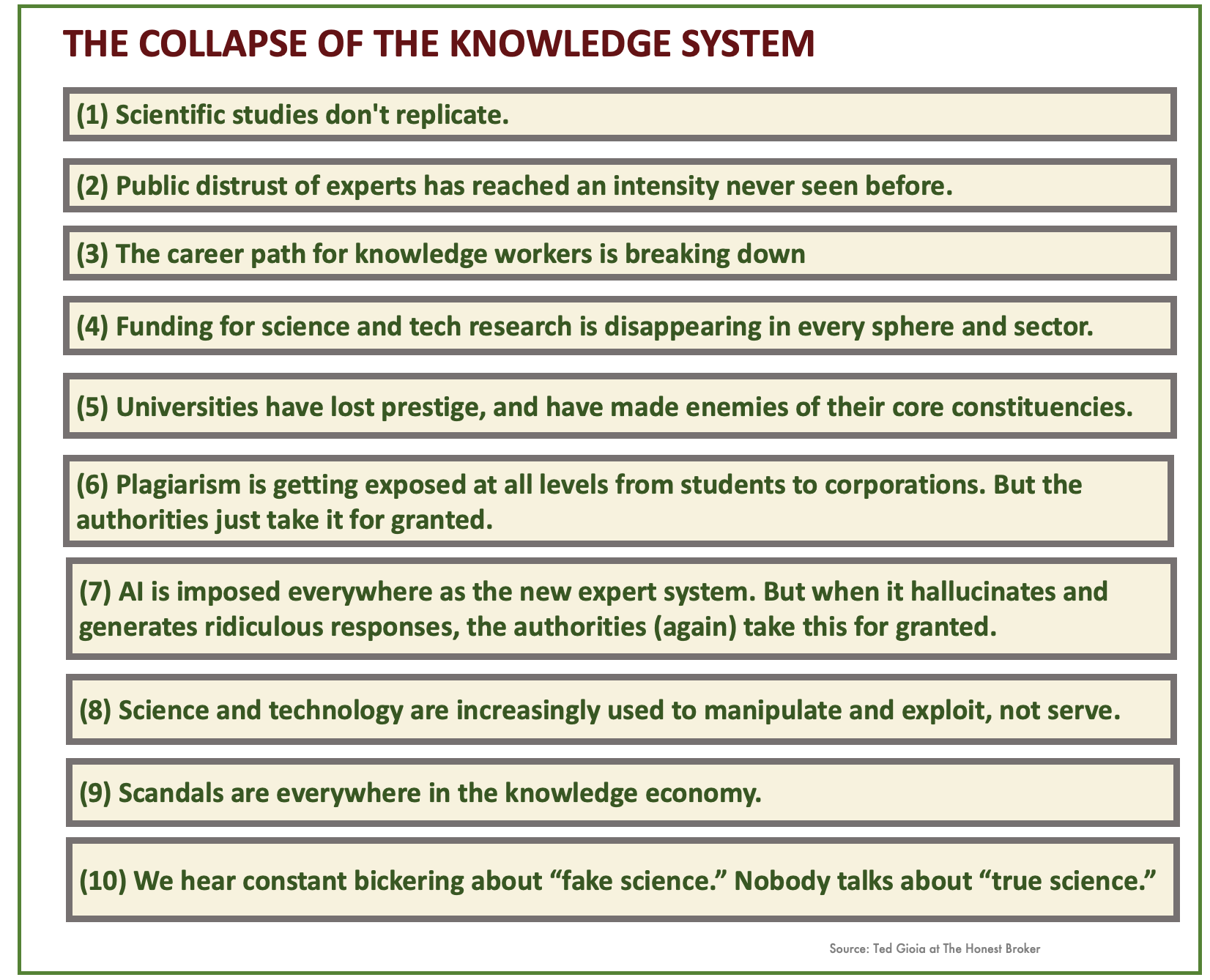
The ten warning signs
The Canadian Retribution at Normandy | History Traveler Episode 196
The History Underground
Published 16 Feb 2022Throughout the Battle of Normandy, the Canadians of the 3rd Infantry Division and the Germans of the 12th SS Panzer Division found themselves locked in a battle of attrition that would mark some of the most vicious fighting of the entire campaign. After suffering a blow at Buron and Authie (as seen in the last episode) the fight shifted over to a place that has now become legendary in Canadian military history: Bretteville-l’Orgueilleuse. In this episode, we’re joined by Paul Woodadge of @WW2TV to show a small part of one of the most epic fights in the battle to take Normandy.
(more…)
June 7, 2025
The US President Saves Germany – Rise of Hitler 18 – June 1931
World War Two
Published 5 Jun 2025In June 1931, Germany teeters on the edge of collapse — facing riots, unemployment, and a banking crisis. Amidst chaos and international pressure, US President Herbert Hoover offers a dramatic moratorium on war debts, giving Germany a critical lifeline. Can this American intervention stabilize the Weimar Republic, or is disaster still on the horizon? Explore how global politics, economic turmoil, and desperate diplomacy shape a nation’s fate.
(more…)


