
Forgotten Weapons
Published 19 Aug 2024After World War Two the Swiss needed a new self-loading military rifle to replace their K-31 bolt actions. Two major design tracks followed; one being a roller-delayed system based on the G3 at SIG and the other being a derivative of the German FG-42 at Waffenfabrik Bern. Bern, under the direction of Adolph Furrer, had been experimenting with intermediate cartridges since the 1920s, and they used this as a basis to develop an improved FG-42 using an intermediate cartridge (7.5x38mm). The program began in 1951 and went through about a half dozen major iterations until it ultimately lost to the SIG program (which produced the Stgw-57).
Today we are looking at one of the later steps in the Bern program, the WF-54. By this point the intermediate cartridge had been discarded in favor of using the standard Swiss GP11 (7.5x55mm). The overall design was a bit simplified as well. The Bern program would continue for two more years after this rifle before ultimately losing out to the SIG 510 for Swiss military adoption.
(more…)
July 9, 2025
WF-54: The Swiss FG-42 Scaled up to 7.5×55
QotD: “Look at those high cars roll”
Another New York Central president who rode The Century in preference to the fine business car No. 1 which was at his disposal was F.E. Williamson. […] he took pleasure in the same amenities of luxury travel as he shared with other Century regulars: cocktails in the club car, a breath of fresh air on the open observation platform that survived into his regime, The Century Dinner and a long night’s sleep as the train rolled tranquilly under the stars.
Once encountered on the observation platform by the author as The Century rocketed through the Indiana countryside to overtake and pass a long merchandise train doing a mere sixty on the adjacent track […]
“Look at those high cars roll”, he exclaimed, as we passed the head end of the swiftly moving freight. “There’s nothing so beautiful in the world as a money making train going places fast on a spring evening!”
Lucius Beebe, 20th Century, 1962.
July 8, 2025
Korea: War Without End by Richard Dannatt and Robert Lyman
Taylor Downing reviews the latest co-operative work between former British Chief of the General Staff Lord Dannatt and Dr. Robert Lyman:
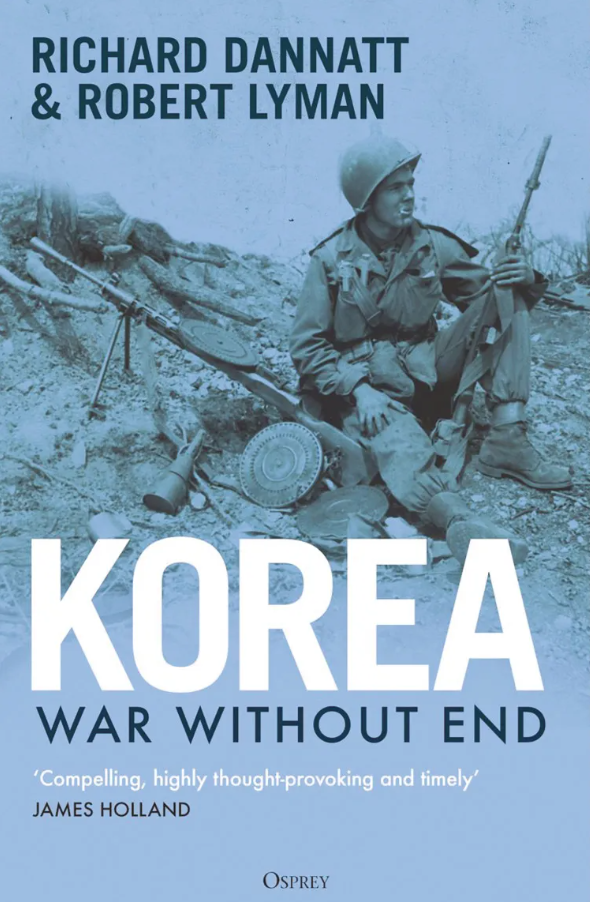
Their book has three premises. First, that the conflict in Korea is a forgotten one that very much deserves retelling. Second, that the war is very topical today partly because it shows how to fight (or not to fight) a conventional war in a nuclear age, and partly because it shows how politics must always take precedence over military ambition. And, third, the authors argue that the war was not a single conflict but was in fact two wars, quite separate but consecutive.
The “first” war is the story of the surprise invasion of South Korea by the North Korean People’s Army (NKPA), or the In Mun Gun, in June 1950 as their leader Kim Il Sung sought to reunite the Korean peninsula under Communist control without having any sense of the political response he would unleash. What followed was a rapid advance towards the southern city of Pusan in a form of Blitzkrieg that had not been seen since World War II.
This early phase covers the establishment of a US-led United Nations force for the first time in its history – only formed because the Soviet Union was boycotting the Security Council at the time. US troops finally slowed the NKPA advance and then, in a brilliant counterstroke masterminded by General Douglas MacArthur, an amphibious troop landing took place behind enemy lines at Inchon. This resulted in a complete reversal in the fortunes of the North Koreans and their retreat to pretty well their starting lines on the 38th Parallel that had divided the peninsula since 1945.
This, the authors argue, is where the war should have ended. The UN had achieved its aim of liberating the south from a Communist takeover. But instead a “second” war unfolded in which General MacArthur, convinced that he was fighting a crusade against world Communism, advanced rapidly through North Korea towards the Yalu River and the border with Communist or (as he called it) “Red” China. For him, victory had to include total defeat of the enemy. In scenes of remarkable hubris, MacArthur was convinced he had the war wrapped up and his troops would be home by Christmas. Instead, he provoked an attack by the Chinese People’s Volunteers on a massive scale, leading to the humiliating rout of US troops and a midwinter retreat back into southern Korea.
This “second” war had as its next phase the final standstill along lines roughly similar to the 38th Parallel and two years of stalemate, before an armistice was signed. The breakdown of the war into two separate conflicts is a fine way of interpreting the remarkable see-saw events of the first year of fighting. Seoul was captured and recaptured four times in nine months. Pyongyang was captured and lost, becoming the only Communist capital to have been taken in battle during the entire Cold War.
In the first stages of the conflict, UN troops, largely Americans who had been sent in from keeping the peace in Japan and who were entirely untrained and unprepared for combat, were thrown back so rapidly that many simply threw down their weapons and retreated. The NKPA, using the tactics the Japanese had used in their invasions of Malaya and Burma, completely outclassed the unprepared US forces.
Then, a few months later, the US-led advance made the Americans feel completely unstoppable as they headed north, only to be turned once more by the Chinese. Again, tactically outclassed and totally unprepared for mountain warfare in midwinter, where conditions were brutal, the UN forces collapsed. It is a remarkable story that very much merits the retelling.
QotD: Sixty years of intelligence service operations going sideways
There’s also another version of the Historian’s Fallacy in play with Intelligence work:
The historian’s fallacy is an informal fallacy that occurs when one assumes that decision makers of the past viewed events from the same perspective and having the same information as those subsequently analyzing the decision. It is not to be confused with presentism, a similar but distinct mode of historical analysis in which present-day ideas (such as moral standards) are projected into the past. The idea was first articulated by British literary critic Matthew Arnold in 1880 and later named and defined by American historian David Hackett Fischer in 1970.
Things that seem obvious in retrospect weren’t at the time. That’s the “formal” Historian’s Fallacy, if you like. But there’s another one, that we could call the “Narrative Fallacy” or the “Assumed Rationality Fallacy” or something (I stink at titles). Historians are, or at least should be, acutely sensitive to the danger of seeing patterns that aren’t really there (in a very real sense, “conspiracy theorists” e.g. McGowan are just Historians manqué. Coincidences are coincidental, and without training and practice and — crucially — an experienced hand to smack you upside the head for going farther than the available sources allow, it’s easy to run wild with them. So-and-So knew Joe Blow … yes, but that does not automatically mean that So-and-So conspired with Joe Blow).
Compounding it further: It’s indeed rational to assume rationality on your enemies’ part, so some catastrophic intelligence “failures” have come because analysts were unwilling to acknowledge that the enemy was, in fact, making a mistake. It’s a bit pricey, but I highly recommend James Wirtz’s The Tet Offensive: Intelligence Failure in War (here’s a preview page of a review at JSTOR, which points to a trade journal, American Intelligence Journal. Wirtz is a professor at the Naval Postgraduate School; I bet his book rattled a lot of cages that needed rattling). Breaking it out a bit further, and these categories are mine, not Wirtz’s:
In the case of Tet, there was top-level structural “failure” that hardly deserves the term “failure” — the NVA’s intelligence boys were no fools; they were bright guys doing their damnedest to put one over on the American intelligence crew, and they had some success at it. That’s only “failure” in the sense that in binary system, a win for them is a loss for you — you “failed” to win the game against a highly skilled, highly motivated opponent. The Americans didn’t fail to recognize that The Enemy Gets a Vote; they just didn’t realize how he’d voted.
But there was what I’ll call “Narrative” failure, and that’s all on the Americans. They seem to have decided that the North Vietnamese were not only losing the war, but knew themselves to be losing the war. So what the North Vietnamese saw as merely “the next phase of the plan”, the Americans saw as “increasing desperation”. Which led to other Narrative Failures. I might be misremembering the details, so check me on this, but I believe that the Americans were correct despite themselves about the attack on the big Marine base at Khe Sanh — it was indeed a diversion. But the Americans somehow concluded that it was a diversionary attack, specifically a “spoiling attack”, on something the NVA shouldn’t have known about in the first place — a top secret operation called “Muscle Shoals” (in Wiki under Operation Igloo White).
In reality, the Khe Sanh attack was a diversion against the main Tet operation, and it worked so well that it took a week or more, IIRC, for Westmoreland to come around. He insisted on interpreting the Tet “uprising” as yet a further diversion — a diversion in support of what he assumed was the main NVA operation, the attack on Khe Sanh!
Those are Narrative Failures. Twitter didn’t exist then, but we could nowadays profitably call them “Twitter Failures”. Whatcha gonna believe, your own lying eyes or the blue checkmarks in the Pocket Moloch?
All of which was aided and abetted by the third kind of failure, that “Assumed Rationality” failure. One CIA analyst, Joseph Hovey, not only predicted the Tet Offensive, but got large parts of it exactly right. But Hovey had a hard time believing his own analysis, because its central assumption was that the North Vietnamese were, in fact, making a mistake. The North Vietnamese did not, in fact, have the forces in place to do what they wanted to do. They were suffering a catastrophic Narrative Failure of their own, one endemic (it seems reasonable to say) to Communist regimes — since political officers are highly encouraged to submit exaggerated reports of unit strength and morale (and often lethally discouraged from reporting the opposite), the NVA thought they had far more, and far better prepared, forces than they actually did.
In an Alanis-level irony, US military intelligence had a better idea of the NVA’s strength than the boys in Hanoi did. (They confirmed this, in fact, when they nabbed a high-level NVA defector, who only “rallied” because the formation he was sent south to lead didn’t actually exist!). When faced with the possible conclusion that the Enemy is about to make a big mistake, it’s only rational to assume that something else is going on. Hovey knew that, of course, and that’s one of the main reasons his analysis went nowhere — being a conscientious professional, he noted at the outset that his analysis was premised on the NVA setting up to make a big mistake, which seemed extremely unlikely.
Given all that, if I had to guess, I’d bet that the KGB had a similar record, if the truth is ever known, because they had similar problems. They had a different, more systematic kind of Narrative Failure, I’d imagine — “Marxism-Leninism” vs. “bow-tied Ivy Leaguers running around cosplaying Lawrence of Indochina” — but it probably all washed out in the end. It’d be extremely interesting to hear about the Vietnam War from the KGB’s side …
Severian, “Friday Mailbag”, Founding Questions, 2023-04-15.
July 7, 2025
Why the Cold War Gave Us LEGO, Credit Cards, and Video Games – W2W 35
TimeGhost History
Published 6 Jul 2025Think the 1950s were all poodle skirts and jukeboxes? Think again! From the first credit cards and modems to LEGO bricks, video games, and even skateboards, discover the surprisingly futuristic side of the Cold War era.
In this episode of War to War by TimeGhost, Sparty dives into the forgotten innovations of the 1950s that still shape our daily lives in 2025.
Topics covered:
• The first commercial credit card (Diners Club)
• The birth of the computer modem
• The first microchip and the rise of computing
• “Tennis for Two” – the 1950s’ video game
• LEGO and the System of Play
• Skateboards before Marty McFlyThe 50s were WAY more high-tech than you think!
#1950s #coldwar #inventions #historyyoudidntknow #SkateboardHistory #lego #timeghost #techhistory #Modem #microchips #creditcard #videogames
(more…)
Augustus: Visionary Statesman or Destroyer Of The Republic?
The Rest Is History
Published 27 Jan 2025The Roman historian Suetonius’ The Lives of the Caesars, written during the early imperial period of the Roman Empire, is a seminal biography covering the biographies of the early emperors of Rome, during two spectacular centuries of Roman history. Delving deep into the personal lives of the Caesars and sparing no detail, no matter how prurient, pungent, explicit or salacious, it vividly captures Rome at the peak of her power, and those colourful individuals at the heart of everything. It is an unsettling yet fascinating portrait of the alien and the intimate, that sees some of history’s most famous characters revealed as almost modern men, plotting a delicate line between private and public, respectability and suspicion. From the showmanship of Augustus, the first Caesar, and his convoluted family melodramas, to Tiberius, a monster in the historical record famed for his sexual misdeeds, to Caligula, who delighted in voyeuristic moral degeneracy, and the looming shadow of Nero; all will be revealed …
00:00 A humble plug from Tom
02:55 The most spectacular two centuries in Roman history
05:25 The value of Suetonius as a biographer
08:43 Suetonius’ interest in the love lives of the Caesars
12:58 Suetonius’ influence on popular culture
16:15 Augustus: Rome’s greatest actor
21:25 Roman politics as spectacle
21:55 Augustus as the model of a good emperor
24:30 What kind of monarchy was this?
28:00 The life of Suetonius
35:52 How did Roman histories work?
39:04 Why Romans had no idea of privacy
40:05 Did Roman emperors sexual misdemeanours matter
42:08 How we see sexual relations different to the Romans
(more…)
July 6, 2025
Day Six – Breakout – Ten Days in Sedan
World War Two
Published 5 Jul 2025May 15 1940 — Ten Days in Sedan, continues as our WW2 Blitzkrieg documentary follows Germany’s drive through France. Today French 2nd Army chief Charles Huntziger faces a pivotal choice: try and contain the German bridgeheads at Sedan, where Heinz Guderian is trying desperately to breakout, or pivot south to shield the Maginot forts he still trusts. His choice may just decide the fate of France.
(more…)
Steyr-Solothurn S2-200: the Austrian MG30 and Hungarian 31M
Forgotten Weapons
Published 23 Sept 2024The S2-200 was developed by Louis Stange at the Rheinmetall company in Germany in the late 1920s. Because Germany was not allowed to be doing this sort of arms development at the time, Rheinmetall bought a controlling stake in the Swiss firm Solothurn AG, to make the product deniably Swiss. The gun itself is recoil operated, with a rotating locking collar connecting the bolt and barrel, rather like the Hotchkiss Portative. It was a design that had some early influence on the German MG34, although the German military declined to adopt it. Instead, it was taken into service in 8x56mm by both Austria (as the MG30) and Hungary (as the 31M). A third purchaser was El Salvador, which purchased 47 examples in 7x57mm caliber.
After the anschluss in 1938, the Austrian guns were integrated into the Wehrmacht, where they were primarily used by mountain troops. Hungary did later make a version in 7.92x57mm, designated the 43M.
(more…)
QotD: After the Bronze Age Collapse
But what surprised me most about After 1177 B.C. is how short this era was. In some places, anyway.
We have a vague picture of what happens after a civilizational collapse, but it’s been disproportionately influenced by two particularly dramatic examples: sub-Roman Britain and the Greek Dark Ages. This was perfectly sensible coming from the Anglo historians and archaeologists who have dominated the public conception of the field — after all, the only thing more interesting than the history of your own island is that of the classical world you’ve been studying since you got your first Latin grammar at age six — but it turns out that neither of these are the general rule. Foggy, faraway Britain, so reliant on imported goods and troops, was far more seriously impacted by the withdrawal of Rome than was most of the Empire and saw a longer and more significant reduction in cultural complexity, standards of living, average stature, and of course population. (Imagine what would happen to a Mars colony if the connections to the home planet stopped working.)
Greece after the fall of the Mycenaeans suffered an even more striking decline. As Austrian archaeologist Sigrid Deger-Jalkotzy summarizes:
The impressive palatial structures were not rebuilt, and very little of the representational arts and crafts of the palaces seems to have survived. The complex forms of political, social, and economic organization fell into oblivion. Palaces, kings, and royal families became matter for Greek myths. The art of writing was lost for centuries. In short, Greek civilization was reduced to the level of a prehistoric society.
The Greeks of the classical era had little conception that the Mycenaeans had even existed, let alone that they were their own ancestors: they retained a vague mythological tradition of past kings, but they attributed the few surviving Mycenaean structures to the work of cyclopes. In fact, the disconnect between the civilization of the Late Bronze Age and the later classical world was so great that until Michael Ventris deciphered Linear B, it was an open question whether the people responsible for the Lion Gate and the Treasury of Atreus were even Greeks at all. (The answer, in case you’re wondering, is yes: Linear B turns out to be a syllabic script for the most ancient attested form of Greek. It features a number of uniquely Greek words and deity names even in the limited surviving corpus. More recently, ancient DNA has confirmed the linguistic evidence: the classical Greeks were the descendants of the Mycenaeans.)1
But the more you look at the archaeological record, the more you can pick out signs of cultural continuity. Agricultural practices don’t seem to have changed much, nor did Mycenaean pottery styles, and the names and attributes of the gods preserved in Linear B are close if not identical to their forms as codified in Homer and Hesiod. Even the cyclopean architecture continued to provide shelter: the Mycenaean palace at Pylos was almost completely destroyed in the Collapse, but the few rooms that survived intact show signs of having been inhabited by squatters over the next century or two.
Homer too is chock full of details that turn out to be distant memories of the Mycenaean world, somehow preserved in the oral tradition until writing was reintroduced to Greece.2 For instance, he describes a kind of boar’s tusk helmet that, by his time, no one had worn for centuries, but which archaeologists have since regularly discovered in Mycenaean shaft graves throughout the Aegean. But my favorite example, which is of course linguistic, is the word for “king”: Homer describes Menelaus, Agamemnon, Odysseus and others with the word anax, which is recognizably the Linear B word 𐀷𐀙𐀏, wa-na-ka, used in the Bronze Age to describe the supreme rulers of the Mycenaean palatial societies. (The w sound was lost with the tragic death of the digamma.) By the classical era, however, anax had fallen out of use in preference for basileus (Linear B 𐀣𐀯𐀩𐀄, qa-si-re-u), which in the Mycenaean period had referred to a much lower-level chieftain.
This all paints an evocative picture of a post-apocalyptic world. You can imagine it transplanted to an American context, with the scattered survivors of some great cataclysm huddled around fires built in the corners of a crumbling Lincoln Memorial. You can picture them passing on stories of the great men of the past with their tall tube-shaped hats and the shiny black stones they carried in their pockets. And by the time this remnant rebuilt, they might well have forgotten the word “President” except as an archaism; after centuries of as a small-scale society, “Mayor” might become so deeply engrained as the highest title that two thousand years later they would still use it to refer to their emperor.
Jane Psmith, “REVIEW: After 1177 B.C., by Eric H. Cline”, Mr. and Mrs. Psmith’s Bookshelf, 2024-07-08.
1. It’s slightly more complicated than that, because of course it is; see here for more detail from Razib Khan.
2. A reasonable ballpark guess is that the poems traditionally attributed to Homer were composed in something like their current forms around 750 BC and written down for the first time shortly before 525 BC, although like the dating of Beowulf there’s a great deal of argument.
July 5, 2025
“This is what happens when a major label morphs into a copyright and IP management business”
Ted Gioia reads the tea leaves of the big music labels and says that the future does not look good. At all:
I follow music industry news the way other people read obituaries.
Those two kinds of articles have a lot in common — both death notices and music biz news deal mostly with the past. The only new thing in the story is that something was living, and now it ain’t.
Here’s an example from yesterday:
This sounds like a happy story, no? These smart people are investing in music.
But it isn’t a happy story. They are investing in the rights to old music. They won’t spend any of that money on new music.
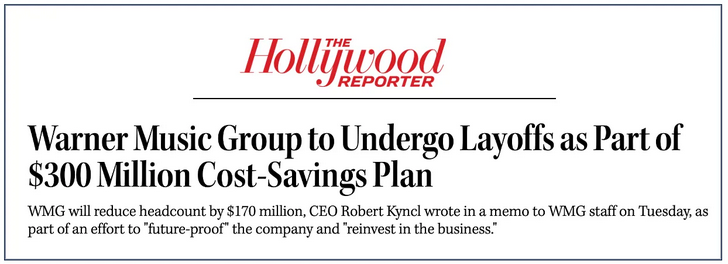
If you have any doubts about Warner’s priorities, here’s another headline — also from yesterday.
If you’re looking for a clear signal from a major record label, it won’t get any clearer than this.
This is exactly what a record label does when it no longer views music as a vital creative force in the current day. This is what happens when a major label morphs into a copyright and IP management business — which can be run by a small team of lawyers and accountants.
Yes, you can make money living off the past — but not for long.
I keep waiting to read a news story about a major label investing a billion dollars in developing new artists. But I never see that story.
I’ve written in the past about fans who prefer old music. But big record labels are even more obsessed with vintage and retro songs.
And it’s not just Warner Music. Universal Music is doing the same thing. So is Sony and Concord and other big labels.
That’s disturbing.
These are the same companies who should be creating the future of music. They should be convincing the public to listen to new songs and new artists. After all, if record labels don’t invest in the future of music, who will?
Maybe nobody.
A few years ago, investment firms started viewing old songs as investments. That didn’t work out very well. The most prominent song investment fund crashed and burned — as I predicted long in advance.
At that point, the smart money headed for the exits.
In the aftermath, the only enthusiastic buyers of old songs were the big record labels. They are the buyers of last resort.

Surviving a Medieval Winter
Tasting History with Max Miller
Published 4 Feb 2025Hearty wheat berry porridge thickened with egg yolks and tinted with saffron
City/Region: France
Time Period: c. 1300There was little in the way of fresh food during a medieval winter. Meat, if you could get it, was salted, brined, or smoked (or some combination of the three). During some particularly harsh winters in the beginning of the 1300s, rivers froze for months at a time, making it impossible for water-powered mills to grind wheat into flour.
At such a time, this hearty porridge would be just the ticket. Everyone ate frumenty during the Middle Ages, from royalty to peasants, though wealthier people would add expensive spices and sugar and serve it with venison.
This frumenty is made of whole wheat berries and is a rib-sticking, satisfying meal all by itself. The wheat berries retain some wonderful texture so that it’s not just a mush, and egg yolks add richness and flavor. It’s more flavorful than I thought it would be, but I’d add some cinnamon and sugar.
Formentee
Take wheat, prepare it, wash it very well, and cook it in water. When it is cooked, drain it. Take cow’s milk and bring it to a boil, add the wheat, and boil it again stirring frequently. Remove it from the fire, stir often, and add in plenty of beaten egg yolks, and it should not be too hot when they are added. Some people add spices, a little saffron and venison stock. It should be yellowish and quite thick.
— Le Viandier de Taillevent by Guillaume Tirel, c. 1300
QotD: Roman provinces under the Republic
While the Romans mostly improvise this system for just a handful of provinces – most of the basic patterns of Roman provincial governance develop in just the first four provinces1 – that system becomes the customary way Roman magistrates [consuls and praetors]and promagistrates [proconsuls and propraetors] handled the overseas provinces they were assigned to. Consequently, it was replicated over and over again through Rome’s steadily expanding empire. By the time the Republic collapses into the Empire, Rome will have not four provinces but fourteen; by the end of the reign of Augustus, as the Roman Empire largely took the borders it would mostly hold for the next four centuries, there were just under thirty provinces. Yet the way Rome will govern these provinces largely continued to hold to model established in the Republic, at least through to the Severan Dynasty (193-225 AD), if not further.
As a result, the improvised system the Romans developed for those first four provinces would end up being how the vast majority of people in the Roman empire would experience Roman governance.
Bret Devereaux, “Collections: How to Roman Republic 101, Addenda: The Provinces”, A Collection of Unmitigated Pedantry, 2023-11-03.
1. Sicily, Corsica et Sardinia, Nearer Spain and Further Spain, gained in the period from 241 to 197 and Rome’s only provinces until the addition of Macedonia in 147.
July 4, 2025
Everyone’s Mad About AI; Here’s What We Think
World War Two
Published 3 Jul 2025Is AI rewriting history? Indy, Anna, Sebastian, Sparty, and Iryna tackle some tricky questions about the future of history, our channels, and the world in general. We discuss our recent use of AI in the Rise of Hitler series, animating portraits, and the use of large language models in research. What risks and opportunities are there for TimeGhost in the future?
(more…)
July 4, 1826
The History Guy: History Deserves to Be Remembered
Published 4 Jul 2022On the fiftieth anniversary of the ratification of the Declaration of Independence, the US lost two of the men most responsible for its creation. Independence Day 1826 might be the most important since July 4, 1776.
(more…)
QotD: US-Canadian conflict before Confederation
The Aroostook War (1838–1839) drew no blood. The conflict concerned the Maine-New Brunswick border and was resolved amicably by the Webster-Ashburton Treaty of 1842. A quarter of a century later the Fenian Raids (1866–1871) saw the Irish-American Fenian Brotherhood make multiple non-state sanctioned attacks in British North America in an effort to sway Britain to withdraw forces from Ireland.
The other far more consequential military struggles between the two North American friends and neighbours occurred first in the late eighteenth century, and second in the early nineteenth century. During the American Revolutionary War (1775-1783), which saw limited involvement of areas north of the 49th parallel, British North America thwarted a particularly serious invasion by the Americans in 1775 known as The Battle of Quebec.
It was fought during a snowstorm on December 31, 1775 (one of few battles fought in such miserable conditions during the revolutionary war). The American intention was to conscript the British colony, which today forms the province of Quebec (and also included parts of Ontario) into their struggle against the British. The Patriots of the Thirteen Colonies had earlier that year begun rebelling against British taxation and governance. They surmised that the French-speaking Quebec settlers, disaffected with the imposition of British rule as it was laid out in the 1763 Treaty of Paris (which ended the Seven Years War), would join the American cause. A significant miscalculation, to say the least.
The battle was fought on two fronts against a British garrison of 1800 soldiers led by British commander, Governor Guy Carleton. The combined total of American troops was only 1200. The first front was commanded by Brigadier General Richard Montgomery, who led his troops in an attack of the Lower Town from the south. The second assault occurred from the north and was led by Colonel Benedict Arnold (who would later become an infamous American traitor).
Montgomery and several officers were killed instantly on their initial advance. This sparked a retreat amongst his remaining soldiers. Arnold had slightly more luck. His army penetrated northern defences but were stymied in the narrow streets of Quebec. During fighting Arnold was wounded, after which he handed the command to Daniel Morgan. After hours of fighting, Morgan and his men were forced to surrender. The Americans lost the battle decisively ensuring Quebec would remain a loyalist stronghold.
The second of the two significant conflicts involving British North America and the Thirteen American Colonies was the infamous War of 1812 – a more well-known period of antagonism between proto-Canada and her American neighbours.
Here is a topline summary with some extra history concerning the U.S.-Canada border (the world’s longest undefended border), from Terry Glavin:
The War of 1812 — which the Americans still pretend they won — was officially concluded with the Treaty of Ghent in 1814. Then came the Rush-Bagot Pact of 1817 and the Convention of 1818, which set the border at the 49th parallel.1
The War of 1812 took place during Britain’s struggle against Napoleonic France. The two most famous Canadian battles from this tragic conflict were the Battle of Queenston Heights and the burning of York (now Toronto) – British troops would even the score of the latter by burning Washington D.C.
The war was unpopular. Like today, there were too many bonds between the Americans and proto-Canadians. But also like today, with Canada and the United States once again bickering over trade and various political interests, the disagreements were accompanied by a reluctance to engage in hostilities.
From Pierre Burton’s War of 1812:
At the outset, it was a gentleman’s war. Officers on opposing sides met for parlays under flags of truce, offered hospitality, exchanged cordialities, murmured the hopes that hostilities would quickly end.2
No matter what time period we are examining, we can never forget that Britons, Canadians and Americans are all first cousins. Yes we disagree from time to time, sometimes we even fight. But always over some unfortunate political dispute, and never for each other’s annihilation.
In 1812, for a variety of reasons, the Americans, especially a minority of hawkish elites in Washington, felt they had no other choice but to invade the north. Some of them felt it would be easy. An aggravating factor concerned Britain’s support of Indian tribes in the north west, at a time when the Americans were aggressively expanding into that region. But also, during their imperial contest with France, the British were impressing sailors in the American navy (forcing them to join British forces), because they considered them traitors of the British crown. Further, they blocked key trade ports under Napoleon’s control, disrupting trade between America and France.
Isn’t it curious how trade so often appears as the rift in Canadian-American relations? Further examples include: the Reciprocity Treaty of 1854 which allowed for free trade of natural resources between the American and British colonies. However, the Americans abrogated that treaty in 1866 partly out of frustration at perceived British support of the confederacy after the Civil War. A post-confederation trade war with the Americans ensued after Canada’s first Prime Minister John A. MacDonald adopted the National Policy in 1879, which imposed high tariffs to protect Canadian industry. Triggering the Americans to respond with tariffs of their own.
James Pew, “Canadians and our ties to Americans”, Woke Watch Canada, 2025-03-30.
1. Because of the day that’s in it – by Terry Glavin
2. Pierre Berton’s War of 1812.


