
Quotulatiousness

August 18, 2012

Prog rock today: looking back on the future

Filed under: History, Media — Tags: , , , , — Nicholas @ 00:05

The final installment of Dave Weigel’s history of prog rock at Slate:

This is what fascinates me about prog. The music is relentlessly futurist, with no nostalgia for anything in rock. Was there excess? I think we’ve answered that — there was horrible excess, and some of it involved the lead singer from the Who singing atop a giant rubber penis. In the U.K., the music press turned on prog, and turned viciously. Same thing in the States. “If you can’t have real quality,” wrote Lester Bangs of ELP, “why not go for quantity on a Byzantine scale, why not be pompous if you’re successful at it?” Bangs, played by Philip Seymour Hoffman, made it into Cameron Crowe’s ‘70s nostalgia film Almost Famous. ELP did not.

[. . .]

Pop’s move away from prog didn’t happen that quickly. It was slow and tortured and involved a ton of moving parts breaking around the same time. In the United States, where most of this music ended up being sold, progressive rock radio slowly, slowly was assimilated into the Borg of commercial networking. “The reason free-form, underground progressive ended up becoming unpopular is it was the ultimate ‘active’ format,” says Donna Halper. “It was aimed at music freaks who adored everything about the newest groups and didn’t ever wanna hear a hit. OK, fine, that makes up about 6 percent of your audience. But the mass audience wanted a middle ground.” A&R men stopped looking for “progressive” acts. Sire stopped promoting Renaissance and started schlepping the Ramones. “You’d put an album out, but they were expecting to sell so many thousand,” says Davy O’List. “I don’t think it hurt the live concert attendances, but it hurt overall.”

Culturally and lyrically, prog began as anti-“establishment” music. But compositionally, it rewarded long listens and worship of virtuosity. Punk deconstructed that. [. . .]

Prog, went the thinking, was an affront against sincerity. If you gussied a song up with strings, surely you were covering for a lack of feeling. That point was made countless times, usually in the same terms with which Bangs dismissed ELP. The originators of prog were trying to make simple pop songs irrelevant. The music that replaced prog copied that reaction — what had gone before was corrupt, and had to be destroyed.

That sensibility lasted longer than most medieval land wars. The occasional mainstream defender of prog always, always started in defense mode. In June, this year, Ted Leo published a confessional in Spin all about his love for Rush. It was packaged as a “confessional” because Rush were proggy, and you couldn’t endorse prog qua prog.

[. . .]

Rush, who came late to the prog wave (1974), have trimmed back the pretention while flaunting the virtuosity. As a reward, they can still play stadiums, in basically any country. They just happen to be the most sellable artists in a niche genre. Virtuoso metal and math rock, bands like Mastodon and Protest the Hero, have nestled into the same place. That’s one fractal of modern-day prog.

August 17, 2012

The plight of Russian submariners

Filed under: History, Military, Russia — Tags: , , , , — Nicholas @ 08:36

An update from Strategy Page on how far the Russian nuclear submarine threat has diminished from its peak during the cold war:

Three years ago two Akulas were detected (by the U.S. Navy) off the east coast of the United States, in international waters. Russia admitted two of its Akula class boats were out there. This was the first time Russian subs had been off the North American coast in over a decade. This spotlights something the Russian admirals would rather not dwell on. The Russian Navy has not only shrunk since the end of the Cold War in 1991, but it has also become much less active. In the previous three years, only ten of their nuclear subs had gone to sea, on a combat patrol, each year. Most of the boats going to sea were SSNs, the minority were SSBNs (ballistic missile boats). There were often short range training missions, which often lasted a few days, or just a few hours.

The true measure of a fleet’s combat ability is the number of “combat patrols” or “deployments” in makes in a year and how long they are. In the U.S. Navy, most of these last from 2-6 months. Currently U.S. nuclear subs have carry out ten times as many patrols as their Russian counterparts. Russia is trying to catch up, but has a long way to go.

Russia has only 14 SSNs (nuclear attack subs) in service and eight of them are 7,000 ton, Akulas. These began building in the late 1980s and are roughly comparable to the American Los Angeles class. All of the earlier Russian SSNs are trash, and most have been decommissioned. There are also eight SSGN (nuclear subs carrying cruise missiles) and 20 diesel electric boats. There is a new class of SSGNs under construction, but progress has been slow.

[. . .]

The peak year for Russian nuclear sub patrols was 1984, when there were 230. That number rapidly declined until, in 2002, there were none. Since the late 1990s, the Russian navy has been hustling to try and reverse this decline. But the navy budget, despite recent increases, is not large enough to build new ships to replace the current Cold War era fleet that is falling apart. The rapid decline of Russia’s nuclear submarine fleet needed international help to safely decommission over a hundred obsolete, worn out, defective or broken down nuclear subs. This effort has been going on for over a decade, and was driven by the Russian threat to just sink their older nuclear subs in the Arctic Ocean. That might work with conventional ships, but there was an international uproar over what would happen with all those nuclear reactors sitting on the ocean floor forever. Russia generously offered to accept donations to fund a dismantling program that included safe disposal of the nuclear reactors.

Prog rock still has those who poke fun… via @daveweigel

Filed under: History, Humour, Media — Tags: , , , — Nicholas @ 00:13

Although I’ve been happily linking to the prog rock series of articles at Slate, not everyone thinks that progressive rock is great. Here’s an “ad” put together by @SlateV for prog’s greatest hits (H/T to Dave Weigel himself):

And here’s James Lileks from a few years back:

It’s obvious from Note One that everyone involved in the effort had so much THC in their system you could dry-cure their phlegm and get a buzz off the resin, but instead of having the loose happy ho-di-hi-dee-ho cheer of a Cab Calloway reefer number, the songs are soaked with Art and Importance and Meaning. You can imagine the band members sitting down to hash out (sorry) the overarching themes of the album, how it should like start with Total Chaos man because those are the times in which we live with like war from the sky, okay, and then we’ll have flutes because flutes are peaceful like doves and my old lady can play that part because she like studied flute, man, in high school. The lyrics are all the same: AND THE KING OF QUEENS SAID TO THE EARTH THE HEIROPHANT SHALL NOW GIVE BIRTH / THE HOODED PRIESTS IN CHAMBERED LAIRS LEERED DOWN UPON THE LADIES FAIR / NEWWWW DAAAAY DAWNNNING!

Weigel’s prog rock series: the excess goes critical

Filed under: Britain, History, Media — Tags: , , — Nicholas @ 00:04

Part four of Dave Weigel’s look at the rise and fall of progressive rock:

The order, Rick Wakeman remembers, was for chicken vindaloo, rice pilau, six papadums, bhindi bhaji, Bombay aloo, and a stuffed paratha. This was November 1973 and Yes had sold out the Manchester Free Trade Hall for a performance of Tales From Topographic Oceans. The album consisted of four songs that rolled gently together, over four sides of vinyl, for 83 minutes. “There were a couple of pieces where I hadn’t got much to do,” Wakeman would recall, “and it was all a bit dull.

During every show, a keyboard tech reclined underneath Wakeman’s Hammond organ, ready to fix broken hammers or ribbons and to “continually hand me my alcoholic beverages.” That night in Manchester, the tech asked the bored Wakeman what he wanted to eat after the show. Wakeman, the lone carnivore in Yes, ordered the curry. “Half the audience were in narcotic rapture on some far-off planet,” Wakeman wrote in his 2007 memoir, “and the other half were asleep, bored shitless.”

Wakeman kept on at the keyboards, adding gossamer organ melodies and ambient passages to the songs. And then, around 30 minutes later, his tech started handing up “little foil trays” of curry, and Wakeman began placing them on top of his keyboards. “I still didn’t have a lot to do,” he wrote, “so I thought I might as well tuck in.” The food was obscured by the instrument stacks, further obscured by Wakeman’s cape, but the aroma danced over to Yes’s lead singer, Jon Anderson. He took a good look at the culinary insult. Shrug. Papadum in hand, he returned to his microphone to sing his next part.

Tales From Topographic Oceans just might be the recorded ur-text of prog rock excess. No band had ever tried to fill each side of two LPs with long, multisection suites. Yes did it, and voila — a No. 1 album. They went on tour with a sci-fi lullaby backdrop, designed by their three-time album cover artist Roger Dean. He had seen the sort of enormous venues they’d booked, realized how hard it now was for faraway audiences to see the band, and so voila — phantasmagoric eye candy. Their set began with 82 minutes of new music before they played an old familiar tune. They played in their biggest-ever concert halls, and they sold them out.

But as the tour went on, Yes dropped the third section of the album from the show, then the second. Soon, Wakeman vented to reporters about the band’s screw-up. “Tales From Topographic Oceans is like a woman’s padded bra,” he told one interviewer. “The cover looks good but when you peel off the padding there’s not a lot there.” Yes had gotten too damn silly. The music had collapsed in on itself.

August 16, 2012

Weigel’s prog rock series: the excess creeps in

Filed under: Britain, History, Media — Tags: , , — Nicholas @ 08:32

The third entry in Dave Weigel’s excellent and informative history of progressive rock:

With more gigs came more pomp. Ian Dove, one of the New York Times’ rock writers, approached ELP’s December 1973 Garden shows the way a reporter might write about a fully loaded nuclear submarine. The gear — tell us about this gear. ELP had arrived in Manhattan, Dove wrote, with “over 200 separate items of equipment, valued by customs at just over $100,000.”

Among them:

  • “Thirteen keyboard units” for Keith Emerson, including a “brand new prototype Moog synthesizer.”
  • A $5,000 Persian rug, “for bass player Greg Lake to stand on while playing.”
  • A drum kit as complex as a painting by H.R. Giger — he’d designed the nightmare cover to ELP’s most recent album, Brain Salad Surgery — crafted in stainless steel, topped off by an “old church bell from the Stepney district of London,” surrounded by Chinese gongs. If a stage was equipped right, the kit could rotate 360 degrees while Carl Palmer pounded out the solos in “Tarkus.” Cost: $25,000.

Band members got a little tired of talking about all this. Lake showed up for a Rolling Stone interview in cheap jeans and pronounced touring “incredibly tiring.” The excess was the sacrifice the band made for you, the fan. “It is very hard to get something across to 10,000 people with just a piano, a bass, and a set of drums,” Emerson told the Times. “It works fine in smaller places and the recording studio. I always compose on the piano. But in the large arenas where we have to play, everything gets lost.”

Where we have to play — a magnificent early example of the humblebrag.

George Orwell, “the moral compass of the 20th century”

Filed under: Books, Britain, History, Media, WW2 — Tags: , , , — Nicholas @ 08:15

A review of Diaries by George Orwell in the Wilson Quarterly:

The early entries cover Orwell’s days as a tramp, a period that provided material for Down and Out in Paris and London (1933), and his subsequent investigation of poverty in the industrial north of England, from which he drew for The Road to Wigan Pier (1937). This volume’s lacuna is Orwell’s experience fighting the fascists during the Spanish Civil War. Plainclothes policemen in Barcelona seized the one or two diaries that recorded those events, and delivered the work to the Soviets. Though the writings likely remain in the archives of the former KGB, Orwell transformed them into literature as well, with the extraordinary memoir Homage to Catalonia (1938).

Of greatest interest are entries from the periods of Orwell’s life that he did not turn directly into books. His World War II diaries are the highlight. Although all of the entries feature Orwell’s direct prose style, there are occasional hints of the novelist at work: “Characteristic war-time sound, in winter: the musical tinkle of raindrops on your tin hat.” And there are ominous passages that reveal his unusually clear view of the awful century unfolding, such as this one from June 1940 that prefigured his 1945 novel Animal Farm:

Where I feel that people like us understand the situation better than so-called experts is not in any power to foretell specific events, but in the power to grasp what kind of world we are living in. At any rate I have known since about 1931 . . . that the future must be catastrophic. I could not say exactly what wars and revolutions would happen, but they never surprised me when they came. Since 1934 I have known war between England and Germany was coming, and since 1936 I have known it with complete certainty. . . . Similarly such horrors as the Russian purges never surprised me, because I had always felt that — not exactly that, but something like that — was implicit in Bolshevik rule. I could feel it in their literature.

August 15, 2012

Dave Weigel on the rise of prog rock

Filed under: Britain, History, Media — Tags: , , — Nicholas @ 10:44

The second installment in Dave Weigel’s informative history of progressive rock:

That keyboardists were suddenly rock gods represented the sea change that progressive music brought to the rock ‘n’ roll scene of the 1970s. The pop song was out. The prog epic was in. We laugh now at the foolhardiness of these 20-minute rock operas, but at the time they felt revolutionary — like the future of music, arrived all at once in the form of a wall of keyboards and a Moog organ. Small A&R teams went on treasure digs for progressive music. Labels like Charisma, Immediate, Harvest, and Sire signed bands that never intended to record three-minute singles. And the labels could sign them because the tours and the LPs sold. Rick Wakeman could write a thematic micro-opera about the Knights of the Round Table, and sell 10 million copies. In 14 months, Jethro Tull recorded not one but two albums that consisted of single, 40-minute songs. And they both went platinum.

Who was listening to this music? Hippies. Teenagers. Fans who were sure there was something more out there. People who wanted to drop acid and have their pupils bombarded by lasers. Arty types who wanted to find meaning in music, and who — rather than searching for it in short pop songs based on American blues — found it in the quirky Britishness of prog, equal parts twee and subversive.

The musicians, and the audiences, had grown up with rock. They took it seriously. But they didn’t feel constrained. They were more interested in personalizing or stretching the forms passed down to them. Everybody loved the Beatles, but they loved them best when they got weird. “The Beatles,” said guitarist and producer Robert Fripp, “achieve probably better than anyone the ability to make you tap your foot first time round, dig the words sixth time round, and get into the guitar slowly panning the twentieth time.”

This was supposed to be rebellious music. The Louis XVI of the time was the standard pop song structure — creative kryptonite. In a 1974 feature on Yes for Let It Rock magazine, David Laing explained that the “basic impetus was a justified discontent with the limitations of the pre-Pepper pop approach — the glorification of image, the three-minute single, the pressure towards repetition of the already successful formula.” Rejecting the three-minute single in favor of the suite meant rejecting the “establishment” in every way. “It was felt after Sgt. Pepper anybody could do anything in music,” said Yes/King Crimson drummer Bill Bruford in a 1994 interview. “It seemed the wilder the idea musically the better.”

Canadian liberty, 1776-2012

Filed under: Cancon, History, Liberty, USA — Tags: , , , , — Nicholas @ 09:32

F.H. Buckley has an interesting article in the National Post, comparing the American and Canadian “flavours” of liberty from the American Revolution down to today:

The Fathers of Confederation had seen the American constitution close up and didn’t want any part of it. They didn’t foresee just how we’d turn out. Overall, however, our good fortune would not have surprised them, for they knew that they were founding a free country.

On reading the Confederation debates, one is struck by how the Fathers insisted that we had real liberty in Canada, more so even than Americans. That comes as a bit of a shock, as we had thought that Americans had property rights in liberty. They owned it, and on occasion were kind enough to try to export it to lesser countries, as they did 200 years ago in the War of 1812 (where they came in a very strong second).

[. . .]

When McGee and the other Fathers looked south, they saw a country with more of Constant’s liberty of the ancients but less of the liberty of the moderns. Moreover, of the former, the right of self-government had been corrupted by political machines and trivialized by elections for dogcatchers. The high ideals of the American Founders had been forgotten, and their republican virtue was now, in the era of Boss Tweed and Jay Gould, little more than American braggadocio. As for the liberty of the moderns, there was that little matter of slavery and its aftermath. True, Americans could express themselves through lynch-parties, but that was the kind of liberty the Canadians did not want.

Many of the differences between the two countries remain, but Canadians no longer have more of the liberty of the moderns than Americans. In both countries, benign neglect has been replaced by the bureaucrat’s officious nudges, giving us ugly light bulbs, toilets that don’t flush and idiotic playground rules. Could one have predicted this 25 years ago? I think not. Back then I had legal scholar Cass Sunstein over for dinner. Until a few days ago he was Obama’s regulatory czar, and over dinner in 1987 he predicted how the regulatory state would expand, in the name of risk reduction. “Americans won’t stand for this,” my wife told him. They prize their freedom too much. “Ah, but we’ll change their preferences,” he replied. And he was right.

The birth of Prog Rock

Filed under: History, Media — Tags: , , — Nicholas @ 00:14

Shameful confession time: I’m a long-time fan of prog rock. I suspect I’m not completely alone, as Dave Weigel wouldn’t have put this article together if there weren’t more than a tiny number of us fans still alive:

By 1967, Emerson was touring with the Jimi Hendrix Experience and Pink Floyd, and composing the first long classical-rock symphony. By 1970, he was one-third of a super-group that could sell out Madison Square Garden and summon 350,000 people to the Ontario (California) Speedway, possibly the biggest single concert of the 1970s.

And by 1977, Keith Emerson was, to critics and a new generation of fans, the wince-inducing icon of progressive rock. Prog. And prog, thanks to the heroic efforts of the culture-gatekeepers, was deader than Elvis locked in King Tut’s sarcophagus and spit out of an airlock.

You can’t completely kill an art form. Even if a musical genre becomes despised, it endures — on master tapes, on cut-out LPs, on Spotify or MP3-trade fora. Simon Reynolds describes how the “massive, super-available archive” gifted to us by the Internet allows anyone to rediscover anything, and pop music to gnaw its own tail. Hip-hop artists, our cultural magpies, comb through prog’s greatest hits to sample its stranger riffs and lost organ bleats. Modern, prog-influenced acts like Dream Theater and Porcupine Tree can sell out midsized venues.

But if ever a form of popular music dropped dead suddenly, it was prog. Progressive rock essentially disappeared, and has remained in obscurity for 35 years, ridiculed by rock snobs, ignored by fans, its most famous artists — Yes, King Crimson, ELP, Jethro Tull — catchphrases for pretentious excess.

August 12, 2012

The (long awaited) growth in Indian manufacturing

Filed under: Business, Germany, History, India, Technology — Tags: , , , , , — Nicholas @ 08:59

The Economist on the relatively slow development of India’s manufacturing sector:

If India is to become “the next China” — a manufacturing powerhouse — it is taking its time about it. “We have to industrialise India, and as rapidly as possible,” said the country’s first prime minister, Jawaharlal Nehru, in 1951. Politicians have tried everything since, including Soviet-style planning. But India seems to prefer growing crops and selling services to making things you can drop on your foot.

Manufacturing is still just 15% of output (see chart), far below Asian norms. India needs a big manufacturing base. No major country has grown rich without one and nothing else is likely to absorb the labour of the 250m youngsters set to reach working age in the next 15 years. But it can seem a remote prospect. In July power cuts plunged an area in which over 600m people live into darkness, reminding investors that India’s infrastructure is not wholly reliable. And workers boiled over at a car factory run by Maruti Suzuki. Almost 100 people were injured and the plant was torched. The charred body of a human-resources chief was found in the ashes.

Yet not all is farce and tragedy. Take Pune in west India, a booming industrial hub that has won the steely hearts of Germany’s car firms. Inside a $700m Volkswagen plant on the city’s outskirts, laser-wielding robots test car frames’ dimensions and a giant conveyor belt slips by, with sprung-wood surfaces to protect workers’ knees. It is “probably the cheapest factory we have worldwide”, says John Chacko, VW’s boss in India. In time it could become an export hub. Nearby, in the distance it takes a Polo to get to 60mph, is a plant owned by Mercedes-Benz.

The initial demand for a domestic manufacturing base was more political than economic: it would serve to reinforce the newly won independence of India by showing that India could make its own goods rather than importing from the UK or other major manufacturing nations. It was also economic, in that it would provide relatively high-paying jobs for India’s rapidly urbanizing population.

Ironically, now that the manufacturing sector seems to be on the upswing, the one thing it isn’t going to do for India is provide lots and lots of jobs: as with the rest of the world, manufacturing “things” is being done with fewer workers every year (even when the total output increases, fewer workers are needed to produce that output).

August 8, 2012

Sometimes simulation isn’t close enough to reality

Filed under: History, Military, Technology, Weapons, WW1 — Tags: , — Nicholas @ 08:06

The military depends on accurate simulations to train troops, to develop new weapons, and to find ways to counteract military developments in potential enemy forces. It’s obvious that the quality of your simulation is very important, but sometimes the assumptions made in those simulations are quite at odds with the reality they’re supposed to be mimicking:

Increasingly, over the last half century, there has been a culture clash among weapons developers over how to test the new stuff. The problem revolves around the question of what is the most realistic reality. Put another way, how do you go about providing really accurate testing of what the new weapon will do when encountering a real opponent.

The problem is an ancient one, but let us keep the examples less than a century old. At the start of World War I in 1914 there were two types of artillery shells. One was high explosive. The other, more expensive to build and theoretically more effective, was shrapnel. This type was like a shotgun shell. It exploded in the air and sprayed the ground below with metal balls. Tests had shown that these balls would penetrate wood boards set up to represent troops. Because of the expense, less than half the shells used were shrapnel. The need for more artillery shells and the high cost of shrapnel shell led to it being largely replaced by the less effective high-explosive.

Later came a startling revelation. In the 1930s a group of American technicians were setting up some shrapnel shells for a test and one shell exploded prematurely, peppering some of the people with the “lethal” metal balls. They all survived. Further investigation revealed that human skin, muscle and bone were far more resistant to the metal balls than wood boards. World War I combat surgeons, when questioned, remembered that they had never seen a penetration wound caused by shrapnel balls. There has never been much official note made of this very humane weapon during, or after war.

August 6, 2012

Admiral Fisher: an excitable sort of man

Filed under: Britain, Germany, History, Humour, WW1 — Tags: , , , — Nicholas @ 10:41

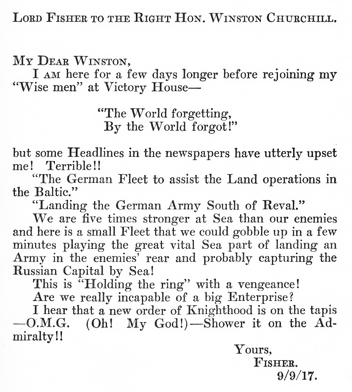
Admiral “Jackie” Fisher was a major historical figure in the Royal Navy, advocate of the modern dreadnought battleship and a tad high-strung (“…and on one occasion, the king asked him to stop shaking his fist in his face”). His relationship with Winston Churchill at the Admiralty must have been something to observe, as two of the most influential men in London worked together (for a while). After leaving the Admiralty for the last time, he still kept in touch with Churchill. Here is an example of his communication style:

This is believed to be the first documented use of the now familiar “OMG”.

H/T to Shaun Usher.

August 5, 2012

Raoul Wallenberg remembered

Filed under: Europe, Germany, History, Russia, WW2 — Tags: , , , , — Nicholas @ 11:05

Yesterday was what would have been Raoul Wallenberg’s 100th birthday. It was observed in Sweden:

Sweden on Saturday commemorated the life of a diplomat credited with saving thousands of Hungarian Jews from the Nazis in World War II, but whose fate remains one of the country’s greatest war-time mysteries.

Crowds gathered in the town of Sigtuna, 50 kilometers (30 miles) north of Stockholm to celebrate the centennial of the birth of Raoul Wallenberg, whose defiance of the Nazis has been commemorated worldwide in statues, streets names, and on postage stamps.

Wallenberg served as Sweden’s envoy in Budapest from July 1944 — where he saved the lives of at least 20,000 Jews by giving them Swedish travel documents, the so-called “shutzpass,” or moving them to safe houses. He is also credited with dissuading German officers from massacring the 70,000 inhabitants of the city’s ghetto.

But, in January 1945, the young Swede was arrested by the Soviet Red Army on leaving Budapest to go to the eastern part of the country, and suddenly disappeared.

The Soviets initially denied they had detained him, but later said he had died of a heart attack in prison on July 17, 1947.

Angers still pushing for compensation for Plantagenet murder in 1499

Filed under: Britain, Europe, France, History, Law — Tags: , , — Nicholas @ 10:22

I mentioned this amusing little issue last month. The city of Angers is still trying to get the British crown jewels as compensation for Henry VII’s judicial murder of the last legitimate male Plantagenet claimant to the English throne. Lowering The Bar has more:

What’s the connection between these French people and the English throne? It looks like the first connection that mattered was between Matilda, the daughter of King Henry I, and Geoffrey of Anjou (the county in which Angers was located). Their oldest son became Henry II of England in 1154. After 331 years of exciting adventures, the ruling line ended with Richard III, who was killed in battle by the forces of Henry Tudor (Henry VII). (Since history is written by the victors, Richard III now appears in plays as a murderous hunchback and the Tudors got their own miniseries on Showtime.)

But Angers doesn’t appear to care about any of those guys (especially the hunchback), only about Edward, Earl of Warwick. He had a claim to the throne (he was Richard III’s nephew, or something), but was only 10 in 1485, and judging from this portrait was so poor that he could not even afford to be drawn from the neck down. But Henry threw him in the Tower of London anyway and kept him there until he was old enough to kill, basically, which happened in 1499. He was the last legitimate male Plantagenet.

Angers is sponsoring a petition drive about this 513-year-old outrage and will send the official results to Queen Elizabeth II (House of Windsor) in September. This will coincidentally coincide with Angers’s annual cultural festival. A spokesperson for the city admitted that the petition “had little chance of success” (the original crown jewels were done away with by Oliver Cromwell anyway), but said that the crime against the Plantagenets was worth remembering. According to the report, he also “encouraged British people to visit Angers, which has medieval buildings including a magnificent castle which recalls the glory days of the Plantagenets.”

A quixotic quest to rehabilitate the reputation of Richard Nixon

Filed under: History, Media, Politics, USA — Tags: , , , , , , — Nicholas @ 00:07

President Richard Nixon’s reputation could hardly be any worse: he’s seen as the most evil president if not of all time, certainly of the 20th century. Conrad Black attempts to correct the record:

Forty years after Watergate, as the agreed demonology of that drama begins to unravel and the chief authors of it, Bob Woodward and Carl Bernstein, struggle to keep the conventional wisdom about it intact as an article of righteous liberal faith, a factual review is timely. When Richard Nixon was inaugurated president in 1969, the United States had 550,000 draftees in Indochina with no plausible explanation or constitutionally legitimate reason for them to be there and 200 to 400 of them were coming back every week in body bags. President Lyndon Johnson had offered Ho Chi Minh deferred victory in his Manila proposal of October 1966: withdrawal of all foreign forces from South Vietnam. Ho could have taken the offer and returned six months after the Americans had left, saved his countrymen at least 500,000 combat dead, and lived to see a communist Saigon. He chose to not even give LBJ a decent interval for defeat and insisted on militarily humiliating the United States.

In January 1969, there were no U.S. relations with China, no arms control talks in progress with the U.S.S.R., no peace process in the Middle East, there were race or anti-war riots almost every week all over the United States, and the country had been shaken by the assassinations of Martin Luther King and Robert Kennedy (both in their early 40s). LBJ could not go anywhere in the country without demonstrations, as students occupied universities and the whole country was in tumult.

Four years later, Nixon had withdrawn from Vietnam, preserving a non-communist South Vietnam, which had defeated the North Vietnamese and Viet Cong in April 1972 with no American ground support, though heavy air support. He had negotiated and signed the greatest arms control agreement in world history with the Soviet Union, founded the Environmental Protection Agency, ended school segregation and avoided the court-ordered, Democratic Party-approved nightmare of busing children all around metropolitan areas for racial balance, and there were no riots, demonstrations, assassinations or university occupations. He started the Middle East peace process, reduced the crime rate and ended conscription. For all of these reasons, he was re-elected by the greatest plurality in American history, 18 million votes, and a percentage of the vote (60.7) equalled only by Lyndon Johnson in 1964 and Franklin D. Roosevelt in 1936. His term was rivalled only by Lincoln’s and FDR’s first and third terms as the most successful in U.S. history.

« Newer PostsOlder Posts »

Powered by WordPress

