Quotulatiousness

January 27, 2014

The not-so-humble torpedo and the genesis of the military-industrial complex

Filed under: History, Military, Technology, USA, Weapons, WW1 — Tags: , , — Nicholas @ 10:18

In the Boston Globe, Katherine C. Epstein makes a strong case for the origin of the military-industrial complex not being the era that President Eisenhower warned about, but actually in the run-up to the First World War:

The phrase [Eisenhower] popularized to describe the emerging system — the “military-industrial complex” — has since become a watchword, and Eisenhower’s account of its rise has struck most observers as accurate: It was a product of an immense war effort and the new attitudes spawned in the aftermath.

But what if Eisenhower — and others — had the origin story wrong? Although the military-industrial complex unquestionably became far larger and more deeply entrenched as a result of World War II and the Cold War, a closer reading of the history suggests that its essential dynamics were actually decades older. An armaments industry in close collaboration with the military — coping with global and national arms markets, sophisticated technology, intense geopolitical rivalries, and a government prone to expand its power in the name of national security — had its roots in the way geopolitics, industrialization, and globalization collided at the turn of the 20th century. And one key innovation that helped to tip the United States over into the national security regime that we recognize today was, of all things, the torpedo.

The torpedo didn’t just threaten to change naval warfare. It was a sophisticated new weapon so important to the US Navy that it forced the government to form a novel relationship with industry — and to introduce the trump card of national security as a rationale for demanding secrecy from private companies. The policy that developed along with the torpedo set the terms for the efforts to control information in the name of national security that we’re seeing now. To appreciate just how far back that policy runs — back to a time not of war, but of peace — gives us a new lens on our current struggles over the military-industrial complex, and perhaps a different reason to worry.

January 24, 2014

QotD: Antiques

Filed under: History, Humour, Quotations — Tags: , — Nicholas @ 15:06

… they must have had very fair notions of the artistic and the beautiful, our great-great-grandfathers. Why, all our art treasures of to-day are only the dug-up commonplaces of three or four hundred years ago. I wonder if there is real intrinsic beauty in the old soup-plates, beer-mugs, and candle-snuffers that we prize so now, or if it is only the halo of age glowing around them that gives them their charms in our eyes. The “old blue” that we hang about our walls as ornaments were the common every-day household utensils of a few centuries ago; and the pink shepherds and the yellow shepherdesses that we hand round now for all our friends to gush over, and pretend they understand, were the unvalued mantel-ornaments that the mother of the eighteenth century would have given the baby to suck when he cried.

Will it be the same in the future? Will the prized treasures of to-day always be the cheap trifles of the day before? Will rows of our willow-pattern dinner-plates be ranged above the chimneypieces of the great in the years 2000 and odd? Will the white cups with the gold rim and the beautiful gold flower inside (species unknown), that our Sarah Janes now break in sheer light-heartedness of spirit, be carefully mended, and stood upon a bracket, and dusted only by the lady of the house?

Jerome K. Jerome, Three Men in a Boat (to say nothing of the dog), 1889.

January 23, 2014

Investigating the “Grand Slam” of 1945

Filed under: Britain, History, Military, Weapons, WW2 — Tags: , — Nicholas @ 09:48

In the Independent, David Keys talks about the Grand Slam, the largest conventional bomb of WW2:

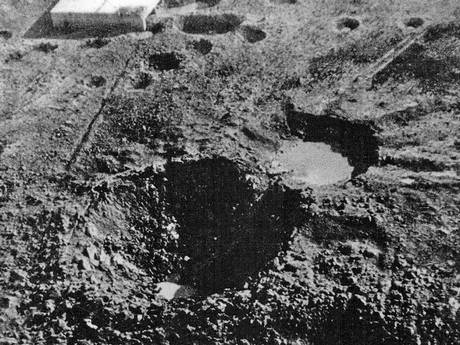
The 70 ft deep and 130 ft diameter crater which Grand Slam created in the New Forest on 13 March 1945 - with the target building in the background (Crown Copyright)

The 70 ft deep and 130 ft diameter crater which Grand Slam created in the New Forest on 13 March 1945 – with the target building in the background (Crown Copyright)

The final secrets of Britain’s largest-ever conventional weapon of war are being ‘unearthed’ by archaeologists.

Geophysics experts are using ground-penetrating radar and other high tech methods to ‘x-ray’ the ground, in a remote area of the New Forest in Hampshire, to shed new light on the most powerful top secret World War Two weapon test ever carried out in the UK.

The weapon – a bomb designed by the British aircraft and munitions inventor, Barnes Wallis, and codenamed ‘Grand Slam’ – was almost 26 foot long and weighed 22,000 pounds, substantially bigger than any other wartime explosive device ever developed by Britain.

The New Forest test is historically important because it heralded an expansion in the crucial strategic air offensive against key infrastructure targets in Nazi Germany. The first RAF bomber command Grand Slam sortie got underway within hours of the successful test of the bomb.

Four geophysical techniques – ground penetrating radar, magnetometry, electrical resistivity and electrical resistivity tomography – are being used by the archaeologists to assess the damage done to the large concrete target building which has lain buried under a vast mound of earth for the past 66 years.

January 22, 2014

Fifty years later – The making of Zulu (1964)

Filed under: Africa, Britain, History, Media — Tags: , , — Nicholas @ 14:05

Published on 20 Dec 2012

……and snappeth the spear in sunder.
Short film detailing how this great film was made.
With contributions from Lady Ellen Baker, James Booth, Glynn Edwards and others.

Update: Zulu was primarily the story of the defence of Rorke’s Drift by B Company of the 24th Regiment under temporary command of Royal Engineer Lieutenant John Chard (who was senior to Lieutenant Bromhead of the 24th). Less well-known is the larger battle of Isandlwana which happened earlier the same day, where Zulu forces defeated a much larger British force. This show investigates the site of the battle, discussing some of the reasons why the battle was quickly forgotten, as one of the worst British defeats of the Victorian era:

Published on 8 Sep 2013

We are all familiar with the famous story of a handful of British redcoats fending off thousands of Zulu warriors, made famous by the film starring Michael Caine, but this did well to mask another battle just a few miles away where 1,300 British were slaughtered by the natives in just two and a half hours. This fascinating programme looks at what went wrong for the British Empire builders on that fateful day.

January 21, 2014

George Orwell – confessed pamphlet addict

Filed under: Britain, History, Media, Politics — Tags: , , , — Nicholas @ 11:22

The British Library has posted an interesting short item on their Untold lives blog about George Orwell’s pamphlet collection:

George Orwell’s collection of mostly political ephemera was an important barometer of the social changes of the 1930s and 1940s, and a measure of his influences during those decades. While Orwell’s personal papers went to University College London and the National Archives, his miscellaneous materials are held by the British Library. Totalling over 2700 items, a full inventory of Orwell’s collection of pamphlets is now available via the British Library’s website.

Orwell was not a writer of ‘bestselling’ books until the end of his life, after the Second World War. He became known as a journalist, a critic of other people’s writings and a word-portraitist of the landscape of politics. It is likely he never passed up the opportunity to acquire pamphlets of any persuasion. He wryly observed in The Tribune that the pamphleteer’s road was paved by a “complete disregard for fairness or accuracy” (8 December 1944). Perhaps the most appealing aspect of his pamphlets collection is that he wasn’t Hoovering them up to form a George Orwell Archive; he considered them as a spectrum of thought that was deserving of preserving.

[…]

Orwell’s heaps of pamphlets informed his writing, both fiction and non fiction. He took pride in his squirrelling-away of pamphlets, “political, religious and what-not”. In 1949, he estimated that this hoard numbered 1200-2000, but even the higher figure was an underestimation. He wrote that “a few of them must be great rarities” and they were “bound to be of historical interest in 50 years time.” In line with most of his considerations, he wasn’t wrong.

What The Three Musketeers owes to real history

Filed under: Books, Europe, France, History, Media — Tags: , — Nicholas @ 07:56

Boyd Tonkin discusses some of the real historical incidents that Alexandre Dumas drew upon for his fiction:

In September 1784, an unpleasant incident took place at M. Nicolet’s fashionable theatre in Paris. A young, aristocratic man-about-town, born in the French colony of Saint-Domingue (now Haiti), had escorted to the play an elegant lady whose family also came from the West Indies. Dashing, handsome, the son of Count Davy de la Pailleterie might have seemed the ideal squire for the evening. Save, in many eyes, for one thing. He was black — notably dark-skinned, the mixed-race youth had a slave mother — and his companion white.

At Nicolet’s, a white West Indian officer, Jean-Pierre Titon de Saint-Lamain, decided that it would be good fun to insult the count’s black son. First, he pretended to mistake the young man of colour for the lady’s lackey. Then, after an affray, Titon’s henchmen forced the victim to kneel in front of his assailant and ask for pardon. Soon the police arrived and took both men into custody. Statements were taken, but no further action followed. In 1786, the humiliated colonial boy forsook his life of leisure to embark on a military career. He enrolled in the Queen’s Dragoons under a surname not his father’s. Instead, he chose the identity of his slave-born mother: Marie-Cessette Dumas.

[…]

By the early 1850s, this Alexandre Dumas had become not only the famous novelist but, arguably, the most famous Frenchman in the world. At this point, garlanded with international fame and quickly spent riches, he wrote his memoirs. Dumas the novelist adored and hero-worshipped his father, who had died in 1806 but left indelible memories. The first 200 pages of My Memoirs deal with General Alex; in fact, Dumas abandons the narrative of his own life at the age of 31. But in his version of the contretemps at Nicolet’s, the strapping young Alex picks up Titon and chucks him into the orchestra pit. This is a feat of derring-do worthy of… well, worthy of a musketeer.

[…]

Dumas relished his life, and the privileges and pleasures that his mythic tales earned. He made and lost fortunes as quickly as he wrote bulky novels. He meddled in revolutionary politics first in France and then in rebellious Italy (where he founded a paper called The Independent). He ran through perhaps 40 mistresses and sired (at least) seven children with them. His published works comprise 300 volumes and 100,000 pages. After packing around five lives into one, he died after a stroke in 1870 — the same year as Charles Dickens, whose A Tale of Two Cities pays its own tribute to the style of the comrade with whom he dined in Paris. If living well is the best revenge, then Alexandre made the bigoted society which had tried to humble General Alex kneel to him.

H/T to Jessica Brisbane for the link.

Update, 4 February: A.A. Nofi reviews The Black Count: Glory, Revolution, Betrayal, and the Real Count of Monte Cristo, by Tom Reiss.

Reiss […] fits Dumas into his times and his social environment. So we get a look at the brutalities of slavery and racism under the Ancien Régime and later during the supposedly enlightened French Republic. We see the dying days of the Bourbon monarchy, the Revolution that finished it off, and the rise of Bonaparte’s empire, which brought things part way back to their start again. Reiss also gives us little portraits of many individuals; the general’s family, of course, but also soldiers and rulers such as Carnot, Kleber, the Neapolitan and French royals, Lafayette, and others, including Bonaparte, who would become Dumas’ nemesis. Finally, Reiss looks at how the count’s life shaped that of his son and influenced the latter’s novels, noting traces of the senior Dumas in some of the younger’s characters, notably Edmund Dantes of The Count of Monte Cristo.

The book has some flaws. Reiss betrays a certain over-fondness for Revolutionary France, failing to see its dark side. He neglects the corruption of French officials, both at home and in occupied territories, the widespread plundering of supposedly “liberated” peoples, the slaughter of dissidents, and the widespread atrocities committed by French troops, which often sparked resistance from the very people the Revolution claimed to be liberating. There are, however, flaws common in treatments of the era, and Reiss is commendably more critical of Napoleon, who also tends to get a favorable press.

The Black Count, which was awarded the 2013 Pulitzer Prize in biography, is an excellent work, well-crafted, with a flowing narrative that makes for an easy read.

January 20, 2014

Addressing commonly held beliefs about the First World War

Filed under: Britain, Europe, Germany, History, Military, WW1 — Tags: , , , — Nicholas @ 08:37

BBC News Magazine has an article by Dan Snow discussing some commonly held beliefs about the First World War:

3. Men lived in the trenches for years on end

Front-line trenches could be a terribly hostile place to live. Often wet, cold and exposed to the enemy, units would quickly lose their morale if they spent too much time in them.

As a result, the British army rotated men in and out continuously. Between battles, a unit spent perhaps 10 days a month in the trench system, and of those, rarely more than three days right up on the front line. It was not unusual to be out of the line for a month.

During moments of crisis, such as big offensives, the British could occasionally spend up to seven days on the front line but were far more often rotated out after just a day or two.

4. The upper class got off lightly

Although the great majority of casualties in WW1 were from the working class, the social and political elite was hit disproportionately hard by WW1. Their sons provided the junior officers whose job it was to lead the way over the top and expose themselves to the greatest danger as an example to their men.

Some 12% of the British army’s ordinary soldiers were killed during the war, compared with 17% of its officers. Eton alone lost more than 1,000 former pupils – 20% of those who served. UK wartime Prime Minister Herbert Asquith lost a son, while future Prime Minister Andrew Bonar Law lost two. Anthony Eden lost two brothers, another brother of his was terribly wounded and an uncle was captured.

[…]

7. Tactics on the Western Front remained unchanged despite repeated failure

Never have tactics and technology changed so radically in four years of fighting. It was a time of extraordinary innovation. In 1914 generals on horseback galloped across battlefields as men in cloth caps charged the enemy without the necessary covering fire. Both sides were overwhelmingly armed with rifles. Four years later, steel-helmeted combat teams dashed forward protected by a curtain of artillery shells.

They were now armed with flame throwers, portable machine-guns and grenades fired from rifles. Above, planes, that in 1914 would have appeared unimaginably sophisticated, duelled in the skies, some carrying experimental wireless radio sets, reporting real-time reconnaissance.

Huge artillery pieces fired with pinpoint accuracy — using only aerial photos and maths they could score a hit on the first shot. Tanks had gone from the drawing board to the battlefield in just two years, also changing war forever.

January 18, 2014

British army unit diaries from WW1 now online

Filed under: Britain, Cancon, France, History, Military, WW1 — Tags: , , — Nicholas @ 12:07

Rather than the diaries of individual soldiers (as the original title of the video suggests), these are the formal day-to-day action records of battalions and regiments of the British army. A proportion of the diaries from the First World War have been digitized and are available on the internet:

Published on 15 Jan 2014

Diaries describing life during the First World War by British soldiers have been digitised and can be read online.

As part of the organisations centenary programme the National Archives is publishing the first batch of unit diaries from France and Flanders.

One soldier from the 4th Division, 1 Battalion Somerset Light Infantry in 1917 describes one occasion of gunfire: “The Germans quickly got their artillery into position, and a considerable amount of shelling was experienced. Our casualties in this engagement were slight.”

Another entry by Captain CJ Paterson, one of the First Battalion’s soldiers describes the horrendous reality of life in the trenches:

“As I say all should be nice and peaceful and pretty. What it actually is is beyond description.

“Trenches, bits of equipment, clothing (probably blood-stained), ammunition, tools, caps, etc., etc., everywhere.

“Poor fellows shot dead are lying in all directions. Some of ours.”

“Everywhere the same hard, grim, pitiless sign of battle and war. I have had a belly full of it.”

Maria Miller, Culture Secretary, Maria Miller, said: “The National Archives’ digitised First World War unit diaries will allow us to hear the voices of those that sacrificed their lives and is even more poignant now there are no living veterans who can speak directly about the events of the war. This new online vehicle gives a very public voice to some of these soldiers, through which we will be able to hear their thoughts and feelings.”

You can read the online war diaries on the National Archive website here: www.nationalarchives.gov.uk/first-world-­war

Records for the Canadian Corps (which fought as part of the British army) are in the process of being digitized, according to the Library and Archives Canada website.

War diaries are a day-to-day description of unit activities for army units in active service, and contain information about unit location and the military operations in which it may be involved. The diaries rarely mention individuals by name, with the exception of some references to officers.

[…]

War diaries for the Army in the First World War (RG 9 IIID3) are being digitized and can be viewed online by using the Advanced Archives Search. Records not yet digitized are available on microfilm.

  • Select Finding Aid Number in the pull down menu, and enter: 9-52
  • Enter a keyword, for example, the unit name or battalion number: “102nd” or “Royal Canadian Dragoons”

How “safe” is your safe?

Filed under: History, Military — Tags: , , , — Nicholas @ 10:44

Safe manufacturers generally ship their products with a factory-standard combination. Many people fail to change them once the safe is in use:

In England many years ago, chatting with a locksmith while he worked, I learned the following thing: One of the country’s leading manufacturers of safes shipped all its products set to a default opening combination of 102030, and a high proportion of customers never reset it.

He: “If I need to open a Chubb safe, it’s the first thing I try. You’d be surprised how often it works.”

This came to mind when I was reading the story about Kennedy-era launch codes for our nuclear missiles:

    …The Strategic Air Command greatly resented [Defense Secretary Robert] McNamara’s presence and almost as soon as he left, the code to launch the missile’s [sic], all 50 of them, was set to 00000000.

I use a random-string generator for my passwords and change them often. I guess safeguarding my Netflix account is more important than preventing a nuclear holocaust.

QotD: Belief

Filed under: History, Quotations, Religion — Tags: , , , — Nicholas @ 09:59

Why do so many people believe in a god? Dennett’s Breaking the Spell is an attempt to examine that question, for Christian fundamentalists, Islamic teachers, Buddhist monks, atheists, and others. He begins by pointing to the commonality of pre-scientific answers in groups of people: “How do thunderstorms happen?” answered by “It must be someone up there with a giant hammer” (our example, not his). Then, probably after a minimum of discussion, a name such as “Thor” becomes agreed. Having successfully sorted out thunderstorms, in the sense that you now have an agreed answer to why they happen, other forces of nature are similarly identified and named. Soon you have a pantheon, a community of gods to blame everything on. It’s very satisfying when everyone around you agrees, so the pantheon soon becomes the accepted wisdom, and few question it. In some cultures, few dare to question it, because there are penalties if you do.

Terry Pratchett, Ian Stewart, & Jack Cohen, “Disbelief System”, The Science of Discworld IV: Judgement Day, 2013.

January 15, 2014

QotD: Early 20th century American imperialism

Filed under: Americas, History, Military, USA — Tags: , , , — Nicholas @ 00:02

I spent thirty-three years and four months in active military service as a member of this country’s most agile military force, the Marine Corps. I served in all commissioned ranks from Second Lieutenant to Major-General. And during that period, I spent most of my time being a high class muscle-man for Big Business, for Wall Street and for the Bankers. In short, I was a racketeer, a gangster for capitalism.

I suspected I was just part of a racket at the time. Now I am sure of it. Like all the members of the military profession, I never had a thought of my own until I left the service. My mental faculties remained in suspended animation while I obeyed the orders of higher-ups. This is typical with everyone in the military service.

I helped make Mexico and especially Tampico safe for American oil interests in 1914. I helped make Haiti and Cuba a decent place for the National City Bank boys to collect revenues in. I helped in the raping of half a dozen Central American republics for the benefit of Wall Street. I helped purify Nicaragua for the International Banking House of Brown Brothers in 1902-1912. I brought light to the Dominican Republic for the American sugar interests in 1916. I helped make Honduras right for the American fruit companies in 1903. In China in 1927 I helped see to it that Standard Oil went on its way unmolested.

Looking back on it, I might have given Al Capone a few hints. The best he could do was to operate his racket in three districts. I operated on three continents.

Major General Smedley Darlington Butler, USMC (1881–1940), War is a racket, 1935.

January 12, 2014

Obscure old German book from 1925 becomes surprise e-book hit

Filed under: Books, Europe, Germany, History, Media, Politics — Tags: , , , — Nicholas @ 00:01

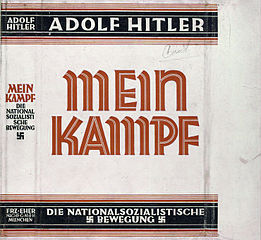
Dust jacket of 1926–1927 edition

Dust jacket of 1926–1927 edition

Sales of printed copies of Mein Kampf have been declining for years, but the e-book version is disturbingly popular:

Adolf Hitler’s Mein Kampf has quietly become an e-book bestseller, climbing high on the charts of political books on Apple’s iTunes and Amazon’s Kindle, even as print sales of the 1925 anti-Semitic screed continue to languish.

Mein Kampf hasn’t made the New York Times‘ nonfiction chart since its U.S. release in 1939, the same year Germany invaded Poland, and its print sales have fallen steadily ever since,” Chris Faraone wrote for the website Vocativ. “But with a flood of new e-book editions, Hitler’s notorious memoir just clocked a banner digital year.”

Two different digital versions of Mein Kampf currently rank third and fourth on the Politics & Current Events on iBooks, outpacing books by modern-day conservative pundits and celebrities such as Sarah Palin, Charles Krauthammer and Glenn Beck. The books sell for 99 cents and $2.99 respectively.

On Amazon, the Kindle version of Mein Kampf ranks No. 1 in the category of Propaganda and Political Philosophy.

Odd how the LA Times‘ instinct is to compare the sales of Mein Kampf with books by American conservatives, rather than works by, say, Marx, Mao, or Mussolini. You know, comparable theorists of totalitarian power (oh, wait…that is how the Times views Palin, Krauthammer, and Beck).

In a post from 2010, Reason TV looks at the power of Nazi Propaganda:

From radio and film to newspapers and publishing, the Nazi regime controlled every aspect of German culture from 1933-1945. Through Josef Goebbels’ Ministry of Public Enlightenment and Propaganda, the German state tightly controlled political messaging, promoting deification of the leader—the Führerprinzip—and the demonization of the ubiquitous and duplicitious “racial enemy.” A new exhibit at the United States Holocaust Memorial Museum in Washington, D.C., examines “how the Nazi Party used modern techniques as well as new technologies and carefully crafted messages to sway millions with its vision for a new Germany.” Reason.tv’s Michael C. Moynihan visited with museum historian and curator Steve Luckert to discuss the role and effectiveness of propaganda in the rise of fascism and what lessons can be drawn from the Nazi experiment in mass manipulation.

January 10, 2014

US analysis of captured German U-boats after WW2

Filed under: Germany, History, Military, WW2 — Tags: , — Nicholas @ 08:12

Tony Zbaraschuk posted an interesting link to the Lois McMaster Bujold Mailing list (http://lists.herald.co.uk/cgi-bin/mailman/listinfo/lois-bujold):

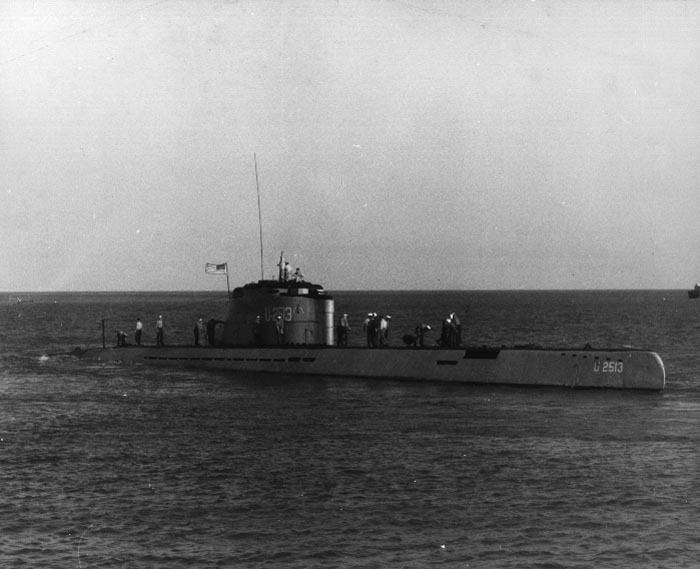
Design Studies of German Submarines by the US Navy

The Design Study of Type IXC U-boats was made available by Scott Sorenson. The Design Study of Type XXI U-boats was made available by the Portsmouth Naval Shipyard Public Affairs Office and the Navy Yard Museum — in particular Debora White, Gary Hildreth, Jim Dolf and Bill Tebo (a member of the US Navy crew of U-2513).

Photographs and documents of surrendered German submarines and their crews were made available by John Cunningham (a member of the US Navy crew of U-2513).

U-2513 off Key West, Florida - 30 October 1946

U-2513 off Key West, Florida — 30 October 1946

QotD: Teddy Roosevelt

Filed under: Books, History, Quotations, USA, WW1 — Tags: , , , — Nicholas @ 08:02

In the face of such acute military imbecility it is not surprising to discover that all of the existing biographies of the late Colonel Roosevelt — and they have been rolling off the presses at a dizzy rate since his death — are feeble, inaccurate, ignorant and preposterous. I have read, I suppose, at least ten of these tomes during the past year or so, and in all of them I have found vastly more gush than sense. Lawrence Abbott’s Impressions of Theodore Roosevelt and William Roscoe Thayer’s Theodore Roosevelt may well serve as specimens. Abbott’s book is the composition, not of an unbiased student of the man, but of a sort of groom of the hero. He is so extremely eager to prove that Roosevelt was the perfect right-thinker, according to the transient definitions of right-thinking, that he manages to get a flavor of dubiousness into his whole chronicle. I find myself doubting him even when I know that he is honest and suspect that he is right. As for Thayer, all he offers is a hasty and hollow pot-boiler — such a work as might have been well within the talents of, say, the late Murat Halstead or the editor of the New York Times. This Thayer has been heavily praised of late as the Leading American Biographer, and one constantly hears that some new university has made him Legum Doctor, or that he has been awarded a medal by this or that learned society, or that the post has brought him a new ribbon from some literary potentate in foreign parts. If, in fact, he is actually the cock of the walk in biography, then all I have said against American biographers is too mild and mellow. What one finds in his book is simply the third-rate correctness of a Boston colonial. Consider, for example, his frequent discussions of the war — a necessity in any work on Roosevelt. […]

Obviously, Roosevelt’s reaction to the war must occupy a large part of any adequate biography of him, for that reaction was probably more comprehensively typical of the man than any other business of his life. It displayed not only his whole stock of political principles, but also his whole stock of political tricks. It plumbed, on the one hand, the depths of his sagacity, and on the other hand the depths of his insincerity.

Fundamentally, I am convinced, he was quite out of sympathy with, and even quite unable to comprehend the body of doctrine upon which the Allies, and later the United States, based their case. To him it must have seemed insane when it was not hypocritical, and hypocritical when it was not insane. His instincts were profoundly against a new loosing of democratic fustian upon the world; he believed in strongly centralized states, founded upon power and devoted to enterprises far transcending mere internal government; he was an imperialist of the type of Cecil Rhodes, Treitschke and Delcasse. But the fortunes of domestic politics jockeyed him into the position of standing as the spokesman of an almost exactly contrary philosophy. The visible enemy before him was Wilson. What he wanted as a politician was something that he could get only by wresting it from Wilson, and Wilson was too cunning to yield it without making a tremendous fight, chiefly by chicane — whooping for peace while preparing for war, playing mob fear against mob fear, concealing all his genuine motives and desires beneath clouds of chautauqual rhetoric, leading a mad dance whose tune changed at every swing. Here was an opponent that more than once puzzled Roosevelt, and in the end flatly dismayed him. Here was a mob-master with a technique infinitely more subtle and effective than his own. So lured into an unequal combat, the Rough Rider got bogged in absurdities so immense that only the democratic anaesthesia to absurdity saved him. To make any progress at all he was forced into fighting against his own side. He passed from the scene bawling piteously for a cause that, at bottom, it is impossible to imagine him believing in, and in terms of a philosophy that was as foreign to his true faith as it was to the faith of Wilson. In the whole affair there was a colossal irony. Both contestants were intrinsically frauds.

H.L. Mencken, “Roosevelt: An Autopsy”, Prejudices, Second Series, 1920.

January 7, 2014

“Boomer Classic” and “Boomer Reboot”

Filed under: History, Media, USA — Tags: , , , , , — Nicholas @ 09:45

Chronologically speaking, I’m a late Baby Boomer, but I’ve never felt I was a Boomer culturally. In the New York Times, Richard Pérez-Peña helps to explain why this is:

This year the youngest of the baby boomers — the youngest, mind you — turn 50. I hit that milestone a few months back. But we aren’t what people usually have in mind when they talk about boomers. They mean the early boomers, the postwar cohort, most of them now in their 60s — not us later boomers, labeled “Generation Jones” by the writer Jonathan Pontell.

The boom generation really has two distinct halves, which in my mind I call Boomer Classic and Boomer Reboot. (Take this quiz to see where you stand.) The differences between them have to do, not surprisingly, with sex, drugs and rock ‘n’ roll — and economics and war. For a wide-ranging set of attitudes and cultural references, it matters whether you were a child in the 1940s and ‘50s, or in the 1960s and ‘70s. And it probably matters even more whether you reached adulthood before or after the early ‘70s, a time of head-spinning changes with long-term consequences for families, careers and even survival.

[…]

Late boomers like me had none of that — no war, no draft, no defining political cause, and most of our fathers were too young for World War II. I remember, as a teenager, seeing old footage of the riots outside the 1968 Democratic convention in Chicago, and thinking, “People my age don’t feel that strongly about anything.”

People raised in the immediate postwar years had more faith in their government, and an idealistic view of America that curdled in the ‘60s and ‘70s. My childhood memories of the evening news, on the other hand, include the war, protests, Watergate and the dour faces of Johnson and Nixon, not the grins of Truman, Eisenhower and Kennedy.

In this way, I think we late boomers have more in common with the jaded Generation X that followed: we had less idealism to spoil. No, I don’t remember where I was when Kennedy was killed and innocence died (I was an infant), but I sure remember where I was when Nixon resigned and cynicism reigned. Older boomers may have wanted to change the world; most of my peers just wanted to change the channel.

H/T to Kathy Shaidle for the link.

« Newer PostsOlder Posts »

Powered by WordPress