Quotulatiousness

January 7, 2014

The “politicization” debate about the First World War

Filed under: Britain, Education, History, Media, Politics, WW1 — Tags: , — Nicholas @ 08:54

In sp!ked, Frank Furedi says that the row in Britain over the centennial of the start of World War 1 isn’t really about the war at all:

Somehow, the First World War has come alive. Suddenly, everyone in Britain seems to have strong views about its causes, meaning and the way it is taught in schools and represented by the entertainment industry.

Boris Johnson, the Conservative mayor of London, is certain that the Germans started the war. Michael Gove, the Conservative secretary of state for education, concurs, insisting that the ‘ruthless social Darwinism of the German elites’ and their ‘aggressively expansionist war aims’ made ‘resistance more than justified’. Gove, who believes Britain fought a ‘just war’ back in 1914, has denounced ‘left-wing academics’ and cynical TV shows like Blackadder for mocking Britain’s role in the conflict.

The Labour Opposition has dutifully done what it always does — attack Gove. Labour’s shadow education secretary, Tristram Hunt, said in response to Gove that ‘few imagined that the Conservatives would be this crass’. He also reminded his opposite number that the left played an honourable role in the Great War. Labour activist Sir Tony Robinson, who played Baldrick in Blackadder, also joined the fray, accusing Gove of ‘slagging off teachers’.

This looks and sounds like a debate about the past — but actually, its main drivers are contemporary conflicts over cultural values and political opinions.

Hunt claims Gove is using history for political ends. No doubt he is right. However, Hunt himself, and other Labour-supporting critics of Gove, fail to acknowledge their own complicity in the politicisation of the current debate on the meaning of the First World War. When they depict Gove’s attack on media cynicism about the war as just another example of him ‘slagging off teachers’, what they’re really doing is continuing today’s education debate under the guise of talking about the past.
January 6, 2014

Austria, the “laboratory of the Apocalypse”

Filed under: Europe, History, WW1 — Tags: — Nicholas @ 09:25

Bethany Bell in Vienna writes about Austria just before the start of the war in 1914:

Across the road, a crowd had gathered outside a large, late 19th Century building. I walked over to have a look. It was the Embassy of what was then still Yugoslavia. An official had just pinned to the door two notices about the war that was, at that time, raging in Bosnia. Two men in front of me were talking about the siege of Sarajevo.

I shivered. History suddenly seemed very close.

A few months ago, a Viennese friend frowned as he stirred his coffee. We were sitting in Cafe Griensteidl, in the centre of town.

I’d just told him that, even after 15 years of living here, I’m still haunted by Vienna as it was just before the outbreak of World War One, before the defeat that led to the collapse of the rotting Austro-Hungarian Empire.

“But don’t lots of periods of history feel close in Vienna?” he asked. “You’ve got Mozart and the Baroque, you’ve got the 19th Century and the Ringstrasse, you’ve even got the Flak towers of the World War Two… Why not focus on them?”

I looked around at the cafe with its marble-topped tables and high white ceiling. Among the visitors and tourists, I recognised several senior Austrian civil servants, a couple of foreign diplomats and one of the country’s most distinguished historians.

“It’s partly the idea of cafe society,” I said lightly. “Just think who might have been sitting here back then!”

At the end of the 19th Century, Cafe Griensteidl was at the heart of Vienna’s dazzling intellectual life, patronised by people such as Arnold Schoenberg and Theodore Herzl. Sigmund Freud is thought to have preferred the nearby Cafe Landtmann.

“Ah, you have bought into the romance of fin-de-siecle Vienna!” he exclaimed. “You know that it was encouraged by some of Austria’s leaders after 1945. They wanted people to look back at a period of history they could be proud of — not like World War Two.”

He looked up at the Jugendstil mirror above our table.

“Even this cafe isn’t really genuine,” he said. “The original Griensteidl shut down in 1897 — this place was re-opened in the 1990s.”

“You know better than me that lots of traditions and places have survived,” I replied. “It’s not all fake — just look over there,” and I pointed through the window at the bank opposite. Built by the Modernist architect Adolf Loos, around 1910, the building had caused a scandal because of its severe lack of decoration.

“I think what haunts me is something a bit different,” I said.

“It’s the thought that this exquisite, civilised place didn’t seem to be able to stop its own collapse — and that it unleashed so many destructive ideas and people that tore Europe — and the 20th Century apart.”

The writer Karl Kraus had a phrase for it. In his obituary for Franz Ferdinand, he called Austria the laboratory of the Apocalypse.

My friend smiled wryly. “Ah, yes,” he said, “the Viennese, dancing towards destruction.”

Boris Johnson – Germany started the war

Filed under: Europe, Germany, History, WW1 — Tags: — Nicholas @ 08:29

In the Telegraph Boris Johnson is exasperated by recent comments that try to obscure or minimize the German role in starting the First World War:

It is a sad but undeniable fact that the First World War — in all its murderous horror — was overwhelmingly the result of German expansionism and aggression. That is a truism that has recently been restated by Max Hastings, in an excellent book, and that has been echoed by Michael Gove, the Education Secretary. I believe that analysis to be basically correct, and that it is all the more important, in this centenary year, that we remember it.

That fact is, alas, not one that the modern Labour Party believes it is polite to mention. According to the party’s education spokesman, Tristram Hunt, it is “crass” and “ugly” to say any such thing. It was “shocking”, he said in an article in yesterday’s Observer, that we continued to have this unacceptable focus on a “militaristic Germany bent on warmongering and imperial aggression”.

He went on — in a piece that deserves a Nobel prize for Tripe — to mount what appeared to be a kind of cock-eyed exculpation of the Kaiser and his generals. He pointed the finger, mystifyingly, at the Serbs. He blamed the Russians. He blamed the Turks for failing to keep the Ottoman empire together, and at one stage he suggested that we were too hard on the bellicose Junker class. He claimed that “modern scholarship” now believes that we have “underplayed the internal opposition to the Kaiser’s ideas within the German establishment” — as if that made things any better.

[…]

Hunt is guilty of talking total twaddle, but beneath his mushy-minded blether about “multiple histories” there is what he imagines is a kindly instinct. These wars were utterly horrific for the Germans as well as for everyone else, and the Germans today are very much our friends. He doesn’t want the 1914 commemorations to pander to xenophobia, or nationalism, or Kraut-bashing; and I am totally with him on that.

We all want to think of the Germans as they are today — a wonderful, peaceful, democratic country; one of our most important global friends and partners; a country with stunning technological attainments; a place of incomparable cultural richness and civilisation. What Hunt fails to understand — in his fastidious Lefty obfuscation of the truth — is that he is insulting the immense spiritual achievement of modern Germany.

The Germans are as they are today because they have been frank with themselves, and because over the past 60 years they have been agonisingly thorough in acknowledging the horror of what they did. They don’t try to brush it aside. They don’t blame the Serbs for the 1914-18 war. They don’t blame the Russians or the Turks. They know the price they paid for the militarism of the 20th century.

January 5, 2014

In the dictionary, the word “narcissism” is defined as “baby boomer default mental state”

Filed under: History, Media, USA — Tags: , , , , , — Nicholas @ 11:22

Okay, it isn’t really (but if you think it is, you’ve probably fallen for the “gullible isn’t in the dictionary” prank as well). In the Wall Street Journal, Terry Teachout discovers that every defining event of the Baby Boom era always comes back to being about the Baby Boomers themselves:

Most “Monty Python” fans are, of course, baby boomers, who have long been a nostalgic lot and are growing more so as they totter toward old age. Witness their tiresomely obsessive fascination with the popular television series of their youth. Likewise their undimmed passion for the rock music of the 1960s and ’70s, which they still love so much that they’ll buy expensive tickets to see wrinkled old codgers play it onstage.

As always with the boomers, this nostalgia contains more than a touch of narcissism. The same narcissism was on display in many of the countless gushy boomer-penned reminiscences occasioned by the 50th anniversary of the Kennedy assassination. An indisputably major historical event, to be sure, but there was also something decidedly creepy about the self-centered tone of those suddenly-my-world-changed pieces, which was deftly skewered by this Onion headline: “Area Man Can Remember Exactly Where He Was, What He Was Doing When He Assassinated John F. Kennedy.” Like everything else in the boomers’ world, Kennedy’s death turned out in the end to have been all about them.

[…]

Not surprisingly, my parents’ generation did everything they could to make life easier for their own children. Was that good for us? I wonder. It certainly didn’t do us any good from a cultural point of view. I’m struck by how few boomers have embraced adult culture in middle age. My impression is that they’d much rather watch sitcoms than read novels, go to the opera or listen to jazz. In large part they’re a cohort of Peter Pans, determined not to grow up any more than they can help. Indeed, not a few of them seem to take a perverse kind of pride in their adolescent enthusiasms. I read the other day that a “Fat Albert and the Cosby Kids” lunch box from 1973 now sells for $1,200 — and that the Smithsonian Institution’s National Museum of American History owns one. I’m not quite sure which of those facts makes me sadder.

If I live long enough, I’ll enjoy finding out how the millennials remember the world of their youth a quarter-century from now. Since they’re having a much harder time earning a living than did their baby-boom parents, I wouldn’t be at all surprised if their attitude ends up being much more like that of the wised-up kids of the Great Depression, especially as regards cultural matters. While I don’t know whether they’ll go in for late Beethoven by the time they reach their 50s, somehow I doubt that watching an ancient episode of “30 Rock” will cause them to recall with fondness the good old bad old days when they were living in crummy studio apartments — or their parents’ basements.

Infamous Edinburgh bodysnatchers’ final five victims?

Filed under: Britain, History — Tags: , , — Nicholas @ 10:36

If you’ve ever visited Edinburgh, you’ll probably have heard about the sinister pairing of Burke and Hare, the bodysnatchers who murdered 16 people and sold the bodies to medical students for dissection. In 2012, five skeletons were uncovered during a townhouse renovation in the Haymarket district, and it’s speculated that the four adults and a child were previously unknown victims:

Archaeologists have only now determined that the five date back to the early 19th century following studies by Historic Scotland and consultants Guard Archaeology.

Altogether around 60 bones were found, including four adult jawbones and others believed to be from a child.

The bodies are thought to be those of criminals or dwellers of the poor houses. Those that were not claimed were frequently used for either dissection, to be anatomical skeletons, or both.

Irish immigrants William Burke and William Hare murdered 16 people in Edinburgh in 1828 and sold the bodies as dissection material, but it is thought unlikely that the pair were responsible for the five found in Grove Street as the notoriety of their crimes means that all their victims are believed to have been accounted for.

John Lawson, from the Edinburgh City Council Archaeology Service, was the first to examine the remains on site.

He said: “At the end of the Enlightenment period there was significant demand for cad­avers and which indeed outstripped supply, and that led to a thriving illegal trade, with Burke and Hare clearly the most infamous of those who supplied bodies to medical schools.

“We can’t rule out that those found on Grove Street were sold by the resurrectionists, as they were called, although it might be a stretch to say it was Burke and Hare themselves, given their crimes are well-documented.”

He said that most would be used for dissection, with the skeletons of others used to teach anatomy to students.

But Lawson said it was still unclear why they would have been buried in the garden.

This is a good example of the division of work in the newsroom: the headline says the bodies are linked to Burke and Hare, while the article itself quotes an expert saying it’s “a stretch” to say that. Headlines are usually written by editors, rather than the journalists who put the stories together.

December 29, 2013

QotD: Memes and culture

Filed under: History, Quotations, Religion — Tags: , , — Nicholas @ 08:41

People in all cultures grow up and acquire a set of beliefs. One way of looking at this is to call the beliefs that are inherited “memes”. Just as “genes” code for hereditary traits, so memes are intended to show the inheritance of individual items, rather than a whole belief system. A tune like “Happy Birthday”, a concept like Father Christmas, atom, bicycle, or fairy — all are memes. A whole slew of memes that forms an interacting whole is called a memeplex, and religions are the best examples, which at various times and in various cultures have had, or still do have, many linked-up memes like “There is Heaven and there is Hell …” and “Unless you pray to this God you’ll go to Hell” and “You must kill those who don’t believe in this …” and so on. You will have some familiarity with other religions, and you will appreciate that we’re not saying that your religion is like that. It’s all the others, the mistaken ones …

Terry Pratchett, Ian Stewart, & Jack Cohen, “Disbelief System”, The Science of Discworld IV: Judgement Day, 2013.

December 28, 2013

Un-noticed marker of social change

Filed under: Books, History, Media, WW2 — Tags: — Nicholas @ 10:36

Ann Althouse talks about the dust-up at National Review Online, where an editor objected to something that Mark Steyn wrote and posted what I’m sure he thought was a gentle rebuff. Steyn reacted exactly the way you’d expect him to, and in the end the editor got a chance to polish up his resumé for his next position. As an addendum to the original post, she quotes from William Shirer’s The Rise and Fall of the Third Reich as a rather jarring example of how much society’s attitudes to homosexuality have changed (for the better) since the early 1960s:

The point of the Rat Pack joke — “How do you make a fruit cordial?”/ “Be nice to him.” — wasn’t that it’s funny. It’s that not too long ago junk like that was the norm. It was probably considered sweet, gentle and even gay-friendly. Steyn is paying attention to how cultural norms change. This is something I’ve been talking about too, and I am confounded by what a hard time people have understanding this subject.

[…]

ADDED: Here’s something a little different that corresponds to that Rat Pack joke, not in the realm of comedy, but in a best selling history book that was published in 1961 and got high praise in places like The New York Times Book Review and won the National Book Award. It’s William Shirer’s The Rise and Fall of the Third Reich. Listening to the audiobook, I was struck by the references to homosexuality, made in an offhandedly negative way that you’d never encounter in a book published today by a respectable publisher and an author who meant to be taken seriously. Examples:

A tough, ruthless, driving man — albeit, like so many of the early Nazis, a homosexual — [Ernst Roehm] helped to organize the first Nazi strong-arm squads which grew into the S.A., the army of storm troopers which he commanded until his execution by Hitler in 1934….

Such was the weird assortment of misfits who founded National Socialism…. The confused locksmith Drexler provided the kernel, the drunken poet Eckart some of the “spiritual” foundation, the economic crank Feder what passed as an ideology, the homosexual Roehm the support of the Army and the war veterans, but it was now the former tramp, Adolf Hitler… who took the lead….

“I know Esser is a scoundrel,” Hitler retorted in public, “but I shall hold on to him as long as he can be of use to me.” This was to be his attitude toward almost all of his close collaborators, no matter how murky their past — or indeed their present. Murderers, pimps, homosexual perverts, drug addicts or just plain rowdies were all the same to him if they served his purposes….

But the brown-shirted S.A. never became much more than a motley mob of brawlers. Many of its top leaders, beginning with its chief, Roehm, were notorious homosexual perverts. Lieutenant Edmund Heines, who led the Munich S.A., was not only a homosexual but a convicted murderer. These two and dozens of others quarreled and feuded as only men of unnatural sexual inclinations, with their peculiar jealousies, can….

No other party in Germany came near to attracting so many shady characters. As we have seen, a conglomeration of pimps, murderers, homosexuals, alcoholics and blackmailers flocked to the party as if to a natural haven. Hitler did not care, as long as they were useful to him…..

December 23, 2013

Ambrose Bierce, remembered

Filed under: Books, History, Media, USA — Tags: , — Nicholas @ 14:04

In The Weekly Standard, Andrew Ferguson recounts the life and (theories about the) death of Ambrose Bierce:

“We have produced but one genuine wit,” H. L. Mencken wrote, in a survey of American letters: “Ambrose Bierce. And save to a small circle he is unknown today.” Mencken was writing decades after Bierce had gone off to Mexico, by which time his life was best remembered for the way he had left it. And the circle of those who read him is even smaller now, needless to say. When the Library of America finally got around to issuing a canonical selection of his writing, in 2011, the single volume (Philip Roth got nine!) was relatively slender; it was the 219th in the library’s series of great American writers.

His fame was not general, even at its most robust. Those who admired him, mostly his fellow writers, admired him extravagantly. He was a “writer’s writer,” in the deadly phrase. The tributes from William Gladstone, Arnold Bennett, Bret Harte, and many other popular and learned literary men shared a common thread: Why, they all asked, wasn’t Bierce better known? Bierce himself ached for fame as awfully as any writer, but was, in time, amused by the strange status he had achieved: He was famous for not being famous. He wrote to a friend toward the end of his life:

    How many times, and during a period of how many years must one’s unexplainable obscurity be pointed out to constitute fame? Not knowing, I am almost disposed to consider myself the most famous of authors. I have pretty nearly ceased to be “discovered,” but my notoriety as an obscurian may be said to be worldwide and everlasting.

The problem with “writers’ writers” — as many readers have discovered — is that they are seldom “readers’ writers.” It depends on the readers as much as the writers, of course, and today’s readers might find they have caught up to Bierce’s jaded view of war, politics, romantic love, religion, family life, and nearly everything else. When he is remembered these days it is usually for the short story “An Occurrence at Owl Creek Bridge,” which, until recently, was one of a handful of short stories — along with “The Lottery,” “The Most Dangerous Game,” “To Build a Fire,” and a few others — that no student could escape an American high school without having pretended to read.

His witticisms, which were of a very high order, reappear sometimes, too. His best aphorisms in The Devil’s Dictionary are easily a match for La Rochefoucauld, maybe even Voltaire. His most reprinted book review consists of a single sentence: “The covers of this book are too far apart.” When a young mother pestered him for advice on bringing up children, he finally replied: “Study Herod, madam. Study Herod.” Democracy he defined as “four wolves and a lamb voting on what to have for lunch.” At the death of a local politician, Bierce volunteered the epitaph: “Here lies Frank Pixley, as usual.” Disdainful of philosophical pretension, he rewrote Descartes’s axiom as “Cogito cogito ergo cogito sum”: “I think I think, therefore I think I am.”

H/T to Jon, my former virtual landlord, for the link.

December 21, 2013

The Ross Rifle

Filed under: Cancon, History, Military, Weapons, WW1 — Tags: , , , — Nicholas @ 10:46

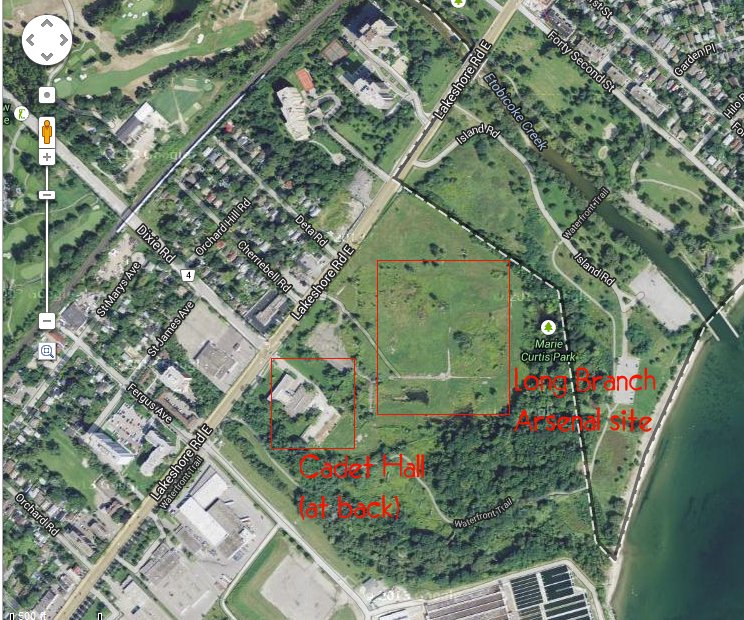
When I was an army cadet, the weapon we trained on was the Lee Enfield, an old but highly reliable British rifle. Our cadet range used Lee Enfields with .22 adapters, but due to an odd quirk of timing, the very first weapon I ever fired was a Lee Enfield .303 … I think it weighed nearly as much as I did at 12. Interestingly, our cadet hall was adjacent to the site where the Long Branch Arsenal had manufactured Lee Enfield rifles during WW2, and the building may have been part of the factory complex.

Long Branch Arsenal site

Lee-Enfield No 4 Mk I (1943)

At the beginning of World War One, the Canadian army was supposed to be equipped as much as possible with Canadian-produced kit, including the infantry rifle. Canadian industrial development meant that we didn’t have factories that could immediately turn out bigger pieces of armament, but rifles were easily within reach. The government’s choice was the Ross rifle, which was already in production and was highly accurate but had a few disadvantages that were not discovered until the first Canadian troops were in Flanders. Wikipedia says:

The Ross rifle was a straight-pull bolt action .303 inch-calibre rifle produced in Canada from 1903 until 1918.

The Ross Mk.II or (“1905”) rifle was highly successful in target shooting before WWI, but the close chamber tolerances, lack of primary extraction and overall length made the Mk.III (or “1910”) Ross rifle unsuitable for the conditions of trench warfare and the often poor quality ammunition issued.

By 1916, the rifle had been withdrawn from front line service, but continued to be used by many snipers of the Canadian Expeditionary Force until the end of the war due to its exceptional accuracy.

The Ross Rifle Co. made sporting rifles from early in its production, most notably chambered in .280 Ross, introduced in 1907. This cartridge is recorded as the first to achieve over 3000 feet per second velocity, and the cartridge acquired a very considerable international reputation among target shooters and hunters.

Lickmuffin, who frequently posts comments here on the blog, recently acquired a “sporterized” version and produced a short video about the rifle:

December 20, 2013

Why we know so little about the Maya

Filed under: Americas, History, Science — Tags: , , , — Nicholas @ 08:56

David Friedman is running a seminar called “Legal Systems Very Different from Ours” and one of the students in the seminar chose to do her paper on the Mayan legal system … or at least what we can deduce from the various sources. We don’t have a coherent view on many aspects of the Mayan culture, but he identifies the key sources that can be drawn from:

1. Modern Archeology.

The advantage is that one can dig up ruins, artifacts, other physical remains of a civilization and date them. Physical objects, unlike written texts or oral tradition, can’t lie or be mistaken.

The disadvantage is the problem of interpreting what you find — which may well depend in part on what you expect to find. As Chesterton pointed out, future archaeologists might conclude that the 19th century English believed the dead could smell things, as shown by the evidence of flowers in grave sites.

2: The oral traditions and current practices of the descendants of the Maya civilization.

The advantage of that source of information is that there are lots of people who are bilingual in one of the Maya languages and a modern language, so anthropologists who interview them can avoid the problem of making sense of an ancient language and an extinct system of writing.

The disadvantage is that we do not know how much of what current Maya believe about events in the distant past is true, nor to what degree current institutions preserve the institutions of the distant past.

3. A book written in Spanish by a 16th century Spanish Bishop describing his observations shortly after the conquest.

The advantage is that it is written in a language we can read, using a writing system we can read, based on first hand observation.

The disadvantages are, first, that it is first hand observation by a single observer of a society very different from his own, and second that the observer had serious biases that may well have affected what he observed and recorded. […]

December 19, 2013

Patrick West on “the mourning wars”

Filed under: Britain, History, Media, Politics — Tags: , , — Nicholas @ 09:07

In sp!ked, Patrick West notes the difference in tone for two recently deceased world leaders:

Remember when Margaret Thatcher died in April? ‘Ding dong, the witch is dead!’ they rejoiced on the streets and on social media, the recalcitrant losers of the old left uniting with today’s self-styled radicals, for whom Thatcher was a semi-mythical creature from the past who had wronged their ancestors. The Iron Lady was a mean old bitch, they cried, her creed of individualism being responsible for today’s troubled times.

A few months later, the hero of the left dies. Where was the comparable vitriol from the right, as was expected, about ‘Nelson Mandela the terrorist’? Sure, there was the odd, fringe UKIP fruitcake (isn’t there always?), but for the most part there was warmth and praise. Some, like former UK prime minister John Major, even said that the Conservatives were wrong on South Africa in the 1980s. Even the right-wing press has been quiet on Mandela’s real legacy and South Africa’s future. Curiously, only the Guardian — in articles by Simon Jenkins and Slavoj Žižek — has really questioned the saintly status accorded to Madiba (though not nearly as well as spiked has done, of course).

Indeed, the only tangible vitriol to emerge has come from old lefties themselves, complaining on social media when David Cameron paid homage. How dare the Tories try to appropriate a foreign leader to make themselves appear virtuous? We bagsied him first!

Politics isn’t meant to be this way. Right-wing people are meant to be horrid and selfish and left-wingers caring and nice. Yet, episodes such as this seem to suggest, once again, the opposite. It’s one of the paradoxes today that the liberal-left is often far nastier, more vitriolic, censorious and egotistical than the ‘selfish’ Tories they profess to loath.

December 17, 2013

Io Saturnalia!

Filed under: History, Religion — Tags: , , , — Nicholas @ 09:16

In History Today, Matt Salusbury traces the Roman festival of Saturnalia (which was celebrated on December 17th) and its relationship to Christmas in the late empire:

It was a public holiday celebrated around December 25th in the family home. A time for feasting, goodwill, generosity to the poor, the exchange of gifts and the decoration of trees. But it wasn’t Christmas. This was Saturnalia, the pagan Roman winter solstice festival. But was Christmas, Western Christianity’s most popular festival, derived from the pagan Saturnalia?

The first-century AD poet Gaius Valerius Catullus described Saturnalia as ‘the best of times’: dress codes were relaxed, small gifts such as dolls, candles and caged birds were exchanged.

[…]

Saturnalia originated as a farmer’s festival to mark the end of the autumn planting season in honour of Saturn (satus means sowing). Numerous archaeological sites from the Roman coastal province of Constantine, now in Algeria, demonstrate that the cult of Saturn survived there until the early third century AD.

Saturnalia grew in duration and moved to progressively later dates under the Roman period. During the reign of the Emperor Augustus (63 BC-AD 14), it was a two-day affair starting on December 17th. By the time Lucian described the festivities, it was a seven-day event. Changes to the Roman calendar moved the climax of Saturnalia to December 25th, around the time of the date of the winter solstice.

From as early as 217 BC there were public Saturnalia banquets. The Roman state cancelled executions and refrained from declaring war during the festival. Pagan Roman authorities tried to curtail Saturnalia; Emperor Caligula (AD 12-41) sought to restrict it to five days, with little success.

Emperor Domitian (AD 51-96) may have changed Saturnalia’s date to December 25th in an attempt to assert his authority. He curbed Saturnalia’s subversive tendencies by marking it with public events under his control. The poet Statius (AD 45- 95), in his poem Silvae, describes the lavish banquet and entertainments Domitian presided over, including games which opened with sweets, fruit and nuts showered on the crowd and featuring flights of flamingos released over Rome. Shows with fighting dwarves and female gladiators were illuminated, for the first time, into the night.

December 15, 2013

QotD: Choosing a capital city, Australian style

Filed under: Australia, History, Humour, Politics, Quotations — Nicholas @ 09:22

Australia […] set up a special city just for the national capital. Keep them all in one place, it avoids spreading the contamination.

Partly that’s due to our settlement pattern. Mostly, each state capital is the oldest city in that state, the first point of European settlement. It’s also the largest city in the state (and, to be horribly honest, most other ‘cities’ in each state are really ‘regional centres’, the state capital is pretty much the only show in town.)

So when the states federated to form a nation, there was of course a fight to host the capital. Sydney was the obvious one — the oldest and largest city. Melbourne wanted it because it’s like that irritating little sister who always wants what her big sister has, and the other cities — well, nobody really cared about them anyway.

So, in a wonderful stroke of compromise, they chose a site that is roughly equidistant from Sydney and Melbourne (and set in some of the most boring countryside available). They held a worldwide competition to design the city — Walter Burley Griffin won. Lord knows what lost. It’s a clever plan designed for maximum confusion, condemning some hapless visitors to spending the rest of their lives endlessly circling but never arriving at their destination.

But, as I say, at least it keeps the federal pollies well away from everyone else. Always a plus.

Gwynne Powell, posting to the Lois McMaster Bujold Mailing list (http://lists.herald.co.uk/cgi-bin/mailman/listinfo/lois-bujold), 2013-12-13

December 12, 2013

Sex and the Romans

Filed under: Books, History, Media, Religion — Tags: , , , — Nicholas @ 00:01

In the New York Review of Books, Peter Brown reviews a new book on the evolution of our knowledge about Roman sexuality at the start of the Christian era:

One of the most lasting delights and challenges of the study of the ancient world, and of the Roman Empire in particular, is the tension between familiarity and strangeness that characterizes our many approaches to it. It is like a great building, visible from far away, at the end of a straight road that cuts across what seems to be a level plain. Only when we draw near are we brought up sharp, on the edge of a great canyon, invisible from the road, that cuts its way between us and the monument we seek. We realize that we are looking at this world from across a sheer, silent drop of two thousand years.

Antiquity is always stranger than we think. Nowhere does it prove to be more strange than where we once assumed that it was most familiar to us. We always knew that the Romans had a lot of sex. Indeed, in the opinion of our elders, they probably had a lot more than was quite good for them. We also always knew that the early Christians had an acute sense of sin. We tend to think that they had a lot more sense of sin than they should have had. Otherwise they were very like ourselves. Until recently, studies of sex in Rome and of Christianity in the Roman world were wrapped in a cocoon of false familiarity.

Only in the last generation have we realized the sheer, tingling drop of the canyon that lies between us and a world that we had previously tended to take for granted as directly available to our own categories of understanding. “Revealing Antiquity,” the Harvard University Press series edited by Glen Bowersock, has played its part in instilling in us all a healthy sense of dizziness as we peer over the edge into a fascinating but deeply strange world. Kyle Harper’s book From Shame to Sin: The Christian Transformation of Sexual Morality in Late Antiquity is a scintillating contribution to this series. Not only does it measure the exact nature of the tension between the familiar and the deeply unfamiliar that lies behind our image of the sexual morality of Greeks and Romans of the Roman Empire of the classical period. It also goes on to evoke the sheer, unexpected strangeness of the very different sexual code elaborated in early Christian circles, and its sudden, largely unforeseen undermining of a very ancient social equilibrium in the two centuries that followed the conversion of Constantine to Christianity in 312. As Harper makes plain on the first page of his dense and vivid book, “Few periods of premodern history have witnessed such brisk and consequential ideological change. Sex was at the center of it all.”

December 10, 2013

Twenty years of Doom

Filed under: Gaming, History — Tags: — Nicholas @ 12:26

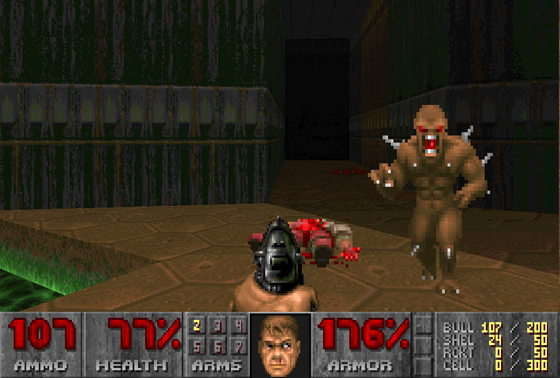
At The Register, Lucy Orr gets all nostalgic for id Software’s Doom, which turned 20 today:

Doom wasn’t short on story, never mind the gore and gunfire to follow, I particularly enjoyed the fact my own government had fucked things up by messing where they shouldn’t and opened a portal to hell. Damn, it’s just me left to go ultraviolent and push the legions of hell back into fiery limbo.

Faced with dual chain gun-wielding bulked up Aryans as your foe, Wolfenstein 3D was funny rather than scary. Indeed, I don’t remember being scared by a game until Doom appeared, with its engine capable of dimmed quivering lights and its repugnant textures. The nihilistic tones of Alien 3 echoed through such levels as the toxic refinery. Like the Alien series Doom’s dark corners allowed my imagination to run wild and consider turning the lights back on.

But Doom had a lot more going for it then a few scary moments, and I don’t just mean those scrambles for the health kit. Being able to carry an army’s worth of gun power is not necessarily realistic but neither are angry alien demons trying to rip my flesh off. I’m never empty handed with a chainsaw, a shotgun, a chain-gun, and a rocket launcher at my disposal.

With Doom you were not only introduced to a world of cyber demons but death matches — be sure to have the BFG 9000 on hand for that one shot kill — cooperative gameplay and also a world of player mods including maps and sometimes full remakes.

id Software - Doom 1993

« Newer PostsOlder Posts »

Powered by WordPress