
December 9, 2013
December 8, 2013
Mandela’s struggle was not the same as Gandhi’s
Salil Tripathi met Nelson Mandela and finds the frequent comparisons between Gandhi and Mandela to do less than justice to both men:
The South African freedom struggle was different from India’s, and the paths Mandela and Gandhi took were also different. That did not prevent many from comparing him with Gandhi. But the two were different; both made political choices appropriate to their time and the context in which they lived.
Gandhi’s life and struggle were political, but securing political freedom was the means to another end, spiritual salvation and moral advancement of India. Mandela was guided by a strong ethical core, and he was deeply committed to political change. At India’s independence, Gandhi wanted the Congress Party to be dissolved, and its members to dedicate themselves to serve the poor. But the Congress had other ideas. Mandela would not have wanted to dissolve his organization; he wanted to bring about the transformation South Africa needed, but he also wanted to heal his beloved country.
This is not to suggest that Gandhi wasn’t political. He was shrewd and he devised strategies to seek the moral high ground against his opponents — and among the British he found a colonial power susceptible to such pressures, because Britain had a domestic constituency which found colonialism repugnant, contrary to its values.
Mandela’s point was that he didn’t have the luxury of fighting the British — he was dealing with the National Party, with its Afrikaans base, which believed in a fight to finish, seeking inspiration from the teachings of the Dutch Reformed Church which established a hierarchy of different races, which led to the establishment of apartheid. “One kaffir one bullet,” said the Boer (the Afrikaans word for farmer, which many Afrikaans-speaking South Africans were); “One settler one bullet,” replied Umkhonto weSizwe, the militant arm of the ANC.
And yet Mandela’s lasting gift was his power of forgiveness and lack of bitterness. He showed exceptional humanity and magnanimity when he left his bitterness behind, on the hard, white limestone rocks of Robben Island that he was forced to break for years, the harsh reflected glare of those rocks causing permanent damage to his eyes. And yet, he came out, his fist raised, smiling, and he wrote in his memoir, Long Walk To Freedom, that unless he left his bitterness and hatred behind, “I would still be in prison.”
By refusing to seek revenge, by accepting the white South African as his brother, by agreeing to build a nation with people who wanted to see him dead, Mandela rose to a stature that is almost unparalleled.
[…]
Calling Mandela the Gandhi of our times does no favour to either. Gandhi probably anticipated the compromises he would have to make, which is why he shunned political office. Mandela estimated, correctly, that following the Gandhian path of non-violent resistance against the apartheid regime was going to be futile, since the apartheid regime did not play by any rules, except those it kept creating to deepen the divide between people.
H/T to Shikha Dalmia for the link.
December 7, 2013
QotD: Minimum wage and Social Darwinism
Consider the debate over the minimum wage. The controversy centered on what to do about what Sidney Webb called the “unemployable class.” It was Webb’s belief, shared by many of the progressive economists affiliated with the American Economic Association, that establishing a minimum wage above the value of the unemployables’ worth would lock them out of the market, accelerating their elimination as a class. This is essentially the modern conservative argument against the minimum wage, and even today, when conservatives make it, they are accused of — you guessed it — social Darwinism. But for the progressives at the dawn of the fascist moment, this was an argument for it. “Of all ways of dealing with these unfortunate parasites,” Webb observed, “the most ruinous to the community is to allow them unrestrainedly to compete as wage earners.”
Ross put it succinctly: “The Coolie cannot outdo the American, but he can underlive him.” Since the inferior races were content to live closer to a filthy state of nature than the Nordic man, the savages did not require a civilized wage. Hence if you raised minimum wages to a civilized level, employers wouldn’t hire such miscreants in preference to “fitter” specimens, making them less likely to reproduce and, if necessary, easier targets for forced sterilization. Royal Meeker, a Princeton economist and adviser to Woodrow Wilson, explained: “Better that the state should support the inefficient wholly and prevent the multiplication of the breed than subsidize incompetence and unthrift, enabling them to bring forth more of their kind.” Arguments like these turn modern liberal rationales for welfare state wage supports completely on their head.
Jonah Goldberg, Liberal Fascism: The Secret History of the American Left, From Mussolini to the Politics of Change, 2008.
December 6, 2013
QotD: Why Mandela was different
Within moments of the announcement that the great man had passed away, left-wingers on twitter gleefully started posting quotes from Reagan-era conservatives about Mandela. At the time, most right-wingers’ opinions of Mandela — with one notable exception — ranged from skepticism to outright hostility. (This William H. Buckley column from 1990, which compares the recently-released Mandela to Lenin, was not atypical.)
Support for apartheid was never justifiable, but when that racist system was in its death throes, it was hardly unreasonable to worry about what might come next. Many political prisoners and “freedom fighters” have eventually come to power in their countries, only to become exactly what they once fought against — or worse. (One of the most infuriating examples is just over the South African border, where the once-promising Robert Mugabe has driven Zimbabwe into the abyss.)
The young Mandela was a revolutionary, and after spending his entire life as a second-class citizen, and 27 years behind bars, any bitterness on his part would have been understandable.
Instead, he chose an unprecedented path of reconciliation:
[…]
The real measure of one’s greatness comes when that person achieves power. And by that standard, Mandela was one of the greatest of them all. May he rest in peace.
Damian Penny, “Why Mandela was different”, DamianPenny.com, 2013-12-06
December 5, 2013
Happy Repeal Day!
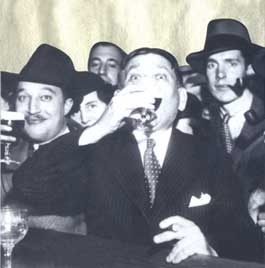
Eighty years ago today, the US finally repealed Prohibition. Baltimore’s own H.L. Mencken was among the first to publicly celebrate the demise of the hated legislation:
Published on 5 Dec 2012
In honor of Repeal Day, which celebrates the end of America’s “noble experiment” in banning alcoholic beverages, Reason TV is happy to introduce you to George Cassiday, a man whose life and work should be taught to every schoolkid — and to every member of Congress hell-bent on legislating the nation’s morals.
From 1920 through 1930 — the thick of the Prohibition era — Cassiday supplied illegal liquor throughout the halls of Congress. Known as “The Man in the Green Hat,” Cassiday was the Capitol’s highest-profile bootlegger, with a client list that included senior members of the Republican and Democratic Parties. How instrumental was he to the D.C. power elite? He even had his own office in the House and Senate office buildings.
Cassiday gave up the liquor trade after his arrest in 1930, but gained notoriety by penning a series of front-page articles for The Washington Post about his days as Congress’ top bottle man.
Though he never named names, Cassiday’s stories detailed every aspect of his former business — and the depths of hypocrisy in Washington. By his own estimation, “four out of five senators and congressmen consume liquor either at their offices or their homes.” Appearing days before the 1930 mid-term elections, Cassiday’s revelations caused a national stir and helped sweep pro-Prohibitionist — and ostensibly tee-totaling — congressmen and senators out of power.
Today, with the rise of cocktail culture and prohibition-vogue in full swing, Cassiday’s life and legacy are being re-discovered. Through books such as Garrett Peck’s Prohibition in Washington, D.C.: How Dry We Weren’t to New Columbia Distillery’s Green Hat Gin, the remarkable story of George Cassiday — “The Man in the Green Hat” — is again being told.
Reason TV spoke with Cassiday’s son, Fred, author Garrett Peck, and New Columbia Distillery’s John Uselton to discuss George Cassiday and the end of Prohibition.
The Hundred Years War
In History Today, George Goodwin reviews A Great and Glorious Adventure: A Military History of the Hundred Years War by Gordon Corrigan:
As Corrigan explains, the Hundred Years War extended over a longer period (1337-1453) than its name suggests, but then it was not a continuous war either. Instead its series of intermittent campaigns featuring major battles and sieges was interspersed with periods of lower tempo siege warfare and long stretches of peace. The war was initially sparked by Philip VI of France’s formal declaration that Edward III’s territories in France (most notably Aquitaine) had been confiscated because the young English king had refused to act as his vassal and to hand over Robert of Artois, Philip’s mortal enemy. The war escalated after the Declaration of Ghent in 1340, when Edward proclaimed himself king of France on the basis that, through his mother, he had a superior claim to the throne than Philip, as she was the daughter of Philip IV, while Philip VI was merely his nephew. France, however, had never allowed for kingship to descend through the female line.
Corrigan’s dramatic description of the Battle of Sluys in 1340 gets the book going. Though fought between opposing navies, Sluys was essentially a land battle that took place on a flotilla of French ships chained across the mouth of an estuary, with the victorious English army moving from vessel to vessel and pushing their French opponents overboard. Corrigan accounts for England’s victory being due to superior tactics and the far greater effectiveness of the longbow in comparison to the French crossbow. This was down to both to the nature of the weaponry and the superior skill of the Anglo-Welsh archers. They proved decisive time and time again at the great set-piece battles of Crecy, Poitiers, Agincourt and Verneuil.
December 3, 2013
The US constitution and the first ten amendments
In the latest Libertarian Enterprise, L. Neil Smith provides a thumbnail sketch of the reasons for the first amendments to the US constitution:
While some of this nation’s Founding Fathers — Thomas Jefferson, Patrick Henry, George Mason — were intent, first and foremost, to create a new country in which individual liberty and free enterprise would be the order of the day, there were others, like Alexander Hamilton, who regarded the fledgling America as his personal piggy bank.
You will have been taught that the Articles of Confederation, our first “operating system” were deeply flawed, The truth is that they provided for an extremely decentralized governance that stood as an obstacle to the vast fortunes Hamilton and his cronies had hoped to amass.
The Articles had to go, and it is revealing that among Hamilton’s first acts as Treasury Secretary under the Constitution that replaced them was a national excise tax on whiskey that, as readers of my novel The Probability Broach know, very nearly sparked a second American Revolution.
Corn farmers of western Pennsylvania long accustomed to turning their crop into a less perishable, more transportable product, were among the first victims of democracy American-style, the kind where three coyotes and a lamb sit down to debate on what’s going to be for dinner.
Nevertheless, that’s why a few stiff-necked libertarian-types, like Jefferson, held out for a Bill of Rights to be added to the new Constitution, and it was written, more or less to Jefferson’s order, by his close friend, James Madison, one of the few Federalists who was genuinely interested in assuaging the Anti-Federalists about the new document.
The Bill of Rights was, unfortunately misnamed. It was not a list of things Americans were allowed too do, under the Constitution. It was and remains a list of things government is absolutely forbidden to do — like set up a state religion, or steal your house — under any circumstances.
The Bill of Rights was the make-or-break condition that allowed the Constitution to be ratified. No Bill of Rights, no Constitution. And since all political authority in America “trickles down” from the Constitution, no Constitution no government. And, since the Bill of Rights was passed as a unit, a single breach, in any one of the ten articles, breaches them all and with them, the entire Constitution. Every last bit of the authority that derives from it becomes null and void.
Blackadder Rides Again
Published on 30 May 2013
Documentary looking at the much-loved sitcom from its first transmission in 1983. The programme features an exclusive in-depth interview with Edmund Blackadder himself, Rowan Atkinson, the first time he has agreed to talk about his experiences making the show. Also reflecting on their time on the show are other key members of the team, including Stephen Fry, Hugh Laurie, Tony Robinson, Rik Mayall, Ben Elton and Richard Curtis.
December 2, 2013
Sea level changes during recorded history
Some interesting points in this guest post by Robert W. Endlich:
Sea level changes over relatively recent geologic and human history demonstrate that alarmist claims do not withstand scrutiny. Sea levels rose significantly after the last ice age, fell during the Little Ice Age, and have been rising again since the LIA ended around 1850. In fact, Roman Empire and Medieval port cities are now miles from the Mediterranean, because sea levels actually fell during the Little Ice Age.
[…]
Those rising oceans created new ports for Greek and Roman naval and trade vessels. But today many of those structures and ruins are inland, out in the open, making them popular tourist destinations. How did that happen? The Little Ice Age once again turned substantial ocean water into ice, lowering sea levels, and leaving former ports stranded. Not enough ice has melted since 1850 to make them harbors again.
The ancient city of Ephesus was an important port city and commercial hub from the Bronze Age to the Minoan Warm period, and continuing through the Roman Empire. An historic map shows its location right on the sea. But today, in modern-day Turkey, Ephesus is 5 km from the Mediterranean. Some historians erroneously claim “river silting” caused the change, but the real “culprit” was sea level change.
Ruins of the old Roman port Ostia Antica, are extremely well preserved – with intact frescoes, maps and plans. Maps from the time show the port located at the mouth of the Tiber River, where it emptied into the Tyrrhenian Sea. The Battle of Ostia in 849, depicted in a painting attributed to Raphael, shows sea level high enough for warships to assemble at the mouth of the Tiber. However, today this modern-day tourist destination is two miles up-river from the mouth of the Tiber. Sea level was significantly higher in the Roman Warm Period than today.
An important turning point in British history occurred in 1066, when William the Conqueror defeated King Harold II at the Battle of Hastings. Less well-known is that, when William landed, he occupied an old Roman fort now known as Pevensey Castle, which at the time was located on a small island in a harbor on England’s south coast. A draw bridge connected it to the mainland. Pevensey is infamous because unfortunate prisoners were thrown into this “Sea Gate,” so that their bodies would be washed away by the tide. Pevensey Castle is now a mile from the coast – further proof of a much higher sea level fewer than 1000 years ago.
London’s Underground system
H/T to Eric Kirkland for the link.
November 30, 2013
November 26, 2013
Twenty-five years on, Canada has clearly changed
Richard Anderson notes the 25th anniversary of an almost forgotten Canadian crisis:
From the perspective of a quarter century the whole thing is almost inexplicable. It isn’t just that everything turned out well. The oddness of that time is how worked up people got about a trade agreement. Seriously. It’s an international trade agreement. The Harper Tories have signed quite a few, including an important deal with the EU. It’s barely headline news. But way back then it was the beginning of the end of Canada, if the good and great of the Canadian Cultural Establishment were to be believed.
Adding more distance to the passage of time is the demographic revolution that has taken place since, a revolution kicked into high gear by Mulroney not Trudeau. The Canada of 1988 was a much whiter and far more WASPish place than it is today. The Canadian WASP is an odd creature. Genial to a fault, decent, hard working and subdued in manner and lifestyle. He does, however, have one terrible weakness: A paranoid fear of the United States.
The Punjabi, the Vietnamese and the Filipino immigrant could not tell a Loyalist from a lolipop. The strange psycho-drama that has consumed the Canadian elite since Simcoe landed is now, mostly, over. The new Canadians have no fear of the old enemy America. There are no intergenerational flashbacks to the Battle of Queenston Heights. The Americans are just the loud neighbour to the south. It is not entirely coincidental that free trade was at last brought to Canada by an Irish Catholic, supported by a phalanx of Quebecois. Neither group ever really feared America. Among them there was never that nagging sense of imminent cultural absorption.
November 23, 2013
The power of the press in World War One
The current issue of History Today includes an interesting article by Adrian Bingham on the British newspapers (especially the Daily Mail and the Times) during WW1:
When Britain declared war on Germany in August 1914 the widespread feelings of fear, uncertainty and patriotic determination were matched at the offices of the Daily Mail by a sense of vindication. The newspaper had been warning about the German threat for years, perhaps most notoriously when it serialised in 1909 a series of inflammatory articles by the journalist Robert Blatchford, which, when reprinted as a penny pamphlet, sold some 1.6 million copies. The Mail had, moreover, consistently demanded that the Royal Navy be reinforced. It was soon styling itself ‘the paper that foretold the war’. For its critics, the Mail’s irresponsible stoking of anti-German sentiment, driven above all by the paper’s owner, Lord Northcliffe, actually helped to create the conditions that enabled conflict to break out. ‘Next to the Kaiser’, wrote the esteemed editor and journalist A.G. Gardiner, ‘Lord Northcliffe has done more than any other living man to bring about the war.’
[…]
It was not long, however, before Northcliffe became frustrated with the strict censorship imposed on the British press when reporting events in Europe. ‘What the newspapers feel very strongly’, wrote Northcliffe to Lord Murray of Elibank, ‘is that, against their will, they are made to be part and parcel of a foolish conspiracy to hide bad news. English people do not mind bad news.’ Such censorship was particularly worrying when it risked hiding failures in the prosecution and management of the war. Drawing both on the experiences of his visits to the front and on private sources of information from his many correspondents, Northcliffe became increasingly convinced that several men in leading positions were not up to the job, including the prime minister, Asquith, the First Lord of the Admiralty, Winston Churchill, and the Secretary of State for War, Lord Kitchener.
The episode that crystallised this concern, over which Northcliffe put both his and the Mail’s reputation on the line, was the Shell Crisis of May 1915. Northcliffe had received letters from the front claiming that British military operations were being undermined by the lack of the right kind of shell and, after the Allies failed to capitalise on an initial breakthrough at Neuve Chapelle due to a lack of munitions, these criticisms began to be publicly aired. On May 15th, 1915 The Times (also owned by Northcliffe at the time) published a telegram from its respected military correspondent, Lieutenant-Colonel Repington, highlighting the problem and Northcliffe decided to go on the offensive. After some critical editorials, on May 21st the Mail published an incendiary piece written by Northcliffe himself and headlined ‘The Tragedy of the Shells: Lord Kitchener’s Grave Error’. Northcliffe pinned the blame for the shells scandal directly on Kitchener:
Lord Kitchener has starved the army in France of high-explosive shells. The admitted fact is that Lord Kitchener ordered the wrong kind of shell … He persisted in sending shrapnel – a useless weapon in trench warfare … The kind of shell our poor soldiers have had has caused the death of thousands of them.
This direct public attack on such an esteemed figure at a time of national crisis was shocking and generated fury among many of Northcliffe’s critics. Members of the London Stock Exchange burned copies of both The Times and the Mail and anxious advertisers cancelled contracts. Thousands of readers stopped buying the papers. Northcliffe, though, was undaunted: at this point he was concerned not with circulation but with what he perceived as his national duty. ‘I mean to tell the people the truth and I don’t care what it costs’, he told his chauffeur. It was clear even to Northcliffe’s opponents, moreover, that there were indeed problems with Britain’s munitions supply. Northcliffe was soon vindicated. Although Kitchener survived in the short term, the Liberal government fell at the end of May 1915, to be replaced by a coalition administration: Asquith remained as prime minister, but Lloyd George was appointed as minister of munitions to address the supply problems.
November 22, 2013
“…you wonder why it took so long for somebody to shoot the swinish bastard”
Colby Cosh makes no friends among the over-60 Kennedy worshipping community:
The myth of Kennedy as a uniquely admirable knight-errant has finally, I think, been wiped out by the accumulation of ugly details about his sexual conduct and family life. For a while it was still possible to regard JFK’s tomcatting as the inevitable concomitant of super-masculine greatness. By now it is pretty clear that he was just an abusive, spoiled creep. There are scenes in White House intern Mimi Alford’s 2012 memoir that make you wonder why it took so long for somebody to shoot the swinish bastard.
As for the assassination itself, the experience of seeing conspiracy theories bloom like a toxic meadow after 9/11 has hardened us all against the nonsense that was still popular in the 1990s. Most adults, I think, now understand that Oliver Stone’s JFK was a buffet of tripe. It is no coincidence that Stephen King’s 2011 time-travel book about JFK’s slaying, written after decades of fairly deep research, stuck close to the orthodox Warren commission narrative.
The new favourite themes in the 50th anniversary coverage dispense with grassy-knoll phantoms and disappearing-reappearing Oswalds. One new documentary has revived Howard Donahue’s idea that the final bullet that blasted Kennedy’s skull apart might have been fired accidentally by a Secret Service agent in one of the trailing cars. This would help explain the oddity of the Zapruder footage, and might also account for some awkwardly disappearing evidence — notably JFK’s brain — without requiring us to believe anything obviously outrageous.
[…]
In the early ’70s Lyndon Johnson made a cryptic remark about JFK possibly being killed because his administration had been “running a damn Murder Inc. in the Caribbean.” This offhand remark turned out to be quite specific; rumours of multiple CIA assassination attempts against Castro were true, as were wilder tales of literal Mafia involvement (confirmed when the CIA “Family Jewels” were declassified in 2007). Oswald would not exactly have been anyone’s first choice as an intelligence asset, and probably had no state sponsor. But notice that it’s 2013 and we still have to say “probably.”
November 21, 2013
Unexploded shells, submunitions and the “dud” rate
Strategy Page discusses one of the problems of wars long-gone, but still dangerous today:
These are the many bombs, shells, grenades, and other explosive devices that did not go off when they were supposed to. In the first half of the 20th century, over a billion fuzed devices were used in combat, and five to ten percent of them were duds. In Europe, the site of heavy fighting in two world wars, dozens of people are still killed or injured each year by duds.
In the last few decades of the 20th century it got worse, and the reason was submunitions. These were smaller bombs carried inside a container. The idea was that when the shell or bomb carrying submunitions was used, it would spread these smaller bombs over a larger area and do more damage than one large explosion. It worked, but it also created more duds. Not just more but smaller duds. Small enough for children to pick up and start playing with. Kids are more adventurous and less well informed than adults. A dud submunition looked like a new toy.
[…]
In actual use submunitions turned out to have a higher dud rate than any previous weapon. New artillery shells have a dud rate of about two percent. Israel went so far as to fire 10,000 new shells to confirm that dud rate. But many nations stockpile shells and as these grow older, their dud rate increases. Shells actually have an expiration date, reflecting the fact that the chemicals in the explosives and the fuzes grow more unstable as they age. The Third World and communist nations often had poor quality control to begin with and were more prone to keep old ammunition. During the Afghanistan war of the 1980s, Russian shells appeared to have a dud rate of some thirty percent. And even the United States would sometimes use submunitions that had exceeded their recommended shelf life.
Submunitions were originally designed to have a dud rate similar to that of artillery shells. But in practice it was much higher, closer to five percent. Part of reason for this is the lighter weight of submunitions. Shell fuzes detonate a shell when the shell hits the ground. The impact sends a pretty strong message to the fuze that now is the time to do it, and go bang. But submunitions, weighing from a few ounces to a few pounds, can make a soft landing and not generate enough force to activate the fuze. These make even deadlier duds, for the fuze is not defective, just deceived. When enough force is applied to activate the fuze, you have an explosion. The dud rate got higher depending on where the submunitions landed. When there is a lot of snow or mud on the ground, the dud rate was as high as fifteen percent.


