Quotulatiousness

November 20, 2013

Jacqueline Kennedy and the Camelot myth

Filed under: History, Media, USA — Tags: , , , — Nicholas @ 08:56

Virginia Postrel on the legacy of Jacqueline Kennedy:

When she was 22, the future Jacqueline Kennedy won a Vogue contest with an essay in which she dreamed of being “a sort of Overall Art Director of the Twentieth Century.” As first lady, she proved herself a genius at visual persuasion. She crafted her own image, refined her husband’s, re-created the White House’s, and even shaped America’s abroad.

Her most evocative and enduring image-making came when John F. Kennedy was assassinated, 50 years ago this week. She art-directed the funeral’s pageantry and then, in an interview with T.H. White for Life magazine, memorably linked her husband to one of the most powerful legends in the English-speaking world. Jackie created the myth of the Kennedy administration as Camelot: the lost golden age that proved ideals could become real.

The Arthurian legends traditionally operate as what the cultural anthropologist Grant McCracken calls “displaced meaning.” Every culture, he observes, maintains ideals that can never be fully realized in everyday life, from Christian charity to economic equality. Yet for all their empirical failings, such cultural ideals supply essential purpose and meaning, offering identity and hope. To preserve and transmit them, cultures develop images and stories that portray a distant world in which their ideals are realized — a paradise, a utopia, a golden age, a promised land, a world to come. Camelot is such a setting.

“When they are transported to a distant cultural domain,” McCracken writes, “ideals are made to seem practicable realities. What is otherwise unsubstantiated and potentially improbable in the present world is now validated, somehow ‘proven,’ by its existence in another, distant one.”

[…] The Kennedy administration ended with sudden violence from without, making Jackie’s analogy doubly potent. It suggested a parallel with a legendary Golden Age while simultaneously implying that, left to itself, this new Golden Age might have continued indefinitely. This Camelot was pure glamour: a frozen moment, its flaws and conflicts obscured.

Glamour invites projection. For 50 years, Americans of various persuasions have imagined their ideals embodied in a Camelot that might have been. Advocates of a vigorous Cold War foreign policy claim John Kennedy. So do their opposites. He did less for the civil-rights movement than his unglamorous successor, Lyndon Johnson, yet in imagination he would have done more. Above all, people imagine that somehow a living Kennedy would have prevented the tumult of the 1960s.

November 17, 2013

QotD: Mixed drinks

Filed under: History, Law, Quotations — Tags: , , — Nicholas @ 14:45

If, as Philip Larkin observed not so long ago, the age of Jazz (not the same thing as the Jazz Age) ran roughly from 1925 to 1945, the age of the cocktail covered the same sort of period, perhaps starting a little earlier and taking longer to die away finally. The two were certainly associated at their inception. Under Prohibition in the United States, the customer at the speakeasy drank concoctions of terrible liquor and other substances added in order to render the result just about endurable, while the New Orleans Rhythm Kings or the Original Memphis Five tried to take his mind further off what he was swallowing. The demise of jazz cannot have had much to do with that of the cocktail, which probably faded away along with the disappearance of servants from all but the richest private houses. Nearly every cocktail needs to be freshly made for each round, so that you either have to employ a barman or find yourself consistently having to quit the scene so as to load the jug. Straight drinks are quicker and guests can — indeed often do — help themselves to them.

Kingsley Amis, Everyday Drinking: The Distilled Kingsley Amis, 2008.

The Anglosphere

Filed under: Britain, History, Liberty, USA — Tags: , , — Nicholas @ 11:27

In the Wall Street Journal, Daniel Hannan discusses exceptionalism and the Anglosphere:

We often use the word “Western” as a shorthand for liberal-democratic values, but we’re really being polite. What we mean is countries that have adopted the Anglo-American system of government. The spread of “Western” values was, in truth, a series of military victories by the Anglosphere.

I realize that all this might seem strange to American readers. Am I not diluting the uniqueness of the U.S., the world’s only propositional state, by lumping it in with the rest of the Anglosphere? Wasn’t the republic founded in a violent rejection of the British Empire? Didn’t Paul Revere rouse a nation with his cry of “the British are coming”?

Actually, no. That would have been a remarkably odd thing to yell at a Massachusetts population that had never considered itself anything other than British (what the plucky Boston silversmith actually shouted was “The regulars are coming out!”). The American Founders were arguing not for the rejection but for the assertion of what they took to be their birthright as Englishmen. They were revolutionaries in the 18th-century sense of the word, whereby a revolution was understood to be a complete turn of the wheel: a setting upright of that which had been placed on its head.

[…]

There was a fashion for florid prose in the 18th century, but the second American president, John Adams, wasn’t exaggerating when he identified the Anglosphere’s beautiful, anomalous legal system — which today covers most English-speaking countries plus Israel, almost an honorary member of the club, alongside the Netherlands and the Nordic countries — as the ultimate guarantor of freedom: “The liberty, the unalienable, indefeasible rights of men, the honor and dignity of human nature… and the universal happiness of individuals, were never so skillfully and successfully consulted as in that most excellent monument of human art, the common law of England.”

Freedom under the law is a portable commodity, passed on through intellectual exchange rather than gene flow. Anyone can benefit from constitutional liberty simply by adopting the right institutions and the cultural assumptions that go with them. The Anglosphere is why Bermuda is not Haiti, why Singapore is not Indonesia, why Hong Kong is not China — and, for that matter, not Macau. As the distinguished Indian writer Madhav Das Nalapat, holder of the Unesco Peace Chair, puts it, the Anglosphere is defined not by racial affinity but “by the blood of the mind.”

At a time when most countries defined citizenship by ancestry, Britain was unusual in developing a civil rather than an ethnic nationality. The U.S., as so often, distilled and intensified a tendency that had been present in Great Britain, explicitly defining itself as a creedal polity: Anyone can become American simply by signing up to the values inherent in the Constitution.

November 16, 2013

QotD: Petronius was right

Filed under: Education, History, Media, Quotations, USA — Tags: , , , , — Nicholas @ 09:57

Sometime in the mid-first century a.d., an otherwise little known consular official, Gaius Petronius, wrote a brilliant satirical novel about the gross and pretentious new Roman-imperial elite. The Satyricon is an often-cruel parody about how the Roman agrarian republic of old had degenerated into a wealth-obsessed, empty society of wannabe new elites, flush with money, and both obsessed with and bored with sex. Most of the Satyricon is lost. But in its longest surviving chapter — “Dinner with Trimalchio” — Petronius might as well have been describing our own 21st-century nomenklatura.

[…]

Another farce in the Satyricon involves the nonchalant ignorance of Trimalchio and his guests. The wannabes equate influence and money with status and learning and so pontificate about current events, with made-up mythologies and half-educated references to history. When Trimalchio and his banqueters begin to sermonize on literature, almost everything that follows turns out to be wrong — as Petronius reminds us how high learning has become as inane a commodity as food or sex, and only sort of half consumed, rather like the 2008 campaign of faux Greek columns and Vero possumus, which were supposed to convey gravitas.

Likewise, in our version, what does a $200,000 Ivy League education or a graduate degree really get you any more? In the sophisticated world of our political and highly credentialed elites, there are 57 states. Atlantic Coast cities are said to lie along the Gulf of Mexico; after all, they are down there somewhere in the South. The Malvinas become the Maldives — Ma- with an s at the end seems close enough. Corps-men serve in the military (as zombies?). Medgar Evans was a civil-rights icon, but you know whom we mean. President Roosevelt addressed the nation on television after the stock-market crash in 1929 — well, he would have, had he been president then and if only Americans had had televisions in their homes. And how are we to know that what we read from celebrity authors is not just made up or plagiarized, whether a Maureen Dowd column or a Doris Kearns Goodwin book?

The famously nouveau-riche Trimalchio’s guests drop the names of the rich and powerful, mostly to remind one another that they are now among the plutocracy that is replacing the old bankrupt aristocracy. We too are seeing something like that metamorphosis. It is hard to guess on any given summer weekend which populist progressive family — the Obamas, the Clintons, the Kerrys, the Gores — will be ensconced on what particular Hamptons, Nantucket, or Martha’s Vineyard beach, rubbing shoulders with just the sort of Silicon Valley or Wall Street new zillionaires who during work hours are supposed to be the evil “1 percent” and “fat cats” who need to be forced to pay their “fair share.”

Victor Davis Hanson, “An American Satyricon”, National Review Online, 2013-08-27

November 11, 2013

“The Canadian Corps … had beaten 47 German divisions since Aug. 8”

Filed under: Cancon, Europe, France, Germany, History, Military, WW1 — Tags: , , , , — Nicholas @ 15:55

In the Globe and Mail, J.L. Granatstein wants us to remember the greatest military achievement of the Canadian Corps in World War One (and it isn’t the battle of Vimy Ridge):

On Aug. 8, 1918, the Canadian Corps had secretly moved into position in front of the French city of Amiens. The German army had been on the offensive since March, and the Amiens sector was rather lightly defended. The Canadians, British and Australians struck this sector a surprise hammer blow in the early morning, a hurricane of artillery fire clearing the way for the tanks and infantry that blasted through the defences. Thousands of Germans surrendered, more were killed and within a few hours, the Canadian advance was almost 15 kilometres. This, wrote the German army’s great strategist, General Erich Ludendorff, was “the black day” of the German Army.

Lt.-Gen. Currie’s troops then moved north to the Arras area, where, at the end of the month, they struck toward and then through the Drocourt-Quéant Line, an immensely strong extension of the Hindenburg Line defended by crack troops. In heavy fighting at high cost, the Corps broke the line, forcing the Germans back behind the Canal du Nord, their last position protecting the key supply point of Cambrai.

[…]

The Germans now were in full retreat, moving eastward as fast as they could go. The Canadians took Valenciennes, smashing the enemy defences with a massive artillery barrage, and then moved into Belgium. By Nov. 11, they were in Mons, the same small town where the men of the British Expeditionary Force had first faced the invading Germans in August, 1914.

The Canadian Corps, more than a hundred thousand strong, had fought its last battles. As Lt.-Gen. Currie noted proudly, it had beaten 47 German divisions since Aug. 8, a quarter of the German forces in the West. The Corps had accomplished this because of its great fighting spirit, its fine leadership at all levels and its effective reinforcement and logistics systems. The cost in lives and in wounded was terrible — 45,000 casualties, 20 per cent of the total of Canadian losses in the entire war — but for once, the campaign had achieved measurable gains on the ground. More than that, the Canadian shock troops had battered the enemy, forced them eastward and obliged them to seek an armistice that was a de facto capitulation. It had scored its greatest victory, the greatest battlefield triumph ever by Canadian troops.

In memorium

Filed under: Britain, History, Military, WW1, WW2 — Tags: , , — Nicholas @ 11:00

A simple recognition of some of our family members who served in the First and Second World Wars:

The Great War

  • A Poppy is to RememberPrivate William Penman, Scots Guards, died 1915 at Le Touret, age 25
    (Elizabeth’s great uncle)
  • Private David Buller, Highland Light Infantry, died 1915 at Loos, age 35
    (Elizabeth’s great grandfather)
  • Private Walter Porteous, Northumberland Fusiliers, died 1917 at Passchendaele, age 18
    (my great uncle)
  • Corporal John Mulholland, Royal Tank Corps, died 1918 at Harbonnieres, age 24
    (Elizabeth’s great uncle)

The Second World War

  • Flying Officer Richard Porteous, RAF, survived the defeat in Malaya and lived through the war
    (my uncle)
  • Able Seaman John Penman, RN, served in the Defensively Equipped Merchant fleet on the Murmansk Run (and other convoy routes), lived through the war
    (Elizabeth’s father)
  • Private Archie Black (commissioned after the war and retired as a Major), Gordon Highlanders, captured at Singapore (aged 15) and survived a Japanese POW camp
    (Elizabeth’s uncle)
  • Elizabeth Buller, “Lumberjill” in the Women’s Land Army in Scotland through the war.
    (Elizabeth’s mother)

In Flanders fields the poppies blow
Between the crosses row on row,
That mark our place; and in the sky
The larks, still bravely singing, fly
Scarce heard amid the guns below.

We are the Dead. Short days ago
We lived, felt dawn, saw sunset glow,
Loved and were loved, and now we lie
In Flanders fields.

Take up our quarrel with the foe:
To you from failing hands we throw
The torch; be yours to hold it high.
If ye break faith with us who die
We shall not sleep, though poppies grow
In Flanders fields.

Lieutenant Colonel John McCrae, MD Canadian Army Medical Corps (1872-1918)

We will remember them

Filed under: Britain, Cancon, History, Military, WW1, WW2 — Tags: , — Nicholas @ 00:01

A Remembrance Day slideshow using Mark Knopfler’s wonderful “Remembrance Day” song from the album Get Lucky (2009). The early part of the song conveys many British images, but I have added some very Canadian images also which fit with many of the lyrics. The theme and message is universal… ‘we will remember them’.

November 10, 2013

Grave robbers of the western front

Filed under: Britain, Europe, France, History, Military, WW1 — Tags: — Nicholas @ 12:05

In the Telegraph, Willard Foxton explains why the growing interest in the centenary of the First World War is also giving a boost to the grave robbers:

Across the UK, there has been a rash of police finds of these First World War explosives, as the online trade in them has boomed. Dealers will often home defuse them, putting themselves and others at risk; some have been maimed doing so. […]

As dangerous as these unexploded devices are, perhaps the ugliest corner of the trade is the sale of other relics — especially dead soldiers’ identification marks. In particular, there’s a premium on British soldier’s spoons, which would often have their owner’s names embossed on them. Helmets can fetch high prices, too — including those bent out of shape by bullets or shells, which gives you some idea of what happened to the poor guy wearing it. As Andy Brockman, a leading conflict archaeologist told me:

“There is a market in all kinds of battlefield memorabilia and in the worst cases this can lead to the sale of identification tags and the removal of personal possessions like spoons and toothbrushes from battlefield burials. These objects can carry identifying marks and their loss can prevent authorities like the Commonwealth War Graves Commission from identifying the soldier concerned, robbing them of the chance of a marked grave.

“When it comes to the illegal removal of equipment and personal possessions from the remains of the missing to feed the collectors market, I would agree with Andy Robertshaw of the Royal Logistics Corps Museum who says that it’s like killing them twice.”

November 7, 2013

Children and the early industrial revolution

Filed under: Britain, Business, History, Law — Tags: , , , , , — Nicholas @ 11:35

Wendy McElroy talks about the plight of poor children in the early days of the industrial revolution in Britain:

Parish workhouses existed in Britain long before the Industrial Revolution. In 1601, the Poor Relief Act paved the way for parish officials to collect property taxes to provide for the “deserving poor.” In 1723, the Workhouse Test Act was passed to prevent false claims of poverty. Any able-bodied person who wished to receive poor relief was expected to enter a workhouse; its harsh conditions would presumably act as a deterrent. About the same time as the Industrial Revolution (circa 1760-1840), attitudes toward the poor underwent their own revolution. The Napoleonic Wars (1803-1815) not only bled Britain of money; they also created a flood of injured and unemployable men who returned from battle. Those men had families who were plunged into poverty. Between 1795 and 1815 the tab for Britain’s poor relief quadrupled. Meanwhile, the cost of mere subsistence soared because of political machinations such as the Corn Laws, a series of trade laws that artificially preserved the high price of grains produced by British agriculture. Many people could not afford a slice of bread.

But sympathy for the poor was in short supply. Historian Gertrude Himmelfarb’s definitive book The Idea of Poverty chronicles the shift in attitude toward the poor during that period; it turned from compassion to condemnation. An 1832 government report basically divided the poor into two categories: the lazy who sucked up other people’s money and the industrious working poor who were self-supporting. The Poor Law Amendment Act of 1834 instructed parishes to establish “Poor Law Unions” with each union administering a workhouse that continued to act as a deterrent by ‘virtue’ of its miserable conditions. Correctly or not, statesman Benjamin Disraeli called the act an announcement that “poverty is a crime.”

Pauper children were virtually imprisoned in workhouses. And nearly every parish in Britain had a “stockpile” of abandoned workhouse children who were virtually sold to factories. Unlike parents, bureaucrats did not view poor children as loved or otherwise valuable human beings. They were interchangeable units whose presence was a glut on the market because there would always be another poor child born tomorrow. Private businessmen who shook hands with government did not have clean fingers, either. Factory owners could not force free-labor children to take dangerous, wretched jobs but workhouse children had no choice and so they experienced the deepest horrors of child labor. The horror was not because of the free market or capitalism; those forces, along with the family, were among the protectors of children. Child laborers were victims of government, bureaucracy and businessmen who used the law unscrupulously.

Astounding historical ignorance … or is he just trolling?

Filed under: History, Media, USA — Tags: , , — Nicholas @ 10:32

You’d have to go a long way to match the degree of ignorance that the Washington Post‘s Richard Cohen admits to in this article:

I sometimes think I have spent years unlearning what I learned earlier in my life. For instance, it was not George A. Custer who was attacked at the Little Bighorn. It was Custer — in a bad career move — who attacked the Indians. Much more important, slavery was not a benign institution in which mostly benevolent whites owned innocent and grateful blacks. Slavery was a lifetime’s condemnation to an often violent hell in which people were deprived of life, liberty and, too often, their own children. Happiness could not be pursued after that.

Steve McQueen’s stunning movie 12 Years a Slave is one of those unlearning experiences. I had to wonder why I could not recall another time when I was so shockingly confronted by the sheer barbarity of American slavery. Instead, beginning with school, I got a gauzy version. I learned that slavery was wrong, yes, that it was evil, no doubt, but really, that many blacks were sort of content. Slave owners were mostly nice people — fellow Americans, after all — and the sadistic Simon Legree was the concoction of that demented propagandist, Harriet Beecher Stowe. Her Uncle Tom’s Cabin was a lie and she never — and this I remember clearly being told — had ventured south to see slavery for herself. I felt some relief at that because it meant that Tom had not been flogged to death.

No modern American — working in the media — could possibly be so ignorant, so he must be trolling. H/T to Julian Sanchez for the link.

November 5, 2013

Camelot? Not so much…

Filed under: Government, History, USA — Tags: , , , , , — Nicholas @ 16:38

Gene Healy thinks that after fifty years, it’s time we stopped pretending that John F. Kennedy was a great president:

In a December 1963 interview, the president’s widow gave a name to the Kennedy mystique, telling journalist Theodore White of Jack’s fondness for the lyric from the Lerner and Loewe musical about King Arthur: “Once there was a spot, for one brief shining moment, that was known as Camelot.”

Much more than a “moment,” Camelot has proven an enduring myth.

JFK places near the top 10 in most presidential ranking surveys of historians, and in a 2011 Gallup poll, Americans ranked him ahead of George Washington in a list of “America’s greatest presidents.”

Kennedy’s murder was a national tragedy, to be sure, but an honest assessment of his record shows that our lawless and reckless 35th president was anything but a national treasure.

[…]

Indeed, JFK rarely let legal specifics deter his exercise of presidential power. At his behest in 1961, the Internal Revenue Service set up a “strike force,” the Ideological Organizations Project, targeting groups opposing the administration.

In 1962, outraged that American steel manufacturers had raised prices, he ordered wiretaps, IRS audits and dawn FBI raids on steel executives’ homes.

In 2011, Pulitzer Prize-winning national security journalist Thomas E. Ricks opined that JFK “probably was the worst American president of the [20th] century.”

In foreign policy, Ricks said, “he spent his 35 months in the White House stumbling from crisis to fiasco.”

True enough, after being buffaloed into the disastrous Bay of Pigs operation by the CIA, Kennedy helped bring the world to the brink of thermonuclear war in the Cuban Missile Crisis — not because Soviet missiles in Cuba altered the strategic balance of power (they did not), but because, as former Defense Secretary Robert McNamara later admitted, the missiles were “politically unacceptable” for the president.

Moreover, Kennedy’s aura of vitality and “vigah” depended on deliberate lies about his medical fitness for office: “I never had Addison’s disease … my health is excellent,” JFK told a reporter in 1961.

As Kennedy biographer Richard Reeves notes, JFK, who “received the last rites of the Catholic Church at least four times as an adult,” was “something of a medical marvel, kept alive by complicated daily combinations of pills and injections,” including a psychiatrically dangerous cocktail of painkillers and amphetamines regularly administered by celebrity physician Max “Dr. Feelgood” Jacobson.

Update, 6 November: Nick Gillespie assigns the blame (for the still-going hagiography) on the boomers in a piece titled “JFK Still Dead, Baby Boomers Still Self-Absorbed”

Indeed, by the early 1970s, what American over or under 30 didn’t agree with the sentiments expressed in a 1971 New York Times Magazine story on youth politics co-authored by Louis Rossetto, the future cofounder of Wired magazine? “John F. Kennedy, one of the leading reactionaries of the sixties, is remembered for his famous line, ‘Ask not what your country can do for you; ask what you can do for your country,’” seethed Rossetto and Stan Lehr. “Today, more and more young people are instead following the advice of [author] David Friedman: ‘Ask not what government can do for you… ask rather what government is doing to you.’”

But boomers were so much older then, they’re younger than that now, right? Despite the raft of revelations not just about governmental abuses of power generally but those involving JFK specifically, boomers just can’t quit him (or their airbrushed image of him) as their own mortality comes into focus. Here’s Vanity Fair’s James Wolcott, known for an “artful nastiness that’s long disappeared from his peers’ arsenal,” still going weak in the knees for Jack:

    I remember the light at the end of the school hallway reflecting off the floor as word went round and the weight in the air the days after. For kids my age, it was like losing a father, a father who had all of our motley fates in his hands…

As Splice Today’s Russ Smith — himself a boomer old enough to remember where he was when Kennedy was shot — notes, this is pure overstatement: “It wasn’t ‘like losing a father,’ and to suggest so is an affront to all the children who actually did lose their own father at a tender age.” Smith, who as the founder of the Baltimore and Washington City Papers and The New York Press knows a thing or two about reader appetites, is “betting that most of these books bomb, mostly because for most Americans those tumultuous days in 1963 are ancient history. Kennedy’s assassination might as well have occurred in the 19th century. Save for ascending and budding historians, where’s the audience for yet another encore of Camelot?”

Lake Michigan’s carrier fleet

Filed under: History, Military, USA, WW2 — Tags: , , , , , — Nicholas @ 12:21

I’d never heard of the US Navy’s carrier training ships that operated on Lake Michigan from 1942-45, so this link to a thread at Warbird Information Exchange from Roger Henry was of great interest:

This thread may give you a nice idea of what that exercise was all about. Many interesting images to study here and quite possibly of interest to those who are involved with the restoration of aircraft that have been recovered from the Lakes. I have also included a page from my dad’s logbook showing his 1st thru 8th carrier landings on the USS Wolverine in July 1944. Sources are the NMNA archives, Library of Congress photo archives, LIFE image archives.

This will be a large photo thread in a few parts so we’ll start with the two principal ships.

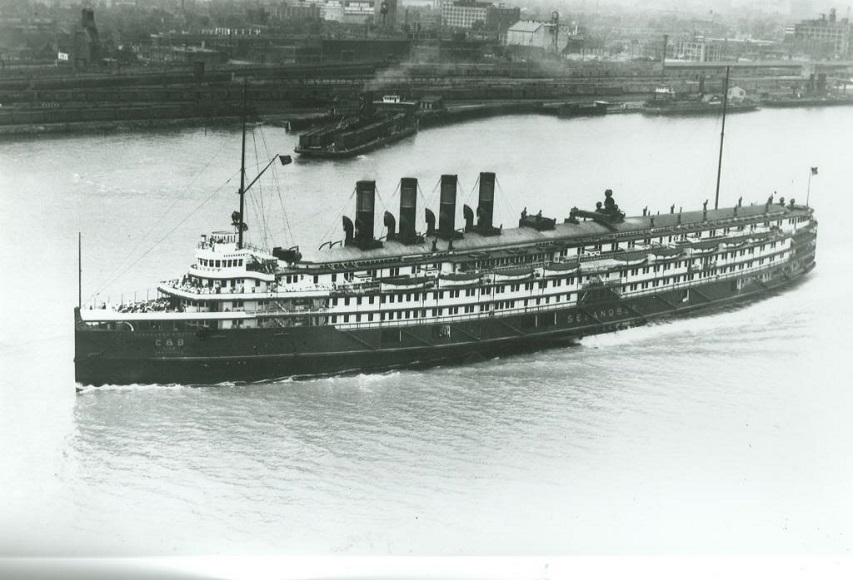
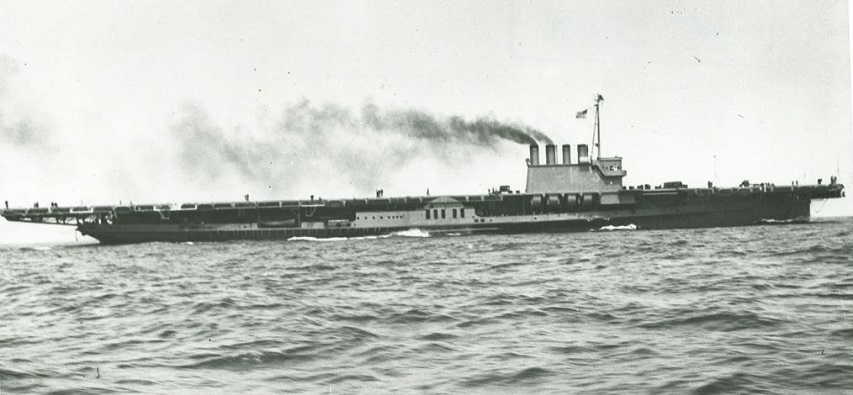
WIKI: USS Sable (IX-81) was a training ship of the United States Navy during World War II. Originally built as the Greater Buffalo, a sidewheel excursion steamer, she was converted in 1942 to a freshwater aircraft carrier to be used on the Great Lakes. She was used for advanced training for naval aviators in carrier takeoffs and landings. One aviator that trained upon the Sable was future president George H. W. Bush. Following World War II, Sable was decommissioned on 7 November 1945. She was sold for scrapping on 7 July 1948 to the H.H. Buncher Company.

The steamship 'Greater Buffalo' before it was converted to the 'USS Sable' (IX-81).

The steamship Greater Buffalo before it was converted to the USS Sable (IX-81).

Overhead view of the training aircraft carrier 'Sable' (IX 81) underway on Lake Michigan with an FM Wildcat making a deck launch from the flattop 1945

Overhead view of the training aircraft carrier Sable (IX 81) underway on Lake Michigan with an FM Wildcat making a deck launch from the flattop 1945

I was initially surprised that both training carriers were converted side-paddle steamers … I’d have thought the extra costs in converting to propeller drive would make them less-than ideal conversion subjects — you can clearly see in the second image that they left the side-paddles in place, so the main cost of conversion was the construction of the flight deck and repositioning the smokestacks to the starboard side (no hangar deck, elevators, or catapults in evidence):

WIKI: USS Wolverine (IX-64) a side-wheel excursion steamer built in 1913—was originally named Seeandbee, a name based upon her owners’ company name, the Cleveland and Buffalo Transit Co.[4] She was constructed by the American Ship Building Company of Wyandotte, Michigan. The Navy acquired the sidewheeler on 12 March 1942 and designated her an unclassified miscellaneous auxiliary, IX-64. She was purchased by the Navy in March 1942 and conversion to a training aircraft carrier began on 6 May 1942.[5] The name Wolverine was approved on 2 August 1942 with the ship being commissioned on 12 August 1942.[5][6] Intended to operate on Lake Michigan, IX-64 received its name because the state of Michigan is known as the Wolverine State.

The steamship 'Seeandbee' before it was converted to the 'USS Wolverine' (IX-64)

The steamship Seeandbee before it was converted to the USS Wolverine (IX-64)

A view of the USS Wolverine (IX-64) while underway in Lake Michigan 1942

A view of the USS Wolverine (IX-64) while underway in Lake Michigan 1942

And given that almost all the pilots were still learning their trade — these were training ships, after all — there were more than a few mishaps:

USS Sable (IX 81) showing a TBF hanging over the side after crashing during carrier qualifications on Lake Michigan.

USS Sable (IX 81) showing a TBF hanging over the side after crashing during carrier qualifications on Lake Michigan.

FM-2 Wildcat after crash onboard USS Sable

FM-2 Wildcat after crash onboard USS Sable

November 2, 2013

It’s “time” for a change

Filed under: Business, Cancon, History, Railways, USA — Tags: — Nicholas @ 10:29

In Quartz, Allison Schrager wonders why we still bother with daylight savings time and four separate timezones for continental US states:

Click to see full-size version at Quartz

Click to see full-size version at Quartz

This year, Americans on Eastern Standard Time should set their clocks back one hour (like normal), Americans on Central and Rocky Mountain time do nothing, and Americans on Pacific time should set their clocks forward one hour. After that we won’t change our clocks again — no more daylight saving. This will result in just two time zones for the continental United States. The east and west coasts will only be one hour apart. Anyone who lives on one coast and does business with the other can imagine the uncountable benefits of living in a two-time-zone nation (excluding Alaska and Hawaii).

It sounds radical, but it really isn’t. The purpose of uniform time measures is coordination. How we measure time has always evolved with the needs of commerce. According to Time and Date, a Norwegian newsletter dedicated to time zone information, America started using four time zones in 1883. Before that, each city had its own time standard based on its calculation of apparent solar time (when the sun is directly over-head at noon) using sundials. That led to more than 300 different American time zones. This made operations very difficult for the telegraph and burgeoning railroad industry. Railroads operated with 100 different time zones before America moved to four, which was consistent with Britain’s push for a global time standard. The following year, at the International Meridian Conference, it was decided that the entire world could coordinate time keeping based on the British Prime Meridian (except for France, which claimed the Prime Median ran through Paris until 1911). There are now 24 (or 25, depending on your existential view of the international date line) time zones, each taking about 15 degrees of longitude.

Now the world has evolved further — we are even more integrated and mobile, suggesting we’d benefit from fewer, more stable time zones. Why stick with a system designed for commerce in 1883? In reality, America already functions on fewer than four time zones. I spent the last three years commuting between New York and Austin, living on both Eastern and Central time. I found that in Austin, everyone did things at the same times they do them in New York, despite the difference in time zone. People got to work at 8am instead of 9am, restaurants were packed at 6pm instead of 7pm, and even the TV schedule was an hour earlier. But for the last three years I lived in a state of constant confusion, I rarely knew the time and was perpetually an hour late or early. And for what purpose? If everyone functions an hour earlier anyway, in part to coordinate with other parts of the country, the different time zones lose meaning and are reduced to an arbitrary inconvenience. Research based on time use surveys found Americans’ schedules are determined by television more than daylight. That suggests in effect, Americans already live on two time zones.

H/T to Tyler Cowen for the link.

Catalonia – the next state in Europe?

Filed under: Europe, Government, History, Politics — Tags: , , , , — Nicholas @ 09:53

Daniel Bogre Udell looks at the state of the independence movement in Catalonia, which has been part of Spain since the War of Spanish Succession in 1714, except for a brief interlude during the Spanish Civil War:

This year, on September 11, hundreds of thousands of Catalans joined hands to form a human chain that extended 460 kilometers across their region, from the French Pyrenean border to Valencia. Complete with matching t-shirts and slogans, this robust act of protest was astonishingly well-organised, which came as no surprise: it was in fact the echo of a mass demonstration that took place one year prior, when a million people took to the streets of Barcelona under the banner: “Catalonia: The Next State in Europe.”

The day after that first demonstration, Catalan President Artur Mas publicly endorsed the protest and called for a referendum on independence. Shortly after, he convoked early elections which produced a sweeping pro-referendum majority in Barcelona.

Overnight, Catalan politics changed. The Independentists were now in control. Unionists softened their rhetoric. Nearly two hundred towns in the Catalan countryside preemptively declared independence [ca]. Parliament passed a declaration of sovereignty.

Instead of taking this clamor seriously and engaging the Catalan public, most in the Spanish government, including Prime Minister Mariano Rajoy, positioned themselves firmly as antagonists. They insisted that referendum was illegal, framing Catalan nationalists as enemies of democracy and, in some extreme cases, comparing the sovereignty movement to Nazism.

They have also tried to promote the idea of Catalan nationalist ambitions as parochial and irrelevant. After a meeting with Catalan business leaders in Barcelona this month, Spain’s Deputy Prime Minister claimed not to have noticed any strong markers of regional identity. In a recent English-language interview with The Wall Street Journal, Prime Minister Rajoy described the hypothetical advent of Catalan independence as contrary to the world’s “natural evolution.” When addressing the Spanish public at the UN General Assembly, he went out of his way assure those in the chamber that none of his fellow world leaders had asked him about Catalonia.

Behind closed doors, however, it seems that Spanish officials are more concerned than their dismissive behavior implies: recently, Spain’s UN delegation drafted a report on how best to respond if Catalan leaders take their case to the international community in the wake of a successful referendum on independence. It asserted that Madrid could possibly draft security council allies into blocking Catalonia’s full statehood, but would be relatively powerless to stop the region’s admission as a General Assembly observer.

“Catalonia: The Next Partially-Recognized State” may not be as elegant a turn of phrase as those coined by activists, but it nonetheless haunts politicians in Madrid.

October 31, 2013

A garage of historical significance

Filed under: History, Technology, USA — Tags: , , — Nicholas @ 08:28

In The Register, a remarkably blasé report on the designation of the house where Jobs and Wozniak created the first Apple computers:

The house where Steve Jobs built his first computers has been added to a list of historic buildings in Los Altos.

The Los Altos Historical Commission voted unanimously to add the home at 2066 Crist Drive as a historic resources, since its hallowed garage was where Jobs made his first computers and co-founded Apple, the San Jose Mercury News reported.

The commission’s report said that it had been reviewing the property for potential designation for the past two years due to its “association with an event and an individual of historic significance”.

From other discussion on the topic, this will require the current owner of the property (Patricia Jobs, the sister of the late Steve Jobs) to get the commission’s advance permission to do any kind of work on the house … including ordinary maintenance. No funds from the municipality go along with this designation: once your house has been so designated, you no longer exercise full rights of ownership, but you still are required to pay for any work the commission deems necessary or desirable. Ms Jobs apparently still has a right to appeal, but I don’t know what her chances of success might be.

« Newer PostsOlder Posts »

Powered by WordPress