Quotulatiousness

February 23, 2014

Visiting the grave of Calvin Coolidge

Filed under: History, Politics, USA — Tags: , — Nicholas @ 11:32

I missed this post earlier in the week, as Mark Steyn briefly talks about visiting the grave of the 30th president in Plymouth Notch, Vermont:

Presidents are thin on the ground in my corner of New Hampshire. There’s Franklin Pierce down south, and Chester Arthur over in western Vermont (or, for believers in the original birther conspiracy, southern Quebec), but neither is any reason for a jamboree. So, for a while around Presidents Day, I’d drive my kids over the Connecticut River and we’d zig-zag down through the Green Mountain State to the Coolidge homestead in Plymouth Notch. And there, with the aid of snowshoes, we’d scramble up the three-foot drifts of the village’s steep hillside cemetery to Silent Cal’s grave. Seven generations of Coolidges are buried there all in a row — including Julius Caesar Coolidge, which is the kind of name I’d like to find on the ballot one November (strong on war, but committed to small government). The 30th president is as seemly and modest in death as in life, his headstone no different from those of his forebears or his sons — just a plain granite marker with name and dates: in the summer, if memory serves, there’s a small US flag in front, and there’s no snow so that, under the years of birth and death, you can see the small American eagle that is all that distinguishes this man’s gravestone from the earlier Calvin Coolidges in his line.

I do believe it’s the coolest grave of any head of state I’ve ever stood in front of. It moves me far more than the gaudier presidential memorials. “We draw our presidents from the people,” said Coolidge. “I came from them. I wish to be one of them again.” He lived the republican ideal most of our political class merely pays lip service to.

I came to Plymouth Notch during my first winter at my new home in New Hampshire, and purchased some cheddar from the village cheese factory still owned by his son John (he sold it in 1998). So, ever afterwards, the kids and I conclude our visit by swinging by the fromagerie and buying a round of their excellent granular curd cheese.

I just finished reading Amity Shlaes’ recent biography of Coolidge (highly recommended, by the way), and I have to admire a man who was able to walk away from the presidency despite the loud demands of his party to run again (and was almost certain to be re-elected if he had chosen to run). Coolidge was the last of the strong advocates for small government to occupy the White House. His immediate successor was very much the opposite: many of the big government ideals of FDR were strongly prefigured in the life and works of Hoover, despite later historians’ claims that Hoover was all about laissez faire economics.

February 19, 2014

Polygamy and the inevitable “bachelor herd”

Filed under: History, Middle East, Religion — Tags: , , , — Nicholas @ 12:11

William Tucker suggests that societies that practice polygamy will always produce a violent fringe of men too poor or too powerless to have even a chance of marriage (or any kind of stable relationship with women):

Polygamy? What does that have to do with anything? Am I suggesting that because some minor sheik outside Baghdad takes two wives, two young Muslim brothers in Massachusetts feel compelled to blow up the Boston Marathon?

Well, yes. In any human society there are approximately the same number of men and women. Under monogamy, which limits each man to one wife, everyone gets a fair chance to marry. When powerful and successful men are allowed to take more than one wife, however, as they are in a polygamous society, this creates a pool of unsuccessful men at the bottom of society who are constantly in conflict with the system.

The history of Islam has been one continuous story of rebel groups off in the desert and deciding that the religion being practiced by the authorities and their harems back in the cities is not the “true Islam.” They come crashing back upon the palaces, overthrowing the leaders (no Ottoman Sultan ever died of natural causes) and establishing a new regime that is just like the old one, where powerful are allowed to take multiple wives.

[…]

The fruits of polygamy are visible all over the Middle East. Because women are always in short supply, families can charge a “bride price” to any man who wants to marry their daughter. Because daughters are now worth money, they must be veiled and sequestered so they don’t run off with some callow youth. Older men desperate for wives push down into younger and younger cohorts of the population. Marriages between 35-year-old men and 13-year-old girls become common. […]

But the main product of polygamy is a population of angry young men who are ripe recruits for terrorism. The Koran supposedly limits a man to four wives but in countries where there are vast disparities of wealth this is routinely violated. Osama bin Laden’s father, a successful Saudi businessman, had 22 wives and 54 children. The unbalance between unmarried men and the available women in Saudi Arabia is the highest in the world.

February 18, 2014

Historical hooch – George Washington’s own White Lightning

Filed under: History, USA — Tags: , , — Nicholas @ 09:53

Uploaded on 16 Feb 2011

Many know George Washington as a general and statesman, but few think of America’s first president as a preeminent entrepreneur, operating the most successful whiskey distillery in the late 18th century. At its height, Washington’s distillery produced over 11,000 gallons of liquor a year, supplying the surrounding area and becoming one of his most lucrative business ventures.

At Washington’s former plantation, Mount Vernon, a group of historic interpreters are looking to bring this story to a wider audience. Thanks to a fully functioning replica of Washington’s distillery (and special dispensation from the Virginia General Assembly), George Washington’s rye whiskey is once again being made and sold to the public.

In November, Reason.tv followed the entire process as Dave Pickerell, Master Distiller and former Vice President of Operations for Maker’s Mark, and Steve Bashore, Mount Vernon Distillery Manager, oversaw a two week production run while adhering as strictly as possible to 18th century means and methods. The result is an 80-proof reminder of the nation’s first president and the entrepreneurial ideals of colonial America.

Shot, edited and produced by Meredith Bragg. Music by www.audionautix.com. Approx. 6 minutes.

H/T to Jon, my former virtual landlord, for the link.

February 17, 2014

Looking forward by looking backward – military evolution

Filed under: History, Military, Technology, Weapons — Tags: , , , — Nicholas @ 11:52

Strategy Page discusses the problems of predicting the future … which isn’t just a task for science fiction writers:

How will warfare change in the next 30 years? Military leaders, and the people they protect, are always trying to figure this out. There’s an easy way to get some good insight on the future. Simply go back 120 years (1894) and note the state of warfare and military technology at the time, then advance, 30 years at a time, until you reach 2014. At that point, making an educated guess at what 2044 will be like will like will be, if not easy, at least a lot less daunting.

In 1894, many infantry were still using single shot black powder rifles. Change was in the air though, and the United States had just begun to adopt the newfangled smokeless powder, a few years after it became widely available. In 1894 American troops were still replacing their black power rifles with a smokeless powder model (the Krag-Jorgensen). The modern machine-gun had been invented in 1883 but armies took about two decades before they began adopting them on a large scale. Most artillery was still short ranged, not very accurate, and could only fire at targets the crew could see. Horses pulled or carried stuff and the infantry marched a lot when they were not being moved long distances by railroad or steamships. But the modern, quick-firing artillery was recently introduced and still unproven in battle. Communications still relied on the telegraph, a half century old invention that revolutionized, in only a few decades, the way commanders could talk to each other over long distances. They could now do it in minutes. This was a big change for warfare. Very big. At this time telephones were all local and not portable. Cavalry was still important for scouting, although less useful for charging infantry (a trend that began when infantry got muskets with bayonets two centuries earlier).

[…]

So what does this portend for 2044? Faster and deadlier, for sure. Information war will be more than a buzzword by then because better sensors and data processing technology will make situational awareness (knowing where you and your enemy are, knowing it first, and acting on it before the other guy does) more decisive than ever.

If the expected breakthrough in batteries (fuel cells) evolves as reliably and cheaply as expected, the 2040s infantryman will be something of a cyborg. In addition to carrying several computers and sensor systems, he might wear body armor that also provides air conditioning. Satellite communications, of course, and two way video. Exoskeletons are already in the works and may mature by then. A lot depends on breakthroughs in battery tech although engineers are also finding to do more with just a little juice. Historians tend to constantly underestimate the cleverness of engineers and inventors in general.

But the big new development will be the continued evolution of robotic weapons. The World War II acoustic torpedo (used by the Germans and the allies, from subs as well as the air) was the first truly robotic weapon. You turned it lose and it would hunt down its prey and attack. There may be a lot of public uproar over land based systems that have sensors, can use them to hunt, and have weapons that can be used without human intervention. But those systems will be easy and cheap to build by 2044, and as soon as one nation builds them others will have to follow. By 2044, machines will be fighting other machines more often than they will be looking for the stray human on the battlefield.

But there will be other developments that are more difficult to anticipate. In 1894 most of the 1924 technologies were already known in a theoretical sense. Same with the 1954 technologies in 1924 and so on. What is most difficult to predict is exactly how new tech will be employed. There will be imagination and ingenuity involved there, and that sort of thing is, by its very nature, resistant to prediction.

February 16, 2014

QotD: Theodore Roosevelt’s admiration for Imperial Germany

Filed under: Europe, Germany, History, Quotations, WW1 — Tags: , , , — Nicholas @ 11:02

There was in the man a certain instinctive antipathy to the concrete aristocrat and in particular to the aristocrat’s private code — the product, no doubt, of his essentially bourgeois origin and training. But if he could not go with the Junkers all the way, he could at least go the whole length of their distrust of the third order — the undifferentiated masses of men below. Here, I daresay, he owed a lot to Nietzsche. He was always reading German books, and among them, no doubt, were Also sprach Zarathustra and Jenseits von Gut und Bose. In fact, the echoes were constantly sounding in his own harangues. Years ago, as an intellectual exercise while confined to hospital, I devised and printed a give-away of the Rooseveltian philosophy in parallel columns — in one column, extracts from The Strenuous Life; in the other, extracts from Nietzsche. The borrowings were numerous and unescapable. Theodore had swallowed Friedrich as a peasant swallows Peruna — bottle, cork, label and testimonials. Worse, the draft whetted his appetite, and soon he was swallowing the Kaiser of the Garde-Kavallerie-mess and battleship-launching speeches — another somewhat defective Junker. In his palmy days it was often impossible to distinguish his politico-theological bulls from those of Wilhelm; during the war, indeed, I suspect that some of them were boldly lifted by the British press bureau, and palmed off as felonious imprudences out of Potsdam. Wilhelm was his model in Weltpolitik, and in sociology, exegetics, administration, law, sport and connubial polity no less. Both roared for doughty armies, eternally prepared — for the theory that the way to prevent war is to make all conceivable enemies think twice, thrice, ten times. Both dreamed of gigantic navies, with battleships as long as Brooklyn Bridge. Both preached incessantly the duty of the citizen to the state, with the soft pedal upon the duty of the state to the citizen. Both praised the habitually gravid wife. Both delighted in the armed pursuit of the lower fauna. Both heavily patronized the fine arts. Both were intimates of God, and announced His desires with authority. Both believed that all men who stood opposed to them were prompted by the devil and would suffer for it in hell.

If, in fact, there was any difference between them, it was all in favor of Wilhelm. For one thing, he made very much fewer speeches; it took some colossal event, such as the launching of a dreadnaught or the birthday of a colonel-general, to get him upon his legs; the Reichstag was not constantly deluged with his advice and upbraiding. For another thing, he was a milder and more modest man — one more accustomed, let us say, to circumstance and authority, and hence less intoxicated by the greatness of his state. Finally, he had been trained to think, not only of his own immediate fortunes, but also of the remote interests of a family that, in his most expansive days, promised to hold the throne for many years, and so he cultivated a certain prudence, and even a certain ingratiating suavity. He could, on occasion, be extremely polite to an opponent. But Roosevelt was never polite to an opponent; perhaps a gentleman, by American standards, he was surely never a gentle man. In a political career of nearly forty years he was never even fair to an opponent. All of his gabble about the square deal was merely so much protective coloration, easily explicable on elementary Freudian grounds. No man, facing Roosevelt in the heat of controversy, ever actually got a square deal. He took extravagant advantages; he played to the worst idiocies of the mob; he hit below the belt almost habitually. One never thinks of him as a duelist, say of the school of Disraeli, Palmerston and, to drop a bit, Blaine. One always thinks of him as a glorified longshoreman engaged eternally in cleaning out bar-rooms — and not too proud to gouge when the inspiration came to him, or to bite in the clinches, or to oppose the relatively fragile brass knuckles of the code with chair-legs, bung-starters, cuspidors, demijohns, and ice-picks.

Abbott and Thayer, in their books, make elaborate efforts to depict their hero as one born with a deep loathing of the whole Prussian scheme of things, and particularly of the Prussian technique in combat. Abbott even goes so far as to hint that the attentions of the Kaiser, during Roosevelt’s historic tour of Europe on his return from Africa, were subtly revolting to him. Nothing could be more absurd. Prof. Dr. Sherman, in the article I have mentioned, blows up that nonsense by quoting from a speech made by the tourist in Berlin — a speech arguing for the most extreme sort of militarism in a manner that must have made even some of the Junkers blow their noses dubiously. The disproof need not be piled up; the America that Roosevelt dreamed of was always a sort of swollen Prussia, truculent without and regimented within. There was always a clank of the saber in his discourse; he could not discuss the tamest matter without swaggering in the best dragoon fashion.

H.L. Mencken, “Roosevelt: An Autopsy”, Prejudices, part 2, 1920.

February 14, 2014

Shakespeare’s Richard III

Filed under: History, Media — Tags: , , , — Nicholas @ 08:02

John Lennard is a fan of William Shakespeare and it shows in this blog post:

The Imploding I

Shakespeare’s Richard III is the principal source of a figure still current in drama and cinema — the witty devil we love to hate. Fusing the role of the (aspiring) King with that of the Vice (the tempter in morality plays, who as a player of tricks and user of disguises was always more theatrically aware than his innocent victims), Shakespeare produced a role that from his first, mesmerising soliloquy, beginning the play, commands both amused and horrified attention. As witty as he is ruthless, and as witting about himself as about others, Richard dominates the stage whenever he is on it, and all his tricks come off marvellously — until they don’t.

I’ve just transcribed the Folio text of the play it calls The Tragedy of Richard the Third : with the Landing of Earle Richmond, and the Battell at Bosworth Field […] and I was struck by how potently verse and punctuation record Richard’s force and his final implosion. Here’s that famous opening soliloquy:

Enter Richard Duke of Gloster, solus.

Now is the Winter of our Discontent,
Made glorious Summer by this Son of Yorke :
And all the clouds that lowr’d vpon our house
In the deepe bosome of the Ocean buried.
Now are our browes bound with Victorious Wreathes,
Our bruised armes hung vp for Monuments ;
Our sterne Alarums chang’d to merry Meetings ;
Our dreadfull Marches, to delightfull Measures.
Grim-visag’d Warre, hath smooth’d his wrinkled Front :
And now, in stead of mounting Barbed Steeds,
To fright the Soules of fearfull Aduersaries,
He capers nimbly in a Ladies Chamber,
To the lasciuious pleasing of a Lute.
But I, that am not shap’d for sportiue trickes,
Nor made to court an amorous Looking-glasse :
I, that am Rudely stampt, and want loues Maiesty,
To strut before a wonton ambling Nymph :
I, that am curtail’d of this faire Proportion,
Cheated of Feature by dissembling Nature,
Deform’d, vn-finish’d, sent before my time
Into this breathing World, scarse halfe made vp,
And that so lamely and vnfashionable,
That dogges barke at me, as I halt by them.
Why I (in this weake piping time of Peace)
Haue no delight to passe away the time,
Vnlesse to see my Shadow in the Sunne,
And descant on mine owne Deformity.
And therefore, since I cannot proue a Louer,
To entertaine these faire well spoken dayes,
I am determined to proue a Villaine,
And hate the idle pleasures of these dayes.
Plots haue I laide, Inductions dangerous,
By drunken Prophesies, Libels, and Dreames,
To set my Brother Clarence and the King
In deadly hate, the one against the other :
And if King Edward be as true and iust,
As I am Subtle, False, and Treacherous,
The day should Clarence closely be mew’d vp :
About a Prophesie, which sayes that G,
Of Edwards heyres the murtherer shall be.
Diue thoughts downe to my soule, here Clarence comes.

Everything here serves to present Richard’s complete control, and it’s an excellent example of the Ciceronian style and balance that characterises much of Shakespeare’s most fluent and speakable verse. For all its dynamism the language is exceptionally balanced and structured, bracing opposites within lines (“Our sterne Alarums chang’d to merry Meetings”, “That dogges barke at me, as I halt by them”) ; within couplets (“Now is the Winter of our Discontent, / Made glorious Summer by this Son of Yorke”, “Vnlesse to see my Shadow in the Sunne, / And descant on mine owne Deformity”) ; and within the quatrains that dominate the grammatical structure (“And now, in stead of mounting Barbed Steeds, / To fright the Soules of fearfull Aduersaries, / He capers nimbly in a Ladies Chamber, / To the lasciuious pleasing of a Lute”). The whole flows as trippingly as commandingly from the tongue, as generations of great actors have found, and the language is so strong and clear that it can bear very different styles of presentation. The two best Richards I’ve had the luck to see on stage, Anthony Sher and Ian McKellen, could not have tackled the role more differently — Sher was seriously hunched and scuttling on calipers that became weapons, feelers, probes at will ; McKellen was a restrained and clipped army officer whose only visible deformity was a hand kept always in his pocket — but both could draw equal strength and suasion from the magnificent verse Shakespeare provided.

February 13, 2014

“Minimize your therbligs”, or Taylor versus Gilbreth

Filed under: Business, History, USA — Tags: , , , — Nicholas @ 09:05

Sippican Cottage makes a strong case for Frank Bunker Gilbreth being the greatest man ever produced by Maine (republishing an older post from 2012):

Frank Gilbreth was born in Fairfield, Maine, in 1868. He never went to college except to teach at Purdue eventually. He’s famous, in a way, and anonymous in another. He’s the father portrayed in the original Cheaper By The Dozen, using a stopwatch to figure out how to make his family more efficient. That was his thing — efficiency.

He was a bricklayer. Built houses. He got to wondering if the repetition of laying one oblong slug of fired clay atop two others in a bed of mortar could be improved by observing the motions of skilled persons, breaking these exertions down into their component movements, and eliminating the wasted motions in the routines. It can, and he did. I’ve been a hod carrier and mason tender, and I can tell you that working off the ground or a platform the same height as your feet would be backbreaking and slow way to assemble masonry. We always used the footing form boards and leftover planks to assemble ad hoc shelves just lower than waist height behind the mason so that they could turn and pick up a brick and some mortar and go back to the next slot in the wall. I had no idea Clifton Webb, er, Frank Gilbreth came up with the idea less than a century before. It would be literally impossible to calculate how much time, money, effort, and how many worker’s backs Frank Gilbreth (and his wife, who was his partner and carried on after his early death) saved anonymously. His method is now universal and uncontroversial. How many people are incalculably useful to their fellow men?

I first heard of Gilbreth in my first college semester, and while the biographical detail is new to me, the basic idea is the same as my (post-strike replacement) instructor described. So who’s the “Taylor” of my title?

Frederick Taylor is the progenitor of so many things that are in the common language today that he deserves to be discussed with the most influential people of his time. That’s not necessarily a good thing. Almost all the fruit of Taylor’s tree is rotten.

Taylor is the guy standing behind dehumanized workers with a stopwatch, keeping track of bathroom breaks, and generally treating all work as a series of unrelated steps that any unskilled human could do, and constantly finding new ways of measuring it and subdividing it to harangue a little more out of the continually less and less skilled worker. “Scientific Management,” they called it. The Soviet Union loved it. They thought all people were just cogs in a big machine anyway. Most of the terms for malingering in dead-end jobs come from Taylorism. Goldbricking. Dogging it. Taylor observed that when normal people are in a group and everyone has the same duties, it is human nature for everyone in the group to devolve and perform at the level of the least capable and energetic member. His solution was a big expansion of management. He is the busted idol of micromanagement, and by extension, big government.

I have a lovely leather-bound copy of Taylor’s The Principles of Scientific Management that I’ve never actually opened … it was on the used book charity fundraising table at my local bank branch, so I paid $1 for it. From Sippican’s description, I may not bother to read it, as I think I’ve encountered most of the content in the working world.

Minimize your therbligs until it becomes automatic; this doubles your effective lifetime — and thereby gives time to enjoy butterflies and kittens and rainbows.

That’s Robert Heinlein in his “Lazarus Long” character voice. What the heck is a therblig, and why is it in this post? Therbligs are Gilbreth’s basic motions of physical work; the essential parts of any manual task. Minimize them to make the work more efficient. The name is derived, as my college instructor put it, by spelling Gilbreth sideways.

February 12, 2014

In praise of Frédéric Bastiat

Filed under: Economics, Europe, France, History — Tags: , , — Nicholas @ 08:48

Douglas Carswell wishes more people knew about nineteenth-century economist Frédéric Bastiat:

I reckon that one of the greatest Frenchman of all time is a fellow called Frédéric Bastiat (1801-1850). Not heard of him? France, I reckon, would have remained a truly global nation if more people had.

A free market, Classical liberal thinker, Bastiat grasped how wealth is created — and how parasitical elites and vested interests will seek to live off the productivity of others.

Nations rise, he could see, when various naturally parasitical interests were reined in, making production more fruitful than parasitism. Nations sunk into mediocrity, or remained there, when the parasites got their way — and other people’s wealth.

Far from being just a creature of his time, Bastiat speaks to us today. His spoof petition of the candlestick makers (they lobbied politicians to block out unfair competition from sunlight) tell us a great deal about the behaviour today of energy renewable interests and central bankers.

As a free market thinker, Bastiat was up there on a par with Adam Smith or Richard Cobden. Yet unlike Smith and Cobden, for all his brilliance, Bastiat had little impact on the French body politic. French lassies faire gave way to dirigisme. In terms of French politics, it is almost as if Bastiat might never have existed. And a once global player, presided over by a succession of enarques and corporatist cliques, sunk slowly into Hollandesque mediocrity.

My fear is that free-market thinkers on this side of the Channel could turn out to be little more than British Bastiats. Already the land of Adam Smith is run by a big, bloated state bureaucracy. The country that produced Cobden trades with the world on the basis of quota, not free competition.

February 11, 2014

Quebec’s anti-capitalist heritage

Filed under: Business, Cancon, History — Tags: , , , — Nicholas @ 13:15

At The Gods of the Copybook Headings, Richard Anderson looks at the problem Quebec has with entrepreneurial and capitalist tendencies:

The hatred of capitalism in the “Quebec Dark Ages” had little to do with Anglo economic dominance. That most quintessential of Canadian capitalist icons, the coureur de bois, was a black marketer who flouted the authority of the colonial government and the sanctioned merchant class. Official French society, on both sides of the Atlantic, has always despised businessmen, except for those rent seekers who paid homage to the powers that be. In New France these licensed traders were known as voyageurs.

This is a never resolved tension in Quebecois society, between the pure entrepreneur represented by the coureur de bois and the official capitalist represented by the voyageur. There has been no shortage in modern economic history of talented Quebecois entrepreneurs, but their efforts are widely regarded as being some how suspicious. There is something slightly unwholesome about turning a profit and speaking French at the same time.

This is not unique to French society. In most Catholic, or post-Catholic countries this suspicion of capitalism and free markets is endemic. To their credit the French-Canadians, unlike the Portuguese, never burnt businessmen at the stake for displaying “Jewish tendencies.” It was only in some of the Protestant societies that capitalism became somewhat respectable. My own suspicion is that this had less to do with theology and more to do with social dynamics.

February 5, 2014

Drawing the rhetorical battle lines for the war over the war

Filed under: Britain, Europe, History, WW1 — Tags: , — Nicholas @ 10:13

Tim Stanley on the ongoing war of words over the “celebrations” planned to mark the First World War in Britain:

The reality is that WWI had nothing to do with modern ideology, yet (ironically) we constantly seek to understand it through modern ideology. It started because the 19th-century diplomatic system broke down, undermining assumptions that various powers had no interest in fighting and would not do so when tested. Its bloodiness was due to technology: industrial warfare trumped the war of fast movement that everybody expected. And it ended because the Germans ran out of food. So it was non-ideological in spirit, but it did become the catalyst for various new ideologies. Britain convinced itself it was fighting for democracy. The Russians turned into Soviets and came to see WWI as the acme of capitalist aggression. A small band of German idiots decided defeat was down to a massive conspiracy of Jews so brilliant that it was impossible to actually explain how they pulled it off. And so the Second World War — a profoundly ideological war — was spawned by a conflict that lacked philosophical justification. No wonder memories are so confused.

We continue the mistake of seeing the past as if it was today. The neoconservatives, for example, are wrong to see “Prussian militarism” as embryonic Nazism — indeed the comparison is so slight as to be offensive. And if the plucky Brits were fighting imperialism, that raises the question of why we didn’t divest ourselves of our own possessions in Africa, Asia, Australisia etc. But the Left is equally wrong to see the First World War as a class conflict, as a case of lions led by donkeys. The aristocratic class happily signed up and were almost entirely exterminated as a result, thanks in part to the fact that they tended to be taller than the average soldier and so easier to aim at in the trenches.

Well, that perhaps, but rather more that the junior officers and company commanders actually led from the front, and were visibly distinct from the mass of their troops (making themselves more attractive targets). The allies were in the position of having to attack German positions for most of the war after the front lines solidified, which meant more opportunities for officers to be come casualties. The life expectancy of a junior officer on the Western front was said to be only six weeks.

This comment rather puzzles me, though:

Second, I’m still not entirely sure what we’re commemorating about the First World War and why. Obviously, we should always remember and honour our nation’s war dead — as we do every November. But why — as a nation — pick through every battle, every fact, every detail, every controversy and turn it into a parade? What relevance does it all have to us now? And why is it so often rated as more important than the American War of Independence, the English Civil War or the Scramble for Africa? Will it overshadow the anniversary of Waterloo next year, when, incidentally, the Brits were rather pleased to have Prussian militarism on their side? As European conflicts go, the Thirty Years War also screams out for a little more attention. The population in Germany fell by between 25 and 40 per cent; the Swedish armies destroyed one third of all German towns. That was Hell, too.

The First World War was different from what came before because it literally touched everyone: there were dead and wounded from every city, town, village, and hamlet. Everyone lost family members, friends, acquaintances, business partners, church members, and so on. Unlike the Crimean War, or the Zulu War, or the Boer War, this was the first mass conflict where the entire society had to be re-oriented to support the struggle. Privation was not just a word, as civilians faced food shortages, coal shortages, unrelenting propaganda through the newspapers, and misery all around. This was the end of Britain’s view of war as being something unpleasant at a distance, to be handled by a few good men in red coats.

February 4, 2014

“Chateau” generals

Filed under: Britain, Cancon, History, Military, USA, WW1, WW2 — Tags: , , , , — Nicholas @ 12:41

Nigel Davies has written a long post about the British and American standard of generalship in the two world wars, which won’t win him very many American (or Canadian) fans. That being said, he’s certainly right about the Canadian generals of WW2:

Contention: American senior generals in World War II were as bad, and for the same reason, as British senior generals in World War I.

[…] the politicians (and I will include Kitchener here, as he was by this time a politician with a military background rather than a real general), had based their recruiting campaign on a trendy ‘new model’ citizens army, rather than use the well developed existing territorial reserve system that would have done a far better job. They new enthusiastic troops were considered incapable of the traditional fire and movement approach of professional troops (the type that the Germans reintroduced in 1918 with their ‘commando units’, and the British army was able to copy soon after with properly trained and combat experienced personnel). Instead the enthusiastic amateurs were considered too badly trained to do more than advance in long straight lines… straight into the meat grinder.

Having said that the generals blame for the results should be at the very least shared with their political masters, I am still willing to express dissatisfaction with the approach of Haig and many of his senior commanders. They were Chateau Generals in approach and in attitude. They drew lines on maps without adequately considering the terrain, issued impossible instructions without looking at the state of the ground, and ran completely inadequate communications that were far from capable of keeping track of, or controlling, a modern battlefield.

[…]

It was noticeable later in the war that the more successful armies were commanded by competent and imaginative officers who insisted on detailed planning; intensive and specific tactical planning and operational training (down to practicing assaults on purpose built life size models); and very close control of operations to ensure success. They had usually learned the hard way, and had matured as experienced and pro-active leaders.

Of course some of this improvement was simply advances in technology. Tanks to breakthrough; better artillery fire plans to support and reduce casualties; air observation to enhance control and assess responses; better communications (including radio’s) to facilitate flexibility on the ground; and a generally better trained and more experienced soldier; with much more skilled officers. It all helped. But a lot came down to the attitude of the generals who believed that you got up front, found out the truth, stayed in close contact, and reacted to changed circumstances as immediately as possible.

However, as the American army was late to the battlefront, Davies contends that the leaders merely recapitulated the first stages of the bloody learning experience as their British counterparts, but didn’t produce the innovative leadership to match the Germans:

The Americans arrived on the Western Front when the war was already won. Only a few thousand were there for the last big German push, and by the time the Allies were moving to their final offensives with real American numbers involved, the German army was a broken reed. Which means that most American officers had only a few weeks of combat experience, and almost all of it against a failing army which had little resilience left to offer the type of resistance that might have caused the inexperienced American officers to have to reconsider their theories from their quicky officer training courses. Even the professional military officers received, at best, only a couple of hints that their ideas might not be inevitably effective against a stronger opponent. Certainly not enough time to learn how to analyse and adapt to circumstances in serious combat.

Which is why the majority of highly recognised American higher commanders in World War II appear to be chateau generals.

[…]

Eisenhower’s mistakes in theatre commands in Italy and France were possibly no worse in results than Wilson’s ongoing problems with Greece (he led the ‘forlorn hopes’ of both 1941 and 1944 there), but Eisenhower failed far more spectacularly with the Italian surrender, the Broad Front strategy, and the Bulge, than Wilson ever did with far inferior resources. MacArthur’s failures are more readily compared with Percival than the successes of a man like Leese, and Nimitz is often referred to as one of the great captains of history, for defeating a navy that repeatedly sabotaged its own efforts in the Pacific theatre. (Often by people who haven’t seemed to have ever heard of Max Horton’s much harder victory against the ruthlessly efficient U-boat campaign in the Atlantic theatre).

Similarly it is fair to say that the American front line commanders most people have never heard of were hardly inferior to their famous British contemporaries. Eichelberger was as good a commander, and as good a co-operator in Allied operations, as Alexander ever was. Truscott was probably at least the equal of Montgomery, given the opportunity. (I suspect possibly even better actually, but who can say?) Simpson, in his brief few months at the front, impressed many British officers who had served for years under men as good as Slim. And Ridgway showed in his few months of active operations a level of skill and competence (not necessarily the same thing) that far more experienced men like O’Connor did not surpass.

Why do we hear about the American chateau generals in preference to their front line leaders? And why do we hear about the British front line leaders in preference to their back office superiors. I would say it is because the British had been through a learning process in WWI that the Americans had not.

And the Canadian angle? As I’ve noted before, the First Canadian Army (scroll down to the item on John A. English’s book) was not as combat-effective in WW2 as the Canadian Corps had been in the First World War. One of the most obvious failings was in the advance to Antwerp:

Note that the equivalent British debacle during that campaign was when the Canadian Army took Antwerp undamaged, but then stopped for a rest before cutting off the retreating Germans. The Germans quickly fortified the riverbanks leading to the port, keeping it out of use for months. This was a clear example of the Canadian generals inexperience, and Montgomery is at fault here for being too involved in the last attempt to break the Germans before Christmas — Market Garden — and not paying close enough attention to one of his Army commanders, who was not supervising his Corps commander, who was not chasing his divisional commander adequately. (No one is imune from such glitches in a fast moving campaign. Inexperience any where down the chain can cause big problems. But it is noticeable that Crerar’s failure did not get him the public acclaim Patton has enjoyed?) Crerar was a ‘political appointment’ by the Canadians (an ‘able administrator’, but militarily ‘mediocre’ according to most) who Montgomery considered to be as inferior in experience and attitude as many of the American ‘chateau leaders’ he would have put in the same basket. By contrast Monty was delighted when the more competent front line leaders – the Canadian Simonds and the American Simpson – were assigned to him instead. As in the cases of the Australian General Morshead or the Polish General Anders, Montgomery only cared about ability, not nationality. But as was the case with the Americans, all too many generals in most armies, including the British and German armies, lacked experience or ability.

Update, 13 February: Mark Collins linked to an earlier post that helpfully describes some of the problems with Canadian generalship in Europe:

The Canadian command style in WW II was even more stuck in the mud than the American. With a few exceptions (McNaughton, Burns, Crerar) most Canadian generals had little or no General Staff experience, and those that did were practitioners of a successful, for the earlier WW I time and place, doctrine based on set piece battles founded on the systematic and intensive use of artillery.

One virtue of the German system is that it allowed officers to make mistakes: it did not allow them to sit on their butts waiting for orders; it encouraged risk taking which often worked but sometimes ended in bloody disaster (indeed it’s amazing it didn’t in France in 1940).

Indeed comparing the Canadian Army in WWII with the German is very difficult. Both had to expand from a tiny base to their war-time peak, but the Germans began in 1933 (actually even before then); we didn’t really begin until 1940. The Germans lost the Great War and the Reichswehr gave serious thought to how to do better next time.

One thing underlying the British set piece battle approach and limited freedom for commanders – the one the Canadian Army followed – seems to have been their realization in the late 1930s that the British Army was simply not as good as its 1914 ancestor. That was partly because of the losses of promising junior officers who never made general [though that affected the Germans too], partly because of indifference to defence at the governmental level, and partly because the military lapsed all too happily back into “real soldiering” in the 20’s.

February 1, 2014

Economics can’t explain everything – the “Great Fact”

Filed under: Economics, History — Tags: , , — Nicholas @ 09:02

David Boaz rounds up a few human moments to illustrate the “Great Fact”:

In Bourgeois Dignity: Why Economics Can’t Explain the Modern World, economic historian Deirdre McCloskey writes about the “Great Fact” — the enormous and unprecedented growth in living standards that began in the western world around 1700. She calls it “a factor of sixteen”: we moderns consume at least 16 times the food, clothing, housing, and education that our ancestors did in London in the 18th century.

[…]

And finally, I note an older book on my own Scottish ancestors, The Scotch-Irish: A Social History by James G. Leyburn:

    The squalor and meanness of [lowland Scottish] life around 1600 [or 1700] can hardly be conceived by a person of the twentieth century. A cluster of hovels housed the tenants and their helpers….A home was likely to be little more than a shanty, constructed of stones, banked with turf, without mortar, and with straw, heather, or moss stuffed in the holes to keep out the blasts….The fire, usually in the middle of the house floor, often filled the whole hut with malodorous clouds, since the smoke-clotted roof gradually stopped the vent-hole. Cattle were tethered at night at one end of the room, while the family lay at the other end on heather piled upon the floor….Vermin abounded…skin diseases…Infectious diseases were propagated readily.

According to scholars such as Angus Maddison and Brad DeLong, GDP per capita hardly rose for thousands, or tens of thousands, of years before the emergence of capitalism. And then after 100,000 years of stagnation (by DeLong’s estimates), around 1750 capitalism and growth began, first in Northern Europe and the American seaboard, and spreading ever since to more parts of the world. That is, the existence of relatively free markets is the reason we don’t live like my Scottish ancestors. This is indeed the Great Fact of the modern world. We should celebrate it, even as we work to extend the benefits of markets to people and nations who don’t yet enjoy as much capitalism as they should.

January 29, 2014

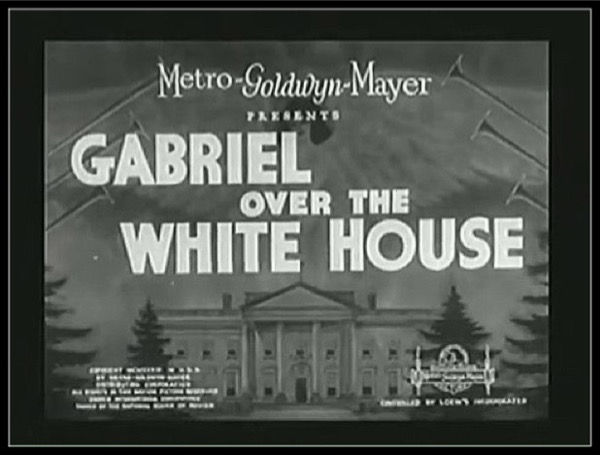
Pitching the New Deal through film – Gabriel Over the White House

Filed under: History, Media, Politics, USA — Tags: , , , — Nicholas @ 10:01

I’d never heard of Gabriel Over the White House, so Jonah Goldberg‘s summary was quite interesting:

The legendary media tycoon William Randolph Hearst believed America needed a strongman and that Franklin D. Roosevelt would fit the bill. He ordered his newspapers to support FDR and the New Deal. At his direction, Hearst’s political allies rallied around Roosevelt at the Democratic convention, which some believe sealed the deal for Roosevelt’s nomination.

But all that wasn’t enough. Hearst also believed the voters had to be made to see what could be gained from a president with a free hand. So he financed the film Gabriel Over the White House, starring Walter Huston. The film depicts an FDR look-alike president who, after a coma-inducing car accident, is transformed from a passive Warren Harding type into a hands-on dictator. The reborn commander-in-chief suspends the Constitution, violently wipes out corruption, and revives the economy through a national socialist agenda. When Congress tries to impeach him, he dissolves Congress.

The Library of Congress summarizes the film nicely. “The good news: He reduces unemployment, lifts the country out of the Depression, battles gangsters and Congress, and brings about world peace. The bad news: He’s Mussolini.”

Hearst wanted to make sure the script got it right, so he sent it to what today might be called a script doctor, namely Roosevelt. FDR loved it, but he did have some changes, which Hearst eagerly accepted. A month into his first term, FDR sent Hearst a thank-you note. “I want to send you this line to tell you how pleased I am with the changes you made in Gabriel Over the White House,” Roosevelt wrote. “I think it is an intensely interesting picture and should do much to help.”

You can probably get the overall tone of the movie from this clip:

Even the editors at Wikipedia — hardly a hotbed of proto-fascists — describe it as “an example of totalitarian propaganda”:

Controversial since the time of its release, Gabriel Over the White House is widely acknowledged to be an example of totalitarian propaganda. Tweed, the author of the original novel, was a “liberal champion of government activism” and trusted adviser to David Lloyd George, the Liberal Prime Minister who brought Bismarck’s welfare state to the United Kingdom. The decision to buy the story was made by producer Walter Wanger, variously described as “a liberal Democrat” or a “liberal Hollywood mogul.” After two weeks of script preparation, Wanger secured the financial backing of media magnate William Randolph Hearst, one of President Franklin D. Roosevelt’s staunchest supporters, who had helped him get the Democratic presidential nomination and who enlisted his entire media empire to campaign for him. Hearst intended the film to be a tribute to FDR and an attack on previous Republican administrations.

Although an internal MGM synopsis had labeled the script “wildly reactionary and radical to the nth degree,” studio boss Louis B. Mayer “learned only when he attended the Glendale, California preview that Hammond gradually turns America into a dictatorship,” writes film historian Leonard J. Leff. “Mayer was furious, telling his lieutenant, ‘Put that picture back in its can, take it back to the studio, and lock it up!'”

Released only a few weeks after Franklin Roosevelt’s inauguration, the film was labeled by The New Republic “a half-hearted plea for Fascism.” Its purpose, agreed The Nation, was “to convert innocent American movie audiences to a policy of fascist dictatorship in this country.” Newsweek‘s Jonathan Alter concurred in 2007 that the movie was meant to “prepare the public for a dictatorship,” as well as to be an instructional guide for FDR, who read the script during the campaign. He liked it so much that he took time during the hectic first weeks of his presidency to suggest several script rewrites that were incorporated into the film. “An aroma of fascism clung to the heavily edited release print,” according to Leff. Roosevelt saw an advance screening, writing, “I want to send you this line to tell you how pleased I am with the changes you made in Gabriel Over the White House. I think it is an intensely interesting picture and should do much to help.” Roosevelt saw the movie several times and enjoyed it. After a private screening, First Lady Eleanor Roosevelt wrote that “if a million unemployed marched on Washington … I’d do what the President does in the picture!”

Update, 5 November, 2018: James Lileks takes the opportunity to review this film on the eve of tomorrow’s US midterm elections.

For Election week, a remarkable movie. And I don’t mean “astonishingly good, technically superb, visually ingenious.” I mean utterly insane.

January 28, 2014

The last Frost Fair on the Thames

Filed under: Britain, Environment, History — Tags: , — Nicholas @ 08:29

The famous river doesn’t freeze as it did during the Little Ice Age, so the very last Frost Fair was held in 1814:

Painting by Luke Clenell, entitled The Fair on the Thames, Feb'y 4th 1814

Painting by Luke Clenell, entitled The Fair on the Thames, Feb’y 4th 1814

It is 200 years ago since the last “frost fair” — an impromptu festival on a frozen Thames, complete with dancing, skittles and temporary pubs. Could such hedonism be repeated today?

Londoners stood on the Thames eating gingerbread and sipping gin. The party on the frozen river had begun on 1 February and would carry on for another four days.

The ice was thick enough to support printing presses churning out souvenirs. Oxen were roasted in front of roaring fires, drink was liberally taken and dances were held. An elephant was marched across the river alongside Blackfriars Bridge.

It was February 1814. George III was on the throne, Lord Liverpool was prime minister and the Napoleonic wars would soon be won.

People didn’t know it then but this “frost fair” — a cross between a Christmas market, circus and illegal rave — would be the last. In the 200 years that have elapsed since, the Thames has never frozen solid enough for such hedonism to be repeated.

But between 1309 and 1814, the Thames froze at least 23 times and on five of these occasions — 1683-4, 1716, 1739-40, 1789 and 1814 — the ice was thick enough to hold a fair.

Update: Over lunch, I was reading Correlli Barnett’s Marlborough and came across this description of the onset of winter in 1708-09 (and a frost fair that the BBC didn’t list):

And for Europe too the coming of a Whig administration in England was a fateful event. The Whig leaders were hot for the exaction from Louis XIV of ‘no peace without Spain – entire’, without any compromise whatsoever. Yet in the winter and spring of 1709 even such inflated war aims began to look practicable. Before the Duke at last closed down the Oudenarde campaign in January 1709, long after the normal time for going into winter quarters, he had retaken Bruges and Ghent. And the siege of Ghent witnessed the onset of an enemy even more terrible to France than Marlborough. In the last days of 1708 cold of unimagined bitterness closed on Europe like a trap. At Ghent the sentinels of besieged and besieging forces alike were frozen to death at their posts. And this was only a beginning: after a short and deceptive thaw in January, the cold set in like another ice age, the people of Europe cringing month after month under a bruise-coloured sky heavy with snow. On the frozen Thames at London Bridge there was an ice fair; a little city of booths and stalls stretching from bank to bank, and bonfires twinkling across the ice in the polar gloom. From Brussels Marlborough was reporting to Heinsius in February:

    The continuall snow as well as hard frost will, if it continues, kill al the cattel of this country and bee very inconvenient for our garrisons, for even in this town we have no forage but what we bring dayly by carts …

The port of Harwich was ice bound; so were the Dutch ports. There were ice floes in the Channel. Even the mouth of the Tagus at Lisbon was frozen. It was fortunate indeed that the Duke had not carried out his post-Oudenarde plan to invade France, or his army might now have been lying somewhere between Abbeville and Paris, with seaborne supplies cut off by ice, and dependent for subsistence on what it could find in the French countryside.

And in France, already impoverished by war as she was, famine had come in the wake of frost. The cattle died; the vines split. In the towns and the country the starving wandered in search of food in ragged, despairing packs. The very fabric of French society seemed in peril from the effects of the cold.

January 27, 2014

QotD: Montreuil and Le Corbusier

Montreuil reminded me strongly of something: ah yes, I remember what it was, Eastern Europe in the good old days. It had that same air of inspissated gloom and ontological pointlessness; the architecture would have gladdened the heart (so to speak) of Elena Ceausescu. The bus passed through a wasteland of 1970s modernism, egalitarian doctrine made not so much flesh as concrete. The buildings did not age, they dilapidated; it was architecture that induced immediate thoughts of suicide. (Le Corbusier is still revered in France and treated as a hero, though it should be obvious to anyone who reads any of his voluminous writings that he was a psychopathic architectural delinquent of totalitarian pretensions whose talents belonged more to the field of propaganda than to those of architecture, in which his abilities were all negative.) The bus stops were in places such as Saint-Just, the patron saint of revolutionary terror, and Nouvelle France: new in the same sense that the New Man, so beloved of Mussolini and Che Guevara, was going to be new. Montreuil is, in fact, firmly communist, and it shows, although honesty compels me to admit that I don’t know which came first: the communism or the ugliness of everything. Probably the relationship is what Marxists used to call a dialectical one.

Theodore Dalrymple, “Museum of the Living Dead”, Taki’s Magazine, 2014-01-26

« Newer PostsOlder Posts »

Powered by WordPress


