Quotulatiousness

March 19, 2014

This isn’t Cold War 2.0, it’s a return to historical norm

Filed under: Europe, History, Politics, Russia, USA — Tags: , — Nicholas @ 08:31

Jonah Goldberg asks everyone to stop talking about a new Cold War, because the old one was a unique event (or event-chain) and what we’re seeing now is more like history unfolded before the Cold War came along to freeze geopolitics for a few decades.

… the Cold War was far more than a conflict with Russia. Everyone should agree on that. Communism, anti-Communism, and anti-anti-Communism divided Americans for decades, particularly among academic and media elites. Right and Left may still argue over the merits of those divisions, but no informed person disputes that the topic of Communism — the real version and the imagined ideal — incited riots of intellectual and political disagreement in the West for a half-century.

Meanwhile, Putin’s ideology holds little such allure to Americans or the populations of the European Union. With the exception of a few cranky apologists and flacks, it’s hard to find anyone in the West openly defending Putin on the merits. And even those who come close are generally doing so in a backhanded way to criticize U.S. policies or the Obama administration. The dream of a “greater Russia” or a “Eurasian Union” simply does not put fire in the minds of men — non-Russian men, at least — the way the dream of global socialist revolution once did. And that’s a good thing.

[…]

Many have called the decade between the fall of the Soviet Union and the attacks of 9/11 a “holiday from history.” The truth is closer to the opposite. The Cold War years, while historic in a literal sense, were something of a great parentheses, a sharp departure from historical norms. Communism was a transnational ideology imposed on nationalist movements. That’s why every supposedly Communist movement eventually became nationalist once in power. Still, the rhetorical and psychological power of Communist ideology, combined with the fear of nuclear war, made international relations seem like a sharp break with how foreign affairs worked before 1945 — or 1917.

It turns out, the Berlin Wall wasn’t blocking us from a new world order, it was holding back the tide of history. Western Europe was especially slow to realize this. Its politicians and intellectuals persuaded themselves that they had created a continental “zone of peace” through diplomacy, when in reality they were taking U.S. protection for granted. They let their militaries atrophy to the point of being little more than ceremonial.

The end of the Cold War fostered the illusion that the “guns or butter” argument had been permanently settled and we “wouldn’t study war no more”. The peace dividend was always an illusion — a very attractive illusion to politicians who wanted to spend money on things that would get them re-elected — and voters rewarded them appropriately. It’s going to be psychologically difficult for the countries of the West to come to terms with the return of the traditional forces of history.


“The French Revolution was a ‘revolution of ideas’ before it became ‘a revolution of fact'”

Filed under: Books, Europe, France, History, Liberty — Tags: — Nicholas @ 07:35

Duncan Kelly reviews Revolutionary Ideas: An Intellectual History of the French Revolution from The Rights of Man to Robespierre, by Jonathan Israel.

According to this hefty new study of the French Revolution by Jonathan Israel, a professor of history at Princeton, what such events really show is the motivating power of ideas in guiding and transforming events. In his terms, the French Revolution was a “revolution of ideas” before it became “a revolution of fact”; indeed, it was three revolutions all at once.

Ideas about political equality, anticlericalism and modern republicanism grounded in “reason” motivated Radical Enlightenment thinkers such as Condorcet and Thomas Paine, while they clashed with the “moderate Enlightenment constitutional monarchism” embodied by more pro-royalist factions (the Feuillants) and aristocratic supporters such as Lafayette. Both struggled against Robespierre’s “authoritarian populism”, which for Israel prefigures modern fascism.

The radical compound in this instance might have been uniquely French but its impact spread widely. The resounding Declaration of the Rights of Man, writes Israel, was a “manifesto entirely incompatible with all ancien régime notions of social, racial, and religious hierarchy”. Revolution lent support to Caribbean struggles for black emancipation such as that of Toussaint L’Ouverture in Haiti, memorably described in CLR James’s 1938 classic The Black Jacobins. James’s book, however, is an odd omission in Israel’s otherwise compendious bibliography.

[…]

Historians have often criticised Israel for flattening out all the differences between these radical ideas except those he wants to retain and, when applied to the French Revolution, his arguments can feel like the inverse of some 19th-century Marxist schema. Instead of subterranean economic determinations, it is Radical Enlightenment that provides the means by which everything from press freedom to de-Christianisation can be slotted into a matrix requiring little in the way of extra interpretation.

What you get from such a focus on subversive editors, disenchanted priests and materialist philosophers has much in common with a more conventional account: food shortages, public debt crises and social grievances from Paris to the Vendée, combined with a plethora of radical ideas about press freedom, absolute equality, political liberty and radical democracy. Yet the vaulting ambition to ascribe such a momentous transformation to one cause still feels hubristic. The obvious parallel in this year of all years would be the thought that there might be a single idea or singular complex of ideas behind the outbreak of the first world war. Can you imagine such a claim commanding general assent?

March 18, 2014

The Hitchhiker’s Guide goes online

Filed under: Gaming, History, Humour — Nicholas @ 09:39

BBC Radio 4 has an online edition of the old Microprose Infocom game The Hitchhiker’s Guide to the Galaxy:

Hitchhiker's Guide 30th anniversary edition

I played this game on my very first PC (a Corona PC clone with a massive 256K memory and two floppy drives). It was incredibly frustrating. I seem to remember dying a lot. I think that was the designer’s intent.

Update: Don’t know why I said it was a Microprose product, when the UI clearly states it was Infocom … senility setting in early, I guess.

March 16, 2014

Defining hackers and hacker culture

Filed under: History, Technology — Tags: , , , — Nicholas @ 09:49

ESR put this together as a backgrounder for a documentary film maker:

In its original and still most correct sense, the word “hacker” describes a member of a tribe of expert and playful programmers with roots in 1960s and 1970s computer-science academia, the early microcomputer experimenters, and several other contributory cultures including science-fiction fandom.

Through a historical process I could explain in as much detail as you like, this hacker culture became the architects of today’s Internet and evolved into the open-source software movement. (I had a significant role in this process as historian and activist, which is why my friends recommended that you talk to me.)

People outside this culture sometimes refer to it as “old-school hackers” or “white-hat hackers” (the latter term also has some more specific shades of meaning). People inside it (including me) insist that we are just “hackers” and using that term for anyone else is misleading and disrespectful.

Within this culture, “hacker” applied to an individual is understood to be a title of honor which it is arrogant to claim for yourself. It has to be conferred by people who are already insiders. You earn it by building things, by a combination of work and cleverness and the right attitude. Nowadays “building things” centers on open-source software and hardware, and on the support services for open-source projects.

There are — seriously — people in the hacker culture who refuse to describe themselves individually as hackers because they think they haven’t earned the title yet — they haven’t built enough stuff. One of the social functions of tribal elders like myself is to be seen to be conferring the title, a certification that is taken quite seriously; it’s like being knighted.

[…]

There is a cluster of geek subcultures within which the term “hacker” has very high prestige. If you think about my earlier description it should be clear why. Building stuff is cool, it’s an achievement.

There is a tendency for members of those other subcultures to try to appropriate hacker status for themselves, and to emulate various hacker behaviors — sometimes superficially, sometimes deeply and genuinely.

Imitative behavior creates a sort of gray zone around the hacker culture proper. Some people in that zone are mere posers. Some are genuinely trying to act out hacker values as they (incompletely) understand them. Some are ‘hacktivists’ with Internet-related political agendas but who don’t write code. Some are outright criminals exploiting journalistic confusion about what “hacker” means. Some are ambiguous mixtures of several of these types.

March 14, 2014

Iain Martin on the three phases of Tony Benn’s political career

Filed under: Britain, History, Politics — Tags: , , , , , — Nicholas @ 08:12

The death of Tony Benn was announced this morning, and the Telegraph‘s Iain Martin says that Benn’s political trajectory had three distinct phases:

The BBC‘s James Landale described it well this morning only minutes after the death of Tony Benn was announced. There were, he told the Today programme, three phases of Tony Benn the public figure. That is right, and in the second phase Benn almost destroyed the Labour Party. His death — or his reinvention as a national treasure from the late 1980s onwards — doesn’t alter that reality.

In the 1950s and 1960s Benn was part of Labour’s supposed wave of the future, serving in Wilson’s governments and embodying the technocratic approach that was going to forge a modern Britain in the “white heat of technology”. It didn’t work out like that.

[…]

But it is when Labour found itself out of power in 1979 that Benn the socialist preacher applied his considerable talents — his gift for public speaking and the denunciation of rivals — to trying to turn Labour, one of Britain’s two great parties that dominated the 20th century, from being a broad church into a party that stood only for his, by then, very dangerous brand of Left-wing extremism. In the wars of that period against Labour’s Right-wing and soft centre he did not operate alone, but he was the figurehead of a Bennite movement that created the conditions in which the SDP breakaway became necessary, splitting the Left and giving Margaret Thatcher an enormous advantage to the joy of Tories. When Labour crashed to defeat in 1983, Benn even said that the result was a good start because millions of voters had voted for an authentically socialist manifesto, which would have taken Britain back to the stone age if implemented.

From there, after a bitter interlude and a sulk, Benn began his final and, this time, wonderful transformation, during which he was elevated to the ranks of national treasure — a pipe-smoking man of letters, like a great National Trust property crossed with George Orwell. As with many journalists of my generation, I encountered him one on one only in that third phase, and found him, as many others did, a deeply courteous, amusing and interesting man. It was his defence of the Commons, against the Executive, that I liked, and when he spoke on such themes it was possible to imagine him at Cromwell’s elbow in the English Civil War, or printing off radical pamphlets before falling out with the parliamentary leadership after the King had had his head cut off.

March 13, 2014

The Pity of War was a strange programme; flashy, lopsided, inconsequentially contrarian”

Filed under: Books, Britain, Europe, Germany, History, Media, WW1 — Tags: , — Nicholas @ 08:00

In a post at the History Today site, Paul Lay describes a rebroadcast of the BBC production based on Niall Ferguson’s The Pity of War:

It featured Niall Ferguson, the Harvard historian, reviving the arguments of his 1998 book of the same name: that Britain and its Empire should have stayed out of the war to leave Europe to be dominated by the economic giant that was the Kaiser’s imperium, much as the EU is now led by the wealthy, democratic Germany of Angela Merkel. After having spent almost an hour outlining his argument, Ferguson’s thesis was then quickly shot down by a phalanx of historians of the First World War, including Gary Sheffield, Heather Jones and Hew Strachan.

The Pity of War was a strange programme; flashy, lopsided, inconsequentially contrarian. At one point it ran a brief clip of A.J.P. Taylor, doyen of television historians, in his 1977 series How Wars Begin. The BBC don’t tend to produce programmes like that anymore — a single academic historian, addressing the audience with complex arguments in real time to camera — except that they do. The best, the most instructive and original television offering so far on the outbreak of the war is that of the constitutional historian Vernon Bogdanor: his lecture entitled Diplomacy: Sir Edward Grey and the Crisis of 1914, originally broadcast last year on the BBC Parliament channel and therefore, sadly, seen by few.

)

March 12, 2014

A short history of the web

Filed under: History, Technology — Tags: — Nicholas @ 09:05

At the Guardian, an amusing way to present the short-but-fascinating history of the World Wide Web (when did we stop calling it by its formal name?):

A partial history of the open web, in snakes and ladders form

It was 25 years ago today that Tim Berners-Lee suggested the creation of the world wide web. As the creator speaks to the Guardian about his hopes for its future, we look at the triumphs of accessibility and challenges to openness that mark the history of the web

A short history of the web

However, pay attention to the claims in many headlines, as Kelly Fiveash suggests:

Top 5 headlines that claim Tim Berners Lee ‘INVENTED the INTERNET’. Whoops!
You’ll never guess what happened next

Newspapers are quite rightly back-slapping Brit inventor Tim Berners-Lee today — the man who brought the world wide web to the, er, world 25 years ago today.

It’s a pity, then, that mainstream publications continue to stumble over the concept by lazily and wrongly saying that Berners-Lee birthed the internet.

Sub-editors across the land are scrambling to correct copy that was carelessly slapped online with headlines stupidly claiming that TBL was the god-like creature who came up with the network of networks idea.

March 11, 2014

Stop That Tank!

Filed under: Cancon, History, Military, Weapons, WW2 — Tags: , , , — Nicholas @ 00:01

Published on 31 May 2013

During World War II, the Disney company joined in the Allied war effort by producing animated movie material at cost for the US government (they also created insignia mascots for hundreds of aircraft and warships by request). These films number well over one hundred – although most are only partially created by Disney – and cover topics from antenna tuning to Beechcraft airplane maintenance to anti-German and Japanese propaganda. However, one piece in particular is of interest to us here at Forgotten Weapons: Stop That Tank!

Produced in 1942 for the Canadian military, it is a training film on the operation and maintenance of the Boys anti-tank rifle. The Disney contribution is in animated x-ray views of the various parts of the gun, and about 3 minutes of introduction featuring a section of Nazi tanks (the lead one driven by none other than Adolf Hitler) being surprised and driven back by a bunch of plucky doughboys hiding Boys AT rifles in bushes, outhouses, and horses.

The intro is pretty hilarious, but the meat of the film is actually a very informative piece on how the Boys works and how to use it. There are a couple copies of this already on YouTube, but thanks to reader Frank, we have this nice high-quality version.

Just one thing: if it was a Canadian film, there wouldn’t be any “doughboys” involved…

H/T to Think Defence for the link. They’ve also got a video of a modern shooter firing the Boys ATR (not using the original ammunition, this has been refitted to fire .50 BMG).

March 10, 2014

Remarkably modern headlines from 100 years ago

Filed under: Europe, France, Germany, History, Russia, WW1 — Nicholas @ 09:18

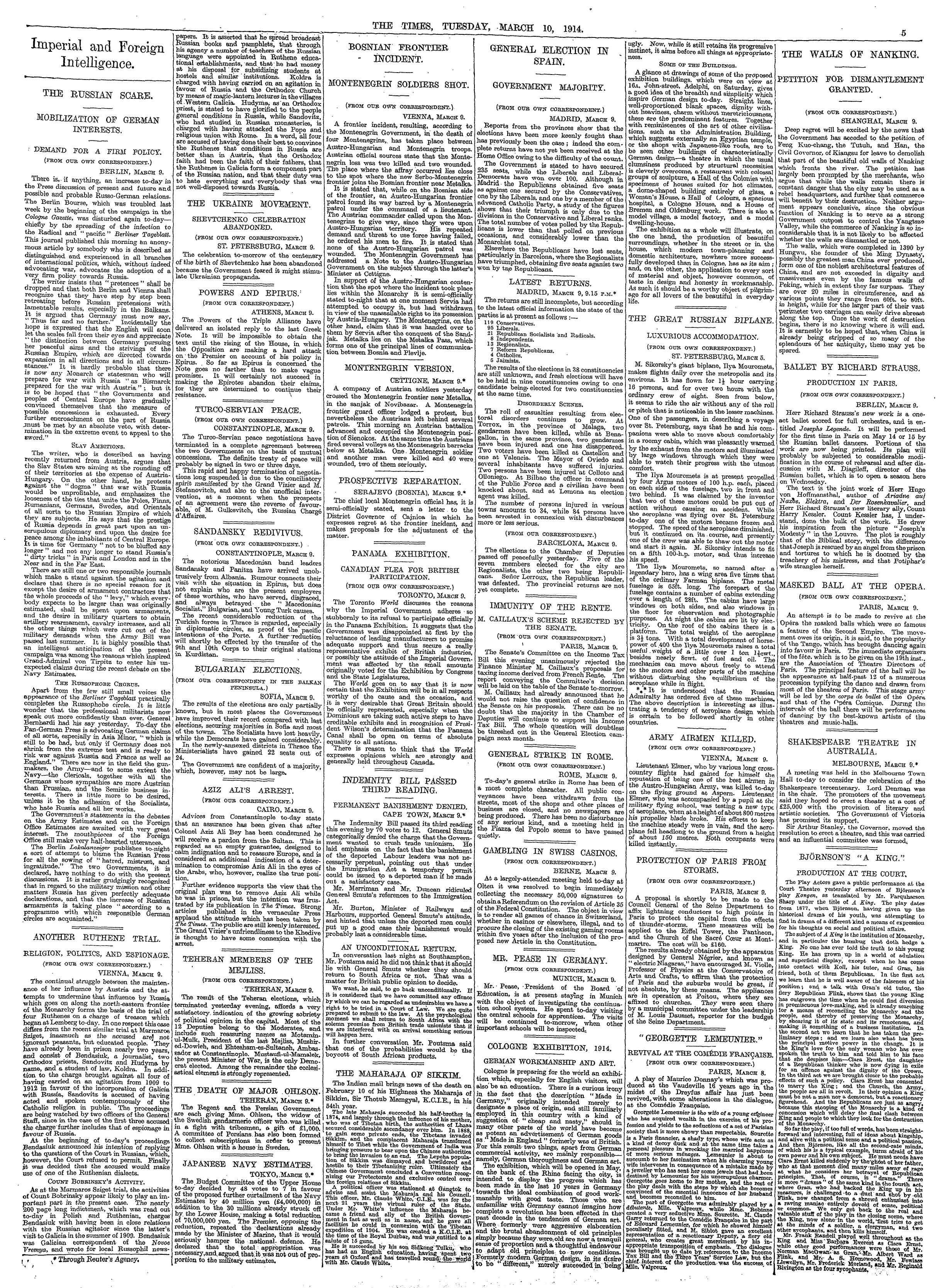
At Samizdata, Patrick Crozier talks about the situation in Europe exactly a century back, and the headlines might almost be run today:

Click to see full page

Click to see full page

Over the last few days (this is 1914 we’re talking about just in case anyone was in any doubt) a large number of articles have appeared in the German press on the threat posed by Russia. And still they come:

    There is, if anything, an increase to-day in the Press discussion of present and future and possible and probable Russo-German relations. The Berlin Bourse, which was troubled last week by the beginning of the campaign in the Cologne Gazette, was disturbed again to-day – chiefly by the spreading of the infection to the Radical and “pacific” Berliner Tageblatt. This journal published this morning an anonymous article by somebody who is described as distinguished and experienced in all branches of international politics, which, without indeed advocating war, advocates the adoption of a very firm policy towards Russia.

This is co-ordinated and there’s only one body that would be doing the co-ordination: the German government. They are preparing the population for war. The argument being used is precisely the argument being used in the corridors of power: the Russians are building up their forces and in a few years they will be too strong and it will be too late. In other words: it’s now or never.

It is not just the Russians the Germans are worried about. The Russians on their own would be fairly harmless (as indeed they proved to be) but they are in alliance with France. This leads to Germany’s worst nightmare: the prospect of a war on two fronts. This in turn leads to the development of the Schlieffen Plan with its aim to eliminate one of those fronts before the other one got going.

There is an alternative. Germany could return Alsace-Lorraine to France. At a stroke they would eliminate the one and only bone of contention in the Franco-German relationship and as a consequence break up the Franco-Russian alliance. But no.

There are good reasons why the German government isn’t so keen on such a move. By accepting self-determination in Alsace-Lorraine they would be accepting the principle of democracy. This is hardly the sort of thing that a monarchy can do. There would also be the element of losing face that weak regimes are very reluctant to do.

March 3, 2014

The origins of hacking and the myth of a lost Eden of open source code

Filed under: History, Technology — Tags: , , , — Nicholas @ 09:40

Gather round you kids, ’cause Uncle Eric is going to tell you about the dim, distant days of hacking before open source:

I was a historian before I was an activist, and I’ve been reminded recently that a lot of younger hackers have a simplified and somewhat mythologized view of how our culture evolved, one which tends to back-project today’s conditions onto the past.

In particular, many of us never knew – or are in the process of forgetting – how dependent we used to be on proprietary software. I think by failing to remember that past we are risking that we will misunderstand the present and mispredict the future, so I’m going to do what I can to set the record straight.

[…]

Without the Unix-spawned framework of concepts and technologies, having source code simply didn’t help very much. This is hard for younger hackers to realize, because they have no experience of the software world before retargetable compilers and code portability became relatively common. It’s hard for a lot of older hackers to remember because we mostly cut our teeth on Unix environments that were a few crucial years ahead of the curve.

But we shouldn’t forget. One very good reason is that believing a myth of the fall obscures the remarkable rise that we actually accomplished, bootstrapping ourselves up through a series of technological and social inventions to where open source on everyone’s desk and in everyone’s phone and ubiquitous in the Internet infrastructure is now taken for granted.

We didn’t get here because we failed in our duty to protect a prelapsarian software commons, but because we succeeded in creating one. That is worth remembering.

Update: In a follow-up post, ESR talks about closed source “sharecroppers” and Unix “nomads”.

Like the communities around SHARE (IBM mainframe users) and DECUS (DEC minicomputers) in the 1960s and 1970s, whatever community existed around ESPOL was radically limited by its utter dependence on the permissions and APIs that a single vendor was willing to provide. The ESPOL compiler was not retargetable. Whatever community developed around it could neither develop any autonomy nor survive the death of its hardware platform; the contributors had no place to retreat to in the event of predictable single-point failures.

I’ll call this sort of community “sharecroppers”. That term is a reference to SHARE, the oldest such user group. It also roughly expresses the relationship between these user groups and contributors, on the one hand, and the vendor on the other. The implied power relationship was pretty totally asymmetrical.

Contrast this with early Unix development. The key difference is that Unix-hosted code could survive the death of not just original hardware platforms but entire product lines and vendors, and contributors could develop a portable skillset and toolkits. The enabling technology – retargetable C compilers – made them not sharecroppers but nomads, able to evade vendor control by leaving for platforms that were less locked down and taking their tools with them.

I understand that it’s sentimentally appealing to retrospectively sweep all the early sharecropper communities into “open source”. But I think it’s a mistake, because it blurs the importance of retargetability, the ability to resist or evade vendor lock-in, and portable tools that you can take away with you.

Without those things you cannot have anything like the individual mental habits or collective scale of contributions that I think is required before saying “an open-source culture” is really meaningful.

Decorative wooden boxes from a steam-powered box factory

Filed under: Business, History, Woodworking — Tags: , — Nicholas @ 09:14

Published on 19 Feb 2011

The Phillips Brothers all Steam Powered Box Factory, founded in 1897, is family owned and operated and listed in the National Register of Historic places. This mill is believed to be the last fully operational all steam powered mill in America.

www.phillipsbrothersmill.com

H/T to Roger Henry for the link.

February 28, 2014

“Reenactment’s for pussies”

Filed under: Europe, History, Russia, Sports, Weapons — Tags: , , — Nicholas @ 13:39

The SCA or Western Martial Arts not macho enough for you? You might be interested in medieval combat with steel weapons:

Steel kisses steel. Actual sparks fly. An axe snaps in half as it dents a helmet. A municipal garbage bin, carelessly left at the fringes of the fight, implodes in a sorry mess of dented plastic as four armored men collapse onto it.

I’m witnessing, from the far side of a flimsy rope, something much more violent than your average historical battle reenactment. These men are engaging in full-contact medieval combat in an open training session for the U.K. iteration of a growing global society. More GBH than LARP, it substitutes foam weaponry for real steel and scripted acting for unpredictable scuffling, and despite the mayhem, operates under tightly controlled rules and regulations.

[…]

The team’s press officer, Nick Birkin, agrees. “Reenactors are used to dink, dink,” he says, mimicking the prissy swordplay anyone who’s sat through a retelling of Agincourt will no doubt cringe to recall. Another weekend warrior sums up the distinction more succinctly: “Reenactment’s for pussies.”

I first heard about the Russian origins of this new organization from a co-worker who was still upset he’d had to leave his chainmail and weapons behind when he came to Canada from St. Petersburg. It sounded like great fun … but was significantly more injury-prone than the SCA combat of my youth.

The Russian connection also brings with it some aspects that make Western practitioners uncomfortable:

The West’s notions of fair play and how an international tournament should be run are, it would seem, at odds with that of the East’s. Dissent has been stirring among the camps and honor was called into question on several sides, and complaints started to be raised about the Russian organizers. The first to percolate were stories about rule-changing and underhand tournament organization.

“They said that under no circumstances can you have a metal handle on your shield, and that you can’t wear titanium armor,” U.S. team captain Andre Sinou tells me later over the phone from his native New Jersey. Sinou is also the owner of an armory manufacturer called Icefalcon. “So I told my guys that. Then when we went out there, all the Eastern teams had metal handles. We complained, and they said, ‘Oh, we sent out a memo’, which none of the Western countries got.”

Many of the Eastern fighters were wearing Kevlar armor under their suits and came with lethal equipment — such as two-handled halberd axes — that was banned for anyone else. “The weapons that some of the Eastern teams were using were just dangerous,” Sinou says. “They were pointy, they didn’t follow the rules for sharpness. After 2013, we had puncture wounds — we had a meaty guy who got punctured all the way down to the bone on the shoulder. It hit his spine. He could have been paralyzed.”

Nick Birkin from Team U.K. echoes many of these complaints and adds his own stories of match fixing, detailing devious techniques that would put a Sochi figure-skating judge to shame and which apparently allowed Russian teams to progress further and enjoy longer rest breaks between contests. But the growing concerns of an increasing number of countries was met by a response almost laughably Kafkaesque.

H/T to Steve Muhlberger for the link.

February 27, 2014

The Parachute Regiment

Filed under: Britain, History, Military, WW2 — Tags: , — Nicholas @ 08:13

February 25, 2014

Official launch of the Laurier Military History Archive

Filed under: Cancon, History, Military, WW2 — Tags: , , — Nicholas @ 10:52

A post at the Laurier Centre for Military Strategic and Disarmament Studies website introduces a digitized collection of maps, unit diaries, and other Canadian military history artifacts:

The Laurier Military History Archive – www.lmharchive.ca – is a project that was initiated in the Summer of 2013 by the Laurier Centre for Military Strategic and Disarmament Studies (LCMSDS), at Wilfrid Laurier University (Waterloo, Ontario). It offers the public previously unavailable access to a variety of digitized materials from LCMSDS’ archival holdings, and will increasingly offer digitized materials in partnership with other archival institutions and private donors. At time of our official launch of the website we would like to draw your attention to three collections in particular which our dedicated volunteers have worked hard to make available to you.

The three featured collections are the Second World War Canadian Army Air Photos Collection, The George Lindsey Fonds, and The Canadian War Diaries of the Normandy Campaign Collection.

February 23, 2014

Winter storms uncover a “Welsh Atlantis”

Filed under: Britain, Environment, History — Tags: , , , — Nicholas @ 11:54

A story in the Express about waves from recent storms having uncovered a previously unknown ancient forest on the shores of Cardigan Bay:

Gales stripped the sand from a beach at Borth in Ceredigion, West Wales, revealing the remains of a 6,000-year-old forest.

A picture of the same spot taken before the storms shows a strip of pristine sand.

The ancient oaks and pines date back to the Bronze Age.

They were discovered by Deanna Groom and Ross Cook from the Royal Commission on the Ancient and Historical Monuments of Wales.

Miss Groom, a maritime archeologist said: “The site around Borth is one where if there’s a bad storm and it gets battered, you know there’s a good chance something will be uncovered as the peat gets washed away.

“It’s regularly monitored and that’s why we went to have a look there again now to see if anything new had emerged.”

The ancient remains are said by some to be the origins of the legend of Cantre’r Gwaelod, a mythical kingdom now submerged under the waters of Cardigan Bay.

It has been described as a “Welsh Atlantis” and has featured in folklore, literature and song.

H/T to Elizabeth for the link.

Update: Elizabeth also sent a link that shows that ancient oak stumps aren’t the only things being uncovered by the waves:

The latest hazard caused by this winter’s devastating storms and floods has been revealed by police — unexploded bombs.

The storms that have ravaged and reshaped parts of the British coastline have led to the discovery of wartime shells long-buried on beaches.

There are also fears that flooding along the Thames will erode riverbanks, leading to the discovery of bombs dropped on the area by the Luftwaffe during the Second World War.

Police say that high tides and huge waves have either exposed devices or brought them closer to the surface.

Further storms and flooding are expected today as a new front moves in from the Atlantic. The Met Office has issued three severe rain warnings and gusts of wind are expected to reach 70mph.

The Environment Agency also still has 48 severe flood warnings issued across the UK following what the Met Office has described as the wettest winter on record.

Now walkers are being urged not to touch unidentified metal objects but to alert police to their finds instead.

In South West England and West Wales, which bore the brunt of the storms, six devices have been handled by bomb disposal units in six weeks.

The Navy’s Southern Diving Group said it had received a 20 per cent increase in reports of unexploded bombs since January.

A 100lb Mk XIX Second World War British anti-submarine mine was found by surfers at Watwick Bay, Haverfordwest, while a rare First World War German mine surfaced on a beach near the popular Cornish resort of Newquay.

« Newer PostsOlder Posts »

Powered by WordPress