
Stormwalker Group
Published 5 Dec 2025Join Mario Gaudet, former Army Reservist and military brat, in Episode 3 of “Units of the CAF” as we delve into the legendary Princess Patricia’s Canadian Light Infantry (PPCLI).
Discover their early history, unique uniform quirks and cap badge story, plus their valor in WW1, WW2, the Cold War, and Afghanistan — featuring the most decorated soldiers from each era.
Sources:
•General PPCLI History: https://www.canada.ca/en/department-n…
•Sgt. George Harry Mullin VC (WW1): https://vcgca.org/our-people/profile/…
•Maj. John Keefer Mahony VC (WW2): https://veterans.gc.ca/en/remembrance…
•Sgt. Tommy Prince MM (Cold War/Korea): https://en.wikipedia.org/wiki/Tommy_P…
•WO Patrick Tower SMV (Afghanistan): https://en.wikipedia.org/wiki/Patrick…
•Additional Regimental Details: https://ppcliassn.ca/ppcli-the-regime…#PPCLI #CanadianArmy #MilitaryHistory #CAF #WW1 #WW2 #KoreanWar #Afghanistan #VictoriaCross #Veterans #CanadianForces
April 27, 2026
UOTCAF – EP 003 – PPCLI (Patricias)
April 26, 2026
Rightists think leftists are stupid and leftists think rightists are evil
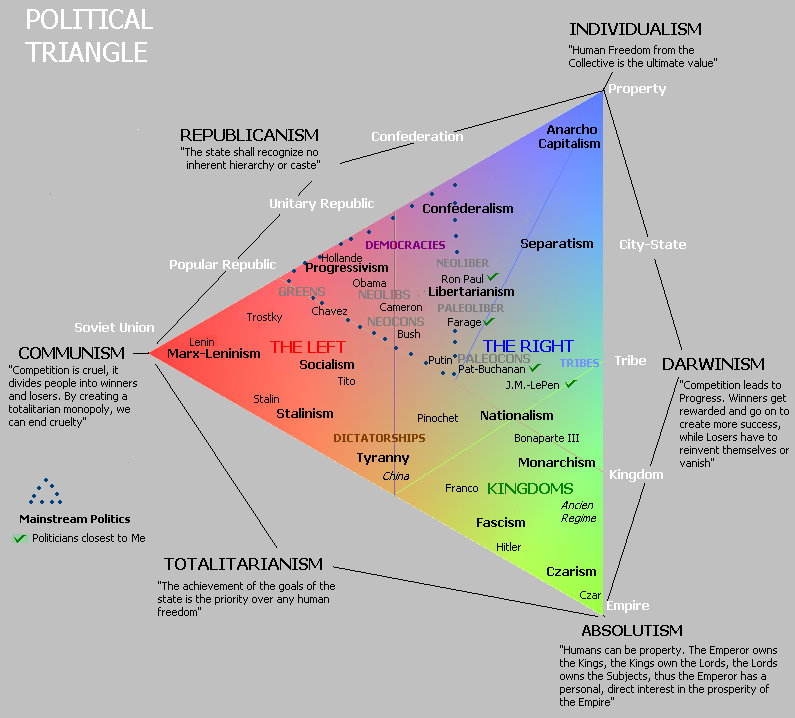
Lorenzo Warby discusses political categories and explains why they aren’t the same as moral categories:
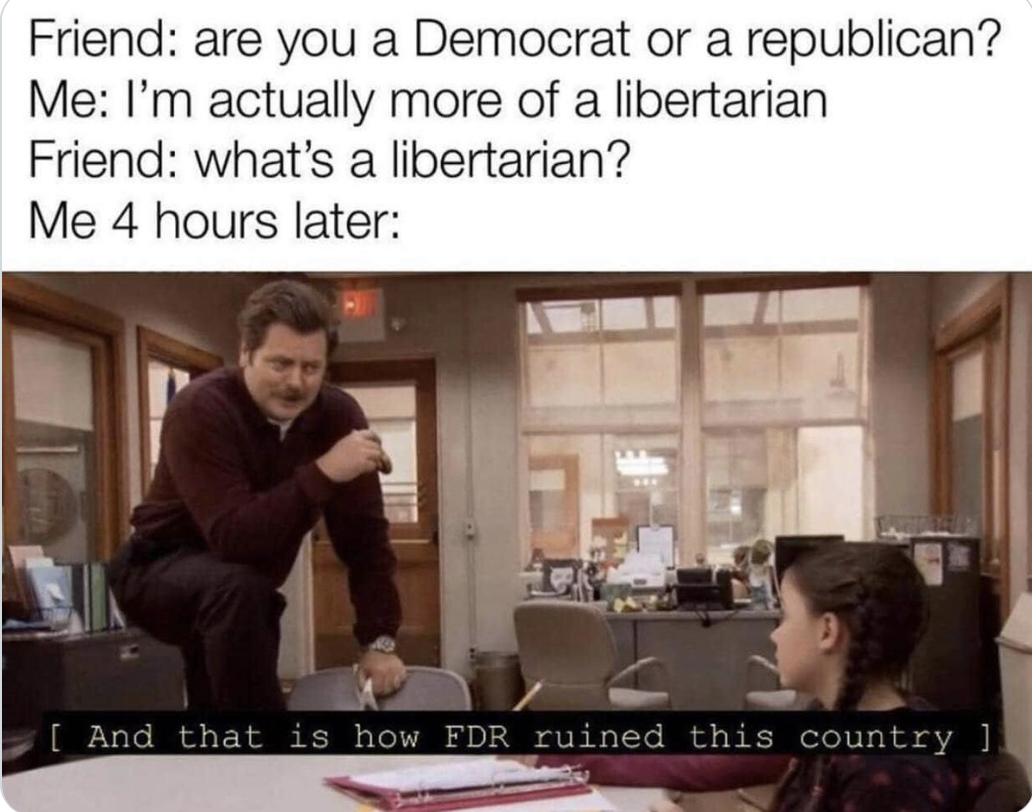
A lot of people who class themselves as being on the Left clearly feel that there is some automatic moral kudos from being on the Left. As a direct implication of this sense of moral kudos, they also clearly think that there is some moral deficiency from being on the Right.
Yes, there are difficulties in defining Left and Right. Nevertheless, even without that difficulty, any such claim of moral kudos is ridiculous. The Left includes Lenin, Stalin, Mao, Kim il-Sung, Pol Pot, Mengistu … Indeed, by far the most important historical impact of Left politics on world history is precisely the actions of this succession of mass-murdering tyrants and their regimes.
If you think that somehow the Left does not include said mass-murdering tyrants, you are simply wrong. It is very revealing that there are clearly many folk on the Left who somehow edit out this history. They are not looking at the Left as it is in history, but as some set of noble aspirations that morally ennoble themselves.
Folk not of the Left absolutely associate the Left with those mass-murdering tyrants. Moreover, if you edit out that history, you are editing out how the political tradition you identify with can go horribly wrong. That is not a reassuring pattern. On the contrary, it is a deeply worrying pattern.
Of course, if you are happy to be associated with some or all of those mass-murdering tyrants, that is even more of a worry.
Clearly, Left is not a moral category. It is a political category, not a moral one.
The same point applies, of course, about the Right. After all, the Right includes Hitler.
Thus, neither Left nor Right are moral categories. They are political categories, and political categories that people can get very tribal about. But they are not moral categories.
This point applies to other political categories: Socialist, for example. Hitler was a socialist. He called himself a socialist, he did socialist things, intended to do more socialist things after the war. In his writings, he argued in socialist ways.
The aforementioned mass-murdering tyrants were all socialists. They were implementing socialism on the way to communism, except for Hitler, who was using socialism as a tool to forge an Aryan super race worthy and able to dominate others. So, Socialist is not a moral category.
If you stop regarding broad political categories as also being moral categories, a lot of silly arguments go away. Such as, for example, whether Hitler was a socialist. Or, whether Hitler was of the Right. Yes, Hitler was a both a socialist and of the Right—which points to how diverse a range of political traditions Right applies to.
Even when there are grounds to attaching moral valence to political categories, that is something to be done carefully and sparingly, otherwise it can seriously get in the way of understanding.
Thus, using Fascist as a boo! word but Communist as a neutral, or even hurrah! word, is ridiculous. It is even more so when Fascist is used to obscure Nazis being National Socialists.
How to Stage (and Win) an International Crisis – Death of Democracy 13 – Q1 1936
World War Two and Spartacus Olsson
Published 25 Apr 2026In early 1936, Adolf Hitler took one of the greatest risks of his rule — sending German troops into the demilitarized Rhineland in direct violation of the Treaty of Versailles and the Locarno Pact. It was a gamble that could have triggered immediate war. Instead, it became a turning point that transformed Hitler from a powerful dictator into a figure many Germans saw as a national savior.
In this episode of Death of Democracy, we examine how the re-militarization of the Rhineland, combined with the propaganda spectacle of the 1936 Winter Olympics in Garmisch-Partenkirchen, helped cement Hitler’s popularity at home while exposing the paralysis of Britain and France abroad. Through contemporary voices like William L. Shirer and Victor Klemperer, we explore the uneasy mix of fear, relief, and growing enthusiasm among ordinary Germans — alongside the continued escalation of repression against Jews and political opponents.
This quarter reveals a crucial dynamic: how foreign policy success, propaganda, and public sentiment fused to elevate Hitler into something approaching a political messiah — while simultaneously closing the space for resistance.
History is not inevitable — but moments like this show how easily it can be shaped.
The Ancient Greeks: 01 – What Made Them Special? (a): Origins, Collapse, and Reinvention
seangabb
Published 31 Jan 2026This section introduces the Greek world and challenges common assumptions about Greek civilisation.
It examines who the Greeks were, where they came from, and how fragmented their political and cultural world was. It then explores the collapse of Bronze Age Greece around 1200 BC and the long Greek Dark Age that followed, during which writing disappeared, monumental architecture ceased, and long-distance trade declined.
When Greek civilisation recovered around 800 BC, it did not restore the Mycenaean world. Instead, it reinvented itself, drawing on epic poetry and myth rather than historical memory.
A central argument of this section is that the later Greeks knew less about their own early history than we do, and that Greek civilisation was rebuilt not on continuity, but on reinvention.
April 25, 2026
Steyr M1912/16 Automatic “Repetierpistole“
Forgotten Weapons
Published 8 Dec 2025In the latter half of World War One the Austro-Hungarian military experimented with a number of select-fire pistol type weapons. One of these was the Steyr Repetierpistole M1912/16, an automatic adaptation of the regular M1912 pistol. It was given a 16-round fixed magazine (loaded via two 8-round stripper clips) and a selector switch. A total of 200 were produced, each supplied with a shoulder stock to help make the blistering 1200 rpm rate of fire somewhat usable. The design was not made from scratch, but rather adapted form the existing 1912 fire control system, which makes for a rather unorthodox system.
In addition to 200 of these pistols, the Austro-Hungarian military also acquired 50 twin-gun systems, which two of these pistols were attached to a frame with a single shoulder stock between them (no surviving examples of those are known today).
Frommer Pistolen-MG Model 1917 video:
• Frommer Pistolen-MG Model 1917: A Crazy Vi…Many thanks to the VHU — the Czech Military History Institute — for giving me access to these two fantastic prototypes to film for you. The Army Museum Žižkov is a part of the Institute, and they have a 3-story museum full of cool exhibits open to the public in Prague. If you have a chance to visit, it’s definitely worth the time! You can find all of their details (including their aviation and armor museums) here:
QotD: Goethe, the lost German master
This was the atmosphere in which I discovered Germany. It was a minor act of defiance to choose German instead of Latin for O-level, but with hindsight I was extremely fortunate to have the choice. There were two German teachers in my grammar school of just 600 pupils. Today, even the best state schools seldom offer the subject; not one of our four children has had the opportunity that I had to study German language and, especially, literature up to the high standard that was then expected at A-level.
Today, the texts are almost all recent and appear to be chosen partly with the film of the book in mind. In particular, Goethe has disappeared from the syllabus, presumably because the language is considered too archaic. Yet I recall the immense pleasure and satisfaction of mastering a Goethe play — Egmont. The story of the dashing Dutchman and his martial defiance of the sinister Duke of Alba, the courage of his beloved, Klärchen, who fantasises in song about how wonderful it would be to be a man and fight the Spaniards — “ein Glück sondergleichen ein Mannsbild zu sein“. Somehow I even obtained an LP of Beethoven’s incidental music for Egmont: seldom heard apart from the overture, but brilliantly evoking the grandeur of the drama.
Like Homer, Dante and Shakespeare, Goethe belongs not just to German literature, but to world literature, Weltliteratur — a term he coined. I am told that even in German Gymnasien, Goethe is little studied now. He is certainly a rare bird in English schools — or even universities. It is tragic that educated people, including students of literature, so seldom encounter the greatest of Germans even in translation. We might get on better with Germany if we did.
Daniel Johnson, “How I discovered Germany”, The Critic, 2020-08-02.
April 23, 2026
They put out propaganda because it works
I often find myself commenting on social media posts that the Canadian government’s direct subsidies to most of the mainstream media in Canada has created one of the most effective propaganda machines since 1930s Germany. “eLbOwS uP!” They keep doing it because it clearly is working fantastically well on a large enough share of Canadian voters that the polls (which may or may not be biased) keep touting that Dear Leader Carney and the Natural Governing Party are ever more popular. And most of the people consuming the propaganda message have their preferences re-inforced and the cycle starts again.
At Cracking Defence, Matthew Palmer discusses wartime propaganda during the 20th century, emphasizing that it’s the use to which it is put rather than the mechanism itself that has a moral value:
Propaganda is an absolute favourite subject of mine — probably not surprising considering that one of my roles in the military was psychological operations.1 Despite its very negative connotations thanks to the work of interwar writers like Frederick Ponsonby,2 propaganda really should be seen as a neutral term, perhaps best defined as “the deliberate attempt to persuade people to think and behave in a desired way”.3 Nor does it need to be state-driven; propaganda can come be generated from below as much as being driven top-down from the state or elites.
Some of the best propaganda comes out of wartime, and the First and Second World Wars were absolute goldmines. I also have a particular weakness for propaganda drawn up in early modernist and art deco styles, for which the first half of the 20th century was the high watermark. As such, here are a few of my all-time favourites for your delectation.4
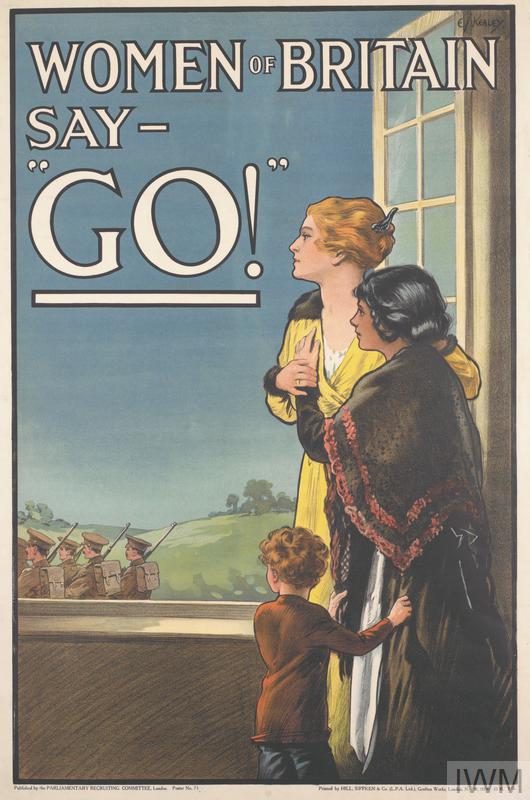
Women of Britain Say — Go!
Women of Britain Say ‘Go!’
Copyright: © IWM. Original Source: http://www.iwm.org.uk/collections/item/object/14592A true classic that has reverbrated through the ages. Despite First World War propaganda having the reputation of being crudely jingoistic, much of it was in fact consciously aware of the pain and sacrifice being endured by the warring population, and did not try to hide it. This one acknowledges the sacrifice undertaken by the women and children left behind, while the background reminds the viewer of the green and pleasant land of ‘old England’ that they are fighting for.
[…]
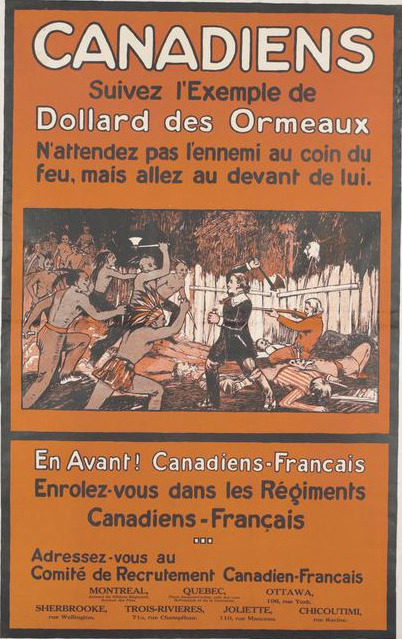
Canadiens, Suivez l’Exemple de Dollard des Ormeaux
Canadiens, Suivez l’Exemple de Dollard des Ormeaux [Canadians, Follow the Example of Dollard des Ormeaux] a depiction of Adam Dollard resisting an attack by Iroquois tribesmen. Dollard’s dead comrades lie at his feet.
Copyright: © IWM. Original Source: http://www.iwm.org.uk/collections/item/object/31027I find this one intriguing, not because I think it is actually a brilliant poster but for what it tells you about historical context and how propaganda was often tailored explicitly for local sensibilities. While Canadian support for the Allies in the First World War was generally fierce, the major exception was Quebec, which saw relatively poor levels of recruitment for overseas service. As such, propaganda aimed at Quebecois often tapped deeply into local traditions, in this case the (extremely dodgy!) myth of Adam Dollard, venerated in the period as a Catholic martyr who died defending Quebec from native Iroquois.5
[…]
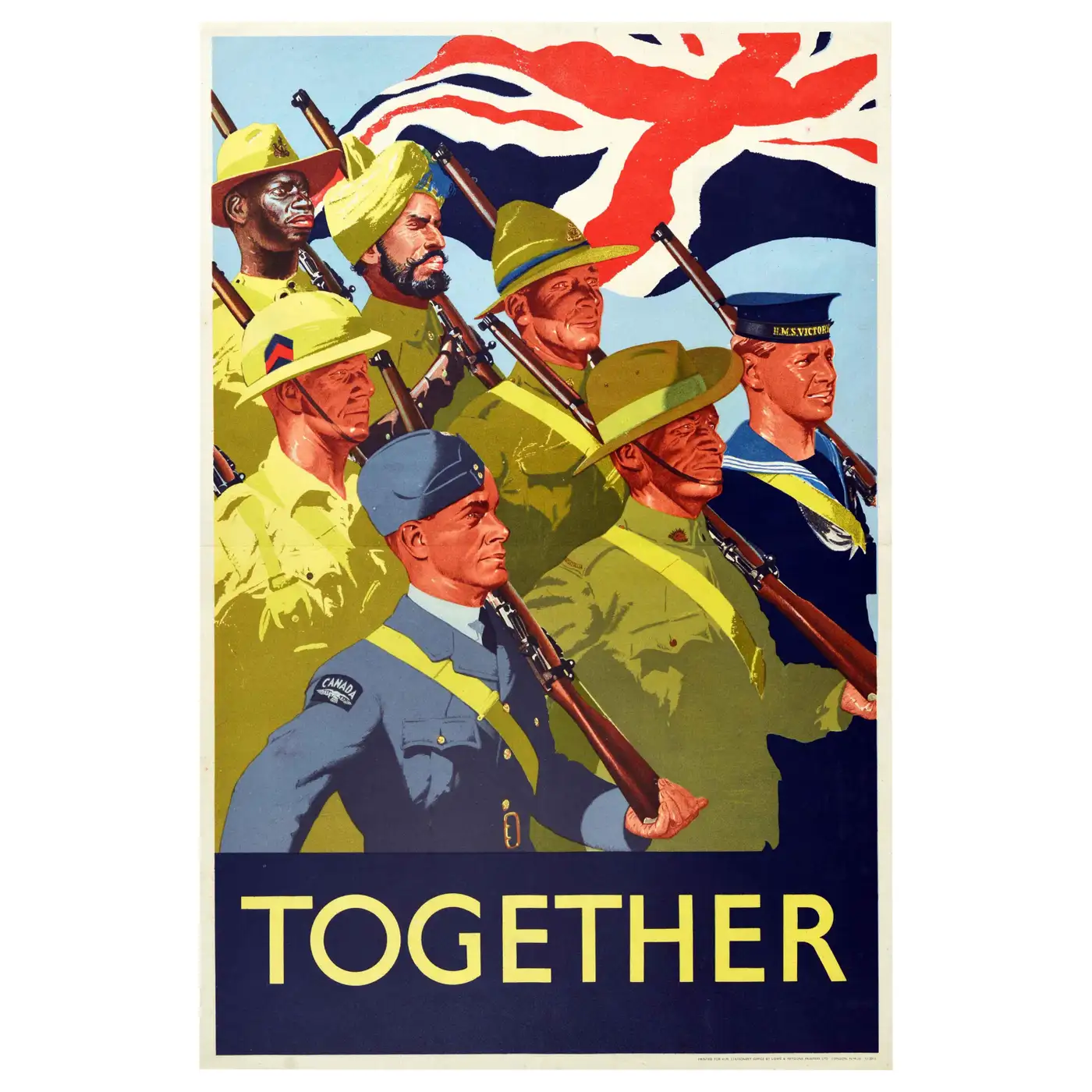
Together
Image courtesy of the IWM.
One can of course criticise the imperialism inherent in this poster, but I think it still works exceptionally well as a bold call for unity between the different nations of the British Empire. It shows how British propagandists took pains to highlight the Second World War as a global conflict against fascism.
- A job which, if I do say so myself, I was pretty bloody good at.
- Ponsonby wrote Falsehood in Wartime in which ironically he basically made up stories about British propagandists in a book supposedly about manufactured atrocity propaganda!
- Phillip Taylor, Munitions of the mind: A history of propaganda (Manchester University Press, 2013).
- I’m only going to present Allied propaganda. Because, frankly, fuck fascism.
- The story of Dollard is mostly myth, and he was more likely an idiot fur-trapper who got himself killed through stupidity.
Alexander the Great and Julius Caesar
Adrian Goldsworthy. Historian and Novelist
Published 1 Oct 2025The first of this year’s video’s in answer to viewers’ questions — today we think about and compare Alexander and Caesar. This is not new, for in the ancient world the pair were often connected, even though they lived centuries apart. Appian compared and contrasted them, Plutarch paired his biographies of them, while Suetonius and others told stories about Caesar’s admiration for the famous Macedonian.
QotD: The problems of a “no first use” nuclear weapons policy
For the United States during the Cold War, the problem with declaring a “no first use” policy was the worry that it would essentially serve as a “green light” for conventional Soviet military action in Europe. Recall, after all, that the Soviet military was stronger in conventional forces in Europe during the Cold War and that episodes like the Berlin Blockade (and resultant Berlin Airlift) seemed to confirm Soviet interest in expanding their control over central Europe. At the same time, the Soviet use of military force to crush the Hungarian Revolution (1956) and the Prague Spring (1968) continued to reaffirm that the USSR had no intention of letting Central or Eastern Europe choose their own fates – this was an empire that ruled by domination and intended to expand if it could.
The solution to blocking that expansion was NATO, the North Atlantic Treaty Organization. Not because NATO collectively could defeat the USSR in a conventional war – the general assumption was that they probably couldn’t – but because NATO’s article 5 clause pledging mutual defense essentially meant that the nuclear powers of NATO (Britain, the United States, and France) pledged to defend the territory of all NATO members with nuclear weapons. But just like deterrence, mutual defense alliances are based on the perception that all members will defend each other. Declaring that the United States wouldn’t use nuclear weapons first would essentially be telling the Germans, “we’ll fight for you, but we won’t use our most powerful weapons for you” in the event of a conventional war; it would be creating a giant unacceptable asterisk next to that mutual defense clause.
So the United States had to be committed to at least the possibility that it would respond to a conventional military assault on West Germany with nuclear retaliation (often envisaged as a “tactical” use of nuclear weapons – that is, using smaller nuclear weapons against enemy military formations. That said, even in the 1950s, Bernard Brodie was already warning that restraining the escalation to general use of nuclear weapons once a tactical nuclear weapon was used would be practically impossible).
Bret Devereaux, “Collections: Nuclear Deterrence 101”, A Collection of Unmitigated Pedantry, 2022-03-11.
April 22, 2026
The Korean War Week 96: Korean Marines Leapfrog the Han – April 21, 1952
The Korean War by Indy Neidell
Published 21 Apr 2026UN Command completes its screening of the 170,000 military and civilian POWs they hold to see how many of them would violently resist repatriation, and it turns out it’s most of them. The Communists are furious. This cannot be good for the armistice negotiations. We also take a look at the defense possibilities the Marines have in their new positions and which Chinese forces oppose them.
00:00 Intro
00:55 Recap
01:32 POW Screening
07:26 The Marines
08:56 The Chinese
13:37 Summary
13:53 Conclusion
Walther’s Forgotten SMG: The MPK (and MPL)
Forgotten Weapons
Published 3 Dec 2025Walther began developing a modern stamped sheet metal SMG in the late 1950s, and it entered production in 1963. It was an open-bolt, simple blowback gun available in a short (MPK; 6.75″ barrel) and long (MPL; 10.25″ barrel) version. It was cheap and simple, but well thought out with a number of quite good features.
The standard design was just safe/full, but a semiautomatic selector position was available if desired by the client. An excellent safety sear prevented the bolt from bouncing open and firing, and the charging handle was both non-reciprocating and capable of also serving as a forward assist if needed. The sights were a bit too clever for Walther’s own good, with a 75m notch and a 150m aperture, both of which were not really great.
Faced with competition from contemporaries like the Uzi and MP5, the Walther never really became massively popular. It did get enough small and medium sized contracts (German police, South African police, Mexican Navy, Portuguese Navy, US Delta Force, etc) to remain in production until 1985 though. Overall a solid and reliable gun even if it failed to really stand out from the other options on the market.
(more…)
QotD: Traditional Chinese approaches to science
It’s not just physics. The central technique of modern science is that of boiling something down to its absolute simplest form, understanding the simplest non-trivial case as thoroughly as possible, and only then building back up to more familiar situations. In physics we start with contrived gedankenexperimenten: “what if two particles collided in a vacuum”, and build experimental apparatuses designed to mimic these ultra-simple cases. In economics we imagine markets with a single buyer and a single seller, both perfectly rational. In political philosophy we imagine human beings in a state of nature, or societies established by a primitive contract. In biology we try to understand the functions of organisms, organs, or other systems by recursively taking them apart and trying to figure out each part in isolation. In every case, what we’re engaging in is “analysis”, ἀνά-λυσις, literally a “thorough unravelling”, understanding the whole by first understanding its parts.
This approach is totally alien to the traditional Chinese understanding of reality, which held instead that no part of the world could be understood except in its relation to the rest of the universe. You can see this in the domains of science where they did maintain a lead. Is it really a coincidence that the Medieval Chinese got frighteningly far with the mathematics of wave mechanics? Or quickly deduced the causes of the tides? Or made great strides with magnetism? In each of these cases, the physical phenomenon in question was compatible with an “organicist conception in which every phenomenon was connected with every other according to a hierarchical order”. Indeed, in all of these cases real understanding was aided by the assumption that a universal harmony underlay all things and connected all things. The tides really are in harmony with the moon, and the lodestone with the earth.
This science, founded on holism rather than on analysis, made great strides in some fields but fell behind in others. It readily imbibed action at a distance, but it could not and would not tolerate the theory of atoms. In this way it serves as a strange mirror of Medieval European science, which also loved the theory of correspondences, also loved alchemy and disdained analysis. The difference is that the glorious intellectual synthesis of Neo-Confucianism was never seriously challenged, it survived the Mongol conquest, it survived the desolation of the civil wars that preceded the Ming founding, it survived everything until communism. In contrast, the eerily-similar Thomistic metaphysics of the High Middle Ages was broken apart by the Reformation, and sufficiently discredited that analytical methods could take their first tentative steps.
This is, to be clear, my own crazy theory, because Needham never really gave a solution to his own puzzle. I came up with it only as a sort of thought-experiment, because I wanted to see if I could find a solution to Needham’s puzzle that disdained material explanations in favour of intellectual tendencies, because I find such theories curiously underrated in our culture. I only half-believe this theory,1 but I find it interesting because twentieth-century Western science has in some ways come back around to the holistic view of things: from Lagrangian methods in theoretical physics, to category theory in mathematics, to systems biology and ecology. It wouldn’t be the first time that a way of viewing the world useful to one age became an impediment to reaching the next one. The question is: what are we missing today?
John Psmith, “REVIEW: Science in Traditional China, by Joseph Needham”, Mr. and Mrs. Psmith’s Bookshelf, 2023-08-14.
- The thing about material conditions is they usually are dispositive!
April 21, 2026
Ivan the Terrible – Feeding the Evil Russian Tsar
Tasting History with Max Miller
Published 14 Oct 2025Soft buns filled with cabbage, onion and dill
City/Region: Russia
Time Period: 16th CenturyIn Russian, Ivan the Terrible is Ivan Grozny, and the translation of “terrible” was meant more in the way of “fearsome” or “formidable” rather than “cruel” or “awful”, though Ivan ended up being all of those. What started off as a good reign with military victories, building Saint Basil’s Cathedral, and restricting the boyars‘ (aristocracy) power over the people descended into a reign of terror with a secret police, the massacre of a city, and even killing his eldest son in a fit of rage.
While Ivan truly was terrible, these piroshki are not. They are absolutely delicious. The bread is soft, and the filling is savory and slightly sweet with the dill really coming through. These were made with all different kinds of fillings, so feel free to try out other ingredients, like meat, fish, fruit, or other vegetables, or put in a hard boiled egg for a modern touch.
Small pies filled with mushrooms, poppy seeds, kasha, turnips, cabbage, or whatever else God sends.
When the servants bake bread, order them to set some of the dough aside, to be stuffed for piroshki.— The Domostroi, 16th Century
April 20, 2026
Airline deregulation in the 1970s
The end result — democratizing air travel and enabling far more people to economically travel long distances — also meant that air travel became far more casual (people no longer dressed “properly” for flights) and economy flights began to more closely resemble long-distance buses, but overall it was a win:
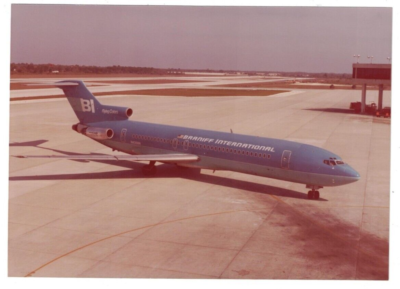
The Airline Deregulation Act of 1978 stands as one of the most spectacular vindications of free market principles in modern American history. Before deregulation, the Civil Aeronautics Board controlled every aspect of commercial aviation: routes, schedules, and most critically, prices. Flying remained a luxury reserved for the wealthy elite, with fares artificially inflated by regulatory capture and government-sanctioned cartels.
Within a decade of deregulation, average airfares plummeted by 50% in real terms. The number of passengers more than doubled from 250 million in 1978 to over 500 million by 1990. New airlines like Southwest and JetBlue emerged with innovative business models that prioritized efficiency over bureaucratic compliance. Routes previously deemed “unprofitable” by government planners suddenly thrived under competitive pressure.
The regulatory regime had created exactly what free-market theory predicts: artificial scarcity, price distortions, and a complete disconnection from consumer preferences. Airlines competed on amenities instead of price because the CAB fixed fares at monopoly levels. They served cocktails and full meals while ordinary Americans couldn’t afford tickets. The moment government stepped aside, entrepreneurs discovered countless ways to serve previously ignored market segments.
Critics warned that deregulation would compromise safety and create chaos. Instead, aviation safety improved dramatically as airlines faced real liability for accidents and insurance companies imposed rigorous standards. Competition forced operational excellence in ways bureaucratic oversight never could. Hub-and-spoke networks emerged organically, maximizing efficiency without central planning.
The contrast couldn’t be starker: decades of stagnation under regulatory control versus explosive innovation and democratization under market freedom.
Yet the same politicians who celebrate affordable air travel continue strangling other industries with identical regulatory schemes.
QotD: The quality of evidence problem for historians
And yet, you can’t entirely discount them, either. Crecy (along with of course Agincourt) is supposed to be the triumph of the English longbow, and that’s the thing: We’ve reconstructed English longbows, and put them through all kinds of trials. The results, as I understand it — which, again, ain’t much — were highly variable. A very strong, well-fed, highly trained longbowman, firing an ideally constructed and maintained bow under optimal conditions, really can put X number of arrows up a flea’s ass at Y range in Z time.
Or they could miss the broad side of a barn at twenty feet, depending.
So: What was the weather like in Northern France on 26 August 1346? That’s not an idle question. Rather, it’s the central question. Assume perfect shooting conditions, and you’ve got a far, far different picture of the battle than if you assume poor ones. And if that seems to be giving too much credit to the weather, watch a few baseball games — you’ll quickly discover that quite often, the difference between a home run and a long out is just a few percentage points of relative humidity.
Ultimately it comes down to judgment. More importantly, it’s a judgment on how any particular event fits into the larger argument you’re trying to make. In a way, then, the details really don’t matter very much on their own — the mechanics of how the English won are almost irrelevant, except insofar as they feed into an analysis of why they won. Why did the French king attack uphill, in the mud? Was he stupid? Overconfident? Did he feel he had to, because of political problems inside his host? Did he have faulty information? Did he have accurate information, but just made a bad call?
That’s the art of History, and why, despite what the Peter Turchin (and Karl Marx) crowd keeps insisting, it will always be an art, not a science. We can have a high degree of confidence, most times, in what happened — there really was a battle at Crecy, and the English really did win it. It’s the why that is susceptible to radical reinterpretation.
Severian, “Friday Mailbag”, Founding Questions, 2022-06-17.


