
[Leon] Festinger’s book When Prophecy Fails was a study of a UFO cult which predicted the end of the world on a very specific date … in 1953. Festinger was on hand to see what happened to the cult when the world didn’t end, and he discovered a very important psychological principle. He called it “cognitive dissonance”, but since that term has taken on a life of its own, we’ll swipe one from [the] Internet and call it a “retcon”.
For those with even a moderate level of commitment to the cult (and I’ll leave it to you to speculate what moderate commitment to a cult might be; Festinger’s work is not without its critics), disconfirmation of the cult’s central belief led, astoundingly, to an even greater commitment to the cult. “The world will end on X date” was immediately retconned into “the world didn’t end on X date because of our righteousness“.
You know you’re really onto something when it seems head-slappingly obvious in retrospect. Yeah, of course they did that. Everybody does that to a degree. You expect something isn’t going to work out, then it does work out — it must be because you’re special, right? It’s another way of assigning yourself agency in a world where you’re basically powerless over the big stuff. Humans are wired to believe they have agency, that things happen for a reason. It sounds like I’m giving Festinger at best a backhanded compliment, but I’m very seriously singing his praises — “everybody knows” this stuff, but no one had isolated and described it before. That’s a major achievement — if I could have the equivalent of “discovered cognitive dissonance” on my tombstone, I’d die an ecstatically happy man.
Severian, “Quick Takes: Festinger Edition”, Rotten Chestnuts, 2021-01-19.
August 16, 2023
QotD: Cognitive dissonance, or when cultists retcon reality
August 15, 2023
History must be forced to fit the narrative
Chris Bray revisits an older article from the Obama years:
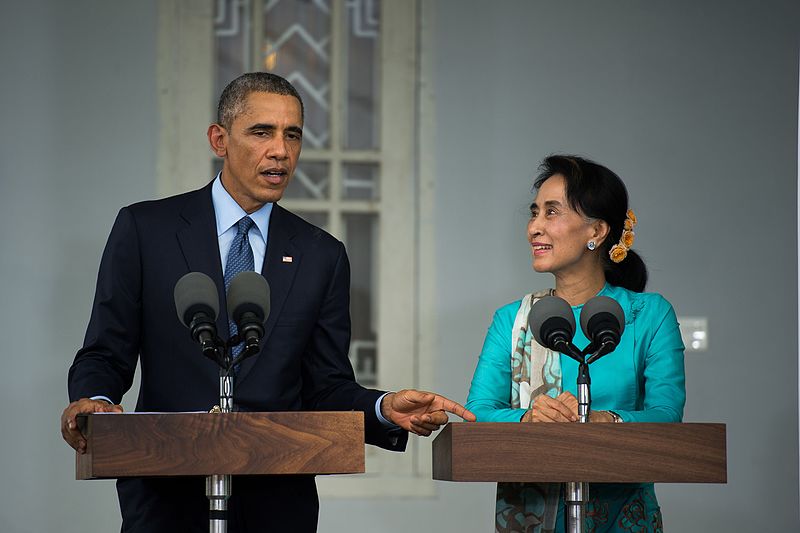
President Barack Obama and Aung San Suu Kyi in 2014.
Photo via Wikimedia Commons
There is no question that authoritarianism is descending on the United States of America, quickly. There is also no question where it’s coming from, as you quickly learn from the current social media musings of the most wonderfully progressive people. Trump must be silenced NOW! Why is the authoritarian being ALLOWED TO SPEAK? Ruth Ben-Ghiat, please call your office.
How have we gotten here?
I’ve mentioned before a looooong essay I wrote, more than ten years ago, about the cottage industry in Barack Obama hagiographies. Obama’s fellatiographers noted, for example, that Obama’s stepfather, Lolo Soetoro, had been ordered back to Indonesia in 1966, and that photos of him from that time show him in the uniform of the Indonesian army. They also mention, with remarkably disingenuous vagueness, that there was maybe some political trouble going on in Indonesia while Obama was there as a child and his stepdad was a soldier.
But what was happening in the mid-1960s in Indonesia is that the Indonesian Communist Party tried to restructure Sukarno’s careful balancing of competing forces in the new country with the kidnapping and killing of a group of right-wing flag officers by leftist soldiers, beheading conservative military power — after which the military responded with the wholesale killing of hundreds of thousands of communists, often with machetes and with a serious commitment to doing the job as grimly as possible: bodies in rivers, heads on pikes, slow killing in front of mass graves. Here’s my last paragraph from that section on the Obama biographies:
And the lesson? Indonesia was where “Ann was Barry’s teacher in high-minded matters—liberal, humanist values”, Remnick concludes. It’s where she taught him the values of “honesty, hard work, and fulfilling one’s duty to others”, where she lectured him about “a sense of obligation to give something back”, Scott adds. It’s where she “worked to instill ideas about public service in her son”. Because Indonesia in the late sixties was the perfect place and time to learn about liberal humanist values and public service.
Barack Obama was a Democrat who attained the presidency, which means that journalists knew he had to be a sainted figure, and he was the first black president, which means that journalists knew he had to be brilliant and extraordinary. So they assembled the threads of his story — Barack Obama went to Indonesia in 1966 with his stepfather, a soldier, during a long period of extraordinarily brutal political retribution by the Indonesian army — and then, pro forma, wove those threads into the foundation of “liberal, humanistic values”.
If Barack Obama had spent his childhood torturing kittens to death and eating their eyeballs in front of a sobbing crowd of kitten-loving toddlers, the Obama biographies would have said that Barack Obama spent his childhood torturing kittens to death and eating their eyeballs in front of a sobbing crowd of kitten-loving toddlers, a heartwarming experience that taught him the value of democratic pluralism and fundamental human decency. The story was written before anyone began working on it: Barack Obama [experience TBD] and [experience TBD], the formative experiences that made him the kind and wonderful genius he is today.
See also this recent discussion with David Garrow, a historian who
has written a new(corrected: published a post-Obama-presidency) biography — and who found, as he researched his subject, that he was often looking at evidence no one had ever pursued before. The hagiographers of the Obama presidency-era weren’t looking for evidence; they already knew the story they meant to write. They came up with some evidence-simulating objects for form’s sake, to assemble their liturgy in the apparent form of biography. Their “Barack Obama” was never Barack Obama.Their “Donald Trump” is not, now, Donald Trump. There’s a formula; they apply it. There’s a narrative to be written. Donald Trump said he would repeal two federal regulations for every new regulation he implemented — textbook authoritarianism! Donald Trump said that America has fought a bunch of “dumb wars”, and should be much more careful about foreign military involvement — JUST LIKE ADOLF HITLER!!!!!!
It’s beside the point to note that the conclusions never matched the evidence. They were never meant to.
This is crazymaking behavior. Constantly spinning narratives that have nothing to do with anything in the actual, physical world is a recipe for a psychotic break. And we have multiple layers of institutional actors who cosplay “elite” — in media, in academia, in government, and in corporations — who’ve been playing with their shadow puppets for so long that they’ve forgotten they’re shadow puppets. They believe themselves.
That’s how you get to we need a single-party ballot to prevent authoritarianism and we have to arrest the opposition leader to prevent authoritarianism. It’s socially distributed insanity, a real descent into the world of false symbols. And it’s becoming incredibly dangerous.
Gnome et Rhône R5: A Foiled Communist Arms Plan
Forgotten Weapons
Published 26 Apr 2023The R-5 was a French-made copy of the Sten produced after the 1944 liberation of France. It was built by Gnome et Rhône, a French company best known for making aircraft engines. The Sten was familiar to French forces, as many had been supplied as military aid to the Free French as well as Resistance organizations — and it was also a simple and cheap weapon to make.
In the aftermath of Liberation, there was a lot of political jockeying for power in France. Many different factions had armed themselves during occupation, from the far right to the far left, and everyone wanted to be in a position of power in post-war France. Gnome et Rhône was contracted to make 20,000 of the R-5 submachine guns specifically for the PCF, the French Communist Party (Parti communiste français). The Gaullist government found out about the production and took the guns for itself before any reached the PCF.
The R-5 (named because it was produced in Limoges, in the 5th Region of France as organized during the Resistance) was parts-interchangeable with the standard British MkII Sten, despite having a number of unique features. The R5 used a barrel 60mm (2.5 inches) longer than the standard Sten barrel, a solid wooden stock of the same shape as the MkII, and a vertical front grip inspired by the Thompson. Although missing on this example, it also had a rotating receiver cover that could be used to lock the bolt in the forward position.
Of the 20,000 R-5s ordered, only 8,000 were delivered as best we can tell today. They were used by the military within France and also in Indochina and even into Algeria. In the immediate postwar years France was heavily dependent on US and UK war material, but wanted to equip a larger force than the Anglo-American allies were planning to supply. The R-5 made a useful interim weapon while the French arms industry reestablished itself and eventually developed the MAS-49 rifle family and the MAT-49 submachine gun.
(more…)
QotD: Iron ore processing in pre-industrial societies
Ore removed from the mine would need to be crushed, with the larger stones pulled out of the mines smashed with heavy hammers (against a rock surface) in order to break them down to a manageable size. The exact size of the ore chunks desired varies based on the metal one is seeking and the quality of the local ore. Ores of precious metals, it seems, were often ground down to powder, but for iron ore it seems like somewhat larger chunks were acceptable. I’ve seen modern experiments with bloomeries […] getting pretty good results from ore chunks about half the size of a fist. Interestingly, Craddock notes that ore-crushing activity at mines was sufficiently intense that archaeologists can spot the tell-tale depressions where the rock surface that provided the “floor” against which the ore was crushed have been worn by repeated use.
Ore might also be washed, that is passed through water to liberate and wash away any lighter waste material. Washing is attested in the ancient world for gold and silver ores (and by Georgius Agricola for the medieval period for the same), but might be used for other ores depending on the country rock to wash away impurities. The simple method of this, sometimes called jigging, consisted of putting the ore in a sieve and shaking it while water passed through, although more complex sluicing systems are known, for instance at the Athenian silver mines at Laurium (note esp. Healy, 144-8 for diagrams); the sluices for washing are sometimes called buddles. Throughout these processes, the ore would also probably be hand-sorted in an effort to separate high-grade ore from low-grade ore.
It’s clear that this mechanical ore preparation was much more intensive for higher-value metals where making sure to be as efficient as possible was a significant concern; gold and silver ores might be crushed, sorted, washed and rewashed before being ground into a powder for the final smelting process. Craddock presents a postulated processing set for copper ore for the Bronze Age Timna mines that goes through a primary crushing, hand-sorted division into three grades, secondary crushing, grinding, a winnowing step for the low-grade ore (either air winnowing or washing) before being blended into the final smelter “charge”.
As far as I can tell, such extensive processing for iron was much less common; in many cases it seems it is hard to be certain because the sources remain so focused on precious metal mining and the later stages of iron-working. Diodorus describes the iron ore on Elba as merely being crushed, roasted and then bloomed (5.13.1) but the description is so brief it is possible that he is leaving out steps (but also, Elba’s iron ore was sufficiently rich that further processing may not have been necessary). In many cases, iron was probably just crushed, sorted and then moved straight to roasting […]
Bret Devereaux, “Iron, How Did They Make It? Part I, Mining”, A Collection of Unmitigated Pedantry, 2020-09-18.
August 14, 2023
56 pounds of beer | Dorktown
Secret Base
Published 1 Aug 2023In the early years, the Minnesota Vikings were like many new franchises of the time: dysfunctional, bad at football, and often intoxicated. And then a former NBA champion came back home to Minnesota and changed the identity of this franchise forever.
This is the first episode of Dorktown’s seven-part docuseries, The History of the Minnesota Vikings.
(more…)
The WEIRDos – Western, Educated, Industrialized, Rich and Democratic societies
Another anonymous book review at Scott Alexander’s Astral Codex Ten considers The Weirdest People in the World: How the West Became Psychologically Peculiar and Particularly Prosperous by Joseph Henrich:

Coming as he does from the scientific side of the aisle, Henrich isn’t just going to tell a story. He has a hypothesis about an empirical puzzle. The puzzle is the most important question, the big one, the one that once you think about it’s hard to think about anything else, the economists’ Holy Grail since Adam Smith: why are some countries rich and others poor?
His hypothesis comes from cross-cultural psychology. The West got rich because Westerners are different. People from Western, Educated, Industrialized, Rich and Democratic societies are WEIRD – the acronym comes from a previous article of his. In particular, compared to everyone else in the world and in history, modern Westerners:
- Are individualist, not collectivist or conformist
- Feel more guilt and less shame
- Explain people’s actions by their innate dispositions, not their social role
- Reason analytically not holistically
- Follow more universal norms and less relationship-specific norms
- Are more patient
- Trust strangers more and are more honest.
This psychology might make societies richer, for fairly well-known and plausible reasons. The Weirdest People in the World (henceforth just WEIRD) sets out a causal chain from cultural change to psychological change to modern economic growth. The start of that chain is surprising: an obscure set of rules pushed by the medieval Catholic church, which banned marriage between cousins. The most important argument of the book is that these rules created WEIRD psychology.
How it worked: these marriage regulations served to dismantle intensive kin networks, which are the social cement of society almost everywhere else in the world. For most people in history, family hasn’t just been the place where children grow up and couples spend time together. Family has been the basic human group, and there have been extensive and precise rules dictating who counts as family (or clan) and how each person should act with respect to different relatives. The Church’s regulations, the Marriage and Family Programme (MFP), aimed to replace intensive kinship, and over many centuries it was more or less successful in doing that. We’ll come back shortly to why it wanted to.
So, the causal chain looks like this:1
WEIRD‘s key evidence is the link between the places where the Church promulgated the MFP and a set of psychological and social outcomes: the level of cousin marriage, the psychology of people living in those places today, social capital and economic growth. This is the scientific story of European history, and Henrich’s answer to the most important question in the world.
These maps from one of the scientific articles behind WEIRD show the basic causal claim: the medieval church reduced the intensity of kinship institutions.
He tells it with an extraordinary mastery of a very wide range of sources from anthropology, psychology, behavioural economics, economic history, and historical narrative. This book is for everyone, but the connoisseur will enjoy the bibliography: if you think it’s important and relevant, it’s probably in there, and there was also plenty of work which I did not know, and now feel I should. It takes a very smart person to keep this many balls in the air. Being at Harvard probably doesn’t hurt either – that’s the “collective brain” of the human network, which makes an appearance later on in the book.
So this book really sets down a marker: the anthropologists are returning from the Amazon, the Sudan and Polynesia, and coming for Western history and economics. It will be interesting to see how those target disciplines react.
Is it true?
Economists and historians think about Western history very differently.
Historians love irony and contingency. They enjoy byways. Triumphalist, linear narratives of progress are distrusted as “Whig history”. Growth economists, by contrast, are all about the linear bigness. They have a relentless focus on the one question of how the West got rich, and if you call that triumphalist, they will take out a chart of South Sudanese child mortality and laugh at you.
Both historians and historical economists — a more appropriate name than “economic historians” nowadays — are interested in causality. But economists have a crunchier, more “scientific” standard for what counts as proof of causality. You’ve got to have a treatment and a control group, and by default if you claim there are no confounds, they won’t believe you. You need you some plausible exogeneity. A random river where Napoleon’s armies stopped. The distance from Wittemberg where Luther nailed up his theses. And then, how does that affect something that matters today (if it doesn’t, then who cares?) Of course, the longer ago the exogenous treatment, the more impressive the result.
You can see the incentives that these disciplinary demands might set up, and that might worry you. At worst, you might get a kind of “underground river” concept of history, where
- X happened long ago
- [underpants gnomes whispering]
- Y is correlated with X today
Indeed this does seem to skip all the interesting, contingent bits:
On the other hand, if you want to explain an all-important outcome like the take-off into modern economic growth, then you can’t just mumble “one damn thing after another” or “irony and contingency”. That a hundred things randomly conspired to make the West Educated, Industrialized, Rich and Democratic is not a satisfying story. Why would the die rolls keep favouring this one place? (And you can’t invoke the law of large numbers. There are only five continents in the world, and modern economic growth did not have to happen anywhere at all.)


1. It’s a bit more complex than that. In particular, the end of intensive kinship directly helps economic growth because it clears the way for voluntary associations to thrive. But the psychology angle is what’s really unique to WEIRD – in particular, Francis Fukuyama has previously argued that kin institutions might be a problem for higher-level cooperation.
QotD: The US Army in the Korean War
The Army needed legions, but society didn’t want them. It wanted citizen-soldiers.
But the sociologists are right — absolutely right — in demanding that the centurion view of life not be imposed upon America. In a holy, patriotic war — like that fought by the French in 1793, or as a general war against Communism will be — America can get a lot more mileage out of citizen-soldiers than it can from legions.
No one has suggested that perhaps there should be two sets of rules, one for the professional Army, which may have to fight in far places, without the declaration of war, and without intrinsic belief in the value of its dying, for reasons of policy, chessmen on the checkerboard of diplomacy; and one for the high-minded, enthusiastic, and idealistic young men who come aboard only when the ship is sinking.
The other answer is to give up Korea-type wars, and to surrender great-power status, and a resultant hope of order — our own decent order — in the world. But America is rich and fat and very, very noticeable in this world.
It is a forlorn hope that we should be left alone.
In the first six months America suffered a near debacle because her Regular Army fighting men were the stuff of legions, but they had not been made into legionaries.
America was not more soft or more decadent than it had been twenty years earlier. It was confused, badly, on its attitudes toward war. It was still bringing up its youth to think there were no tigers, and it was still reluctant to forge them guns to shoot tigers.
Many of America’s youth, in the Army, faced horror badly because they had never been told they would have to face horror, or that horror is very normal in our unsane world. It had not been ground into them that they would have to obey their officers, even if the orders got them killed.
It has been a long, long time since American citizens have been able to take down the musket from the mantelpiece and go tiger hunting. But they still cling to the belief that they can do so, and do it well, without training.
This is the error that leads some men to cry out that Americans are decadent.
If Americans in 1950 were decadent, so were the rabble who streamed miserably into Valley Forge, where von Steuben made soldiers out of them. If American society had no will to defend itself, neither did it in 1861, at First Manassas, or later at Shiloh, when whole regiments of Americans turned tail and ran.
The men who lay warm and happy in their blankets at Kasserine, as the panzers rolled toward them in the dawn, were decadent, by this reasoning.
The problem is not that Americans are soft but that they simply will not face what war is all about until they have had their teeth kicked in. They will not face the fact that the military professionals, while some have ideas about society in general that are distorted and must be watched, still know better than anyone else how a war is won.
Free society cannot be oriented toward the battlefield — Sparta knew that trap — but some adjustments must be made, as the squabbling Athenians learned to their sorrow.
The sociologists and psychologists of Vienna had no answer to the Nazi bayonets, when they crashed against their doors. The soldiers of the democratic world did.
More than once, as at Valley Forge, after Bull Run, and Kasserine, the world has seen an American army rise from its own ashes, reorient itself, grow hard and bitter, knowledgeable and disciplined and tough.
In 1951, after six months of being battered, the Eighth Army in Korea rose from its own ashes of despair. No man who was there still believes Americans in the main are decadent, just as no man who saw Lieutenant General Matt Ridgway in operation doubts the sometime greatness of men.
T.R. Fehrenbach, This Kind of War: A Study in Unpreparedness, 1963.
August 13, 2023
Panzer Revenge in Normandy – WW2 – Week 259 – August 12, 1944 (CENSORED)
World War Two
Published 12 Aug 2023The Germans launch a counter-attack to sabotage the Allied positions in France. In the Baltics the Soviet advances grind to a halt, but the Soviets are busy making plans to invade Romania in the south. Meanwhile in the center the Warsaw Uprising continues. Across the world the siege of Hengyang comes to its end with a Japanese victory, but the Battle for Guam ends with a Japanese loss.
[Promoted from the comments]: An increasingly persistent challenge for us at TimeGhost is that a growing number of our videos are being age restricted. While this was always the case with War Against Humanity, it’s started affecting this weekly series now too. This most recent video was restricted before it was even publicly published. As such we made the difficult decision to publish a censored version instead this week.
Why is it such a big issue? Well it doesn’t only limit the access to educational content for young people, but also to adult audiences. Age restricted videos have a barrier to viewing that ranges from territory to territory, with some countries requiring viewers not only to have a YouTube account, but to link it with their credit card. Even if an account belongs to a verified adult, it’s still less likely to be recommended an age restricted video.
Our core mission at TimeGhost is making the lessons of our past free and accessible to people around the world. While it’s challenging, especially with the new obstacles from YouTube, it’s still possible thanks to everyone in the TimeGhost Army who backs these videos. To all of you that signed up, or who watch regularly, thank you for joining us on this mission.
A Deep Dive Into Victorian Servants
J. Draper
Published 9 May 2022Content warning: mentions of sexual abuse, suicide.
Yes, it is awkward being next-door neighbours with THE ACTUAL SUN, thank you for asking.
(more…)
August 12, 2023
The urge to compare our own culture to the declining Roman Empire
In UnHerd, Alexander Poots wants pundits to stop comparing this or that country in the West to the latter stages of the Gibbonian decline of Rome:
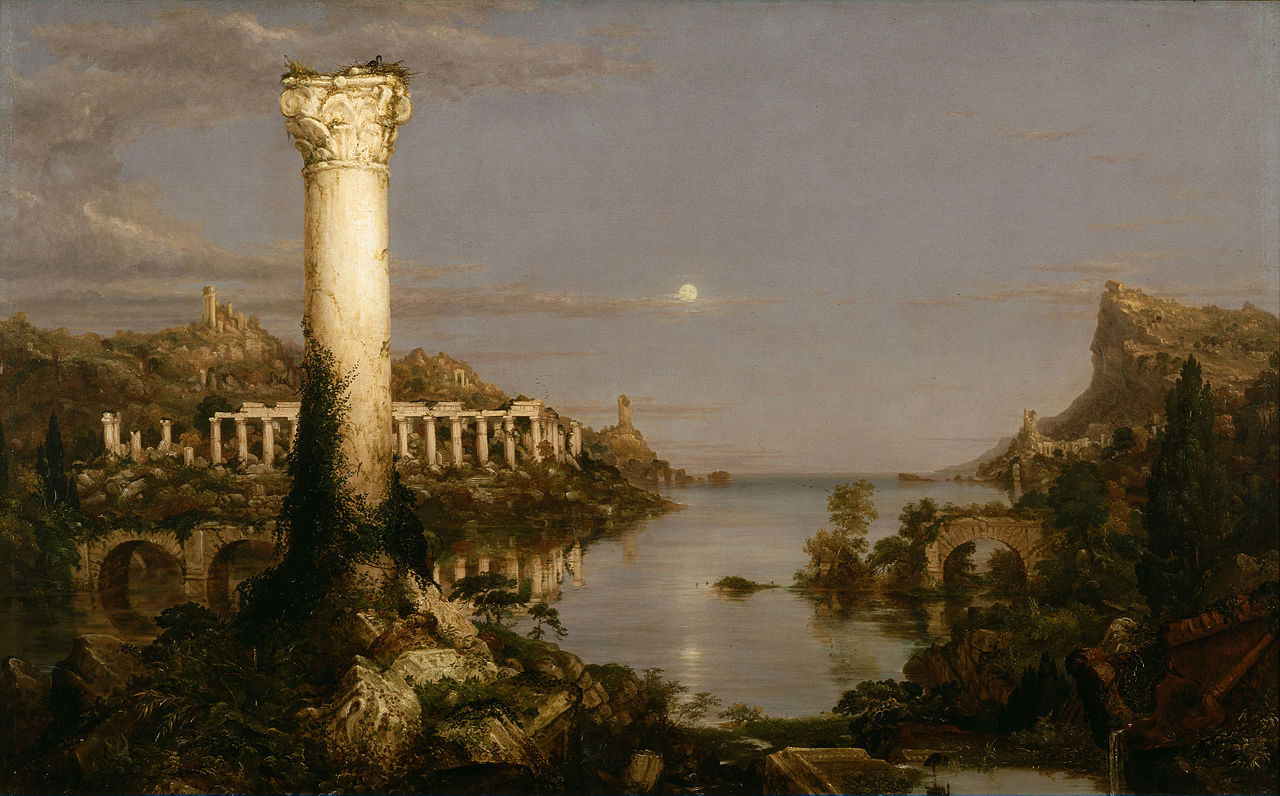
“The Course of Empire – Desolation” by Thomas Cole, one of a series of five paintings created between 1833 and 1836.
Wikimedia Commons.
On both sides of the Atlantic, hysterical comparisons between the collapse of the Roman Empire and the senile polities of the modern West have become the journalistic norm. Every major problem facing our society — from climate change to Covid to inflation — has received the Gibbon treatment.
There are, of course, regional variations. The British, tied by geography to Europe’s fortunes, tend to favour the definitive fall of the Western empire in AD 476. The Americans, ever fearful of an over-mighty executive, linger on the collapse of senatorial authority in 49 BC. And it is also more than a journalistic trope, with the unacknowledged legislators of our world also playing the same game. Elon Musk recently suggested that today’s baby drought is analogous to the low birth rates of Julius Caesar’s dictatorship. Marc Andreessen has compared California to Rome circa AD 250. Joe Rogan, meanwhile, is beginning to suspect that all this gender business might have a worrying ancient precedent.
Such appeals to the past are only human. The fourth word in Virgil’s Aeneid is Troiam. This is the first fact that we learn about Aeneas: he is from Troy. Virgil does not even bother to tell us his hero’s name until the 92nd line. Doubtless, the poets of Ur and Hattusha had their own Troys. And perhaps the first men who placed one mud brick upon another sang of flooded valleys, choked caves and herds that no longer ran. But Rome has been our common loss since the early Middle Ages. As Virgil looked back to Priam, so we look back to Virgil. In 1951, it was perfectly natural for W. H. Auden to compare a dying Britain with a dead Rome: “Caesar’s double-bed is warm / As an unimportant clerk / Writes I DO NOT LIKE MY WORK / On a pink official form”
But journalists and billionaires do not work in a poetic register. They deal in facts and lucre. When they say that Britain or America is following imperium Romanum down the dusty track to oblivion, they seem to be speaking literally. This is not a mistake that Virgil would have made. It is all very well to evoke Rome as an elegiac warning. But if we believe that there are concrete lessons to learn from the Roman Empire’s decline and fall, then we will have to examine the mother of cities as she really was. The results are surprising.
In AD 384, 400 years after Virgil composed his Aeneid, Quintus Aurelius Symmachus had a bridge problem. Symmachus was Urban Prefect of Rome, a role of huge responsibility. By the fourth century, the city of Rome was no longer the imperial capital of the western empire; it had been replaced in 286 by Mediolanum (modern Milan), which was a good deal closer to the empire’s febrile northern borders. But Rome remained the nation’s hearthstone. Her good governance was of the highest priority. The Urban Prefect dispensed justice, organised games, fed the mob and looked after the material fabric of the city. It was not an enviable position. One man had to keep the vast, turbulent metropolis ticking over with the minimum of rioting. Symmachus was well aware of the touchiness of the Roman pleb. His own father had been burned out of his house and chased from the city after making a catty remark of the “let them eat cake” variety during the wine shortage of 375.
The bridge problem went like this. Around 382, the emperor Gratian ordered that a new bridge be built across the Tiber. It soon became clear that construction was taking too long and costing too much. Two years later, as the project neared completion, one span collapsed. Such waste of public funds could not be ignored, and so an inquiry was launched. A specialist diver was engaged to examine the structure; he discovered that the job had been bodged. The engineers responsible for the project, Cyriades and Auxentius, were summoned to account for their failure. Each blamed the other, before Auxentius, who had been caught backfilling sections of the bridge with bales of hay, fled the city — pockets doubtless jingling with public gold.
On the face of it, this sounds like a very late Roman story: a nation once famous for its engineering prowess could no longer build a bridge across the Tiber without everything going horribly wrong. But I’m not sure that’s true. Problems arise all the time, and in themselves tell us very little about a society. What matters is the response to those problems. And Symmachus’s dispatches to the imperial court make it clear that his response was considered and comprehensive. The bridge was completed in the end, and stood for over 1,000 years until its demolition in 1484. Now think of 21st-century London: remember what happened the last time we tried to build a bridge across the Thames?
Churchill and India
Andreas Koureas posted an extremely long thread on Twitter, outlining the complex situation he and his government faced during the Bengal Famine of 1943, along with more biographical details of Churchill’s views of India as a whole (edits and reformats as needed):
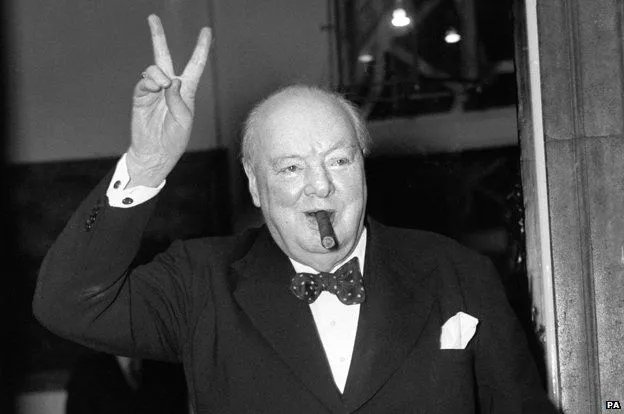
The most misunderstood part of Sir Winston Churchill’s life is his relationship with India. He neither hated Indians nor did he cause/contribute to the Bengal Famine. After reading through thousands of pages of primary sources, here’s what really happened.
A thread 🧵
I’ve covered this topic before, but in a recent poll my followers wanted a more in-depth thread. Sources are cited at the end. I’m also currently co-authoring a paper for a peer reviewed journal on the subject of the Bengal Famine, which should hopefully be out later this year.
I’ll first address the Bengal Famine (as that is the most serious accusation) and then Churchill’s general views on India. It goes without saying that there will be political activists who will completely ignore what I have to say, as well as the primary sources I’ll cite. I have no doubt, that just like in the past, there will be those who accuse me of only using “British sources”.
This is not true. I have primary sources written by Indians as well as papers by Indian academics.
Moreover, I have no doubt that such activists will, choose to “cite” the ahistorical journalistic articles from The Guardian or conspiratorial books like Churchill’s Secret War by Mukerjee — a debunked book that ignores most of what I’m about to write about, and is really what sparked the conspiracy of Churchill and the Bengal Famine. For everyone else, I hope you find this thread useful.
(more…)
Hotchkiss Universal SMG
Forgotten Weapons
Published 27 Aug 2012The Hotchkiss Universal is a pretty interesting submachine gun, despite its rather clumsy appearance. The overriding design intent was to make a very compact folding carbine, and Hotchiss certainly met that objective. However, the gun ended up being too expensive and complex to achieve any real commercial success. Some wound up in Indochina, and some sales were made to Venezuela and Morocco, but that was about the extent of the Universal’s production. There are a few of these guns that were imported into the US as live semi-auto carbines, interestingly.
(more…)
QotD: Scientific management and the work-to-rule reaction
And since this is the great age of “Progress”, you’ve got umpteen government regulations to deal with now, too. And then as now, the august personages in Congress wouldn’t dream of soiling even their shoes, let alone their hands, by going anywhere near anyplace labor is actually performed, so all these regulations have been promulgated ex cathedra. Suddenly the straightforward, mindless job of lever-pulling — the one that was already so insulting to the human spirit, so “alienating”, as Marx put it, something to be endured because one has no choice — is bound up with reams of regulations, too. If you don’t like it, build your own factory.
But in this, the workers saw opportunity. You’re going to tell me how to do my job? Fine, but you’d better tell me how to do all of it. Is there anything the Policies and Procedures manual leaves unexplained? Where to place my feet as I stand in front of the lever, for example? I’d better not do anything until the manager tells me exactly what to do, in writing, in a fully-vetted update to the P&P, and have you run that by Compliance, sir? Perhaps the lawyers in the Environmental Division should take a gander, too, since who knows what might contribute to Global Warm … errrrr, whatever, you get the point. It turns out that even back then, when there was no such thing as OSHA or the EPA or the rest of the Federal alphabet soup, the “scientific managers”, let alone Congress, simply weren’t able to envision the nuances of everyone’s day-to-day job. Or, for that matter, the very basics of everyone’s job. Work ground to a halt because everyone was following the rules.
Severian, “A History Lesson”, Rotten Chestnuts, 2021-01-14.
August 11, 2023
Queer Eye for the Tudor ?guy?
At First Things, Carl R. Trueman looks into a recent post from the Mary Rose Museum (where the remains of King Henry VIII’s favourite warship now resides), considering Tudor artifacts recovered from the wreck from a Queer perspective:
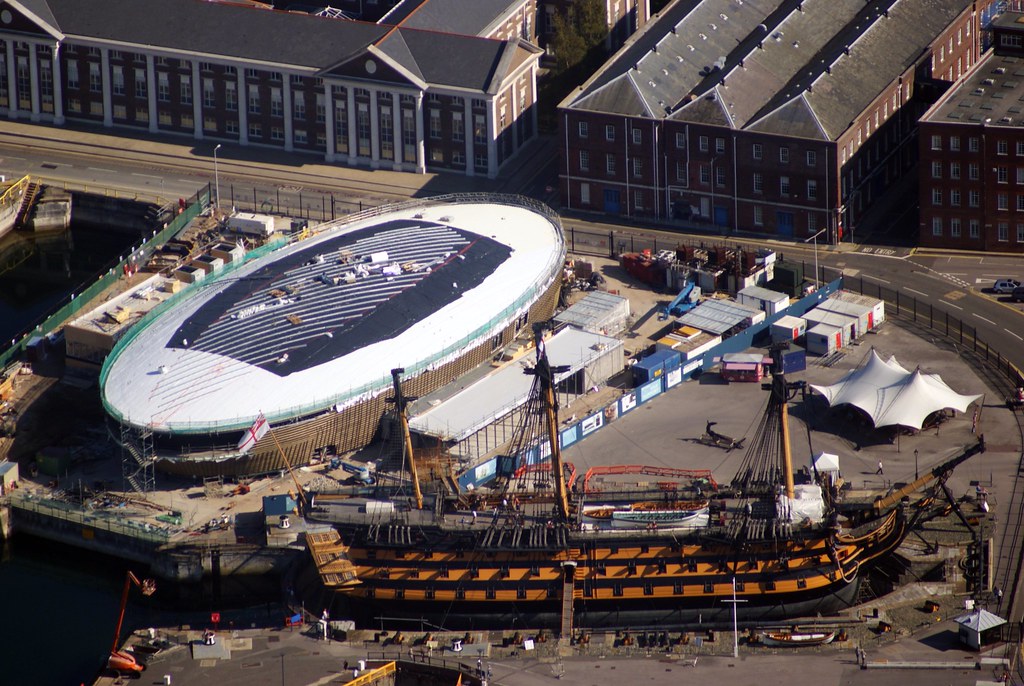
“Mary Rose Museum & HMS Victory” by Silly Little Man is licensed under CC BY-SA 2.0 

 .
.
The anti-Western left has been exposed for its sexual imperialism over the last few months. Evidence is all around. American Muslims have led protests against the imposition of LGBTQ policies and curricula in schools, leaving American progressives uncomfortably caught between two pillars of their favored rhetoric of political thought-crime: transphobia and Islamophobia. The Washington Post opined that anti-LGBTQ moves in the Middle East were “echoing” those of the American culture wars—as if Turkey, Saudi Arabia, and Pakistan had been listed by the Human Rights Campaign as favored vacation destinations until their ruling elites started reading the website of Moms for Liberty.
It is, of course, the nature of imperialism that everything, everywhere, is always to be measured by the imperialists’ standards. And that is also what makes them so impervious to spotting their own imperialism. “Queering the Mary Rose‘s Collection”, an article on the website of the Mary Rose Museum in Portsmouth, England, is a recent example of this. The Mary Rose was a Tudor warship that sank in 1545 and was raised from the seabed in 1982 in a groundbreaking act of marine archaeology. The museum is dedicated to displaying artifacts retrieved from the wreck, some of which are now been analyzed “through a Queer lens”.
The specific examples are an octagonal mirror, nit combs, a gold ring, and Paternosters. Apparently, looking into a mirror can stir strong emotions for both straight and queer people, and for the latter it can generate, for example, feelings of gender dysphoria or euphoria, depending on whether the reflection matches their gender identity. Combs would have been used by the sailors to remove the eggs of hair lice. Today they are reminders of how hairstyles can be the result of imposed gender stereotypes, but also make possible the subverting of these through hairdos that break with social expectations. Rings are a reminder of marriage and, of course, that the Church of England founded by Henry VIII, king during the Mary Rose‘s working life, still does not allow gay marriage. Finally, the Paternosters remind us that the crew were “practicing” Christians and that, once again, Henry VIII, via his initiation of the English Reformation, facilitated the civil criminalization of homosexual acts.
Two things are striking about the article, in addition to its lack of any intellectual merit. First, the absence of any historical awareness is striking. For example, the category of “practicing Christian” is essentially meaningless when applied to the early sixteenth century. Everybody, bar a few underground Jews, Anabaptists, and radicals, was part of the Catholic Church by baptism. The question of how the crew might have understood themselves, whether in terms of mirrors, rings, combs, or Paternosters, is never asked. To be fair, a short blog post cannot ask all the relevant questions, but this does not even nod in the direction of suggesting that the differences between yesterday and today might be remotely interesting or instructive.
David Thompson also has some thoughts on the Mary Rose artifact interpretations:
It’s quality stuff. Just like being there, in the mists of history. And not at all inept, or jarring, or comically incongruous.
As we have seen, many objects can be viewed through a Queer lens and can indirectly tell LGBTQ+ stories.
And thanks to peering through this “Queer lens”, readers will doubtless find that their understanding of Tudor history has been enriched no end.
We’re told – indeed, assured – by Hannah McCann, of the museum’s collections and curatorial staff,
From the Tate Britain and the Wellcome Collection, to the Rijks Museum in Amsterdam and the Whitney Museum of American Art in New York City, museums are reinterpreting and Queering their objects.
A comfort, I know.
Exactly why such “queering” is underway – what its relevance might be – is not, however, made clear. An explanation for this bolting-on of irrelevant, flimsy tat – in the name of “queer theory” – was not, it seems, deemed necessary. Nor is it entirely obvious how such “queering” of museum contents benefits those who wish to know more about Henry VIII’s favourite warship.
Toward a more perfect Homo Sovieticus
Ed West on the interplay between Soviet ideology and Soviet humour during the Cold War:
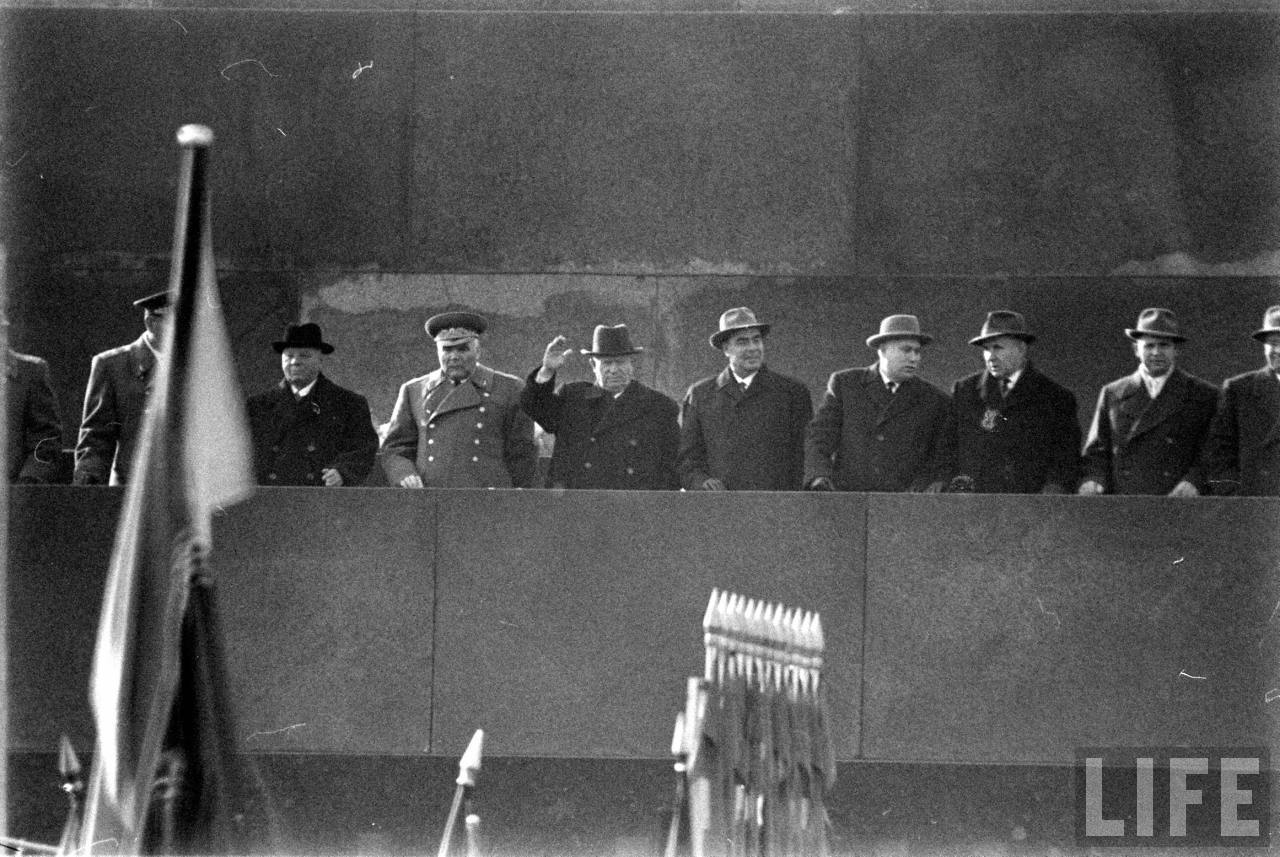
Krushchev, Brezhnev and other Soviet leaders review the Revolution parade in Red Square, 1962.
LIFE magazine photo by Stan Wayman.
Revolutions go through stages, becoming more violent and extreme, but also less anarchic and more authoritarian. Eventually the revolutionaries mellow, and grow dull. Once in power they become more conservative, almost by definition, and more wedded to a set of sacred beliefs, with the jails soon filling up with people daring to question them.
The Soviet system was based on the idea that humans could be perfected, and because of this they even rejected Mendelian genetics and promoted the scientific fraud Trofim Lysenko; he had hundreds of scientists sent to the Gulag for refusing to conform to scientific orthodoxy. Lysensko once wrote that: “In order to obtain a certain result, you must want to obtain precisely that result; if you want to obtain a certain result, you will obtain it … I need only such people as will obtain the results I need.”
Thanks in part to this scientific socialism, harvests repeatedly failed or disappointed, and in the 1950s they were still smaller than before the war, with livestock counts lower than in 1926.
“What will the harvest of 1964 be like?” the joke went: “Average – worse than 1963 but better than 1965”.
The Russians responded to their brutal and absurd system with a flourishing culture of humour, as Ben Lewis wrote in Hammer and Tickle, but after the death of Stalin the regime grew less oppressive. From 1961, the KGB were instructed not to arrest people for anti-communist activity but instead to have “conversations” with them, so their “wrong evaluations of Soviet society” could be corrected.
Instead, the communists encouraged “positive satire” – jokes that celebrated the Revolution, or that made fun of rustic stupidity. “An old peasant woman is visiting Moscow Zoo, when she sets eyes on a camel for the first time. ‘Oh my God,’ she says, ‘look what the Bolsheviks have done to that horse’.” The approved jokes blamed bad manufacturing on lazy workers, while the underground and popular ones blamed the economic system itself. This official satire was of course nothing of the sort, making fun of the old order and the foolish hicks who still didn’t embrace the Revolution and the future.
Communists likewise set up anti-western “satirical” magazines in Poland, East Germany, Czechoslovakia and Hungary, where the same form of pseudo-satire could mock the once powerful and say nothing about those now in control.
Indeed in 1956, the East German Central Committee declared that the construction of socialism could “never be a subject for comedy or ridicule” but “the most urgent task of satire in our time is to give Capitalism a defeat without precedent”. That meant exposing “backward thinking … holding on to old ideologies”.
[…]
Leonid Brezhnev had a stroke in 1974 and another in 1976, becoming an empty shell and inspiring the gag: “The government of the Union of Soviet Socialist Republics has announced with great regret that, following a long illness and without regaining consciousness, the General Secretary of the Central Committee of the Communist Party and the President of the highest Soviet, Comrade Leonid Brezhnev, has resumed his government duties.”
Brezhnev was an absurd figure, presiding over a system few still believed in. His jacket was filled with medals – he had 260 awards by the time of his death – and when told that people were joking he was having chest expansion surgery to make room for all the medals he’d awarded himself, he apparently replied: “If they are telling jokes about me, it means they love me.”


