
English Heritage
Published 23 Nov 2018📖 Order your copy of Mrs Crocombe’s cookery book here: http://bit.ly/2RPyrvQ 📖
Join Mrs Crocombe as she makes a traditional plum pudding at Audley End House. This recipe comes from Modern Cookery by Eliza Acton, who is understood to have been the first person to call it “Christmas Pudding”.
Plan a visit to Mrs Crocombe’s kitchen: http://bit.ly/2BtBzoO
Discover the history of Christmas pudding: http://bit.ly/2Bu2WyS
(more…)
December 23, 2024
How to Make Christmas Pudding – The Victorian Way
Comments Off on How to Make Christmas Pudding – The Victorian Way
December 22, 2024
Canada’s founding peoples
Fortissax contrasts Canadians and Americans ethnically, culturally, and historically. Here he discusses Anglo-Canadians and French-Canadians:

The arms of Canada include those of England, Scotland, Ireland and France in that order.
To understand Canada, you must first understand its foundations.
Canada is a breakaway society from the United States, like the United States was a breakaway society from the British Empire. You might even argue that Britain represented a thesis, America an antithesis, and Canada the synthesis.
Anglo-Canadians
Anglo-Canadians are descendants of the Loyalists from the American Revolution. They were North Americans, not British transplants, as depicted in American propaganda like Mel Gibson’s The Patriot. They shared the same pioneering and independent spirit as their Patriot counterparts. All were English “Yeoman” or free men. American history from the Mayflower to 1776 is also Canadian history. It is why both nations share Thanksgiving. Some historians have identified the American Revolution as an English civil war, and this is a fairly accurate assessment.
The United States’ founding philosophy was rooted in liberalism; it is a proposition nation based on creed over blood, shaped by Enlightenment thinkers like Edmund Burke and John Locke, now considered “conservative”. American revolutionaries embraced ideals of meritocracy, individualism, property rights, capitalism, free enterprise, republicanism, and democracy, which empowered the emerging middle class.
Anglo-Canada’s founding philosophy is British Toryism, emerging as a traditionalist and reactionary force in direct response to the American Revolution. During the revolution, many Loyalists had their private property seized or redistributed, suffered beatings in the streets, and in the worst cases, faced public executions or the infamous punishment of tar and feathering. Canadian philosopher George Grant, who is considered the father of Anglo-Canadian nationalism, traced their roots to Elizabethan-era Anglican theologian Richard Hooker.
Canada’s motto, Peace, Order, and Good Government (POGG), reflects a philosophy in stark contrast to the American ideal of life, liberty, and the pursuit of happiness. Anglo-Canadians valued God, King, and Country, emphasizing public morality, the common good, and Tory virtues like noblesse oblige — the expectation and obligation of elites to act benevolently within an organic hierarchy. While liberty was important, it was never to come at the expense of order. Canadian conservatism before the 1960s was not a variation of liberalism, as in the U.S., but a much older, European, and genuinely traditional ideology focused on community, public order, self-restraint, and loyalty to the state — values embedded in Canada’s founding documents.
Section 91 of the Constitution Act, 1867, empowers Parliament to legislate for the “peace, order, and good government” of Canada, giving rise to Crown corporations like Ontario Hydro, the CBC, and Canadian National Railway — state-owned enterprises. Canada’s tradition of mixed economic policies is often misunderstood by Americans as socialism, communism, or totalitarianism. These state-owned enterprises have historical precedents, such as state-controlled factories during Europe’s industrial revolution, often run by landed nobility. Going further back, state-owned mines in ancient Athens and Roman Empire granaries also exemplify this model, which cannot be simplistically labeled as “Islamofascist communism” — a mischaracterization of anything not aligned with liberalism by many Americans, and increasingly many populist Canadians.
It is also a lesser-known historical fact that Canada was almost ennobled into a kingdom rather than a dominion. This idea was suggested by Thomas D’Arcy McGee, a prominent Irish-Canadian politician, journalist, and one of the Fathers of Confederation. Deeply involved in the creation of Canada as a nation, McGee proposed in the 1860s that Canada could be formed as a monarchy with a hereditary nobility, possibly with a viceroyal king, likely a son of Queen Victoria and Prince Albert. He believed this would provide stability and continuity to the fledgling nation. While this idea was not realized, its influence can be seen in the entrenched elites of Canada, who, in a sense, became an unofficial aristocracy.
An element of Canada’s conservative origins can also be found in its use of traditional British and French heraldry. Every province, for example, has a medieval-style coat of arms, often displayed on its flag, which reinforces this connection to the old-world traditions McGee sought to preserve.
McGee’s vision was rooted in his belief in the importance of monarchical institutions and his desire to strengthen Canada’s bond with the British Crown while fostering a distinct Canadian identity. He argued that ennobling Canada would give the country legitimacy and elevate it in the eyes of Europe and the wider world.
French-Canadians
French Canada, with Quebec as its largest and most influential component, has a distinct history shaped by its French colonial roots. Quebec was primarily settled by French colonists, and its unique culture and identity have evolved over the centuries, heavily influenced by Catholicism and monarchical traditions.
The Jesuits and other Catholic organizations played a pivotal role in shaping early French Canadian society. They not only spread Christianity but also laid the foundation for Quebec’s social and cultural identity. The Jesuits, part of the Society of Jesus, were among the first Catholic missionaries to arrive in New France. Invited by Samuel de Champlain, the founder of Quebec, in 1611, they helped convert Indigenous populations to Catholicism but often remained separate from them. By 1625, they had established missions among various Indigenous nations, including the Huron, Algonquin, and Iroquois.
Unlike France, Quebec bypassed the upheavals of the French Revolution and the Reign of Terror. Isolated from the homeland, the Catholic Church in Quebec consolidated its power, and French colonists faced the threat of extinction due to their initially low numbers, particularly during the one-hundred-year war with the Iroquois. This struggle only strengthened their resolve. Over time, this foundation gave rise to Clerico-Nationalism, particularly exemplified by figures like Abbé Lionel Groulx, a theocratic monarchist and ultramontanist influenced by anti-liberal Catholic nationalist movements in France. Groulx and his contemporaries emphasized loyalty to the Pope over secular governments, and their influence was so strong that the Union Nationale government of Maurice Duplessis embodied many of their beliefs.
Attempts to secularize education in the 1860s were thwarted, as the Catholic theocracy shut them down and restored control to the Church. Quebec remained a theocracy well into the 20th century, with the Catholic Church controlling public schooling and provincial healthcare until the 1960s. For much of its history, Quebecois culture saw itself as the last bastion of the traditionalist, Catholic, monarchist Ancien Régime of the fallen Bourbon monarchy. Liberal republicanism and the French Revolution were regarded as abominations, and French-Canadians believed they were the true French.
This mindset persists today, especially regarding Quebecois French. The 400-year-old dialect, rooted in Norman French and royal court French, is still regarded by many French-Canadians as “true French”. However, Europeans often deny this claim, pointing out the influence of anglicisms and the use of joual, a working-class dialect that was deliberately encouraged by Marxist intellectuals and separatists during the Quiet Revolution of the 1960s to proletarianize the population.
Tanks Prepare for Battle! The Greatest Ever? Prokhorovka Part 2
World War Two
Published 21 Dec 2024In the early hours of July 12, 1943, the Waffen SS and the Red Army are ready for battle. SS General Paul Hausser has his armoured spearheads ready to strike at Prokhorovka while Soviet commander Pavel Rotmistrov’s 5th Guards Tank Army readies his counterattack. Today, Indy walks you through the enormous armoured fleets deployed for the coming fight.
(more…)
Comments Off on Tanks Prepare for Battle! The Greatest Ever? Prokhorovka Part 2
QotD: “Sparta Is Terrible and You Are Terrible for Liking Sparta”
“This. Isn’t. Sparta.” is, by view count, my second most read series (after the Siege of Gondor series); WordPress counts the whole series with just over 415,000 page views as I write this, with the most popular part (outside of the first one; first posts in a series always have the most views) being the one on Spartan Equality followed by Spartan Ends (on Spartan strategic failure). The least popular is actually the fifth part on Spartan Government, which doesn’t bother me overmuch as that post was the one most narrowly focused on the spartiates (though I think it also may be the most Hodkinsonian post of the bunch, we’ll come back to that in a moment) and if one draws anything out of my approach it must be that I don’t think we should be narrowly focused on the spartiates.
In the immediate moment of August, 2019 I opted to write the series – as I note at the beginning – in response to two dueling articles in TNR and a subsequent (now lost to the ages and only imperfectly preserved by WordPress’ tweet embedding function) Twitter debate between Nick Burns (the author of the pro-Sparta side of that duel) and myself. In practice however the basic shape of this critique had been brewing for a lot longer; it formed out of my own frustrations with seeing how Sparta was frequently taught to undergraduates: students tended to be given Plutarch’s Life of Lycurgus (or had it described to them) with very little in the way of useful apparatus to either question his statements or – perhaps more importantly – extrapolate out the necessary conclusions if those statements were accepted. Students tended to walk away with a hazy, utopian feel about Sparta, rather than anything that resembled either of the two main scholarly “camps” about the polis (which we’ll return to in a moment).
That hazy vision in turn was continually reflected and reified in the popular image of Sparta – precisely the version of Sparta that Nick Burns was mobilizing in his essay. That’s no surprise, as the Sparta of the undergraduate material becomes what is taught when those undergrads become high school teachers, which in turn becomes the Sparta that shows up in the works of Frank Miller, Steven Pressfield and Zack Snyder. It is a reading of the sources that is at once both gullible and incomplete, accepting all of the praise without for a moment thinking about the implications; for the sake of simplicity I’m going to refer to this vision of Sparta subsequently as the “Pressfield camp”, after Steven Pressfield, the author of Gates of Fire (1998). It has always been striking to me that for everything we are told about Spartan values and society, the actual spartiates would have despised nearly all of their boosters with sole exception of the praise they got from southern enslaver-planter aristocrats in the pre-Civil War United States. If there is one thing I wish I had emphasized more in “This. Isn’t. Sparta.” it would have been to tell the average “Sparta bro” that the Spartans would have held him in contempt.
And so for years I regularly joked with colleagues that I needed to make a syllabus for a course simply entitled, “Sparta Is Terrible and You Are Terrible for Liking Sparta”. Consequently the TNR essays galvanized an effort to lay out what in my head I had framed as “The Indictment Against Sparta”. The series was thus intended to be set against the general public hagiography of Sparta and its intended audience was what I’ve heard termed the “Sparta Bro” – the person for whom the Spartans represent a positive example (indeed, often the pinnacle) of masculine achievement, often explicitly connected to roles in law enforcement, military service and physical fitness (the regularity with which that last thing is included is striking and suggests to me the profound unseriousness of the argument). It was, of course, not intended to make a meaningful contribution to debates within the scholarship on Sparta; that’s been going on a long time, the questions by now are very technical and so all I was doing was selecting the answers I find most persuasive from the last several decades of it (evidently I am willing to draw somewhat further back than some). In that light, I think the series holds up fairly well, though there are some critiques I want to address.
One thing I will say, not that this critique has ever been made, but had I known that fellow UNC-alum Sarah E. Bond had written a very good essay for Eidolon entitled “This is Not Sparta: Why the Modern Romance With Sparta is a Bad One” (2018), I would have tried to come up with a different title for the series to avoid how uncomfortably close I think the two titles land to each other. I might have gone back to my first draft title of “The Indictment Against Sparta” though I suspect the gravitational pull that led to Bond’s title would have pulled in mine as well. In any case, Sarah’s essay takes a different route than mine (with more focus on reception) and is well worth reading.
Bret Devereaux, “Collections: This. Isn’t. Sparta. Retrospective”, A Collection of Unmitigated Pedantry, 2022-08-19.
Comments Off on QotD: “Sparta Is Terrible and You Are Terrible for Liking Sparta”
December 21, 2024
QotD: Portugal’s early expansion in the Indian Ocean
The collision of the Iberian and Indian worlds, which possessed diplomatic and religious norms that were mutually unintelligible, was therefore bound to devolve quickly into frustration and eventually violence. The Portuguese, who harbored hopes that India might be home to Christian populations with whom they could link up, were greatly disappointed to discover only Muslims and Hindu “idolaters”. The broader problem, however, was that the market in the Malabar coast was already heavily saturated with Arab merchants who plied the trade routes from India to Egypt — indeed, these were precisely the middle men whom the Portuguese were hoping to outflank.
The particular flashpoint which led to conflict, therefore, were the mutual efforts of the Portuguese and the Arabs to exclude each other from the market, and the devolution to violence was rapid. A second Portuguese expedition, which arrived in 1500 with 13 ships, got the action started by seizing and looting an Arab cargo ship off Calicut; Arab merchants in the city responded by whipping up a mob which massacred some 70 Portuguese in the onshore trading post in full sight of the fleet. The Portuguese, incensed and out for revenge, retaliated in turn by bombarding Calicut from the sea; their powerful cannon killed hundreds and left much of the town (which was not fortified) in ruins. They then seized the cargo of some 10 Arab vessels along the coast and hauled out for home.
The 1500 expedition unveiled an emerging pattern and basis for Portugal’s emerging India project. The voyage was marked by significant frustration: in addition to the massacre of the shore party in Calicut, there were significant losses to shipwreck and scurvy, and the expedition had failed to achieve its goal of establishing a trading post and stable relations in Calicut. Even so, the returns — mainly spices looted from Arab merchant vessels — were more than sufficient to justify the expense of more ships, more men, and more voyages. On the shore, the Portuguese felt the acute vulnerability of their tiny numbers, having been overwhelmed and massacred by a mob of civilians, but the power of their cannon fire and the superiority of their seamanship gave them a powerful kinetic tool.
Big Serge, “The Rise of Shot and Sail”, Big Serge Thought, 2024-09-13.
Comments Off on QotD: Portugal’s early expansion in the Indian Ocean
December 20, 2024
Election Fever – Rise of Hitler 08, August 1930
World War Two
Published 19 December 2024August 1930 brings Germany to a critical juncture as parties prepare for the September elections. Amid street violence, bans on political uniforms, and soaring unemployment, the stakes couldn’t be higher. This episode unpacks the campaign strategies, shifting alliances, and rising tensions shaping the Republic’s future.
(more…)
Comments Off on Election Fever – Rise of Hitler 08, August 1930
The Murder of Egypt’s Forgotten Queen – Shajar al-Durr & Om Ali
Tasting History with Max Miller
Published Aug 13, 2024The national dessert of Egypt: bread pudding made from crisp flatbread, pistachios, almonds, sultanas, spices, and rose water
City/Region: Egypt | Baghdad
Time Period: 10th-13th CenturiesOm Ali is the national dessert of Egypt, and its roots go back at least to the 10th century, when we get the base recipe for my version. I took inspiration from other medieval recipes and added the nuts, sultanas, and spices, though they would also use ingredients like camphor, chicken, poppyseeds, and musk.
I really like the flavors, and the dish is sweet without being too sweet, but the bread gives it a kind of noodle-like texture which is a bit odd. Modern versions often use dry croissants, so I won’t judge if you use them or something like phyllo or puff pastry in place of the homemade roqaq.
Take semolina or white bread and soak it in milk until saturated. Then, take half a pound of sugar, or as much as is needed for the amount of bread, crush it, and mix it with the bread. Then, take a clean and shallow pot … add the soaked bread, milk, and sugar … Return the pot to slow burning coals. When the filling is cooked and set, remove the pot from the fire, turn it out onto a wide bowl and serve, God willing.
— Kitab al-Tabikh by Ibn Sayyar al-Warraq, 10th Century
Comments Off on The Murder of Egypt’s Forgotten Queen – Shajar al-Durr & Om Ali
December 19, 2024
“A decree went out from Caesar Augustus” – The evidence for the date of the birth of Jesus
Adrian Goldsworthy. Historian and Novelist
Published 18 Dec 2024It’s December, with Christmas fast approaching, and I suspect that a fair few people who never think much about the Romans will hear mention of Caesar Augustus because of this verse from Luke’s Gospel. I have an appendix about this in my biography of Augustus, so thought that I would talk about how the New Testament dates the Christmas story and how well this fits with our other sources for the Ancient World.
Comments Off on “A decree went out from Caesar Augustus” – The evidence for the date of the birth of Jesus
QotD: Replacing the outdated “left” and “right” with more accurate terms
It was guys like Haldane who caused Stove to write a great essay about “The Ishmael Effect”. He said something like (from memory) it’s a striking fact about powerful minds, that even though they know better than everyone else some fact about the physical world — the conservation of energy, say — their powerful minds cause them to get caught up in all the fascinating implications of their pet theory, such that they fail to see their pet theory requires energy not to be conserved. Thus (said Stove), a guy like Kant: After telling us that no human mind can access the Thing-in-Itself, he gives us four hundred pages of extremely detailed information about the Thing-in-Itself. Or Karl Marx, who was able to soar so far above his own economic class situation as to tell us, with oracular certainty, that no one is able to transcend the cognitive limits of his economic class situation. I don’t think it’s much of an exaggeration to say that “the Ishmael Effect” pretty much IS 19th century philosophy … and thanks to entropy, 20th century politics, and now 21st century culture.
Such are the Theory People who, however many raw IQ points they have, will really see five lights if The Party tells them to, because The Party controls the Theory and the Theory is never wrong, facts be damned. Call them Rubashovs if you like (and are feeling literary), but let’s move on to the Reality People. If Rubashov is the ultimate Theory Person — marching willingly off to his destiny in the dreaded Lubyanka, because The Party requires it and The Party is never wrong — so the ultimate Reality Person is Niccolo Machiavelli.
Much hooey has been written about The Prince, that it’s ACK-shully a biting satire (you could call the Rubashovs’ junior varsity the ACK-shully kids), but Ol’ Nick meant every fucking word. Politics was a contact sport in his day — he picked the wrong side of a political dispute, and got the strappado for it. He knew exactly what he was talking about, and had the disjointed shoulders to prove it.
Machiavelli is often called a cynic, but just as everything in Clown World always turns out faker and gayer than the most jaded can imagine, so even the hardest-bitten cynic can’t touch Ol’ Nick. The Prince is beautifully written, but it’s one of the toughest reads you’ll ever have, because surely he can’t mean what he just wrote … he just can’t. But he does, and it’s true — that for example a man will more quickly get over the murder of his father than the loss of his patrimony. And you know it’s true, if only in the darkest watches of the night when you toss and turn in the coldest of cold sweats. There aren’t more than a handful of sentences in The Prince that won’t give you insomnia, if you really start thinking them through …
But just as (one hopes) even Rubashov would balk at shooting his children on The Party’s orders, so even Machiavelli marvels at the truth that no one is thoroughly, consciously evil, even when it’s in his obvious best interest to be. A man will always convince himself he’s doing good, even when he’s obviously, objectively doing the most heinous evil, and that — Nick implies — is the way to manage a tyrant. Even when doing X is the obviously advantageous thing to do, and doing Y is obviously disadvantageous, you can convince someone to do Y by changing the moral frame.
There’s obviously a spectrum here, which like all human behavior bends in on itself at the extremes. One imagines Rubashov, for instance, going through an “if only Comrade Stalin knew!” type thought process if The Party ordered him to shoot his infant children. Yes, The Party is never wrong … but even though Comrade Stalin IS The Party, The Party is, finally, the historical manifestation of a metaphysical necessity, and therefore, in the light of the Highest Truth, Comrade Stalin — though never wrong!! — is perhaps misinformed in this case … Just as Francesco Sforza or whomever balks at murdering those infants in their cribs, though it’s clearly the very best course of action, politically.
Rubashov vs. Machiavelli. That’s the best I can do.
Severian, “Mail / Grab Bag”, Rotten Chestnuts, 2021-09-10.
Comments Off on QotD: Replacing the outdated “left” and “right” with more accurate terms
December 18, 2024
The Korean War 026 – Chinese Victory in North Korea Complete – December 17, 1950
The Korean War by Indy Neidell
Published 17 Dec 2024The last UN forces still in the northern half of Korea begin their frantic retreat by sea. The evacuation is a huge operation involving over 100,000 men, and needs to go off smoothly if the UN want any hope of halting the Chinese advance. Eighth Army, who spend this week retreating, are certainly not up to the task on their own.
Chapters
00:00 Intro
00:50 Recap
01:07 Failures of Command
05:36 Hungnam Evacuation
09:02 Eighth Army Situation
13:07 National Emergency
14:12 Conclusion
15:48 CTA
(more…)
Comments Off on The Korean War 026 – Chinese Victory in North Korea Complete – December 17, 1950
The modern Furies
In Greek mythology, the Erinyes (the Furies) — euphemized as the Eumenides (the “Gracious ones”) were the goddesses of vengeance. You may dismiss the ancient Greeks and their beliefs, yet they often encapsulate hidden wisdom for those who know how to interpret their stories. Today, as Janice Fiamengo points out, we have no need for mythological Furies, as they’re frequently embodied in otherwise ordinary women:
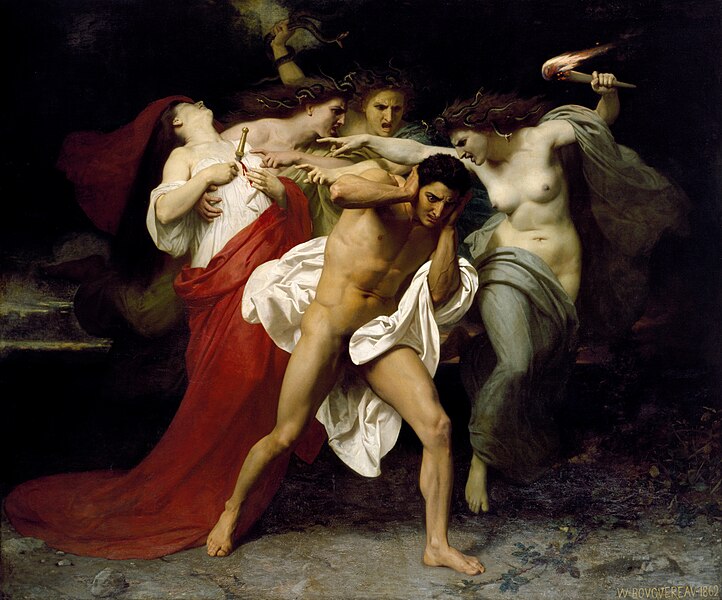
The Remorse of Orestes or Orestes Pursued by the Furies
Oil painting by William-Adolphe Bouguereau, 1862, in the Chrysler Museum of Art via Wikimedia Commons.
Feminist uproar over Trump’s election was easy to predict, and not long in coming. Within ten days of the election, Clara Jeffery wrote in Mother Jones that “Women are furious — in a Greek mythology sort of way“. Taking examples from TikTok, Jeffery chronicled abundant “sorrow, disbelief and terror, but also incandescent rage”, which many women vowed to exorcise on men: “‘If his ballot was red, his balls stay blue‘”, she quoted one.
In The New York Times, a 16-year-old girl, Naomi Beinart, charted her tumultuous emotions, which included a sense of betrayal because her male classmates had carried on with their lives on the day after the election, seemingly immune to the girls’ all-pervasive gloom and outrage. “Many of them didn’t seem to share our rage, our fear, our despair. We don’t even share the same future,” Beinart opined melodramatically.
No one with even a minimal acquaintance with social media can have missed the many similar, raging reactions: the heads being shaved, the death threats, the promised sex strikes, the fantasies of revenge against Trump-voting husbands. We are to understand that the re-election of a man rumored to lack sufficient pro-abortion commitment justifies thousands of self-recorded screams, imprecations, and poisoning plots.
At least one group of women gathered physically in Wisconsin to shout their angst and anger at Lake Michigan, and there have already been tentative (though apparently less enthusiastic than formerly) plans for a revival of the anti-Trump Women’s March protests, in which women with vulgar placards and pink hats exhibited their “collective rage“.
Women’s rage is all the rage.
It is not enough, it seems, for these women to say that they are disappointed by Trump’s win, and certainly inadequate for them to state strong disagreement with his policies or style. Expressing evidence-based positions is the sort of thing a rational person would do, and significant groups of women appear increasingly uninterested in rational talk or behavior. Instead, they reach for the most extreme language, tone of voice, postures and actions to express what feminist journalist Rhiannon Lucy Cosslett called the “visceral” “body horror” produced by the Trump victory, including the “profound physical revulsion” Cosslett and many of her sisters allegedly feel simply as a result of seeing one of Trump’s tweets (talk about fragility!).
Like so many feminist pundits telling us of women’s “horror” and “fury“, the emphasis is squarely on feeling and the female body, as if to bypass the intellect and the will altogether. The idea some feminists once scorned — that women are less reasonable and self-controlled than men — seems to have become a feminist axiom.
[NR: Edited to fix the broken URL.]
Comments Off on The modern Furies
QotD: Western shaming – the grass is always greener overseas
Once Japan’s economy ossified, the new utopia of the 1990s was supposedly the emerging European Union. Americans were supposed to be awed that the euro gained ground on the dollar. Europe’s borderless democratic socialism and its “soft power” were declared preferable to the reactionary U.S.
By 2015, the EU was a mess, so China was preordained as the inevitable global superpower. American intellectuals pointed to its high-speed rail transportation, solar industries and gleaming airports, in contrast to the hollowed-out and grubby American heartland.
Now the curtain has been pulled back on the interior rot of the Chinese Communist Party, its gulag-like re-education camps, its systematic mercantile cheating, its Orwellian surveillance apparatus, its serial public health crises and its primitive hinterland infrastructure.
After the calcification of the Soviet Union, Japan Inc., the EU and the Chinese superpower, no one quite knows which alternative will next supposedly bury America.
Victor Davis Hanson, “The Cult of Western Shaming”, Townhall.com, 2020-01-29.
Comments Off on QotD: Western shaming – the grass is always greener overseas
December 16, 2024
The Price of Victory by N.A.M. Rodger
In The Critic, Phil Weir reviews the final volume in N.A.M. Rodger’s three-book study of the history of the Royal Navy:
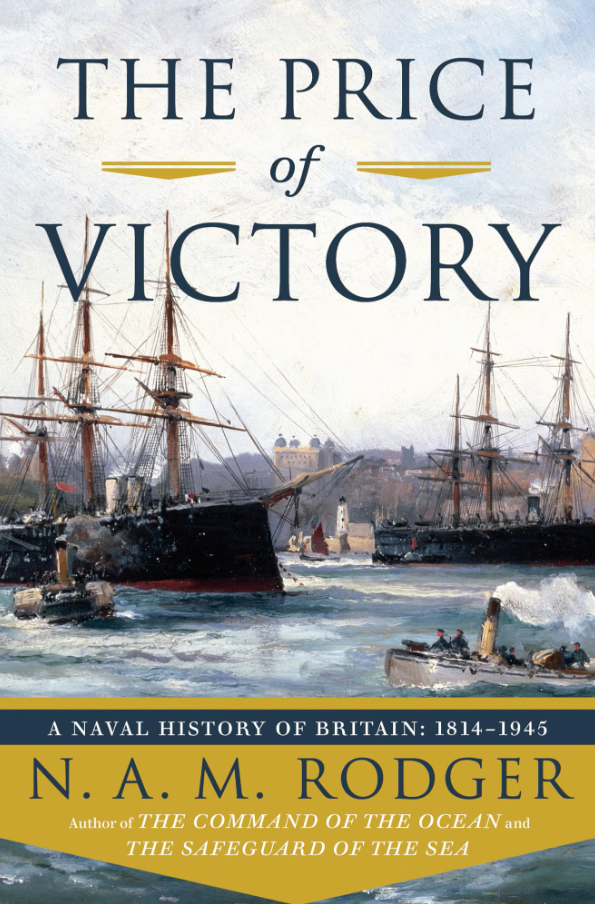
This October a major scholarly achievement was realised with the publication of The Price of Victory, the third and final instalment of N.A.M. Rodger’s great trilogy on the naval history of Britain from 660 AD to 1945. It has been an odyssey, albeit one that to complete took more than three times longer than Homer’s hero took to journey home.
The first volume, Safeguard of the Sea, was published back in 1997, some six years after Rodger had left his job as Assistant Keeper of the Public Records at the then Public Records Office to join the National Maritime Museum. Having moved to Exeter University, he completed the second volume, Command of the Ocean, covering the period from 1649 to 1815, in 2004.
Mindful of the fates of others who have attempted grand, multi-volume naval histories of Britain, Nicholas Rodger, now aged 74, was known to quip that one of his key aims was to become the first historian to live to see it completed. What he describes as “an exciting episode of brain surgery” delayed the completion of the final volume for several years, and left achieving this a closer-run thing than was — one suspects — entirely comfortable.
To the immense relief of all, Rodger recovered to complete his great work, and it has, emphatically, been well worth the wait. The Price of Victory is, like its predecessors, a most substantial work in both physical and scholarly senses.
At the outset of his task, Rodger aimed to create “not a self-contained ‘company history’ of the Royal Navy, but a survey of the contribution which naval warfare with all its associated activities has made to national history”. In doing so, he sought to link naval warfare “to political, social, economic, diplomatic, administrative, agricultural, medical, religious and other histories which will never be complete until the naval component of them is understood”.
He has succeeded handsomely, firmly entwining naval and naval-related matters into the core fabric of the history of the British Isles. The Price of Victory is a worthy conclusion to an epic series that will both stand in its own right and, as he hopes, serve as a baseline for future scholarly endeavours.
The vast, polyglot erudition underpinning Rodger’s prose wears no disguise. Yet, for all its great length and the density of knowledge each page imparts, The Price of Victory is, like its two preceding volumes, a lively read, leavened with the author’s dry wit.
Comments Off on The Price of Victory by N.A.M. Rodger
The academic battle over the legacy of the British Empire
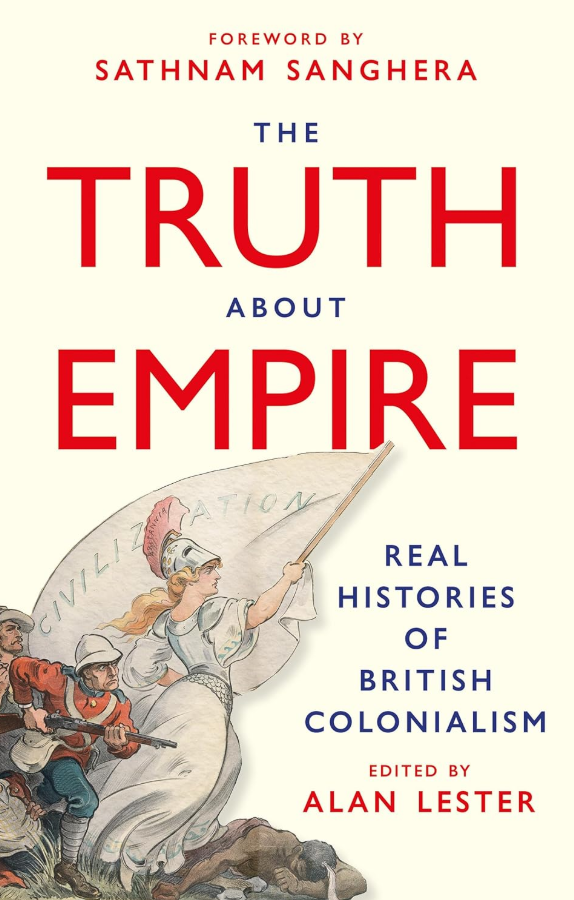
In the Washington Examiner, Yuan Yi Zhu reviews The Truth About Empire: Real histories of British Colonialism edited by Alan Lester:
… the story fitted awkwardly with the new dominant historical narrative in Britain, according to which the British Empire was an unequivocally evil institution whose lingering miasma still corrupts not only its former territories but also modern-day Britain.
When Kipling lamented, “What do they know of England, who only England know?” he was not being elegiac as much as describing a statistical fact. Contrary to modern caricatures, apart from episodic busts of enthusiasm, Britons were never very interested in their empire. At its Victorian peak, the great public controversies were more likely to be liturgical than imperial. In 1948, 51% of the British public could not name a single British colony; three years later, the figure had risen to 59%. Admittedly, this was after Indian independence, but it should not have been that hard. Proponents of the “imperial miasma” theory are right in saying that British people are woefully ignorant about their imperial past; but that was the case even when much of the world was colored red.
The Truth About Empire: Real Histories of British Colonialism is a collection of essays edited by Alan Lester, an academic at the University of Sussex who has been at the forefront of the cultural conflict over British imperialism on the “miasma” side — though, like all combatants, he denies being a participant. Indeed, one of the book’s declared aims is to show that its contributors are not engaged in cultural warring.
Their nemesis, whose name appears 376 times in this book (more often than the word “Britain”) is Nigel Biggar, a retired theologian and priest at the University of Oxford. In 2017, Biggar began a project to study the ethics of empire alongside John Darwin, a distinguished imperial historian. The now-familiar academic denunciations then came along, and Darwin, on the cusp of a quiet retirement, withdrew from the project.
Lester was not part of the initial assault on Biggar but has since then emerged as his most voluble critic. He disclaims any political aims, protesting that he and his colleagues are engaged in a purely scholarly enterprise, based on facts and the study of the evidence.
Yet some of Lester’s public interventions — he recently described a poll showing that British people are less proud of their history than before as an “encouraging sign” — are hard to square with this denial. Biggar, by contrast, is refreshingly honest that his aims are both intellectual and political. I must add that both men are serious scholars, which is perhaps why neither has been able to decisively bloody the other in their jousts.
[…]
“What about slavery?” asks Dubow’s Cambridge colleague Bronwen Everill. Unfortunately, her four pages, which read like a last-minute student essay, do not enlighten us. The most she can manage is to point to an 18th-century African monarch abolishing the slave trade as evidence that the British do not deserve any plaudits for their abolitionist efforts across the world, whose cost has been estimated at 1.8% of its gross domestic product over a period of 60 years.
Meanwhile, Abd al Qadir Kane, Everill’s abolitionist monarch, only objected to the enslavement of Muslims but not to slavery generally, his progressive reputation resting mainly on the misunderstandings of Thomas Clarkson, an overenthusiastic English abolitionist. (Either cleverly or lazily, Everill quotes Clarkson’s misleading account, thus avoiding the need to engage with the historiography on Islamic slavery in Africa.)
Everill’s central argument is that abolitionism allowed Britain to rove the world as a moral policeman and to overthrow rulers who refused to abolish slavery. It is never clear, however, why this was morally bad. If anything, Britain did not go far enough: Well into the 1960s, British representatives still manumitted slaves on an ad hoc basis in its Gulf protectorates, when the moral thing would have been to force their rulers to abolish slavery, at gunpoint if necessary.
Comments Off on The academic battle over the legacy of the British Empire
Whippet – Fast and Furious 1918 | Tank Chats Reloaded
The Tank Museum
Published Aug 16, 2024Was the British Medium Mk A Whippet the world’s first proper tank?
Able to do 8mph, but incredibly difficult to drive, Whippet was far faster than the British heavy tanks of WW1. Using their speed, Whippets were able to operate behind the enemy front line to destroy enemy formations and create chaos. At a stroke, the tank was transformed from what was effectively a siege engine to a fast-moving weapon of attack and exploitation.
At Amiens in August 1918, a Whippet called Musical Box went on a nine-hour rampage in the German Army’s rearward area destroying an infantry battalion, a divisional supply column and an artillery battery, an unheard of feat.
In this film, we look at the Tank Museum’s rare surviving Whippet, what she was like to crew and fight, tell the story of Musical Box‘s rampage and examine the unique achievement of the Whippet on the WW1 battlefield.
00:00 | Intro
02:08 | Breaking the Stalemate
03:45 | A New Design
08:29 | Does It Work?
09:36 | The Tank Corps’ Surprise
11:41 | Proving Its Worth
16:25 | Armoured Warfare RevolutionisedThis video features archive footage courtesy of British Pathé.
Comments Off on Whippet – Fast and Furious 1918 | Tank Chats Reloaded


