
Forgotten Weapons
Published 12 Feb 2025Various militias existed on the Falkland Islands since its earliest settlement, but the Falkland Islands Defense Force of today traces its roots to the 1892 Falkland Islands Volunteer Corps. This force was equipped with Martini Henry rifles. With the outbreak of World War One, the Falklands were a strategically important naval station, and the FIDF grew significantly in size and was fitted out with more modern arms. They expanded again in World War Two, with Lee Enfield rifles, Sten MkV SMGs, and Bren, Lewis’s and Vickers machine guns. Eventually in 1972 the force modernized, acquiring British L1A1 SLR rifles, L2A3 Sterling SMGs, and GPMGs (FALs and FN MAGs) and updating its Bren guns to 7.62mm. These were the standard arms at hand during the Argentine invasion in 1982, although the FIDF was not really an active participant in the resistance to the invasion. In fact, the British Marine party on the island was in the middle of being replaced when the invasion happened and twice the normal number of Marines were present. They armed themselves with most of the FIDF SLRs, leaving the FIDF with mostly just SMLE rifles.
After the war, the FIDF was reconstituted. It kept its SLRs until the early 1990s when they were replaced with 5.56mm rifles. Instead of adopted the British L85A1, the FIDF opted to purchase Steyr AUGs. The intention was to replace the GPMG with the heavy-barreled AUG, but this did not work out in practice. Instead, the GPMGs remained in service and the heavy-barreled AUGs were converted to standard rifles. In the post-war years the FIDF also began to acquire more specialty arms, starting with a Parker-Hale M85, a couple of Steyr HS-50s, and ultimately a batch of LMT 7.62mm rifles. They remain a small but quite well-equipped for today, offering valuable reconnaissance and local knowledge to the British Army garrison should conflict break out again.
Many thanks to the FIDF for giving me access to their armory to dig out these arms to film for you!
(more…)
June 30, 2025
Small Arms History of the Falkland Islands Defense Force
QotD: Britons and their NHS
Anecdotes, neither positive nor negative, are not the way to assess the performance of the NHS or any other healthcare system. But I suspect that I am not alone in finding it distinctly difficult, intimidating and unpleasant even to get to see a doctor (though I am middle-class and tolerably prosperous).
I have to run a gamut of procedures to do so and face a receptionist who treats me as a fraud trying to get something to which I am not entitled, and I have no practitioner whom I can call my doctor. The NHS has crowded out private competition, and the nearest private doctor is 25 miles away. Suffice it to say that, if I want to see a doctor, it is easier, quicker and more pleasant for me to go to France than to the health centre about 300 yards from my house in England.
I cannot in all honesty say, however, that my health has suffered in any measurable way as a result of this unpleasantness, because my health is good and I am not a doctor-botherer. But it does reveal something about Britain that is not true in France: in our dealings with the NHS, we are a nation of paupers who must accept what we are given by grace and favour of the system. It may be good or it may be bad, but we have to accept it.
Furthermore, under the NHS doctors themselves are becoming ever less members of a liberal profession and ever more executors of orders from on high, with little leeway to consider whether these orders are good or bad in the case of the individual case before them.
This is a problem in all systems in which a third party pays for patients’ treatment, but it is particularly acute in a highly-centralised and dirigiste system such as the NHS, in which uniformity is the goal, even if it be uniformity of error. And increasingly, it creates an atmosphere of technical, managerial and ethical conformity.
Theodore Dalrymple, “Empire of conformists”, The Critic, 2020-04-29.
June 29, 2025
QotD: People in the past believed their own religion
It is an old mistake – Polybius makes it of the Romans, writing in c. 150 BC. Polybius notes that Roman religion was “distinctly superior” for maintaining the cohesion of the Roman state, but that “they (= the ruling class) have adopted this course for the sake of the common people” (Plb. 6.56.6-8), by which he means for the sake of the “fickle multitude” which must be “held in invisible terrors and pageantry”. Polybius, I should note, immediately contradicts himself – one benefit of this religion, he says, is that Roman magistrates (read: elite Senators) do not steal from the public treasury even when they are not watched, which would seem to imply that even many very elite Romans believed their own religion (also, irony alert: those famously incorruptible Romans …). Poor men, after all, are not elected to watch the treasury.
Fortunately, Polybius is not our only source on Roman culture, so it is possible to say – and I want to be clear here – Polybius is wrong (on this point at least). Roman elites took their religion very seriously. There are exceptions, of course – Julius Caesar was an Epicurean philosophically, although this does not seem to have altogether disrupted his performance of the duties of Rome’s highest priesthood (he was Pontifex Maximus). Nevertheless, such philosophically minded men were generally regarded with scorn by even the Roman elites (Cicero heaps such scorn on Cato in the Pro Murena in what were clearly intended as friendly “ribbing” before a mostly elite audience), who nevertheless greatly valued religious character (in contrast, Cicero is quick to accuse his hated enemy Catiline of irreligion before the Senate). Roman leaders vowed temples and sacrifices in duress, and built and gave them in victory. Lavish dedications to the gods from all levels of Roman society confirm the overall picture: the Romans believed their religion. Yes, even the elite Romans (there is, I should note, some complicated in that elites tended to separate what they viewed as religion from common “superstition”, but that’s a topic for another day.) And, if anything, the evidence for elite “buy-in” to Medieval religion is far more voluminous.
Yet none of the main characters of Game of Thrones, apart from perhaps Catelyn Stark, is devoted to their region’s traditional religion in any private sense. I cannot recall at any point any character protesting an action on account of religion – no marches held up by high holy days (a regular occurrence in ancient and medieval literature), no groups, individuals or places religiously exempt from violence. The Faith has certain rules about sexuality, but they’re rules that are not only flouted privately by individuals in the show, but also quite publicly by the last ruling dynasty for centuries.
Moreover, none of the ruling characters seem to have any religious functions – or if they do, they simply ignore them most of the time. Keep in mind, these people believe that their gods – be it the Seven or the Old Gods – are powerful divine beings who are directly and immediately interested in the world and who act on that interest. Keeping such beings happy is vitally important – it is not an afterthought. No society, so far as I can tell, has ever believed there is enough gold or enough armies to save you if you have enraged the gods. There is simply no off-setting an angry divinity (and before the smart guy asks, “what about a favorable divinity?” the Greeks had an answer for that – go read Euripides’ Hippolytus. It ends badly for the mortals).
The lack of religious duties or functions for characters who are kings is particularly surprising. Kingship has three core roles in almost all human cultures where the institution appears: kings are 1) chief judge, 2) chief general, and 3) chief priest. That third role appears more or less prominently in almost all societies. In ancient Egypt and (at times) in Mesopotamia, kings were held to literally be either earthly incarnations of major gods or minor gods in their own right. Roman Emperors held the office of Pontifex Maximus, and took over as the chief priest of the state, before becoming gods on their deaths. The Chinese emperor was the “Son of Heaven” and was tasked with maintaining the right relationship with the divine (the “mandate of heaven”). The emperors of Japan are purported to be direct descendants of the goddess Amaterasu (and they have a family tree to back it up).
The relationship between medieval kings and the Church was more complicated, because of the existence of a clear religious head (the Pope) outside of secular authority, but medieval kingship retained a strong sense of religious purpose. Coronation rituals often involved the clergy and were essentially religious rituals, because kingly power was still thought to be bestowed by God. Kings, in turn, had a special role in keeping their kingdom in right relationship with the divine, both through just rule (which included protecting the Church) and through the performance of religious rituals. Those rituals, of course, worked both ways: both believed to be religious efficacious (as in they helped bring about God’s good favor), but also valuable tools of building royal legitimacy (hat tip to my colleague Elizabeth Hassler’s excellent dissertation on the topic of holy kingship). In some places (England and France most notably), kings were thought holy enough to be able to heal certain diseases miraculously by touch – a king who couldn’t was clearly insufficiently pious.
Bret Devereaux, “New Acquisitions: How It Wasn’t: Game of Thrones and the Middle Ages, Part II”, A Collection of Unmitigated Pedantry, 2019-06-04.
June 28, 2025
The Original Beef Stroganoff of Imperial Russia
Tasting History with Max Miller
Published 28 Jan 2025Tender cubes of beef seasoned with allspice and served with a delicious sour cream and mustard sauce
City/Region: Russia
Time Period: 1871Beef stroganoff has certainly gone through a lot of changes since this recipe was printed in 1871. Nowadays mushrooms are often added, and the allspice has pretty much disappeared, but I think it’s a delicious and unusual flavor for modern palates. The mustard flavor is present in the sauce without being super mustardy, and the beef is tender and flavorful.
This tasty dish comes together fairly quickly after the meat has rested with the seasonings, so I definitely recommend giving this a try.
Two hours prior to cooking take two funts of tender beef, cut in small cubes, and sprinkle with salt and allspice; take 30 grams butter and 1 tablespoon of flour and mix, lightly fry in a skillet, then mix with 2 glasses of stock, add 1 teaspoon of Sarepska mustard, a little bit of pepper, mix well, bring to a boil, then strain and add 2 tablespoons of the best fresh sour cream. Then fry the beef in butter, then add it to the sauce, boil again, and serve.
— Podarok molodym khozyaykam (A Gift to Young Housewives) by Elena Molokhovets, 1871
June 27, 2025
RAF Brize Norton apparently had almost no security for its planes at all
Domestic terrorists got into RAF Brize Norton, one of Britain’s main airbases, last week and committed damage that may range into the tens of millions of pounds … and were in and out with the RAF none the wiser:
So this was a serious attack; it’s also an intensely embarrassing one. The terrorists got in and out completely undetected; it appears nobody at Brize Norton was aware of the attack until the perpetrators had already escaped. This would be bad enough if they’d been Spetsnaz-trained infiltrators, flitting silently from shadow to shadow towards their targets. In fact, however, they were a couple of unwashed hippies from Palestine Action, and they “infiltrated” the base on electric motorbikes. It is absolutely staggering that they were able to get in, attack two valuable aircraft and then get out again without being intercepted.
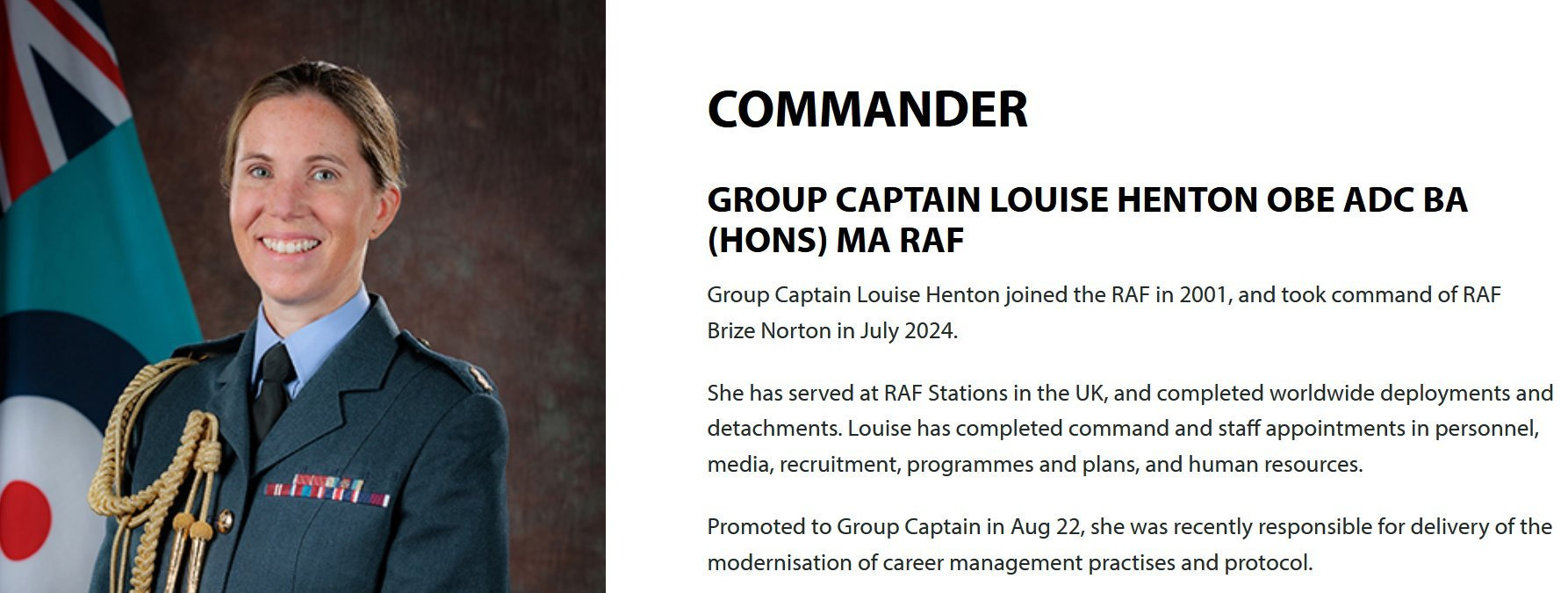
Or maybe it isn’t. This is the station commander of RAF Brize Norton:
Gp Capt Henton appears to have spent her entire career in non-operational roles. She also seems to have some very strange ideas about concepts such as masculinity and even patriotism. In a paper she wrote (which is available online) Henton appears strongly critical of traditional military culture, particularly that in the combat units she has never been part of. Is it just coincidence that, under the command of someone who is effectively an HR manager in a uniform, traditional military concerns such as security appear to have been badly neglected?
It’s undeniable that security at Brize Norton was neglected. One of the things I was trained in, as an Intelligence Corps operator, was protective security. We tended to focus on the protection of classified information, but the same principles apply to the protection of anything else (for example aircraft), and one of those principles is that if the security around an asset is weak in one respect — for example, physical barriers like fences — you can plug that gap by deploying other assets — for example, guards.
I used Google Street View to do a perimeter recce of Brize Norton, and took this screenshot looking from Station Road at the eastern end of the base’s runway:
This shot is taken from a public road, outside the base. The only perimeter security is a simple, easily climbed wooden fence less than six feet high. For a long stretch it has no “topping” — security jargon for razor wire or other anti-climb obstacles. There is also no perimeter security lighting along this section of the road. There aren’t even streetlights on the road itself. This is a massive weakness in physical security, which any terrorist can easily identify using open-source tools like Google Street View. The red ellipse I have drawn on the image highlights aircraft — seven of them, a mix of Voyagers and A400M transports — parked on the apron. They are less than three-fifths of a mile (900m in new money) from the perimeter fence, a distance that an electric scooter can cover in around 90 seconds. This level of physical security is completely unacceptable for the protection of such valuable assets, so it should have been supplemented with armed guards. It wouldn’t take all that many. A twelve-man guard under the command of a corporal could easily supply a pair of two-man prowler patrols, one on the apron and one randomly checking vulnerable points around the perimeter. That would have been enough to intercept and stop this attack.

Germany’s Constitution, Erotica, and a Pastor’s Dignity – Rise of Hitler 19, July 1931
World War Two
Published 26 Jun 2025A rogue preacher breaks into the Reichstag and steals silverware, banned erotica, and the 1848 German Constitution. As Germany’s banks collapse and panic spreads, the press is captivated by the strange tale of Walter Wohlgemuth: pastor, thief, and accidental symbol of a republic in crisis.
(more…)
India’s FAL: The 1A1 Inch/Metric Hybrid
Forgotten Weapons
Published 5 Feb 2025For political reasons, India decided to adopt the 7.62mm NATO cartridge when it needed to replace its No1 MkIII SMLE bolt action rifles with a modern self-loader. They chose the FN FAL as the rifle to adopt, but wanted a license to produce it domestically at the Ishapore rifle factory. FN insisted on the Indians buying Belgian tools as part of the agreement, which India was unwilling to do. So instead, Ishapore used the samples it had of both British L1A1 and Belgian FAL rifles to produce its own reverse-engineered drawings.
The resulting plans use a mixture of British (“inch”) and Belgian (“metric”) parts, and are not interchangeable with either standard pattern. As a result, the Indian 1A1 rifle is a clone of the FAL that is not actually parts compatible with the FAL. That did not prevent Ishapore from producing hundreds of thousands of them, with production apparently ending only in 2012.
Thanks to Sellier & Bellot for giving me access to this 1A1 example to film for you!
(more…)
June 26, 2025
German police raid homes to counteract online “hate speech” by “digital arsonists”
Things are getting worse for free speech in Germany, as eugyppius reports:

Apollo News reports on the newest, most irregular German holiday, which consists of the police conducting coordinated raids on and interrogations of ordinary people who are alleged to have said rude things on the internet:
On Tuesday morning police across Germany conducted raids targeting “hate speech and incitement” on the internet. According to the news agency dpa, there are currently 170 operations underway, including house searches and other measures. Those accused are charged with insulting politicians and inciting hatred …
The Federal Criminal Police Office (BKA) is in charge of the operation … In North Rhine-Westphalia, several police authorities struck simultaneously at 6 a.m. Police from Düsseldorf, Dortmund, Gelsenkirchen, Cologne, Bielefeld, Münster, Hagen, and Bonn are among those involved. Fourteen suspects are to be questioned and two search warrants executed.1 The individuals in question frequently express themselves on social media, such as on X.
… The Action Day against alleged hate posts has been taking place regularly for years. On June 18, the BKA joined forces with the reporting center “REspect!” to participate in the “International Day Against Hate and Incitement”. People were called upon to report posts that allegedly spread hate.
Today was the twelfth such “Action Day against Hate and Incitement on the Internet”. That is only an approximate title; it varies slightly across press sources. This dubious ritual began in 2016, after Merkel opened the German borders to the entirety of the developing world and our politicians grew tired of people calling them imbeciles online. Police are very open that the goal of these coordinated Action Days is intimidation – or, as they put it, “deterrence”.
Our federal police love this holiday so much they often celebrate it twice a year, which is why are already on the twelfth such day, even though we have only had nine years since the establishment of this custom. Sometimes our betters even throw in bonus action days that for some reason don’t count, as during Covid when they conducted a special “Action Day against Political Hate Postings” after the seventh “Nationwide Action Day against Hate Postings” but before the eighth “Nationwide Action Day against Hate Postings”. Who knows how many such action days we have really had, especially considering that since 2020 the broader EU has adopted this sporadic holiday and occasionally coordinates its own Continent-wide “Action Day against Hatred and Incitement on the Internet”.
[…]
By calling these Action Days idiotic, I don’t mean to minimise them. They are borderline illegal, for they exploit what should be purely investigative tactics (interrogations, house searches) to scare and punish people in advance of any criminal conviction. The emphasis is not only on right-leaning posters, but invariably and most disgracefully on ordinary people with relatively little social media reach, whose posts in many cases have been seen a mere handful of times. The message is clear: They can get you, whoever you are; they can get anybody. Living in a country whose authorities amuse themselves by periodically harassing their own citizens in this way is disturbing. It’s an absolute scandal that all the major political parties support this, save for Alternative für Deutschland. It’s a reason to vote AfD all by itself.
NATO members “commit” to a new 5% defence spending target
As many predicted, just as Canada finally gets around to at least pretending to meet the 2% defence spending target we agreed to over a decade ago, those goalposts get moved:

So today the leaders of Nato convene for a landmark summit:
NATO countries agree to increase defence spending to 5%
That headline isn’t strictly accurate. Member states have apparently agreed to commit to a target of 5% by 2035, to mark the start of the fourteenth anniversary of the Ukraine war. Which means that, as always with Nato, they’ll all look butch at the photo-op, and then they’ll do bugger all. Even the “commitment” to a “target” is too much for Spain, which has secured an opt-out.
But hang on a minute: Nato has been at war — or at proxy-war — with Russia for three-and-a-half years now. So it’s been on a war-footing, supposedly, for seven-eighths of the length of the First World War. How’s that war-footing going? Per Nato’s head honcho, Mark Rutte (the woeful former Dutch PM — ask our pal Eva Vlaardingerbroek), earlier this month:
The Russian army is developing its war capabilities by multiple times more than that of NATO despite having an economy 25 times smaller, NATO’s secretary general has warned …
“The Russians, as we speak are reconstituting themselves at a rapid pace and producing four times more ammunition in three months than the whole of NATO in a year,” said Rutte.
That’s a rather confusing way of putting it; what he means is: the Russians (who, as Mark Levin assures us, “scare nobody”) produce more ammunition in three weeks than the whole of Nato does in a year. Can even Nato be that worthless?
Taking the Secretary-General at his word, if you’re wondering why the Pentagon has to divert ammo marked for Israel to Ukraine and then divert it back from Ukraine to Israel … well, let’s do what everybody else does and dredge up the only historical analogy anybody knows — not the First World War, but the Second (see Levin’s “Iranian Nazi regime”): We’re asked to believe that Nato needs longer than the US was in the Second World War for to move to a war-production footing.
To be sure, supply chains are always difficult: Iran’s threat to close the Strait of Hormuz could have seriously impacted McDonald’s need to recall the hash browns it sent to Montenegro and divert them to Kiribati.
Trump gets something very basic: Flying the highest of high-tech weaponry seven thousand miles to drop down a ventilation shaft opening the size of a dishwasher is the kind of brilliant, dazzling one-off only the United States can do. But what next? Almost all geopolitical conflicts start with a bit of shock-&-awe (Pearl Harbor, even the assassination of the Archduke) and then dwindle down to old-school wars of attrition – as the United States should certainly know after taking twenty years to lose to goatherds with fertiliser, and three years to lose to “a gas station masquerading as a country” (thank you, John McCain). In wars of attrition, old-fashioned unglamorous things become important, like the ability to manufacture bullets in a timely manner. The basic arithmetical calculations are not complex: Don’t get into a long war with an enemy whose stock of long-range ballistic missiles outnumbers your surface-to-air missiles.
So Trump had the narrowest window of opportunity, and used it.
On the other side, the last week-and-a-half mostly revealed the shallowness of the War Party. You’ll recall, for example, that Ted Cruz got into a spat with Tucker over the actual population of Iran. Last week, a UK podcast had a brief discussion on The US Army-Marine Corps Counter-Insurgency Field Manual, which notes the following (foot of page xxvi):
The troop demands are significant. The manual’s recommendation is a minimum of twenty counterinsurgents per 1,000 residents.
That’s roughly what the British had in Malaya. Which they won, by the way. Twenty-two years ago, a couple of weeks after the fall of Saddam, I stopped on the shoulder of the main western highway from Jordan to Baghdad to fill up from an enterprising Iraqi who’d retrieved some supplies from a looted petrol station and was anxious to sell them to any passing Canadian tourists. As he was topping off, I asked him how agreeable he found the western soldiery. He grinned a big toothless grin and pointed to a chopper that had just come up over the horizon to hover above our heads. Then he said: “Americans only in the sky.”
We did not win that one, you’ll recall. Instead, we created an Iranian client-state.
That’s why Ted Cruz’s breezy indifference when Tucker asked him the population of Iran was so revealing. The senator told Tucker that it doesn’t matter whether the population of Iran is eighty million or a hundred million. Really?
Because, per the Pentagon’s own field manual, the latter figure would require finding an extra 400,000 troops. Oh, wait. If it’s a Nato mission, the other members could muster 127 guys between them, so it would only require 399,873 extra Americans.
Even if the public were minded to put one-and-a-half million pairs of boots on the ground, it couldn’t do it. “Americans only in the sky” equals what an Australian prime minister told me, after a flying visit to the troops in Afghanistan, was “the Crusader fort mentality”.
It doesn’t work. The political divide in America is between, crudely, Trumpians and neocons. The former are anti-war; the latter are pro-war … but a way of war that doesn’t work.
A Basic Explanation Of The First Punic War
MoAn Inc.
Published 8 Jan 2025GEOGRAPHY NOTES
Messina is the modern name for Messana. Both are correct.
Acragas / Akragas was renamed as Agrigentum by the Romans. Most videos on YouTube use the name Agrigentum for convenience purposes … so again, both are correct.
Panormus is modern day Palermo.
Drepana / Drepanum is modern day Trapani.
Lilybaeum is modern day Marsala.!READ THE SOURCES FOR FREE!
Livy: https://www.perseus.tufts.edu/hopper/…
Polybius: https://www.perseus.tufts.edu/hopper/…
Cassius Dio: https://www.perseus.tufts.edu/hopper/…
(more…)
June 25, 2025
It’s fine to refer to their bead-and-feather superstitious beliefs as a mythology, but not our holy revealed faith!
kulak responds to the “do you really believe this?” question:
One of the reoccurring critiques and challenges I get from Christians and others regarding Paganism is the accusation that I don’t “Really” believe in the Pagan Gods … that I believe or “believe” only as some calculated political/philosophical expedient or aesthetic choice and that really my professed “belief” is some sort of white or darker shade of lie or “LARP”, and that I must plainly KNOW that the Greek, Roman, Nordic, Celtic and other pantheons and only legends, mere mythologies, and cute stories …
I wish I could find it … but there was actually a twitter thread about a group of Christians and Jews responding with OUTRAGE when a group of academics, quite detachedly and seemingly meaning nothing by it, referred to Behemoth, Leviathan, the Flood, the Destruction of Sodom and Gomorrah, David’s defeat of Goliath, Adam and Eve, the Nephilim, the Plagues of Egypt, and Abraham and Issac as stories and figures of “Hebrew Mythology”.
“Mythology” to their mind was not a neutral term referring merely to cultural stories of a supernatural or historically unverifiable nature whose historicity, origin, and attachment to actual events cannot be verified to the standard of primary history — Stories of cultural import which may or may not be true or fictionalized to some extent we can’t differentiate (Imagine if Gone with the Wind was the last American book to survive and then arguing the Battle of Atlanta was fictional and never happened), the way Homer’s account of the sloped walls of Troy turned out to be shockingly accurate when Troy was found, whereas his accounts of Chariot warfare seemed to be confused by the subsequent 300 years without Greeks employing chariot archers. Rather “Mythology” to their minds denotes FALSE STORIES. SUPERSTITIONS with no attachment to reality, and thus to refer to even the most fantastical and supernatural of biblical stories as events or aspects of “Hebrew Mythology” was to state the Bible was false.
Troy, Gilgamesh, the Arthurian Legends, the Buddha, the conquests of Mohammed, the war of the Three Kingdoms, the Battle of Goths and Huns, the Hiawatha, the Wendigo, Quetzalcoatl (the God and the hypothesized historical ruler), the various unconfirmed Pharaoh stories, the Mormon Corpus … THESE ARE MYTHOLOGY. Even the stuff that’s been archeologically confirmed. Our collection of of texts and books though … you can’t call that mythology. It’s the truth!
Ironically many of these same people within nearly the same breath that they accuse me of being a “LARPER” will also accuse me of making pacts with “Demons” and claim that the beings I believe in are in fact vastly more real than I can possibly comprehend and that I am playing with the most dangerous of hellfire … so pressingly REAL and dangerous are the Ancient “Gods” who are actually Satanic Demons in barely concealed disguise.
Somehow I am simultaneously a cringe 90s mall goth playing at witchcraft and also a Later-Day Faustus dealing in a damnable deadly game with the Devil himself.
Amazing film BTW (Faust 1926)
“But do you actually believe in the Pagan Gods?”
Yes. Vastly more deeply and in more ways than the vast majority of Christian believe in their religion.
The Korean War Week 53 – Moscow Says ‘End the War!’ – June 24, 1951
The Korean War by Indy Neidell
Published 24 Jun 2025Soviet Ambassador Jacob Malik speaks to the world on UN radio, saying that the Soviet position on Korea is that ceasefire talks should begin among the belligerents. The Americans are thinking of how they can bring in more non-American UN units, even as South Korean President Syngman Rhee denounces the British and Commonwealth forces and says they should go home.
00:00 Intro
00:41 Recap
01:07 Jacob Malik Speaks
02:02 Chinese Change Plans
03:19 10th Corps Advances
05:37 More Non-American UN Units
07:52 Rhee Denounces his Allies
12:17 Summary
12:40 Conclusion
14:15 Call to action
(more…)
H.G. Wells’ Things To Come: Through The Eyes of its Time
Feral Historian
Published 10 Jan 2025H.G. Wells’ Things To Come played much differently in 1936 than it does today. So much so that it offers us an insight into the politics of the period if we can step back from our post-WWII understanding and look at it on its own terms.
Link to the Coupland essay.
http://digamoo.free.fr/coupland2000.pdf00:00 Intro
02:08 Revolution Envy
05:15 The Gulf of Time
06:32 Wells and the BUF
08:02 Empire and Establishment
12:11 The World State
15:18 To Understand the Past …
QotD: Marie Antoinette and the “Diamond Necklace” scandal
The origins of the affair stretched back to Louis XV, who wished to lavish on his mistress, Madame du Barry, a splendid diamond necklace containing 647 stones and weighing 2,800 carats (worth roughly $15 million today). But Louis XV died before the sale of the necklace was concluded. And when young Louis XVI took the throne, the Paris jewelers Boehmer and Bassenge hoped the new king would purchase the same necklace for his own queen, Marie Antoinette. However, she refused to accept a piece of jewelry that had been created for the previous king’s mistress.
Meanwhile, a socially ambitious minor aristocrat named Jeanne de la Motte was plotting to get her hands on the necklace. Married to the Comte de la Motte, she was also the mistress of Cardinal de Rohan, former French ambassador to Marie Antoinette’s native Austria. Madame de la Motte managed to convince Cardinal de Rohan not only that Marie Antoinette wished to possess the necklace, but that she was acting on the Queen’s behalf. He could ingratiate himself at court, she insisted, by obtaining it. Cardinal Rohan foolishly purchased the necklace on credit, under the naive belief that he’d be repaid by Marie Antoinette. The scam concluded with Madame de la Motte stealing the necklace from the cardinal and, using her husband’s louche connections, selling it in pieces through fences in England.
This tawdry business was closer to comic opera than an affair of state. But when the fraud was discovered, the scandal gripped Parisian society. Louis XVI was so infuriated that he had Cardinal de Rohan arrested and imprisoned in the Bastille, which only heightened public interest. Marie Antoinette was already being caricatured in pamphlets as a depraved nymphomaniac. It was now open season.
In some caricatures, she appeared as a wild beast, a tiger feeding on the French nation. In others, she was depicted as an ostrich, a French wordplay with her home country Autriche, for Austria, which reads like autruche for ostrich. Even worse, she was depicted in pornographic postures, legs open and genitals gaping, cuckolding her obese husband with a succession of lovers, including lesbian trysts. Allusions to her sexual appetites suggested a carnal relationship with Satan. Robespierre’s publication Le Journal des hommes libres described her as “more bloodthirsty than Jezebel, more conniving than Agrippina”. The pamphlets blamed Marie Antoinette for all the nation’s misfortunes, including economic recession. She was so hated by the French public that there were serious concerns for her physical safety.
[…]
Cardinal de Rohan, meanwhile, was tried for his role in the Diamond Necklace affair. Astonishingly, he was acquitted. The scheming Madame de la Motte met a different fate. She was found guilty of theft and sentenced to be whipped and branded on the shoulder with the letter V for voleuse (thief). She was also incarcerated in the Salpêtrière prison in Paris, but escaped to London. In 1789, she published a book, Mémoires justificatifs, a scathing tell-all memoir about Marie Antoinette. It was a good year to attack the French monarchy, for the revolution was just getting going. Madame de la Motte was never returned to France to face justice. Exiled in London, she died in 1791 after falling from a window, apparently fleeing debt collectors. She was buried in St. Mary’s Churchyard in south London.
Matthew Fraser, “Marie Antoinette: Figure of Myth, Magnet for Lies”, Quillette, 2020-06-24.


