Quotulatiousness

January 4, 2012

A call to reform the welfare state … from the pages of the Guardian

Filed under: Britain, Economics, Government — Tags: , , , , — Nicholas @ 09:27

Brendan O’Neill links to Liam Byrne’s column in the Guardian, suggesting not only is Byrne right, but that he doesn’t go far enough:

The Left won’t thank him for it, but in the Guardian Liam Byrne has tried to kickstart a potentially interesting debate about the welfare state. For many well-off Liberal commentators — who, notably, have no interaction with the welfare state, except in the sense that buddies of theirs probably manage huge chunks of it for a fat wage packet — the welfare state is a sacred thing and criticism of it is the equivalent of blasphemy. Yet Byrne surely has a point when he says the welfare state is in need of “radical reform” and we should seriously explore how to get “communities working again”. Indeed, I would go further and say that the expansion of the welfare state into more and more areas of less well-off people’s lives is one of the worst developments of recent years, seriously zapping resourcefulness and social solidarity from working-class communities.

Byrne’s mistake is that he seems motivated by a narrow desire to save the state money. The financial cost of social welfare is “simply too high”, he says, and we should “bring down [the] benefits bill to help pay down the national debt”. That is a Scrooge’s approach to the problem of the welfare state. The really terrible cost of ever-expanding welfarism is measured not in cash, but in the impact welfarism has on working communities, on those who have been made increasingly reliant upon the charity, largesse and therapeutic meddling of the massive and monolithic welfare machine. Relentless financial and therapeutic intervention by the state into poor people’s lives has, not surprisingly, had a pretty devastating impact both on social interaction and individual aspiration.

When people come to be more reliant on the state than they are on each other, community bonds fray and social solidarity falls into disrepair. When the struggling mum looks to the state for help, rather than turning to family, friends, neighbours, the end result is that she becomes more isolated from her community. When a 17-year-old school student short of cash turns to the state for a weekly handout, he never really develops skills of self-sufficiency or dependency on friends and neighbours.

December 29, 2011

Girls from single-parent homes “more resilient” at school than boys

Filed under: Britain, Education, Health, USA — Tags: , — Nicholas @ 10:55

An article in the Guardian summarizes a recent study’s findings:

Girls appear to be more resilient than boys in preventing problems at home from affecting their behaviour in school, according to a study which aims to explain the educational achievement gap between the genders.

The tendency for girls to perform better in the later years of school has become increasingly pronounced in the UK in the past two decades. In 2011 the percentage point gap between the proportion of girls gaining A* or A grades in GCSE subjects and that for boys hit a record 6.7, up from just 1.5 percentage points in 1989.

Educational researchers have sought to explain the difference through a variety of factors connected to both physiology and environment, including theorising that boys are inherently more resistant to a formal educational system.

But the new study, based on detailed data from 20,000 US children over a decade, found no particular evidence of school-based factors being significant. Instead, it discovered that boys raised outside a traditional two-parent family were more likely to display behavioural and self-control problems in school and were suspended more often. The data ended when the children were about 14, but suspensions are seen as a strong indicator of subsequent poorer educational performance.

This finding, if validated by other studies, implies that the gender gap will continue to widen as more children are being raised in single-parent households now than ever before. Girls’ increasing share of university entrance will continue to grow — although the system will still likely consider girls and young women “more vulnerable” and in need of more systemic support.

December 28, 2011

“Truth and love must prevail over lies and hatred”

Filed under: Europe, History, Liberty — Tags: , , , — Nicholas @ 00:06

Matt Welch returns to Prague for Václav Havel’s funeral:

It’s a safe bet that in the history of state funerals, no former president has been sent off to the Absolute Horizon by not one but at least three different live, nationally televised rock songs about heroin.

Such was Václav Havel’s genre-straddling life and thoroughgoing conception of freedom that it seemed as natural as tartar sauce on fried cheese to bookend a portentous, Dvořák-haunted National Requiem Mass in Central Europe’s oldest Gothic cathedral with a loose-limbed, hash-scented rock and roll celebration at the Czech Republic’s most storied music venue, all while the non-VIPs on the streets of Prague (and their counterparts outside the capital) lent the most dignity of all to the three-day National Mourning by creating ad-hoc candlelit shrines in whatever patches of cobblestone reminded them of the man who made them most proud to be Czechs.

It was a remarkable memorial, one that — like Havel himself — could not have happened in any other city or country. Yet the celebration offered enough bread crumbs for non-Czechs to stumble upon the promise of forgotten political alchemies lurking just outside our daily view. I was there to pay my respects; here are some observations and pictures.

December 26, 2011

Evaluating French aircraft carrier performance in the Libya campaign

Filed under: Africa, Europe, France, Military — Tags: , , , — Nicholas @ 10:59

Strategy Page summarizes the efforts of the French aircraft carrier de Gaulle in the recently concluded Libyan operations:

The French nuclear aircraft carrier, the Charles de Gaulle, put in an epic performance of sustained combat air operations off Libya this year. From March to August France was one of the major contributors to the effort, flying 25 percent of the air sorties and contributing many of the warships off the coast of Libya. The 4,500 French air sorties put their aircraft in the air for 20,000 hours. About 30 percent of French sorties were flown from the de Gaulle and over half the French strike sorties were flown from the de Gaulle. Most (62 percent) of the carrier sorties were combat missions (usually bombing). The de Gaulle averaged 11.25 sorties per day when it was conducting air operations. The de Gaulle spent 120 flying days off Libya, in one case 63 straight days conducting combat operations. Aircraft operating from the de Gaulle spent 3,600 hours in the air and conducted 2,380 catapult takeoffs and carrier landings.

French warplanes carried out 35 percent of the bombing missions, using 950 smart bombs. These included 15 French made SCALP missiles and 225 Hammer GPS guided bombs. French helicopter gunships flew 90 percent of NATO helicopter attack missions, using 431 HOT missiles and thousands of cannon rounds. French warships fired over 3,000 rounds of 100mm and 76mm naval gun rounds at sea and land targets off the Libyan coast.

December 23, 2011

Correcting Shakespeare’s sources: the real Richard III

Filed under: Britain, History, Media — Tags: , , , — Nicholas @ 10:37

Robert Fripp talks about the historical Richard III and the vicious caricatures that Shakespeare drew upon to produce his famous play:

In 1983, I was working a high-stress job pulling together CBC TV’s weekly investigative program The Fifth Estate. I still ask myself: Why, on top of that, did I spend my nights and weekends imitating a long-dead playwright? My labour of love was a play called Dark Sovereign, which I wrote in the four-century-old English of William Shakespeare and his 17th-century contemporaries.

The same year, 1983, also happened to be the 500th anniversary of King Richard III’s accession to the English throne. Richard III, the last Plantagenet king, is widely believed to have murdered his two nephews in the Tower of London, usurping the elder boy’s crown and reigning just 25 months before the upstart Henry Tudor (Henry VII) killed Richard in battle in 1485 and displayed his body for three days.

King Henry went on to inflict judicial murder on many whose claim to the throne was better than his. Nearly 20 existing portraits of Richard III were disfigured after his death to show humps painted onto the subject’s back. Writers, principally Sir Thomas More and Raphael Holinshed, gave the dead king a hostile press.

Then Shakespeare borrowed from Holinshed to write The Tragedy of Richard III. (It may be significant that the first edition’s title omits the word “King.”) Shakespeare wrote his character assassination around 1591. It was probably performed first for the Court of Queen Elizabeth I shortly thereafter. Tudor monarchs had been ruling for more than a century by then, but their tenuous claim to the throne still seemed to trouble them. Having denied Richard a decent burial a century earlier, they still had need to heap dirt on his reputation.

In the interests of full disclosure, I should point out that I portrayed the Earl of Northumberland in the 1983 re-enactment of the coronation of Richard III (at the Cathedral Church of St. James in Toronto) on local TV, and I portrayed the Earl of Lincoln in the (non-televised) version on the actual anniversary date. You could say I’m biased in favour of the revisionist view of the character of good King Richard.

December 22, 2011

Britain, Argentina, and the Falkland Islands

Filed under: Americas, Britain, History, Military — Tags: , , , , , — Nicholas @ 15:39

Yesterday, I sent a Twitter update linking an article about rising tensions between Argentina and the United Kingdom over the Falkland Islands:

The South American trade group Mercosur, wrapping up a two-day summit in Uruguay, has sided with Argentina in its ongoing dispute about the Falkland Islands, which it calls the Malvinas, announcing it will ban boats with Falkland Islands flags from their ports.

[. . .]

Note the flurry of activity since 2010. The dispute has become heightened over resources, as British firms explore for oil in the waters surrounding the islands.
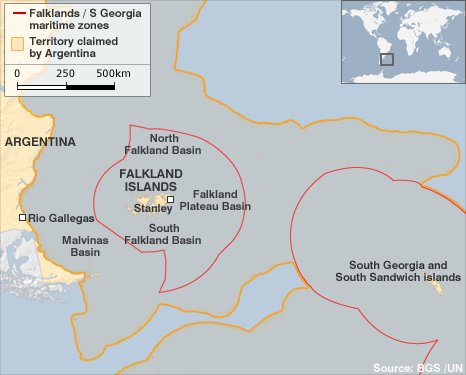
I described the article at the link as “early moves in the next Falklands War”. I then followed up with a another Tweet: “Of course, if Argentina decides to take the Falkland Islands, Britain no longer has the navy to stop them. No carriers = no force projection”

This struck Craig Chandler as seriously misunderstanding the risks: “War can still happen. Do not delude yourself.” I responded that I was “Not deluded about risk of war. Just realistic about outcome.” That is, I didn’t think Britain had any chance of pulling off a victory if Argentina resorted to the military option (again).

Craig had a remarkably positive view of British military power: “Britain would crush them. Missiles, Jets etc… Lot’s of ways to fight a modern war” and “Britain allies would join with them. An attack on one of us is an attack on all of us. Thus, victory would be 100% for Britain”. I responded “Even Reagan had to be cajoled into supporting Thatcher in 82. Obama? Doubt he feels any strong attachment to the UK.” “The UK would have to lodge protest in UN, impose trade sanctions, sit back and accept facts on the ground.”

I was starting to struggle with Twitter’s 140 character limit, as there was much I wanted to say that couldn’t easily be condensed into Twitter-friendly lengths. I’ve said on the blog that Britain’s scrapping of the Harriers and decommissioning/scrapping the remaining aircraft carriers was an open invitation to Argentina to try the Falklands issue again. Argentina’s President Cristina Kirchner wouldn’t be using words like “arrogant” (describing the British government) and characterizing the Prime Minister’s comments as an “expression of mediocrity and almost of stupidity” without good reason.
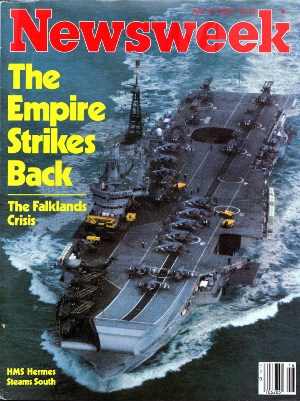
Britain was lucky in 1982, as the government of the day was desperately seeking economies in the budget and (as there was no war with anyone on the horizon), scrapping their aircraft carriers looked like a great way of reducing costs. They’d reduced their military presence in the South Atlantic in an attempt to both save money and appease Argentinian feelings. The announced reductions prompted Argentina’s military rulers to use an external war for internal political benefit. Argentina struck before the intended “economizing” took place. Had they waited six months, Britain would not have had the means to launch the counter-attack that retook the Falklands.
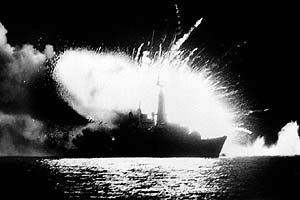
Even with the aircraft carriers HMS Hermes and HMS Invincible each operating several extra Harriers, the British were just barely able to keep enough aircraft going to fend off the majority of Argentinian attacks (losing two destroyers, two frigates, and several support ships sunk or severely damaged). With the Argentinian navy almost entirely confined to base after the sinking of the ARA Belgrano, the British could concentrate on air defence.

Having fought the fleet into position for the invasion, it was possible to pull the more vulnerable ships further out of range for Argentinian air strikes (as even at this stage, losing one of the carriers would endanger the entire mission). While it was much more than a “mere matter of marching”, the smaller but much better trained British forces (primarily Royal Marines, paratroops, Guards, and Gurkhas) were able to defeat the Argentinian troops and bring the military campaign to a close.

Anyway, Craig had an even more positive view of Britain’s likely political and military support today: “The USA owes the UK much for Iraq and Afghanistan there is also the entire Common Wealth. Argentina would be invaded.” “It would be all out war. No acceptance. The Common Wealth and other UK allies would come to support.” I think there’d be some forms of support short of military action: in 1982, for example, New Zealand sent a frigate to the Indian Ocean to replace a Royal Navy ship that was needed to support the Task Force. The rest of the Commonwealth gave verbal and diplomatic support, but no significant military assistance. Today’s Commonwealth is hardly a significant military player — Canada, Australia, and New Zealand combined could not even provide a full division of troops, and none of them would be willing to get involved in a land war in South America on Britain’s behalf.

As far as the islands themselves, there have been some significant changes since 1982, the most significant being a new Royal Air Force base with permanently stationed modern Typhoon fighters (although only four of them at last report). The island transportation net has vastly improved since 1982 — when the only permanent roads were within Port Stanley proper — with all-weather roads now linking all mainland settlements. In addition to the RAF base personnel, there is a British garrison force of a reinforced infantry company and supporting troops, and the Falkland Islands Defence Force which is a company-sized unit of part-time troops.

Argentina’s armed forces have also changed significantly since the war. Two of the most significant changes were post-war fall of the military Junta and the elimination of conscription (creating a more modern, better-trained professional army, navy and air force). The Argentinian navy no longer has a purpose-built landing ship (the ARA Cabo San Antonio was retired shortly after the war and replaced with a modified cargo vessel). They have three submarines in service (replacing the one sub active in 1982), and have replaced all their WW2-vintage ships with more modern designs from France and Germany. The marines, who were the best of the Argentinian troops in 1982, are organized in five battalions of infantry, with supporting artillery, anti-aircraft, engineering and special forces detachments.

Anyway, back to the Twitter exchange that started this. After I’d responded to Craig’s last comment, Colby Cosh joined the discussion: “Sign me up for a bet on 2 PARA if it comes to that, will you?”. I’ll just reproduce the rest of the exchange in approximately correct order below:

NR: “Admire the Paras, but you can’t drop from that far away.”
CC: “I guess they must have teleported onto Goose Green last time.”
NR: “They certainly didn’t fly in from Heathrow!”
CC: “I’m guessing they’ll use the Bay-class ships they built for pretty much that exact mission?”
NR: “Not without air cover.”
CC: “I’m no admiral, but somehow I did get the memo about the fetish for “capital ships” being obsolete.”
NR: “Carriers still relevant.”
CC: “Meanwhile, the Argie navy has not exactly thrived under civilian rule. Not sure if that’s relevant?”
NR: “For a short-haul invasion, you don’t need a massive navy. Air cover is the key. UK only has 1 sub in region normally.”
NR: “No way at all to prevent an invasion, but in 82 UK still had (barely enough) carrier air to cover counter-attack. No longer true”
CC: “Air cover *less* important for Bay class now with close-in antimissile guns. And RN is still operating two carriers, you know.”
NR: “UK paid off Ark Royal and Invincible. Replacement ships still years from launching.”
CC: “The RN just tried out HMS Ocean (I think it was Ocean) as a platform for Apache in the Gadhafi raids.”
CC: “Replacements for fixed-wing capability, yes. Ocean & Illustrious are configured for choppers now.”
NR: “Chopper-equipped force versus missile-armed fighters? Outcome not good for choppers without lots of luck.”
CC: “Helicopters are the name of the game in an amphib op anyway; hence the reconfig.”
NR: “For amphibious work, choppers are great support. Not designed to fight against fixed-wing fighters.”
CC: “We’re forgetting that the islands themselves are garrisoned much more heavily than in ’82.”
NR: “Still indefensible vs Arg”
CC: “The Typhoons that are there are certainly at the sharp end until RN’s Harriers are replaced.”
NR: “Not enough of them to matter.”
CC: “You’ve convinced me to worry about this a little more than I would’ve”
NR: “I’ll post a “Mission Accomplished” banner. ;-)”

Colby did point out some weaknesses in my original contention: for example, I’d forgotten about the construction of the new RAF base, but it isn’t equipped to fight a war: it’s an expensive trip-wire. Four aircraft aren’t going to be enough (especially as Britain had, as of the Libya campaign, only 69 qualified Typhoon pilots). I’ll admit I’m a bit less sanguine about Argentina just waltzing in to Port Stanley this time, but I still think if they can pull off a quick disabling strike followed by a landing, Britain will not be able to reverse the outcome like they did in 1982.

Why Nazis?

Filed under: Books, Britain, Education, Europe, Germany, History, Media, WW2 — Tags: , — Nicholas @ 09:56

A British MP is being investigated for attending a “Nazi-themed” party. A member of the royal family is photographed wearing Nazi regalia to a costume party. World War 2 fiction about Nazi Germany vastly outsells similar fiction about Fascist Italy or Imperial Japan. What is it about the Nazis that Brits find so fascinating? In a Spectator article from 2002, Guy Walters tracks the onset of the Nazi fascination in young Brits:

In some Englishmen this interest has mutated into a not-so-guilty admiration for the Nazis and their uniforms, their pageantry, their military brilliance and — this is the really terrible part — their brutality. It is emphatically not a condoning of the Holocaust; rather, a fetish that exists despite it. In its advanced state the fetish will have evolved into a secret yearning to march up and down a bedroom in the togs of a Hauptsturmführer, riding-boots shining, the red swastika armband set smartly against the blackness of the tunic, the silver death’s-head badge glinting on the peaked cap. Of course, the Beevor reader is a far cry from a Nazi fetishist; but I wonder whether Beevor would enjoy such staggering sales figures if he had written only about the war in the Far East.

[. . .]

At the end of term, the flu now conveniently in remission, Mr Priestley unearths the projector and makes a selection from the school’s extensive range of films. The product of a broad mind, the library consists of just two works, The Guns of Navarone and Force 10 from Navarone. Our nascent fetishist will be particularly drawn by the stylish ease with which David Niven carries off the wearing of an SS officer’s uniform. He will be less than impressed, however, with Edward Fox’s absurdly pukka sergeant in the latter film.

His small head brimming with Nazis, our subject goes home for four solid weeks of constructing Airfix Messerschmitts, Stukas, Heinkels and Dorniers. He will know that the correct colour of the underside of most Luftwaffe aircraft corresponds to Humbrol’s ‘duck-egg blue’. If his condition is particularly advanced, the subject’s mother will be asked to purchase a Tamiya Jagdpanther tank, which he will place in a ‘diorama’, a word he will use in no other context. By now, he should be showing further classic early symptoms of a Nazi fetish: Allied aircraft and armour will hold little or no interest. Most of the young fetishist’s exercise books will be adorned with thousands of tiny swastikas.

[. . .]

By puberty, the fetishist will have repeatedly watched every war film available, including A Bridge Too Far, The Night of the Generals, The Dirty Dozen, The Eagle Has Landed, The Boys from Brazil, Cross of Iron and, for a younger generation, Saving Private Ryan and Band of Brothers. He will have read Pat Reid’s Escape from Colditz and Airey Neave’s They Have Their Exits.

When our subject starts in the sixth form, it is here that the fetish can be incorporated into, and disguised by, his academic studies. Naturally he chooses modern history for one of his A-levels, and his special topic will, of course, be Nazi Germany. He will now be introduced to the diaries of Nazi bigwigs such as Albert Speer, which will breathe life into sinister figures such as Himmler and Goering. In fact, the widespread predilection for Nazi Germany as an A-level subject has angered many university tutors, who have complained recently that it is the only period of history about which undergraduates have any real knowledge.

December 19, 2011

Kelly McParland: “Norwegians are the most revoltingly perfect people in the world”

Filed under: Bureaucracy, Economics, Europe, Food — Tags: , , , , — Nicholas @ 14:24

Don’t worry, my Norwegian friends, it’s just small-minded Canadian jealousy that you tend to beat us in all the “Smug Country” polls and your national monopoly is even more constricting and incompetent than our equivalent national monopoly:

Everyone knows the Norwegians are the most revoltingly perfect people in the world.

They consistently top all lists of Things Good Countries Do.

They give more to foreign aid than just about any other country in the world. Countries are supposed to give 70¢ for every $100 of national production, but hardly any do. Norway gives about 40% more than the benchmark. They’re sitting on hundreds of billions of dollars in oil profits, and instead of blowing it on short-term expediencies (like a certain western province we could mention) they squirrel a lot of it away in an investment fund to help maintain their high standard of living when the oil runs out. And believe me, their standard of living is high: a cradle-to-grave nannyism that revolts conservatives but seems to work for Norwegians. (In Norway, life is so soft that even cows are required to have rubber mats in their stalls so they can rest comfortably between shifts).

They’re so perfect they’re annoying. Even Swedes get tired of hearing about them. So it’s kind of fun to read about how they’ve completely buggered up their supply management system, so that the entire country has been stripped of its butter supply just as Christmas arrives and everyone gears up to make lots of stuff for which butter is required. And if it reminds you of Canada’s own supply management system (think: dairy products and Quebec), all the better.

December 18, 2011

Vaclav Havel has died, aged 75

Filed under: Books, Europe, Government, History, Liberty — Tags: , , , — Nicholas @ 11:43

Matt Welch has a post at Hit & Run quoting his profile of Havel from 2003:

Like Orwell, Havel was a fiction writer whose engagement with the world led him to master the nonfiction political essay. Both men, in self-described sentiment, were of “the left,” yet both men infuriated the left with their stinging criticism and ornery independence. Both were haunted by the Death of God, delighted by the idiosyncratic habits of their countrymen, and physically diminished as a direct result of their confrontation with totalitarians (not to mention their love of tobacco). As essentially neurotic men with weak mustaches, both have given generations of normal citizens hope that, with discipline and effort, they too can shake propaganda from everyday language and stand up to the foulest dictatorships.

Unlike Orwell, Havel lived long enough to enjoy a robust third act, and his last six months in office demonstrated the same kind of restless, iconoclastic activism that has made him an enemy of ideologues and ally of freedom lovers for nearly five decades.

December 15, 2011

James Delingpole on Great Britain, the Green Movement, and the End of the World

Google donates to the Bletchley Park restoration project

Filed under: Britain, History, Technology, WW2 — Tags: , , — Nicholas @ 09:15

Google has made a significant contribution to the preservation and restoration of the famous WW2 codebreaking site:

The centre has won a £4.6million grant from the Heritage Lottery Fund but needs to attract £1.7million in outside funding before the big grant can be delivered and the next stage of the development kickstarted.

The £550,000 Google contribution is the biggest single donation that the Bletchley Park Trust has received so far. It was given by the search engine’s charitable arm, which donated a total of $100 million (£64.4million) in 2011.

“It would be wonderful if other donors follow Google’s example to help preserve our computing heritage,” said Simon Greenish, CEO of the Bletchley Park Trust. “We could then proceed as soon as possible with restoration of the profoundly historically significant codebreaking huts.”

Mick Hume: Dispelling Euro-myths

Filed under: Britain, Europe, France, Germany, Politics — Tags: , , , — Nicholas @ 08:49

In this post at Spiked, Mick Hume pours cold water on five Euro-myths:

Euro-myth No 1: ‘It was a triumph for Cameron — or Sarkozy’

Depending on who you listen to, either UK prime minister David Cameron bravely stood alone for Britain by rejecting a new EU treaty, or else he was beaten by the wily French president Nicolas Sarkozy who got what he wanted by the UK’s omission from the new deal around the Eurozone.

In fact, what the rupture showed was that both the six-footer Cameron and the diminutive Sarkozy are, to coin a phrase, pygmies in political terms. And so are German chancellor Angela Merkel and the rest of Europe’s political elite. Far from a triumph for anybody, it marked an embarrassing failure of basic diplomacy among substandard statesmen and women. There are always tensions and ructions at international summits. But in other times they would have been kept under control by careful diplomatic preparation and consultation beforehand – not left to break out in a schoolboy spat on the day, with Cameron and Sarkozy reportedly almost coming to blows. Even far more strident Eurosceptics such as Margaret Thatcher knew how to play the great power game without tripping over their own laces. Europe’s destiny is now in the hands of self-regarding pygmies who think more of their next headline than the shared future of the continent.

As for the notion that Cameron struck a noble blow for the British people and ‘our’ national sovereignty — come off it. Indeed, one of his main motives appears to have been to avoid giving the British people any kind of say on the matter, by dodging both the referendum that would be demanded if he accepted an amended EU treaty, and the general election that would follow if he went too far the other way and broke up his coalition with the EU-loving Liberal Democrats. The government would rather fall out with the French than risk the wrath of British voters.

December 14, 2011

Eurosceptics described as “bunch of insular snobs who seem to have a hard time restraining their inner fascist”

Filed under: Britain, Europe, Media, Politics — Tags: , , , , — Nicholas @ 09:06

Frank Furedi exposes the real reasons behind the chattering classes’ abuse of David Cameron:

It is one thing to accuse Cameron of committing a diplomatic faux pas or the Foreign Office of ineptitude. But the criticisms currently being made of Cameron verge on the hysterical. When I listen to the hyperbole about what will apparently be the consequences of his destructive behaviour, it almost sounds as if he has committed an act of political betrayal in order to appease a handful of incorrigible reactionary Eurosceptics.

Why this over-the-top reaction to what could turn out to be a relatively minor case of diplomatic miscommunication?

Outwardly, the anger of the cosmopolitan clerisy is directed at Cameron’s alleged appeasement of Tory Eurosceptics. The term Eurosceptic has a special meaning for the adherents to cosmopolitan policymaking. In their view, Euroscepticism is associated with values they abhor: upholding national sovereignty, Britishness and a traditional way of life. The moralistic devaluation of these values was vividly communicated by the New York Times columnist Roger Cohen, who this week characterised Tory Eurosceptics as the ‘pinstriped effluence of an ex-imperial nation’. He seeks to dehumanise these people by arguing that this ‘specimen’s ascendancy’ was reflected in Cameron’s behaviour during the treaty negotiations. Cohen’s moral devaluation of Eurosceptics, his dismissal of them from the ranks of humanity, is captured in his description of them as a ‘bunch of insular snobs who seem to have a hard time restraining their inner fascist’.

The intemperate language suggests that the venomous anger directed at Eurosceptics cannot simply be driven by the clerisy’s love affair with the European ideal. Rather, what is at issue here is the clerisy’s preference for the technocracy-dominated and cosmopolitan-influenced institutions of Brussels. From their standpoint, the main virtue of the EU is that its leaders and administrators speak the same language as the UK clerisy. They read from the same emotional and cultural script, which they believe to be superior to the script and values associated with national sovereignty. That is why it isn’t surprising that a BBC journalist can casually ask the Estonian prime minister to have a go at her own national leader. The UK-based communications clerisy has a greater affinity with the outlook of EU technocrats and political administrators than it does with the outlook of its own people.

December 12, 2011

“Cameron has made a crucial misjudgment, simply to appease the City and his own jingoistic right-wingers”

Filed under: Britain, Bureaucracy, Europe — Tags: , — Nicholas @ 09:12

Bruno Waterfield looks at the frenzied abuse being heaped on David Cameron’s head over the EU negotiations:

The breaking of the EU at an all-night summit last week, where British prime minister David Cameron vetoed changes to the EU Lisbon Treaty, is a healthy sign that politics can assert itself over the slavish routines of Euroland. Until this crack occurred, the EU had been using the full force of statecraft to deny new facts and to enshrine failed doctrines in a world where reality had changed.

Still, over the next few weeks, there will be a concerted establishment campaign to depoliticise the split in the EU and to paper over the cracks with the bureaucratic pieties and conceits at which the EU excels. Quick out of the gate on Sunday was Lord Paddy Ashdown, a serially unelected panjandrum and one-time UN viceroy of Bosnia, who accused Cameron of ‘acting as the leader of the Conservative Party, not the prime minister of Britain’.

[. . .]

The opprobrium heaped on Cameron’s head by Europe’s elites and their fellow travellers is because he is perceived as having allowed the politics of party to triumph over the bureaucratic routines of state. ‘As an act of crass stupidity, this has rarely been equalled’, opined Will Hutton in the Observer. ‘Cameron has made a crucial misjudgment, simply to appease the City and his own jingoistic right-wingers.’

The shrill attacks on Cameron’s failure to achieve the ‘national interest’ demonstrate the extent to which that priceless commodity is now defined by permanent Whitehall officials rather than by public politics or through a clash of parties competing to lead the British people. Similarly, the EU, particularly during this economic crisis, has shown itself to be a mechanism for evading or even overthrowing public politics; it is about drawing up policy away from the institutions of democratic accountability, in an arena that is ‘independent’ of the public.

December 9, 2011

Praise for Britain’s MI6

Filed under: Britain, Military — Tags: , , , , , — Nicholas @ 08:55

It’s the rough equivalent to the US Central Intelligence Agency, but it rarely gets public attention. Strategy Page has a thumbnail sketch of the organization as it gets a brief mention in the British press for its operations against Libya:

MI6 is less than one tenth the size of the CIA (in manpower) and has a budget that’s even smaller. But the CIA is by no means ten times as effective as MI6. For all its size and resources, the CIA cannot, or often will not, do things that MI6 will. Part of this has to do with MI6s greater experience and need to make do with less. But a lot of it has to do with different styles of operation. Both organizations are in the overseas espionage business, but both go about their business in quite different ways, and with often quite different results.

A large part of the difference can be traced to the fact that MI6 has always had a healthier relationship with its diplomats. CIA agents operating overseas often operate out of the local US embassy. Their cover is a diplomatic passport indicating they work for the State Department. But from the beginning, the diplomats were hostile to this sort of thing (British diplomats were not.) So CIA people were forced to use diplomatic passports indicating they were part of the Foreign Service Reserve instead of just Foreign Service. For those in the know, and that means just about everyone, it was easy to find out who the CIA guys were.

MI6 has a degree of legal cover for its operations that the CIA could only envy. Under the Intelligence Services Act of 1994, MI6 officers have immunity from prosecution for crimes committed outside Great Britain. The Criminal Justice Bill of 1998 makes it illegal for any organization in Great Britain to conspire to commit offenses abroad, but Crown agents have immunity. Which means, in effect, that yes, Her Majesty’s Secret Intelligence Service really is licensed to kill.

[. . .]

Another advantage of MI6 is that they have a number of SAS commandos trained to work with MI6 and are always available for any MI6 needs. This commando organization is called Increment and is used for assassinations, sabotage or other dangerous jobs (like arresting war criminals in the Balkans.) In addition, every station chief has a direct line to SAS headquarters and a good working relationship with the commandos.

« Newer PostsOlder Posts »

Powered by WordPress


