
Quotulatiousness

January 20, 2012

The anti-Top Gear crowd: “In certain quarters, Clarkson-bashing has started to replace tennis as a favourite pastime”

Filed under: Britain, Humour, India, Media — Tags: , , , , , — Nicholas @ 09:28

Patrick Hayes on the tut-tutting, disapproving folks who only watch Top Gear to generate more outrage at Jeremy Clarkson’s antics:

I wonder what proportion of the five million viewers of the Top Gear India Special over Christmas were desperate-to-be-offended members of the chattering classes? Skipping the second instalment of Great Expectations, they no doubt sat through the show solely to tweet about how awful Jeremy Clarkson and Co’s monkeying about on the road to the Indian Himalayas was.

In certain quarters, Clarkson-bashing has started to replace tennis as a favourite pastime. He was chastised for offending blind people when he called former UK prime minister Gordon Brown a ‘one-eyed Scottish idiot’, censured for driving while sipping a gin and tonic en route to the North Pole, and generated fury when a couple of years ago he called for the Welsh language to be abolished. But never has he generated so much controversy as the Twitch-hunt that took place against him at the end of last year, after he made a quip that public sector strikers ‘should all be shot’.

This was so evidently a joke, although a crap one, that you had to wonder whether the tens of thousands of ‘offended’ people who took to their keyboards to campaign to get him sacked were for real. Is it humanly possible to be that po-faced? Evidently so. Irony-phobic Labour leader Ed Miliband led the way, calling the comments ‘absolutely disgraceful and disgusting’. A sour-mouthed trade union rep even compared his comments to the atrocities carried out by former Libyan tyrant Muammar Gaddafi.

[. . .]

For these petty censors, it’s not enough simply to change the channel. The danger, so the argument goes, is that Clarkson could become a red-blooded role model to millions of impressionable viewers who will mimic his expressions and share his juvenile, PC-averse passions. Attempts to tame Jezza are invariably attempts to try to reform the viewing public, too. If not stopped now, it would seem, Top Gear could generate an army of misogynistic, environment-despoiling racists-in-the-making.

The danger doesn’t come from Clarkson, however. It comes from these Clarkson-bashing killjoys who are intolerant of informal banter, suspicious of anything ‘fun’, taking every word said in jest literally and moaning to the authorities because Clarkson sets a bad example. These are the ones who, to steal a phrase from the man himself, ‘should be avoided like unprotected sex with an Ethiopian transvestite’.
January 19, 2012

Vada a bordo, cazzo!

Filed under: Europe, Italy — Tags: , — Nicholas @ 12:24

It takes a lot to vault ahead of someone like world-class competitor President Bashar al-Assad of Syria in the most-hated person contest, but Captain Francesco Schettino has “triumphed” in this, at least temporarily:

The coward in the hot seat is Captain Francesco Schettino, who infamously abandoned his sinking ship, the Costa Concordia, leaving hundreds of passengers stranded in the dark off the Tuscan coast.

The transcript of his conversation with Gregorio De Falco, an enraged Italian Coast Guard, has made a hero of DeFalco and rained down contempt on Schettino. T-shirts with an enraged De Falco’s command, “Vada a bordo, cazzo!” (Get back on the boat, for f—’s sake!) have been a big hit.

In the latest implausible explanation for his behaviour, Schettino claims he tripped on the listing Costa Concordia and somehow found himself in a lifeboat from which he was unable to extricate himself. Certainly he did not return to the stricken vessel, where rescue operations went on until 6 a.m.

The Christian Science Monitor lists the bumbling Schettino’s “top four deceptions.” The best (or feeblest, depending on your level of cynicism) is a variation of the old insurance claim excuse — the tree came out of nowhere and hit me.

Update: Now there’s speculation that the shipwreck may have been caused in the course of an attempt to impress a young woman.

The 25-year-old blonde, identified as Domnica Cemortan, was invited onto the bridge as the cruise liner sailed perilously close to Giglio, in what was apparently a ‘salute’ to an old friend of the captain’s and a favour to the ship’s head waiter, whose family were from the island.

She was reportedly the guest of one of the ship’s officers and may be the woman that passengers saw drinking and chatting with Capt Francesco Schettino on Friday evening, a few hours before the Costa Concordia ran aground.

Italian judicial authorities, who are investigating the accident and the captain’s conduct, want to interview Ms Cemortan, who according to her Facebook page was born in Chisinau, Moldova, and lives in Bucharest, Romania.

They believe she may be able to shed light on what happened on the bridge when the giant cruise ship collided with a rocky outcrop, ripping a massive gash in its hull.

Adding to the mystery, she was reportedly not on the official list of passengers and crews.

The Guardian: Cameron is being foolish over Falklands

Filed under: Americas, Britain, History, Military — Tags: , , , — Nicholas @ 12:11

Michael White on the last time Britain and Argentina collided over the Falkland Islands:

As soon as I heard David Cameron suggest at Wednesday’s PMQs that Argentina’s latest squeeze on the Falkland Islands was “far more like colonialism” than Britain’s stance on the subject I knew there would be trouble. Sure enough, 8,000 miles across the global village in Buenos Aires, the home secretary denounced the remark as “totally offensive”.

We can expect more of this on both sides as the 30th anniversary of the Argentinian junta’s invasion approaches. Sabre-rattling may be fun for the armchair generals of Fleet Street and their Latino counterparts, but it will be a waste of energy. Nothing looks like changing — and if it does, Britain is in a far worse position to do much to prevent it than it was then.

As I’ve mentioned before, there are some fascinating parallels between the situation in 1982 and the situation today:

Even at the time the Falklands war, which I witnessed from the Commons press gallery as the Guardian’s sketchwriter, was a pretty odd business. I later likened it to the last fleet sent out by the ancient Venetian Republic to tackle the Barbary (North African) pirates in the 1780s a few years before the maritime empire of Venice finally collapsed — the last hurrah.

In cutting defence spending and withdrawing the Falklands guardship, HMS Endurance, in an ill-considered round of defence cuts, Margaret Thatcher’s government had more or less invited the discredited and brutal junta of General Leopoldo Galtieri to try to ingratiate itself with its own people at our expense. The cunning plan: to reclaim their “Malvinas” islands which the Spanish colonialists had never inhabited, but were just 400 miles from their shore — a sort of Latin version of the Channel Islands, an anomaly.

Ignoring noisy hints from BA, as the Labour government of the ex-Navy man Jim Callaghan did not in 1977 (Callaghan quietly dispatched a nuclear hunter-killer sub to the South Atlantic, then leaked the fact), Thatcher and Co looked prime idiots on invasion day — Friday 2 April 1982 — and spent it denying that an invasion had happened. Meryl Streep does not convey this bit very well in Iron Maggie. The decision to sent a 40,000-strong task force was taken by the cabinet on the rebound next day.

And also echoing my criticism of the particular defence decisions the current British government has made:

But gung-ho attitudes in the Fleet Street press in 2012 are a nostalgic echo of 1982, which strike me as both foolish and delusional. Yes, after the 1982 war we spent a lot of money building a proper airfield to resupply the islands in a military emergency and the Royal Navy too has its own port.

But the latest round of hasty defence cuts, made by Liam Fox at the behest of the Treasury in 2011, have left the armed forces weaker than before. Even in 1982 Britain was lucky to have two carriers at its disposal — having planned to sell one off. The US, which proved a loyal ally under Ronald Reagan once the diplomatic options failed (were sabotaged, say some) is not the US it was then. Latin America, richer and more confident, is a different region too.

January 18, 2012

First they came for the smokers, then the drinkers, and now the meat-eaters

Filed under: Britain, Government, Health, Liberty — Tags: , , , — Nicholas @ 10:52

Rob Lyons on the flimsy case for declaring that “eating meat causes cancer”, and the rising tide of buttinsky government and their nudge, hector, prod, and persecute urges:

Meat causes cancer. It’s been said so many times that you’d have to be an idiot not to believe it, right?

The latest confirmation of this apparent common sense was a report published last week in the British Journal of Cancer Research. The authors, from the Karolinska Institute in Sweden, brought together 11 studies — published between 1993 and 2011 — that assessed the risk of pancreatic cancer from eating red meat and ‘processed’ meat. From this meta-analysis, the authors found that red meat increased the risk of pancreatic cancer for men, but not for women, and that the risk of pancreatic cancer rose by 19 per cent for every 50 grams of processed meat consumed.

The simple claim that ‘processed meat causes cancer’ was widely reported after the study was published. However, it would be wrong to assume that such claims about risk are all they are cracked up to be.

[. . .]

There are so many ways in which the crude tools of epidemiology could screw up the result of studies like this that it is normal for fairly small risks — like the 19 per cent increase in this case — to be treated with a massive pinch of salt. The authors of this study even note: ‘All studies controlled for age and smoking, but only a few studies adjusted for other potential confounders such as body mass index and history of diabetes.’

[. . .]

So, to sum up: the association between processed meat and pancreatic cancer is so weak it might well be a mirage; the increased risk might not be caused by the processed meat itself; and even if it is, the risk is so low that it’s really not worth bothering about. Yet still we are advised to consider cutting down on our red meat and processed meat consumption. Life is, frankly, too short to miss out on such tasty foods on the slim chance that we might lose a few years of life in old age.

[. . .]

Now that the precedent has been set for the government to lambast those who engage in unapproved habits, it’s open season on any habit that a campaigner or columnist disapproves of. Ban it! Tax it! Make them get a prescription for it! Deny them medical care! Ellen’s article is objectionable but it only follows the remorseless logic of so many others.

There is another lesson from the meat-and-cancer story: at a time when all sorts of dubious claims are made based on junk science and dodgy statistics, only some panics get wide publicity; others just pop up and disappear again in a matter of hours. The difference is that some play to an existing political or media agenda and some do not. The idea that meat causes cancer appeals to health busybodies, politicians scrabbling around for a sense of purpose, vegetarians who can’t win a moral argument about animal rights, and environmentalists who have failed to convince us that increasing the ‘human footprint’ — by wanting to eat more meat, for example — is killing the planet.

January 17, 2012

Details on the British defence cuts

Filed under: Britain, Bureaucracy, Military — Tags: , , , — Nicholas @ 09:43

The unit hardest hit by the reductions will be the Brigade of Gurkhas:

In a statement, the MoD revealed it was looking to shed 2,900 posts from the army, around 1,000 from the RAF and 300 from the Royal Navy.

The total is higher than the first round of the process last year, and there are expected to be more compulsory redundancy notices this time.

The MoD announced it was looking to shed approximately 400 Gurkhas — one in eight of the brigade. Approximately 500 infantry privates with more than six years’ service will also be axed.

The senior ranks of the army have not been spared. Eight brigadiers and 60 lieutenant colonels are expected to go.

The Royal Navy will lose five commodores and 17 captains. Nineteen Royal Marine officers will be shed, but no one from the ranks.

The RAF will lose up to 15 air commodores and 30 group captains. The MoD believes that by slowing recruiting, and not replacing those who leave, the navy and the RAF will be able to achieve the cuts they need without a “tranche 3” of redundancies. The army needs to shed almost 20,000 jobs over the next eight years and will continue to make cuts for years to come.

The media angle on the Costa Concordia wreck

Filed under: Europe, Italy, Media — Tags: , , , — Nicholas @ 09:17

Tim Black points out the most common media memes about the Costa Concordia have much more to do with snobbery and disdain than with human interest or concern about the actual causes of the shipwreck:

The sequence of events that led to the sinking of the luxury cruise liner, the Costa Concordia, is now pretty much established. But facts have not got in the way of a variety of commentators who are using the accident to parade their prejudices about too-big ships and ignorant passengers.

[. . .]

These are the tragic facts so far. What no one knows exactly is why it happened. Explanations have been mooted, of course: a power blackout affecting the ship’s steering; inaccurate navigation charts failing to show the rocks; or human error, in particular by the ship’s captain, Francesco Schettino. Yet while the exact reason for the ship straying off course remains unclear, that has not stopped another object of blame coming to the fore in some of the coverage. That is, the real, underlying reason for the Costa Concordia accident is to be sought not in the actual events of Friday evening but rather in the profit-driven, build-‘em-high cruise industry and, by association, in the sea-faring ignorance of all those who sailed aboard her.

This is why so much of the coverage seems obsessed with the size of the Costa Concordia. Over the past few days, we have been repeatedly told that cruise ships have doubled in size over the past decade. While this is true — and as the twenty-sixth-largest liner in the world, the Costa Concordia is far from the most impressive of this new breed of ships — the Concordia’s size does not actually tell us why it was three miles off course. Nor does it explain why the ship’s crew was unaware of the rock outcrop despite having navigation equipment. Yes, perhaps ship size does affect manoeuvrability, but would a smaller vessel not have suffered a similar fate that befell the Concordia? In fact, the obsession with the ship’s size sheds very little light on what happened to the Concordia on Friday evening.

What the convenient obsession with size draws upon, rather, is an antipathy towards the cruise industry, a sense that it is little more than the ocean-going equivalent of that other right-thinking person’s bête noire, Dubai. In other words, a vulgar testament to profit and sky-high consumption. So although size here is not really relevant as a cause of the Concordia’s capsizing, it appears relevant to certain commentators as a symbol of commercial hubris, of complacent materialism.

January 16, 2012

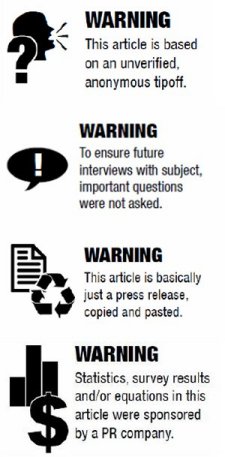
Journalism warning stickers

Filed under: Britain, Humour, Media — Tags: , — Nicholas @ 10:50

A timely addition to your media toolkit from Tom Scott:

It seems a bit strange to me that the media carefully warn about and label any content that involves sex, violence or strong language — but there’s no similar labelling system for, say, sloppy journalism and other questionable content.

I figured it was time to fix that, so I made some stickers. I’ve been putting them on copies of the free papers that I find on the London Underground. You might want to as well.

H/T to Tim Harford for the link.

Cory Doctorow recommends a book on English libel law

Filed under: Books, Britain, Law, Media — Tags: , , , , — Nicholas @ 10:17

There’s a reason that individuals and organizations try to sue for libel under English law, rather than their own national legal system:

The Guardian published a long excerpt from Nick Cohen’s forthcoming You Can’t Read This Book: Censorship in an Age of Freedom, a fantastic-looking book that reveals the dirty truth of English libel law, where “money buys silence” for some of the world’s most notorious dictators, thieves, and bad guys. English libel law is so broad that it allows, for example, Russian oligarchs to sue Russian newspapers for punitive sums (“the cost of libel actions in England and Wales is 140 times higher than the European average”) in an English court, merely by demonstrating that someone, somewhere in England looked at the paper’s website. And yet, the libel law in England and Wales doesn’t actually protect people from the most common forms of libelous publication: false declarations of criminal suspicion by the police, false claims of financial irregularities from credit reporting bureaux and false statements in former employers’ reference letters are protected unless they can be shown to have been malicious and negligent.

January 14, 2012

How much is your time worth?

Filed under: Britain, Economics, Railways, Randomness — Tags: , , , , — Nicholas @ 12:00

In an article about the recently approved high speed train link between London and Birmingham, Tim Harford points out a few oddities in the calculations that supposedly show how beneficial the new railway connection will be:

But it’s not just about forecasts — it’s about the value of time saved because of a faster journey, right?

That’s true. The high-speed link would save about 40 minutes on a journey from London to Birmingham. How much that is worth is an interesting question.

If you have a morning meeting it might mean an extra 40 minutes in bed.

It might indeed, which is priceless. HS2 Ltd told me that they use numbers from the Department for Transport. The DfT apparently values leisure time at about £6 an hour — this, intriguingly, implies that the UK government’s official position is that anyone under the age of 21 is wasting their time earning the young person’s minimum wage and would be wise to chillax in front of the Nintendo.

What about business travel?

Well, business travel is valued at £50 an hour. Unless the business travel in question is commuting, in which case it’s £7 an hour.

What?

Doesn’t make a bit of sense to me, either. Perhaps the idea is that commuting is eating into your leisure time, which is almost valueless apparently, whereas business travel is eating into your employer’s time, which is precious indeed. Complain to the DfT if you don’t like it.

QotD: In praise of memorization

Filed under: Britain, Education, History, Quotations — Tags: , — Nicholas @ 11:17

I didn’t mean only memorising poetry or prose passages, but anything that requires memorisation.

Two instances to chew on.

1. To me the most crippling side-effect of “modularisation” in education — i.e. self-contained courses, no terminal examinations etc. — is that it obviates what is actually a principle purpose of exams based on several years’ work, forcing the transfer of information from short- to long-term memory. Students who take only end-of-semester course exams or write final papers retain far less of the data than those who undergo old-fashioned final exams. Methodological competence can certainly be learned in modularised systems, but detailed memory is not fostered.

2. I will never forget the candidate for Cambridge admission (15+ years ago) who had done O-level modules (9th and 10th grade) on the English Civil War and the Industrial Revolution but did not know which came first. Honest to Betsy; didn’t have a clue and couldn’t work it out either. Even before that I made my own undergrads learn a regnal list, from at least Richard III to Elizabeth II with dates, so that they had at least one continuous historical frame to which they could attach other dates they learned or came across. I wasn’t bigoted about it — it could be a list of popes, archbishops of Canterbury, or Dalai Lamas (Dalais Lama?) if they wanted, though English monarchs are more useful in English literature — but they had to know something that gave accurate chronological depth to their grasps of history, not just sit grinning ignorance on a jumble of impressions and quasi-factual fragments. They used to moan about it loudly … for a while and then start being grateful. Heh.

Memorising poems is dandy, and there’s no reason it has to be the saccharine and long-line stuff that was the pedagogic legacy of late C19 tastes and pieties — lots of good strong stuff out there that anyone’s better off knowing than not knowing — but there are bigger issues at stake.

(Excerpt from a much longer discussion on the Lois McMaster Bujold mailing list)

John Lennard, MA DPhil. (Oxon.), MA (WU)
General editor, Humanities-E-Books Genre Fiction Sightlines and Monographs

January 12, 2012

When is an “insult” a criminal offence?

Filed under: Britain, Law, Liberty — Tags: , , , , — Nicholas @ 10:18

The answer, in the UK anyway, may well be “any time the insultee cares to call in the police“:

If you are reading this, chances are, you are a moron. There, have I insulted you? I’m asking because I have no idea if what I just stated has insulted you. Only YOU can be the judge of what you find insulting, yet plans are afoot for it to be a criminal offence to “insult” someone. So if you feel insulted, there is nothing to stop you ringing 999 and having the evil perpetrator banged up, DNA’ed and given a criminal record, although they will have had absolutely no idea that their actions or words have insulted you. If we criminalise “insults”, we shut up everyone and everything. For ever. Do you want to live in a society where you dare not speak in case the State decides your words may cause offence to people you will never meet? Now’s your chance to speak against it, USE IT, whilst you still can.

Now, I choose to be anonymous on my many public outings because, well, my face is my business. Unless I am actually committing a crime, it is not the business of the State to know what I look like anymore than it is the business of the State to randomly sweep bus stop queues for fingerprints. One of the reasons I wear a mask is because of the habit of the state to record the faces of those “who might” cause trouble, “for future reference”. The Met employ teams of photographers to take photos of any members of public who may be dissenting, sticks them on a database and cross references them. No thanks. My face belongs to me, it is my property, I will cover it when and if I choose. Naturally, this proposal is stop women wearing Burqas because some sensitive souls “may be offended” (see above), but as always, I say it is not the role of the State to dictate how I may dress.

January 10, 2012

Scottish independence on the front-burner

Filed under: Britain, Government, History — Tags: , , , — Nicholas @ 09:31

An interesting summary of the independence debate in Scotland from The Economist:

Put up or shut up. That is the risky (but arguably rather canny) message that David Cameron has sent to the pro-independence head of the Scottish devolved government in Edinburgh, Alex Salmond. Specifically, Mr Cameron has announced that the British government and Westminster Parliament are willing to give Mr Salmond the referendum on Scotland’s future that he says he wants — as long as it is a proper, straight up-and-down vote on whether to stay in the United Kingdom or leave, and is held sooner rather than later.

It is not that Mr Cameron wants to break the three hundred year old union between London and Edinburgh. Both emotionally and intellectually, he is fiercely committed to the union as a source of strength for both Scotland and Britain, insist Conservative colleagues who have discussed the question with him. Publicly, he has pledged to oppose Scottish independence with “every fibre” of his being.

But Mr Cameron and his ministers also feel that Scotland has been drifting in a constitutional limbo, ever since Mr Salmond’s Scottish National Party (SNP) won an outright majority at Scottish parliamentary elections in 2011 (a feat that was supposed to be impossible, under the complex voting system used in Scotland). The SNP campaigned on a simple manifesto pledge to hold a referendum on the future of Scotland. But after his thumping win Mr Salmond slammed on the brakes and started talking about holding a consultative vote in the second half of his term in office, ie, some time between 2014 and 2016.

January 7, 2012

Conrad Black: Current events vindicate Margaret Thatcher

Filed under: Britain, Economics, Europe — Tags: , , , , , — Nicholas @ 11:25

The current situation in Europe proves that British prime minister Margaret Thatcher was right all along:

Though it is probably happening too late to be overly gratifying to her, events are piling on to vindicate Margaret Thatcher completely in her reservations about British integration in Europe. Her response to the proposal to reduce Britain to a local government in a federal Europe was, memorably: “No, no, no, and never.” And her reward for her refusal to get on board what was then the thundering bandwagon of Eurofederalism, was to be sent packing by her own ungrateful party, though she was the only British political leader who had won three consecutive, full-term election majorities since before the First Reform Act expanded the electorate in 1832.

She was immensely popular with millions of Britons as a patriotic and courageous leader who took Britain off financial life support, saved it from strangulation by over-mighty, almost anarchistic unions, built a prosperous, home-owning democracy, threw the Argentinians out of the little corner of the British Empire they had wrongfully seized (the Falkland Islands), and played a starring role in winning the Cold War.

[. . .]

And as she liberalized the economy; imposed a free, secret ballot for labour strikes; lowered all taxes; privatized industry, housing, airports, almost everything except the National Health Service and the BBC; jolting economic growth resulted. Unfortunately, its most conspicuous exemplars included many successful entrepreneurs and financier types who offended British sensibilities by their garish and spivvy ostentation. The basis of Margaret Thatcher’s support was the Daily Telegraph-reading, gin and tonic-drinking, cricket-loving middle class, the backbone of the nation. But her enemies identified her with an infelicitous combination of Colonel Blimp fuddy-duddies and sticky-fingered, vulgar parvenus.

She had a somewhat hectoring manner in debates, and was notoriously impatient with what she considered pusillanimity from senior colleagues, sometimes calling cabinet members “blanc-manges,” or “suet puddings,” or even “spineless, boneless, men” (not necessarily inaccurately). Naturally less known was her exquisite courtesy and unaffected and egalitarian kindness to subordinates and strangers. It annoyed feminists that she was such a traditionalist, and weak men that she was a strong woman. But she triumphed by perseverance and courage; to the end, though a stirring speaker, she was nervous before a speech. She was a strong woman, but not at all a mannish one.

January 5, 2012

The quest to re-create Shackleton’s whisky

Filed under: Britain, History, Science — Tags: , , — Nicholas @ 14:01

AntarcticaYour wee dram of SCIENCE! How they managed to re-create the whisky from Mackinlay & Co. that Ernest Shackleton’s Antarctic expedition took along in 1907:

How was the re-creation carried out? Dr. James Pryde, chief chemist at Whyte and Mackay, subjected the samples to a comprehensive chemical analysis, in conjunction with a rigorous sensory analysis (that is, sniffing and tasting). Firstly, it was established that the alcoholic strength of the whisky was high enough that it very likely never froze over the years it spent interred in Antarctica. In winter, the hut reached a minimum temperature of -32.5°C, but, at 47 percent alcohol, the whisky remained liquid down to a couple of degrees cooler than that extreme. This eliminated what had been a significant source of concern about the quality of the sample, that decades of freezing and thawing had altered or ruined it. Carbon dating verified that the whisky did indeed date from the Shackleton era.

Phenol and related phenolic compounds show up in Scotch whiskies, giving them the unmistakable character that’s referred to “peaty,” because the flavor is introduced when the grain is exposed to peat smoke during the malting process. Chemical analysis revealed not only the quantity of phenolics in the Mackinlay — surprisingly low, given that era’s reputation for heavily peated malts — but also the particular balance of compounds, which enabled the experts to pinpoint what region the peat used had likely come from. The answer? Orkney.

Similarly, analysis of the compounds that result from barrel-aging was able to finger the barrels in which the whisky was aged as ones made from American oak and probably used once before to age wine or sherry. Gas chromatograph olfactometry, in which the spirit is broken down into its volatile components and each of these smelled individually by experts, gave clues as to details of the fermentation and distilling process.

Double-jeopardy falls to political correctness

Filed under: Britain, History, Law, Liberty — Tags: , , , — Nicholas @ 10:14

Brendan O’Neill on the terrible precedent of a recent British government decision and it’s most recent mis-use:

On Nick Ferrari’s breakfast show on London’s LBC radio this morning, I argued that all the people describing this case as a victory for justice are overlooking the fact that it is a victory built upon the wreckage of some pretty important legal principles. One longstanding legal protection in particular — the double jeopardy rule, the idea that no one should be tried twice for the same crime — had to be dismantled in order to get Dobson back in the dock. Having been acquitted of the murder of Lawrence in 1996, Dobson was what we used to call ‘autrefois acquit‘, previously acquitted, which in the past would have meant that he could not have been tried for the murder a second time. That all changed in 2003, when New Labour ditched the double-jeopardy rule.

[. . .]

Double jeopardy is the elephant in the room of the Dobson and Norris conviction. Sure, journalists are mentioning it, usually in fluffy factboxes titled ‘How this case came to court’, but no one wants to discuss it in detail. No one wants to discuss the extraordinary amount of history and progressive tradition that had to be consigned to the dustbin of ‘bad ideas’ in order to secure one conviction against two nasty blokes.

The double-jeopardy rule had existed in some form or other for centuries. There was a Roman maxim which said ‘nemo bis in idem debet vexari‘ — no man shall be punished twice for the same. It’s there in early Christianity, too, in St Jerome’s insistence in the fourth century that ‘there shall not rise up a double affliction’. It’s also in the sixth-century Digest of Justinian, the seed of much of modern jurisprudence, which insisted that, ‘The governor should not permit the same person to be accused of a crime of which he has been acquitted’. An academic study of the double jeopardy rule in history points out that it is one of the ‘few legal rights recognised by the Christian fathers throughout the Dark and Middle Ages’.

In twelfth-century England, a form of double jeopardy was codified in the Constitutions of Clarendon, which, in an attempt to rein in the authoritarian instincts of Henry II, stipulated that no man could be tried for the same offence in both the ecclesiastical courts and the king’s courts. It had to be one or the other. From England it spread to the US, where the eighteenth-century revolutionaries and their successors made a bar against double jeopardy a key plank of their new republic’s constitutional guarantee of liberty against state power. In each historic period, the purpose of the rule against ‘double afflictions’ was strikingly similar: to protect individuals from potentially being hounded and interminably retried by governors, crown forces or cops determined to stick them in jail. That’s because being permanently at risk of prosecution is itself a kind of life sentence.

« Newer PostsOlder Posts »

Powered by WordPress


