
Quotulatiousness

February 1, 2012

The “Iron Lady” was not good for women

Filed under: Britain, Government, History — Tags: , , , — Nicholas @ 11:06

Barbara Kay on the “failings” of Margaret Thatcher (that is, not advancing the cause of women in a way that organized feminists would have preferred):

The “Iron Lady” is, of course, not only a sobriquet for Margaret Thatcher, but the title of the wonderful new Meryl Streep biopic about the former British PM. Bagnall’s predictable answer is that no, Thatcher was not good for women: “She did not pave the way for other women, as they had every right to expect her to, since she was one of them.”

Bagnall’s stated beefs are that Thatcher urged women to leave the workforce, and only nominated one woman to her cabinet. Well, so did unions of that era ask women to leave the workforce — to open up more jobs for men. And Thatcher’s appointments were based on who was good for Britain, not who was good for women.

Politically, Thatcher despised tokenism (“I owe nothing to women’s lib,” she once said), but it is true that personally she preferred men to women. This was made clear in the film by the non-judgmental tenderness the older widowed Thatcher lavishes on her negligent son (who rarely visited, but inconsiderately telephones her from South Africa at 3 a.m. English time) and the casual verbal cruelties Thatcher tosses at her attentive, under-appreciated daughter.

I think it’s Thatcher’s lack of fellow feeling for women that’s really bugging Bagnall and other feminists. How could Thatcher not like women if she was “one of them”?

I daresay it’s for the same reason most of us hold prejudices about the opposite sex. I don’t think most gender antipathy is rooted in doctrine; I think we drift toward doctrines that confirm our lived experiences. So in spite of (fictional) Thatcher’s protestations to the doctor attending her in her old age that she prefers “thoughts” to “feelings,” Thatcher’s bias toward men sprang directly from her lived experiences and the feelings they engendered (pun intended).

January 31, 2012

Germany issues “secret” document to Greek government on debt repayment

Filed under: Economics, Europe, Germany, Government, Greece, Politics — Tags: , — Nicholas @ 09:41

Mick Hume recounts the machinations within the European Union:

One outraged Greek government minister described it as ‘the product of a sick imagination’. Another called it ‘absolutely laughable’. The formal title of the document in question is ‘Assurance of Compliance in the Second GRC Programme’. It is neither a joke, nor a sick fantasy. It reads more like the draft of a death warrant for democracy, first in Greece and then elsewhere in Europe.

This supposedly secret document was issued by Angela Merkel’s German government to its partners in the Eurozone — and then carefully leaked, to ensure maximum impact. It sets out two extraordinary measures that the Germans want to impose to ensure that the Greek authorities comply with the swingeing budget cuts which they promised but have apparently failed to deliver to the markets’ satisfaction.

First, it says Greece must ‘legally commit itself to giving absolute priority to future debt service’. All state revenues must go first to paying debts and interest due, before a cent can be spent on public services. And the Greek government will not be allowed to threaten to default on its debts in future; if it cannot pay, it must accept that ‘further cuts’ will be ‘the only possible consequence’.

Second, the Germans want the Eurozone to oversee the ‘transfer of national budgetary sovereignty’ from Greece to ‘the European level’ under a ‘strict steering and control system’. The plan is for the Eurozone group to appoint a budget commissioner to oversee Greek finances, with the power ‘to veto decisions not in line with the budgetary targets’ set by European and international officials. If that was not humiliating enough, the Greeks would also have to look happy to bend the knee by ensuring that this new system of outside control ‘is fully enshrined in national law, preferably through constitutional amendment’.

To get the Greeks to agree to these unprecedented conditions, the German document also offers incentives — or as we used to call it, threats. If Athens does not accept the compliance measures, then ‘the Eurozone will not be able to approve guarantees for GRC II’. That is the second huge bailout of €130 billion which Greece desperately needs if it is not to go officially bust in weeks. The ‘Assurance of Compliance’ document is a ‘secret’ blackmail note.

Update: Ah, Monty captures the absurd state of the EU perfectly in a throw-away line in today’s Daily DOOM — “Like German porn, the politics of the Greek bailout just keep getting weirder and more complicated.”

January 30, 2012

Irish bishop accused of hate speech

Filed under: Europe, Law, Liberty, Religion — Tags: , , , — Nicholas @ 10:25

Blogger “Archbishop Cranmer” is calling for an “I’m Spartacus” response to this pending prosecution of Bishop Philip Boyce:

The Most Reverend Dr Philip Boyce is the Catholic Lord Bishop of Raphoe. He preached a homily on 20th August 2011, entitled ‘To Trust in God’. His Grace reproduces it in its entirety, for the two sentences highlighted in bold have landed the Bishop in a bit of hot water.

Apparently, they constitute an incitement to hatred, at least according to ‘leading humanist’ John Colgan. And so the Gardai have thoroughly investigated the complaint and compiled a file which they have handed to the Republic’s Director of Public Prosecutions.

So what horrible things did the Bishop utter in his “incitement to hatred” that has John Colgan so upset?

The moment of history we live through in Ireland at present is certainly a testing one for the Church and for all of us. Attacked from the outside by the arrows of a secular and godless culture: rocked from the inside by the sins and crimes of priests and consecrated people, we all feel the temptation to lose confidence. Yet, our trust is displayed and deepened above all when we are in troubled and stormy waters. It is easier to be confident when we ride on the crest of a wave, when the tide is coming in. Not so easy, however, yet every bit as necessary, when what is proclaimed by the Church namely the truth of faith with its daily practice and influence on behaviour, is under severe pressure.

[. . .]

Indeed unless we trust in a higher power, in God himself, what hope can we have? St. Paul told his converts at Ephesus that before they came to know Christ, they were “without hope and without God in the world” (Eph. 2:12). We need the radiance of a hope that looks beyond the horizons of space and time, one as Pope Benedict teaches “that cannot be destroyed even by small-scale failures or by a breakdown in matters of historic importance” (Spe Salvi No. 35). For the distinguishing mark of Christian believers is “the fact that they have a future: it is not that they know the details of what awaits them, but they know in general terms that their life will not end in emptiness…. To come to know God — the true God — means to receive hope” (Ibid, No. 2.3). We thank God for the faith, that enables us to trust in Him.

Perhaps I’m just particularly dense but the bold sentences above are apparently the “hate speech” nuggets in question. I don’t see it myself…

John Colgan said of these two sentences: “I believe statements of this kind are an incitement to hatred of dissidents, outsiders, secularists, within the meaning of the (Incitement to Hatred) Act, who are perfectly good citizens within the meaning of the civil law. The statements exemplify the chronic antipathy towards secularists, humanists etc, which has manifested itself in the ostracising of otherwise perfectly good Irish citizens, who do not share the aims of the Vatican’s Irish Mission Church.”

Researching how to stop asteroids from “just dropping in”

Filed under: Europe, Science, Space, Technology — Tags: , , , — Nicholas @ 10:08

Brid-Aine Parnell in The Register on some of the technologies being explored to reduce or eliminate the chance of unpleasantly close encounters with celestial objects:

A new international consortium has been set up to figure out what Earthlings could do if an asteroid came hurtling towards the planet on a path of imminent destruction.

The project will look at three methods of averting disaster: the Hollywood-sanctioned solutions of sending up a crack team of deep drillers with a nuclear bomb to sort it out, or frantically hurling of all our nukes at it; dragging it to safety with a Star Trek-inspired tractor beam; or hitting it with something we have more control over, like a spaceship.

Sporting the cool moniker NEOShield, the project will explore the possibilities for kinetic impactors, gravity tractors and blast deflection as ways to save our planet from oblivion.

[. . .]

“In the light of results arising from our research into the feasibility of the various mitigation approaches and the mission design work, we aim to formulate for the first time a global response campaign roadmap that may be implemented when an actual significant impact threat arises,” NEOShield boldly stated.

The battle of the stereotypes over the “Page 3 girls”

Filed under: Britain, Liberty, Media — Tags: , , — Nicholas @ 10:01

In spiked, Gabrielle Shiner explains that she doesn’t want or need the “Turn Your Back on Page 3” campaigners to pre-select what she’s allowed to see in the newspaper:

With the Leveson Inquiry currently insisting that the press bares all, campaign groups such as Turn Your Back on Page 3 have spotted an opportunity to force the tabloid’s topless ladies to cover themselves up. And all in the name of protecting girls like me from being terrorised by tits.

The campaign to get bare chests banned is certainly not short of grand claims. Apparently, Page 3 and its like perpetuate sexism by, ‘at best, encouraging and endorsing negative attitudes towards us and within us, and at worst, [encouraging and endorsing] acts of violence committed against us’. According to campaigners, the government therefore has a responsibility to satiate these campaigners’ appetite for paternalism, which they believe equates to ‘stamping out sexism once and for all’.

The Turn Your Back on Page 3 campaigners are right about one thing: an offensive misrepresentation of women exists in society. But it is this group of self-appointed saviours that has offended. The group parades itself as representative of women in order to justify forcing its views on the public. But if these supposed advocates of women’s rights were serious about liberties, they would not condone such bans.

And it is not just that the campaigners are unjustified in speaking on behalf of women — they have also misrepresented women and men. These campaigners present women as pitiful animals teeming with self-loathing. Men are depicted as uncontrollable beasts who are so mesmerised by the breasts on Page 3 that these images, at best, define their perception of women for evermore and, at worst, turn them to violence.

January 29, 2012

Step aside, Ottawa: London may have “Frost Fairs” on the Thames in future

Filed under: Britain, Environment, Europe, History — Tags: , , , — Nicholas @ 11:48

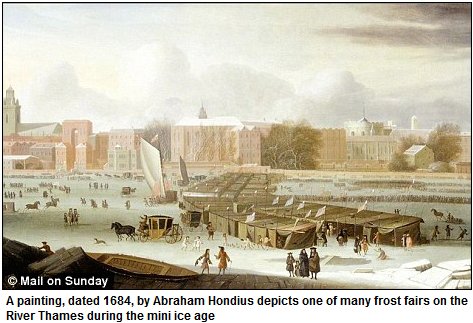
The Thames River used to freeze over solidly enough that temporary buildings could be erected on the ice. Northern Europe may be facing those kinds of cold winter temperatures in the future:

The supposed ‘consensus’ on man-made global warming is facing an inconvenient challenge after the release of new temperature data showing the planet has not warmed for the past 15 years.

The figures suggest that we could even be heading for a mini ice age to rival the 70-year temperature drop that saw frost fairs held on the Thames in the 17th Century.

Based on readings from more than 30,000 measuring stations, the data was issued last week without fanfare by the Met Office and the University of East Anglia Climatic Research Unit. It confirms that the rising trend in world temperatures ended in 1997.

Meanwhile, leading climate scientists yesterday told The Mail on Sunday that, after emitting unusually high levels of energy throughout the 20th Century, the sun is now heading towards a ‘grand minimum’ in its output, threatening cold summers, bitter winters and a shortening of the season available for growing food.

January 28, 2012

Deirde McCloskey on the “Bourgeois Virtues” that sparked the modern world

Filed under: Britain, Economics, History, Liberty, Media — Tags: , , , , — Nicholas @ 00:08

Writing in the Wall Street Journal, Dalibor Rohac reviews some of the key arguments in McCloskey’s recent book Bourgeois Dignity: Why Economics Can’t Explain the Modern World (which I’m currently reading — and very impressed with).

Unlike “Bourgeois Virtues,” “Bourgeois Dignity” makes a historical argument. Modern economic growth, she claims, is a result of an ideological and rhetorical transformation. In the Elizabethan period, business was sneered upon. In Shakespeare’s plays, the only major bourgeois character, Antonio, is a fool because of his affection for Bassanio. There is no need to dwell on how the other bourgeois character in “The Merchant of Venice,” Shylock, is characterized.

She contrasts this with attitudes 200 years later. When James Watt died in 1819, a statue of him was erected in Westminster Abbey and later moved to St. Paul’s cathedral. This would have been unthinkable two centuries earlier. In Ms. McCloskey’s view, this shift in perceptions was central to the economic take-off of the West. “A bourgeois deal was agreed upon,” she says. “You let me engage in innovation and creative destruction, and I will make you rich.” A commercial class that was not ostracized or sneered at was thus able to activate the engine of modern economic growth.

Ms. McCloskey insists that alternative explanations for the Industrial Revolution fail, for a variety of reasons. Property rights, she says, could not have been the principal cause because England and many other societies had stable and secure property rights for a long time. Similarly, Atlantic trade and plundering of the colonies were too insignificant in revenue to have made the real difference. There had long been much more trade in the Indian Ocean than in the Atlantic, moreover, and China or India had never experienced an industrial revolution.

By elimination, Ms. McCloskey concludes that culture and rhetoric are the only factors that can account for economic change of the magnitude we have seen in the developed world in past 250 years.

January 26, 2012

The Crazy Years: today’s exhibit – the junction between bad parenting and bad nutrition

Filed under: Britain, Food, Health, Randomness — Tags: , , , — Nicholas @ 11:21

May we present Stacey Irvine, 17, the new poster girl for neglectful parenting and test case for even more Nanny State intervention:

A teenage girl who has eaten almost nothing else apart from chicken nuggets for 15 years has been warned by doctors that the junk food is killing her.

Stacey Irvine, 17, has been hooked on the treats since her mother bought her some at a McDonald’s restaurant when she was two.

[. . .]

Miss Irvine, who has never eaten fruit or vegetables, had swollen veins in her tongue and was found to have anaemia.

[. . .]

Her exasperated mother Evonne Irvine, 39, who is battling to get her daughter seen by a specialist, told the newspaper: ‘It breaks my heart to see her eating those damned nuggets.

‘She’s been told in no uncertain terms that she’ll die if she carries on like this. But she says she can’t eat anything else.’

She once tried starving her daughter in a bid to get her to eat more nutritious food – but did not have any success.

Miss Irvine, whose only other variation in her diet is the occasional slice of toast for breakfast and crisps, said that once she tried nuggets she ‘loved them so much they were all I would eat’.

Of course, this is reported in the Daily Mail, so the story’s relationship with reality may be a bit looser than one might hope.

Ireland’s septic protest

Filed under: Bureaucracy, Environment, Europe, Government — Tags: , , , , , — Nicholas @ 10:52

Elizabeth sent me a link to this Independent.ie article which allowed Lise Hand to dig deep into the Irish septic tank issue while managing not to get too potty-mouthed:

These doughty lads of the West weren’t messing about with a bit of chanting and poster-waving in the manner of an, ahem, bog-standard protest outside Leinster House. Not a bit of it, having driven since dawn in buses up from the corners of Galway, the attitude was, when we’re out, we’re out.

And so the Charge of the Septic Tank Brigade to the gates of Leinster was a colourful affair. They had brought a toilet with them and all, as a pertinent prop to illustrate their admanatine opposition to the introduction of a €50 septic-tank registration charge — a charge which affects rural Ireland, as it’s being imposed on almost half a million households who are not part of a public-sewage scheme.

What’s more, if any tanks fail an inspection, householders will be obliged to upgrade or replace them, which could cost thousands of euro.

And so, the several hundred men (and a few women) from the West were in fighting form on Kildare Street yesterday afternoon. And along with the toilet — which proved a handy seat for the protest’s organiser, Padraig ‘An Tailliura’ O’Conghaola from Rossaveal who was minding the megaphone and trying to keep a bit of order on proceedings.

There was an impressive array of giant paintings on black banners, tastefully depicting images such as sunsets and sailboats and a puzzled-looking lassie sitting on a toilet.

And there was quite a smorgasbord of slogans being waved about: from Winston Churchill’s observation, “We contend that for a nation to tax itself into prosperity is like a man standing in a bucket trying to lift himself up by the handle”; to more earthy exhortations, such as: “Septic Tank Charges are A Pain in the Hole”; and the bi-lingual “‘Cac’ Hogan RIP — Ireland’s Saddam Hussein”; to the pithy enjoinder, “Get A Grip — Stand Up to Europe”.

January 24, 2012

Scottish Americans: nostalgia compounded of Braveheart, whisky tours, and castles

Filed under: Britain, Media, Politics, USA — Tags: , , , , — Nicholas @ 09:35

The BBC looks at the views of Scotland held by Scottish Americans:

It’s the time of year when Americans everywhere get in touch with their Scottish roots, however tangled and distant they might be, as they celebrate Burns Night.

The concept of Scottish identity has recently been invigorated as plans for a referendum on independence take shape in Holyrood. So what do Americans with Caledonian ancestry make of the debate?

[. . .]

Their vision of Scotland is mostly taken from movies like Braveheart, Mel Gibson’s 1995 tale of Scottish rebel William Wallace, who leads an uprising against an English tyrant, says Mr Forbes.

Few have any idea what modern Scotland is like, he adds, and if they do it will have been picked up from dark and twisted tales like Trainspotting or Shallow Grave.

“There are elements of truth in what people believe the whole of Scotland to be but it is not the whole truth. If you look at the marketing of Scotland, you see these broad mountainous vistas, these sparkling lakes, these old castles.

“They don’t talk about the Silicon Glen, they don’t talk about the industry around the northern oil fields.”

[. . .]

Members of a Gaelic speaking society are, apparently, still smarting after their inquiries about promoting the language in Scotland were batted away by Scottish government officials, who told them that more people speak Farsi than Gaelic in modern Scotland.

John King Bellassai, former president of the DC St Andrews Society, says Scottish Americans tend to let romance cloud their judgement when it comes to an independent Scotland

January 23, 2012

Richard Branson: End the war on drugs

Filed under: Britain, Health, Law, Liberty — Tags: , , , — Nicholas @ 10:21

In advance of appearing before the Home Affairs Select Committee’s inquiry into drug policy, Richard Branson expresses his anti-prohibition views in the Telegraph:

Just as prohibition of alcohol failed in the United States in the 1920s, the war on drugs has failed globally. Over the past 50 years, more than $1 trillion has been spent fighting this battle, and all we have to show for it is increased drug use, overflowing jails, billions of pounds and dollars of taxpayers’ money wasted, and thriving crime syndicates. It is time for a new approach.

Too many of our leaders worldwide are ignoring policy reforms that could rapidly reduce violence and organised crime, cut down on theft, improve public health and reduce the use of illicit drugs. They are failing to act because the reforms that are needed centre on decriminalising drug use and treating it as a health problem. They are scared to take a stand that might seem “soft”.

But exploring ways to decriminalise drugs is anything but soft. It would free up crime-fighting resources to go after violent organised crime, and get more people the help they need to get off drugs. It’s time to get tough on misguided policies and end the war on drugs.

[. . .]

Drugs are dangerous and ruin lives. They need to be regulated. But we should work to reduce the crime, health and social problems associated with drug markets in whatever way is most effective. Broad criminalisation should end; new policy options should be explored and evaluated; drug users in need should get treatment; young people should be dissuaded from drug use via education; and violent criminals should be the target of law enforcement. We should stop ineffective initiatives like arresting and punishing citizens who have addiction problems.

The next step is simple: countries should be encouraged to experiment with new policies. We have models to follow. In Switzerland, the authorities employed a host of harm-reduction therapies, and successfully disrupted the criminal drug market. In Portugal, decriminalisation for users of all drugs 10 years ago led to a significant reduction in heroin use and decreased levels of property crime, HIV infection and violence. Replacing incarceration with therapy also helped create safer communities and saved the country money — since prison is far more expensive than treatment. Following examples such as these and embracing a regulated drugs market that is tightly controlled and complemented by treatment — not incarceration — for those with drug problems will cost taxpayers a lot less.

The EU culture war against Hungary

Filed under: Europe, Government, Media — Tags: , , , , , — Nicholas @ 10:07

Frank Furedi on the confused situation between the European Union bureaucracy and the government of Hungary:

Thirty or 40 years ago, the way that the EU and the IMF are behaving towards Hungary would have been described as a classic example of neo-colonial pressure. Unlike Greece, Hungary is not simply being lectured about the need to sort out its economy — it has also been subjected to a veritable culture war. As far as the EU and the Western media are concerned, the real crime of the Hungarian government is not so much its inept economic strategy as its promotion of cultural and political values that run counter to what is deemed correct in Brussels.

The Brussels bureaucracy has long regarded Hungary as a society in danger of being engulfed by white savages. In 2006, when people in Budapest rioted against their corrupt government, the EU and sections of the Western media described the demonstrators as right-wing mobs posing a threat to democratic values. At the time, Brussels weighed in to support its man in Budapest, Ferenc Gyurcsany, the Socialist prime minister. The fact that Gyurcsany had lied to cover up the scale of Hungary’s massive budget deficit, and that he had admitted his dishonesty to some of his close colleagues, did not stop his mates in the EU from singing his praises. Poul Nyrup Rasmussen, president of the Party of European Socialists, was quick to rush to Gyurcsany’s defence, claiming he was the ‘best man to make the reforms that Hungary needs’.

What the Western media overlooked was that the corrupt Gyurcsany government was complicit in creating the conditions for mass demoralisation and cynicism. It was this EU-backed regime that did much to unravel and damage public life in Hungary. Gyurcsany’s humiliating electoral defeat in 2010, and the triumph of Viktor Orban and his Fidesz party, meant that the EU’s placeman was replaced by an autocratic nationalist and populist prime minister.

[. . .]

But then, the EU itself has no inhibitions about imposing its values on to its target audiences. It, too, does not want its constitutional proposals held up to public scrutiny. Sometimes it rules by decree and refuses people’s requests to hold any referenda on EU-related matters, on the basis that the issues are far too complex for ordinary people to understand. Evidently, the EU commissioners have read their Voltaire. To recall — it was Voltaire who praised the Russian absolute monarch Catherine the Great’s invasion of Poland and celebrated her ability ‘to make fifty thousand men march into Poland to establish there toleration and liberty of conscience’. The EU does not have 50,000 men but it does have many other resources for executing its culture war. Voltaire was tragically mistaken in his belief that deploying coercion was a legitimate tool for forcing people to change their beliefs — but at least he actually believed in tolerance and freedom of conscience. In contrast, the EU technocracy has little time for genuine tolerance.

Raising the wreck of the earlier HMS Victory

Filed under: Britain, History, Military — Tags: , , , — Nicholas @ 00:01

The famous British warship HMS Victory preserved in Portsmouth was built to replace an earlier ship lost in a storm in 1744:

The remains of a 300-year-old warship are to be raised from the sea bed, according to reports.

The wreck of HMS Victory, a predecessor of Nelson’s famous flagship, was found near the Channel Islands in 2008.

The British warship, which went down in a storm in 1744 killing more than 1,000 sailors, could contain gold coins worth an estimated £500m.

The Sunday Times says the Maritime Heritage Foundation is set to manage the wreck’s raising.

It also reports that the charity will employ Odyssey Marine Exploration to carry out the recovery.

The American company found the ship four years ago, with the ship’s identity confirmed by a bronze cannon.

January 22, 2012

The real story of The King’s Speech

Filed under: Australia, Britain, Economics, History, Media — Tags: , — Nicholas @ 12:13

I was going to just tack this on as an update to the last entry (as it’s the same author and a kinda-sorta similar topic), but it deserves to be in its own post. Colby Cosh on the historical reality behind the movie The King’s Speech:

I got the book The King’s Speech for Christmas and just finished it; in the very wide field of “slender material adapted into a thrilling hit movie, on whose strength it is then flogged”, it must be some kind of record-breaker. I enjoyed the book, as a reader with about a degree-and-a-half in European history and a keen interest in the pre-war period, but I do not have the creative imagination to have imagined it as fodder for Hollywood. The plain fact is that Lionel Logue scored his big breakthrough in treating the Duke of York (the future King George VI) very quickly, taking a matter of literally a few weeks in late 1926 to help him overcome his stammer and to raise his oratorical abilities to a standard of adequacy. After that time, Logue was consulted very occasionally, serving the King as a sort of good-luck totem on major occasions like the Coronation.

The men obviously got on well, and for decades His Majesty treated Logue with a touching solicitude. Logue’s life was otherwise uneventful. As even the most unschooled reader must have intuited, most of the stuff of the movie — the shouting match in the street, the poignant reconciliation, the surprise royal visit to Logue’s home — is a fairy tale.

But it’s a rare article by Colby that doesn’t include a juicy bit of economics:

It was only with the return of Australian soldiers from the First World War that Logue’s calling as an elocution teacher began to tilt, almost imperceptibly, toward the bailiwick of medicine. Like chiropractors of today, he was ostensibly able to assist some afflicted people for whom scientifically validated medical care cannot do much good. His looks, along with a bit of actor’s training, must have helped a great deal.

(Incidentally, after Logue climbed to the top of the new discipline with royal help, he shrewdly pulled the ladder up after himself, employing George VI in an effort to establish standards and licensing criteria he could never himself have met when he was starting out. Public-choice economists will find this a textbook example of how health cartels establish “restricted entry” barriers.)

January 21, 2012

The Birkenhead drill

Filed under: History, Italy — Tags: , , — Nicholas @ 11:55

Mark Steyn’s latest column in the Orange County Register contrasts the behaviour of the crew of the Costa Concordia with that of the crew (and male passengers) of the RMS Titanic:

In the centenary year of the most famous of all maritime disasters, we would do well to consider honestly the tale of the Titanic. [. . .]

On the Titanic, the male passengers gave their lives for the women and would never have considered doing otherwise. On the Costa Concordia, in the words of a female passenger, “There were big men, crew members, pushing their way past us to get into the lifeboat.” After similar scenes on the MV Estonia a few years ago, Roger Kohen of the International Maritime Organization told Time magazine: “There is no law that says women and children first. That is something from the age of chivalry.”

If, by “the age of chivalry,” you mean our great-grandparents’ time.

In fact, “women and children first” can be dated very precisely. On Feb. 26, 1852, HMS Birkenhead was wrecked off the coast of Cape Town while transporting British troops to South Africa. There were, as on the Titanic, insufficient lifeboats. The women and children were escorted to the ship’s cutter. The men mustered on deck. They were ordered not to dive in the water lest they risk endangering the ladies and their young charges by swamping the boats. So they stood stiffly at their posts as the ship disappeared beneath the waves. As Kipling wrote:

    We’re most of us liars, we’re ‘arf of us thieves, an’ the rest of us rank as can be,
    But once in a while we can finish in style (which I ‘ope it won’t ‘appen to me).

Sixty years later, the men on the Titanic — liars and thieves, wealthy and powerful, poor and obscure — found themselves called upon to “finish in style,” and did so. They had barely an hour to kiss their wives goodbye, watch them clamber into the lifeboats, and sail off without them. They, too, ‘ope’d it wouldn’t ‘appen to them, but, when it did, the social norm of “women and children first” held up under pressure and across all classes.

Today there is no social norm, so it’s every man for himself — operative word “man,” although not many of the chaps on the Titanic would recognize those on the Costa Concordia as “men.”

« Newer PostsOlder Posts »

Powered by WordPress

