Quotulatiousness

September 19, 2012

Just who does join the early queue for a new iPhone?

Filed under: Britain, Business, Technology — Tags: , , — Nicholas @ 08:09

The Register‘s Anna Leach asks the folks in line at the Apple store in London:

The iPhone 5 doesn’t go on sale until 8am on Friday, 21 September – yet lines of fanbois, socio-averse hipsters, campaigners and self-promoting twits awaiting the new mobe are already clogging the pavements outside Apple Stores.

Yesterday on the steps of London’s flagship Regent Street pomaceous-product outlet, punters queueing to seize the slightly updated phone include an unemployed bloke, a very keen Apple enthusiast and his carer and some very recalcitrant bods who insisted that El Reg bring them coffees. No such luck, Popeye.

The fact that four of the first seven queuers were making films about why people queue for iPhones speaks volumes about pre-launch iPhone hype. Given the media circus surrounding those who shun more practical methods of shopping and instead queue in the British September air, it’s not surprising that all of the first six were representing interest groups on the lookout for publicity.

September 15, 2012

The Richard III debate moves to “where should we bury him this time”

Filed under: Britain, History — Tags: , , , — Nicholas @ 10:33

In the Telegraph, Dan Hodges calls for giving Richard III “a last, glorious summer”:

It’s a brilliant idea. Seriously. Think of where Richard stands. At the centre of our history, our art, our education, our national identity. What a staggering opportunity this represents.

Let’s give him a full, no-holds-barred state funeral. Everyone’s been banging on about preserving the Olympic spirit; well here — DNA tests permitting — is our chance. This is a once in a generation opportunity. In fact, it’s a once in about 20 generations opportunity. Let’s bring our history alive.

Just imagine the crowds that would gather for the chance of watching a 21st century ceremonial to a Plantagenet king. And not just an English king, but thanks to Shakespeare, a global monarch.

Picture the moment. A silent Mall. A slow drum beat. An honor guard, heads bowed in tribute to their leader who fell 500 years before. Richard, making his last journey, laid upon a ceremonial gun carriage, draped in the flag of the kingdom he died fighting for. And ahead of him walks a riderless horse. The horse that in his last moments, he would have swapped that kingdom for.

Bloody hell, I’d miss an episode of Strictly for that. And I bet a few million others would as well.

Okay, there’s the slightly unfortunate business of the Princes and the Tower. But we’ve all made the odd mistake. Plus, if you read Josephine Tay’s the Daughter of Time, it was a fit up anyway.

If there’s one thing we’ve learnt over the past couple of months it’s that — to borrow a phrase from another high profile if much maligned senior statesman — we are at our best when at our boldest. Or more accurately, when we say “damn it, let’s do it”.

Now is one of those moments. Damn it. Let’s give Richard III one last, glorious summer.

Our collective maladjusted attitude to small risks

Filed under: Economics, Europe, Italy — Tags: , , , , , — Nicholas @ 09:44

Tim Harford shows that you can learn a lot about economics by looking at the process of hiring a rental car:

Here’s a puzzle. If it costs €500 to hire a €25,000 car, how much should you expect to pay to hire a €50 child’s car seat to go with it? Arithmetic says €1; experience suggests you will pay 50 times that.

This was just one of a series of economics posers that raised their heads during my summer vacation – indeed, within a few minutes of clearing customs in Milan. One explanation is that the apparently extortionate price reflects some unexpected cost of cleaning, fitting or insuring the seat – possible but implausible. Or perhaps parents with young families are less sensitive to price than other travellers. This, again, is possible but unconvincing. In other contexts, such as package holidays and restaurants, children with families are often given discounts on the assumption that money is tight and bargains keenly sought.

[. . .]

After paying through the nose for the car seat we were alerted to a risk. “If your car is damaged or stolen, you are liable for the first €1,000 of any loss.” Gosh. I hadn’t really given the matter any thought but the danger suddenly felt very real. And for just €20 a day, or something like that, I could make that danger vanish.

[. . .]

What’s happening here? Behavioural economists have long known about “loss aversion”: we’re disproportionately anxious at the prospect of small but salient risks. The car hire clerk carefully created a very clear image of a loss, even though that loss was unlikely. I haven’t paid such fees for years and have saved enough cash to write off a couple of hire cars in future.

September 14, 2012

Why did people travel all over the ancient Greek world to consult the Oracle at Delphi?

Filed under: Books, Europe, Greece, History — Tags: , — Nicholas @ 00:01

Megan McArdle on self-help, self-help books, and a good guess about why the Oracle at Delphi was so influential:

I must have read dozens — hundreds — of melancholy laments about the process of aging when I was in my twenties. I enjoyed the writing of many, and even managed to eke a wistful moment out of a few of them. But then one day, in my mid-thirties, I found myself reading another — and resonating to its message of lost youth like a finely tuned wind-chime. Suddenly I shared the wistful and slightly angry sense of a profound loss of possibility; I too had realized that there was no longer time for me to try another career, take up ballet, or enlist in the military. For the rest of my life, I was going to be basically what I am now. I also shared the sense of comfort that that realization brings; I wasted far too much of my twenties trying to construct unlikely selves from the basic starting material I was given.

Some messages can only be heard when you are ready. And some can only be taken from a stranger, as witness the dismal record of friends who try to “help” each other with their marriages. “Practice makes perfect” may not be any more true because someone did a study demonstrating it — but the edict may be easier to swallow coming from Malcolm Gladwell than from your mother.

[. . .]

Hale was part of the team that investigated the Oracle at Delphi, and found that the oracle seems to have sat directly above a crack in the earth which emitted psychoactive gases, putting her in an altered state from which she delivered her pronouncements. He gave us a stunning lecture on the topic of the Oracle (you can get a taste of what it was like here). And one of the topics he explored was what role the oracle played in Greek society. Why did people come to this remote place from all over the Mediterranean, and even beyond, in order to ask her a question? Not just to ask — to act on it. People seemed to have believed that the Oracle was really pointing the way for them.

One possibility, of course, is that the psychoactive gasses actually allowed the Oracle to see the future, and thus provide a very useful service. But I think we can assume arguendo that this is probably not the case. So why were people so interested in what she had to say?

Perhaps they were just all stupid — this is a popular theory about the past. But Hale offered another possibility. He suggested that even cryptic, elusive statements such as the oracle liked to make can be very valuable, because they snap us out of our current mode of thinking. When you are stuck in a rut, rehearsing the same arguments (or behaviors) over and over again, just having someone offer you new food for thought may open up possibilities that you previously hadn’t considered.

September 13, 2012

Cutty Sark now housed in “worst new building in Britain”

Filed under: Architecture, Britain, History — Tags: , , , — Nicholas @ 10:33

Andrew Gilligan tells the sad story of the Cutty Sark‘s new “home”:

The architectural trade journal, Building Design, has announced that the historic tea clipper is the 2012 winner of the Carbuncle Cup, the wooden spoon for the dregs of British architecture.

The architects, Grimshaw, have taken something delicate and beautiful and surrounded it with a building that looks like a 1980s bus station. Clumsy and ineptly detailed, their new glass greenhouse around the Cutty Sark totally ruins her thrilling lines, obscures much of her exquisite gilding and cynically forces anyone who actually wants to see her to pay their £12 and go inside. The sight of people pressing their faces forlornly against the smoked glass to try to see something of the ship is one of the sadder in London.

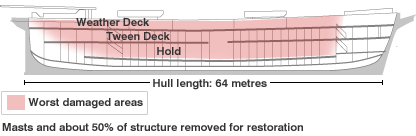
Grimshaw have also punched a shopping centre-style glass lift up through the middle of the ship — and put two more lifts in a new square building, the size of a small block of flats, next to and towering over the ship herself. They’ve plonked a glass pod on the open main deck for a staircase (the old housing was wood, but that’s so nineteenth-century). They’ve installed lights on the masts which make it look like a Christmas tree. Above all, of course, they’ve hoicked the ship up on girders, dangling above the dry dock to create an “unparalleled corporate entertaining space” underneath — an act of vandalism that prompted the resignation of the chief engineer, who said it would place the vessel under unacceptable strain and end in its destruction.

Cutty Sark was severely damaged in a drydock fire in May 2007.

Margaret Thatcher: not quite the hawk of popular memory

History Today has an Archie Brown review of Reagan and Thatcher: The Difficult Relationship by Richard Aldous:

… Thatcher had serious reservations about Reagan’s Strategic Defence Initiative project (SDI — soon popularly referred to as ‘Star Wars’). In particular she rejected his idea that this hypothetical anti-missile defence system would make nuclear weapons — and the concept of deterrence — obsolete. When, at the Reykjavik summit in 1986, only Reagan’s determination to continue with SDI prevented his agreeing with Mikhail Gorbachev on a plan for total removal of nuclear weapons from global arsenals, the British prime minister became incandescent with rage.

Her strong attachment to nuclear weapons as a deterrent, in the belief that they would never be used, went alongside a foreign policy that was less bellicose than her popular image might suggest. Thatcher’s willingness to use force to take back the Falkland Islands, following their takeover by Galtieri’s Argentina, should not obscure her extreme reluctance to endorse military intervention where there had been no external attack on Britain or on a British dependency. Aldous cites her clearly-expressed opposition to military interventions for the sake of ‘regime change’:

    We in the Western democracies use our force to defend our way of life … We do not use it to walk into independent sovereign territories … If you’re going to pronounce a new law that wherever communism reigns against the will of the people, even though it’s happened internally, there the USA shall enter, then we are going to have really terrible wars in the world.

That was provoked by the American invasion of Grenada to reverse an internal coup. Thatcher also took a sceptical view of American military strikes in Lebanon and Libya, saying: ‘Once you start to go across borders, then I do not see an end to it and I uphold international law very firmly’.

September 12, 2012

Richard III’s remains may have been found in Leicester

Filed under: Britain, History — Tags: , , , , — Nicholas @ 09:17

Fascinating announcement today from the dig site:

11.12: He says one skeleton and other human remains have been found and a barbed metal arrowhead was found between vertebrae of the skeleton’s upper back. The arrow was near the spine, but not embedded in the bones.

11.15: Mr Taylor says that an articulated skeleton has been found that is of significant interest to us. Scientists have also found a set of “disarticulated human remains” but because they are female and therefore not Richard III.

The skeleton shows signs of “near death trauma” that “appears to be consistent with injury from battle”. Scientists now hope to extract DNA from the bones.

He added:

“It also has spinal abnormalities and an individual form of spinal curvature, which makes his right shoulder visibly higher than his left shoulder. We believe the individual would have had severe scoliosis. The skeleton was not a hunchback.”

It is consistent with other accounts of Richard III.”

It is now at an undisclosed laboratory where it is going through “rigorous” testing.

September 10, 2012

Extending the state’s say in private decision-making

Filed under: Britain, Law, Liberty — Tags: , , , , , — Nicholas @ 09:55

Barbara Hewson on recent legal developments in Britain which extend the state’s ability to interfere in the private lives of adults:

For centuries, the High Court has claimed an ‘inherent jurisdiction’ to take care of the persons and property of those who could not look after themselves. This power covers minors and wards of court, as well as adults who lack mental capacity. It originates in an ancient Crown Prerogative, going back to feudal times (1). But in a little-noticed legal development, some judges of the Family Division have started to claim an ‘inherent jurisdiction’ over the lives of adults in full possession of their faculties.

This is a disturbing trend. These rulings are given at private hearings. Parliament, the public, and indeed the Ministry of Justice, are none the wiser. The problem, at base, is a constitutional one. Our judges are unelected, and are not supposed to make laws. That is parliament’s function.

Parliament has said that people become adults at age 18 (2). Most people think that the point of reaching adulthood is that you get to decide where you live, and who your friends are. If you make unwise decisions, that is unfortunate, but it is not a basis for the authorities to intervene. However, last March, in a case called ‘DL’, the Court of Appeal said that the High Court is entitled to disregard adult decision-making (3).

[. . .]

Judges of the Family Division of the High Court have been seduced by what Frank Furedi has called ‘the fatalistic sociology of the precautionary principle’. This views all human beings as innately powerless, vulnerable and at risk (7). And if to be at risk is a condition of life, then everyone becomes a legitimate target of judicial intervention and protection. This refusal by the courts to acknowledge adults as self-determining agents has ominous implications for liberty and the law.

September 9, 2012

You know who are really sick of the Euro crisis? Press photographers

Filed under: Europe, Media — Tags: , — Nicholas @ 09:43

The unsung heroes who provide you with those ?memorable? images of Euro coins being eaten by toy sharks to illustrate stories about the Euro crisis:

Stratenschulte is a photographer with the German news agency DPA. He has been photographing euro coins from various angles for the past three years. He tries to convey the complex crisis in images. The problem is that the crisis won’t end, which means Stratenschulte has to keep coming up with fresh ideas.

His colleagues have resorted to using children’s toys, arranging a plastic shark to look like it’s eating a Lego man holding a Greek flag. They have photographed coins in a free fall. Rumor has it that one photographer poured gasoline on coins to try to make them glow with heat.

Photographers call such images illustrations, they use them to help visualize abstract events. Most crises don’t hold the public’s attention for more than a few weeks or months, but it has been different with the ongoing euro-zone debt debacle. Stratenschulte has had enough of it.

“It is difficult to keep finding a new approach,” he says. “I’m glad the euro coins have different designs in each country. That makes it possible to vary things at least a bit.”

H/T to Tim Harford for the link:

https://twitter.com/TimHarford/statuses/244699544028315648

September 8, 2012

QotD: The European Project

Like all people with bad habits, politicians and bureaucrats are infinitely inventive when it comes to rationalizing the European Project, though they’re inventive in nothing else. Without the Union, they say, there would be no peace; when it’s pointed out that the Union is the consequence of peace, not its cause, they say that no small country can survive on its own. When it is pointed out that Singapore, Switzerland, and Norway seem to have no difficulties in that regard, they say that pan-European regulations create economies of scale that promote productive efficiency. When it is pointed out that European productivity lags behind the rest of the world’s, they say that European social protections are more generous than anywhere else. If it is then noted that long-term unemployment rates in Europe are higher than elsewhere, another apology follows. The fact is that for European politicians and bureaucrats, the European Project is like God — good by definition, which means that they have subsequently to work out a theodicy to explain, or explain away, its manifest and manifold deficiencies.

[. . .]

The personal interests of European politicians and bureaucrats, with their grossly inflated, tax-free salaries, are perfectly obvious. For politicians who have fallen out of favor at home, or grown bored with the political process, Brussels acts as a vast and luxurious retirement home, with the additional gratification of the retention of power. The name of a man such as European Council president Herman Van Rompuy, whose charisma makes Hillary Clinton look like Mata Hari, would, without the existence of the European Union, have reached most of the continent’s newspapers only if he had paid for a classified advertisement in them. Instead of which, he bestrides the European stage if not like a colossus exactly, at least like the spread of fungus on a damp wall.

Corporate interests, ever anxious to suppress competition, approve of European Union regulations because they render next to impossible the entry of competitors into any market in which they already enjoy a dominant position, while also allowing them to extend their domination into new markets. That is why the CAC40 of today (the index of the largest 40 companies on the French stock exchange) will have more or less the same names 100 years hence.

More interestingly, perhaps, Hannan explains the European Union’s corruption of so-called civil society. Suppose you have an association for the protection of hedgehogs because you love hedgehogs. The European Union then offers your association money to expand its activities, which of course it accepts. The Union then proposes a measure allegedly for the protection of hedgehogs, but actually intended to promote a large agrarian or industrial interest over a small one, first asking the association’s opinion about the proposed measure. Naturally, your association supports the Union because it has become dependent on the Union’s subsidy. The Union then claims that it enjoys the support of those who want to protect hedgehogs. The best description of this process is fascist corporatism, which so far (and it is of course a crucial difference) lacks the paramilitary and repressive paraphernalia of real fascism.

Theodore Dalrymple, “Rejecting the European Project”, City Journal, 2012-09-07

Rush wins “Album of the Year” at first Progressive Music Awards

Filed under: Britain, Cancon, Media — Tags: , , , — Nicholas @ 00:22

In a “how is this possibly the first time” event, Rush won the Album of the Year award for Clockwork Angels.

Veteran rock band Genesis have been honoured at the first Progressive Music Awards, alongside other bands including Pink Floyd and Rush.

Genesis members Mike Rutherford and Tony Banks picked up the lifetime achievement award at a ceremony at Kew Gardens on Wednesday.

Keyboard legend and ex-Yes member Rick Wakeman was given the Prog God Award.

The awards, created by Prog Magazine, were hosted by BBC Newsnight presenter Gavin Esler.

Prog rock, which grew out of 1960s psychedelia, was originally associated with 70s bands including Pink Floyd, Genesis, Yes and King Crimson.

[. . .]

Canadian rock band Rush’s latest concept album, Clockwork Angels, was named Album Of The Year.

With its dystopian steampunk theme, the three-piece’s 19th studio album has earned rapturous reviews, even in the mainstream press.

Describing it as Rush’s “most solid and compelling set of songs in years”, The Guardian went on to say: “Those who worship at the temple of Rush will be in raptures; for those who remain agnostic, there may well be enough here to justify a leap of faith.”

It was also a handy reminder to me that I hadn’t actually bought the album yet: it was on sale in the Canadian iTunes store for $6.99. Sold.

September 6, 2012

Switzerland to buy Swedish warplanes

Filed under: Europe, Military, Technology — Tags: , , — Nicholas @ 09:12

Switzerland is planning to replace their aging fleet of F-5 fighter jets with a smaller number of modern Swedish aircraft:

Switzerland has decided to buy 22 Swedish JAS-39E Gripen fighters to replace their elderly F-5s. The 16 ton JAS-39E is roughly comparable with the latest versions of the F-16 and is a substantial upgrade of the current JAS-39C model. The Gripen is also used by Sweden, Thailand, South Africa, Hungary, and the Czech Republic. The 39E is still in development and will eventually replace the 14 ton JAS-39C.

[. . .]

Often regarded as an also-ran in the current crop of “modern jet fighters,” the Swedish Gripen is proving to be more competition than the major players (the F-16, F-18, F-35, Eurofighter, Rafale, MiG-29, and Su-27) expected. Put simply, Gripen does a lot of little but important things right and costs about half as much (at about $35 million each) as its major competitors. In effect, Gripen provides the ruggedness and low cost of Russian aircraft with the high quality and reliability of Western aircraft. For many nations this is an appealing combination. The Gripen is easy to use (both for pilots and ground crews) and capable of doing all jet fighter jobs (air defense, ground support, and reconnaissance) well enough.

The Gripen is small but can carry up to 3.6 tons of weapons. With the increasing use of smart bombs, this is adequate. The aircraft entered active service in 1997 and has had an uphill battle getting export sales. Sweden does not have the diplomatic clout of its major competitors, so they have to push quality and service. Swedish warplanes and products in general have an excellent reputation in both categories. Nevertheless, the Gripen is still expected to lose out on a lot of sales simply because politics took precedence over performance.

Update: Yes, I caught the mis-attribution in the headline about a minute after I posted this. Sorry for the error, etc., etc., etc.

Gentrification of Brixton

Filed under: Britain, History — Tags: , , , — Nicholas @ 08:30

The Economist looks at the demographic and social changes underway in Brixton:

A good deal has changed in Brixton, a south London district, since Eta Rodney bought her Victorian terraced house in 1980. Then many of her neighbours were, like her, Jamaican. West Indians had settled in Brixton since 1948, when some arrived on the Empire Windrush. Today many of Mrs Rodney’s black neighbours are selling up and moving out of the area, making way for predominantly white newcomers. Britain’s historic black centre is being transformed — but in an odd way.

The Afro-Caribbean population of Lambeth, the borough where Brixton is located, is estimated to have fallen by 8% since 2001 even as the borough’s overall population has risen by 9%. Interracial mixing explains only part of this: the main reason is black flight. Afro-Caribbeans have dispersed from other parts of central London too, such as Hackney and Hammersmith and Fulham. They move to escape crime, buy bigger houses and get their children into better schools — the familiar reasons people of all races head for suburbia. In the South East outside London, Afro-Caribbean numbers have jumped, albeit from a low base.

[. . .]

Mrs Rodney feels both pressures. Her husband would like to retire to Jamaica. She prefers Streatham, further south in London, where she could buy a palace for the money gentrifiers are keen to pay for her house, with its original cornicing and marble fireplaces. The former council house she bought under the Conservative Party’s right-to-buy scheme—“I love Mrs Thatcher, God bless her soul”—would today fetch at least 20 times what she paid.

Of course, for many of us, the name Brixton has a very Clash-y context:

September 2, 2012

Margaret Thatcher and the British intelligence organizations

Filed under: Britain, Government — Tags: , , , , — Nicholas @ 00:01

An interesting post at the official website for Prime Minister David Cameron talks about former Prime Minister Margaret Thatcher and her relationship with the Joint Intelligence Committee during her time in office:

Soon after taking office a new Prime Minister receives special briefings from the Cabinet Secretary. One is on the ‘letters of last resort’, which give instructions to the commander of the British submarine on patrol with the nuclear deterrent, in the event of an attack that destroys the Government. Another briefing outlines the structure and control of the intelligence machinery, including the Joint Intelligence Committee (JIC) in the Cabinet Office. Sir John Hunt, the Cabinet Secretary in 1979, briefed Margaret Thatcher on the intelligence structure, including counter-subversion activities, the day after her election victory of 3 May.

Thatcher had started a programme of visits to Government departments to see first-hand what some of the 732,000 officials inherited from James Callaghan’s administration actually did. In September, during a routine briefing by Brian Tovey, the Director of GCHQ, Thatcher showed great interest in the way in which intelligence was collated and assessed by the JIC, stressing that assessment should be free from policy (or political) considerations. She also expressed a wish to attend a JIC meeting. It would be the first time a Prime Minister had attended the JIC since its creation in 1936.

It fell to Sir John Hunt, a former Secretary of the JIC, to make the arrangements, but there were complications. First, the JIC Chairman, Sir Antony Duff of the Foreign and Commonwealth Office (FCO), had also been made Deputy Governor of Southern Rhodesia (now Zimbabwe) after the British Government assumed direct rule of the rebellious colony. He was a key participant in the Lancaster House Conference, aiming finally to settle the Rhodesian problem, and could not be sure to attend the JIC until after its conclusion. Second, the JIC normally met on Thursday mornings in 70 Whitehall, which was also when the Cabinet met in 10 Downing Street, so a special JIC meeting would need to be arranged.

August 31, 2012

Where would London be without the Tube?

Filed under: Books, Britain, Media, Railways — Tags: , — Nicholas @ 09:27

At sp!ked, Neil Davenport reviews a new book about London’s iconic underground:

The closing ceremony of the 2012 London Olympics was notable for its groaning reliance on tourist-shop icons — all black cabs, bowler hats, Houses of Parliament, red pillar-boxes and Mini Coopers. In a dreary way, what could we expect? A tourist-shop portrayal of Britain is still internationally recognisable and, for the organisers, safe enough to avoid party-pooping controversy. Curiously, though, one famous figure of the capital was noticeable by its absence: the London Underground. With its roundel logo, distinctive trains and elegantly functional map, few landmarks of London are as richly iconic as this. Indeed, as a character player in umpteen films, novels and pop songs, no London setting would be complete without the Underground.

Throughout the network’s history, though, Londoners’ relationship with the Tube has often been uneasy and aggravating: overcrowding, delays, cancellations, the fare’s dent on the wallet and, for the middle classes, striking tube workers and their ‘inflated’ salary. Nevertheless, it is only when the Tube is not working properly that we become aware of its magnitude. Unlike Tower Bridge or Beefeaters, the Tube isn’t a remote or mythical symbol of London. It’s the living, working and organic lifeblood of the capital. It is the way in which millions of Londoners are able to work and play and thus, unlike Parliament, has meaning to ordinary people’s lives.

The boons and banes of the tube for Londoners (and visitors) are warmly captured in Andrew Martin’s Underground, Overground: A Passenger’s History of the Tube. A novelist and former ‘Tube Talk’ columnist for the London Evening Standard, Yorkshireman Martin pithily combines an authoritative history of the network’s development with personal reflections on his daily journeys. People can say they have become Londoners when they can navigate the vast system and reflect on its highs and lows, quirks and anomalies. Whether we admit it or not, Londoners will have their favourite stations and lines (the author’s is the Central line, mine the Victoria). They will notice the art décor splendour of Arnos Grove station or the beautifully rich tiles at Baker Street. They will curse themselves for falling asleep on the last tube (it’s that gentle rocking motion that sends you off to the Land of Nod) and waking up, as I have on numerous occasions, in High Barnet.

« Newer PostsOlder Posts »

Powered by WordPress