
Quotulatiousness

November 4, 2013

Law, the military, and the media

Filed under: Britain, Law, Military — Tags: , , , , — Nicholas @ 11:23

Sir Humphrey debunks a recent story in the Telegraph which makes a big deal about the British military hiring more lawyers at the same time as they are disbanding front-line units:

The Forces have always needed effective legal support, and arguably the tiny number of military lawyers provides an utterly vital capability. Its not just about the provision of support to people who understand the arcane intricacies of a military law system which is very complex, and very different to our normal law — though this is extremely important. It’s about the provision of people who bring a vital advisory role to Commanders on the ground, and the wider MOD.

[…]

Similarly, once the direct fighting is over, UK troops often find themselves operating in a very strange environment — one only has to look at Iraq in the aftermath of the initial war fighting phase to realise that its not a clear cut place to operate. The advice offered by in theatre legal personnel can often make a huge difference in helping commanders understand their freedom to operate, and what genuine constraints may affect them. For instance, on a single tour in Iraq, units may have found themselves conducting everything from searches, checking for IEDS, detaining known individuals through deliberate operations, and then engaging in combat — quite possibly in the same day. The requirement for modern troops to adapt very quickly to all manner of situations places a huge burden on them — it is important that they get the best possible guidance to know they are acting correctly. Certainly in this authors experience on both TELIC and HERRICK, the LEGAD advice was often one of the most critical parts of any potential operation.

The same lawyers provide vital services back home — in the Royal Navy for instance, there are a range of in house experts on the Law of the Sea, international maritime disputes and territorial waters and the like. This may sound questionable, but when the RN is daily conducting counter piracy and counter narcotics operations across the globe, or sailing in possible maritime flashpoints where different nations have very different interpretations of maritime boundaries, having a good legal understanding on hand of the art of the possible is absolutely vital.

November 2, 2013

Catalonia – the next state in Europe?

Filed under: Europe, Government, History, Politics — Tags: , , , , — Nicholas @ 09:53

Daniel Bogre Udell looks at the state of the independence movement in Catalonia, which has been part of Spain since the War of Spanish Succession in 1714, except for a brief interlude during the Spanish Civil War:

This year, on September 11, hundreds of thousands of Catalans joined hands to form a human chain that extended 460 kilometers across their region, from the French Pyrenean border to Valencia. Complete with matching t-shirts and slogans, this robust act of protest was astonishingly well-organised, which came as no surprise: it was in fact the echo of a mass demonstration that took place one year prior, when a million people took to the streets of Barcelona under the banner: “Catalonia: The Next State in Europe.”

The day after that first demonstration, Catalan President Artur Mas publicly endorsed the protest and called for a referendum on independence. Shortly after, he convoked early elections which produced a sweeping pro-referendum majority in Barcelona.

Overnight, Catalan politics changed. The Independentists were now in control. Unionists softened their rhetoric. Nearly two hundred towns in the Catalan countryside preemptively declared independence [ca]. Parliament passed a declaration of sovereignty.

Instead of taking this clamor seriously and engaging the Catalan public, most in the Spanish government, including Prime Minister Mariano Rajoy, positioned themselves firmly as antagonists. They insisted that referendum was illegal, framing Catalan nationalists as enemies of democracy and, in some extreme cases, comparing the sovereignty movement to Nazism.

They have also tried to promote the idea of Catalan nationalist ambitions as parochial and irrelevant. After a meeting with Catalan business leaders in Barcelona this month, Spain’s Deputy Prime Minister claimed not to have noticed any strong markers of regional identity. In a recent English-language interview with The Wall Street Journal, Prime Minister Rajoy described the hypothetical advent of Catalan independence as contrary to the world’s “natural evolution.” When addressing the Spanish public at the UN General Assembly, he went out of his way assure those in the chamber that none of his fellow world leaders had asked him about Catalonia.

Behind closed doors, however, it seems that Spanish officials are more concerned than their dismissive behavior implies: recently, Spain’s UN delegation drafted a report on how best to respond if Catalan leaders take their case to the international community in the wake of a successful referendum on independence. It asserted that Madrid could possibly draft security council allies into blocking Catalonia’s full statehood, but would be relatively powerless to stop the region’s admission as a General Assembly observer.

“Catalonia: The Next Partially-Recognized State” may not be as elegant a turn of phrase as those coined by activists, but it nonetheless haunts politicians in Madrid.

October 30, 2013

Dr. Richard Holmes – Agincourt 1415

Filed under: Europe, France, History, Weapons — Tags: , — Nicholas @ 10:46

Published on 3 Oct 2012

Dr Richard Holmes’ TV Documentary series from 1996 entitled War Walks. This episode concerns the legendary Battle of Agincourt. Unfortunately, Richard Holmes — my favourite military historian — died of Pneumonia only last year (2011).

QotD: The career of Karl Marx

Filed under: Britain, Economics, Germany, History, Quotations — Tags: , , , — Nicholas @ 00:01

[Karl Marx] was also an unemployed professor, a scholar in the German tradition with a first-rate brain, a vast depth of learning and considerable obscurity of thought. Of his intellect and scholarship there can be no doubt at all. He knew many languages and had read widely in many subjects. A very learned man indeed, he was admirably fitted for the life of a German university. Marx’s complete absorption in his philosophy, history and economics was quite typical of the sort of professor he should by right have become. That mixture of scholarship, vagueness, poverty and practical inexperience would have graced a chair at Heidelberg or Bonn. But for the death in 1840 of Frederick William IV, a man of strictly orthodox views on religion, Marx might have had an academic career. Barred from this, however, as an atheist, he had no class to teach, no pupils from whom he might have learned. There is a sense, of course, in which a professor lives apart from the world. But his duties, even in the mid-nineteenth century, involved some contact with other people. The most professorial of German professors would have examinations to set and appointments to keep. Sessions of Senate and Faculty might give him scope for eloquence or intrigue, and he would find for himself the need to compromise, concede and persuade. Howbeit painfully and slowly, the professor comes to know something of administration and finance. But this was the practical knowledge which Marx was denied. All the experience he had was in his own home, where his failure was catastrophic for his wife and family. Of his children some died of slow starvation and two committed suicide. Retaining and increasing all his professional learning, he became more purely theoretical than even professors are allowed to be. Of the difficulties of organizing human society he knew practically nothing. There was in fact no human society — no province or city, no school or club — of which he could be said to have been a member. His whole life was bounded by the printed page.

C. Northcote Parkinson, “Internal Contradiction”, Left Luggage, 1967.

October 26, 2013

NATO after the cold war

Filed under: Europe, Military, Russia, USA — Tags: , , , , — Nicholas @ 09:15

Austin Bay looks at the latest re-invention of the North Atlantic Treaty Organization (NATO):

As the Cold War faded in the early 1990s, “end of NATO” prognosticators argued that the collapse of the Soviet Union would lead to the collapse of the military alliance forged to defeat it. They maintained that intra-alliance political frictions, no longer checked by the threat of Soviet tanks and nuclear weapons, would inevitably fracture the complex organization.

Moreover, Western Europe, re-cast as the European Economic Community and preparing for life as the European Union, could do it alone, militarily and economically. According to these seers, the outbreak of peace in Europe meant Europeans no longer needed to fret with those overbearing Americans.

However, European peace didn’t break out, not quite. Instead, Yugoslavia broke up, a USSR in Balkan miniature, its dissolution sparking a series of dirty wars on European soil.

U.N. peacekeeping efforts in the Balkans failed to prevent massacres like Bosnia’s Srebrenica genocide. When Kosovo exploded, the Clinton Administration, Britain and France sidestepped the U.N. To fight the Kosovo War, they used a democratic political alliance capable of waging war on behalf of a better peace: NATO. By doing so, they reinvented NATO as a global actor for the North Atlantic democracies.

Balkan troubles still plague Europe, but NATO’s Kosovo intervention staunched the bloodshed. European diplomats also quickly learned that (excepting Serbia) the ex-Yugoslav Balkan states regarded NATO and the European Union as classy clubs. Diplomatic clout is one of NATO’s continuing utilities. Membership has prestige. Dangling NATO and European Union membership still encourages better, if not quite good, Balkan behavior.

[…]

The “deep goal” of this new round of reinvention is to insure that the alliance can fulfill its NATO treaty Article 5 obligation to current members. Article 5 commits every NATO nation to the defense of a member suffering attack by a non-NATO member. NATO invoked Article 5 after the 9-11 terror attacks on the U.S. The 9-11 Article 5 invocation and the Kosovo War were predicates to NATO’s “beyond Europe” involvement in Afghanistan and in Libya 2011.

NATO’s demise is anything but imminent. Evolving threats have seeded closer cooperation.

The origins of the British army

Filed under: Britain, History, Military — Tags: , , — Nicholas @ 09:07

A primer called “Boots on the Ground” at Think Defence provides a quick historical sketch of how the British army came to be:

It is worth reminding ourselves that up until Cromwell in effect there was no ‘Army’ as such.

Individual nobles raised troops top fight for the king in haphazard amounts and units, equipped according to their finances; and often with little relation to their feudal dues. A rich Knight often turned up to fight for or against the King with more and better equipped troops than a poor Earl.

The New model Army (more properly contemporaneously called the ‘Newly Modelled’ Army,(if I recall) changed that. Fed up with troops that would only fight under ‘Their’ commander and on ‘Their’ turf Parliament said (and I paraphrase):-

    ‘Sod this literally for a game of soldiers we need to get an Army we can command, if we are going to get any of this shit sorted’…

So the UK’s first professional full time paid and resourced Army was born.

The revolutionary Ideas of:

  • Paying the troops well and on time,
  • Concentrating on Moral, (through religious conformity it its case),
  • An organization of units according to modern requirements,
  • Proper logistics.
  • And a proper code of Military justice.

Worked so well that it pretty much kicked arse from the moment it hit the ground.

However with the restoration of the monarchy a lot of old attitudes re-emerged.

It was very much the case for hundreds of years that you joined ‘The Regiment’. Often named after the Colonel who was in command. The British Army seems at some points to have been almost an accidental conglomeration of like minded units a bit like a trade organisation of organisations who happened to wear uniforms and fight for the King.

OK, this was slowly chipped away at by events in the Napoleonic and Crimean wars, to the stage by the late 19th century it was an ‘Army’, but some traditions and mindsets seem to take an age to die.

For all the ‘esprit de corps’ it undoubtedly delivered, incidents of internecine ‘warfare’ between units hampering actions in the field are well recorded up to WWII and beyond.

It is worth reminding ourselves that we are only now returning to an army the same size as the one we entered the run up to World war 1 with. That’s the one that was so small by European power standards that when asked what he would do if the British Army invaded Germany in the 1890′s [Otto von Bismarck] replied ‘I would call the police and have it arrested’!

On the topic of internecine warfare between army units, regimental memories are long and opportunities to “pay off” old scores arise when dissimilar/unfriendly units are brigaded together. George MacDonald Fraser (author of the fantastic Flashman novels) mentioned in one of his MacAuslan stories that it was dangerous to let certain Highland regiments get too close to one another for fear they’d fight one another instead of the enemy (or overthrow the government).

I strongly disagree with the author’s belief that the regimental system should be scrapped, but he makes a reasonable case for that step (“reasonable” if you’ve never actually served in the army, that is…)

October 24, 2013

The Somme, then and now – “most of these men would be dead 40 minutes after this film”

Filed under: Britain, Europe, France, History, Military, WW1 — Tags: , — Nicholas @ 00:01

Published on 6 Oct 2013

After painstaking research I found a lot of the exact positions that Malins filmed the Battle footage from. I hope to re-edit it soon and make it a bit smoother; also will be going back soon to film where the artillery bombarded Gommecourt.

H/T to Think Defence for the link.

October 23, 2013

The most dangerous shipwreck in the Thames Estuary

Filed under: Britain, History, WW2 — Tags: , — Nicholas @ 09:45

Uploaded on 16 Aug 2010

A documentary about the SS Richard Montgomery. The remains of this second world war Liberty ship lie semi-submerged in the Thames estuary. There are currently over 1500 tons of explosives left on board. This documentary looks into the danger the wreck still presents.

I’m mildly amused that they frequently mis-name the vessel as the “USS” Richard Montgomery (she was never a commissioned ship of the US Navy, so it should be just “SS” not “USS”). If you watch to the end of the documentary, they’ve included a “blooper reel” of voice-overs for the last minute or so…

October 19, 2013

CETA as a lever to (finally) loosen rules on inter-provincial trade

Filed under: Cancon, Economics, Europe — Tags: , , , — Nicholas @ 11:18

In Maclean’s, Paul Wells thinks that the new free trade deal between Canada and the European Union will be one of the historical successes of Stephen Harper’s career, but also notes it has a potentially great domestic influence:

Flip it around. Every delay in reaching an agreement with the EU on freer trade in goods and services has been merrily mocked by a few critics in the gallery, yours truly first among them. And if Stephen Harper had failed to conclude this deal, having taken negotiations this far, he would have durably wrecked Canada’s reputation as a serious trading nation.

(That goes doubly so now that Canada and the EU have reached an agreement in principle. Could it still fall apart? It could, although my test on this, for reasons I explained long ago, is the reaction of the Europeans. I’m told there is no love lost between Harper and José Manuel Barroso; Barroso would not waste time in Brussels on an empty dog and pony show so Harper could duck a few questions about Mike Duffy. The Europeans think this is real. For now we should take today’s announcement at face value. The Council of Canadians sure does.)

Well, if delay was worth criticism and failure would have been read as a career-threatening personal defeat, success must be counted as a personal triumph for Stephen Harper. When his political career ends, this is one of the first three things the newspapers will mention.

But as he notes, there’s a long-term, nagging domestic trade issue that might also improve under the new international agreement:

Best of all, any advantage offered by any province and its municipalities to European importers must, in simple logic, be made available to businesses from other Canadian provinces. This accord will act powerfully to deepen the still fragmented internal Canadian market. In a week when some cabinet ministers were turning cartwheels because it will now be legal to drive from Hull to Ottawa with a bottle of wine, that’s an overdue change. I’m on the record being skeptical Harper couldn’t close this deal, and I’m happy to eat crow. This CETA deal will be the most powerful pro-market accomplishment of any Canadian government in a quarter century.

As Wells correctly notes, this isn’t a true free trade deal but it’s a “free-r trade” agreement that moves us a few notches closer to actual free trade with the EU. Regulators and bureaucrats of all stripes will still have a lot of say in what goods and services are actually exchanged between the signatories, but that will still be less than the influence they currently wield.

QotD: Army leadership

Filed under: Britain, Military, Quotations — Tags: , , — Nicholas @ 00:01

Long ago I had learned that in conversation with an irate senior, a junior officer should confine himself strictly to the three remarks, “Yes, sir”, “No, sir”, and “Sorry, sir”! Repeated in the proper sequence, they will get him through the most difficult interview with the minimum discomfiture.

Field Marshal William Slim, “Student’s Interlude”, Unofficial History, 1959.

October 17, 2013

Who were the Vikings, Episode one

Filed under: Europe, History — Tags: , , , , — Nicholas @ 07:23

Neil Oliver heads for Scandinavia to reveal the truth behind the legend of the Vikings. In the first programme, Neil begins by discovering the mysterious world of the Vikings’ prehistoric ancestors. The remains of weapon-filled war boats, long-haired Bronze Age farmers, and a Swedish site of a royal palace and gruesome pagan ritual conjure up an ancient past from which the Viking Age was to suddenly erupt.

October 13, 2013

QotD: Luck of the draw

Filed under: Britain, Middle East, Military, Quotations, WW2 — Tags: , , , — Nicholas @ 00:01

When the time came for us to leave Persia and make the long trek back to Iraq, we stopped again for a few days with Robertson in Kermanshah. Then I said good-bye to my host, my Persian friends, and to his house with keen regret — with, as a matter of fact, a secret personal regret.

As a junior officer in the first World War, I had been presumptuous enough sometimes to hope that if I survived and were not found out, I might with tremendous luck, by the time the next great war arrived, be a general. Then, I fondly imagined my headquarters would move from château to château, from which I would occasionally emerge, fortified by good wine and French cooking, to wish the troops the best of luck in their next attack. Alas, when the time did come and, by good fortune in the game of military snakes and ladders, I found myself a general, I was so inept in my choice of theatres that no châteaux were available. More often than not, I had to make do with a plot of desert sand, a tree in the African bush, or a patch of jungle, while my cuisine was based on bully beef and the vintages of my imagination were replaced by over-chlorinated water. Once or twice, however, I did get, if not my château with its chef and its cellar, at least an excellent substitute — an oil company bungalow. Once having sampled its comfort I would not have swapped Robertson’s house for all the châteaux of the Loire. Dug in there, a delectable future had spread before me in which I achieved my youthful ambition and conducted the war from linen-sheeted bed and luxurious long bath. But, like other youthful hopes, the vision faded. I was once more, had I known it, destined to châteaux-less wilderness.

Field Marshal William Slim, “Persian Pattern”, Unofficial History, 1959.

October 12, 2013

Not quite as I remember it (from hiding behind the settee in the living room)

Filed under: Britain, Media — Tags: , , — Nicholas @ 00:01

Published on 10 Oct 2013

Trailer for the newly-recovered and remastered Patrick Troughton Doctor Who episode The Enemy of the World. Unseen in the UK for 45 years, and formerly considered missing, The Enemy of the World sees Troughton play the dual-role of the Doctor and also Salamander – the “saviour of the world”. Or is he… Also starring Frazer Hines as Jamie and Deborah Watling as Victoria.

October 10, 2013

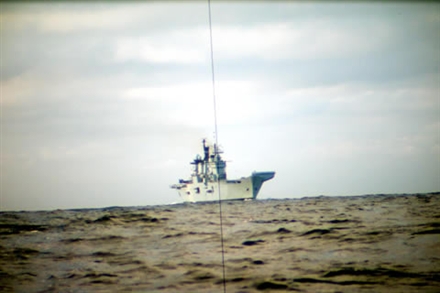
Periscope view of HMS Illustrious, courtesy HMCS Corner Brook

Filed under: Britain, Cancon, Military — Tags: , , , — Nicholas @ 12:55

Submariners love other ships … as potential targets:

In 2007 HMCS Corner Brook, a diesel-electric submarine of the Canadian navy, sneaked up on Illustrious during an exercise in the Atlantic.

HMS Illustrious in HMCS Corner Brook's periscopeTo prove they could have sunk the carrier, Corner Brook’s crew snapped a photo through the periscope — and the Canadian navy helpfully published it. “The picture represents hard evidence that the submarine was well within attack parameters and would have been successful in an attack,” boasted Cmdr. Luc Cassivi, commander of the Canadian submarine division.

Corner Brook, a former British submarine displacing only 2,400 tons, is no more capable than Dallas — and probably much less so once crew training is taken into account. American submariners spend far more time at sea than their Canadian counterparts.

Dallas and Corner Brook scored their simulated carrier kills against allied warships in the context of a scripted exercise. But many other close encounters between subs and flattops have occurred between rival nations deep at sea, in a usually bloodless duel that is nevertheless deadly serious.

Defending an independent Scotland

Filed under: Britain, Military — Tags: , , , , — Nicholas @ 08:33

Sir Humphrey has read the British Ministry of Defence paper on Scottish options in a post-independence scenario and has a few thoughts:

The paper nicely highlights the reality that you cannot slice up defence assets and turn them into a coherent military force – ORBATs may look impressive, but dividing them into something more meaningful is particularly difficult.

Additionally the paper highlights the issue of how one takes a world class military, optimised for power projection abroad, and then carves off a smaller chunk of it to focus on missions for which it was not designed. For instance, the idea that Scotland would keep running a modern air force built around Typhoon seems interesting, but where does the pilot training pipeline come from, how is this affordable and what happens when the Eurofighter nations move to upgrade their aircraft? Is it truly feasible to imagine a relatively small Scottish Defence Force being able to shoulder the burden of paying the costs of sustaining an increasingly obsolescent Typhoon fleet, which is no longer at the same standard as its multi-national peers?

The problem facing a newly independent Scotland seems to be that the UK military assets are simply not appropriate for what will be a low level defence force in a relatively small country. Stripped of the recruiting, support and logistical contracts and pipeline that have sustained the equipment, one can imagine a future Scottish Defence Force burdened down with legacy equipment which requires expensive training and support to run properly, and which is too expensive to meet what will be a very small budget.

One could almost argue that rather than take much UK military equipment, it would be more sensible for Scotland to instead take a large cash payment and procure a low level defence force (with UK forces providing sovereignty assurance in the interim) which better meets their specific needs. So, procurement of low level OPVs, simple vehicles and so on – in other words start from scratch with something that is feasible, and not take on equipment that is designed for a very different role.

Update: His look at the SNP’s proposed military structure from last year is also worth reading:

At the moment, the current policy seems to be that on separation, those army regiments deemed Scottish will become part of the SDF. Similarly, an equivalent amount of manpower, roughly 1/8th of all UK military assets and personnel will be offered to the Scottish Government. In broad-brush terms, this leads to an Army of about 10,000 troops, 5,000 air force and 4000 navy/marines (say 19,000 overall).

Here is where the fun really starts. Firstly, the armed forces do not neatly break into component parts which can be divided up. An infantry battalion may have 650 people on its strength, but there may be many more from supporting arms such as REME and so on who will be there to maintain and support weapons and equipment. Do the SNP want to take the supporting arms too?

Secondly — how will they attribute manpower against specialisations — the RN for instance has a deeply specialised manpower structure, made up of composite branches – it’s not just a mixy blob of 30,000 sailors looking good and drinking rum prior to catching the eye of hairy women with tattoos, it’s a collection of branches and capabilities.

[…]

The author knows relatively few individuals who would willingly wish to transfer to any SDF. Most of the Scots personnel he knows are immensely proud of being Scottish, but are also equally proud of belonging to something much greater in the form of HM Armed Forces. They relish the challenge offered by soldiering in a military that has a track record for being employed aggressively overseas. How many of them will willingly want to transfer to a SDF that is unlikely to be used in any similar manner?

The SDF is going to have a challenging initial few years — it will inherit people at all levels, but probably not enough for any one role. It’s going to take time to grow personnel into the jobs required of them, and even if it started recruiting on the day of independence, it would still take 5-10 years to grow the critical mass of SNCOs and junior officers needed to manage and lead the organisation.

« Newer PostsOlder Posts »

Powered by WordPress

