
France, for all its faults, has genuinely federalized food: a distinctive cheese every 20 miles down the road. In America, meanwhile, the food nannies are lobbying to pass something called the National Uniformity for Food Act. There’s way too much of that already.
The federalization of food may seem peripheral to national security issues, and the taste of American milk — compared with its French or English or even Québécois equivalents — may seem a small loss. But take almost any area of American life: what’s the more common approach nowadays? The excessive government regulation exemplified by American cheese or the spirit of self-reliance embodied in the Second Amendment? On a whole raft of issues from health care to education the United States is trending in an alarmingly fromage-like direction.
Mark Steyn, “Live Brie or Die!” SteynOnline.com, 2014-03-13
June 12, 2014
QotD: Regulating cheese
June 10, 2014
England’s World Cup team – where’s the hype?
BBC News Magazine has expatriot Scot Jon Kelly wondering where all the traditional pro-England hype has gone, compared to previous World Cup campaigns:
The flags are missing from the cars. British newspapers aren’t heralding imminent victory. In pubs from Penrith to Plymouth there’s a distinct lack of gaiety, optimism and hope.
I for one couldn’t be happier.
As a Scotsman resident in London, I’ve come to dread the wildly delusional over-confidence that grips my adopted homeland every time an international football tournament is staged.
The certainty of victory. The talk of a “golden generation”. The interminable references to 1966. And the inevitable splutterings of anguish when it’s eventually confirmed on the pitch that, actually, Germany or Argentina or Portugal are superior teams after all.
Now, don’t get me wrong. I like all things Anglo very much. While Scotland will always be the national side I support, in spite of our dependable rubbishness, I’ve always felt the Anyone-But-England tendency among some of my fellow Scots diminishes our status as a self-confident, modern nation.
1966 – it seems like only yesterday to many England fans
But the bellicose hysteria that envelops many in England — not to mention the irritating assumption by certain broadcasters, newspapers and advertisers that their audiences are comprised entirely of England fans — makes the team in white a difficult one for non-English folk to like, never mind cheer on.
And I say all this as someone who takes an interest in football. For those who dislike the game, it must be excruciating.
This year it’s different, however. No-one with more than a cursory knowledge of the international game seriously believes England will win.
That much is true: if they stick to the traditional formula, they’ll go out on penalties in the quarter-finals.
Invariably, a motley crew of psychologists, positive-thinking gurus and snake-oil sellers will be forming a queue outside FA headquarters, offering cures for the English penalty curse. I think there’s a simpler solution. Let’s campaign for spot kicks to be scrapped. We should use whatever arguments we think might work. I’d play the inclusion card. Penalty kicks clearly discriminate against the mentally frail. The English, who suffer from a collective, penalty-induced trauma, will always get a raw deal. How can that be fair? If FIFA wants a truly level playing field, the answer is to get rid of the pseudo-lottery of spot kicks. What we need is a proper lottery. We don’t want skill or nerve to play any part. Tossing a coin, rolling dice, drawing straws, a game of scissor-paper-stone — anything is better than a shootout. Come on Mr Blatter, give us chokers a chance.
Still one of my favourite World Cup comments (and I’m flying the English flag for the tournament):
Erectile dysfunction is on the increase. If you suffer please put a whiteflag with a redcross on your car to show your support #england #lfc
— pheadtony (@pheadtony) June 1, 2010
June 7, 2014
Europe should bear more of the costs of their own defence
The American government is being called upon to re-assure NATO allies with suddenly volatile borders (that is, those near Russia and Ukraine). That re-assurance is to take the form of greater US military involvement in the Eastern European sector of NATO. The Cato Institute’s Doug Bandow says that this is actually an opportunity for those NATO countries to start living up to their own obligations to maintain viable defensive forces:
The Baltic States are screaming for enhanced military protection. Yet Estonia devotes just two percent of its GDP to defense. Latvia spends .9 percent of its GDP on the military. Lithuania commits .8 percent of its GDP on defense.
Poland may be the country most insistent about the necessity of American troops on along its border with Russia. To its credit, Poland has been increasing military outlays, but it still falls short of NATO’s two percent objective. Warsaw spent 1.8 percent last year.
Only Great Britain and Greece joined Estonia in hitting the two percent benchmark. France and Turkey fall short. Germany comes in at 1.3 percent. Overall NATO hit 1.6 percent last year. America was 4.1 percent.
Per capita military spending is even more striking. My Cato Institute colleague Chris Preble figured that to be $1896 for Americans. And $399 for Europeans. A disparity of nearly five to one.
Unfortunately, President Barack Obama doesn’t appear to recognize the dependency problem. At West Point he merely indicated that “we are now working with NATO allies” to reassure the Eastern Europeans. “We”?
Poland expects to hit 1.95 percent of GDP this year. Latvia and Lithuania promised to up outlays to meet the two percent standard — in a few years. No one else is talking about big spending increases. Absent is any commitment to move European troops to NATO’s eastern borders.
Nothing will change as long as Washington uses the defense budget as a form of international welfare. The more the president “reassures” U.S. allies, the less likely they are to do anything serious on behalf of their own defense.
Canada is also a military freeloader on US resources. While our NATO commitments imply we’ll spend 2% of GDP on our defences, we spend 1.3% in 2012, and the Department of National Defence is struggling to reduce spending below previous years’ outlays to meet the federal government’s overall budget balancing plans.
Update, 8 June: Stephen Gordon posted a Twitter update that puts Canadian military spending into a bit of perspective
Increase GST by 3 ppts? RT @pmlagasse: If Cda to meet 2% NATO request, defence budget ~0 $40b/yr. Good to know where extra $20b wd come from
— Stephen Gordon (@stephenfgordon) June 8, 2014
Historic WW2 aircraft fly over Juno Beach
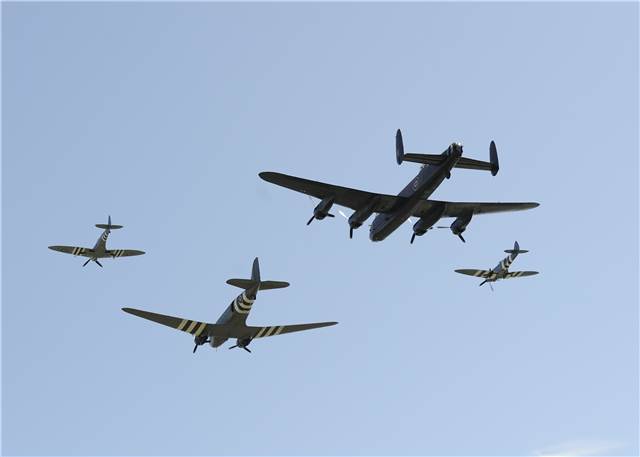
Two Spitfires, a Dakota DC-3, and a Lancaster Bomber conduct a flypast over Juno Beach, France, during commemorative ceremonies of the 70th Anniversary of D-Day on June 6, 2014. Photo by Sgt Bern LeBlanc Canadian Army Public Affairs AS2014-0027-002
“30, 40 or 50 years ago, a year the quality of 2013 Bordeaux would have been a complete disaster”
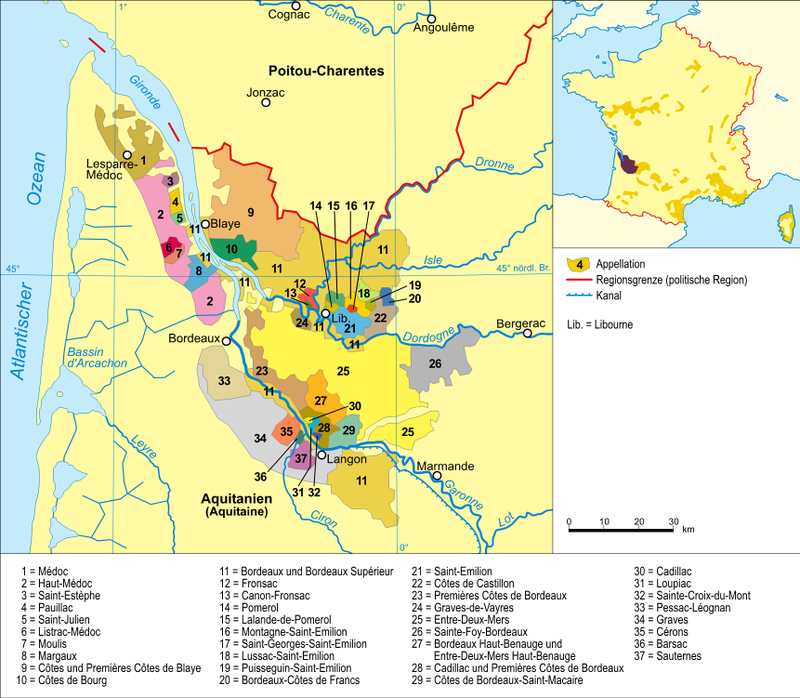
Even in a good year, I don’t have the money to invest in Bordeaux futures, so I rarely bother to read much about them. Even so, I’d heard that the 2013 vintage was not going to be a good one given the weather that year in the region. The price for Bordeaux wines, however, didn’t do the rational thing and drop below previous (good) years: prices went up. The Wine Cellar Insider explains what happened next:
2013 Bordeaux is not the vintage of the century. The growing season, with its cold, damp character made sure of that. 30, 40 or 50 years ago, a year the quality of 2013 Bordeaux would have been a complete disaster.
But that is not what took place with 2013 Bordeaux. With the willingness to sacrifice quantity for quality, the best producers, with the financial ability to do what needed to be done made some fine wine. 2013 Bordeaux is not an exciting, sexy vintage. But having tasted close to 400 different 2013 Bordeaux wines, clearly, there are some nice wines worth drinking.
So, what’s the problem? When it comes to the wine, none. The average scores from the majority of wine writers and critics show the wines at an average of 89/90 Pts for perhaps the top 100 – 200 wines. Clearly, those are the not the scores for a bad vintage.
[…]
Had the wines been priced in proportion to consumer demand, while 2013 Bordeaux was never going to be an easy sell, it would not have been an impossible sale. I am all for the open, free market when it comes to pricing. Producers can and should price their wine for what they think the market will bear. But 2013 Bordeaux wines remain unsold. Selling the wines to a negociant is not selling the wine. Merchants need to buy and consumers need to purchase as well for it to be a true sale. For some odd reason, in the great vintages, Bordeaux has a knack for pricing the wines correctly. They might seem expensive to mature collectors that are used to paying lower prices, but for the next generation of wine lovers, the wines seem fairly priced.
I get it. On the one hand, due to the excessive unflattering and at times, unfair press, 2013 Bordeaux was never going to receive a warm reception in the marketplace. Perhaps the price the market was actually willing to pay was unappetizing to the chateau owners. But it would have been nice to see an effort. It is difficult for 2013 Bordeaux to sell through to consumers when other recent, and more successful vintages are available in the market for less money.
H/T to Brendan for the link.
June 6, 2014
1st Canadian Parachute Battalion War Diary
Excerpt from 6 June, 1944:
6th June 1944
Place: Carter Bks, Bulford
The initial stages of operation OVERLORD insofar as the 1st. Cdn. Parachute Battalion was concerned, were divided into three tasks. The protection of the left flank of the 9th Para Battalion in its approach march and attack on the MERVILLE battery 1577 was assigned to “A” Company. The blowing of two bridges over the RIVER DIVES at 1872 and 1972 and the holding of feature ROBEHOMME 1873 was assigned to “B” Company with under command one section of 3 Para Sqdn Engineers. The destruction of a German Signal Exchange 1675 and the destruction of bridge 186759 plus neutralization of enemy positions at VARRAVILLE 1875 was assigned to “C” Company.
The Battalion was to drop on a DZ 1775 in the early hours of D Day, “C” Company dropping thirty minutes before the remainder of the Battalion to neutralize any opposition on the DZ. The Battalion emplaned at Down Ampney Airfield at 2250 hours on the 5th June, 1944. “C” Company travelled in Albemarles and the remainder of the Battalion in Dakotas (C-47). The flight was uneventful until reaching the French coast when a certain amount of A.A. fire was encountered. Upon crossing the coast-line numerous fires could be seen which had been started by the R.A.F. bombers. Unfortunately the Battalion was dropped over a wide area, some sticks landing several miles from their appointed R.V.. This factor complicated matters but did not deter the Battalion from securing its first objectives.
Protection of Left Flank of 9 Para Bn – A Company
“A” Company was dropped at approximately 0100 hours on the morning of 6th June, 1944. Lieut. Clancy, upon reaching the Company R.V. found only two or three men of the Company present. After waiting for further members, unsuccessfully, of the Company to appear, he decided to recce the village of GONNEVILLE SUR-MERVILLE 1676. Taking two men he proceeded and penetrated the village but could find no sign of the enemy. He then returned to the Company R.V. which he reached at approximately 0600 hours and found one other Officer and twenty Other Ranks of the Battalion and several men from other Brigade Units waiting. The entire body then moved off along the pre-arranged route to the MERVILLE battery. Encountering no other opposition enroute other than heavy R.A.F. Bombardment at GONNEVILLE SUR-MERVILLE. Upon completion of the 9th Battalion task the Canadian party acted first as a recce patrol to clear a chateau 1576 from which a German M.G. had been firing and then acted as a rear guard for the 9th Battalion withdrawal toward LE PLEIN 1375. The party left the battalion area (9th Battalion) at LE PLEIN at 0900 hours and reached the 1st Cdn. Para. Bn. position at LE MESNIL BAVENT cross roads 139729 at 1530 hours on the 6th June, 1944.ROBEHOMME – “B Company
Two platoons of “B” Company were dropped in the marshy ground south and west of ROBEHOMME. Elements of these platoons under Sgt. OUTHWAITE then proceeded toward the Company objective. Enroute they encountered Lieut. TOSELAND with other members of “B” Company making a total of thirty All Ranks. They were guided through the marshes and enemy minefields to the ROBEHOMME bridge by a French Woman. On arriving at the bridge they met Capt. D. GRIFFIN and a further thirty men from various sub-units of the Battalion, including mortars and vickers Platoons. MAJOR FULLER who had been there for some time left in an attempt to locate Battalion Headquarters. Capt. GRIFFIN waited until 0630 hours for the R.E.’s who were to blow the bridge. As they failed to arrive explosives were collected from the men and the bridge successfully demolished.
A guard was left on the bridge and the main body withdrawn to the ROBEHOMME hill. Although there were no enemy in the village there were several skirmishes with enemy patrols who were attempting to infiltrate through the village and some casualties were suffered by the Company. An O.P. was set up in the church spire. An excellent view was obtained of the road from PONT DE VACAVILLE 2276 to VARRAVILLE. Artillery and infantry could be seen moving for many hours along this road from the East. It was particularly unfortunate that wireless communication could not be made with Bn. H.Q. as the subsequent fighting of the Battalion was carried out in such close country that observation of enemy movement was almost impossible.
At 1200 hours on the 7th June, 1944, it was decided to recce the route to Bn. H.Q.. Upon the route being reported clear orders were issued for the party to prepare to join Bn. H.Q. Lieut. I. WILSON, Bn. I.O. came from LE MESNIL to guide the party back. The move was made at 2330 hours, the strength of the party by this time being 150 All Ranks, the addition having been made by stragglers of various units who had reported in. The wounded were carried in a civilian car given by the cure, and a horse and cart given by a farmer. The route was BRIQUEVILLE 1872 to BAVENT road 169729, through the BOIS DE BAVENT and on to LE MESNIL cross roads. Near BRIQUEVILLE the lead platoon was challenged by enemy sentries. The platoon opened fire killing seven and taking one prisoner. Shortly afterwards this same platoon was fortunate enough to ambush a German car which was proceeding along the road from BAVENT. Four German Officers were killed. Bn. Headquarters was reached at 0330 hours on the 8th June, 1944.
VARRAVILLE – “C” Company
The majority of “C” Company was dropped west of the RIVER DIVES, although some sticks were dropped a considerable distance away including one which landed west of the RIVER ORNE. Due to this confusion the company did not meet at the R.V. as pre-arranged but went into the assault on the Chateau and VARRAVILLE in separate parties. MAJOR McLEOD collected a Sgt. and seven O.R.’s and proceeded towards VARAVILLE. En route they were joined by a party under Lieut. WALKER. One of the Sgts. was ordered to take his platoon to take up defensive positions around the bridge that the R.E. sections were preparing to blow. This was done and the bridge was successfully demolished.
MAJOR McLEOD and Lieut. WALKER with the balance of the party then cleared the chateau and at the same time other personnel of “C” Company arrived from the DZ and cleared the gatehouse of the chateau. The gatehouse then came under heavy M.G. and mortar fire from the pill box situated in the grounds of the chateau. The pill-box also had a 75 mm A/Tk. Gun. The whole position was surrounded by wire, mines and weapon pits. MAJOR McLEOD, Lieut. WALKER and five O.R.’s went to the top floor of the gatehouse to fire on the pillbox with a P.I.A.T. the enemy 75mm A/Tk. Gun returned fire and the shot detonated the P.I.A.T. ammunition. Lieut. WALKER, CPL. OIKLE, PTES. JOWETT and NUFIELD were killed and MAJOR McLEOD and PTE. BISMUKA fatally wounded. PTES. DOCKER and SYLVESTER evacuated these casualties under heavy fire. CAPT. HANSON, 2 i/c of “C” Company was slightly wounded and his batman killed while proceeding to report to the Brigade Commander who had arrived in the village from the area in which he dropped. “C” Company, together with elements of Brigade H.Q. and the R.E.’s took up defensive positions around the village and a further party encircled the pill-box in order to contain the enemy. A further party of “C” Company under Lieut. McGOWAN who had been dropped some distance from the DZ arrived in VARAVILLE in time to catch two German Infantry Sections who were attempting to enter the town. Lieut. McGOWAN’s platoon opened fire causing casualties and the remainder of the enemy surrendered. This platoon took up firing positions firing on the enemy pill-box. “C” Company H.Q. which was located in the church yard pinned an enemy section attempting to advance in a bomb crater killing at least three. The chateau was evacuated by our troops and left as a dressing station. An enemy patrol re-entered the chateau and captured the wounded including Capt. BREBNER, the Unit M.O., and C.S.M. Blair of “B” Company. This patrol although attacked by our own troops managed to escape with their prisoners.
Heavy enemy Mortar Fire and sniping was brought to bear on our positions from the woods surrounding VARAVILLE. During this time the local inhabitants were of great assistance, the women dressing wounds and the men offering assistance in any way. One Frenchman in particular distinguished himself. Upon being given a red beret and a rifle he killed three German Snipers. This man subsequently guided the Brigade Commander and his party towards LE MESNIL. Although it is believed he was a casualty of the bombing attack that caught this party enroute to LE MESNIL.
At approximately 1030 hours the enemy pill-box surrendered. Forty-two (42) prisoners were taken and four of our own men who had been captured were released. From 1230 hours on artillery fire was brought to bear on VARAVILLE from the high ground east of the RIVER DIVES. At 1500 hours cycle troops of the 6th Commando arrived and at 1730 hours on 6 June, 1944, “C” Company proceeded to the Bn. area at LE MESNIL. The german prisoners giving evident satisfaction to the French population enroute.
VICKERS PLATOON – Initial Stages
The Vickers platoon was dropped in four sticks of ten or eleven each being a total of forty-one (41) All Ranks. For the first time their M.G.’s were carried in Kit Bags, a number of which tore away and were lost.
The Platoon was dropped over a wide area, a part of them joining “C” Company’s attack on VARAVILLE, part joining “B” Company at ROBEHOMME and part joining Bn. H.Q.. Casualties on the drop totalled twelve missing and three wounded. One of the missing, PTE. PHIPPS, was identified in a photo in a German newspaper found on a P.W. After the initial Company tasks had been accomplished the platoon was deployed to the Companies as single gun detachments or as Sections.
MORTAR PLATOON – Initial Stages
The Mortar Platoon was dropped over a wide area and suffered very heavy loss in equipment due to kit bags breaking away and a great majority of the men landing in marshy ground. As the platoon dropped they attached themselves to the nearest company they could find and assisted in the capture of the objectives. One detachment commander landed on top of the German pill-box at VARAVILLE. He was made prisoner and spent the rest of the time in the pill-box until the Germans surrendered to “C” Company. A point of interest was that the P.I.A.T. Bombs did definite damage to the interior of the pill-box and had a very towering effect upon the morale of the defenders.
Some of the Mortar Platoon which joined “B” Company at ROBEHOMME were detailed to guard the approaches to the destroyed bridge. Three enemy lorries full of infantry appeared on the other side of the bridge. The guard opened fire knocking out one truck killing most of its occupants. The other two lorries were able to withdraw. One of our own men who was a prisoner in the lorry was able to make good his escape.
Upon the detachments arriving at LE MESNIL they were re-grouped as a platoon and given three mortars which had arrived by sea. These mortars were set up in position in the brickworks where they engaged the enemy.
BATTALION HEADQUARTERS – Initial Stages
The Commanding Officer, 2 i/c, Signals Officer and the Intelligence Officer and a small portion of the Battalion Headquarters together with elements of 224 Para Fd. Ambulance and other Brigade Units met at the Battalion R.V. in the early hours of the morning of 6th June, 1944. The Signals Officer was detailed to look after the Enemy Signal Exchange near the R.V.. He went into the house and found a certain amount of Signals equipment which he destroyed but he found no Germans. The Intelligence Officer set out with two men to recce VARAVILLE and bring back a report on the situation. In the Battalion Headquarters meantime the party moved off to LE MESNIL taking with them many scattered elements including a 6 Pdr. A/Tk. Gun and crew. Upon reaching the Chateau 1574 they encountered part of the Brigade Headquarters. The party there upon split up into unit parties and continued until they reached the orchards 141729 where they came under heavy sniping fire from nearby houses. This fire caused several casualties including one Officer. The enemy were forced to withdraw from the buildings after an attack by the party. The party reached the Battalion area at approximately 1100 hours on 6th June, 1944.
H/T to @LCMSDS for the link.
Update: War diaries for units in the 3rd Canadian Division in Normandy can be read here.
“Fizzy dishwater” instead of Champagne for the “wine Fuhrer”
Chris Mercer on the various ways the French Champagne producers tried to keep their best wine from being diverted to the use of the Nazis:
By the time the French city of Reims was liberated in August 1944, many Champagne houses and growers had spent four years playing a game of high stakes cat-and-mouse with the local Nazi ‘wine fuhrer’, Otto Klaebisch.
As Julian Hitner writes in a feature published in the July issue of Decanter magazine, it was Klaebisch’s job to keep the Nazi empire topped up with France’s finest Champagnes. At its peak, Klaebisch was demanding 400,000 bottles per week.
In response, many Champenois resorted to subterfuge to try to protect their most precious vintages and cuvees.
As noted in the book Wine & War by Don & Petrie Kladstrup, some built fake walls in their cellar to hide their best stocks, while others intentionally mislabelled bottles.
On more than one occasion, Klaebisch suspected he was being duped. ‘How dare you send us fizzy dishwater?’ he asked 20-year-old Francois Taittinger.
‘Who cares? It’s not as if it’s going to be drunk by anyone who knows anything about Champagne,’ replied the young Taittinger, who was subsequently thrown in prison for several days.
H/T to Brendan for the link.
Mulberries, PLUTO and Hobart’s Funnies
Seventy years ago today, the Allies launched Operation Overlord, the invasion of Normandy by the combined British, American, and Canadian armies. A huge fleet of combat and transport vessels, supported by a large proportion of the United States Army Air Force and the Royal Air Force bomber and fighter aircraft were all deeply involved in making the invasion a success. In addition, perhaps the world’s largest disinformation campaign was being run to keep the German high command unsure of the real time and location of the invasion: the Pas de Calais and the Norwegian coast were also potential invasion targets, forcing the defenders to spread their forces thinner and to keep as many as possible out of reach of the real beaches.
In addition to the operational uncertainty of where to expect the blow, the Germans were also split about how best to conduct the defence: Field Marshal Rommel wanted to rush units to the beach as soon as possible, to defeat the Allies before they got inland. General Geyr von Schweppenburg, commander of Panzer Group West (and Field Marshal von Rundstedt, overall commander in the West), on the other hand, preferred to meet the Allies further inland (not taking the full impact of Allied air superiority into account). On 6 June, the defenders fell between the two philosophies, not being able to mass enough force to stop the invaders in their tracks, but suffering higher casualties in the attempt to move units toward the coast in the teeth of RAF/USAAF attacks.

Operation Overlord (detail) Click to see full-sized image at wwii-info.net
The invasion beaches were code-named Utah (4th US Division), Omaha (1st and 29th US divisions), Gold (50th British Division), Juno (3rd Canadian Division), and Sword (3rd British Division). Before the amphibious forces landed, three paratroop divisions were dropped behind the beaches to slow down German response (US 82nd and 101st Airborne Divisions to the West and Southwest of Utah beach, and the 6th British Airborne to the East of Sword beach).
One thing to note from the map is that there wasn’t a significant port within the invasion zone: the Allies had learned the bitter lessons of attacking a port in August of 1942 and the 2nd Canadian Division had paid in blood for the tuition. This meant a way had to be found to keep getting supplies to the troops after they moved off the beaches, until a functioning port could be secured. The Allied answer was to bring a port with them from England — two of them, actually — one to support the US forces in the West and one to support the British and Canadian forces in the East. These were the Mulberry harbours:
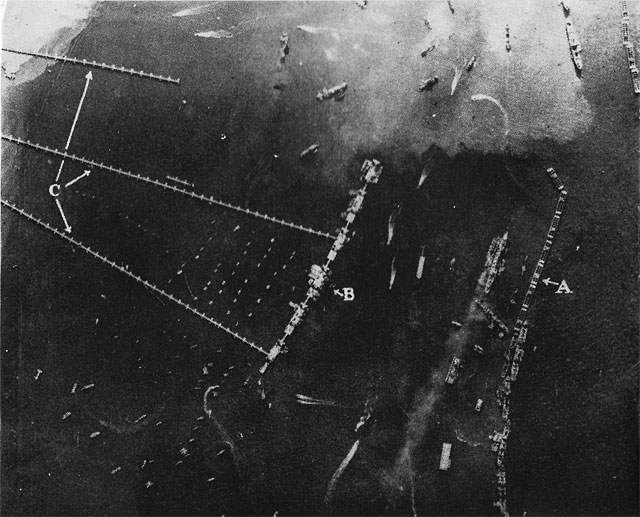
Think Defence explains how the Mulberry harbour worked:
In the image above these three components are shown.
A; Breakwater to attenuate waves
B; Pier heads at which to load and unload
C; Causeways that connected the pier heads to the beach
Each of the components was given a code word but fundamentally, they were concerned with either providing sheltered water or connecting ships and the beach.
There have been a number of different theories about how the Mulberry name was chosen, the more fanciful ones being completely incorrect.
Brigadier White recalls the moment he received a memo, unclassified, with the heading ‘Artificial Harbours’ and after recovering from the shock of such poor security immediately consulted with the Head of Security at the War Office. The next code, from the big book of code words, was Mulberry, it was that simple.
[…]
There were two complete Mulberry harbours, A for American and B for British, each the size of Dover harbour. Once the task of constructed and assembling the components on the South coast of England was complete they were ordered to Normandy on the 6th of June 1944, D-Day, departing on the 7th
Assembling the components was an effort in itself, requiring 600 tugs drawn from all parts of the UK and USA, all under the supervision of the Admiralty Towing Section commanded by Rear Admiral Brind.
Operational security was paramount, the captains of the block ships were told they were going to the Bay of Biscay and a model of the Mulberry harbour and invasion beaches in the headquarters of the Automobile Association at Fanum House was made by toymakers who were confined to the building until well after the invasion.
Unfortunately, the Western harbour was severely damaged in a storm a few weeks after coming into service, so the Eastern Mulberry had to do double duty after that.
Aside from the need to get reinforcements, rations, ammunition and other supplies forward, the Allied armies were highly motorized, and required vast amounts of fuel. Without a port’s specialized unloading facilities, it was assumed that it would be somewhere between difficult and impossible to keep the armies mobile. To address this, PLUTO was developed: Pipe Line Under The Ocean.
A great solution, although as Think Defence points out, it didn’t actually go into service until a few months after D-Day, and was not quite the war-winner the newsreel portrayed:
Second in daring only to the artificial harbors project and provided our main supplies of fuel during the Winter and Spring campaigns.
What also PLUTO did was allow vital tanker tonnage to be deployed to the Far East theatre.
Despite the understandable over exaggeration of the success of PLUTO it should be noted that fuel did not start flowing until September 1944, well after the invasion and on the 4th of October, BAMBI was closed down and operations concentrated on DUMBO after it had delivered a measly 3,300 tonnes, hardly war winning.
Cherbourg was by then receiving tanker supplies direct from the USA.
 Getting across the channel was a major undertaking, but getting the troops ashore with enough firepower to break out of the beach defences required more innovation. The British army established a specialized unit to develop and operate vehicles and weapon systems specifically designed for that purpose. Major General Sir Percy Hobart was the commander of the 79th Armoured Division, and he was exactly the right man for the job (being related by marriage to Montgomery may have helped, too, but before taking command he was acting as a corporal in the Home Guard).
Hobart’s unit developed some of the most interesting armoured vehicles (not all of which were brilliant successes) and it’s safe to say that the Allies would have suffered much higher casualties without Hobart’s “Funnies”. In fact, General Eisenhower said as much himself: “Apart from the factor of tactical surprise, the comparatively light casualties which we sustained on all beaches, except OMAHA, were in large measure due to the success of the novel mechanical contrivances which we employed, and to the staggering moral and material effect of the mass of armor landed in the leading waves of the assault. It is doubtful if the assault forces could have firmly established themselves without the assistance of these weapons.” Think Defence has a good summary of many of these odd and interesting vehicles:
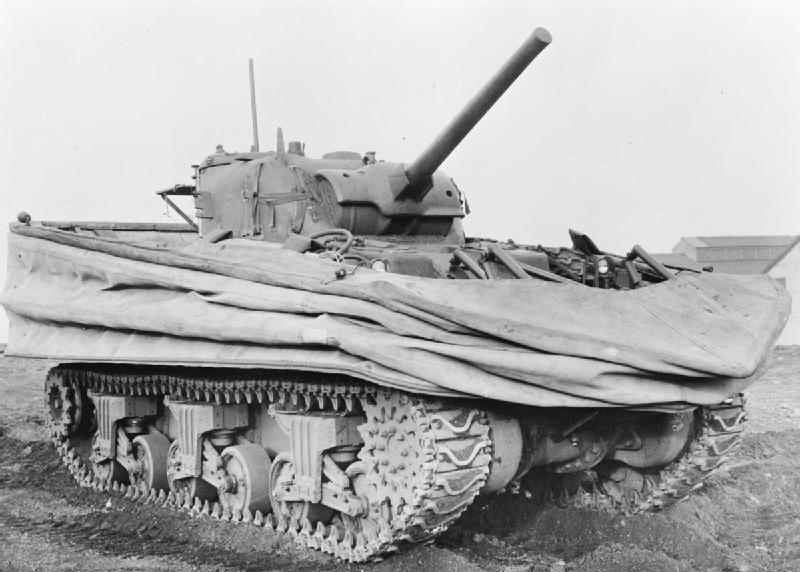
Sherman tanks were also converted into amphibious vehicles by the addition of a canvas skirt, propellers and other modifications. These provided vital armoured fire support in the opening phase of the beach assault although a number were lost to the heavy seas when they were launched too far from the beach. It is widely thought that as these losses were particularly heavy on Omaha beach it was this that contributed to the very high losses in that area.
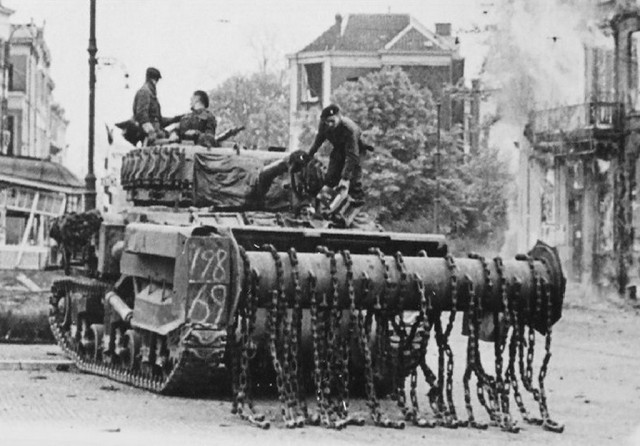
Mine clearance was carried out by a number of means but the preferred method was to use rotating chain flails to detonate the mines thus clearing a path the width of the tank. The flails were mounted on the front of the tank and were called Sherman Crabs. A number of Churchill based designs using rollers and ploughs were also employed, although this image shows one mounted on a Sherman.
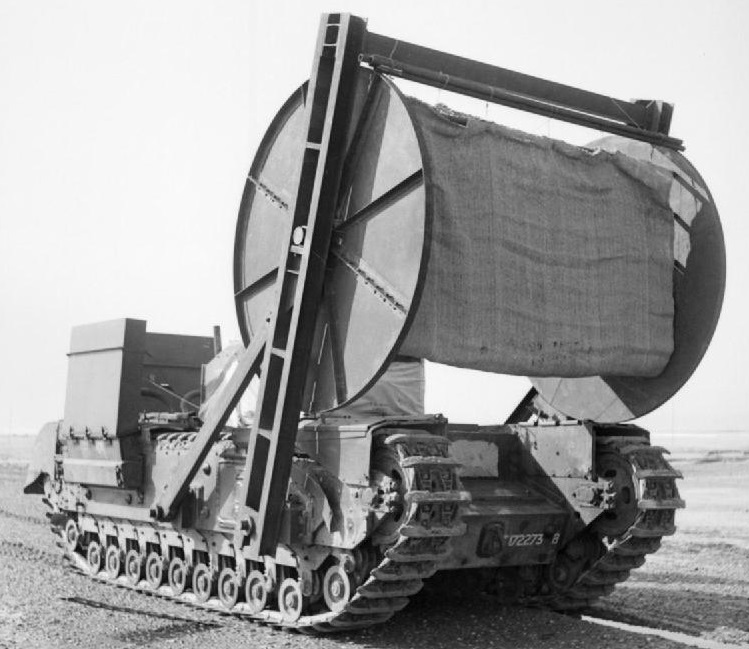
The beach surveys had revealed the existence of large patches of clay that would not bear the weight of heavy vehicles and artillery. To overcome this the ‘bobbin’ tanks were used that laid a continuous reinforced canvas mat over the soft ground, thus spreading the load over a wider area.
Canadian paratroopers on D-Day – “he thought we were battle hardened and we were as green as green could be”
Lance Corporal John Ross tells the Ottawa Citizen about his D-Day experiences with the 1st Canadian Parachute Battalion:
“We attacked the strong point; there was an all-night fire fight. We had casualties and the Germans did too. At about 10 o’clock in the morning they surrendered. There were about 30 of us there, 42 Germans surrendered to us. They outnumbered us and they out gunned us,” describes Capt (Ret) John Ross, now 93 years-old recalling his time as a paratrooper who dropped several kilometers inland of Normandy on D-Day.
“We took off on the 5th of June, one day before D-Day. C Company was given the job to go in 30 minutes ahead to clear the drop zone of any enemy and attack the German complex.”
Capt (Ret) Ross served as a Lance Corporal in C Company, 1st Canadian Parachute Battalion, 3rd Airborne Brigade, 6th British Airborne Division. He was dropped from an Armstrong Whitworth Albemarle, a small two engine paratroop transport aircraft.
[…]
When thinking back to his time in Normandy Capt (ret) Ross remembers how Canadian soldiers were thought of as, seasoned warriors.
“I read an excerpt written by a German General after the war. He was in that area that we dropped in and he said that the reason they were overcome was because they faced battle hardened Canadians. I’d like to write a letter to him and say none of those Canadians had ever heard a shot fired in anger; he thought we were battle hardened and we were as green as green could be.”
June 5, 2014
QotD: Churchill, Roosevelt and de Gaulle
The central problem of relations with de Gaulle stemmed from President Roosevelt’s distrust. Roosevelt saw him as a potential dictator. This view had been encouraged by Admiral Leahy, formerly his ambassador to Marshal Petain in Vichy, as well as several influential Frenchmen in Washington, including Jean Monnet, later seen as the founding father of European unity.
Roosevelt had become so repelled by French politics that in February he suggested changing the plans for the post-war Allied occupation zones in Germany. He wanted the United States to take the northern half of the country, so that it could be resupplied through Hamburg rather than through France. “As I understand it,” Churchill wrote in reply, “your proposal arises from an aversion to undertaking police work in France and a fear that this might involve the stationing of US Forces in France over a long period.”
Roosevelt, and to a lesser extent Churchill, refused to recognize the problems of what de Gaulle himself described as “an insurrectional government”. De Gaulle was not merely trying to assure his own position. He needed to keep the rival factions together to save France from chaos after the liberation, perhaps even civil war. But the lofty and awkward de Gaulle, often to the despair of his own supporters, seemed almost to take a perverse pleasure in biting the American and British hands which fed him. De Gaulle had a totally Franco-centric view of everything. This included a supreme disdain for inconvenient facts, especially anything which might undermine the glory of France. Only de Gaulle could have written a history of the French army and manage to make no mention of the Battle of Waterloo.
Anthony Beevor, D-Day: The Battle for Normandy, 2009.
June 4, 2014
It’s clearly time for The Something Must Be Done Act 2014
A post by David Allen Green from last year that prefigures the political landscape of today:
… all this statutory output is subject to the tiresome jurisdiction of the courts — the High Court will quash delegated legislation and use “human rights” jurisprudence to interpret the word of parliament out of recognition. Something must be done.
So this Act is a modest proposal for our legislators and public officials. Once it is passed, no other legislation will ever be necessary and the meddlesome courts will be neutered. This would be a Good Thing.
Let’s start with Section 1:
“The Crown shall have the power to do anything, and nothing a Minister of the Crown does will be ultra vires.”
That should shut up the High Court for a while with their judicial review decisions.
But adding a second section to the Act will make sure that Ministers will act in the interests of all of us. So for the avoidance of doubt, Section 2 provides:
“The power given by Section 1 of this Act shall include the banning of things by any Minister of the Crown.”
But what things can be banned? Well, here’s Section 3:
“The things to be banned referred to in Section 2 of this Act shall be the things which a Minister of the Crown says are bad for us.”
Which in turn leads us to Section 4:
“What is bad for us for the purposes of Section 3 shall be determined by a Minister of the Crown with regard either to (a) headlines in the tabloid press of the day and/or (b) the headlines the Minister of the Crown would like to see in the tabloid press tomorrow.”
Section 5 will then provide:
“Any person
(a) voicing opposition to a determination made under Section 4 of this Act; or
(b) acting in breach of a ban made under Section 1 of this Act, shall be deemed to not care about the children and/or to be soft on terrorism.”
The Act should also include the following power at Section 6 so that any emerging issues can be addressed:
“In the event something must be done, a Minister may at his or her discretion choose a thing to do, and the thing chosen shall be deemed as the something that must be done.”
This discretionary power, however, is subject to Section 7:
“The thing chosen under Section 6 shall not have any rational or proportionate relationship to any intended objective.”
The way a lot of ministers carry on, you’d think this act had already been promulgated…
June 2, 2014
The naval revolution and HMS Dreadnought
BBC News Magazine looks back on the launch of the first modern all-big-gun battleship, HMS Dreadnought, in 1906.

HMS Dreadnought underway, circa 1906-07
[HMS Dreadnought] “really transformed naval warfare rather like the tank did on land warfare. In fact Dreadnought was described at the time as ‘the most deadly fighting machine ever launched in the history of the world'”.
Dreadnought brought together for the first time a series of technologies which had been developing over several years. Most important was her firepower. She was the first all big-gun battleship — with ten 12-inch guns. Each gun fired half-ton shells over 4ft tall and packed with high explosive. They weighed as much as a small car. Standing next to one today, it is easy to see how a single broadside could destroy an opponent — and do so at 10 miles’ distance.
These great distances caused problems of their own — in controlling and directing the fire — and Dreadnought was one of the first ships fitted with new equipment to electrically transmit information to the gun turrets.
For potential enemies on the receiving end this was a terrifying prospect. Admiral Lord West, a former head of the Royal Navy, calls Dreadnought “a most devastating weapon of war, the most powerful thing in the world”.
Potential adversaries would also have trouble outrunning her. New steam turbine engines gave her a maximum speed of about 25mph. They made her more reliable than previous ships, and able to sustain a higher speed for much longer.
But there was something else, too. Dreadnought had been built in just one year — a demonstration of British military-industrial might at a time when major battleships generally took several years to build. This, says Roberts, was an “enormous achievement which made the Germans sit up because their shipbuilding capability just could not match that”.

Despite the Royal Navy’s reputation for being tradition-bound and stodgy, they had quite an interesting history of experimentation and innovation in ship design. The launch of HMS Dreadnought was a good example of the navy being willing to take risks — specifically the risk of making the rest of the battlefleet obsolete overnight.
Update, 18 February, 2018: A recent post at Naval Gazing provides more information on the evolution of the Dreadnought design.
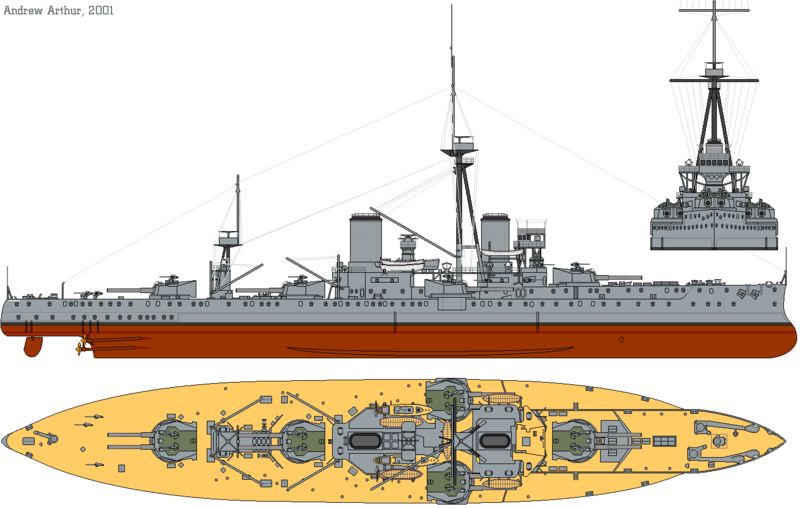
HMS Dreadnought in 1911
[Admiral Sir John “Jackie”] Fisher established a committee, including John Jellicoe and Reginald Bacon, who settled on the characteristics that would define Dreadnought. Bacon, later Dreadnought’s first captain – regarded by Fisher as “the cleverest officer in the Navy” – was the man who convinced Fisher to switch from all-10″ to all-12″. Reports of the effectiveness of the 12″ gun during the Russo-Japanese war helped confirmed this decision.
The second major change that Dreadnought brought is less obvious but in many ways more important. Dreadnought was the first large warship to use steam turbines instead of reciprocating engines. This increased her speed from the previous standard of 18 kts to 21 kts, saved 1000 tons, and most importantly allowed her to maintain high speed for much longer without the risk of mechanical failure. This was a vital component of Fisher’s other innovation, what we now call net-centric warfare. The high sustained speed of the new ships allowed them to cover greater areas, based on the improved information gathering and dissemination system that Fisher set up.
Dreadnought broke new ground in other areas, too. Her hull was about 18% lighter by volume than that of the proceeding Lord Nelson class, and she set a new standard for watertight integrity, removing most doors below the waterline. The only area without major improvement was armor, which was actually slightly less than in the Lord Nelson.
The design process began in November of 1905, initially with plans for 6 turrets. The first set of designs included the obvious (a hexagonal layout), the slightly less obvious (three superfiring turrets on each end) and the weird (a triangle at each end, with two turrets abreast and a superfiring turret above them). Eventually, it was decided that muzzle blast made the later two designs infeasible. Blast interference between the wing turrets meant that the aft pair was replaced by a single centerline turret, producing the arrangement used in Dreadnought.
The final result was a ship of 18,000 tons and 527 ft. With an 8-gun broadside, she matched the long-range firepower of almost any two ship afloat, and she set a new standard for speed in battleships. She was laid down on October 2nd, 1905, and launched only 5 months later, on February 10th, 1905. The 14 months exactly from laying down to commissioning set a record that has never been broken for capital ships, and was intended by Fisher to send a message to the world.
He also references the Dreadnought Hoax, which I’d never heard of … I’m surprised Cole wasn’t prosecuted as a spy, given the popular anxieties about foreign espionage and worries about an invasion.
May 31, 2014
Amusing Telex exchange as Falkland Islands were invaded by Argentina
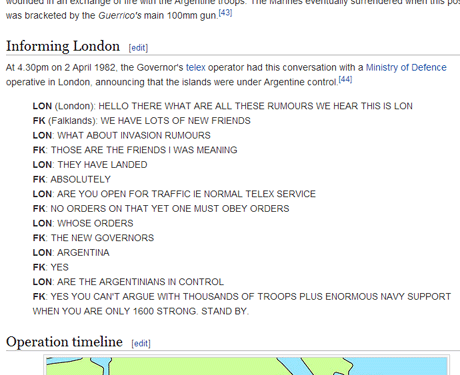
H/T to Jonathan Liew for the image.
QotD: Clear your mind of cant
My dear friend, clear your mind of cant. You may talk as other people do: you may say to a man, ‘Sir, I am your most humble servant.’ You are not his most humble servant….You tell a man, ‘I am sorry you had such bad weather the last day of your journey, and were so much wet.’ You don’t care six-pence whether he was wet or dry. You may talk in this manner; it is a mode of talking in society: but don’t think foolishly.
Dr. Samuel Johnson to James Boswell on May 15th, 1783. (quoted by John Derbyshire in “A Whining Pretension to Goodness”, Taki’s Magazine, 2013-10-17)
May 30, 2014
“French spies [are] number two in the world of industrial cyber-espionage”
High praise indeed for French espionage operatives from … former US Secretary of Defence Robert Gates:
Former spy and defense department secretary Robert Gates has identified France as a major cyber-spying threat against the US.
In statements that are bound to raise eyebrows on both sides of the Atlantic, Gates (not Bill) nominated French spies as being number two in the world of industrial cyber-espionage.
“In terms of the most capable, next to the Chinese, are the French – and they’ve been doing it a long time” he says in this interview at the Council on Foreign Relations.
Rather than a precis, The Register will give you some of Gates’s (not Bill) words verbatim, starting just after 21 minutes in the video, when he answers a question about America’s recent indictment of five Chinese military hackers.
“What we have accused the Chinese of doing – stealing American companies’ secrets and technology – is not new, nor is it something that’s done only by the Chinese,” Gates tells the interviewer. “There are probably a dozen or fifteen countries that steal our technology in this way.
“In terms of the most capable, next to the Chinese, are probably the French, and they’ve been doing it a long time.


