Quotulatiousness

July 3, 2014

Jeremy Bentham’s “secret” writings

Filed under: Britain, History, Liberty, Media, Quotations — Tags: , , , — Nicholas @ 10:43

In the Guardian, Faramerz Dabhoiwala reviews a recent “discovery” that Jeremy Bentham, far from being an innocent about sexual matters (as portrayed by his disciple John Stuart Mill among others), had thought deeply on the topic and had written much. After his death, these writings were ignored for fear that they would discredit his wider body of work.

Bodily passion was not just a part of Bentham’s life: it was fundamental to his thought. After all, the maximisation of pleasure was the central aim of utilitarian ethics. In place of the traditional Christian stress on bodily restraint and discipline, Bentham sought, like many other 18th-century philosophers, to promote the benefits of economic consumption, the enjoyment of worldly appetites and the liberty of natural passions. This modern, enlightened view of the purpose of life spawned a revolution in sexual attitudes, and no European scholar of the time pursued its implications as thoroughly as Bentham. To think about sex, he noted in 1785, was to consider “the greatest, and perhaps the only real pleasures of mankind”: it must therefore be “the subject of greatest interest to mortal men”. Throughout his adult life, from the 1770s to the 1820s, he returned again and again to the topic. Over many hundreds of pages of private notes and treatises, he tried to strip away all the irrational and religious prohibitions that surrounded sexual activity.

Of all enjoyments, Bentham reasoned, sex was the most universal, the most easily accessible, the most intense, and the most copious — nothing was more conducive to happiness. An “all-comprehensive liberty for all modes of sexual gratification” would therefore be a huge, permanent benefit to humankind: if consenting adults were freed to do whatever they liked with their own bodies, “what calculation shall compute the aggregate mass of pleasure that may be brought into existence?”

The main impetus for Bentham’s obsession with sexual freedom was his society’s harsh persecution of homosexual men. Since about 1700, the increasing permissiveness towards what was seen as “natural” sex had led to a sharpened abhorrence across the western world of supposedly “unnatural” acts. Throughout Bentham’s lifetime, homosexuals were regularly executed in England, or had their lives ruined by the pillory, exile or public disgrace. He was appalled at this horrible prejudice. Sodomy, he argued, was not just harmless but evidently pleasurable to its participants. The mere fact that the custom was abhorrent to the majority of the community no more justified the persecution of sodomites than it did the killing of Jews, heretics, smokers, or people who ate oysters — “to destroy a man there should certainly be some better reason than mere dislike to his Taste, let that dislike be ever so strong”.

Though ultimately he never published his detailed arguments for sexual liberty for fear of the odium they would bring on his general philosophy, Bentham felt compelled to think them through in detail, to write about them repeatedly and to discuss them with his acquaintances. In one surviving letter to a friend, he joked that his rereading of the Bible had finally revealed that the sin for which God had punished the inhabitants of Sodom and Gomorrah was not in fact buggery, but the taking of snuff. He and his secretary had consequently taken a solemn oath to hide their snuff-pouches and nevermore to indulge “that anti-Christian and really unnatural practice” in front of one another. Meanwhile, they were now both happily free to enjoy “the liberty of taking in the churchyard or in the market place, or in any more or less public or retired spot with Man, Woman or Beast, the amusement till now supposed to be so unrighteous, but now discovered to be a matter of indifference”. Among those with whom Bentham discussed his arguments for sexual toleration were such influential thinkers and activists as William Godwin, Francis Place and James Mill (John Stuart Mill’s father). Bentham’s ultimate hope, “for the sake of the interests of humanity”, was that his private elaboration and advocacy of these views might contribute to their eventual free discussion and general acceptance. “At any rate,” he once explained, even if his writings could not be published in his own lifetime, “when I am dead mankind will be the better for it”.

July 2, 2014

EU publishers want a totally different online model for content – where they can monetize everything

Filed under: Business, Europe, Law, Media — Tags: , , — Nicholas @ 10:19

Glyn Moody reports on the passionate desire of EU publishing organizations to get rid of as much free content as possible and replace it with an explicit licensing regime (with them holding all the rights, of course):

For too many years, the copyright industries fought hard against the changes being wrought by the rise of the Internet and the epochal shift from analog to digital. Somewhat belatedly, most of those working in these sectors have finally accepted that this is not a passing phase, but a new world that requires new thinking in their businesses, as in many other spheres. A recent attempt to codify that thinking can be found in a publication from the European Publishers Council (EPC). “Copyright Enabled on the Network” (pdf) — subtitled “From vision to reality: Copyright, technology and practical solutions enabling the media & publishing ecosystem” — that is refreshingly honest about the group’s aims:

    Since 1991, Members [of the EPC] have worked to review the impact of proposed European legislation on the press, and then express an opinion to legislators, politicians and opinion-formers with a view to influencing the content of final regulations. The objective has always been to encourage good law-making for the media industry.

The new report is part of that, and is equally frank about what lies at the heart of the EPC’s vision — licensing:

    A thread which runs through this paper is the proliferation of ‘direct to user’ licensing by publishers and other rights owners. Powered by ubiquitous data standards, to identify works and those who have rights in those works, licensing will continue to innovate exponentially so that eventually the cost of serving a licence is close to zero. The role of technology is to make this process seamless and effective from the user’s perspective, whether that user is the end consumer or another party in the digital content supply chain.

[…] the EPS vision includes being able to pin down every single “granular” part of a mash-up, so that the rights can be checked and — of course — licensed. Call it the NSA approach to copyright: total control through total surveillance.

Last year, when the National Post started demanding a paid license to quote any part of their articles (including stories they picked up from other sources), I stopped linking to their site. I suspect most Canadian bloggers did the same, as I see very few links to the newspaper now compared to before the change in their policy. It worked from their point of view: I’m certainly not sending any traffic to their site now, and there was never a chance of me being able to afford their $150 per 100 word licensing rate. Win-win, I guess. The EPS is hoping to avoid that scenario playing out in Europe by mandating that all content use the same kind of licensing, backed up by the power of the courts (and the kind of pervasive surveillance tactics the NSA and its Anglosphere partners have honed to a very fine edge).

June 25, 2014

The British politician’s fear of being “isolated” over Europe

Filed under: Britain, Europe, Media — Tags: , — Nicholas @ 07:58

In the Telegraph, Iain Martin says the appointment of Jean-Claude Juncker as President of the European Commission may play out differently than the traditional “isolated Britain” scenario:

It comes straight from the British political playbook as practised by the parties and reported by the media since the mid-1980s. There is a row in the European Union. Britain is right (an inconvenient detail, usually skimmed over), although lots of other countries don’t agree with us for a host of reasons. This means that Britain is — good grief, the horror — “isolated” in Europe with only a handful of allies. Broadcasters will then brandish the “i” word in front of any minister who goes on television or radio during the row. Hasn’t UK government incompetence left us almost alone? Shouldn’t we agree with everyone else so that we might not be isolated?

Perhaps it is comforting, or even reassuring, to think of the European story in this hackneyed way. Bad old Britain, grumbling about sovereignty and trying in its stick-in-the-mud way to stop a disastrous appointment or opting out of the single currency, can be presented as the dinosaur that needs to get with the European programme. Come on, do a deal. If we do the wrong thing, at least we won’t be isolated.

This is the conventional prism through which the likely appointment of Jean-Claude Juncker as President of the European Commission might be viewed. But in reality it is much more interesting and significant than the standard diplomatic kerfuffle. His appointment, if it happens, will be a historic disaster on a grand scale which makes Britain’s exit from the European Union very likely. And I speak as someone who has been for reform and staying in the EU if possible.

[…]

Back in the here and now, as the Financial Times story this morning makes clear, Juncker would be really quite rubbish at the job. An exhausted veteran of the squalid deals which established the disastrous single currency in the 1990s, there is nothing in his record to suggest that he would even be good at the basics of administration. What he seems to be about is contempt for Eurosceptic opposition, a disregard for democracy, a resistance to reform and a relentless federalist vision of the EU which cannot accommodate a recalibrated relationship for countries such as Britain. According to opinion polls, the British want to trade, be friends and cooperate with the EU, but not immerse themselves in a country called Europe. Despite knowing this, the EU’s governments are giving the British voters the finger.

And still, most of Europe accelerates madly towards disaster as though they do not care, either ignoring British concerns on Juncker’s unsuitability, or being rude about one of the EU’s largest contributors (us) and talking now as though they want us to leave.

The bottom line is this. If Juncker gets the gig, this is the week that the door was opened to Britain’s exit from the EU.

“The only serious black mark against the NHS was its poor record on keeping people alive”

Filed under: Australia, Britain, Cancon, Europe, Government, Health, USA — Tags: , — Nicholas @ 07:25

Britain’s NHS came in for rave reviews in a recent study that compared healthcare systems in several European countries and the Anglosphere. There was, as John Kay points out, only one minor flaw in the way the measurements were weighted:

“NHS is the world’s best healthcare system” was a headline last week in The Guardian newspaper. However, six paragraphs in, the authors observed: “The only serious black mark against the NHS was its poor record on keeping people alive.” Further investigation was clearly required.

The newspaper was reporting a survey of health provision by the US-based Commonwealth Fund in 11 advanced countries: seven European states, the US and Canada, Australia and New Zealand.

The findings use measures of service quality, mainly derived from judgments by patients. The effectiveness of care is judged by the intensity of preventive activity – whether necessary tests are carried out, whether doctors advise on a healthy lifestyle – and the reliability of management of chronic conditions.

The safety of care is judged by the frequency of medical mistakes, and the incidence of hospital-induced infection. Good care is patient-centred and timely, with necessary treatment easily accessible. The survey also reports measures of efficiency, or more often inefficiency – how great is the burden of medical administration, how much unnecessary use is made of emergency services, how reliably test results reach medical professionals.

The UK’s National Health Service is at or close to the top on almost all these indicators, and its health spending per head is the second lowest in the survey. The US system scores badly on everything except preventive care, and US medical costs are off the scale when compared with other countries.

The problem, however, is that when it comes to keeping you alive, the World Health Organisation puts Britain tenth out of 11; only the US is worse. If your objective is to live a healthy life, go to France. Medical outcomes are judged by reference to three measures: avoidable mortality, infant mortality, and healthy life expectancy at age 60. And the NHS does not do well on these metrics.

June 24, 2014

QotD: Back in the boozy USSR

Filed under: History, Quotations, Russia — Tags: , , — Nicholas @ 00:01

The Soviet government recently issued one of its condemnations of public drunkenness and the usual warning about stern countermeasures. This is partly routine, like official attacks on rock music, jeans and other signs of decadence, but it’s also an indication that the legal booze supply is improving after a setback. Like every other industry in the USSR, the state liquor monopoly, Prodintorg, is appallingly inefficient, the constant victim of breakdowns and shortages. At such times the authorities’ attitude to illicit distilling, normally harsh in the extreme, mellows wonderfully. The bootleg stills spring up in their tens of thousands and the police look the other way until Prodintorg recovers.

Because, come what may, Soviet man has got to be given his drink. Some say the Russian Revolution of 1917 happened because the Czar had banned alcohol three years before as a wartime measure, or at least that was why it was so bloody. Certainly Russian attitude to drink is different from ours in the West, probably always has been. Centuries ago, travellers recorded that a typical Russian meal was one where everybody got speechlessly drunk, all classes, all ages, both sexes, seven days a week, that people were always falling down dead in public through over-use, that “drinke is their whole desire,” as an English diplomat wrote of his visit in 1568.

Drinking to get drunk is probably known in every country, and there are alcoholics in most places, but even the ordinary Russian drinks to be drunk with the minimum of delay — hence the down-in-one ritual, which of course also shortens the agony of getting down the local hooch. And once drunk he acts drunk. It’s expected of him; indeed the regard and sympathy shown drunks in public is something almost unknown in the West outside Ireland — a suggestive comparison. From time immemorial a Russian needing to buy a bottle has gone to the head of any queue in a grocery or market, not by law but by natural right.

Kingsley Amis, Everyday Drinking: The Distilled Kingsley Amis, 2008.

June 23, 2014

Sir Humphrey signs off

Filed under: Britain, Media, Military — Tags: — Nicholas @ 08:25

I’m very sorry to learn that Sir Humphrey will no longer be updating his well-written and informative blog on British (and allied) military affairs:

I started this blog in late 2011 as a response to the levels of debate which surrounded many issues impacting on Defence and wider UK security policy. I felt a keen frustration that all too often the debate quickly descended into poor reporting, tired clichés (e.g. more admirals than ships) and a general sense that the UK was a declining nation with good armed forces who were being betrayed by the MOD.

In starting it I wanted to try to address some of these myths, try to put across an alternate viewpoint and suggest that actually the UK remains a relatively influential nation with capable armed forces and that there is often very logical reasons why things have been done as they are. In other words, I wanted to put across that it is possible to be very positive about Defence in the UK and that there is a remarkably good story to tell. In the intervening two and a half years, nearly 200 articles, over 2600 comments and over 650,000 page hits later, I feel that hopefully some of this has been achieved.

That said, I’ve now reached a point where the decision has been made to close down this blog. There are several reasons why I feel this is the right time to do this: Firstly, from a career perspective, it is increasingly difficult to balance holding down busy jobs as both a civilian and a reservist, and be able to comment objectively here. Recent changes to both commitments mean I don’t think I can continue to be able to post material here without having a conflict of interest in my professional roles.

World Cup sour grapes for England

Filed under: Britain, Soccer — Tags: , , , — Nicholas @ 08:03

While the England team may not need to worry about what to do in the elimination round (because they’re not going to get that far), James Delingpole claims that this is the greatest World Cup ever, and offers five reasons he’s right:

1. Filthy, cheating foreigners are conforming satisfyingly to stereotype.

The reason England are already out of the competition, claimed Wayne Rooney over the weekend, is that we are far too nice. If ever we wish to win again at the game we invented, he suggested, then we will have to learn to cheat like all the filthy foreigners with their effeminate hairstyles, their casual fouling and their extravagant diving.

But obviously we can’t do that sort of thing because then we’d look like the kind of people who still live with their mothers and eat garlic on toast and ride around piazzas on mopeds.

Which is why we prefer to lose because it shows our national superiority. Anyway, football is fixed now — so really it’s not up to the players who wins any more anyway, it’s decided by the betting syndicates in India and Pakistan and Ghana.

[…]

3. It has given the Scots something not to grumble about

Nothing — not a warming draught of deep fried Irn Bru (copyright Michael Deacon) nor the skirl of pipes nor the reassuring “pit” of the latest welfare cheque landing on the floor of your council flat — gladdens a Scotsman’s heart quite so much as the sight of England losing in a major (or indeed minor) sporting event.

It’s quite possible that, had England won this World Cup, the backlash would have driven the whole of Scotland into voting “Yes” in the forthcoming referendum. Those of us who love the Scots and dearly wish them to remain part of the Union, therefore, should rejoice in Britain’s tactical defeat in the World Cup.

[…]

5. Nazi Pope Reefer Man

Do I really need to explain?

My favourite Twitter post from the start of the World Cup now seems prescient:

Censoring WW1 art

Filed under: Britain, History, Military, WW1 — Tags: , , — Nicholas @ 07:29

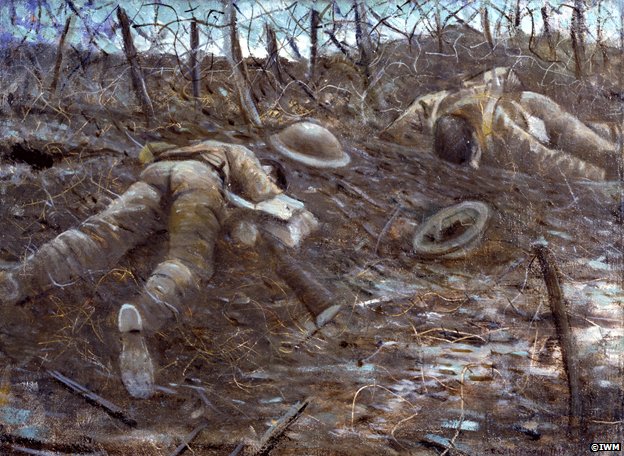
In BBC News Magazine, Alan Little looks at some early WW1 art that fell afoul of the censors for being too accurate:

Paths of Glory by Christopher Nevinson

What you notice first about the two figures in Christopher Nevinson’s painting Paths of Glory is the banality of their deaths. Their commonplace, mundane fate. They lie face down in the blasted earth, two men in British military fatigues, their helmets and rifles lying in the mud beside them.

They are indistinguishable from each other, stripped of individual identity. Nothing marks them out as the unique human beings they must once have been with names, and families, and remembered childhoods, and desire and love and hope and ambition.

From the bottom left of the composition, where the corpse in the foreground lies with the soles of his boots facing you, your eye moves diagonally upwards and to the right, to the second dead man, who has fallen forwards towards you, and you see the top of his dark head but Nevinson denies you a glimpse of his face. He has no face, no personality, no story of his own. In colour, texture and even contour, the lifeless bodies are almost indistinguishable from the land on which they lie, and which will now swallow them.

In my time as a war reporter for the BBC I have come across scenes like this. You cannot mistake the recently dead for the sleeping, for there is something bloodless, something shockingly, arrestingly lifeless about them. I have found myself transfixed by odd detail — a bootlace tied just a few hours ago, by fingers that will now never move again. What talents lie locked into the muscle memory of those fingers? Could they, as recently as this morning, have picked out a melody on a piano? With the death of each individual, an entire universe vanishes.

[…]

I think of those two young men whose names I never learned when I look at Nevinson’s Paths of Glory. Its title is taken from Thomas Gray’s Elegy Written in a Country Church-Yard. “The boast of heraldry, the pomp of pow’r, / And all that beauty, all that wealth e’er gave / Awaits alike th’inevitable hour. / The paths of glory lead but to the grave.”

Government censors did not like Paths of Glory. They judged it bad for morale and refused to pay Nevinson for it. But he included it anyway in the first exhibition of his war paintings in London early in 1918, with a brown paper strip across the canvas carrying the word “censored”. He was reprimanded both for exhibiting a censored painting and, bizarrely, for unauthorised use of the word “censored” in a public place. But the painting was bought, during that exhibition, by the Imperial War Museum, where it remains.

June 22, 2014

A Frisian translation of Lois McMaster Bujold’s The Hallowed Hunt

Filed under: Books, Europe, Germany, Media — Tags: , , — Nicholas @ 00:02

Lois McMaster Bujold posted an image to her Goodreads page, showing the cover of a new translation of The Hallowed Hunt into a language I didn’t think was still spoken:

LMB - Hallowed Hunt in Frisian

She also posted a letter from the translator, which discusses some of the problems inherent in translating a fantasy novel into a language which only really became a written language quite recently:

Originally (we’re talking the early Middle Ages here), Frisian was the language closest related to English, but after more than a millennium of being heavily influenced by Dutch and German, this is no longer the case. Over the centuries, Dutch, German and the Low Saxon dialects of the eastern Netherlands and northern Germany have made such inroads into the original Frisian language area (once stretching all along the North Sea coast from what is now Belgium to Denmark), that it has crumbled into several small — or smallish — enclaves, which are still shrinking or at least remain under constant pressure. In the outside world, the term “Frisian” is generally used as if it were a monolithic language, but in fact there are three different Frisian languages, which are mutually quite incomprehensible and have been so for a long time.

• North Frisian is spoken in northern Germany, in an area along the North Sea coast and on the nearby islands directly south of the Danish border, by about 10,000 people.

• East Frisian was once spoken in the German coastal area adjacent to the Dutch border, but has gone extinct there, except for one small inland area, Saterland, which was originally surrounded by almost impassable peat bogs. Saterlandic, or Saterland Frisian, is still spoken today, by some 2,200 people.

• In the Dutch province of Friesland, Frisian is still spoken as a first language by about 350,000 people (out of a total provincial population of c.630,000). It has official status equal to Dutch, here, and some 110,000 inhabitants of the province speak it as a second language. There are a lot of Frisians who for the sake of (better) employment have moved away from Friesland, bringing the total number of native Frisian speakers in the Netherlands to c.450,000. From this point, I will refer to this language, my native tongue, as “Frisian”, which is the name we have for it (Frysk), but FYI, in English it is often called “West Frisian” (a somewhat confusing name, since in the Netherlands, that is what we call a Dutch dialect spoken in northern tip of the province of North Holland).

Today, Frisian is a minority language used by about 3% of the total Dutch population, and although a lot of things have changed for the better since the beginning of the 20th century, when the Frisian language movement first emerged, we still have to fight for our rights more often than not. To give you an impression of the situation we have to deal with, a 1994 survey showed that of the total number of inhabitants of Friesland (now c.630,000), 94% can understand Frisian, 74% can speak it, 65% can read it, and 17% can write it. (These are still the most recent numbers available; I’ve read that they’re in the process of doing a follow-up survey, but apparently the results aren’t in yet.)

On the subject of literary translations, it should be understood that this is a relatively new phenomenon for the Frisian language. The Bible was not published in Frisian until 1943, and Shakespeare’s entire oeuvre appeared in our language in eight big omnibus editions between 1955 and 1976 (although some plays, like Hamlet and A Midsummer Night’s Dream, had already been published separately in the twenties and thirties).

For any native Frisian readers who’d like to read this excellent book in your own language, you can buy the translation here.

June 20, 2014

The Black Death, the peasants’ revolt, and … tax increases

Filed under: Britain, France, History — Tags: , , , , , — Nicholas @ 07:47

Put yourself in the position of an advisor to the 10-year old King Richard II shortly after his coronation in 1377. You’ve just witnessed one of the greatest population disasters in European history — the Black Death — where one third of the people of all classes died. The crown is at war with France (the Hundred Years’ War), and there’s little or no money in the treasury. You could probably come up with better policy ideas in your sleep than what Richard’s advisors did:

Fixated with outright victory in the One Hundred Years War, started by his grandfather Edward III, Richard’s government introduced hugely unpopular poll taxes in 1377 and 1379. A further tax introduced in 1381 was to be the straw that broke the camel’s back. Irrespective of wealth, the tax was fixed at a rate of 12 pence per person, meaning that it was a huge burden on the poor, but a minor inconvenience to the wealthy. In addition, rumours spread of widespread corruption in the government. The peasants were ripe for revolt.

Following the expulsion of a tax collector from the town Brentwood, 30 kilometres north-east of London, a band of rebels swept through Kent and Essex, swelling their numbers with volunteers as they went. They advanced upon London in a pincer movement from the south and east. The two leaders of the rebellion emerged as Wat Tyler, of whom little was previously known, and John Ball, a radical priest who had been broken out of prison by Kentish rebels, where he had been held for his beliefs in social equality and a fair distribution of wealth within the church. Indeed, as he preached to the crowd of thousands of rebels at Blackheath, then just outside London, he cried: ‘When Adam delved and Eve span, Who was then the gentleman? From the beginning all men by nature were created alike, and our bondage or servitude came in by the unjust oppression of naughty men.’

Londoners willingly opened the gates of their city to the rebels who set about their task with fervour. They sacked Savoy Palace, the home of the key adviser to the now 14-year-old Richard. Guards in the Tower of London opened the gates to the rebels, who freed the inmates and executed Simon Sudbury, the Archbishop of Canterbury and Lord Treasurer of England, who had been hiding inside. There were also several incidents of misplaced rage among the rebels, like when the crowd set their sights upon Flemish immigrants, many of whom were wealthy wool merchants, and murdered them in the streets.

Faced with a grave situation, the young king rode out to meet the rebel leaders at Blackheath. Their demands were an end to poll taxes, an immediate end to serfdom, the introduction of a more democratic form of government with local representation based on the Provisions of Oxford in 1258, and a fair distribution of wealth and power from the nobility. Richard initially gave into their demands as well as issuing pardons for all involved.

It got worse (for the peasants) after that brief high point…

British steam locomotives

Filed under: Britain, History, Railways — Tags: — Nicholas @ 00:01

H/T to Jon, my former virtual landlord, for the link.

June 18, 2014

Is the RCN “kicking the tires” of the Mistral?

Filed under: Cancon, France, Military — Tags: , , , — Nicholas @ 10:59

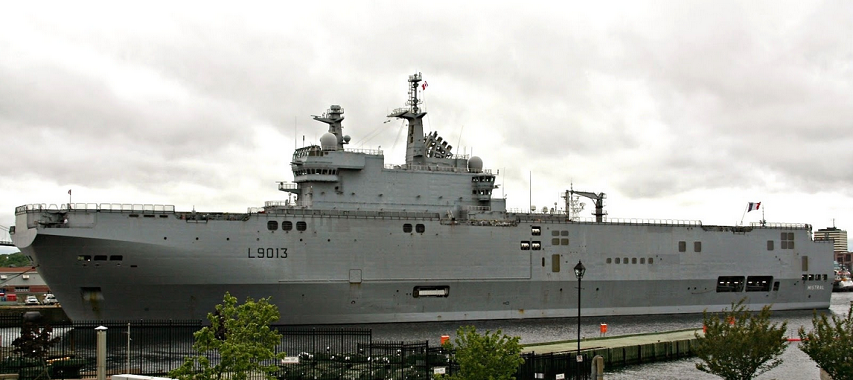
The French navy is visiting Canada’s East coast this week, taking part in Exercise LION MISTRAL. David Pugliese reported on the operation a few days ago:

Approximately 200 Canadian Army soldiers from 5 Canadian Mechanized Brigade Group in Valcartier, Quebec will take part in Exercise LION MISTRAL alongside members of the French Navy and Royal Canadian Air Force from June 16-23, 2014, in Gaspé, Quebec, according to a news release from the DND.

  • Canadian Army soldiers, primarily from the 1st Battalion, Royal 22e Régiment (1 R22eR), will board The Mistral, the French amphibious assault ship and helicopter carrier in Halifax on June 18; 

  • Canadian Army troops will conduct littoral operations, including running air-land operations and battle procedures, and establishing a helicopter landing site and a beachhead. Ex LION MISTRAL will also feature a humanitarian assistance air evacuation operation that will help train expeditionary forces to respond to humanitarian disasters;


  • Ex LION MISTRAL will culminate in two disembarkation operations on a Gaspé beach on June 20-21 marking the end of the amphibious exercise. In response to a request by the town of Gaspé, the members of the 1 R22eR will also be offering a static display of their vehicles and equipment on June 21;


  • More than 400 French Navy members of The Mistral and 175 of La Fayette will be participating alongside some 200 Canadian soldiers, including 20 engineers from 5 Combat Engineer Regiment from Valcartier;


On Flickr a couple of photos from yesterday, as equipment was being loaded onto Mistral in Halifax:

Members of the 1st Battalion, Royal 22e Regiment load light armored vehicles onboard the French Navy amphibious ship Mistral as part of Exercise LION MISTRAL 2014 in Halifax, Nova Scotia, June 17, 2014. Photo: MCpl Patrick Blanchard, Canadian Forces Combat Camera IS2014-3030-06

Members of the 1st Battalion, Royal 22e Regiment load light armored vehicles onboard the French Navy amphibious ship Mistral as part of Exercise LION MISTRAL 2014 in Halifax, Nova Scotia, June 17, 2014.
Photo: MCpl Patrick Blanchard, Canadian Forces Combat Camera IS2014-3030-06

Halifax, Nova Scotia.  FS Mistral (L-9013) is an Amphibious assault ship, and lead ship of her class. She was commissioned in 2006. She features a landing craft dock, and Helicopter facilities. Photo: Halifax Shipping News

Halifax, Nova Scotia.
FS Mistral (L-9013) is an Amphibious assault ship, and lead ship of her class. She was commissioned in 2006. She features a landing craft dock, and Helicopter facilities.
Photo: Halifax Shipping News

Additional photos by M/Cpl Blanchard were posted on the Ottawa Citizen website.

June 17, 2014

Not all wines should be cellared

Filed under: France, Wine — Nicholas @ 00:01

At the Wall Street Journal, Will Lyons has some suggestions for wines you can — and should — drink sooner rather than stashing them in your cellar for a far distant future date:

These are styles of wines that aren’t enormously serious, in that they don’t have a huge range of flavors. (A shorthand for this category, suggested by Charles Lea, owner of London fine wine merchant Lea & Sandeman, is “anything you can drink out of an ice bucket,” which includes a variety of reds as well as whites.) That isn’t to deride these wines in any way. It is as legitimate to appreciate an uncomplicated style of white wine, designed to refresh and be sipped without too much thought, as it is to purr enthusiastically over the grandeur of a classed growth Bordeaux. In that vein, let’s celebrate this expression of youth.

The obvious place to start is with white wine, as the vast majority are best drunk within a year of the harvest — although the later bottlings always tend to taste a little better. Sauvignon Blanc, Vinho Verde, Moscato, Pinot Grigio and Picpoul de Pinet are the best candidates for “better when young.”

One wine that is absolutely made for this time of year is France’s Condrieu, made from the Viognier grape. Wine writer Hugh Johnson likened its smell to that of a “garden of unknown flowers.” You can find Viognier now planted all over the world, particularly in Australia and California, and I always find it is best drunk young. Chenin Blanc, dry Riesling and Argentina’s Torrontés can also bypass the cellar, as can almost any rosé.

With red wines, the choices aren’t as obvious. As a rule of thumb, anything heavy with lots of tannin, like Cabernet Sauvignon, Barolo or a heavy Merlot, improves with time in the bottle. Italy’s soft, fruity Dolcetto; straight Beaujolais, by which I mean Nouveau and Beaujolais-Villages (not Cru Beaujolais); and anything made with the Gamay grape are good to go from the off.

June 16, 2014

The tomb for Richard III

Filed under: Britain, History — Tags: , — Nicholas @ 09:16

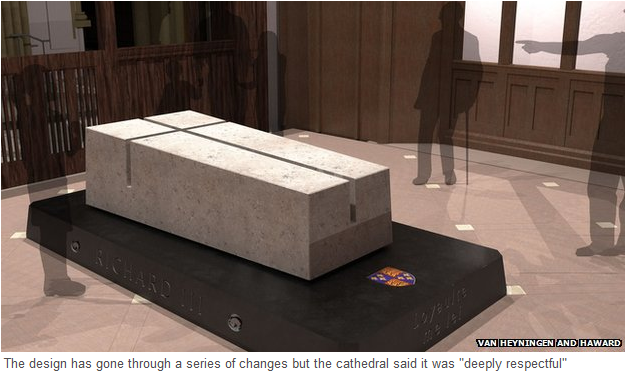
BBC News has images of the tomb designed for the re-burial of Richard III at Leicester Cathedral:

Design of Leicester tomb for Richard III

The design of the tomb King Richard III will be reburied in at Leicester Cathedral, has been unveiled.

The wooden coffin will be made by Michael Ibsen, a descendent of Richard III, while the tomb will be made of Swaledale fossil stone, quarried in North Yorkshire.

The total cost of reburial is £2.5m and work will start in the summer.

The Very Reverend David Monteith, Dean of Leicester, said the design “evokes memory and is deeply respectful”.

Judges ruled his remains, found under a Leicester car park in 2012, would be reinterred in Leicester, following a judicial review involving distant relatives of the king who wanted him buried in York.

A new visitor centre is set to open in July, which will tell the story of the king’s life, his brutal death in Battle in 1485 and rediscovery of his remains.

Magna Carta

Filed under: Britain, History, Liberty — Tags: , , , — Nicholas @ 08:35

Allan Massie says there was “nothing revolutionary” about the signing of the Magna Carta on June 15, 1215:

The document was presented to the king and his signature, by seal, extracted. He had violated so many customs of the realm and infringed long-established liberties, which we might rather call privileges, that his rule in its present form had become intolerable to the barons and landholders, to the Church, and to the merchants of boroughs protected by their own charters.

The Magna Carta rehearsed these customs and liberties. It was a reproof to the king, to compel him to mend his ways. Far from being an abstract statement of rights, it was a practical document: calling the king to order, reminding him of the limits on his power, and insisting that he was not above the law, but subject to it.

This was not unusual. Kings had been brought to a similar point before. Medieval monarchy was limited monarchy, in theory and of necessity. Kings had to govern in collaboration with “the Community of the Realm” (essentially the propertied classes) and with their consent. Ultimately, having neither a standing army nor a police force, they had little choice. Moreover, the society of the Middle Ages was intensely legalistic – and the purpose of Magna Carta was to remind the king of what the laws were and of his duty to observe them if he himself was to receive loyalty and obedience.

If Shakespeare makes no mention of the document it is because in the years of the Tudor despotism the balance between government and governed shifted in favour of the former. The Tudors made use of what were called the Prerogative Courts to bypass the common law of England. Torture, practised on “subversive” Roman Catholics by the Elizabethan government, was illegal under the common law (and indeed under Magna Carta), but inflicted by the judgment of the Prerogative Courts (the Star Chamber and High Commission).

It was the parliamentary and judicial opposition to the less effective (and less oppressive) despotism of the early Stuarts which revived interest in Magna Carta, now presented as the safeguard or guarantee of English liberty. Though it had been drawn up by Anglo-Norman bishops and presented to the king by Anglo-Norman barons, the theory was developed that it represented a statement of the rights and liberties enjoyed in Anglo-Saxon England by the “free-born” Englishmen before they were subjugated to the “Norman Yoke”.

This, doubtless, offered an unhistorical and rather-too-rosy view of Anglo-Saxon England before the Norman Conquest, but it had this to be said for it: that the Norman and Plantagenet kings had regularly promised to abide by the “laws of King Edward” – the saintly “Confessor” and second-last Saxon king.

« Newer PostsOlder Posts »

Powered by WordPress