
Published on 20 Aug 2015
The Entente was in desperate need of American supplies and so the German submarine campaign in the Atlantic was a real problem. The British started to run false flag operations with so called Q-Ships to hunt down U-Boats which lead to the so called Baralong Incident this week. In the meantime, Russia was standing up against the wall as the fortresses of Kovno and Novogeorgievsk were falling to the Germans leading to a catastrophic loss in men, equipment and supplies.
August 21, 2015
Escalation At Sea and Russia Up Against the Wall I THE GREAT WAR – Week 56
Comments Off on Escalation At Sea and Russia Up Against the Wall I THE GREAT WAR – Week 56
Allocating the blame for “Operation Jubilee”
In a BBC post from a few years back, Julian Thompson looks at the Dieppe raid:
On 19 August 1942, a disastrous seaborne raid was launched by Allied forces on the German-occupied French port of Dieppe. Why was such a raid ever undertaken? Because, with Germany operating deep in the Soviet Union, the Russians were urging the Allies to relieve the pressure on them by opening a second front in north-west Europe.
At the same time the British Chief of Combined Operations, Rear Admiral Louis Mountbatten, was agitating for a practical trial beach landing, against real opposition, for his troops. In the face of this pressure, Churchill decided that Operation Rutter, a ‘hit and run’ raid on Dieppe, should go ahead.
[…]
Churchill and the Chiefs of Staff — the heads of the Navy, Army and Air Force, who met daily to discuss strategy and advise Churchill — were responsible for this disastrous misjudgement. But, because no written record exists of the Chiefs of Staff approving the raid in its final form, it has sometimes been suggested that it was really Mountbatten who remounted it without authorisation. This is almost certainly nonsense.
The Chiefs of Staff disliked Mountbatten, regarding him as an upstart foisted on them by Churchill, so any unauthorised action on his part would have given them the ammunition to recommend his removal. Since Mountbatten was not removed, and the Chief of the Imperial General Staff, General Sir Alan Brooke, in his frank and detailed diary, makes no mention of his having exceeded his authority, it seems unlikely that Mountbatten can be accused of mounting the raid without authority.
General Brooke was in the Middle East from 1 August 1942, returning on the 24th, after the event. This was unfortunate, for, as the most forceful and intelligent of the Chiefs of Staff, had he been in Britain in the days preceding the raid, he might have persuaded Churchill to call it off.
Much has been said since about the fact that the Dieppe raid was a necessary precursor to the great amphibious operations that were to follow, in terms of the lessons learned and experience gained. Mountbatten pursued that line all his life. But as Chief of Combined Operations, he did bear some of the responsibility for mounting the operation, so one can only comment, ‘he would say that, wouldn’t he?’
The disaster did point up the need for much heavier firepower in future raids. It was recognised that this should include aerial bombardment, special arrangements to be made for land armour, and intimate fire support right up to the moment when troops crossed the waterline (the most dangerous place on the beach) and closed with their objectives.
However, it did not need a debacle like Dieppe to learn these lessons. As judged by General Sir Leslie Hollis — secretary to the Chiefs of Staff Committee and deputy head of the Military Wing of the War Cabinet with direct access to Churchill — the operation was a complete failure, and the many lives that were sacrificed in attempting it were lost with no tangible result.
Comments Off on Allocating the blame for “Operation Jubilee”
August 20, 2015
Frédéric Bastiat
Lawrence W. Reed makes the case for Frédéric Bastiat to be awarded a Nobel Prize … if they awarded them posthumously, anyway:
If a posthumous Nobel Prize was awarded for crystal-clear writing and masterful storytelling in economics, no one would be more deserving of it than Frédéric Bastiat (June 30, 1801–December 24, 1850). He set the standard over a century and a half ago.
This remarkable Frenchman was an economist in more than the traditional sense. He understood the way the economic world works, and he knew better than anybody how to explain it with an economy of words. He employed everyday language and a conversational tone, an innate clarity that flowed from his logical and orderly presentation. Nothing he wrote was stilted, artificial, or pompous. He was concise and devastatingly to the point. To this day, nobody can read Bastiat and wonder, “Now what was that all about?”
Economic writing these days can be dull and lifeless, larded with verbosity and presumptuous mathematics. Bastiat proved that economics doesn’t have to be that way: the core truths of the science can be made lively and unforgettable. In literature, we think of good storytelling as an art and stories as powerful tools for understanding. Bastiat could tell a story that stabbed you with its brilliance. If your misconceptions were his target, his stories could leave you utterly, embarrassingly disarmed.
If you aspire to be an economist or a policy maker or a teacher or just an influential communicator, take time to study at the feet of this 19th-century master.
Comments Off on Frédéric Bastiat
One of the slickest marketing campaigns of our time
In Forbes, Henry I. Miller and Drew L. Kershen explain why they think organic farming is, as they term it, a “colossal hoax” that promises far more than it can possibly deliver:
Consumers of organic foods are getting both more and less than they bargained for. On both counts, it’s not good.
Many people who pay the huge premium — often more than 100% — for organic foods do so because they’re afraid of pesticides. If that’s their rationale, they misunderstand the nuances of organic agriculture. Although it’s true that synthetic chemical pesticides are generally prohibited, there is a lengthy list of exceptions listed in the Organic Foods Production Act, while most “natural” ones are permitted. However, “organic” pesticides can be toxic. As evolutionary biologist Christie Wilcox explained in a 2012 Scientific American article (“Are lower pesticide residues a good reason to buy organic? Probably not.”): “Organic pesticides pose the same health risks as non-organic ones.”
Another poorly recognized aspect of this issue is that the vast majority of pesticidal substances that we consume are in our diets “naturally” and are present in organic foods as well as non-organic ones. In a classic study, UC Berkeley biochemist Bruce Ames and his colleagues found that “99.99 percent (by weight) of the pesticides in the American diet are chemicals that plants produce to defend themselves.” Moreover, “natural and synthetic chemicals are equally likely to be positive in animal cancer tests.” Thus, consumers who buy organic to avoid pesticide exposure are focusing their attention on just one-hundredth of 1% of the pesticides they consume.
Some consumers think that the USDA National Organic Program (NOP) requires certified organic products to be free of ingredients from “GMOs,” organisms crafted with molecular techniques of genetic engineering. Wrong again. USDA does not require organic products to be GMO-free. (In any case, the methods used to create so-called GMOs are an extension, or refinement, of older techniques for genetic modification that have been used for a century or more.)
Comments Off on One of the slickest marketing campaigns of our time
August 19, 2015
Canada looks very good on an international ranking you won’t hear about from our media
Our traditional media are quick to pump up the volume for “studies” that find that we rank highly on various rankings of cities or what-have-you, but here’s someone pointing out that Canada’s ranking is quite good, but it’s not the kind of measurement our media want to encourage or publicize:
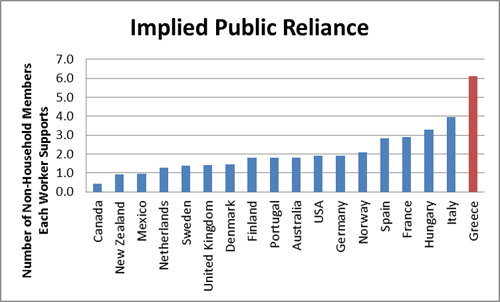
First, we must identify a nation’s currently employed population. Next, all public sector employees are removed to obtain an adjusted productive workforce. It may be objectionable that certain professions, like teaching, nurses in single payer systems and fire fighters, are classified as an unproductive workforce, but as our system is currently designed, the salaries of these individuals are not covered by the immediate beneficiaries like any other business but are paid through dispersed taxation methods.
Finally, this productive population is divided into the nation’s total population to identify the total number of individuals a worker is expected to support in his country. To remove bias toward non-working spouses and children, the average household size is subtracted from this result to get the final number of individuals that an individual must support that are not part of their own voluntary household. In other words, how many total strangers is this individual providing for?
The Implied Public Reliance metric does a far better job of predicting economic performance:
Greece, the nation with the debt problem, is currently expecting each employed person to support 6.1 other people above and beyond their own families. This explains much of the pressure to work long hours and also explains the unstable debt loads. Since a single Greek worker can’t possibly hope to support what amounts to a complete baseball team on a single salary, the difference is covered by Greek public debt, debt that the underlying social system cannot hope to repay as the incentives are to maintain the current system of subsidies. To demonstrate how difficult it is to change these systems within a democratic society, we just have to look at the percentage of the population that is reliant on public subsidy.

Oh, and by the way … Greece is doomed:
The numbers imply that 67 percent of the population of Greece is wholly reliant on the Greek government to provide their incomes. With such a commanding supermajority, changing this system with the democratic process is impossible as the 67 percent have strong incentives to continue to vote for the other 33 percent — and also foreign entities — to cover their living expenses.
Comments Off on Canada looks very good on an international ranking you won’t hear about from our media
August 18, 2015
Capturing the Horrors – The Art of World War 1 I THE GREAT WAR Special
Published on 17 Aug 2015
The beginning of the 20th century saw rapid changes to the understanding of the fine arts and the First World War was a big catalyst for all the new art movements of Modernity like Cubism, Expressionism or Impressionism. Countless painters like Otto Dix or Max Beckmann used their paintings to process the horrors they had lived through. Before this war, paintings used to glorify soldiers and generals, but the new schools of art couldn’t be further from that and so it is no wonder that the Nazis displayed a lot of World War 1 paintings in their exhibition of degenerate art (“Entartete Kunst“) before World War 2.
Comments Off on Capturing the Horrors – The Art of World War 1 I THE GREAT WAR Special
August 16, 2015
Farewell to the Vulcan … in infra-red
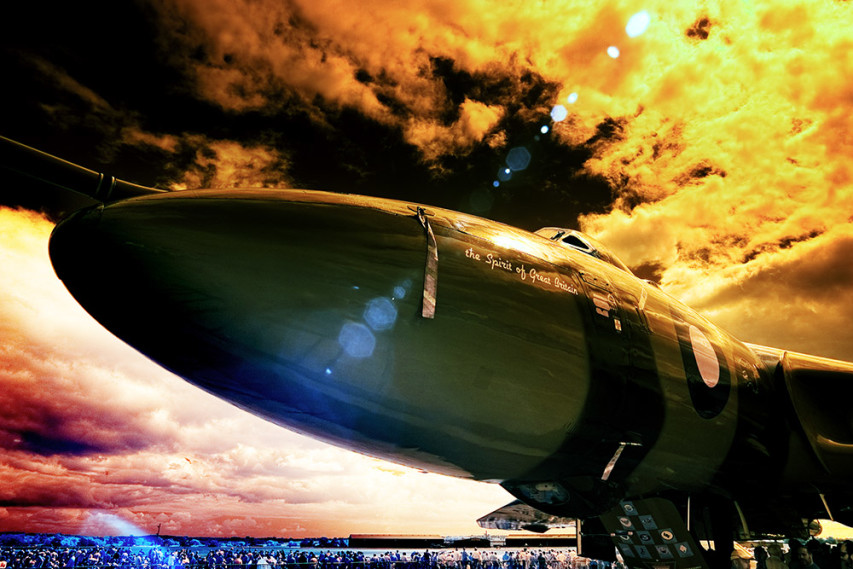
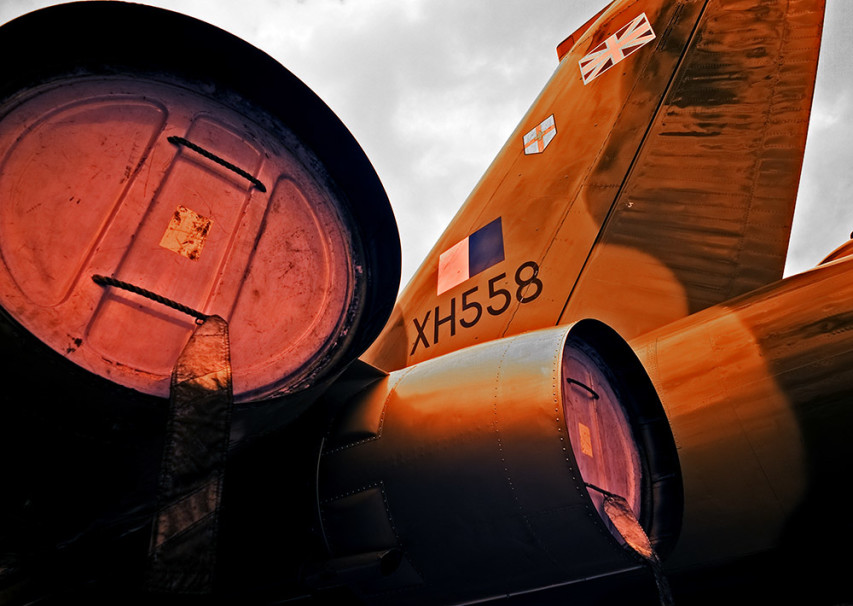
Ashley Pomeroy attended the Yeovilton Air Day event, one of the last flying events for the last of the Vulcans. She took along her camera to capture some rather interesting images:
Off to the Yeovilton Air Day, with an infrared camera and a bottle of pop. This year the Avro Vulcan retires for the third and final time. Like Lazarus, it was raised from the dead; and like Lazarus it is fated to die again, this time forever.
I used an infrared camera – there is no shortage of Vulcan photographs taken with visible light – in part because the results are dramatic but also because I was curious to see what would happen.
The Vulcan entered service in the 1950s. Its original mission was to incinerate Russians – tens of thousands of them – with our nuclear bombs. In practice this never came to pass, and the only people incinerated by Vulcans were Argentine ground crew, six of them, during the Falklands War of 1982. The Vulcan was retired from service almost immediately afterwards. It remained in flight as a display aircraft until 1993, at which point the expense of keeping a jet bomber in the air became too great.
In this shot, for example, you can see that some of the panels were made of a different material from the rest of the airframe, or perhaps they used a fundamentally different paint.
[…]
What’s it like to see a Vulcan dancing in the sky? In an airshow context the experience is somewhat muted, because regulations prevent it from flying overhead. The pilot can only make long passes parallel with the crowd line plus some wingovers. The Vulcan’s low wing loading gave it superb high-altitude performance – I imagine that the likes of the F-86 or MiG-15 would have found it an incredibly hard gun target – but this doesn’t help at an airshow. Nonetheless, when the pilot gunned the engines it was like being punched in the chest, and I could feel a collective grin from the crowd, although I was too far from the car park to hear the car alarms going off.

Comments Off on Farewell to the Vulcan … in infra-red
An interesting era in Portuguese history
Sarah Hoyt on the time when the throne of the Kingdom of Portugal was occupied by the Kings of Spain:
When I was little, one of my favorite times in history class every year was when we studied the Spanish occupation.
From 1560 to 1640 and due to some truly gifted stupid actions of Portuguese kings, the throne of Portugal was occupied by the Philips. The first Philip was the famous Philip of the Armada.
Now the throne of Portugal was acquired as legitimately as any other succession at the time and more legitimately than most. Technically Philip was the late King Sebastian’s nephew. (And possibly first cousin, uncle and grandfather. There is no word on whether the royal lines of Portugal and Spain could play the banjo really well, but if they didn’t it was only because they didn’t have banjos.)
However by the time I studied the occupation or “usurpation” EVERY year of elementary school, great indignation was built towards the Philips. One of the reasons I really liked that lesson is that our prim and elderly school marm would instruct us to bring out our crayons and deface our pictures of Philip of Portugal and Spain. (And for those cringing about destruction of school property, in Portugal you buy your school books. You can sometimes buy them used or inherit them from a sibling — not me, my brother was much older than I and books had changed — but in general everyone from the richest to the poorest bought the school books. I rather suspect, now I think about it, that this keeps the Portuguese publishing system working.)
The reason they were hated, the reason we were instructed to deface the pictures was that while occupying the Portuguese throne, perhaps because they were sure it wouldn’t last, or perhaps because they wanted to reduce the proud and independent spirit of the Portuguese (from their perspective the last of the small kingdoms in the peninsula to be swallowed by the Spanish leviathan) the Philips seemed to go out of their way to destroy all Portuguese interests, possessions and wealth, as well as the Portuguese standing with their allies and the world.
It’s been a long time, and mostly I spent my time studying how to deface a picture, but I remember the Spaniards broke the Portuguese alliance with the English which had lasted almost since before there was England, and save for that interruption has lasted to present day. This meant Portuguese ships could fall prey to the British privateers. They also failed to adequately defend Portuguese colonies and gave some of them away as dowry to Spanish Princesses or perhaps party favors.
There were other things, and the rule must have been felt even at the time as disastrous because particularly in the North a cult of the “King who will return” (in this case King Sebastian, young and possibly nuts or at least a really good banjo player, since his mother was the upteenth Spanish princess the Portuguese kings had married in a row.) He died in a futile attack on the North of Africa (there’s taking the fight to the enemy and then there’s nuts) which left the kingdom without a king. Save the Spaniards.
For years, and then centuries, adding an element of fantasy, the legend grew that he had not died and would return “one foggy morning.”
I must have had a fantastical or romantic bend from early on, because one of my favorite songs was by a group called 1111 (Ah ah) which sang about King Sebastian and how they’d found his horse and pieces of his doublet, his sword and his heart, notwithstanding which he’d come back in a foggy morning to lead the half mad seers and witches of the foggy Northern lands. (Represent, I say, represent.)
However, no matter how bad the Spanish occupation was, in that morality tale it became the inflection point at which Portugal stopped being amazing and became beaten down and down and out. At that moment (even though colonies and empire remained) Portugal was broken in the eyes of the world and in its own eyes.
Comments Off on An interesting era in Portuguese history
QotD: German coachmen
Another peculiarity of the German coachman is that he never attempts to pull in or to pull up. He regulates his rate of speed, not by the pace of the horse, but by manipulation of the brake. For eight miles an hour he puts it on slightly, so that it only scrapes the wheel, producing a continuous sound as of the sharpening of a saw; for four miles an hour he screws it down harder, and you travel to an accompaniment of groans and shrieks, suggestive of a symphony of dying pigs. When he desires to come to a full stop, he puts it on to its full. If his brake be a good one, he calculates he can stop his carriage, unless the horse be an extra powerful animal, in less than twice its own length. Neither the German driver nor the German horse knows, apparently, that you can stop a carriage by any other method. The German horse continues to pull with his full strength until he finds it impossible to move the vehicle another inch; then he rests. Horses of other countries are quite willing to stop when the idea is suggested to them. I have known horses content to go even quite slowly. But your German horse, seemingly, is built for one particular speed, and is unable to depart from it. I am stating nothing but the literal, unadorned truth, when I say I have seen a German coachman, with the reins lying loose over the splash-board, working his brake with both hands, in terror lest he would not be in time to avoid a collision.
Jerome K. Jerome, Three Men on the Bummel, 1914.
Comments Off on QotD: German coachmen
August 15, 2015
Impersonal forces acting on passive innocents
We’ve seen plenty of examples of this kind of “reporting”, where the presentation of the case absolves the actors in advance of any motive or action … they’re always implicit victims of circumstances beyond their control. Theodore Dalrymple points to a recent example:
Sometimes the employment of a single word in common use gives away an entire worldview. There was just such a usage in the headline of a story in the Guardian newspaper late last month: “How the ‘Pompey Lads’ fell into the hands of Isis.”
Pompey is the colloquial name for Portsmouth, the naval town on the south coast of England, and the “lads” of the headline were five young men of Bangladeshi origin who grew up there and later joined Isis in Syria. The article describes how the last of the five has now been killed, three others having been killed before him and one, who returned to Britain, having been sentenced to a four-year prison sentence (in effect two years, with remission for good behavior). The use of the word “lads” is intended to imply to the newspaper’s readers that there was nothing special or different about these five young men, nothing that distinguished them from the other young men of Portsmouth. Its use was a manifestation of wishful or even magical thinking, as if reality itself could be altered in a desired way by the mere employment of language.
But the word that implied a whole worldview was “fell.” According to the headline, the young men “fell” into the hands of Isis as an apple falls passively to the ground by gravitational force. The word suggests that it could have happened to anybody, this going to Syria via Turkey to join a movement that delights in decapitation and other such activities in the name of a religion — their religion. Joining Isis is like multiple sclerosis; it’s something that just happens to people.
The word “fell” denies agency to the young men, as if they had no choice in the matter. They were victims of circumstance by virtue of their membership of a minority, for minorities are by definition victims without agency.
Comments Off on Impersonal forces acting on passive innocents
August 14, 2015
The Ruse at Gallipoli and the Siege of Kovno I THE GREAT WAR – Week 55
Published on 13 Aug 2015
Another 20.000 soldiers fresh from the barracks are supposed to turn the tide at Gallipoli. But Mustafa Kemal is an Ottoman commander to be reckoned with. With a tactical ruse and the right timing, he surprises the inexperienced ANZAC recruits with a bayonet charge. As the sand of Chunuk Bair turns red, one thing is clear, Gallipoli is still not taken. On the Eastern Front the Germans lay siege on Kovno and are about to encircle the Russian troops near Brest-Litovsk. The German offensive on the Western Front is not nearly as successful though.
Comments Off on The Ruse at Gallipoli and the Siege of Kovno I THE GREAT WAR – Week 55
August 12, 2015
Who might buy a Mistral?
At the International Business Times, Christopher Harress reports on the two Mistral-class helicopter carriers France built for Russia and is now trying to find new homes for:
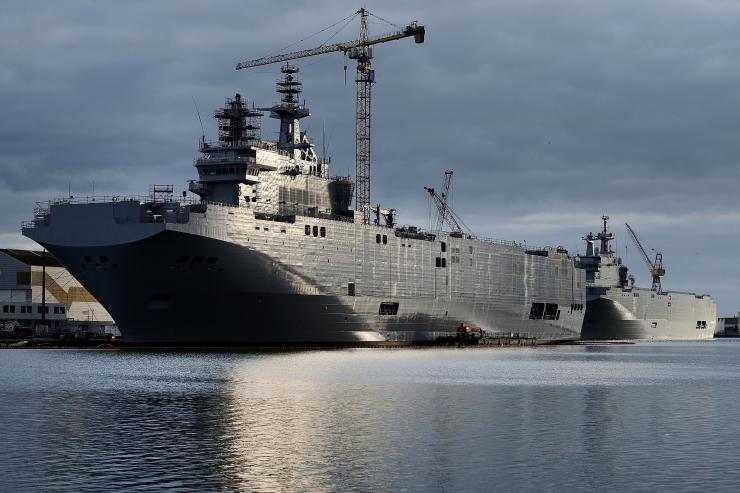
The Sevastopol (left) and the Vladivostok warships, two Mistral class LHD amphibious vessels ordered by Russia from STX France, are seen in St. Nazaire, France, Dec. 20, 2014. Jean-Sebastien Evrard/Agence France-Presse/Getty Images
Inside the sprawling dockyard in the ancient town of St. Nazaire in southwestern France sits $1.2 billion worth of unsold naval hardware. Despite having never left the dock, the two Mistral helicopter landing ships, originally built by France for use in the Russian navy, inadvertently have become involved in the growing international dispute between Russia and the West over the annexation of Crimea and the war in eastern Ukraine.
Now they are causing problems in France.
Two days after managing to negotiate a way out of the deal with Moscow that had become a divisive, ethical and political dilemma in Europe, France faces the fresh challenge of looking for a new buyer that has both the military need and the hard cash for the two 21,000 ton warships.
“I think this will be a difficult product to sell,” said Dakota Wood, senior research fellow of defense programs at the Heritage Foundation, a conservative Washington think tank. “Military ships are highly specialized and designed for a specific purpose that accounts for all the weapons systems and unique specifications that the navy in questions needs. In this case, the spacing and logistics to accommodate the unique aircraft that Russia was going to use. What other country shares those exact specifications?”
With Canada in the middle of a long, long election campaign, there’s no point in pretending that one or both of the ships might end up as part of the Royal Canadian Navy (unlike a few earlier reports), so France is forced to look further abroad for countries that have both the ready money (like Saudi Arabia) and the pressing need (uh, like Saudi Arabia).
August 11, 2015
Byzantine Empire: Justinian and Theodora – III: Purple is the Noblest Shroud – Extra History
Published on 4 Jul 2015
A group of monks declared sanctuary for two hooligans from the demes (Constantinople’s fanatical chariot racing factions) who had miraculously survived a hanging. The public wanted them pardoned for their crimes, so when Justinian made his public appearance at the next chariot race, they begged him to have mercy. When Justinian refused, the crowd turned on him and became a rioting mob that tore through the streets of Constantinople. During the Nika Riots, they burned down neighborhoods and even the Hagia Sophia cathedral, rampaging until Justinian agreed to pardon the two men from the demes. Now, however, the mob would not accept that. They demanded that he fire his advisors. Then they decided to appoint their own emperor, a man named Hypatius who was related to the previous emperor Anastasius. Assaulted on all sides, Justinian made plans to flee, only to be confronted by Theodora. She gave a now famous speech asking whether he would rather live a failure or die an emperor, announcing that she would choose the latter. Justinian followed her lead and made new plans to retake his city. He called Belisarius and Mundus, his best generals, to marshal a force. He also sent the eunuch Narses to bribe one faction of the demes and begin dismantling their leadership. Then he ordered his forces to invade the Hippodrome, where they cut down some thirty thousand civilians and executed the false emperor Hypatius. Justinian’s reign was once again secure.
Comments Off on Byzantine Empire: Justinian and Theodora – III: Purple is the Noblest Shroud – Extra History
August 9, 2015
Robert Conquest’s historical vindication
David Warren on the late Robert Conquest:
[Robert Conquest’s] grand works of historical investigation — The Great Terror (1968), documenting the incredible extent of Stalin’s purges; and, The Harvest of Sorrow (1986), surveying the catastrophic effects of his collectivization — were books of remarkable ambition; of bold conception and real consequence. Other writers had (often at the cost of their careers) reported upon Soviet failings. But they had done so in ways modest enough to be ignored, or dismissed by the fashionable Left as “biased.” The broad, massive, systematic nature of Conquest’s researches was something new. It cracked even the faith of many diehard Communists. The history he told fit together; it was all meticulously sourced; it was overwhelming. There was, as it rose on the horizon, too much to deny.
Yet others could still simply block it out. For people believe what they want to believe, and may resolutely look away from what they do not want to see, or even chute the cocksure laugh, in the face of the mounting tsunami of evidence that finally washes them away.
Conquest was also a light or minor poet, and verse translator, of skill, talent, and integrity. He moved, privately, more in literary than in political circles. His closest friends were such as Kingsley Amis and Philip Larkin; another was Alexander Solzhenitsyn.
He was no ideologue, and judging by the way he burned through wives, not a moralist either. Outwardly, in the tiny glimpse I had of him, he was not passionate or irascible. Inwardly, he was surely “driven.” But I would count him as a detached artist, working in a rather unusual modern genre: the author of elaborately proven epics of debunkment.
It was not Conquest, incidentally, but Amis who proposed that the revision of The Great Terror, published after the Berlin Wall fell, should be re-entitled, I Told You So, You Fucking Fools. But Conquest was content with, A Reassessment. He presented his facts emotionlessly. This magnified his impact, as historian. When he had a provocation to offer, that he was entirely unable to resist, he would put it safely into verse form, so that it wouldn’t be noticed.
Comments Off on Robert Conquest’s historical vindication
QotD: The distinctive scent of the Black Forest
There was one night when, tired out and far from town or village, we slept in a Black Forest farmhouse. The great charm about the Black Forest house is its sociability. The cows are in the next room, the horses are upstairs, the geese and ducks are in the kitchen, while the pigs, the children, and the chickens live all over the place.
You are dressing, when you hear a grunt behind you.
“Good-morning! Don’t happen to have any potato peelings in here? No, I see you haven’t; good-bye.”
Next there is a cackle, and you see the neck of an old hen stretched round the corner.
“Fine morning, isn’t it? You don’t mind my bringing this worm of mine in here, do you? It is so difficult in this house to find a room where one can enjoy one’s food with any quietness. From a chicken I have always been a slow eater, and when a dozen — there, I thought they wouldn’t leave me alone. Now they’ll all want a bit. You don’t mind my getting on the bed, do you? Perhaps here they won’t notice me.”
While you are dressing various shock heads peer in at the door; they evidently regard the room as a temporary menagerie. You cannot tell whether the heads belong to boys or girls; you can only hope they are all male. It is of no use shutting the door, because there is nothing to fasten it by, and the moment you are gone they push it open again. You breakfast as the Prodigal Son is generally represented feeding: a pig or two drop in to keep you company; a party of elderly geese criticise you from the door; you gather from their whispers, added to their shocked expression, that they are talking scandal about you. Maybe a cow will condescend to give a glance in.
This Noah’s Ark arrangement it is, I suppose, that gives to the Black Forest home its distinctive scent. It is not a scent you can liken to any one thing. It is as if you took roses and Limburger cheese and hair oil, some heather and onions, peaches and soapsuds, together with a dash of sea air and a corpse, and mixed them up together. You cannot define any particular odour, but you feel they are all there — all the odours that the world has yet discovered. People who live in these houses are fond of this mixture. They do not open the window and lose any of it; they keep it carefully bottled up. If you want any other scent, you can go outside and smell the wood violets and the pines; inside there is the house; and after a while, I am told, you get used to it, so that you miss it, and are unable to go to sleep in any other atmosphere.
Jerome K. Jerome, Three Men on the Bummel, 1914.
Comments Off on QotD: The distinctive scent of the Black Forest


