
Published on 5 Dec 2015
Indy sits in the chair of wisdom again to answer your questions and this time we are telling the story of German New Guinea and talk about Germans passing through Belgium in 1914.
December 10, 2015
Why Weren’t The Germans Allowed to Pass Through Belgium in 1914? I Out Of The Trenches
December 7, 2015
QotD: The problem of Belgium
Judging by emerging reports, it almost looks as though the big new international-relations problem highlighted by the latest massacre might end up being the failure of the Belgian state. Some of the perpetrators seem to have fled toward the terrorist-riddled Brussels suburb of Molenbeek, which has sprouted a long sequence of killers involved with everything from the 2004 Madrid attacks to the failed August Amsterdam-Paris train attack that was stopped by American passengers. The Belgian authorities are contrite about the helplessness of their police and security apparatus in a zone that is a giant magnet for Europe’s Muslim creeps and ne’er-do-wells.
This raises further existential questions, and it is not as though they are new, about an ethnically divided country fabricated by 19th-century great powers mostly for geopolitical purposes. Foreign-policy amateurs are fond of saying, with some justice, that most of the world’s problems come from borders badly drawn by Europeans in out-of-the-way places. Belgium’s worsening habit of exhaling spores of Muslim terror on to its neighbours may actually put it on that list, unless its problem is solved pretty quickly.
Colby Cosh, “After Paris, are we sure the map that needs changing is in the Middle East?”, National Post, 2015-11-17.
Comments Off on QotD: The problem of Belgium
December 4, 2015
The Serbian Exodus Through Albania I THE GREAT WAR – Week 71
Published on 3 Dec 2015
Serbia’s last stand is over and the remaining forces and civilians have to leave their home country across the inhabitable trails of the Albanian Alps. So, a whole nation is on the run while their enemies celebrate their successful military operation. The German Army is gladly relocating the much needed troops to other fronts while they leave the Austrians and Bulgarians to deal with the new situation on the Balkans.
Comments Off on The Serbian Exodus Through Albania I THE GREAT WAR – Week 71
The moral wretchedness of BDS
Brendan O’Neill talks about the anti-Israeli BDS movement:
There are many weird and angry political movements in the 21st-century West. But it’s hard to think of any as ugly, vindictive and packed with prejudice as the Israel-bashing BDS movement.
BDS stands for Boycott, Divestment and Sanctions. Its backers want every institution, retail outlet and right-minded person in Christendom to refuse to have anything to do with Israel and its apparently wicked wares and people.
They want us to stop buying Israeli produce. To refuse to read books written by Israeli academics. Even to refuse to listen to the Israel Philharmonic Orchestra, lest its beautiful music infect our minds and make us think for a dangerous split second that Israel might just be made up of people like us.
The ugliness of BDS was thrown into sharp relief yesterday, when it was revealed that a former Cambridge academic refused to answer a 13-year-old girl’s curious questions because the girl is an Israeli.
Marsha Levine, a supporter of Jews for Justice for Palestinians, is an expert on horses. Israeli schoolgirl Shachar Rabinovitch emailed her to ask her some questions, saying “I know you are a very important person and I’ve read your articles about horses”.
Ms Levine’s response was like something out of a Grimms’ fairytale: an angry woman barking irrationally at an innocent, inquisitive girl who made the mistake of (virtually) knocking on angry woman’s door.
“I’ll answer your questions when there is peace and justice for Palestinians”, she said. “You might be a child, but if you are old enough to write to me, you are old enough to learn about Israeli history and how it has impacted on the lives of Palestinian people.”
And that was it. Ms Levine refused to respond to a schoolgirl’s questions about horses because the schoolgirl lives in a part of the world where there is conflict. Actually, scrap that. She refused to answer the girl’s questions because of the girl’s nationality. Nasty stuff.
Comments Off on The moral wretchedness of BDS
Britain’s “ghost trains”
BBC Future explains why there are some very odd trains that run on British railways, but aren’t advertised or even known about by railway staff:
The Leeds-Snaith line is what rail enthusiasts call a ghost train; Snaith station, a ghost station. The webpage about Snaith on ticket sales site TheTrainLine.com warns that ticket machines are not available at the station. Nor is there a ticket office, taxi rank or cab office.
It’s one of many train services around Britain that run with empty carriages – sometimes once or twice a day, sometimes as rarely as once a week. Sometimes even ticket sellers don’t know they exist, and it takes dedicated amateurs to seek them out. So why do these trains run at all?
There is no single definition of what constitutes a ghost train, although the general consensus is that it’s when a service is so infrequent, the train becomes effectively useless. Slippery or not, though, the term “ghost train” seems apt. It implies a service that is not exactly whole – something that whispers through towns and countryside, leaving barely a dent in its wake.
Perhaps most important of all, the term ghost train implies something that only a special few know exists. The press contact of the National Rail Museum of York, for example, was baffled by my request for an interview about ghost trains, thinking I wanted to discuss “haunted items” in the museum’s collection.
Nobody knows exactly how many ghost trains there are. On the website The Ghost Station Hunters, run by rail enthusiasts Tim Hall-Smith and Liz Moralee, there are 37 listed, and those are only the stations the intrepid pair has gotten to and written about so far. Hall-Smith says he’s counted more than 50 by looking through timetables.
So what is the point of running trains that almost nobody uses or even knows about?
Given the overcrowding on Britain’s trains, it may seem odd for these empty carriages to ride the rails – or for empty stations to stand sentry over them. From 1995-96 to 2011-12, the total number of miles ridden by train passengers leapt by 91%, while the entire UK train fleet grew by only 12%.
“Ghost trains are there just for a legal placeholder to prevent the line from being closed,” says Bruce Williamson, national spokesperson for the advocacy group RailFuture. Or as Colin Divall, professor of railway studies at the University of York, puts it: “It’s a useless, limited service that’s borderline, and the reason that it’s been kept is there would be a stink if anyone tried to close it.”
That is the crux of why the ghost trains still exist. A more official term is “parliamentary trains”, a name that stems from past years when an Act of Parliament was needed to shut down a line. Many train operators kept running empty trains to avoid the costs and political fallout – and while this law has since changed, the same pressures remain.
Closing down a line is cumbersome. There must first be a transport appraisal analysing the effect of a closure on passengers, the environment and the economy. The proposal is submitted to the Department of Transport and at that point its details must be published in the press, six months ahead of the closure. Then comes a 12-week consultation period, during which time anyone is welcome to protest; public hearings are sometimes held, especially if the closure is controversial. Then, finally, the plans are submitted to the Office of Rail and Road, who decide if the line closes.
In other words, it’s cheaper to run just enough service to keep the line “active” than it is to go through the bother and cost of shutting it down.
Comments Off on Britain’s “ghost trains”
December 2, 2015
Can the Royal Navy fund a “cheap and cheerful” frigate?
In the most recent British government SDSR plan, the Royal Navy’s hopes to get 13 new Type 26 frigates have been trimmed down to only eight. Save the Royal Navy speculates on developing a cheaper ship design that could perhaps fill the gap:
Is it really possible to produce a fully effective frigate that is significantly cheaper than a T26? Let us call it the ‘Type 31’, It still requires point defence missiles, anti-ship weaponry, a hangar and small flight deck (even if only for a UAV or Lynx size helicopter), plus a command and control system and suite of sensors. Although the hull size could be reduced, a simpler propulsion system used and the anti-submarine capability eliminated or reduced. You might cut the cost by 30%, and get a general purpose ship but there is still the cost of developing a new design. (At least £200M has already been spent on the T26 design as well as various development ‘blind alleys’ along the way.) A second frigate type will also need its own equipment support logistics and training pipelines.
The desire to create an exportable frigate is laudable but will we not be re-inventing the wheel when there are already cheaper foreign designs that could be licensed or adapted. The highly successful German MEKO design and the Danish Stanflex system are good examples.
If your warship is designed to cope in high-intensity conflict then it will need expensive weapons and sensors. Today’s generation of supersonic anti-ship missiles are truly formidable. Modern surface ships face greater and more diverse threats than ever. To counter this requires good sensors, agile missiles and an array of decoys, backed up by last-ditch close in weapon systems (CIWS). Although the general purpose frigate may not be dedicated to hunting submarines, it will still need a decent sonar to give some hope of prosecuting a submarine or detecting and avoiding torpedo attack. Submarines are also getting more and more stealthy with a growing arsenal of weapons. Without quiet propulsion and sophisticated sonars (i.e. towed arrays) that can detect threats at range and helicopters to attack, the Type 31 could ‘just be another target’.
If your escorts are really going to escort anything eg. an aircraft carrier or merchant shipping, then it needs more than just last-ditch self-defence weapons. A Phalanx CIWS may defend the ship it is mounted on, but it is little use protecting another vessel. If the escort ship can only defend itself, it has very limited use or must be permanently on the offensive. The Sea Ceptor being fitted to the Type 23 and Type 26 frigates has the major advantage over the Sea Wolf it replaces by having more than double the range (around 25Km), significantly extending the size of the protection umbrella over ships being escorted. Frigates are traditionally built to hunt submarines, if our Type 31 has no real ASW capability then it is pretty limited in a wartime role.

Sleek, fast and loved by their crews, the Type 21 was the poster child for the cheap frigate. There is a very fine line between a successful ‘less capable, cheaper frigate’ and a compromised warship design that becomes a liability. The Type 21 Frigate design of the 1970s was designed by a private company and accepted by the RN as a way to get a modern and affordable frigate to sea. Unfortunately when tested in the heat of the Falklands war their deficiencies became obvious. A top-heavy design on a lightweight hull, they suffered structural problems in the prolonged South Atlantic operations. They were also inadequately armed and suffered accordingly. God help them if they had gone up against Soviet aircraft or missiles. Ironically the surviving Type 21s still soldier on today in the Pakistani navy. Upgraded with a Phalanx system and Chinese SAMs / Harpoon missiles they are now slightly more potent.
Comments Off on Can the Royal Navy fund a “cheap and cheerful” frigate?
December 1, 2015
Hell’s Handmaiden – Canadian Flying Ace Billy Bishop I WHO DID WHAT IN WORLD WAR 1?
Published on 30 Nov 2015
William “Billy” Bishop was not only the top Canadian flying ace but also one of the most successful flying aces of World War 1. With 72 confirmed victories, he soon became the fear of the German Jagdstaffeln who actually put a bounty on his head and called him Hell’s Handmaiden. Surviving one of the bloodiest theatres of war, the sky above the Western Front, Billy Bishop’s skill made him a national hero.
Comments Off on Hell’s Handmaiden – Canadian Flying Ace Billy Bishop I WHO DID WHAT IN WORLD WAR 1?
Britain’s welfare system
Brendan O’Neill says it’s time to smash the welfare system because it’s too badly broken to fix:
… however much the the apologists for the Byzantine system of welfarism might kick and shout, we need to get the facts out there, and we need to talk about them frankly.
The fact that more than half of Britain’s households, 13.7m, receive more in welfare benefits than they pay in taxes. The fact that this represents a rise from 45.9 per cent of households in 1997 to 51.5 per cent today. The fact that 20.3m families now receive some kind of state benefit. The fact that for 9.6m of these families, benefits account for more than half of their income. The fact that nearly five million people have their rent paid by the state. The fact that vast numbers of people, first through Incapacity Benefit and then through Employment Support Allowance, have been redefined by the state as ‘incapable’ — of work, of independence, of dignity, in effect — and have been put out to pasture. There are parts of Britain where a state-sanctioned culture of incapacity has deadened community spirit, destroyed its soul.
The growth of welfarism in recent decades, the replacement of economic vision and the creation of new wealth with a colossal system of state charity and therapy, has terrible consequences. It dents individual ambition, and corrodes social solidarity. When people are invited to rely for their every financial and psychic need on the distant, faceless state, then they’re less likely to rely on their own volition and on the support and kindness of neighbours and friends.
Welfarism is a classic good intention turned hellish: in the name of helping people it actually weakens both individual pluck and community zest. Of course, the loudest cheerleaders of welfarism — the comfortable, cushioned liberals who shout down anyone who criticises the welfare state — have no experience of this. They don’t even want to see it on their TV, as their lust to censor Benefits Streets demonstrated. Yet a few miles from the leafy suburbs in which they churn out their defences of welfarism there will be communities branded incapable and made divided by that welfarism.
Some people say, ‘But welfare benefits is not a huge part of government spending!’ This is true. It accounts for somewhere over 20 per cent. Or they say, ‘And old people get most of it!’ This is also true, and I think it is quite proper: the generational jihadists who moan about pension spending don’t seem to realise that old people who have worked or child-reared all their lives deserve society’s help in their twilight years, and that this is massively different to giving state largesse to fit, young 25-year-olds.
But my concern with welfarism is not how much it costs the government but the costs it has for community life, public spirit, the self-willed individual. Welfarism should be radically rethought not in order to save a few billion quid but in order to reverse the state’s spread into communities and to repair the self-belief and independence of working-class and poorer sections of society.
Comments Off on Britain’s welfare system
November 30, 2015
Charles Stross cover reveal for The Nightmare Stacks

The Nightmare Stacks (UK edition)
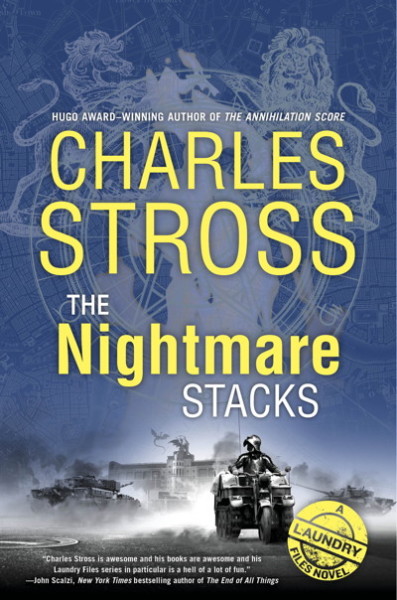
The Nightmare Stacks (North American edition)
Charlie Jane Anders talked to Charles about the book and the series:
How has the Laundry Files series changed and evolved in the dozen years or so that you’ve been writing it? Are there elements that you’re still surprised became so prominent?
I’ve been writing the Laundry Files series for 16 years at this point. When I began, I intended the short novel “The Atrocity Archive” (published with “The Concrete Jungle” in the book The Atrocity Archives — note the plural!) as a one-shot. It was only a few years later, when people began asking for more, that I had any idea of writing a sequel, and only with the third book, 8 years in, that I realized I needed a Plan. And because the book’s narrator, Bob, had been aging in line with the real world as I wrote the first three books, the most obvious plan was: track Bob’s career as he grows older, more senior, and more cynical.
This turned out to be a really fortuitous choice. It allowed me to fix some minor inconsistencies in the earlier books; because they’re Bob’s workplace memoir, he often gets the wrong end of the stick at first then learns better about some aspect of the job over time. It also allowed me to deepen him as a character, adding complexity to the narrative as he ages and possibly becomes more self-aware (although he doesn’t really have to grow up until books 8 or 9).
What I really wasn’t expecting was that Bob’s life would take over — and that the most important events in it would end up taking place off-screen, so far off-screen that I needed to pick new narrative voices! His wife Mo, for example, exhibits a very unvarnished perspective on Bob’s seemingly bottomless reserves of self-delusion in The Annihilation Score, and demonstrates that the series is very much about the Laundry as an organization, rather than just being Tales of Bob. And in The Nightmare Stacks I had to leave Bob behind entirely in order to give a worm’s eye view of the start of events that will give rise (eventually) to the climax of the series.
This book features a new character, Alex, instead of Bob. What’s the reason for switching focus?
In The Atrocity Archives Bob starts out as a twenty-something tech support guy who has blundered into a Len Deighton spy thriller (with added tentacles). By the start of The Rhesus Chart, Bob has leveled up so far that he can wade into a nest of vampires — admittedly rather inexperienced vampires — and escape with mildly damaged dignity and a stack of paperwork. Power-ups are a constant problem for any multi-book series that riffs off the Hero’s Journey: how do you engage with the underdog when your protagonist has risen from Midshipman to Admiral of the Fleet?
Alex is in some ways not dissimilar to Bob in his early incarnation. There are drastic differences: Alex has powers of his own — although they come at a drastic price. But Alex takes us back to the guy who gets sent to fix the cabling rather than spending all his time in policy meetings. And he’s got a young guy’s problems and social anxieties, unlike Bob (who by this point is in his early forties).
Comments Off on Charles Stross cover reveal for The Nightmare Stacks
Why Don’t You Use Modern Names For Cities? Who Was A Capable Commander in WW1? I OUT OF THE TRENCHES
Published on 28 Nov 2015
Indy sits in the chair of wisdom again and this time answers two questions that you were asking a lot. He explains his policy for naming places in a historical context and if there were any good commanders actually.
Comments Off on Why Don’t You Use Modern Names For Cities? Who Was A Capable Commander in WW1? I OUT OF THE TRENCHES
November 29, 2015
QotD: German women
If anything change the German character, it will be the German woman. She herself is changing rapidly — advancing, as we call it. Ten years ago no German woman caring for her reputation, hoping for a husband, would have dared to ride a bicycle: to-day they spin about the country in their thousands. The old folks shake their heads at them; but the young men, I notice, overtake them and ride beside them. Not long ago it was considered unwomanly in Germany for a lady to be able to do the outside edge. Her proper skating attitude was thought to be that of clinging limpness to some male relative. Now she practises eights in a corner by herself, until some young man comes along to help her. She plays tennis, and, from a point of safety, I have even noticed her driving a dog-cart.
Brilliantly educated she always has been. At eighteen she speaks two or three languages, and has forgotten more than the average Englishwoman has ever read. Hitherto, this education has been utterly useless to her. On marriage she has retired into the kitchen, and made haste to clear her brain of everything else, in order to leave room for bad cooking. But suppose it begins to dawn upon her that a woman need not sacrifice her whole existence to household drudgery any more than a man need make himself nothing else than a business machine. Suppose she develop an ambition to take part in the social and national life. Then the influence of such a partner, healthy in body and therefore vigorous in mind, is bound to be both lasting and far-reaching.
For it must be borne in mind that the German man is exceptionally sentimental, and most easily influenced by his women folk. It is said of him, he is the best of lovers, the worst of husbands. This has been the woman’s fault. Once married, the German woman has done more than put romance behind her; she has taken a carpet-beater and driven it out of the house. As a girl, she never understood dressing; as a wife, she takes off such clothes even as she had, and proceeds to wrap herself up in any odd articles she may happen to find about the house; at all events, this is the impression she produces. The figure that might often be that of a Juno, the complexion that would sometimes do credit to a healthy angel, she proceeds of malice and intent to spoil. She sells her birth-right of admiration and devotion for a mess of sweets. Every afternoon you may see her at the café, loading herself with rich cream-covered cakes, washed down by copious draughts of chocolate. In a short time she becomes fat, pasty, placid, and utterly uninteresting.
When the German woman gives up her afternoon coffee and her evening beer, takes sufficient exercise to retain her shape, and continues to read after marriage something else than the cookery-book, the German Government will find it has a new and unknown force to deal with. And everywhere throughout Germany one is confronted by unmistakable signs that the old German Frauen are giving place to the newer Damen.
Jerome K. Jerome, Three Men on the Bummel, 1914.
Comments Off on QotD: German women
November 28, 2015
“Free speech” means more than just allowing speech you happen to agree with
Brendan O’Neill reminds us that being a supporter of free speech requires you to support those who don’t always agree with you or express themselves in ways you’re comfortable with:
It’s the 21st century and Europe is meant to be an open, enlightened continent, and yet a man has just been sentenced to jail — actual jail — for something that he said. Will there be uproar? It’s unlikely. For the man is Dieudonné M’bala M’bala, the French comedian, and what he says — that Jews are scoundrels and the Holocaust is a fiction — is deeply unpleasant. Yet if we’re serious about freedom of speech, if we are truly committed to ensuring everyone has the liberty to think and say whatever they please, then the jailing of Dieudonné should outrage us as much as the attempts to shut down Charlie Hebdo or the jailing of a Saudi blogger for ridiculing religious belief. We should be saying ‘Je Suis Dieudonné’.
Due to the regimen of hate-speech laws in 21st-century Europe — which police and punish everything from Holocaust denial to Christian denunciations of homosexuality — Dieudonné has been having run-ins with the law for years. In 2009, a French court fined him €10,000 for inviting a Holocaust denier on stage during a gig. In March this year, a French court gave him a two-month suspended prison sentence for saying he sympathised with the attack on Charlie Hebdo and with the anti-Semite who murdered Jews at a Parisian supermarket a few days later. Now, this week, a Belgian court has given him an actual prison sentence: a court in Liège found him guilty of incitement to hatred for making anti-Semitic comments during a recent show and condemned him to two months in jail.
In all these cases, Dieudonné has been punished simply for thinking and saying certain things. This is thought-policing. It’s a PC, spat-and-polished version of the Inquisition, which was likewise in the business of raining punishment upon those who said things the authorities considered wicked. To fine or imprison people for expressing their beliefs is always a scandal, regardless of whether we like or hate their beliefs. Dieudonné really believes the Holocaust is a myth, as much as a Christian fundamentalist believes that people who have gay sex will go to hell or American liberals believe Hillary Clinton will make a good president. He is wrong, massively, poisonously so; but then, so are those Christians about gays and those liberals about Hillary. If every person who says wrong, malicious or stupid things were carted off to jail, Europe’s streets would be emptied overnight.
[…]
It is incredibly illiberal for the state to police hatred. Hatred might not be big or clever, but it’s only an emotion. And officialdom has no business telling us what we may feel — or think, or say, or write. Allowing the state to monitor belief represents a brutal reversal of the Enlightenment itself. John Locke, in his Letter Concerning Toleration (1689), set the tone for the Enlightenment as an attempt to ‘settle the bounds’ between the business of government and the business of morality. ‘The business of laws is not to provide for the truth of opinions, but for the safety and security of every particular man’s goods and person’, he wrote. That ideal is now turned on its head. Across Europe, governments ‘provide for the truth of opinions’, and in the process they silence those they don’t like and patronise the rest of us, reducing us to imbeciles incapable of working out what is right and wrong, and of speaking out against the wrong.
All hate-speech laws should be scrapped. Dieudonné should be freed. And a continent whose governments argue against the imprisonment of bloggers in Saudi Arabia while jailing comedians at home needs to take a long, hard look in the mirror.
Comments Off on “Free speech” means more than just allowing speech you happen to agree with
November 27, 2015
Pride Comes Before The Fall – British Trouble in Mesopotamia I THE GREAT WAR – Week 70
Published on 26 Nov 2015
Far away from the Western Front, the British Indian Army gets intro trouble in Mesopotamia against the Ottoman Empire. In the Alps, the Fourth Battle of the Isonzo is proving just as disastrous to the Italians the other three before. And in Serbia the situation is getting darker and darker as Nis is falling to the Central Powers. All while the flying aces of World War 1 are fighting it out in the skies over the Western Front.
Comments Off on Pride Comes Before The Fall – British Trouble in Mesopotamia I THE GREAT WAR – Week 70
November 26, 2015
Tom Kratman’s “Dear Russia” letter
Tom Kratman looks at what is known about the Turkish military’s attack on a Russian aircraft earlier this week:
Firstly, my condolences on the recent murder of your two pilots. While one might argue that shooting descending parachutists (as opposed to paratroopers) would be permissible in some circumstances, as when there is no reasonable possibility of capture, in this case there was such a possibility. Obviously, you’ll want revenge. I – and I think most Americans, at least such as are not in favor of a large and viciously fundamentalist Islamic state in the Middle East – understand and, generally speaking, approve of things like that, where called for. The situation, however, is more complex than that. Because of that complexity, I strongly encourage you to dispense with emotion, to the utmost of your ability, and reason carefully before acting.
I can’t offer condolences on the initial shoot down of your Sukhoi-24, because I really don’t know what happened. If it drifted into Turkish airspace, and the Turks shot it down, even if they pursued it out of Turkish airspace…well, you’re in an unenviable moral position to complain about any of that, given the conduct your predecessor in interest, the USSR, with regard to KAL 007. If, however, it never violated Turkish airspace, and the Turks crossed over to attack it, you may well have a casus belli against Turkey.
If the Turks are offering war I strongly advise you to decline the invitation. They are very nearly a peer competitor, having similarly sized armed forces, quite possibly better trained, an economy almost as strong as your own, and likely rather stronger when you count out export of raw materials. They’re not as technologically sophisticated as you are, but they have friends who are more so. And you just wouldn’t believe the long-standing love affair between the US Army and the Turkish Army, based on their performance in Korea in the early fifties.
*****
A little aside is in order at this point. I’m not really so concerned about the incident that just took place, with one of your planes shot down by the Turks, and the ejected pilots murdered on the way down. What’s really bugging me is the almost instantaneous assumption of people over here that this was the first set of shots in World War V, World War III having been the Cold War, and World War IV the on-again, off-again, fiasco with the Islamics. On its own, this should not be capable of doing that. Add in paranoia, self-fulfilling prophecy, idiotic foreign policy on many fronts, from many fonts, a fairly inscrutable Turkey…I’m a little concerned that things might spiral out of control.
*****
Earlier in this missive I said I don’t know what happened. Nonetheless, here’s what I think happened. I think that Sukhoi was on a strike mission against the Turkmen Brigades in Syria. I think you’ve been occasionally bombing the crap out of the Turkmen Brigades in Syria for a while now. That would tend to explain the vindictiveness of the folks on the ground who shot at your descending pilots. I think because of that bombing, the Turks, or at least one of the Turks, north of the border decided to help his or their close cousins in Syria. I think it made not a bit of difference whether or not you crossed the border; the Turks wanted to set an example and instill a little fear and friction on you, so would have crossed themselves even if you hadn’t. I suspect the order to do this came from the highest levels in Turkey, probably Erdogan, himself.
No, that doesn’t mean that whipping out the Polonium 210 dispensers would be a good idea.
Comments Off on Tom Kratman’s “Dear Russia” letter


