
Published on 14 May 2016
The Council of Nicaea convened to decide the guiding rules of the church – and to resolve the questions posed by Arian theology. A deacon named Athanasius set himself against Arius and succeeded in getting his teachings declared heresy.
____________Disclaimer: This series is intended for students, to give them a broad overview of a complicated subject that has driven world history for centuries. Our story begins and focuses on Rome.
Constantine called the Council of Nicaea not only to address the teachings of Arius, but also to decide basic matters for how the church would go forward. Yet it was the debate over Arian theology which quickly came to dominate the council’s time. The bishops effectively split into two factions, one backing Arius and the other led by a deacon named Athanasius. Athanasius vehemently opposed the Arian teachings and would not allow any compromise to be formed with the other group. Yet he played the politics very carefully, adopting in his own arguments the phrase “homoousian” (or “of the same substance”) to describe the relationship between the Father and the Son, knowing full well that Arius would never accept an agreement which included this idea. Even when others tried to compromise with the phrase “homoiousian” (or “of similar substance”), Arius would not agree. Athanasius used the extra time to make private deals and assemble a majority coalition, with which he successfully caused Arianism to be declared heresy and forced Arius himself into exile. Emperor Constantine was just happy a decision had been reached, but a bishop in his own court would not let matters rest so easily. This bishop, Eusebius, campaigned tirelessly for the restoration of Arius and managed to get Athanasius exiled instead. Constantine himself wound up being baptized by Eusebius, and his son Emperor Constantius II would be a die-hard Arian in his turn. Eusebius even ordained a Goth named Ulfilas to preach to the Gothic tribes, and his sucess meant that the tribes became Arian Christians who would never completely assimilate into the Roman Empire. Thus, despite the firm decree at the First Council of Nicaea, Arian Christianity continued to grow and thrive alongside orthodox teachings.
June 16, 2016
Early Christian Schisms – III: The Council of Nicaea – Extra History
QotD: Humanity’s near-infinite capacity for rationalization and self-deception
So how can an otherwise functional intellect close itself to all this irrefutable evidence and claim that the Holocaust was either a hoax or nowhere near as large in scope as claimed?
The answer, of course, lies in the nearly unlimited human capacity for self-deception. We are really, really good at both rationalizing our own preferences, and “explaining away” evidence that points to something we don’t want to be true. Denying Auschwitz is a piece of cake for someone with conviction when you consider that people can deny, on the spot, the reality of things that happen right then and there. That’s how you can have 9/11 truthers. That’s how you can have people claiming that the Charlie Hebdo attacks were a false flag operation perpetrated by a sinister race of “magical Jews” who can shape-shift. That’s why it doesn’t even matter if police officers wear body cameras — because you can videotape the most justified shooting of an armed perpetrator, and there will still be people who will watch the video and claim that the police officer executed someone in cold blood for no reason.
It’s because when you are invested in an ideology, you have to make reality subordinate to that ideology. And when the physical evidence points to the possibility that your ideology doesn’t match reality, then you have to deny that reality, or face the possibility that you ideology is wrong. It’s much easier to dismiss historical records or claim that a video was doctored than to examine your beliefs and concede that everything you believe is wrong.
But reality doesn’t go away when you deny it. Those buildings and crematoriums at Auschwitz still stand, and every time someone denies what they were used for, they deny the humanity of all the people who died there. And just as importantly, they deny the human ability to commit such atrocities, which in turn paves the way for a repeat of those atrocities. To borrow my friend Kathy’s words, there’s a world of difference between “Never Again” and “It can’t happen here.”
Because if a society of civilized, educated people, the nation of Goethe and Schiller and Beethoven, can build and staff a place like Auschwitz and systematically murder millions of people in just a few years — if orderly, fastidious Germans can go from bookkeeping to putting on a uniform and herding women and children into gas chambers at gunpoint because they perceive the approval of society and enjoy the power they are given — then it can happen anywhere, at any time.
Marko Kloos, “on the holocaust and self-deception”, the munchkin wrangler, 2015-01-28.
June 15, 2016
A sneak peak at The Nightmare Stacks by Charles Stross
If you’ve read any of the Laundry books, you’ll want to read the first chapter of the latest book in the series here.
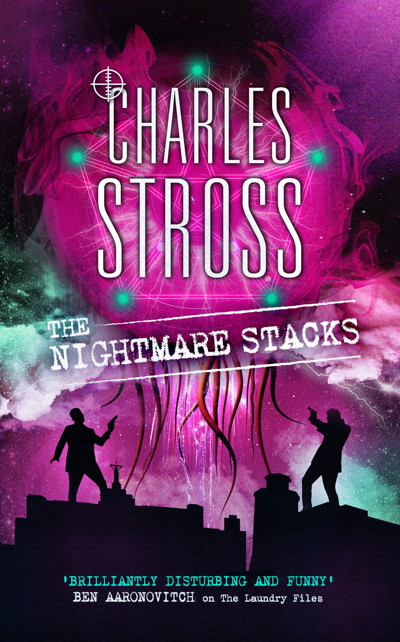
The Nightmare Stacks by Charles Stross (UK edition cover)
If it follows the formal schedule, the book will go on sale on June 23rd in the UK, and the 28th in the US and Canada. You may see it offered a bit sooner in a few locations, depending on the vagaries of the book distribution system (and some retailers’ inability to keep to publication dates).
June 14, 2016
Beyond The Genocide – Armenia in WW1 I THE GREAT WAR Special
Published on 13 Jun 2016
The region of Armenia was a play ball between the interests of Russia and the Ottoman Empire long before World War 1. But the Armenian people were striving for self determination like the peoples all across Europe were doing too. In our special episode we take a look at the struggle of the Armenians beyond the Armenian Genocide.
Early Christian Schisms – II: The Woes of Constantine – Extra History
Published on 7 May 2016
Constantine had restored full rights to Christians in the Roman Empire with the Edict of Milan, but he did not expect theological debates to divide the church. Conflict between the orthodox church and both the Donatists and the Arians drew him to intervene.
____________Disclaimer: This series is intended for students, to give them a broad overview of a complicated subject that has driven world history for centuries. Our story begins and focuses on Rome.
Constantine had gained control of the Roman Empire, its first Christian emperor, and he restored full rights to people of the Christian faith with the Edict of Milan. But his generosity immediately raised a question: what did the church do with so-called traditors, who had renounced the Christian faith during the days of persecution and now wanted to return? The Roman Church demanded they be restored, because the doctrine of penance declared that anyone could repent for any sin, no matter how grievous. But in North Africa, one group was outraged when a traditor named Caecilian was not only restored to the faith but elected Bishop of Carthage. They refused to accept him and elected their own bishop, Donatus, instead. Donatus performed the role of a bishop without official church authority and he insisted on re-baptizing traditors in contradiction to the doctrine of penance. The church wanted to put him on trial, but since Donatus had rebelled against the people calling for his trial, he didn’t believe it would be a fair trial. He wrote Constantine asking for help and the emperor decided to intervene, setting a dangerous precedent for imperial involvement in affairs of the church. Over a series of several trials, church leaders continued to condemn Donatus and he continued to ask Constantine for retrials until the emperor grew fed up and washed his hands of the matter. The unrepentant Donatists went on to become a splinter church that divided North Africa for centuries. Around the same time, a bishop named Arius had begun to teach a view on the nature of the Father and the Son which contradicted the trinitarian belief in co-equal and co-substantial natures. The Bishop of Alexandria excommunicated him when his teachings attracted too many followers and again threatened to split the church. Since the debates continued to rage, Constantine sent a cleric to try and broker peace between the two sides – but the cleric he sent was a strident trinitarian who only tried to put down the Arian sect and sparked riots instead. That cleric attempted to call a local council to resolve the matter, but Constantine – well aware by now that his representative was probably laying a trap for the Arians – suggested instead that a universal council of bishops from across the empire be called together at Nicea.
June 13, 2016
Coming soon – “the most serious constitutional crisis since the Abdication of King Edward VIII”
In the Daily Mail, Peter Hitchins rubs his hands in glee at the implications of the surge in popularity of the Brexiteers:
I think we are about to have the most serious constitutional crisis since the Abdication of King Edward VIII. I suppose we had better try to enjoy it.
If – as I think we will – we vote to leave the EU on June 23, a democratically elected Parliament, which wants to stay, will confront a force as great as itself – a national vote, equally democratic, which wants to quit. Are we about to find out what actually happens when an irresistible force meets an immovable object?
I am genuinely unsure how this will work out. I hope it will only destroy our two dead political parties, stiffened corpses that have long propped each other up with the aid of BBC endorsement and ill-gotten money.
I was wrong to think that the EU referendum would be so hopelessly rigged that the campaign for independence was doomed to lose. I overestimated the Prime Minister – a difficult thing for me to do since my opinion of him was so low. I did not think he could possibly have promised this vote with so little thought, preparation or skill.
I underestimated the BBC, which has, perhaps thanks to years of justified and correct criticism from people such as me, taken its duty of impartiality seriously.
Everything I hear now suggests that the votes for Leave are piling up, while the Remain cause is faltering and floundering. The betrayed supporters of both major parties now feel free to take revenge on their smug and arrogant leaders.
June 12, 2016
Cossacks – Cavalry – Wolves I OUT OF THE TRENCHES
Published on 11 Jun 2016
Indy sits in the Chair of Wisdom again and this week we talk about Cavalry on the Eastern Front, Cossacks and wolves.
Discovering the “Pompeii of Peterborough”
In The New Yorker, Charlotte Higgins describes the Bronze Age archaeological dig near Peterborough in the fens:
… from time to time, the soil pushes up clues, particularly in the fens, where the waterlogged earth creates anaerobic conditions that slow decay. One summer day in 1999, a local archeologist was walking at Must Farm, along the edge of a disused clay pit; at one time it was filled with water, but the water level had dropped enough to reveal some wooden stakes poking out. The Cambridge Archaeological Unit, which operates out of the university, an hour’s drive away, did some exploratory work and found, through radiocarbon dating, that the material dated from about 900 B.C. The site was monitored for several years, until Historic England, a government agency devoted to preserving the country’s heritage, began to press for it to be properly excavated. Last September, with funding from Historic England and the brick-making company Forterra, a team of about a dozen archeologists went to work.
Each day, they are making discoveries that are radically expanding the knowledge of Bronze Age Britain. The site is unparalleled in the U.K. for its wealth of artifacts and the pristine state of their preservation. Three thousand years ago, it was a settlement of wooden roundhouses, but life there ended abruptly: a fire tore through it, and the buildings collapsed, sank into the marshland, and were quickly entombed by silt and mud. “In archeology, very occasionally, there is the feeling that you have turned up just a week too late, that the people who were here have just moved on,” Mark Knight, the archeologist in charge of excavation at Must Farm, told me when I visited for a day in April. “This site has that feeling to it. Normally in Britain, when you dig, three thousand years of history seems manifest in the remains, because the most you tend to find is a few postholes and a potsherd. Here, somehow, the time span feels short. It’s so intact, so three-dimensional.” Inevitably, perhaps, the site has been nicknamed the Pompeii of Peterborough.
[…]
We stood on a low rise, and in the dip below us was a white tent about a quarter the size of a football field, erected to cover the archeological site and keep it from drying out in the harsh East Anglian wind. Knight led me down a path toward it. At the top of the slope, marking the present day, were fragments of bricks, rejects from the nearby factory. Farther down, he indicated a dark layer of earth. “This is Iron Age peat,” he said. And a few steps later: “This is where the sea came in, in the early Roman period, the first century A.D.” As we approached the tent, he said, “Now we’re down into the period where we’re excavating, around 900 B.C.—river channels. Can you see the shells of freshwater mussels?” Inside the tent, the excavation was being conducted two metres below the surface; had we been able to continue down another eighteen metres, to the level of the base of the quarry, we would have arrived at the Jurassic, a hundred and forty-five million years earlier.
From a viewing platform, we could look down on the whole excavation: a large, muddy, roughly rectangular area from which a number of wooden stakes poked up. Gradually, some of the stakes resolved themselves into the shape of a palisade that had once encircled the whole settlement. Inside this enclosure, I could make out individual objects—a human skull, the spine of a horse, something that looked like a woven-willow fence, the lips of pots, all half-buried. “There are some bowls,” Knight said. “There’s a wooden platter. There’s a big wooden trough. Over there, a storage vessel.”
Also within the perimeter of the palisade were three large shapes, each comprising a number of wooden rafters radiating unevenly outward from a central point, like the spokes of a broken umbrella. These were the collapsed roofs of the roundhouses. Several archeologists were working on excavating a fourth. They had already lifted and removed its roof timbers and were uncovering the dwelling’s contents, now compressed by three millennia of mud. They scraped with their trowels methodically, emptying the dirt into buckets that would later be sifted for small finds. One researcher, who looked to be in his twenties, wore a sweatshirt with the words “MY FUTURE LIES IN RUINS.”
Early Christian Schisms – I: Before Imperium – Extra History
Published on 30 Apr 2016
Understanding the early theological struggles of the Christian church is vital to understanding history. This series will focus on Rome and the political and religious forces that drove various interpretations of Christ and his teachings – and a push towards orthodoxy.
Disclaimer: This series is intended for students, to give them a broad overview of a complicated subject that has driven world history for centuries. Our story begins and focuses on Rome.
One of the toughest questions early Christians had to face was Mosaic Law. Did the laws of Moses still apply, or did the teachings of Jesus Christ replace them? The issue of circumcision became a focal point for this conflict. In an era without surgical anaesthetic or procedures, asking grown men to have their foreskins removed was a painful process. Paul the Apostle argued vehemently against the practice because he believed that Christianity needed to be accessible to Romans, the gentiles, and he knew that requirements like circumcision would vastly reduce the number of people willing to convert. Gradually, Judaizing forces were pushed out of mainstream Christianity as the religion began to convert more Romans. But it soon faced another crisis: what was the nature of Christ? This issue would come up time and time again, but one of the earliest conflicts over it came from the Docetists. They believed Christ was a being of pure spirit, and that it would denigrate his godhood to consider him a human man. But in the Epistles, John argued fervently against that idea, saying that Christians must believe in Christ “in the flesh” in order for his sacrifices to be meaningful. A bishop named Ignatius of Antioch embraced that idea when facing a conviction to be thrown to lions in the Colossuem, believing that his martyrdom echoed Christ’s and he was proud to give his body to prove his faith. Then the 3rd Century Crisis hit, and the Roman government fell apart. The Church stepped in, and many people believed its prophesies of apocalypse had come to pass in this era. Although the government eventually recovered thanks to men like Aurelian and Diocletian, conversion rates had gone up. But civil war rocked the empire again, and it came down to the Battle of the Milvian Bridge. Constantine, one of the claimants for the throne, supposedly had a vision telling him to paint “Chi Rho” (the Greek letters for Christ) on his soldiers’ shields. He did so, and won the day. In gratitude he converted to Christianity and eventually brought most of the empire with him, with the population going from about 10% Christian to 50% Christian followers.
June 10, 2016
The Brusilov Offensive – The Arab Revolt I THE GREAT WAR Week 98
Published on 9 Jun 2016
The Brusilov Offensive is unleashed on the Eastern Front this week 100 years ago. General Aleksei Brusilov wants to crush the Austro-Hungarian Army and uses a variety of new tactics for his plan. At the same time, the Germans take Fort Vaux during the Battle of Verdun and in the Middle East, the Arab Revolt is declared.
June 9, 2016
NATO’s peacetime border problems
In Foreign Affairs, Elisabeth Braw discusses a problem NATO faces every time there’s a need to move troops across national borders within the alliance:
“NATO’s member states are willing to defend one another, and they have the troops and the equipment to do so. But quickly getting those troops and equipment to their destination is a different matter altogether. In some new NATO member states, bridges and railroads are simply not suitable for large troop movements. But one thing frustrates commanders even more: the arduous process of getting permission to move troops across borders.
“I was probably naïve,” admits Lieutenant General Ben Hodges, the commander of the U.S. Army in Europe. “I assumed that because these were NATO and EU countries we’d just be able to move troops. But ministries of defense are not responsible for borders.”
[…]
And there’s the complication. Moving troops across Europe requires permission at each border. “During the Cold War, we had pretty good plans to rapidly move across borders, but until [the 2014 NATO summit in] Wales we didn’t have similar plans for new NATO member states,” says a NATO official knowledgeable with the issue. “Right after Crimea we sent out a questionnaire about [border regulations] to each member states, and the results were pretty scary. Some countries needed to recall parliament in order to let NATO units cross their borders. And one country said, ‘we can only have 1,600 soldiers on our soil.’” In reality, that meant that NATO would be unable to use that member state, which the NATO official declined to identify, for passage.
Since then, NATO has made impressive progress. It has tripled the size of its 13-year-old NATO Response Force (NRF), which can muster up to 40,000 troops and is, at least in theory, able to deploy quickly to new NATO member states as well as old ones. And all of its member states have agreed to pre-clearance—the military version of a green card for troops and equipment—although it is not clear how the system will work in practice. As the NATO official reports, “some countries say ‘we don’t need any advance notice for pre-clearance,’ while others say they need four to five days’ notice.” According to the official, in most of NATO’s eastern-facing countries, getting the clearance would be a matter of five days or fewer, although one country—he declined to specify which one—still requires more time.
And so, although Hodges and his fellow commanders know how fast their troops can physically move, they have little idea whether crossing borders will take five days, two days, or perhaps just hours. “An official [in an eastern European NATO member state] told me, ‘I hope we can get this [clearance] done quickly,’” Hodges reports. “But you can’t plan based on hopes and wishes.”
H/T to Colonel Ted Campbell for the link.
June 8, 2016
June 7, 2016
Russia’s Finest General – Aleksei Brusilov I WHO DID WHAT IN WW1?
Published on 6 Jun 2016
Aleksei Brusilov was the mastermind of Russia’s finest moment in World War 1: The Brusilov Offensive. Although it didn’t achieve it’s planned objective, it broke the back of the Austro-Hungarian Army. The life of Aleksei Brusilov was an interesting one between the cultures and even after Imperial Russia was gone, his career was not over.
June 6, 2016
Verdun Fortress Design – Gas Development Sights I OUT OF THE ETHER
Published on 5 Jun 2016
Since you all liked our first test of OUT OF THE ETHER so much, we decided to bring in some new episodes occasionally. In this episode we talk about the design behind the forts at Verdun and gas development sights in Washington.
June 5, 2016
Execution Squads – Jews in WW1 I OUT OF THE TRENCHES
Published on 4 Jun 2016
It’s time for the Chair of Wisdom again and this week we talk about the organisation of execution squads, the fate of Jews in WW1 and the the motivation of soldiers.


