
The School of Life
Published on 25 Nov 2016George Orwell is the most famous English language writer of the 20th century, the author of Animal Farm and 1984. What was he trying to tell us and what is his genius?
October 13, 2017
October 12, 2017
Britain’s Old Boy Network – from “the Establishment” to “the Embarrassment”
In the media rounds supporting his new book, The Square and the Tower: Networks, Hierarchies and the Struggle for Global Power, Niall Ferguson discusses the decline and fall of the oldest power network in Britain:
It used to be that the United Kingdom of Great Britain and Northern Ireland was the United Cronydom of Great Poshhouse and Northern Grousemoor. The only network that mattered was the Old Boy Network. The OBN was formed by men who were the old boys of a tiny elite of boarding schools known as “public schools” because they were closed to the public. Most boys at those schools were scions of the aristocracy or the landed gentry: future barons and baronets.
Even if thick to the point of educational sub-normality, these young gentlemen would attend either Oxford or Cambridge. They would then be given one of the following jobs:
1. Estate manager and courtier (eldest son).
2. Foreign Office or Treasury mandarin (brightest son).
3. Cabinet minister (most extrovert son).
4. Governor of [insert Caribbean island] (youngest son).
5. BBC director-general (Left-wing son).
This is of course a caricature. In reality, there were all kinds of sub-networks — clusters — within the elite network that ran Britain. Sometimes, a brilliant group of talented young men would come together to achieve great things. There was the “Kindergarten” formed by Alfred Milner, which tried (and failed) to transform South Africa into a second Canada or Australia. There were the Apostles — the Cambridge Conversazione, the most exclusive intellectual club of all time — to which the economist John Maynard Keynes belonged.
However, with increasing frequency after 1945, the OBN’s achievements were less than brilliant. Suez. Wilson. Heath. Double-digit inflation. The three-day week. From being the winners of glittering prizes, the OBN degenerated in the eyes of a previously deferential public into the upper-class twits of the year.
In the Sixties the journalists Henry Fairlie and Anthony Sampson popularised the disdainful name that the historian A.J.P. Taylor had given the British elite: “The Establishment”. By the Seventies the Establishment were more like The Embarrassment — objects of sitcom ridicule. By the Eighties they had been almost entirely driven from the corridors of power. Nothing better illustrated this than the Thatcher governments: not only was the prime minister a woman from provincial Lincolnshire (albeit one with an Oxford degree); there were enough ministers in her Cabinet with Jewish backgrounds to inspire off-colour jokes about “Old Estonians”.
Comments Off on Britain’s Old Boy Network – from “the Establishment” to “the Embarrassment”
October 11, 2017
Reading Gibbon’s History of the Decline and Fall of the Roman Empire
In the latest Libertarian Enterprise, Richard Blake introduces one of the greatest English historians and explains why his work is still well worth reading:
Edward Gibbon (1737-94) was born into an old and moderately wealthy family that had its origins in Kent. Sickly as a child, he was educated at home, and sent while still a boy to Oxford. There, an illegal conversion to Roman Catholicism ruined his prospects of a career in the professions or the City. His father sent him off to Lausanne to be reconverted to the Protestant Faith. He came back an atheist and with the beginnings of what would become a stock of immense erudition. He served part of the Seven Years War in the Hampshire Militia. He sat in the House of Commons through much of the American War. He made no speeches, and invariably supported the Government. He moved for a while in polite society – though his increasing obesity, and the rupture that caused his scrotum to swell to the size of a football, made him an object of mild ridicule. Eventually, he withdrew again to Switzerland, where obesity and his hydrocele were joined by heavy drinking. Scared by the French Revolution, he came back to England in 1794, where he died of blood-poisoning after an operation to drain his scrotum.
When not eating and drinking, and putting on fine clothes, and talking about himself, he found time to become the greatest historian of his age, the greatest historian who ever wrote in English, one of the greatest of all English writers, and perhaps the only modern historian to rank with Herodotus and Thucydides and Tacitus. The first volume of his History of the Decline and Fall of the Roman Empire astonished everyone who knew him. The whole was received as an undisputed classic. The work has never been out of print during the past quarter-millennium. It remains, despite the increase in the number of our sources and our better understanding of them, the best – indeed, the essential – introduction to the history of the Roman Empire between about the death of Marcus Aurelius and the death of Justinian.
I’ve read a few abridged versions of Gibbon’s great work, and I intend to start on the unexpurgated version once I’ve finished the New Cambridge Modern History (I have all in hand except Volume XII, the Companion Volume). This is why Blake considers Gibbon to be such an important and still-relevant writer:
1. Greatness as a Writer and a Liberal
I cannot understand the belief, generally shared these past two centuries, that the golden age of English literature lay in the century before the Civil War. I accept the Prayer Book and the English Bible as works of genius that will be appreciated so long as our language survives. I admire the Essays of Francis Bacon and one or two lyrics. But I do not at all regard Shakespeare as a great writer. His plays are ill-organised, his style barbarous and tiresome. I fail to understand how pieces like A Midsummer Night’s Dream and Romeo and Juliet, with their long, ranting monologues, can be thought equal to the greatest products of the Athenian theatre. I grant that Julius Caesar is a fine play – but only because Shakespeare stayed close to his ancient sources for the plot, and wrote in an uncharacteristically plain style. Perhaps I am undeveloped in some critical faculty; and I know that people whose judgements I trust have thought better of him. But I cannot see Shakespeare as a great writer or his age as the greatest in our literature. […]
2. His Scholarship
As said, this was not my first meeting with Gibbon. I was twelve when I found him in the abridgement by D.M. Low. As an undergraduate, I made use of him in the J.B. Bury edition up till the reign of Heraclius and the Arab conquests. In my middle twenties, I went through him again in a desultory manner, skipping chapters that did not interest me. But it was only as I approached thirty that I read him in the full and proper order, from the military resources of the Antonines to the revival of Rome under the Renaissance Popes. It is only by reading him in the whole, and by paying equal attention to text and footnotes, that he can be appreciated as a supreme historian. […]
3. His Fairness as an Historian
Even where he can be criticised for letting his prejudices cloud his judgement, Gibbon remains ultimately fair. He dislikes Christianity, and is convinced that it contributed to the decline of the Empire. His fifteenth and sixteenth chapters are one long sneer at the rise and progress of the Christian Faith. They excited a long and bitter controversy. There was talk for a while of a prosecution for blasphemy. But this was only talk. A man of Gibbon’s place in the social order was not to be taken into court like some hack writer with no connections.
Comments Off on Reading Gibbon’s History of the Decline and Fall of the Roman Empire
How a German Squad attacks a position (WW2)
FootageArchive – Videos From The Past
Published on 17 Nov 2013Welcome to FootageArchive! On this channel you’ll find historic and educational videos from the 1900s. Watch, learn, and take a trip back in time as we gain insight into a previous time.
(Note: this video is being shown strictly for educational and historical purposes)
Comments Off on How a German Squad attacks a position (WW2)
October 10, 2017
Evolution Of British Battle Tanks In WW1 I THE GREAT WAR Special
The Great War
Published on 9 Oct 2017Support the Tank Museum: https://www.patreon.com/tankmuseum
Tank Museum on YouTube: https://www.youtube.com/TheTankMuseumIndy talks to Tank Museum curator David Willey about the evolution of the British Tank during World War 1. From the early beginnings with prototypes like Little Willie and the first deployed Mark I to later versions like the famous Mark IV, the Mark V and lesser known tanks like the Mark IX, Mark V** or Mark VIII “Liberty Tank”.
Comments Off on Evolution Of British Battle Tanks In WW1 I THE GREAT WAR Special
Crap archery in Helen of Troy
Lindybeige
Published on 9 Jan 2014This film continues to be a mine of errors, and there were so many on archery, that I thought I could do a whole video on this one subject.
On the speed of arrows, I was assuming the belly of the horse to be 12 feet above the archers. The first arrow to arrive took 20 frames to get there, which is 4/5 second (PAL 25 frames per second), and 5/4 of 12 is 15, so they were travelling at about 15 feet per second.
On opposed landings, I could give the example of the British liberation of the Falkland Islands. Even though there were not vast numbers of Argentinians on the Islands, and the British had air and sea superiority, the British still chose to land unopposed the other side of the islands and walk all the way across, rather than risk an opposed landing. In the ancient world, I do not know of a successful attack on a fortified place from the sea. When the Romans cleared the Mediterranean of pirates, they did it by landing troops away from the pirate strongholds, and then marching to the strongholds overland.
www.LloydianAspects.co.uk
Comments Off on Crap archery in Helen of Troy
October 9, 2017
Great Northern War – Lies – Extra History
Extra Credits
Published on 7 Oct 2017Could Sweden have won the Great Northern War? Was Charles XII actually assassinated? James answers questions from our Patreon supporters in this special edition of Lies!
Comments Off on Great Northern War – Lies – Extra History
The Centuries-Old Debt That’s Still Paying Interest
Tom Scott
Published on 25 Sep 2017In the archives of Yale University, there’s a 367-year-old bond from the water authority of Lekdijk Bovendams, in the Netherlands. And it’s still paying interest.
Thanks to:
Prof. Geert Rouwenhorst for his time and explanation
All the team at the Beinecke Rare Book and Manuscript Library
Michelle Martin (@mrsmmartin) for editing the interview
and Leendert van Egmond for telling me about the bond!
Comments Off on The Centuries-Old Debt That’s Still Paying Interest
October 8, 2017
Electricity – Wright Brothers – Hip Firing MGs I OUT OF THE TRENCHES
The Great War
Published on 7 Oct 2017Chair of Wisdom Time! This week we talk about the advancements of electricity during the war, the Wright brothers patent wars and hip/shoulder firing MGs. Oh and Italian Spiderman.
Comments Off on Electricity – Wright Brothers – Hip Firing MGs I OUT OF THE TRENCHES
October 7, 2017
The Trojan War – A tale of Passion and Bloodshed! l HISTORY OF SEX
IT’S HISTORY
Published on 23 Sep 2015The Trojan War is one of the most epic and passionate legends set in Greek Mythology. Legend has it, that Prince Paris fell in love with the beautiful Helena, wife of King Menelaos of Sparta. He took her to Troy, which sent all of the rest of Greece, including the famous warrior Achilles after the city. We’ll explain which incidents on the battles are actually proven and how sex, powerplay and love is interpreted to have led to blood shed more than once during Antiquity. Join Indy for our new episode of BATTLEFIELDS!
Comments Off on The Trojan War – A tale of Passion and Bloodshed! l HISTORY OF SEX
October 6, 2017
Sabotage In The Desert – Battle of Broodseinde I THE GREAT WAR Week 167
The Great War
Published on 5 Oct 2017While the regular British forces were advancing towards Jerusalem and Baghdad, T.E. Lawrence and the Arab Revolt were causing havoc behind the lines. This week 100 years ago, they were continuing to attack the important Hejaz railway which was one of the vital supply routes for the Ottoman Army. On October 4, the Battle of Broodseinde was fought near Ypres and the costly British victory there caused real headaches for German general Erich Ludendorff.
Comments Off on Sabotage In The Desert – Battle of Broodseinde I THE GREAT WAR Week 167
October 5, 2017
The greatest general you’ve probably never heard of
I missed this article when it was posted in September: Iskander Rehman discusses the life and times of Byzantium’s greatest general, Belisarius:
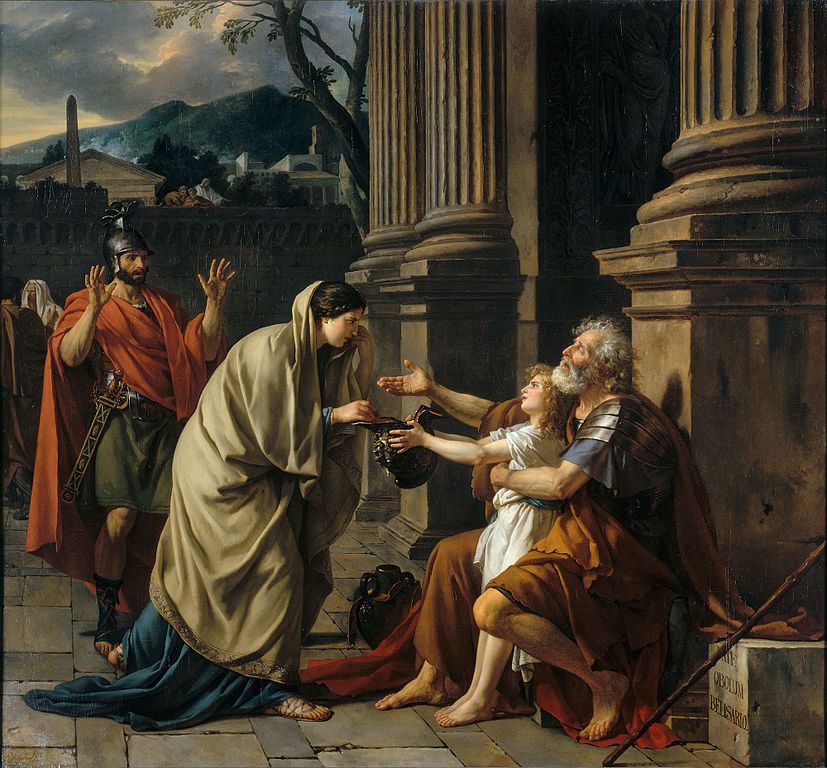
Belisarius begging for alms. Painting by Jacques-Louis David, 1781.
(Via Wikimedia)
In 1780, the great neoclassical painter Jacques-Louis David completed one of his finest works. Entitled “Belisarius Begging for Alms,” the oil painting depicts an aging warrior, blinded with a hand outstretched, seated at the base of a colossal Roman monument. His feet are bare, his beard unkempt, and his armor draped in coarse rags, dull in sheen. A slender walking cane rests to his side, propped against a stone slab bearing the name of a famous former general — Belisario, or Belisarius. A beautiful woman, her face etched in concern, drops a few coins into an upturned helmet, and whispers words of consolation. Her husband, a man in the vigor of youth and full military regalia, is in shock, his arms raised and his mouth open. He has just realized that the stricken veteran is his former commander, the legendary Belisarius himself.
Although his name is not as well known as it once was, Belisarius has long been considered one of history’s finest tacticians. Under the orders of the Byzantine emperor Justinian I, the sixth century general reclaimed vast tracts of Western Roman territory, from northern Africa to the Italian peninsula. Frequently outnumbered and leading an eclectic grouping of warriors composed of romaioi (Eastern Romans), foederati (Barbarian allies), and ethnikoi (specialist ethnic troops), the Thracian commander greatly expanded the footprint of the Byzantine empire at a time when many thought that Rome’s ancestral lands had been irredeemably lost. The fact that many of these conquests, as we shall see, only proved fleeting, has, if anything, only burnished his myth, transmogrifying the soldier into something of a crepuscular icon — Western Europe’s last great Roman protector before the advent of the so-called Dark Ages.
For Liddell Hart, Belisarius was also the consummate practitioner of the so-called “indirect approach” and the “master of the art of converting his weakness into strength; and the opponent’s strength into a weakness.” T.E. Lawrence, an avid reader of the ancient military classics, considered “the Thracian genius” to be one of “three really first-class Roman generals in history” (the other two being Scipio Africanus and Julius Caesar) and encouraged his friend, Robert Graves, to write the novel Count Belisarius. This piece of historically informed fiction retraces Belisarius’s military campaigns and was much admired by Winston Churchill, who is said to have often turned to it for guidance during the fraught early years of World War II.
Who was the man behind the myth? And why do the tales of Belisarius’s life and military exploits continue to resonate, firing the imaginations of great men from David to Churchill and Lawrence of Arabia? What insights can be gleaned, not only from his campaigns, but from the Eastern Roman Empire’s strategic literature more broadly?
Comments Off on The greatest general you’ve probably never heard of
Time to update your political vocabulary for the era of Corbyn
In The Spectator, Stephen Daisley provides a great crib sheet to get you up to speed with the new Corbynista words and phrases you need to understand to stay relevant in the Labour Party:
Are you considering a career in Labour politics but fear you may be left behind amid all the exciting changes the party is undergoing?
Maybe you want to be a part of the Jez revolution but can’t get your head around the ever-developing terminology.
Perhaps you are eyeing up a safe seat but aren’t sure which paramilitary cell’s endorsement would most impress the selection panel.
Help is at hand with this guide that takes you through the key terms of Corbynspeak.
Centrist dad: Anyone old enough to remember when Labour was a political party and not an evangelical tent ministry. Owns more than one pair of chinos and only uses Facebook to post ‘FFS’ with links to Owen Jones pieces. Centrist dads just don’t get how politics works in 2017. It’s all about getting people excited by promising to bring change and give them free stuff. That’s never happened before.
Jeremy Corbyn: Substitute father figure for people whose centrist dad didn’t give them enough hugs growing up.
Oh Jeremy Corbyn: The Red Flag for people who don’t know the words to the Red Flag because they only joined the Labour Party five minutes ago.
[…]
Misogyny: It has no place in the Labour Party, save the narrow exception of every woman who has ever disagreed with Jeremy ever.
Slug: Tory. The sort of heartless, racist scum who still hasn’t been convinced to vote for us.
Melt: Blairite. Worse than slugs.
[…]
Racism: Vile prejudice. Totally unacceptable. Victims’ concerns must be taken seriously.
Anti-Semitism: Well, let’s not be hasty. Probably a smear. Victims must be in league with Laura Kuenssberg.
Neoliberalism: The economic arrangements responsible for the laptops, tablets and smartphones Corbynistas use to post memes of Jezza. Also, evil.
Both sides: To blame for terrorism.
Hamas: Not to blame for terrorism.
IRA: They were like Momentum in Ireland or something, right? Pals with Jez. Slugs and melts don’t like them for some reason.
Brexit: A disastrous/progressive/uncertain move, fuelled by xenophobia/working-class discontent/many factors, and is sure to isolate the UK/break up the Brussels capitalist cartel/have an unknown impact. As such, Labour must oppose/lead/express no opinion on the matter. N.B. The party line changes from time to time, so best to avoid taking a clear position. Alternatively, take all three positions at once. Works for Keir Starmer.
Comments Off on Time to update your political vocabulary for the era of Corbyn
October 4, 2017
TANKFEST 2017 – Behind the Scenes with The Mighty Jingles
Tank Museum
Published on 3 Oct 2017See the best display of historic moving armour in the world, 29 June – 1 July, at The Tank Museum, Bovington. Tickets for TANKFEST 2018 are now on sale. www.tankfest.com
Youtuber The Mighty Jingles went behind the scenes at TANKFEST 2017 to meet the people who make TANKFEST work.
Comments Off on TANKFEST 2017 – Behind the Scenes with The Mighty Jingles
British Boys Anti-Tank Rifle
Forgotten Weapons
Published on 24 Aug 2015http://www.patreon.com/ForgottenWeapons
Hammer Price: $3,750
Pretty much every major military had an antitank rifle in service when WW2 kicked off, and the British example was the Boys rifle, named after the Captain Boys who designed it. It was a bolt action .55 caliber rifle with 5-round detachable magazines. If was obsolete by 1943 and replaced by the more effective but equally unpleasant PIAT.
Comments Off on British Boys Anti-Tank Rifle


