
Extra Credits
Published on 21 Oct 20171848. Revolution swept Europe as the working class rose up to claim their freedoms from an oppressive ruling class. But as a member of that ruling class, Bismarck had some resistance to this movement. He channeled his wild energy into productive avenues, gradually becoming the man of realpolitik that we know today.
October 22, 2017
Otto von Bismarck – II: A Man of Great Ideas – Extra History
Comments Off on Otto von Bismarck – II: A Man of Great Ideas – Extra History
Interview With Pär Sundström from Sabaton I THE GREAT WAR Special
The Great War
Published on 21 Oct 2017Learn more about Sabaton: http://www.sabaton.net/
Sabaton is a Heavy Metal band from Sweden. Battles and events during World War 1 inspired them to do multiple songs about them and Indy is talking with bass player Pär Sundström about the process.
Comments Off on Interview With Pär Sundström from Sabaton I THE GREAT WAR Special
IKEA’s strengths and weaknesses, from a consumer point of view
Paul Sellers posted an article on his woodworking blog, reacting to some British journalists praising IKEA’s “democratisation of design”:
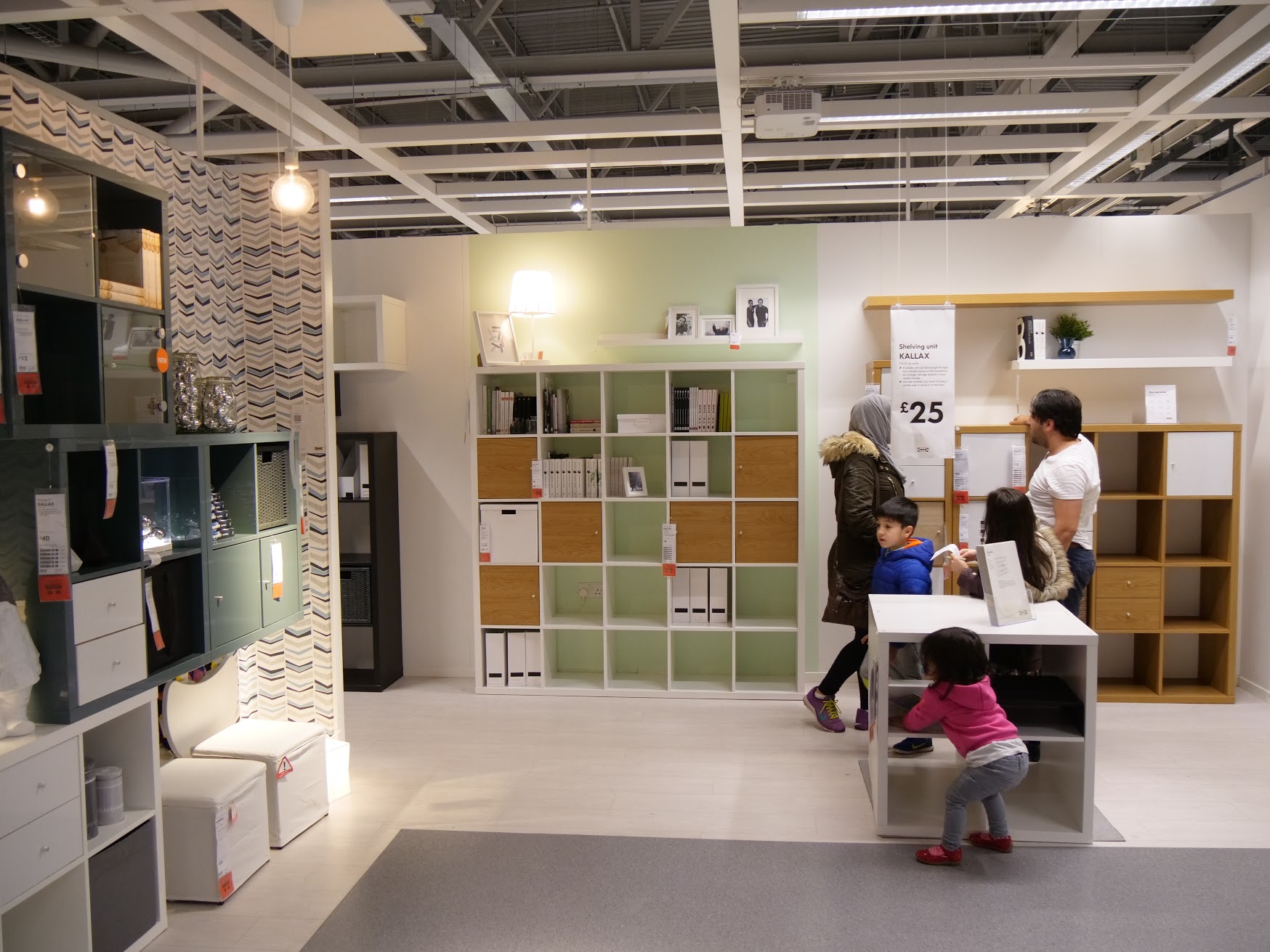
Visually neat and relatively cheap at first glance, but they are basic and they resolve the need in a new and young family for storage. The pinnacle of three-dimensional cubism!
(photo from PaulSellers.com)Yup! a couple of newspaper writers (maybe more, knowing British journalism) reported the same thing in a short space of time, both hailing IKEA as a ‘democratising’ force revolutionising people’s perspectives on furniture design. Both articles were interesting in the way some articles can be, you know, not contributing much to society really, but time filling on a lazy Sunday. What actually struck me most between their somewhat opposing points of views was the unifying thread in their use of the terms “democratisation of design” and “democratising design and the theme of creating affordable, non-fusty furniture for the masses.” As far as I have seen through the years it is not so much IKEA’s ability to design but more their ability to produce zero- or minimalist-design products that seem less to be concepts of style, shape or form but mostly the selling of square-edged, styleless, plank-type items in the form of very, very plain boxes. Yes, I do understand the needs of young families for low cost storage and first year students to furnish their rooms, but democratisers of design!
Unpretentious though their lines are, you can hardly say they are designs so much as meagre assemblies and of course assemblies you generally have to take care in the way they are used because the selling points are their lightweight cheapness, transportability, dismantle-ability and simple (or complex) self-assembly products. You might be better to strike out into similar fashion statements rejecting the classics of old and adopt an equally classless line of unimagination by using old scaffold planks for dining tables and benches or, say, a shipping pallet coffee table on commercial galvanised swivel casters.
Elizabeth and I used to enjoy visiting a furniture store up in Peterborough, but about a year or so back, they stopped carrying the kind of furniture we liked and started stocking exactly the sort of stuff Paul is talking about. Industrial chic is all very well, but these pieces looked like they’d been thrown together at the last possible second as a student project for a college design course: the industrial fittings were cobbled together as crudely and as shoddily as possible, with no eye to either aesthetics or sturdiness. They were literally props that might appear in the background of a Victorian or Edwardian shop floor scene in an off-, off-, off-Broadway kind of production.
I’m far from a curmudgeon on the topic of home decor and furniture, but the pieces in that store were expensive crap. You can do the industrial chic look, or more modern variations using cast-offs from all sorts of places. My friend Brendan, in his first couple of apartments, had no spare cash at all so he scrounged up pretty much all of his furniture from around town. He had the weirdest collection of decades-old store signs, former display cabinets from different eras, and I don’t know what else, but he has a great eye for design, so no matter how eclectic it all was, he managed to make it look appealing and (somehow) integrated. That was clearly the ideal for the owners of the Peterborough furniture store, but they missed the mark by a very large amount.
I never liked lazy, press-release type journalism (as we are used to in British woodworking magazines) because it can be the same as lazy design work; both lacking any true imagination. But the two authors, each celebrating IKEA’s birth for opposite and then too the same reasons, seemed more focussed on this issue of IKEA somehow ‘democratising’ something rather than considering what could be in essence more a diktat. I question whether IKEA makes products that people actually want or makes people want what they make by virtue of cheapness and driving out competition, but then what do I know? I know this though, IKEA only sells what it wants you to buy, sells stuff so cheap that no one else can compete, and devalues the market by forcing down prices to a level that promotes mainly quite dumbed down designs. I don’t ever recall much in IKEA’s selling centres that I would describe as at all imaginative. People buy there because it’s cheap. To zone in on the reporting world, on Beeb 4 a day later a reporter interviewed some head of IKEA UK and allowed way too much waffling claptrap boasting IKEA’s products were now no longer going into the landfill after a short lifespan as the reporter suggested, which is of course absolutely true, but onto the secondhand market, which IKEA wants to include in its ‘widening circle of circulation’.
[…]
On the one hand Rhiannon Cosslett article in the Guardian describes IKEA accurately as the “symbol of impermanence”, but she also follows the same track as India Knight in stating that this IKEA is enabling people to shed their ties with “snobbery regarding middle-class home decoration”. The woman reporting in the Times, India Knight, describes the pretension of owning a semi (duplex, USA) and adding furniture that emulates the chintz (a word used in the two articles) of the rich and famed owners living in UK mansions past as a kind of mindless hypocrisy. I agree to some degree, but then there are those millions of others who follow the IKEA trending in equally mindless ways buying into its philosophies purely on the basis that it’s IKEA, as though IKEA holds the keys to concepts of good design. This, in my mind at least, shows how lacking we can become in discerning just what a good design is. I might liken IKEA designs to all the nations County Councils use of standardised street and buildings signage. Yes, they work effectively, but only because they have a created dull and unimaginative examples that stand out because of dullness. The main difference here of course is that for safety reasons the County Councils have a get out clause. I have yet to walk through an IKEA store without thinking (smelling too) MDF, pressed fibreboard, resins and plastic but how is it even possible that any company could put so much effort into creating so much artificiality.
Nope, not plywood, faux ply ‘engineered hollow core particle board.’
(Photo from PaulSellers.com)

Comments Off on IKEA’s strengths and weaknesses, from a consumer point of view
German capitulation…
arutixar
Published on 1 Jan 2015Germany offers their surrender to Allied forces…
Sketch by Mel Smith and Griff-Rhys Jones.
Comments Off on German capitulation…
October 21, 2017
Surprise, surprise – exclusive universities draw almost exclusively from rich regions
In the Guardian, Sally Weale, Richard Adams and Helena Bengtsson disclose the shocking news that Oxford and Cambridge select very few students from outside the two wealthiest tiers of society or from outside London and the southeast:
Oxford and Cambridge universities have gone backwards on the socio-economic diversity of their student bodies, with more than four in five students coming from the most privileged groups, a Guardian analysis has found.
Data released to the MP for Tottenham, David Lammy, under the Freedom of Information Act shows that 82% of offers from Oxford and 81% from Cambridge went to students from the top two socio-economic groups in 2015, up from 79% at both universities five years earlier.
Lammy, who has campaigned for greater ethnic and socio-economic diversity at Oxbridge, said he was appalled that the universities were moving backwards on socio-economic background measurements. “This data clearly shows that a privileged background is still the key to getting through the Oxbridge admissions process,” he said.
The data shows huge regional disparities in offers, with some parts of England and Wales failing to secure a single place for years while students in London and the south-east received almost half of all offers.
Despite the two universities’ extensive efforts to increase the diversity of their intake, new research shows there are still swaths of the country with low rates of application and disproportionately fewer offers.
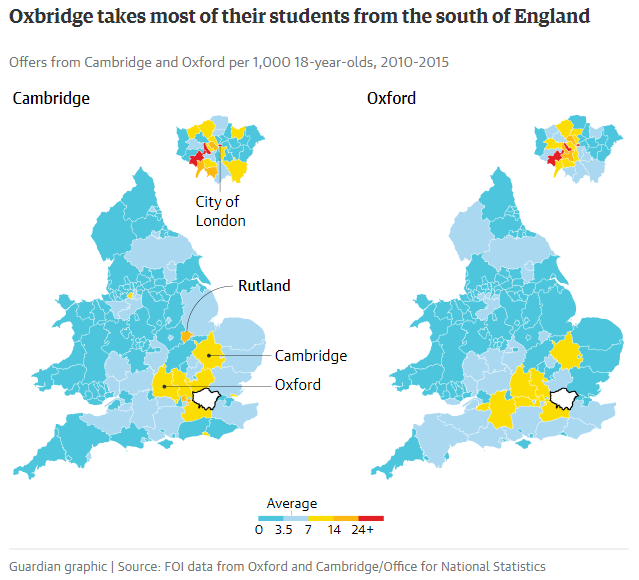
Students from benighted, uncivilized places like Middlesbrough are rarely able to gain admission:
Middlesbrough, where 101 students applied to Oxbridge, secured just 11 places in five years.
Carolyn Yule, the director of A-levels at Middlesbrough College, said that not one of her Oxbridge applicants had been successful in her three years in the job. “One of the students we did a lot of work with, he wanted to read mathematics and he was absolutely fantastic,” she said. “He got an interview and could not have done any more, but he didn’t get in. We didn’t really get a lot of feedback from them. We don’t even feel we know why our students don’t get in.”
However, it’s important to find out how many students applied to make sense of the numbers accepted:
There are 38 colleges at Oxford, 31 at Cambridge (close enough anyway). Given that not everyone with that sort of level of academic achievement actually tries to enter Oxbridge then what do we think should be the offer rate to these Black Britons? It’s most certainly not 4 offers per college per year, is it? Or 6, or whatever 400 divided by 70 is.
Given the small numbers the stats are going to be weird anyway, but what is the number of total offers made by all colleges, related to the total number of people who get 3 A grades? Vriance from that would probably be a good starting point for us.
Lammy does however make a good point:
With this degree of disproportionately against black students, it is time to ask the question of whether there is systematic bias.
I’m certainly willing to believe there is. I am not deluded enough to think that Britain is perfect, nor its education system. But I would probably start with the thought that the bias is in the system that leads to the 400 not with the selection within it.
H/T to Colby Cosh for the link.
Comments Off on Surprise, surprise – exclusive universities draw almost exclusively from rich regions
October 20, 2017
Operation Albion Concludes – Allied Failures In Belgium I THE GREAT WAR Week 169
The Great War
Published on 19 Oct 2017100 years ago this week, Operation Albion comes to a successful end for the Germans, as revolution is on the horizon in Russia. The Allies aren’t faring quite so well on the Western Front, where the weather continues to worsen and the death toll climbs ever higher. Haig believes a breakthrough is imminent and German morale is tested. The stalemate continues, but sooner or later the Battle of Passchendaele must come to an end.
Comments Off on Operation Albion Concludes – Allied Failures In Belgium I THE GREAT WAR Week 169
October 19, 2017
October 18, 2017
Cognitive bias – it can be a problem for the “nudgers”, too
Ilya Somin says that replacing private decisions with “rational” government nudges does not guarantee that there are no cognitive biases still being expressed:
Economist Richard Thaler recently won the 2017 Nobel Prize in economics for his important work documenting widespread cognitive errors in human decision-making. All too often, people fail to act as rationally as conventional economic models assume, and at least some of those errors are systematic in nature. Such errors can lead to mistakes that greatly diminish our health, happiness, and welfare.
Thaler and many other behavioral economics scholars argue that government should intervene to protect people against their cognitive biases, by various forms of paternalistic policies. In the best-case scenario, government regulators can “nudge” us into correcting our cognitive errors, thereby enhancing our welfare without significantly curtailing freedom.
Irrational Nudgers
But can we trust government to be less prone to cognitive error than the private-sector consumers whose mistakes we want to correct? If not, paternalistic policies might just replace one form of cognitive bias with another, perhaps even worse one. Unfortunately, a recent study suggests that politicians are prone to severe cognitive biases too – especially when they consider ideologically charged issues. Danish scholars Caspar Dahlmann and Niels Bjorn Petersen summarize their findings from a study of Danish politicians:
We conducted a survey of 954 Danish local politicians. In Denmark, local politicians make decisions over crucial services such as schools, day care, elder care and various social and health services. Depending on their ideological beliefs, some politicians think that public provision of these services is better than private provision. Others think just the opposite. We wanted to see how these beliefs affected the ways in which politicians interpreted evidence….
In our first test, we asked the politicians to evaluate parents’ satisfaction ratings for a public and a private school. We had deliberately set up the comparison so one school performed better than the other. We then divided the politicians into two groups. One group got the data — but without any information as to whether the school was public or private. The schools were just labeled “School A” and “School B.” The other group got the exact same data, but instead of “School A” and “School B,” the schools’ titles were “Public School” and “Private School.”
If politicians are influenced by their ideologies, we would expect that they would be able to interpret the information about “School B” and “School A” correctly. However, the other group would be influenced by their ideological beliefs about private versus public provision of welfare services in ways that might lead them to make mistakes….
This is exactly what we found. Most politicians interpreting data from “School A” and “School B” were perfectly capable of interpreting the information correctly. However, when they were asked to interpret data about a “Public School” and a “Private School” they often misinterpreted it, to make the evidence fit their desired conclusion.
Even when presented additional evidence to help them correct their mistakes, Dahlmann and Petersen found that the politicians tended to double down on their errors rather than admit they might have been wrong. And it’s worth noting that Denmark is often held up as a model of good government that other countries should imitate. If Danish politicians are prone to severe ideological bias in their interpretation of evidence, the same – or worse – is likely to be true of their counterparts in the United States and elsewhere.
Are There Parts of German WW1 Warships in Space?
Real Engineering
Published on 19 Jul 2017
Comments Off on Are There Parts of German WW1 Warships in Space?
October 17, 2017
Monty Python – Dirty Hungarian Phrasebook
rylxyc
Published on 20 Nov 2006The Dirty Hungarian Phrasebook sketch and courtroom scene from Monty Python’s Flying Circus
P.S. Yes, we know they’re just speaking gibberish and it’s not really Hungarian. We don’t need any more smartypants commenters telling us that.
Comments Off on Monty Python – Dirty Hungarian Phrasebook
October 16, 2017
Otto von Bismarck – I: The Wildman Bismarck – Extra History
Extra Credits
Published on 13 Oct 2017Otto von Bismarck became the greatest statesman of a generation, but he began as an intransigent and irresponsible youth. He coasted through college, got himself thrown out of an early political appointment, and caused havoc with his divisive opinions during a meeting of parliament.
Comments Off on Otto von Bismarck – I: The Wildman Bismarck – Extra History
October 15, 2017
The Edge of the Abyss – Mountain Warfare On The Italian Front I THE GREAT WAR Special
The Great War
Published on 14 Oct 2017The mountains along the Italian front made for one of the most brutal and unforgiving battlefields of the World War 1, and the soldiers who fought here were tougher and more resilient than most. The Italian Alpini and the Austro-Hungarian Alpenjäger and Kaiserschützen who fought in the Dolomites waged different versions of mountain warfare, but both were subject to the harsh conditions of the peaks.
Comments Off on The Edge of the Abyss – Mountain Warfare On The Italian Front I THE GREAT WAR Special
Panzers in Poland 1939 – Success, Failures & Losses
Military History Visualized
Published on 1 Sep 2017German Panzers in Poland 1939 were crucial in the success, but also suffered quite some losses and various shortcomings were detected.
Comments Off on Panzers in Poland 1939 – Success, Failures & Losses
October 14, 2017
Brexit hangover – a proposed deal for the “Remoaners”
In Spiked, Brendan O’Neill offers an olive branch to the Remoaners:
I propose a deal with Remoaners: Leavers will stop calling you enemies of democracy when you stop behaving like enemies of democracy. Sound good?
By Remoaners, I don’t mean the 16.1million who voted Remain, the vast majority of whom are not part of any elite, and a huge chunk of whom now accept Brexit must happen. I don’t even mean those sad people who traipse through the streets shouting ‘Brex-shit!’ and who agitate, or at least tweet, for Britain to stay in the EU: the rights to protest and speak are essential to democracy and these people must be free to fulminate for as long as they like against the democratic will. No, I mean those sections of the elite who have sworn their financial, political and institutional clout to the cause of preventing or diluting Brexit. You guys: we’ll stop calling you destroyers of democracy when you stop trying to destroy democracy, cool?
The war on Brexit – which is a war on the largest democratic mandate in British history, on the very right of the masses to decide the fate of their nation – is getting serious. For too long Leavers have had a tendency to chortle at the myriad spittle-producing haters of Brexit in business, politics, the law. But it’s not funny anymore, because they’re in the ascendancy. Not courtesy of democracy; the people have rejected their preference for oligarchy over democracy, for technocracy over debate, for expertise over the public’s opinions and beliefs. No, their rise, their influence, is built on their economic supremacy and behind-closed-doors influence, on the fact that they are wealthier, better connected and – let’s be frank – more ruthless than us, the demos.
The seriousness of this bloodless coup d’etat against Brexit has been perfectly and brutally summed up this week in the elitists’ suggestion that we revoke Article 50. Not content with seeking to wound Brexit – by, for example, suggesting we stay under the jurisdiction of the European Court of Justice, or institute a second referendum even before Brexit has become a reality – now they’re openly calling for the whole thing to be reversed. The Observer revealed on Sunday that, contrary to what some ministers have intimated, Article 50 is revocable. This is all the proof we needed, said a QC in the Guardian, that it is ‘not too late to step back from the Brexit brink’. Translation: the plebs, the unwashed throng, took us to a political cliff edge with their strange, prejudiced passions, and now it falls to the clever, the legally minded, the rational, to put Britain back on course.
Comments Off on Brexit hangover – a proposed deal for the “Remoaners”
October 13, 2017
Operation Albion – Passchendaele Drowns In Mud I THE GREAT WAR Week 168
The Great War
Published on 12 Oct 2017The situation for the German Army on the Western Front looks grim, but in the East they have the upper hand and this week begin to put pressure on the Russians in Operation Albion – an amphibious landing operation in the Estonian archipelago. At the same time, the battlefield at Passchendaele is turning into a muddy swamp.
Comments Off on Operation Albion – Passchendaele Drowns In Mud I THE GREAT WAR Week 168


