
Military History Visualized
Published on 6 Oct 2017Prussian Infantry during the time of Frederick the Great of Prussia. Basic background on infantry types like Grenadiers, Fusiliers, etc., organization and combat formations.
»» SUPPORT MHV ««
» patreon – https://www.patreon.com/mhv
» paypal donation – https://www.paypal.com/cgi-bin/webscr…Military History Visualized provides a series of short narrative and visual presentations like documentaries based on academic literature or sometimes primary sources. Videos are intended as introduction to military history, but also contain a lot of details for history buffs. Since the aim is to keep the episodes short and comprehensive some details are often cut.
» SOURCES «
Guddat, Martin: Grenadiere, Musketiere, Füsiliere. Die Infanterie Friedrich des Großen
Fiedler, Siegfried: Taktik & Strategie der Kabinettskriege
Ortenburg, Georg: Waffen der Kabinettskriege
Militärgeschichtliches Forschungsamt: Friedrich der Große und das Militärwesen seiner Zeit. Vorträge zur Militärgeschichte. Band 8.
Chandler, David: The Art of War in the Age of Marlborough
Buchner, Alex: Handbuch der Infanterie 1939-1945
Bucher, Alex: Handbook on German Infantry 1939-1945
Haythornthwaite, Philip: Frederick the Great’s Army (2) – Infantry
Militärgeschichtliches Forschungsamt: Deutsche Militärgeschichte 1648-1939. Band 1.
Militärgeschichtliches Forschungsamt: Deutsche Militärgeschichte 1648-1939. Band 6.
Clark, Christopher: Iron Kingdom, The Rise and Downfall of Prussia 1600-1947
Guddat, Martin: Kürassiere, Dragoner, Husaren. Die Kavallerie Friedrichs des Großen.
Hawkins, Vincent B.: “Frederick the Great”, in: Brassey’s Encyclopedia of Military History and Biography, p. 339-345» DISCLAIMER «
Amazon Associates Program: “Bernhard Kast is a participant in the Amazon Services LLC Associates Program, an affiliate advertising program designed to provide a means for sites to earn advertising fees by advertising and linking to amazon.com.”
Bernhard Kast ist Teilnehmer des Partnerprogramms von Amazon Europe S.à.r.l. und Partner des Werbeprogramms, das zur Bereitstellung eines Mediums für Websites konzipiert wurde, mittels dessen durch die Platzierung von Werbeanzeigen und Links zu amazon.de Werbekostenerstattung verdient werden können.
» TOOL CHAIN «
PowerPoint 2016, Word, Excel, Tile Mill, QGIS, Processing 3, Adobe Illustrator, Adobe Premiere, Adobe Audition, Adobe Photoshop, Adobe After Effects, Adobe Animate.
» CREDITS & SPECIAL THX «
Song: Ethan Meixsell – Demilitarized Zone
March 10, 2019
Prussian Infantry under Frederick the Great
QotD: Surnames and taxes
… (related: Scott examined some of the same data about Holocaust survival rates as Eichmann In Jerusalem, but made them make a lot more sense: the greater the legibility of the state, the worse for the Jews. One reason Jewish survival in the Netherlands was so low was because the Netherlands had a very accurate census of how many Jews there were and where they lived; sometimes officials saved Jews by literally burning census records).
Centralized government projects promoting legibility have always been a two-steps-forward, one-step back sort of thing. The government very gradually expands its reach near the capital where its power is strongest, to peasants whom it knows will try to thwart it as soon as its back is turned, and then if its decrees survive it pushes outward toward the hinterlands.
Scott describes the spread of surnames. Peasants didn’t like permanent surnames. Their own system was quite reasonable for them: John the baker was John Baker, John the blacksmith was John Smith, John who lived under the hill was John Underhill, John who was really short was John Short. The same person might be John Smith and John Underhill in different contexts, where his status as a blacksmith or place of origin was more important.
But the government insisted on giving everyone a single permanent name, unique for the village, and tracking who was in the same family as whom. Resistance was intense:
What evidence we have suggests that second names of any kind became rare as distance from the state’s fiscal reach increased. Whereas one-third of the housholds in Florence declared a second name, the proportion dropped to one-fifth for secondary towns and to one-tenth in the countryside. It was not until the seventeenth century that family names crystallized in the most remote and poorest areas of Tuscany – the areas that would have had the least contact with officialdom. […]
State naming practices, like state mapping practices, were inevitably associated with taxes (labor, military service, grain, revenue) and hence aroused popular resistance. The great English peasant rising of 1381 (often called the Wat Tyler Rebellion) is attributed to an unprecedented decade of registration and assessments of poll taxes. For English as well as for Tuscan peasants, a census of all adult males could not but appear ominous, if not ruinous.
Scott Alexander, “Book Review: Seeing Like a State”, Slate Star Codex, 2017-03-16.
March 9, 2019
Anglo-Zulu War | 3 Minute History
Jabzy
Published on 30 Dec 2014Anglo-Zulu War
March 8, 2019
Project Lightening Episode 07: Conclusions
Forgotten Weapons
Published on 7 Mar 2019Want to keep a copy of the entire series for yourself? You can download the entire series right now to keep for just $6:
https://candrsenal.com/product/lighte…
Project Lightening is a collaborative series with Othais and Mae of C&Rsenal in which we test all seven light machine guns and automatic rifles of World War One and put them through a series of tests and evaluations. Each week we will be posting one video on Forgotten Weapons and one on C&Rsenal. Today we have the final conclusions, with a series blooper reel posted right now over on C&Rsenal:
http://www.patreon.com/ForgottenWeapons
Cool Forgotten Weapons merch! http://shop.bbtv.com/collections/forg…
Contact:
Forgotten Weapons
PO Box 87647
Tucson, AZ 85754
Wokescolds, rejoice! Titania McGrath has been unmasked!
After the woke wolfpack finally dragged down and destroyed the great Twitter troll Godfrey Elfwick (RIP), the satirical void was eventually filled by the ultra-woke poet Titania McGrath. All good things must come to an end, apparently, because we recently discovered that noble Titania is actually — gasp! — just another Twitter troll:
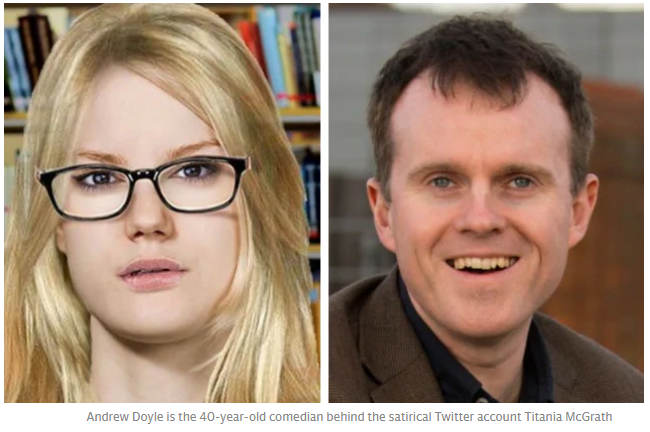
When a former Oxford University postgraduate student set up a satirical Twitter account in April 2018 under the name of Titania McGrath, he had no idea of the social media storm that was to follow.
Aiming to poke fun at the “identitarian left” who use “vicious tactics to push identity politics above all else”, the parody account quickly amassed over 180,000 social media followers.
After months of speculation, the individual behind it can finally be revealed – as a 40-year-old former private school teacher with a doctorate in Early Renaissance Poetry from Wadham College, Oxford.
Dr Andrew Doyle created the account to mock today’s “woke culture” that is obsessed with gender fluidity, identity politics and hates freedom of speech.
Describing Titania McGrath as “a militant vegan who thinks she is a better poet than William Shakespeare”, Mr Doyle told The Telegraph: “Woke is the concept that everything must be inclusive, inoffensive, that you always use the correct language and that you must be hyper aware of other people’s sensitivities.
“This social justice movement is full of people who are arrogant, narcissistic and very certain in themselves. The very idea that they could be wrong doesn’t even cross their mind. That to me is incredibly funny. I thought Titania could embody all of that.
“The majority of people are desperate for this culture to be mocked. The account has become so popular because people are sick of feeling that they can’t say what they want. It used to be the case that if someone spoke out of turn, you would say that’s a bit much, apologise and everyone would move on. Now you post a screenshot on Twitter and try to get someone fired.
“Titania is staying the stuff that most people want to say.”
“Last Dying Breath” – The Defence of Belgrade – Sabaton History 005
Sabaton History
Published on 7 Mar 2019When the Austro-Hungarians invaded Serbia in 1914, the Serbian defenders managed to set up an effective defence. A year later, a combined Austro-Hungarian and German offensive is launched to take Belgrade for once and for all. The Serbs mount a final defence as a last stand against the Central Powers.
Support Sabaton History on Patreon: https://www.patreon.com/sabatonhistory
Watch the official “Last Dying Breath” lyric video here: https://www.youtube.com/watch?v=USz2O…
Listen to Sabaton on Spotify: http://smarturl.it/SabatonSpotify
Official Sabaton Merchandise Shop: http://bit.ly/SabatonOfficialShopHosted by: Indy Neidell
Written by: Markus Linke and Indy Neidell
Directed by: Astrid Deinhard and Wieke Kapteijns
Produced by: Pär Sundström, Astrid Deinhard and Spartacus Olsson
Creative Producer: Joram Appel
Executive Producers: Pär Sundström, Joakim Broden, Tomas Sunmo, Indy Neidell, Astrid Deinhard, and Spartacus Olsson
Maps by: Eastory
Edited by: Iryna Dulka
Sound Editing by: Marek KaminskiEastory YouTube Channel: https://www.youtube.com/channel/UCEly…
Archive by: Reuters/Screenocean https://www.screenocean.comMusic by Sabaton.
Visual Sources:
Library of Congress
National Archives and Records Administration http://www.bildarchivaustria.at
Imperial War MuseumAn OnLion Entertainment GmbH and Raging Beaver Publishing AB co-Production.
© Raging Beaver Publishing AB, 2019 – all rights reserved.
From the comments:
Sabaton History
1 day ago
And we’re back with another video! This time we visit familiar territory for Indy: World War One. The Sabaton song “Last Dying Breath” [from the Last Stand album] is about the battle of Belgrade between the Serbian army and an Austro-Hungarian and German coalition. The speech made by Dragutin Gavrilović to his men is especially important in both this episode and in the song. Let us know in the comments what you think of the episode! We hope you like it!
Stephen Fry on Political Correctness and Clear Thinking
The Rubin Report
Published on 4 Apr 2016Stephen Fry (actor and comedian) joins Dave Rubin for a quick discussion about political correctness, clear thinking, V for Vendetta, free speech, and his decision to quit Twitter.
This is a bonus edition of ‘The Sit Down’ on The Rubin Report, filmed on the set of Larry King Now.
What are your thoughts? Comment below or tweet to Dave: https://twitter.com/RubinReport
Watch more on Ora TV: http://www.ora.tv/rubinreport
Find us on Patreon: https://www.patreon.com/rubinreport?ty=h
******
Stephen Fry
Actor, Author, and Comedian
******
Care about free speech? Tired of political correctness? Like discussions about big ideas? Watch Dave Rubin on The Rubin Report. Real conversations, unfiltered rants, and one on one interviews with some of the most interesting names in news and entertainment. Comedians, authors, and influencers join Dave each week to break down the latest in politics and current events. Real people, real issues, real talk.
March 7, 2019
Outbreak of the War Against Humanity – WW2 – WaH 001 – 5 March 1940
World War Two
Published on 6 Mar 2019When the Second World War breaks out, it is at first largely a war between one side of totalitarian aggressors against a portion of the democratic countries of the world defending other totalitarian states. From the first day of the war in Poland, as it already is in China, this will be a war against humanity.
Join us on Patreon: https://www.patreon.com/TimeGhostHistory
Or join The TimeGhost Army directly at: https://timeghost.tvFollow WW2 day by day on Instagram @World_war_two_realtime https://www.instagram.com/world_war_t…
Between 2 Wars: https://www.youtube.com/playlist?list…
Source list: http://bit.ly/WW2sourcesWritten and Hosted by: Spartacus Olsson
Produced and Directed by: Astrid Deinhard
Executive Producers: Bodo Rittenauer, Astrid Deinhard, Indy Neidell, Spartacus Olsson
Creative Producer: Joram Appel
Post Production Director: Wieke Kapteijns
Research by: Spartacus Olsson
Edited by: Spartacus Olsson and Wieke KapteijnsArchive by Screenocean/Reuters https://www.screenocean.com
A TimeGhost chronological documentary produced by OnLion Entertainment GmbH.
From the comments:
World War Two
47 minutes ago (edited)
READ THIS AND OUR RULES BEFORE COMMENTING Here it is with some slight delay – the first episode of War Against Humanity, written and hosted by Spartacus Olsson. Due to the delay, this video went public on YouTube and was not in Preview for the TimeGhost army – we apologise for this – the next WaH video will be given in advance. To be clear it is the support of the TimeGhost army that enables us to continuously expand and improve our coverage – if you haven’t already, consider signing up on timeghost.tv or https://www.patreon.com/TimeGhostHistory – Now, we have age-restricted this video of our own accord because of the extremely graphic content in some sections. While we are of the opinion that it should be available for anyone over the age of 15, YouTube does not offer us that possibility. We apologise to our viewers that are in that bracket, but we felt that it was more important to protect children from exposure to this kind of violence without the help of an adult to digest it.
Anti-semitism in Europe
Mark Steyn discusses the unexpected result of a few generations of Europeans feeling guilt for allowing the Holocaust to happen: renewed feelings of anti-semitism all around.
As Laura Rosen Cohen likes to say, everyone meets at Jew-Hate Junction: excitable young Mohammedans, secular polytechnic Euro-lefties, anti-globalist conspiracy theorists… It’s getting pretty crowded over there. As I wrote almost exactly a decade ago about the Ismalization of Europe:
There are already many points of cultural friction — from British banks’ abolition of children’s ‘piggy banks’ to the enjoining of public doughnut consumption by Brussels police during Ramadan. And yet on one issue there is remarkable comity between the aging ethnic Europeans and their young surging Muslim populations…
…Jews.
Young Muslims do not like Jews: that is a simple fact, and it’s a waste of everybody’s time denying it. Where Muslims predominate, Jews vanish – as in Molenbeek, across the canal from downtown Brussels. I remember from my childhood the main drag, the Chaussée de Gand (or Steenweg op Gent, if you’re Flemish, as my mum was), as a bustling strip with many Jewish businesses. But in the first decade of the 21st century they all disappeared, and their former owners chose to remain silent â because it was easier that way.
One hairdresser, for example, had “DIRTY KIKE” sprayed on his window and was punched in the face by a gang of half-a-dozen “youths”. So he went to the police and filed a complaint. One hour later, the “youths” returned and smashed all his hairdressing mirrors. His clients didn’t want to come after that, and so a 35-year business closed its doors.
Now they’re all gone.
Ethnic Continentals, on the other hand, do not like Muslims, and they see where this is headed, and it’s easy to blame Jews. The logic is not difficult: ‘Tween-wars Europeans would never have entertained for a moment the construction of mosques in every corner of their countries. But then the Holocaust happened, and “nationalism” got blamed, and mass immigration was instituted as a form of penance, and in one of history’s blacker jests the principal beneficiary of Holocaust guilt was Islam. So, in the newest variant of the oldest hatred, Jews get hated for the Islamization of Europe.
And then there’s simply the crude arithmetic of day-by-day remorseless demographic transformation in democratic societies: Muslims are where the votes are, and Jews aren’t. Which is why Jeremy Corbyn’s Labour Party is happy to while away the hours on such vital debates as the question of whether Hitler was a Zionist.
History Summarized: Thebes’ Greatest Accomplishment Ever
Overly Sarcastic Productions
Published on 25 May 2017This story, this ludicrous, insane story, is near and dear to my heart. It also conveniently explains what went on in the century between the Peloponnesian War and Philip II conquering Greece — this story is pretty much it. Speaking of, I hope to cover all that Macedonian shenaniganery at ~some point~
PATREON: www.patreon.com/user?u=4664797
Find us on Twitter @OSPYouTube!
March 5, 2019
If Brexit doesn’t happen, will there be a meaningful reaction?
The British government under Prime Minister Theresa May believes — or appears to believe — that with sufficient delay, muddle, and obfuscation, the voters will mutter and grumble but in the end do nothing. David Betz and MLR Smith believe differently:

What do you get when you have a Conservative party that doesn’t conserve, a Labour party that doesn’t represent the interests of the working class, and a Liberal Democrat Party that is neither liberal nor democratic?
The answer is, a pretty accurate description of the current British political landscape. Here are different kinds of political ice cream for sale, but when licked they all turn out to have roughly the same unpalatable taste: a bland, socially progressive, anti-traditionalist, globalist, corporatist flavour. And, you the people, don’t ask for anything else! We know how to make ice cream. You don’t.
Of course, it is Brexit and the reactions of the political classes to it, that most clearly reveals the startling democratic deficit in the United Kingdom. Brexit is, though, not the cause of political strife. It is merely the symptom that has brought these latent anti-democratic inclinations to the surface. Arguably, they have always been there in one form or another since ancient times.
In November 2016, Nigel Farage told the BBC’s Andrew Marr: ‘Believe you me, if the people in the country think they’re going to be cheated, they’re going to be betrayed, then we will see political anger the likes of which none of us in our lifetimes have ever witnessed in this country’. It was an obvious point and true. Yet the striking thing about such a warning has been the degree to which national politicians and media have tried to ignore it.
How, we might wonder, has it all come to this and, just as vitally, what are the possible long-term consequences?
The government is gambling that reaction will be fierce, but localized and short-lived, and that the establishment can ride out the storm with little or no real problem. They may be seriously underestimating the anger and resentment of a voting public who are being explicitly denied the outcome they chose. But will there be serious outbreaks of violence?
Cumulatively, over the past three decades, then, the empirically demonstrable lesson is that violence and threats work. Crudely, there is simply no arguing with the fact that violence is the deus ex machina for changing the way people think and act. Physical force is a method of political communication, and when it is sustained it invariably succeeds in changing minds and changing policies.
Under the threat of violence, it is often easier for governments to knuckle under for the sake of maintaining a semblance of peace, to wax piously about societal cohesion and resilience, and to climb onwards as though the status quo ante were not crumbling beneath them. The progressive factions of academia, culture, and media cheer them for it. So, if the populace don’t really react in the face of such threats and actual violence, and merely light candles and hug teddy bears, then the bet of the political classes is sustained. They have gambled correctly.
But do enough people feel that violence is their only resort when the government refuses to do what the voters want? Might things go beyond mere loud, angry protests and transition towards rioting? Worse?
Thus, we come to the ultimate gamble of the political class, one that appears strongly to be operative in the minds of many in Parliament, namely, that Britons do not rebel and, therefore, faced with a fait accompli they will lump it even if they do not like it. Unlike the French, Italians, or Germans each of which nation is prone in its own way to violent mass spasms of political passion, the British are a phlegmatic people given to the sensible path. So the cliché goes.
It is true to an extent that revolution is a continental phenomenon that does not travel well across the English Channel — British governments have been better at responding to incipient uprisings, sometimes deflecting them, betimes co-opting their leaders, but mostly muddling through by accommodating their demands within the parameters of the status quo. This is a system that has succeeded precisely because parliamentary democracy, for over 300 years now, is able to internalise the will of the people, even when faced with threats of violent revolt, be it in the demands of Chartists, Irish nationalists or suffragettes.
Should we be so sanguine to believe that the British political system, for so long a beacon of stability, is immune from the turbulence that has afflicted other societies? As Remainers are so keen to remind us, we are not an island whose fortunes and follies are separate from those of our near-neighbours. If people, goods, and ideas flow freely across the borders of Europe why should not the concept of the Yellow Jackets too? White Van Man voted strongly for Brexit, after all. Why should there be an Alternative for Germany movement but not an alternative for Britain, even though the people were asked to choose one and did?
March 4, 2019
Irish Potato Famine – Black ’47 – Extra History – #3
Extra Credits
Published on 2 Mar 2019Watching the Irish suffer from the view of London, Sir Charles Trevelyan believed that the potato famine was part of God’s will. Inspired by the meritocracy-based philosophy of starvation that Thomas Malthus held, Treveylan created a relief plan with the sole goal of protecting the markets, and not the people. Thus the new year of “Black ’47” brought chaos and horror to the Irish people.
Join us on Patreon! http://bit.ly/EHPatreon
The history-pedants’ guide to The Last Kingdom – episode one
Lindybeige
Published on 11 Feb 2016The Last Kingdom – here I review the authenticity of episode one of this television series set in medieval England.
Support me on Patreon: https://www.patreon.com/Lindybeige
The Last Kingdom is a television series, eight hours long, based on the books by Bernard Cornwell. Here, I give the first episode the Lindybeige treatment – that is to say I go through it and in smarmy way point out various things it gets wrong.
People have pointed out in the comments that one character, Uhtred father of Uhtred, whom I describe as a ‘king’, is technically not a king at this point in the story. This is true. I decided not to spend half a minute of screen-time explaining the distinction. He is of a line of kings, has hopes to gain the title ‘king’ again, and is the ruler of Bernicia, and commander of the main force that engages in the battle, and is a very senior nobleman, variously described as ‘king’, ‘earl’, ‘lord’, and ‘ealdorman’.
Lindybeige: a channel of archaeology, ancient and medieval warfare, rants, swing dance, travelogues, evolution, and whatever else occurs to me to make.
▼ Follow me…
Twitter: https://twitter.com/Lindybeige I may have some drivel to contribute to the Twittersphere, plus you get notice of uploads.
website: http://www.LloydianAspects.co.uk
March 3, 2019
Hitler Plans His New Wars – WW2 – 027 – March 2 1940
World War Two
Published on 2 Mar 2019The German plans for the invasion of Western Europe start taking shape. Manstein’s plan is innovative, bold and controversial, but Hitler likes it. If everything goes according to his plan, the Germans will be celebrating their victory in Paris come spring.
Join us on Patreon: https://www.patreon.com/TimeGhostHistory
Or join The TimeGhost Army directly at: https://timeghost.tvFollow WW2 day by day on Instagram @World_war_two_realtime https://www.instagram.com/world_war_t…
Between 2 Wars: https://www.youtube.com/playlist?list…
Source list: http://bit.ly/WW2sourcesWritten and Hosted by: Indy Neidell
Produced and Directed by: Spartacus Olsson and Astrid Deinhard
Executive Producers: Bodo Rittenauer, Astrid Deinhard, Indy Neidell, Spartacus Olsson
Creative Producer: Joram Appel
Research by: Indy Neidell
Edited by: Iryna Dulka
Map animations: EastoryPortrait colorizations by Norman Stewart.
Photos of the Winter War are mostly from the Finnish Wartime Photograph Archive (SA-Kuva).
Eastory’s channel: https://www.youtube.com/channel/UCEly…
Archive by Screenocean/Reuters https://www.screenocean.comA TimeGhost chronological documentary produced by OnLion Entertainment GmbH.
Fake News in the Radio Age | Between 2 Wars | 1926 Part 1 of 2
TimeGhost History
Published on 28 Feb 2019Modernization caused a communication revolution in the 1920’s with the mass adaptation of the radio, with all sorts consequences for the entertainment industry as well as the political game.
Join us on Patreon: https://www.patreon.com/TimeGhostHistory
1919 Between Two Wars Episodes on post war technology: https://www.youtube.com/edit?o=U&vide…
Hosted by: Indy Neidell
Directed by: Spartacus Olsson
Written by: Spartacus Olsson
Produced by: Astrid Deinhard
Executive Producers: Bodo Rittenauer, Astrid Deinhard, Indy Neidell, Spartacus Olsson
Creative Producer: Joram Appel
Edited by: Wieke Kapteijns
Research by: Spartacus OlssonCredits for this episode: Bundesarchive | Old Time Radio Researchers Group | Library of Congress
Colorized Pictures by Olga Shirnina and Norman Stewart
Thumbnail by Klimbim/Olga Shirnina: https://klimbim2014.wordpress.com
Norman’s pictures https://oldtimesincolor.blogspot.com/Video Archive by Screenocean/Reuters http://www.screenocean.com
A TimeGhost chronological documentary produced by OnLion Entertainment GmbH


