
The Tank Museum
Published on 22 Dec 2017Development of Matilda I began in 1935. Production began just before the outbreak of the Second World War in July 1939 and 139 vehicles were delivered by August 1940. 97 of these were lost after the evacuation of troops from Dunkirk, without having had much use. The rest were removed from British service in 1941, but captured vehicles stayed in German service in domestic security roles.
Support the work of The Tank Museum on Patreon: ► https://www.patreon.com/tankmuseum
Or donate http://tankmuseum.org/support-us/donateVisit The Tank Museum SHOP: ►https://tankmuseumshop.org/
Twitter: ► https://twitter.com/TankMuseum
Tiger Tank Blog: ► http://blog.tiger-tank.com/
Tank 100 First World War Centenary Blog: ► http://tank100.com/ #tankmuseum #tanks
March 3, 2019
Tank Chats #43 Matilda I | The Tank Museum
March 2, 2019
Rommel, German Press and Polish Resistance – WW2 – OOTF 001
World War Two
Published on 28 Feb 2019This is the very first episode of Out of the Foxholes, in which we answer questions from the community. In this first edition, we’ll talk about the early-war career of Erwin Rommel, German press on the invasion of Poland and the birth of Polish resistance movements after the German occupation in 1939.
Join us on Patreon: https://www.patreon.com/TimeGhostHistory
Or join The TimeGhost Army directly at: https://timeghost.tv
Between 2 Wars: https://www.youtube.com/playlist?list…
Written and Hosted by: Indy Neidell
Produced and Directed by: Spartacus Olsson and Astrid Deinhard
Creative Producer: Joram Appel
Executive Producers: Bodo Rittenauer, Astrid Deinhard, Indy Neidell, Spartacus Olsson
Research by: Joram Appel and Spartacus Olsson
Edited by: Joram Appel and Spartacus OlssonA TimeGhost chronological documentary produced by OnLion Entertainment GmbH
From the comments:
World War Two
20 hours ago
Hey all! We are here with the very first episode of Out of the Foxholes in which we answer YOUR questions. Because we would like to be a little more reactive, Spartacus and Joram will also occasionally answering the questions, but rest assured, we’ll never replace Indy. Do you have a question on your own? Don’t just write it in the comments, but submit it on our community Forum by adding it as a topic (read the instructions first please) -> https://community.timeghost.tv/c/Out-of-the-Foxholes-QsCheers,
Joram
Liberal democracy and the ungovernable voters
In Quillette, Ross Stitt discusses the apparent weakness of western liberal democracies and the rise of the ungovernables:
2019 marks the thirtieth anniversary of Francis Fukuyama’s seminal essay for the National Interest “The End of History?” Its central hypothesis was that we were witnessing “the end point of mankind’s ideological evolution and the universalization of Western liberal democracy as the final form of human government.” That looked plausible in 1989, particularly when the Berlin Wall fell just months after the essay’s release. Thirty years later — not so much.
To be fair to Fukuyama, he never suggested that the world had seen the end of geopolitical conflict or that democracies would experience no more of Macmillan’s “events.” Today, he continues to view liberal democracy as the best form of government, but he is less optimistic about its robustness. It’s hard to disagree with him. The Brexit chaos, the Trump presidency, the collapse of support for centrist parties across Europe, and the pervasive rise of populism and nationalism, all point to the growing fragility of liberal democracy.
Why is this happening now? The usual response is to blame it all on the politicians. Leaders like Orban and Trump are subverting the institutions at the heart of liberal democracy. Political parties like Alternative für Deutschland and the National Rally are promoting illiberal and xenophobic policies. If only we had better leaders, democracy would flourish — so goes the argument.
But bad politicians are hardly a novelty. Two thousand years ago, Cicero declared that “Politicians are not born: they are excreted.” Shakespeare’s Hamlet described a politician as “one who would circumvent God.” If we’ve always had bad politicians, then there must be other explanations for the current downward trajectory of liberal democracy. The four explanations most commonly proffered are greater competition from alternative political models, the increased complexity of modern democratic politics in a post-material world, the constraints on democratic states imposed by globalisation, and the emergence of a range of international threats like climate change and terrorism.
But there is another explanation for liberal democracy’s troubles that is much less talked about and, in my view, more powerful — the fact that voters have become more difficult to govern.
Post WW1 Violence Theory – Paris Peace Conference I BEYOND THE GREAT WAR
The Great War
Published on 28 Feb 2019In our first episode of our new format BEYOND THE GREAT WAR Jesse answers two questions. The first one is in regards to the Brutalization Theory that tries to explain the level of violence during and after the First World War. In our second question, we talk about the start of the Paris Peace Conference 100 years ago.
» SUPPORT THE CHANNEL
Patreon: https://www.patreon.com/thegreatwar
Merchandise: https://shop.spreadshirt.de/thegreatwar/» SOURCES
Audoin-Rouzeau, Stéphane and Annette Becker. 14-18, retrouver la guerre (Npp : Gallimard, 2000).Depechin, Annie. “La conférence de la paix,” in Stéphane Audoin-Rouzeau and Jean-Jacques Becker, eds. Encyclopédie de la Grande guerre 1914-1918 (Paris : Bayard, 2013): 935-948.
Gerwarth, Robert. “The Continuum of Violence,” in Jay Winter, ed. The Cambridge History of the First World War, vol. 2: The State (Cambridge: Cambridge University Press, 2014): 638-662.
Gerwarth, Robert. The Vanquished. Why the First World War Failed to End, 1917-1923 (Penguin, 2017).
Konrad, Helmut. “Drafting the Peace,” in Jay Winter, ed. The Cambridge History of the First World War, vol. 2: The State (Cambridge: Cambridge University Press, 2014): 606-637.
Mosse, George. Gefallen für das Vaterland. Nationales Heldentum und namenloses Sterben (Stuttgart: Klett-Cotta, 1993). English version: Fallen Soldiers. Reshaping the Memory of the World Wars (New York: Oxford UP, 1990).
Prost, Antoine. “Les limites à la brutalisation : tuer sur le front occidental, 1914-1918,” Vingtième Siècle. Revue d’histoire (2004/1 no 81) : 5-20. Accessed at https://www.cairn.info/revue-vingtiem…
Sharp, Alan. “The Paris Peace Conference and its Consequences,” in in 1914-1918 online. International Encyclopedia of the First World War. https://encyclopedia.1914-1918-online…
»CREDITS
Presented by: Jesse Alexander
Written by: Jesse Alexander
Director: Toni Steller & Florian Wittig
Director of Photography: Toni Steller
Sound: Toni Steller Editing: Toni Steller
Mixing, Mastering & Sound Design: http://above-zero.com
Motion Design: Christian Graef – GRAEFX
Maps: Daniel Kogosov (http://patreon.com/Zalesky)
Research by: Jesse Alexander
Fact checking: Florian Wittig
Channel Design: Alexander Clark
Original Logo: David van StepholdA Mediakraft Networks Original Channel
Contains licenced material by getty images
All rights reserved – Real Time History GmbH i.Gr. 2019
From the comments:
The Great War
1 day agoICYM the special message at the end of the video: THANK YOU FOR 1 MILLION SUBSCRIBERS! And we also hope you like our new format BEYOND THE GREAT WAR. It will also replace what used to be special episodes and biographies. Just ask us a question about a person, event or country and we will see that we answer it in the same depth that our special episodes had. Simple as that.
March 1, 2019
“To Hell and Back” – Audie Murphy – Sabaton History 004
Sabaton History
Published on 28 Feb 2019In “To Hell and Back” (on the Heroes album), Sabaton sings about an actor, singer and one of the most remarkable heroes of World War Two. Audie Murphy served and fought in many different locations of the Second World War, which resulted in him being the most decorated soldier in the US army during WW2. “To Hell and Back” is about his actions during and after the landings at Anzio during the Allied campaign in Italy.
Support Sabaton History on Patreon: https://www.patreon.com/sabatonhistory
Watch the official video for “To Hell And Back” here: https://www.youtube.com/watch?v=RhmHS…
Hosted by: Indy Neidell
Written by: Markus Linke and Indy Neidell
Directed by: Astrid Deinhard and Wieke Kapteijns
Produced by: Pär Sundström, Astrid Deinhard and Spartacus Olsson
Creative Producer: Joram Appel
Executive Producers: Pär Sundström, Joakim Broden, Tomas Sunmo, Indy Neidell, Astrid Deinhard, and Spartacus Olsson
Maps by: Eastory
Edited by: Iryna Dulka
Sound Editing by: Marek KaminskiEastory YouTube Channel: https://www.youtube.com/channel/UCEly…
Archive by: Reuters/Screenocean https://www.screenocean.comMusic by Sabaton.
Dennis Henson – sirnossi@gmx.net
Youtube: https://www.youtube.com/user/SirNossi
Twitch: https://www.twitch.tv/SirNossiAn OnLion Entertainment GmbH and Raging Beaver Publishing AB co-Production.
© Raging Beaver Publishing AB, 2019 – all rights reserved.
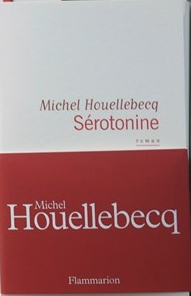
Theodore Dalrymple on Michel Houellebecq: “Houellebecq runs an abattoir for sacred cows”
At the New English Review:
Not reading many contemporary French novels, I am not entitled to say that Michel Houellebecq is the most interesting French novelist writing today, but he is certainly very brilliant, if in a somewhat limited way. His beam is narrow but very penetrating, like that of a laser, and his theme an important, indeed a vital one: namely the vacuity of modern life in the West, its lack of transcendence, lived as it is increasingly without religious or political belief, without a worthwhile creative culture, often without deep personal attachments, and without even a struggle for survival. Into what Salman Rushdie (a much lesser writer than Houellebecq) called “a God-shaped hole” has rushed the search for sensual pleasure which, however, no more than distracts for a short while.
Something more is needed, but Western man — at least Western man at a certain level of education, intelligence and material ease — has not found it. Houellebecq’s underlying nihilism implies that it is not there to be found. The result of this lack of transcendent purpose is self-destruction not merely on a personal, but on a population, scale. Technical sophistication has been accompanied, or so it often seems, by mass incompetence in the art of living. Houellebecq is the prophet, the chronicler, of this incompetence.Even the ironic title of his latest novel, Sérotonine, is testimony to the brilliance of his diagnostic powers and his capacity to capture in a single word the civilizational malaise which is his unique subject. Serotonin, as by now every self-obsessed member of the middle classes must know, is a chemical in the brain that acts as a neurotransmitter to which is ascribed powers formerly ascribed to the Holy Ghost. All forms of undesired conduct or feeling are caused by a deficit or surplus or malalignment of this chemical, so that in essence all human problems become ones of neurochemistry.
On this view, unhappiness is a technical problem for the doctor to solve rather than a cause for reflection and perhaps even for adjustment to the way one lives. I don’t know whether in France the word malheureux has been almost completely replaced by the word déprimée, but in English unhappy has almost been replaced by depressed. In my last years of medical practice, I must have encountered hundreds, perhaps thousands, of depressed people, or those who called themselves such, but the only unhappy person I met was a prisoner who wanted to be moved to another prison, no doubt for reasons of safety.
Houellebecq’s one-word title captures this phenomenon (a semantic shift as a handmaiden to medicalisation) with a concision rarely equalled. And indeed, he has remarkably sensitive antennae to the zeitgeist in general, though it must be admitted that he is most sensitive to those aspects of it that are absurd, unpleasant, or dispiriting rather than to any that are positive.
Development of the British Tank Arm, 1918-1939
The_Chieftain
Published on 5 Jan 2019Supporting the World War Two channel, https://www.youtube.com/channel/UCP1A…
The second in the series of videos discussing how various nations spent the time in between the two wars analyzing what did or did not work for their tank doctrines, how they were developed, and what they came up with. This video (obviously) looks at the British, where budgets and votes were far more important than tank capability.
References:
Mechanised Force, David Fletcher
The Challenge of Change, Harold Winton
Military Innovation in the Interwar Period, Williamson Murray
The Business of Tanks, G. Mcleod Ross
Men, Ideas and Tanks, J.P. Harris
February 28, 2019
First Crusade Part 2 of 2
Epic History TV
Published on 31 Mar 2017Part 2 of Epic History TV’s story of the First Crusade continues with the Siege of Antioch. The Crusaders endure immense hardships outside the city walls, but finally take Antioch thanks to a ruse by Bohemond of Taranto. Against the odds, and inspired by their recent discovery of a relic believed to be the ‘Holy Lance’, the Crusaders then defeat the Seljuk army of Kur Burgha. After disagreements within the Crusader camp, the army finally moves on to Jerusalem in the spring of 1099. During a full-scale assault of the city walls, Godfrey of Bouillon’s troops gain a foothold in the defences, and Crusader troops pour into the city. A bloodbath follows. Victory results in the creation of four Crusader states, but their existence is precarious, surrounded by hostile Muslim powers, who will one day return with a vengeance.
Produced in partnership with Osprey Publishing
https://ospreypublishing.com/Campaign: The First Crusade 1096–99
https://ospreypublishing.com/the-firs…Essential Histories: The Crusades
https://ospreypublishing.com/the-crus…The Armies of Islam 7th–11th Centuries
https://ospreypublishing.com/the-armi…Armies of the Crusades
https://ospreypublishing.com/armies-o…Music with thanks to Filmstro: https://www.filmstro.com/
Get 20% off an annual license! Use our exclusive coupon code: EPICHISTORYTV_ANNImage credits – via Flickr under Creative Commons CC-BY-SA 2.0
Sky – Anyul Rivas
Wooded Hills – Alexander Annenkov
Dramatic Fields – Antonio Caiazzo
Twin peaks of Mount Ararat – Adam JonesPlease help me make more videos at Patreon: https://www.patreon.com/EpicHistoryTV
QotD: Lawrence of the Arabian Nights
The everlasting battle stripped from us care of our own lives or of others’. We had ropes about our necks, and on our heads prices which showed that the enemy intended hideous tortures for us if we were caught. Each day some of us passed; and the living knew themselves just sentient puppets on God’s stage: indeed, our taskmaster was merciless, merciless, so long as our bruised feet could stagger forward on the road. The weak envied those tired enough to die; for success looked so remote, and failure a near and certain, if sharp, release from toil. We lived always in the stretch or sag of nerves, either on the crest or in the trough of waves of feeling. This impotency was bitter to us, and made us live only for the seen horizon, reckless what spite we inflicted or endured, since physical sensation showed itself meanly transient. Gusts of cruelty, perversions, lusts ran lightly over the surface without troubling us; for the moral laws which had seemed to hedge about these silly accidents must be yet fainter words. We had learned that there were pangs too sharp, griefs too deep, ecstasies too high for our finite selves to register. When emotion reached this pitch the mind choked; and memory went white till the circumstances were humdrum once more.
Such exaltation of thought, while it let adrift the spirit, and gave it licence in strange airs, lost it the old patient rule over the body. The body was too coarse to feel the utmost of our sorrows and of our joys. Therefore, we abandoned it as rubbish: we left it below us to march forward, a breathing simulacrum, on its own unaided level, subject to influences from which in normal times our instincts would have shrunk. The men were young and sturdy; and hot flesh and blood unconsciously claimed a right in them and tormented their bellies with strange longings. Our privations and dangers fanned this virile heat, in a climate as racking as can be conceived. We had no shut places to be alone in, no thick clothes to hide our nature. Man in all things lived candidly with man.
The Arab was by nature continent; and the use of universal marriage had nearly abolished irregular courses in his tribes. The public women of the rare settlements we encountered in our months of wandering would have been nothing to our numbers, even had their raddled meat been palatable to a man of healthy parts. In horror of such sordid commerce our youths began indifferently to slake one another’s few needs in their own clean bodies — a cold convenience that, by comparison, seemed sexless and even pure. Later, some began to justify this sterile process, and swore that friends quivering together in the yielding sand with intimate hot limbs in supreme embrace, found there hidden in the darkness a sensual co-efficient of the mental passion which was welding our souls and spirits in one flaming effort. Several, thirsting to punish appetites they could not wholly prevent, took a savage pride in degrading the body, and offered themselves fiercely in any habit which promised physical pain or filth.
T.E. Lawrence, Seven Pillars of Wisdom, 1926.
February 27, 2019
First Crusade Part 1 of 2
Epic History TV
Published on 13 Jan 2017The First Crusade was one of the most extraordinary, bloody and significant episodes in medieval history. It began with an appeal for aid from the Christian Byzantine Empire, threatened by the rising power of the Muslim Seljuk Turks. But when Pope Urban II preached a sermon at Clermont in 1095, the result was unlike anything ever seen before. The Pope offered spiritual salvation to those willing to go east to aid their fellow Christians in a holy war, and help liberate Jerusalem from Muslim rule. Knights and peasants alike signed up in their thousands, leading to the disastrous People’s, or Peasants’, Crusade, then to a much more organised and powerful Princes’ Crusade. Their forces gathered at Constantinople, where they made an uneasy alliance with Byzantine Emperor Alexius I Comnenus. Entering Anatolia, they helped to win back the city of Nicaea, then won a decisive but hard-fought victory at Dorlyaeum, before marching on the great city of Antioch…
Produced in partnership with Osprey Publishing
https://ospreypublishing.com/Campaign: The First Crusade 1096–99
https://ospreypublishing.com/the-firs…Essential Histories: The Crusades
https://ospreypublishing.com/the-crus…The Armies of Islam 7th–11th Centuries
https://ospreypublishing.com/the-armi…Armies of the Crusades
https://ospreypublishing.com/armies-o…Music with thanks to Filmstro: https://www.filmstro.com/
Get 20% off an annual license! Use our exclusive coupon code: EPICHISTORYTV_ANNImage credits – via Flickr under Creative Commons CC-BY-SA 2.0
Sky – Anyul Rivas
Wooded Hills – Alexander Annenkov
Dramatic Fields – Antonio Caiazzo
Twin peaks of Mount Ararat – Adam JonesPlease help me make more videos at Patreon: https://www.patreon.com/EpicHistoryTV
February 26, 2019
Laissez-faire versus “Fairtrade”
In the Guardian, a sad tale of the fading bright hopes of the (relatively small number of) affluent westerners who passionately supported the “Fairtrade” movement:
When, in 2017, Sainsbury’s announced that it was planning to develop its own “fairly traded” mark, more than 100,000 people signed a petition condemning the move. Today, on the eve of Fairtrade Fortnight, the fact that most supermarkets have moved away from the standards developed by the Fairtrade Foundation is worrying.
While some grocery chains have sought the foundation’s stamp of approval, many have gone their own way. This means most consumers have little sense of which organisation is doing what to protect the wages and rights of developing world workers. Over the next two weeks, the foundation plans to focus its publicity efforts on cocoa farmers in west Africa and the way the Fairtrade mark can improve their lives.[…]
That is a sad situation. After the great financial crash of 2008, a commodity boom that lasted from 2013 to 2017 turned into a slump that has robbed farmers and developing world governments of vital cash. Just as they were managing to stabilise their finances and set aside money to invest, the world price tumbled and wiped out their profit. Fairtrade practices protect farmers from this sort of setback and allow them to plan for the future.
Of course they have their critics. These are most mostly from the US – people who favour unfettered markets and seek to undermine the Fairtrade ideal, saying it is a form of protectionism that dampens innovation and ultimately ruins farms.
Theirs is an almost religious adherence to the free market that discounts the gains in stability and security that Fairtrade provides, and the scope of the community premium to promote universal education and the rights of women.
But without large employers making strides to adopt the standardised and transparent Fairtrade practices put forward by the foundation, it will be left to consumers to drive the project forward.
At the Continental Telegraph, Tim Worstall responds:
The Guardian tells us that the Great White Hope of global trade, Fairtrade, isn’t in fact working. On the basis that no one seems to be doing very much of it. To which the answer is great – for the only fair trade is laissez faire.
This does not mean that Fairtrade should not have been tried – to insist upon that would be to breach our basic insistence upon the value of peeps just getting on with doing what they want, laissez faire itself. But the very value of that last is that we go try things out, see whether they work and if they don’t we stop doing them. If they do then great, we do more of them.
[…]
So, trying out Fairtrade, why not? Let’s go see how many other people feel the same way? In exactly the same way we find out whether people like Pet Rocks, skunk or Simon Cowell. Product gets put on the market we see whether it adds to human welfare or not. If people value it – and revealed preferences please, by actually buying it – at more than the use of those scarce resources in other uses then that’s adding to human welfare and long may it thrive. If it doesn’t, if it’s subtracting value from the human experience, then we’ll stop doing it as those trying go bust.
This is not an aberration of the system it is the system and it’s why laissez faire works. Peeps get to do whatever and we keep doing more of what works, less of what doesn’t.
Fairtrade? No, I never thought it was going to work as anything other than virtue signalling for Tarquin and Jocasta but that’s fine. Why shouldn’t Tarquin and Jocasta gain their jollies by virtue signalling? As it turns out, now that we’ve tried it, no one else gives a faeces*. So, we can stop. Except, obviously enough, for those specialist outlets like the Co Op where the odd can still gain their jollies. It being that very mark of a laissez faire, liberal, society that the jollies of the odd are still catered to in due proportion to the desire for them.
*From Gibbon, all the fun stuff’s in Latin.
Irish Potato Famine – The Corn Laws – Extra History – #2
Extra Credits
Published on 23 Feb 2019Prime Minister Robert Peel was caught between the political pressures of the Whigs and the Tories. He repealed the corn laws in Britain to keep food prices low in Britain, with the secondary goal of famine relief for Ireland, but that bureaucratic multi-tasking would not help the Irish very much…
Join us on Patreon! http://bit.ly/EHPatreon
February 25, 2019
Modern parenting – too many helicopters yield lots of snowflakes
It’s a commonplace assertion that children today have less unscheduled, unsupervised opportunities for play and exploration, and parents have been indoctrinated into the belief that the world has become a much more dangerous place and their kids need 24/7 protection from those myriad dangers. “Helicopter” parenting is a rational response to this indoctrination, but it comes with costs to the growth and maturity of the next generation. More than a decade ago, I posted this graphic showing how each generation has been more protective of their own children than their parents had been for them:
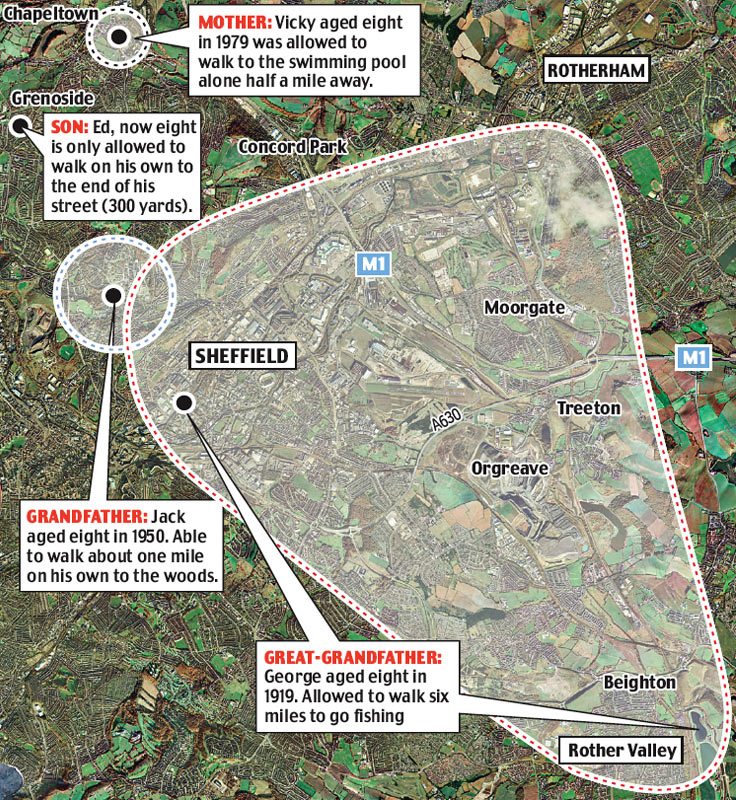
The problem has been getting worse over time, as Rob Creasy and Fiona Corby describe:
Children growing up in the UK are said to be some of the unhappiest in the industrialised world. The UK now has the highest rates of self harm in Europe. And the NSPCC’s ChildLine Annual Review lists it as one of the top reasons why children contact the charity.
Children’s mental health has becomes one of British society’s most pressing issues. A recent report from the Prince’s Trust highlights how increasing numbers of children and young people are unhappy with their lives, sometimes with tragic consequences.
This is a generation of young people that has been labelled as “snowflakes” – unable to handle stress and more prone to taking offence. They are also said to have less psychological resilience than previous generations. And are thought to be too emotionally vulnerable to cope with views that challenge their own.
[…]
Children’s lives are being stifled. No longer are children able to spend time with friends unsupervised, explore their community or hang around in groups without being viewed with suspicion. Very little unsupervised play and activity occurs for children in public spaces or even in homes – and a children’s spare time is often eaten up by homework or organised activity.
This is further impacted by the way children are taught in schools and how pressure to succeed has led to a taming of education. But if children are never challenged, if they don’t ever experience adversity, or face risks then it is not surprising they will lack resilience.
HMCS Bonaventure of the Royal Canadian Navy
Sneaky Loon
Published on 9 Apr 2017The Bonaventure was purchased from the Royal Navy to replace HMCS Magnificent because the Bonaventure could operate fighter jets to conduct anti-submarine activities.
February 24, 2019
Manstein Makes a Plan and Hitler has a Man Crush – WW2 – 026 – February 23 1940
World War Two
Published on 23 Feb 2019German General Erich von Manstein has a cunning plan. And as it happens, it’s just how Hitler likes it. This week, the German war plans change quite drastically. In the meantime, the Soviet Red Army continues it push through the Finnish Mannerheim line, except for a stubborn Finnish pocket of resistance at Taipale.
Join us on Patreon: https://www.patreon.com/TimeGhostHistory
Or join The TimeGhost Army directly at: https://timeghost.tvFollow WW2 day by day on Instagram @World_war_two_realtime https://www.instagram.com/world_war_t…
Between 2 Wars: https://www.youtube.com/playlist?list…
Source list: http://bit.ly/WW2sourcesWritten and Hosted by: Indy Neidell
Produced and Directed by: Spartacus Olsson and Astrid Deinhard
Executive Producers: Bodo Rittenauer, Astrid Deinhard, Indy Neidell, Spartacus Olsson
Creative Producer: Joram Appel
Research by: Indy Neidell
Edited by: Iryna Dulka
Map animations: EastoryPortrait colorizations by Norman Stewart.
Photos of the Winter War are mostly from the Finnish Wartime Photograph Archive (SA-Kuva).
Photo of Sartre by Government Press Office Israel, https://www.flickr.com/people/6906147….Eastory’s channel: https://www.youtube.com/channel/UCEly…
Archive by Screenocean/Reuters https://www.screenocean.comA TimeGhost chronological documentary produced by OnLion Entertainment GmbH.
From the comments:
World War Two
2 days ago (edited)
While the Winter War seems to be coming to an end, new plans are being crafted in Germany to invade most of their neighbours. And before someone asks: the Swastika in the thumbnail is NOT used as a political statement of some sort. Just like in all of our earlier episodes, we use relevant symbols from the different armies and powers to illustrate the topic of the thumbnail. And yes, we are aware of regulation in Germany and Austria regarding the use of Nazi symbols, but as long as they are used in an historical context for educational purposes, which it clearly is, showing this symbol is allowed.And before I forget: the release of this episode marks exactly half a year since we have started doing World War Two on 1 September 2018/1939. A lot has changed in these months, and there are still many exciting new things on the horizon. The series is about to enter a very eventful time, we are going to start with some new projects which you’ll hear about soon and there are more specials coming – which we hope to be able to bring to you on a regular basis as soon as possible. We hope you enjoy the episode!
Cheers, Joram


