
World War Two
Published 26 Feb 2022Erich von Manstein’s Axis counterattack on the Eastern Front begins this week and right away smashes through the Red Army lines, threatening all the recent Soviet gains. The Allies — the Americans — also suffer a big defeat in Tunisia at the Kasserine Pass, though in the Pacific it is the Americans who occupy the Russell Islands.
(more…)
February 27, 2022
The Blitzkrieg is Back – WW2 – 183 – February 26 1943
Comments Off on The Blitzkrieg is Back – WW2 – 183 – February 26 1943
February 26, 2022
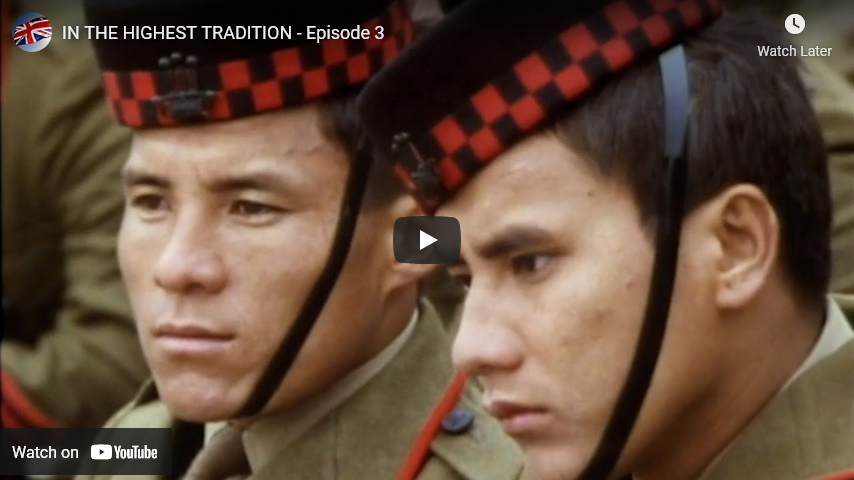
In The Highest Tradition — Episode 3
British Army Documentaries
Published 27 Oct 2021This third episode in a six-part series delving into the world of regimental tradition looks Gurkhas’ history and commitment to the British Army. They swear their oath of allegiance directly to Her Majesty the Queen and continue to revere “The Queen’s Truncheon”, which was awarded to them by Queen Victoria in recognition of their service during the Indian Mutiny.
© 1989
This production is for viewing purposes only and should not be reproduced without prior consent.
This film is part of a comprehensive collection of contemporary Military Training programmes and supporting documentation including scripts, storyboards and cue sheets.
All material is stored and archived. World War II and post-war material along with all original film material are held by the Imperial War Museum Film and Video Archive.
Comments Off on In The Highest Tradition — Episode 3
“The [House of] Commons of 1621 would get completely out of control — all thanks to beer”
In the latest Age of Invention newsletter from Anton Howes, we’re still back in the reign of King James I of England (also at the same time King James VI of Scotland), and the king has a financial woe that has forced him once again to try getting Parliament to vote him the funds he needs to wage war:
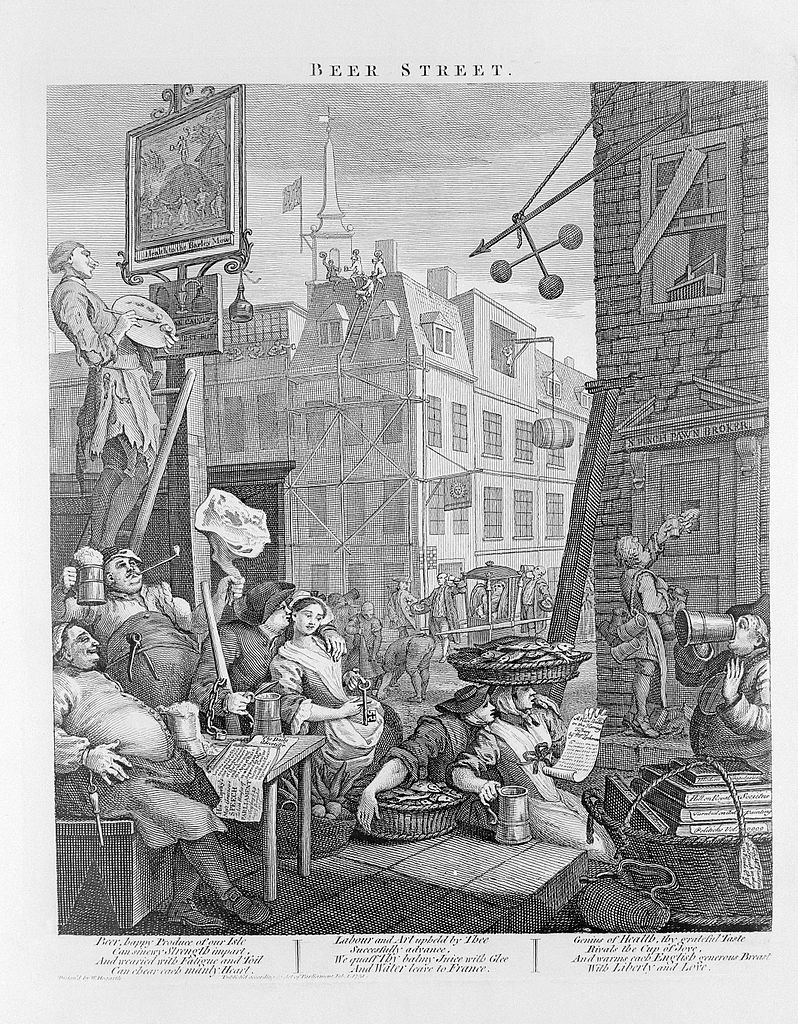
Beer Street, from Beer Street and Gin Lane by William Hogarth. The picture is a counterpoint to the more powerful Gin Lane — Hogarth intended Beer Street to be viewed first to make Gin Lane more shocking — but it is also a celebration of Englishness and depicts of the benefits of being nourished by the native beer.
Wikimedia Commons.
1620 was a dramatic year for England. As I mentioned last time, the rashness of the king’s son-in-law threatened to pull the country into a major European conflict. Religion, honour, and family — James I’s grandchildren were set to lose their inheritance, the Palatinate of the Rhine — dictated that the king should break his decades-long habit of peace. But war was hugely expensive, and the king already heavily in debt. He was forced to summon Parliament so that it could vote him the taxes he would need to wage war.
Parliament was already a major source of annoyance to James I. After 1610, he had done everything in his power to rule without its aid, at one point even comparing its lower house, the Commons, to a “House of Hell”. Yet the MPs of 1610 would come to seem almost angelic compared to those who assembled in Westminster in 1621. The Commons of 1621 would get completely out of control — all thanks to beer.
Beer (and ale, made without hops) was the most important source of calories after bread, and the first choice for hydration — cheaper than wine and safer than water, with coffee, tea, and spirits only becoming popular much later. It financially supported inns, the crucial infrastructure for travellers. Alehouses also provided a major focal point for socialising. If you controlled beer, you controlled society — second only, perhaps, to religion.
If beer was too strong, it could lead to drunkenness and unrest. If inns went unpoliced, they could become havens for criminals, heretics, sinners, and rebels. If brewers used too much malt, made from grains like barley, they could drive up the price of bread and cause famine. If beer-brewers demanded too many hops — used as both a preservative and a source of bitterness compared to sweeter ale — they could also put pressure on otherwise scarce land for food. Regulating the drinks industry correctly was thus a major priority for those in charge.
The making and selling of ale had originally been dominated by brewsters — that is, by female brewers. (Compare with the more persistent word spinster, to mean a woman who spins thread. Spinning remained women’s work long after the brewsters had been driven out of their industry. Only later, because of the independence that earning one’s own money brought, did spinster gain the more general meaning of a woman who was unmarried.) Meanwhile, hopped beer had been the preserve of immigrants. As one popular ditty put it, “Hops, Reformation, baize, and beer, Came into England all in one year”, though it had actually happened more gradually over the course of the late fifteenth and early sixteenth centuries.
Yet with population growth, and the dramatic expansion of London in particular, the drinks market became larger and more concentrated, while hop-less ale gave ground to the rise of beer. Male, English ale-brewers seized an opportunity to suppress their competition. London’s Ale Brewers’ Guild, for example, abandoned the use of hucksters — predominantly female ale-sellers — and then in 1556 absorbed the Beer-Brewers’ Guild, which had largely consisted of immigrants. The newly-amalgamated Worshipful Company of Brewers then barred immigrants from becoming members, while the English ale-brewers switched to producing beer. In 1574, they even successfully lobbied for the city to bar foreigners from being members of any guilds at all, including even second-generation immigrants born in England. The bigger the business, the more ruthless it became.
Comments Off on “The [House of] Commons of 1621 would get completely out of control — all thanks to beer”
Tank Chats #140 | M24 Chaffee | The Tank Museum
The Tank Museum
Published 19 Nov 2021Our Patreons have already enjoyed Early Access and AD free viewing of our weekly YouTube video! Consider becoming a Patreon Supporter today: https://www.patreon.com/tankmuseum
David Fletcher is back with another Tank Chat on the M24 Chaffee. Learn all about this American light tank and how it was used at the end of the Second World War and in post-WW2 conflicts.
(more…)
Comments Off on Tank Chats #140 | M24 Chaffee | The Tank Museum
February 25, 2022
Total War NOW – WAH 053 – February 1943, Pt. 2
World War Two
Published 24 Feb 2022Germany declares total (unconditional war) putting its economy on a full war footing over three years into the war. Given the unconditional war they are already waging, and the resistance and opposition they now face, it’s unclear what it shall mean.
(more…)
Comments Off on Total War NOW – WAH 053 – February 1943, Pt. 2
Tsar Vlad begins the next stage in rebuilding the Russian empire
Niall Ferguson from The Spectator:
“War:, in Prussian military theorist Carl von Clausewitz’s most famous dictum, “is nothing but a continuation of politics with the admixture of other means.” A generation of Democrats — the American variety, but also European Christian and Social Democrats — have sought to ignore that truth. Appalled by the violence of war, they have vainly searched for alternatives to waging it. When Vladimir Putin ordered the annexation of Crimea in 2014, Barack Obama responded with economic sanctions. When Putin intervened in the Syrian civil war, they tried indignant speeches.
When it became clear that Putin intended a further and larger military incursion into Ukraine, Joe Biden and his national security team opted for sanctions once again. If Putin invaded Ukraine, they said, Russia would face “crippling” or “devastating” economic and financial penalties. When these threats did not deter Putin, they tried a new tactic, publishing intelligence on the likely timing and nature of the Russian assault. Cheerleaders for the administration thought this brilliant and original. It was, in reality, a species of magical thinking, as if stating publicly when Putin was going to invade would make him less likely to do so.
Those who dread war approach diplomacy the wrong way, as if it is an alternative to war. This gives rise to the delusion that, so long as talks are continuing, war is being averted. But unless you are prepared ultimately to resort to force yourself, negotiations are merely a postponement of the other side’s aggression. They will avert war only if you concede peacefully what the aggressor is prepared to take by force.
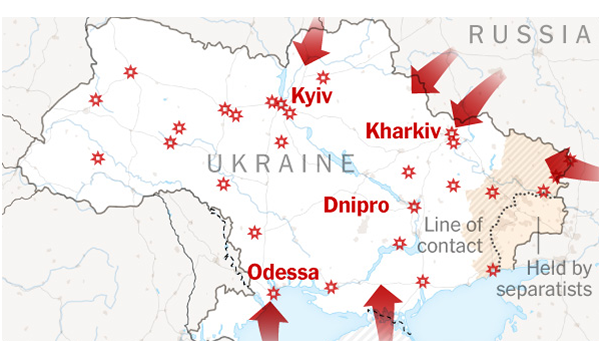
Putin decided on war against Ukraine some time ago, probably in July when he published a lengthy essay, “On the Historical Unity of the Russians and Ukrainians”, in which he argued tendentiously that Ukrainian independence was an unsustainable historical anomaly. This made it perfectly clear that he was contemplating a takeover of the country. Even before Putin’s essay appeared, Russia had deployed around 100,000 troops close to Ukraine’s northern, eastern and southern borders. The response of the United States and the European Union was to make clear that Ukraine was a very long way indeed from either Nato or EU membership, confirming to Putin that no one would fight on Ukraine’s side if he went ahead with his planned war of subjugation.
Over the past few months, Putin has used diplomacy in the classical fashion, seeking to gain his objectives at the lowest possible cost while at the same time carefully preparing for an invasion. Western leaders have achieved nothing more than to remain united in saying they will impose sanctions if he invades. But a Russian invasion of Ukraine beyond the Donbas will create an entirely new situation. Politicians on both sides of the Atlantic may express a common outrage, but it will not take long for their unity to be eroded by the altered reality and their fundamentally divergent interests. The US does not need Russia’s natural gas. At least in the short run, Europe does.
Arthur Chrenkoff offers what he calls “disjointed thoughts at a tragic time”:
Putin is invading Ukraine – not just sending “peacekeepers” into the breakaway pro-Russia regions in the east of the country – in order to “denazify” and “demilitarise” the country. The former is an outrageous slur in a long communist tradition from Stalin to today’s Western left of smearing anyone they don’t like and agree with as a Nazi. Ukraine is as Nazi as Australia or Greece, or Russia for that matter. “Demilitarisation” is the more pertinent excuse. What Putin wants is a cordon sanitaire separating Russia from the West (which now includes Poland and the Baltic states). His vision for Ukraine is a pro-Russia puppet state or at least a neutral and impotent non-entity. According to Putin, Russia’s got a legitimate security interest in not being bordered by hostile (read pro-Western) states. Why this should trump Ukraine’s (or any other country’s) legitimate security interest in its own security, territorial sovereignty and the choice of international friends is unknown, except that might makes right and Russia fancies itself as a special case on the basis of its past great power status.
No country has an obligation to send it troops to fight a conventional war with Russia in Ukraine. But countries have moral obligation to offer any and all assistance to the people of Ukraine, including military equipment, as they defend themselves against unprovoked aggression. Countries also have moral obligation to punish Putin and Russia with utmost severity, including – if only they had the guts – complete economic and trade sanctions. Not a drop of Russian oil or a cubic foot of its gas. Let Putin swim in his unsold carbohydrates. Sadly that won’t happen because the Western European governments have, despite numerous warnings, made themselves energy dependent on imports from Russia. Shutting down coal, closing nuclear power plants and praying to the sun and the wind are now coming home to roost.
At First Things before the invasion began, George Weigel explained what was being obscured by Russian propaganda and western media complaisance:
For months now, the world press has described Russian troop deployments along Ukraine’s borders as spearheads of a possible invasion. The truth, however, is that Russia invaded Ukraine seven years ago, when it annexed Crimea and Russian “little green men” ignited a war in eastern Ukraine that has taken over 14,000 lives and displaced over a million people. Whatever the current military developments, a Russian invasion of Ukraine has not been “imminent”; the invasion is ongoing.
That fact has been obscured by a massive Russian propaganda and disinformation campaign. So some truth-telling is imperative.
The first fact: This is a Russian crisis, not a “Ukraine crisis”. What is typically called the “Ukraine crisis” is entirely of Russian autocrat Vladimir Putin’s making. Ukraine did not create this crisis. The United States did not create it, and neither did NATO. The North Atlantic Treaty Organization, which is, was, and always will be a defensive alliance, is no more a threat to Russian national security than NATO is to Botswana’s national security. The claim that NATO threatens Russia is a Big Lie that obfuscates the security realities in central and eastern Europe: Former Soviet satellites (Poland, the Czech Republic, Slovakia, Hungary, Romania, Bulgaria) and the Baltic states (Lithuania, Latvia, Estonia) joined NATO because they fear Russia, not because they intend to invade Russia. The same rationale explains Ukraine’s NATO application.
The second fact: This artificially created crisis, aimed at Ukraine’s destabilization and subjugation, is one expression of Putin’s determination to reverse history’s verdict in the Cold War. Putin has been quite clear about this for twenty years, and only fools or those peering through the ideologically befogged lenses of the new “national conservatism” fail to grasp what is afoot here. Putin, the old KGB apparatchik, is bent on overturning the victory of imperfect democracies over pluperfect tyrannies in the Revolution of 1989 and the Soviet crack-up of 1991. That grand strategic goal is at the cold heart of the recently announced alliance of purpose between Putin’s kleptocratic regime in Russia and Xi Jinping’s genocidal regime in China — an announcement these two wicked men made just before the Winter Olympics. Putin and Xi want nothing less than a fundamental re-ordering of world affairs in which their oppressive regimes call the tune. In the tyrants’ bid for global hegemony, Ukraine and Taiwan are in the role played by Austria and Czechoslovakia in the late 1930s: If they fall to the tyrant-regimes, others will follow.
At Samizdata, Perry de Havilland notes that not every single thing that happens in the wider world is linked to or directed by American action:
Yes, the United States is the richest and most powerful nation on earth and it has been since World War II. And yes, it has interfered under presidents of all stripes for good or ill in a great many places, in pursuit of its perceived geopolitical interests, sometimes benignly, other times with a breathtaking lack of judgement.
But just as the leaders of that great nation have often overestimated the USA’s ability to impose its will in far away lands, many people in many places similarly overestimate America’s involvement everywhere. They largely deny that local people have agency, oblivious to the fact people everywhere are capable of organising politically in ways not directed and driven from an agency in Langley, Virginia. As a friend of mine who was deeply involved in the 2014 Maidan revolt in Kyiv said to me once:
“Woah! I’ve just heard we’re all CIA puppets on Washington’s payroll. There must have been an oversight as me and my friends never got a penny. You know people in America, so can you get me an address to apply for that lovely CIA money I’m apparently due?”
He was of course joking, but Maidan was a golden example of how something overwhelmingly driven and executed by Ukrainians, in Ukraine, in response to Ukrainian political and social pressures becoming intolerable, was nevertheless written off as CIA mischief-making.And whilst that was pushed hard by Russia when their pet oligarch was deposed, its entirely possible Putin himself believes it too. It is actually more supportive of his worldview than the notion it really happened because millions of Ukrainians loathed Putin, his Ukrainian’s puppet in Kyiv, and the malign influence of Russia generally.
But so many people seek a simpler world, a bipolar one in which everything is down to the Big Actors (with America still the biggest at the moment). Understanding that and feeding into it grants profound insight into Russian (and to some extent Chinese) propaganda. Add to that the rightly shattered confidence in Western institutions the last two years has wrought, and it is not surprising otherwise discerning folk fall for it.
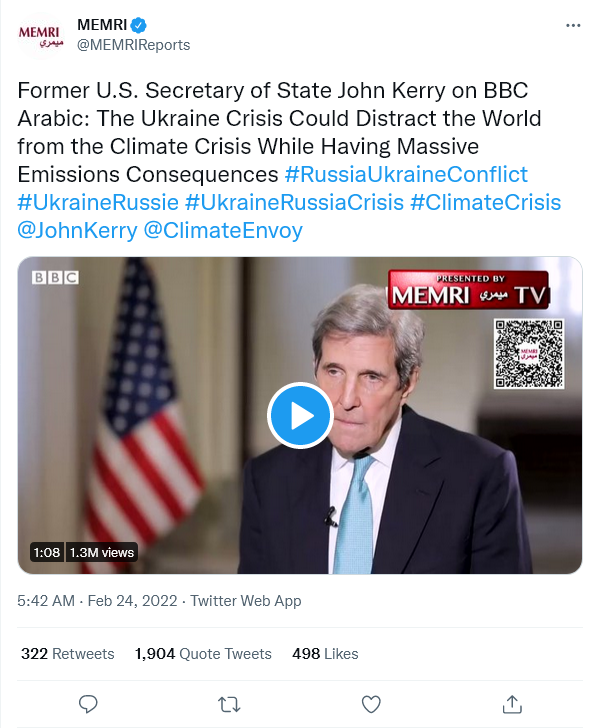
And with bombs dropping and people being killed in Ukraine, John Kerry keeps his laser focus on the important issue — climate change:
Comments Off on Tsar Vlad begins the next stage in rebuilding the Russian empire
This tiny railway across the sea has an important job
Tom Scott
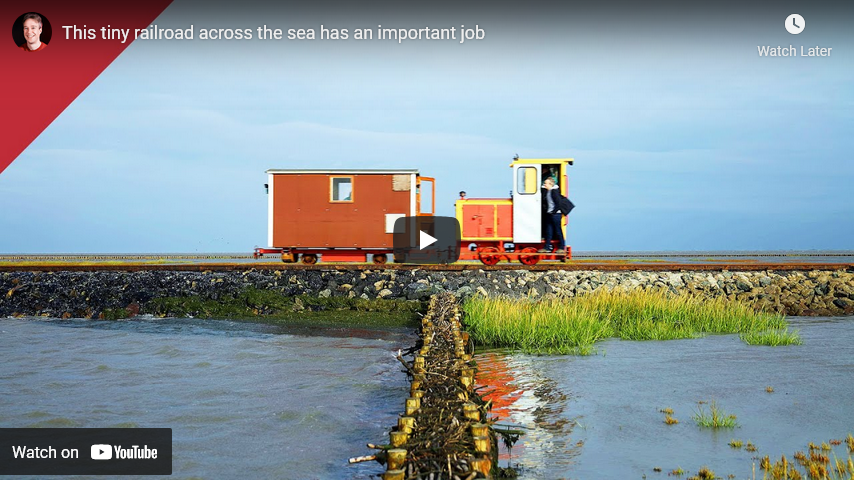
Published 15 Nov 2021The Lorenbahn, the Lüttmoorsiel-Nordstrandischmoor island railway, is famous for the tiny, private trains that take residents to and from the mainland. But that’s not why it was built: and it’s got a more useful purpose as well.
Thanks to everyone from Landesbetrieb für Küstenschutz, Nationalpark und Meeresschutz Schleswig-Holstein, and to the islanders, for all your time and patience!
Camera operator: Richard Bielau
Producer: Maximilian Thesseling of Klein Aber https://kleinaber.de/I’m at https://tomscott.com
on Twitter at https://twitter.com/tomscott
and on Instagram as tomscottgo
Comments Off on This tiny railway across the sea has an important job
February 24, 2022
Got Wood? – The de Havilland Mosquito
World War Two
Published 23 Feb 2022What if there was a plane that the enemy could neither catch nor reach? One that fully relied on speed instead of defensive armaments? The de Havilland DH.98 Mosquito was the first multi-role aircraft developed during World War Two. Made mostly out of wood, the “Wooden Wonder” could be easily converted into different roles — a fighter, a fighter-bomber, a bomber, and a reconnaissance aircraft.
(more…)
Comments Off on Got Wood? – The de Havilland Mosquito
Politicians Ruin Everything: Dutch Luger Trials
Forgotten Weapons
Published 27 Oct 2021http://www.patreon.com/ForgottenWeapons
https://www.floatplane.com/channel/Fo…
Cool Forgotten Weapons merch! http://shop.forgottenweapons.com
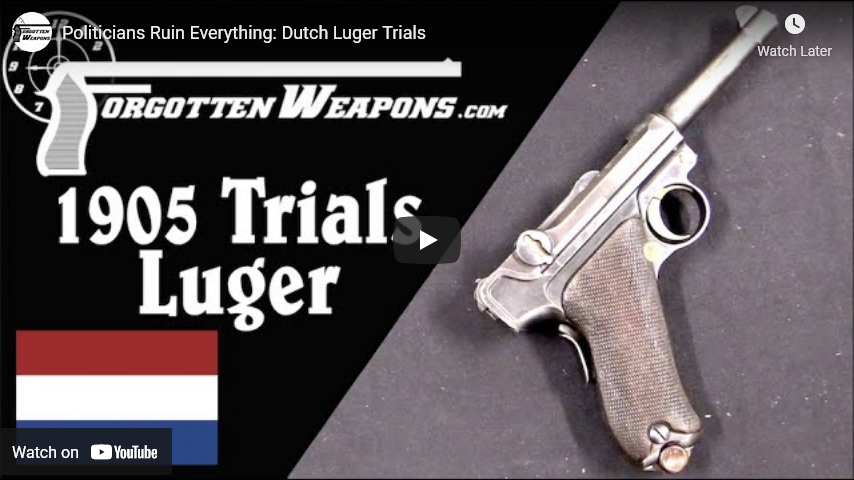
The Dutch military started looking for semiauto pistols to replace its aging revolvers around 1899. They tested all the early models: the Roth, Borchardt, Mauser and Mannlicher — and then they obtained a Borchardt-Luger (aka, a Parabellum, or Luger). They first tested a long-barreled model with shoulder stock for artillery crews in 1901. The guns performed very well mechanically, but the officers in charge were dubious about the utility of the gun.
In 1903, another set of trials was run by the infantry, this time on short-barreled Lugers in both 9mm and 7.65mm. In addition, the Dutch requested a number of special changes to a subset of their guns – this “Dutch Model” was to have Dutch markings and a stronger coil mainspring designed by the Dutch ordnance department. That coil mainspring would be adopted by DWM and became the most significant improvement in the New Model Lugers.
Anyway, the 1903 trials were concluded with much success in 1905, and the Dutch War Minister happily adopted the Luger in 9mm. He wrote out an order to start getting the Army new modern pistols … only to be overridden by the Dutch Parliament. They decided that the new guns were basically too dangerous, and cancelled the adoption. This left the Army in a rather unexpected lurch, and they had to restart production of revolvers in 1906 to make up the shortages in handguns.
Contact:
Forgotten Weapons
6281 N. Oracle 36270
Tucson, AZ 85740
Comments Off on Politicians Ruin Everything: Dutch Luger Trials
February 23, 2022
From Shell Shock to PTSD – Understanding the Trauma of War – WW2 Special
World War Two
Published 22 Feb 2022Humanity has spent millennia developing ever more efficient ways to kill. This reaches its apogee in WWI and WWII, the most terrible conflicts in human history. Broken bodies bring with them broken minds. The trauma of war brings with it the mysteries of shell shock, war neurosis and PTSD.
(more…)
Comments Off on From Shell Shock to PTSD – Understanding the Trauma of War – WW2 Special
Peter Cushing (1956)
British Pathé
Published 14 Apr 2013Kensington, London.
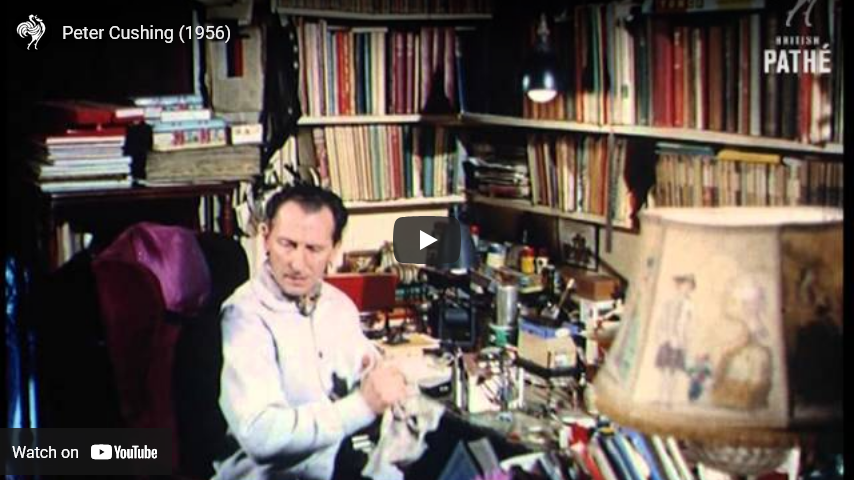
M/S of actor Peter Cushing sitting at his desk looking at papers in his hand. He takes a model toy soldier on a horse and compares it with its drawing. He puts it back and takes another toy soldier. C/U of his hand painting a white belt on the little soldier’s uniform. C/U on his eyes as he works — he must have a good eyesight to do this!
Peter Cushing, enthusiastic member of Model Soldier Society, collects, makes and plays with toy soldiers from all periods of military history. He plays with his toys in accordance to the rules laid down by H.G. Wells in his book Little Wars. M/S of Mr Cushing getting off his chair, approaching a little battlefield laid out on the floor. He organises the battlefield to match a map in his hand.
Voiceover tells the audience that many of historical figures played this game, for example Napoleon [obv. not following the rules devised by Mr. Wells]. It engages the mind of a person as much as the game of chess, which means it is not as simple as it looks. M/S of Mr Cushing kneeling on the floor, putting a horse drawn carriage next to a little house. Top panning shot reveals his little battlefield: soldiers, huts, horses, trees, farms …
M/S of Mr Cushing taking a cigarette, putting it in his mouth and lighting it while observing the battlefield. C/U shot of H. G. Wells’ book Little Wars.
A VIDEO FROM BRITISH PATHÉ. EXPLORE OUR ONLINE CHANNEL, BRITISH PATHÉ TV. IT’S FULL OF GREAT DOCUMENTARIES, FASCINATING INTERVIEWS, AND CLASSIC MOVIES. http://www.britishpathe.tv/
British Pathé also represents the Reuters historical collection, which includes more than 136,000 items from the news agencies Gaumont Graphic (1910-1932), Empire News Bulletin (1926-1930), British Paramount (1931-1957), and Gaumont British (1934-1959), as well as Visnews content from 1957 to the end of 1984. All footage can be viewed on the British Pathé website.
H/T to Jon Salway for the link.
Comments Off on Peter Cushing (1956)
QotD: Debunking the “Spartan one-man-army” myth
… the Spartans, like all hoplites, were oriented very strongly towards group combat. The one-man-army is simply not how they fought, nor how they ever intended to fight.
Well, ok, perhaps they fought in groups, but were individually better at it. There is something to this. Multiple sources – most notably Xenophon stresses the greater degree of physical fitness that the Spartiates display (Xen. Lac. 4.5, 5.9). The Spartiates were rich after all, so they were well fed and able to build muscle accordingly; they also had a pretty active life-style (mostly things like sport-hunting) and kept athletically active. Chances are the average Spartiate was thus larger and fitter than the average hoplite – although again, the other Lakedaemonians in the phalanx (perioikoi, hypomeiones, mothakes, neodamodes, even helots fighting as hoplites) would probably balance out this effect to at least some degree (more strongly as time went on and the number of Spartiates shrunk!)
But what about martial skills and combat expertise? The fact is, there isn’t much evidence for a Spartan military training regime – certainly nothing like what the Romans had, or even what later Hellenistic Greek poleis set up. We’ve already discussed the agoge and you will note that at no point did swordsmanship, spear use, shield use, or anything of the like come up. There is, to be fair, some mock battles with fennel stalks in place of spears and some war-dances which may have served to mimic combat, but the agoge isn’t a training program, it’s an indoctrination program. Plutarch and Xenophon – who describe it – are quite clear on this: the point is to produce men who are obedient to the laws and subservient to the community (Xen. Lac. 2.10-11; Plut. Lyc. 25.3). Any advantages to military quality are evidently secondary (e.g. Xen. Lac. 2.7).
Xenophon himself notes – in the words of Cyrus (who he presents as an ideal ruler) – that hoplite-style warfare in close-combat required little practice (Xen. Cyrop. 2.1.9-16). And I want to stress two things about this statement: first that Xenophon had seen a lot of hoplite battle when he knew this and was in a position to know and second that he had also seen a lot of Sparta. It is hard to imagine Xenophon – with his Laconophilia – saying that practice for hoplites was unimportant if the Spartans had relied on it heavily. Nevertheless, there he is, saying that all of the movements a hoplite actually needed to perform – blocking with the shield, striking with spear or sword – were instinctive and did not need to be taught or practiced.
Plato provides our first solid evidence for the hoplomachia – practice drills in hoplite warfare – but immediately suggests through the person of Laches that the Spartans, specifically do not practice it (Plat. Lach. 182d-183a), because they think it doesn’t work. There is clearly some practicing with arms in Sparta as elsewhere in Greece (see J. K. Anderson, Military Theory and Practice in the Age of Xenophon (1970), 84-93 for the best discussion of the evidence; note also Wheeler, “Hoplomachia and Greek Dances in Arms” (1982)), but it never approaches the formal weapons drills we see from the Romans, or the complex fighting systems of the late Middle Ages. Nor does Sparta appear to be meaningfully exceptional in this regard; they seem to be exactly as tutored – or untutored – as all the other Greeks.
Nor may we rely on the assumption that the Spartan has more battle experience than his foes. The fact is that Greek poleis went to war fairly regularly and that they tended to bring most of their hoplite class out to battle when they did and as such most Greeks of the hoplite class from anywhere will have likely experienced combat. The Spartans are not unique in this and it is not clear that Sparta fights more often – they murder helots more often, sure, but this is hardly effective preparation for open battle.
(The contrast with Rome is again instructive. Sparta is intermittently at war, but the Roman Republic is continuously at war for all but six years out of five centuries, with the average Roman citizen probably spending upwards of seven years under arms – and this is before the professionalization of the legion. The average Roman free-holding farmer (the technical term is assidui) of the Middle Republic might truthfully have considered Leonidas and his 300 as amateurish by comparison.)
So what can we conclude? Well, the Spartiates are probably, on the whole, better nourished and fitter than their average opponent. If they have an edge in weapons training, it is fairly small – some sort of martial arts experts or superlative weapon-masters they are not. Which, of course they aren’t; the way they fight doesn’t require them to be. Hoplite fighting was never about individual martial excellence or skill, but about holding a position in the formation, supporting and being supported in turn by the shields of the men around you. The hoplite didn’t need to be a spear-master and evidently – we must agree with Xenophon – gained little from becoming so.
Bret Devereaux, “Collections: This. Isn’t. Sparta. Part VI: Spartan Battle”, A Collection of Unmitigated Pedantry, 2019-09-20.
Comments Off on QotD: Debunking the “Spartan one-man-army” myth
February 22, 2022
Triumph of the Will and the Cinematic Language of Propaganda
Folding Ideas
Published 10 Feb 2017Clickbait title: Nazis hate him! Secrets of propaganda exposed!
This took far longer to put together than I’d anticipated. It wasn’t even the work itself, it’s the emotional load. I eventually had to start chopping out huge planned segments, like looking at modern propaganda like that awful “Surfing in the DPRK” white guy rap video. I’m sorry about the downer ending, but there’s no way to spruce it up. To a certain degree we lost.
You should seriously read, and then re-read, Umberto Eco’s “Ur-Fascism”. It’s available online for free. It’s not that long. Here, I’ll even link it for you. http://www.nybooks.com/articles/1995/…
Books mentioned:
Urania’s Children
The Occult Roots of Nazism
The Origins of TotalitarianismWritten and performed by Dan Olson
Twitter: https://twitter.com/FoldableHuman
Comments Off on Triumph of the Will and the Cinematic Language of Propaganda
February 21, 2022
D-Day – The Biggest Trick in History – WW2 Special
World War Two
Published 17 Feb 2022It’s 1943, the preparations for D-Day have already begun: deceive the Wehrmacht. Here at TimeGhost, we have begun to prepare our D-Day for 2023, and we want you to join us! Find out how in the pinned comment.
(more…)
Comments Off on D-Day – The Biggest Trick in History – WW2 Special
February 20, 2022
Can the Red Army Capture Hitler? – 182 – February 19, 1943
World War Two
Published 19 Feb 2022The Red Army liberates both Rostov and Kharkov this week, but their advancing spearheads are close to an even bigger prize, Adolf Hitler himself. It is the Axis, however, who are both advancing and consolidating in Tunisia, and gearing up for new offensive actions next week.
(more…)
Comments Off on Can the Red Army Capture Hitler? – 182 – February 19, 1943


