
The Tank Museum
Published 25 Mar 2022
(more…)
July 23, 2022
Tank Chat #152 | Swiss Centurion | The Tank Museum
Comments Off on Tank Chat #152 | Swiss Centurion | The Tank Museum
July 22, 2022
Inventing historical connections with slavery where they don’t exist
In Quillette, David Foster recounts the story from the National Museum of Wales which effectively fabricated a connection to the slave trade as part of their politically correct performative “decolonization” efforts:
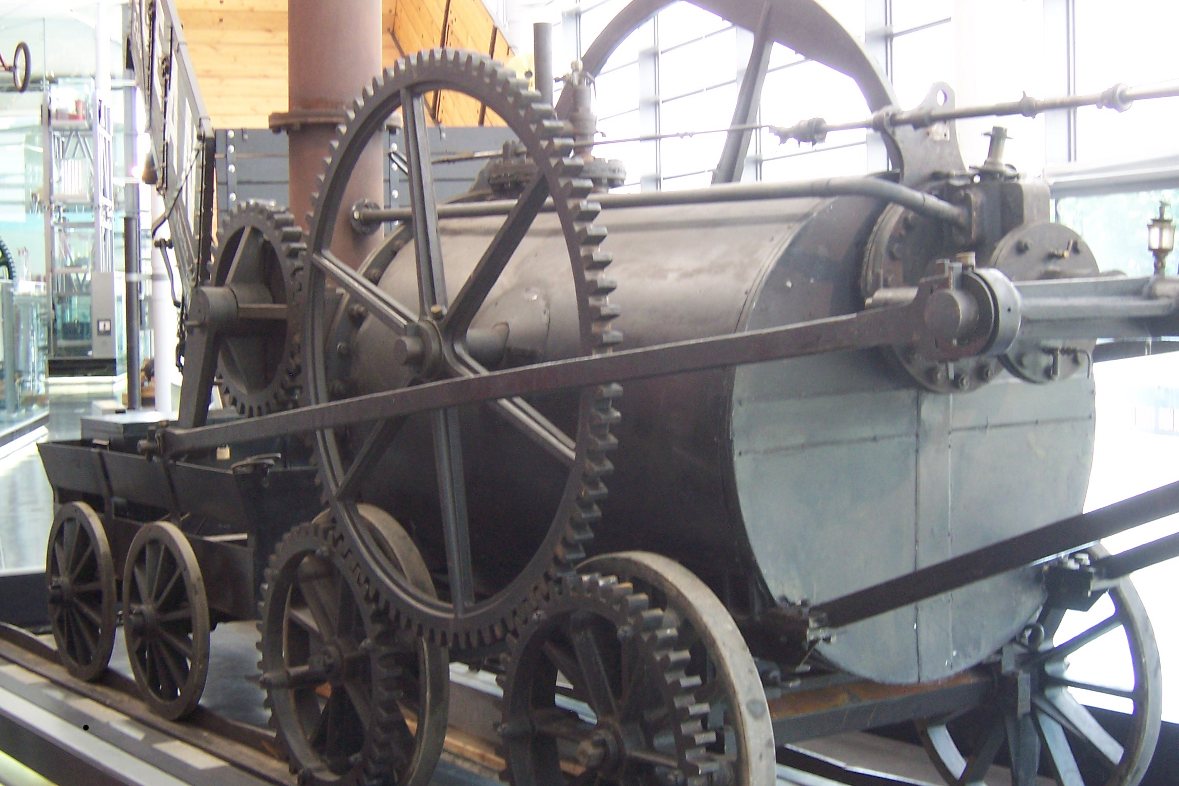
A replica of Richard Trevithick’s 1802 steam locomotive at the National Waterfront Museum in Swansea.
Photo by Chris55 via Wikimedia Commons.
In March, Britain’s Daily Telegraph and GB News channel both reported that the National Museum of Wales would be relabelling a replica of the first steam-powered locomotive, unveiled by its Cornish inventor Richard Trevithick in 1804. Trevithick had no links to slavery, but the amendment has apparently been included anyway as part of the museum’s commitment to “decolonizing” its collection. In a statement defending what it described as the addition of “historical context”, the museum said: “Although there might not be direct links between the Trevithick locomotive and the slave trade, we acknowledge the reality that links to slavery are woven into the warp and weft of Welsh society.” The statement continued:
Trade and colonial exploitation were embedded in Wales’ economy and society and were fundamental to Wales’ development as an industrialised nation. As we continue to audit the collection, we will explore how the slave trade linked and fed into the development of the steam and railway infrastructure in Wales.
[…]
When a society compulsively disrespects its historical accomplishments — when it obsessively seeks to turn every good thing into a bad thing — the outlook for that society is bleak. It destroys social cohesion, and sends the wrong kind of message to actual and potential opponents. The matter of the steam locomotive display in Wales may seem minor, and certainly trivial when compared with the appalling events in Ukraine or the threat of Iranian nuclear weapons. But it is not.
The behavior of the museum administrators in Wales is of a piece with other contemporary symptoms, such as the eagerness within influential circles in the US to embrace the conclusions of the New York Times‘s revisionist 1619 project. It is part of the politicization of everything. Science, technology, and art cannot — indeed, must not — be appreciated simply on the grounds of beauty, utility, or truth; everything must be reduced to race, gender, and other academically and media-approved categories of analysis.
Trends such as these have real-world implications, including the growth and decline of nations and their relative power. Writing in 1940, C.S. Lewis, warned about the dangers of what he called the National Repentance Movement, which focused on the need to apologize for Britain’s sins (thought to include the Treaty of Versailles) and to forgive Britain’s enemies.
Certainly, the British State had done many bad things during its long and eventful history — as well as many good things. But the excessive focus on its sins was part of a phenomenon manifested in a 1933 motion debated at the Oxford Union: “This House will under no circumstances fight for King and country”. To the Nazis and the Imperial Japanese, attitudes like these indicated that aggression would not meet much resistance. They also informed a policy of appeasement.
Liberals and progressives (as they call themselves) claim to be greatly concerned with physical sustainability of resources and ecosystems. But they are too eager to undercut the social sustainability of their own societies and the physical infrastructures on which those societies depend, however fond they may be of repeating the word “infrastructure”.
Comments Off on Inventing historical connections with slavery where they don’t exist
Why Did The First World War Break Out? (July Crisis 1914)
[My 2014 series on “The Origins of World War I” can be read here. Although I’d read a fair bit of history on the period, once I began researching the period, even I was surprised at how many different contributing causes there were.]
The Great War
Published 15 Jul 2022The assassination of Archduke Franz Ferdinand and his wife in Sarajevo on the 28th of June 1914 kicked off a crisis among the European Powers. Tensions that built up in the decades before erupted and in early August 1914 the world was at war. But what happened in these fateful July weeks 1914?
(more…)
Comments Off on Why Did The First World War Break Out? (July Crisis 1914)
Winemaking in the Middle Ages | The Process, Taste, Storage and Use
Kobean History
Published 31 Aug 2020
(more…)
Comments Off on Winemaking in the Middle Ages | The Process, Taste, Storage and Use
QotD: Spoiler – there was no technological solution to trench warfare in WW1
On the one hand, the later myth that the German army hadn’t been defeated in the field was nonsense – they had been beat almost along the entire front, falling back everywhere. Allied victory was, by November, an inevitability and the only question was how much blood would be spilled before it happened. On the other hand, had the German army opted to fight to the last, that victory would have been very slow in coming and Foch’s expectation that a final peace might wait until 1920 (and presumably several million more dead) might well have been accurate. On the freakishly mutated third hand, it also seems a bit off to say that [the French doctrine of] Methodical Battle had won the day; it represented at best an incremental improvement in the science of trench warfare which, absent the blockade, potentially endless American manpower and production (comparatively little of which actually fought compared to the British and the French, even just taking the last Hundred Days) and German exhaustion might not have borne fruit for years, if ever.
All of which is to say, again, that the problem facing generals – German, French, British and later American – on the Western Front (and also Italian and Austrian generals on the Italian front) was effectively unsolvable with the technologies at the time. Methodical Battle probably represented the best that could be done with the technology of the time. The technologies that would have enabled actually breaking the trench stalemate were decades away in their maturity: tanks that could be paired with motorized infantry to create fast moving forces, aircraft that could effectively deliver close air support, cheaper, smaller radios which could coordinate those operations and so on. These were not small development problems that could have been solved with a bit more focus and funding but major complexes of multiple interlocking engineering problems combined with multiple necessary doctrinal revolutions which were in turn premised on technologies that didn’t exist yet which even in the heat of war would have taken many more years to solve; one need merely look at the progression of design in interwar tanks to see all of the problems and variations that needed to be developed and refined to see that even a legion of genius engineers would have required far more time than the war allowed.
It is easy to sit in judgement over the policy makers and generals of the war – and again, to be fair, some of those men made terrible decisions out of a mix of incompetence, malice and indifference (though I am fascinated how, in the Anglophone world, so much of the opprobrium is focused on British generals when frankly probably no British commander even makes the bottom five worst generals. Most lists of “worst generals” are really just “generals people have heard of” with little regard to their actual records and so you see baffling choices like placing Joseph Joffre who stopped the German offensive in 1914 on such lists while leaving Helmuth von Moltke who botched the offensive off of them. Robert Doughty does a good job of pointing out that men like Haig and Foch who were supposedly such incompetent generals in 1915 and 1916 show remarkable skill in 1918).
But the problem these generals faced was fundamentally beyond their ability or anyone’s ability to solve. We didn’t get into it here, but every conceivable secondary theater of war was also tried, along with naval actions, submarines, propaganda, and internal agitation. This on top of the invention of entirely new branches of the army (armor! air!) and the development of almost entirely new sciences to facilitate those branches. Did the generals of WWI solve the trench stalemate? No. But I’d argue no one could have.
Bret Devereaux, “Collections: No Man’s Land, Part II: Breaking the Stalemate”, A Collection of Unmitigated Pedantry, 2021-09-24.
Comments Off on QotD: Spoiler – there was no technological solution to trench warfare in WW1
July 21, 2022
Prime Minister Look-At-My-Socks shocked to discover that betraying an ally has consequences
In The Line, Andrew Potter outlines why the Ukrainian government is unhappy with Prime Minister Photo-Op’s decision to break the sanctions on Russia as a favour to Germany:
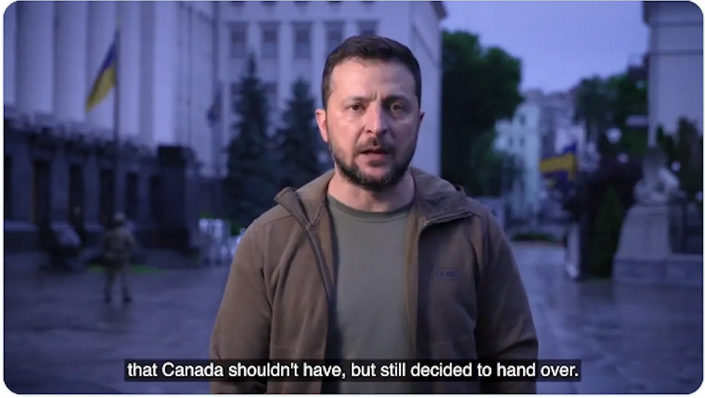
Well, one thing is for certain: There isn’t going to be a “Justin Trudeau Lane” anywhere in Ukraine any time soon.
In case you missed the drama last week, Trudeau found himself on Ukraine president Volodymyr Zelenskyy’s shit list after Canada announced, on July 9, that it would allow Siemens to return to Germany up to six gas turbines for the Nord Stream 1 pipeline that were being repaired in Montreal. Russia was threatening to shut down the pipeline and cut off the flow of gas to Germany, which is facing a very serious energy crisis.
In response, a furious Zelenskyy summoned Canada’s ambassador to Ukraine for what one presumes was a solid chewing out, after which the Ukrainian president posted a video in which he lit into Trudeau for “an absolutely unacceptable exception to the sanctions regime against Russia”. As Zelenskyy put it, the problem isn’t just that Canada handed some turbines back to Russia, via Germany. It is that it was a direct response to blackmail by Russia. And if Canada is willing to bend when its sanctions become politically uncomfortable, what is to stop other countries from carving out their own exceptions to their own sanctions, when it suits? Furthermore, Zelenskyy added, it isn’t like this is going to stop Russia from shutting down the supply of gas to Europe — the turbines were always just a pretext, an opportunity to cause strife and stir dissension amongst the countries allied with Ukraine against Russia.
Trudeau — who spent the weekend flipping pancakes at the Calgary Stampede — must have woken up on the Monday wondering what had gotten into his old buddy in Kyiv. After all, hadn’t Trudeau, along with other members of his cabinet, made it clear through their many, many tweets on the subject that Canada stood by Ukraine? Hadn’t Canada sent enough money, arms and humanitarian aid to Ukraine? Hadn’t Trudeau himself paid a visit to Kyiv in May, to re-open our embassy and to underscore just how seriously Zelenskyy should understand Canada’s commitment?
[…]
Ultimately, the problem here is a serious failure by Canada to manage Ukrainian expectations, brought about by the profound mismatch between the level of our rhetoric and the clear limits of our commitment. For Ukrainians, there is a moral clarity to the Russian invasion of Ukraine that, from a Western perspective, has not been present in any other conflict since the Second World War. Zelenskyy assumed that Canadians saw that. He assumed that if Ukrainians were going to be slaughtered, the least we could do would be to stick to our principles, even if it meant asking the population to suffer economic harms and the government to manage genuine political discomfort.
He assumed wrong.
Five months into their war for survival against the genocidal Russian regime, the Ukrainians have learned something important about Canadians: When it comes to our foreign affairs, we don’t mean what we say. When we say we stand with a country, that we fully support them, that we will help defend them or hold their enemies to account, there’s always a “but” or an “until” or an “unless”. We will stand with you, unless it’s politically difficult. We will help you, but not if it means genuine sacrifice. We will support you, until the costs get too high. Then, all bets are off.
The bigger point is this: Canada doesn’t do moral clarity anymore. Whether it is our business dealings with China, our arms sales to Saudi Arabia, or sending a diplomat to a garden party at the Russian embassy in Ottawa, we are always and everywhere hedging our bets, fudging our principles, letting down our allies.
Farmers’ protests against insane environment mandates continue in the Netherlands
For some unknown reason, the huge protests by Dutch farmers against ridiculous environment-protection rules seems to be getting almost no media coverage. As Rex Murphy pointed out in the National Post, if this was happening in Canada, the government would already have imposed the Emergencies Act and be actively depriving people of their civil rights across the board. Somehow, this protest is uninteresting to most of the legacy media, but as Brendan O’Neill explains, it is a huge deal:
This strange, sunny week has provided the best proof yet that the West’s elites have taken leave of their senses. That they have fully retreated from reason, and from reality itself. As farmers and workers across the world continue to rise up against the tyrannical consequences of climate-change alarmism, what are the elites doing? Engaging in yet more climate-change alarmism. Wringing their hands over the hot weather and its forewarning, as they see it, of the manmade heat-death of the planet that is apparently just around the corner. They continue to peddle the very politics of eco-dread that is whacking farmers and the working class and storing up problems for us all.
The contrast could not have been more stark. On one side we have farmers everywhere from Ireland to the Netherlands to, of course, Sri Lanka making it as plain as they can that the warped ideology of Net Zero will make it harder for them to produce the food that humanity needs. And on the other side we have the Net Zero fanatics of the upper middle classes continuing to push their dire, destructive green ideology. The heatwave proves we must cut emissions even faster and more severely, they tweet in their breaks from sunning themselves in their spacious gardens, even as farmers tell them that the zealous obsession with cutting emissions will make it harder to grow crops. So this is where we’re at – with a ruling class more invested in fact-lite narratives of apocalypse than in the basic responsibility of a society to make food.
This politics is best understood as luxury apocalypticism. It is clearer than it has been for a very long time that the fantasy of the end of the world, of marauding, industrious mankind polluting itself into oblivion, is something only the well-off and time-rich can afford to indulge. The dream of eco-doom is a simultaneously self-hating and self-serving political narrative. It expresses the elite’s turn against the very modernity they helped to create while also flattering their belief that only they can save us. That only their plans to slash emissions, to cut back on global travel and generally to shrink the “human footprint” can hold Armageddon at bay. The great benefit of the global revolt of farmers and workers is that it is injecting a truth and a realism into public discussion that might just help to push back the luxurious and ruinous ideologies of the new elites.
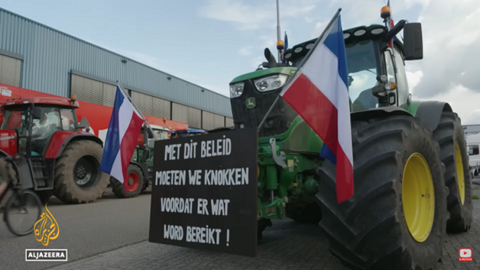
Everywhere, farmers are saying “Enough”. In the Netherlands farmers have been revolting for weeks against their government’s perverse demands that they slash their use of nitrogen compounds. The Dutch government, under pressure from the EU, has committed itself to cutting its nitrogen emissions in half by 2030. This would entail farmers getting rid of vast numbers of their livestock, crushing their ability to make a living and to produce what needs to be produced. So we have the truly surreal situation where Dutch farmers are protesting in their thousands for the right to feed the people of the Netherlands while the elites of the Netherlands demonise them, harass them and even shoot at them. I can think of no better illustration of the loss of logic and humanity within the modern elites than this strange spectacle.
Comments Off on Farmers’ protests against insane environment mandates continue in the Netherlands
July 20, 2022
Climate change is nothing new, and it was warmer in England for a few hundred years in the Middle Ages
If you’ve been reading the blog for a while, you’ll have noticed that I’m not a fan of trying to panic people about climate change … catastrophism just isn’t my thing. I certainly don’t deny that climate change happens and I agree that it is happening now, but I’m highly skeptical that human action has more than a minor influence compared to the ups and downs of long-term climate shifts driven by natural forces. Ed West has a thumbnail sketch of just how much the European (and especially English) climate change impacted ordinary people during the Middle Ages:
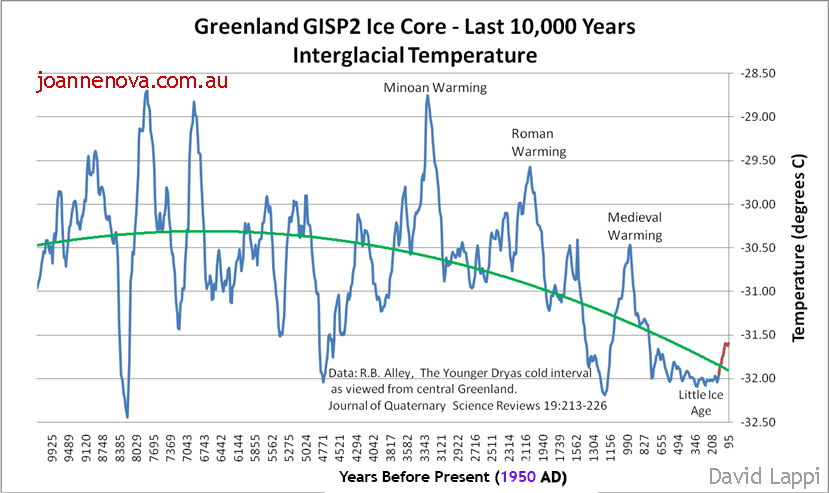
Chart from the Journal of Quaternary Science Reviews showing Greenland ice core data over the last 10,000 years. At the end of the Minoan Warming came the Bronze Age Collapse, after the Roman Warming came the fall of the western Roman Empire.
The climate is changing, with all that entails, something we’ve known about for several decades now. Among the early proponents of the theory of climate change was mid-century climatologist Hubert Lamb, who spent most of his career at the Met Office and during the course of his studies made a curious historical discovery.
It was once widely believed that climate remained relatively stable over recorded history, civilisational lifespans being too brief to see such grand changes. But while looking into medieval chroniclers, Lamb was struck by the numerous references to vineyards in England, some as far as the midlands. As long as anyone had ever remembered, the country had been too cold to grow wine, except in tiny pockets of Sussex which occasionally produced almost-drinkable white.
William of Malmesbury, living in the 12th century, observed of his native Wiltshire that “in this region the vines are thicker, the grapes more plentiful and their flavour more delightful than in any other part of England. Those who drink this wine do not have to contort their lips because of the sharp and unpleasant taste, indeed it is little inferior to French wine in sweetness.” How could that have been?
Lamb concluded that Europe must have been considerably warmer during the Middle Ages, and in 1965 produced his great study outlining the theory of the Medieval Warm Period; this posited that Europe was at its hottest in the High Middle Ages (1000-1300) and then became unusually cool between 1500 and 1700.
Since then, Lamb’s thesis has been reinforced by analysis of pollen in peat bogs, as well as the radioactive isotope Carbon-14 found in tree rings (the less sun, the more Carbon-14). In Medieval Europe, every summer was a hot girl summer — and tiny changes could make earth-shattering differences.
The people of Europe enjoyed that extended period of warmer weather for about 300 years, then things suddenly got far worse:
Across Europe, people must have noticed a change. Farmers in the Saastal Valley in Switzerland were probably the first to observe what was happening, back in the 1250s, when the Allalin Glacier began to flow down the mountain. Surviving plant material from Iceland suggests an abrupt decrease in the temperature from 1275 — and, as Rosen points out, a reduction of one degree made a harvest failure seven times more likely. From 1308 England saw four cold winters in succession; the Thames froze, chroniclers recalling dogs chasing rabbits across the icy surface for the first time.
As with many things, change was gradual, until it was dramatic, for then came the disastrous year of 1315. The Chronicle of Guillaume de Nangis, written by a monk at the Abbey of Saint-Denis outside Paris, recorded that in April the rains came down hard — and didn’t stop until August.
Drenched and starved of sunlight, the crops failed across Europe. The price of food doubled and then quadrupled. By May 1316, crop production in England was down by up to 85 percent and there was “most savage, atrocious death”, as a chronicler put it. Hopeless townsfolk walked into the countryside, searching for any bits of food; men wandered across the country to work, only to return and find their wives and children dead from starvation. At one point, on the road near St Albans, no food could be found even for the king. Emaciated bodies could be seen floating face down in flooded fields.
The Great Famine killed anywhere between 5-12% of the European population, although some areas, such as Flanders, suffered far worse death rates, losing up to a quarter of their population to hunger.
Comments Off on Climate change is nothing new, and it was warmer in England for a few hundred years in the Middle Ages
Book Review: The Wipers Times
Forgotten Weapons
Published 6 May 2018Get your copy here: https://amzn.to/2jzWnkI
Or here: https://amzn.to/2JOpMm3The Wipers Times was a satirical trench newspaper printed from February 1916 until December 1918 by British Captain F.J. Roberts and a crew of assistants. Such papers were not particularly uncommon, but the Wipers Times was particularly successful, well written, and long-lived, and it has survived in reprints today to a greater extent than any other similar work. A total of 23 issues were printed, and they consist of poetry, commentary, mock advertisements, advice columns, and short stories. While much of the humor is still quite accessible to us today, much of it also includes references, abbreviations, and inside jokes that are inscrutable to those who are not quite knowledgeable about life in the trenches.
Roberts and his cohorts were legitimate front-line soldiers, not writing as visiting journalists or from the safety of the rear echelons. Beyond its basic entertainment value, their writings also provide a rare and interesting view into the minds of men who were truly living the Great War.
Note that a book about the newspaper has also been printed, titled The Wipers Times, and with a very similar cover. If you want to buy a copy of the reprinted original issues, make sure you are not buying that book.
The BBC made a 90 minute program based on the Times, which is available in its entirely on YouTube here:
https://www.youtube.com/watch?v=SKPXu…[The original channel has been deleted, but I believe this is the same video: https://www.youtube.com/watch?v=juZBxhUYRpg]
(more…)
Comments Off on Book Review: The Wipers Times
QotD: Fascism and the state
Occasionally you’ll get one of these like Francisco Franco who borrows fascist tropes as propaganda tools but keeps a tight rein on the actual Fascist elements in his power base (the Falange). Franco remained a conservative monarchist all his life and passed power to the Spanish royal family on his death.
This highlights one of the other big lies about Fascism; that it’s a “conservative” ideology. Not true. Franco, a true reactionary, wanted to preserve and if necessary resurrect the power relations of pre-Civil-War Spain. Actual Fascism aims at a fundamental transformation of society into a perfected state never seen before. All of its type examples were influenced by Nietzschean ideas about the transformation of Man into Superman; Fascist art glorified speed, power, technology, and futurism.
Eric S. Raymond, “Spotting the wild Fascist”, Armed and Dangerous, 2019-04-30.
Comments Off on QotD: Fascism and the state
July 19, 2022
Barbarian Europe: Part 2 – The Fall of Rome
seangabb
Published 22 Apr 2021In 400 AD, the Roman Empire covered roughly the same area as it had in 100 AD. By 500 AD, all the Western Provinces of the Empire had been overrun by barbarians. Between April and July 2021, Sean Gabb explored this transformation with his students. Here is one of his lectures. All student contributions have been removed.
(more…)
Comments Off on Barbarian Europe: Part 2 – The Fall of Rome
July 18, 2022
General Patton Orders War Crimes – WAH 069 – July 17, 1943
World War Two
Published 17 Jul 2022This week, we see a contrast in the way different civilians behave within occupied Ukraine, Patton orders war crimes, and Jewish resistance give up one of their own fighters.
(more…)
Comments Off on General Patton Orders War Crimes – WAH 069 – July 17, 1943
Russian Invasion of Finland – The Winter War 1939-40
Mark Felton Productions
Published 24 Mar 2022Find out why Russia invaded neutral Finland in late 1939, and how the outnumbered and outgunned Finns managed to defend their country for 3 months until making peace with Stalin.
(more…)
Comments Off on Russian Invasion of Finland – The Winter War 1939-40
July 17, 2022
Science by press release
Christopher Snowden on a media-genic “study” from a few years ago that supported the priors of the anti-alcohol campaigners and thus was given full uncritical media coverage, despite obvious flaws in data selection and methodology:
In 2018, the Lancet published a study from the “Global Burden of Disease Alcohol Collaborators” which claimed that there was no safe level of alcohol consumption. This was widely reported and was naturally welcomed by anti-alcohol campaigners. The BBC reported it under the headline “No alcohol safe to drink, global study confirms”. (Note the cheeky use of the word confirms, despite the finding going against fifty years of evidence.)
The study wasn’t based on any new epidemiology. Instead it took crude, aggregate data from almost every country in the world, mashed it together and attempted to come up with a global risk curve.
The study contains no new evidence and uses an unusual modelling approach based on population-wide data from various online sources. If you look at this massive appendix you can see the kind of data they were using. The figures are extremely crude.
The authors don’t dispute the benefits of moderate drinking for heart disease but they claim that the benefits are matched by risks from other diseases at low levels of consumption and are outweighed by the risks at higher levels of consumption. Some diseases which have been associated with benefits of drinking, such as dementia, are excluded from the analysis entirely. They also ignore overall mortality, which you might think was kind of important.
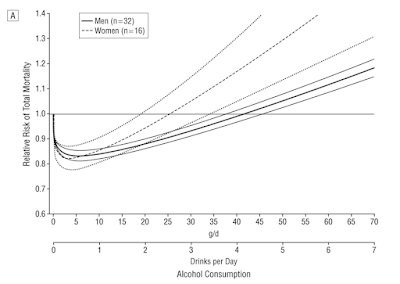
A typical risk curve for alcohol consumption and mortality is J-shaped. It looks like this …
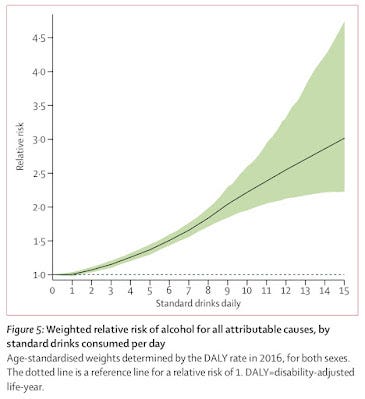
But the GBD’s risk curve for “all attributable causes” looked like this…
You will notice that there appears to be no protective effect at moderate rates of consumption in the GBD’s curve. One important reason for this is that they associate alcohol consumption at any level with tuberculosis. Tuberculosis remains a serious health problem in much of the world, but not in Britain. So what relevance does a global risk curve have to us? None.
Moreover, TB is not really an alcohol-related disease and is only viewed as such in this study because (a) drinking might weaken the immune system and (b) people who go to bars and clubs are more likely to catch an infectious disease. I kid you not.
Comments Off on Science by press release
Who Let the Dogs Out?! – The Invasion of Sicily – WW2 – 203 – July 16, 1943
World War Two
Published 16 Jul 2022The Allies have begun their fight to take back Western Europe with Operation Husky. That’s not the only news though. They are also trying to extend their foothold in the Solomons, and Germany and the USSR continue smashing into one another at Kursk.
(more…)
Comments Off on Who Let the Dogs Out?! – The Invasion of Sicily – WW2 – 203 – July 16, 1943


