
World War Two
Published 27 Jul 2022Being allies does little to discourage Moscow from recruiting double agents in the British establishment. The most famous of them all, Kim Philby and the Cambridge Five, penetrate deep into MI5, MI6, and Bletchley Park. With friends like the NKVD, who needs enemies?
(more…)
July 28, 2022
The Posh Brits Betraying Their Country – WW2 – Spies & Ties 20
Comments Off on The Posh Brits Betraying Their Country – WW2 – Spies & Ties 20
July 27, 2022
Poland and South Korea Ink Huge Arms Deal
Ed Nash’s Military Matters
Published 26 Jul 2022Poland and South Korea are apparently on the verge of signing a huge arms deal that will replace much of the heavy frontline equipment of the Polish Army.
Sources for this video can be found at the relevant article on:
https://militarymatters.online/
(more…)
Comments Off on Poland and South Korea Ink Huge Arms Deal
When the founder of the SAS was captured by Italian troops in 1943
In The Critic, Saul David describes what happened when Lieutenant Colonel David Stirling was captured during his “most hare-brained scheme” to link up the troops of Britain’s First and Eighth armies in Tunisia:
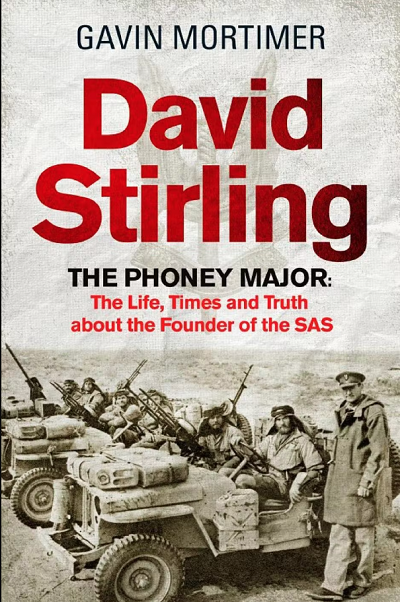
In January 1943 Lieutenant Colonel David Stirling, founder of the SAS, was flown to Rome for interrogation. He had been captured by the Italians on his “most hare-brained scheme yet” — leading a small raiding party deep into enemy territory in Tunisia to attack lines of communication, reconnoitre the terrain and become the first Eighth Army unit to link up with the First Army advancing from the west.
Cautious when speaking to the Italians, he was “vain and voluble” in conversation with a fellow “captive”, Captain John Richards. Unbeknown to Stirling, Richards was an Anglo-Swiss stool pigeon, Theodore Schurch, who had deserted from the British army and was working for fascist intelligence.
Prior to Schurch’s court-martial for treachery in late 1945, Stirling denied he had revealed any sensitive information. If he had, it was inaccurate and “designed to deceive”. This was a lie, told to protect Stirling’s reputation. In fact, as the British authorities knew all too well from intercepted signals, Stirling had told Richards vital details about current SAS operations, including the location of patrols and their orders. He had even given them the name of his probable replacement as SAS commander: Paddy Mayne.
The story of Stirling’s unfortunate encounter with Schurch has been told before, notably by Ben Macintyre in his bestselling SAS: Rogue Heroes. But Macintyre underplays Stirling’s indiscretion and fails to link it to the many other examples of the SAS commander’s recklessness and poor judgement of character. For Gavin Mortimer, on the other hand, both the capture and loose talk were typical of a man who was “imaginative, immature, immoderate and ill-disciplined”. Small wonder that even his own brother Bill thought he would be better off in a prisoner-of-war camp.
The subtitle of Mortimer’s book — a carefully researched and impeccably sourced take-down of the legendary special forces pioneer — is a corrective to the flattering but inaccurate nickname that was first coined for Stirling by British tabloids during the Second World War. “When word reached Cairo of the Phantom Major moniker,” writes Mortimer, “it must have sparked a mix of hilarity and indignation. All the falsehoods and fabrications would have been harmless enough had Stirling not stolen the valour of his comrades.”
Thread by thread, Mortimer unpicks the myth of Stirling’s life and war service that the subject and his fawning admirers had so carefully constructed, both during and after the war. Stirling was not training in North America for an attempt on Mount Everest’s summit when war broke out in 1939, as he later claimed, but rather working as a ranch hand because his exasperated family hoped it might give the feckless youth some focus and direction.
Comments Off on When the founder of the SAS was captured by Italian troops in 1943
Italy’s Worst Machine Gun: The Breda Modello 30
Forgotten Weapons
Published 28 Jul 2017http://www.patreon.com/ForgottenWeapons
Cool Forgotten Weapons merchandise! http://shop.bbtv.com/collections/forg…
The Breda Model 30 was the standard Italian light machine gun of World War II, and is a serious contender for “worst machine gun ever”. Yes, given the choice we would prefer to have a Chauchat (which really wasn’t as bad as people today generally think).
The Breda 30 suffered from all manner of problems. To begin with, it was far more complicated than necessary. The amount of machining needed to build one is mind boggling compared to contemporary guns like the ZB26/Bren or BAR. And for all that work, it just didn’t work well in combat conditions.
Mechanically, the Breda used a short recoil action with a rotating bolt. The recoil action meant that the barrel moved with each shot, so the sights were mounted on the receiver to keep them fixed. This seems like a good idea, but it meant that the sights would need to be re-zeroed each time the barrel was changed. To compound this, the gun fired from a closed bolt which made it more susceptible to overheating and it was recommended to change barrels every 200 rounds or so. An oiling mechanism was built in to lightly oil each cartridge on feeding. This allowed the gun to extract without ripping rims off the cases, but was a disaster waiting to happen on the battlefield. In places like North Africa, the oil acted as a magnet for sand and dust, leading to quick jamming if the gun were not kept scrupulously clean.
The next huge judgment error on Breda’s part was the magazine. The thought behind it was that magazine feed lips are easily damaged in the field, and they can be protected by building them into the gun receiver rather than in each cheap disposable box magazine (the Johnson LMG and Madsen LMG recognized this issue as well). However, Breda’s solution was to make the 20-round magazine a permanent part of the gun. The magazine was attached to the receiver by a hinge pin, and was reloaded by special 20-round stripper clips. This meant that reloading took significantly longer than changing magazines, and any damage to the one attached magazine would render the gun inoperable. As if anything else were needed, the magazine was made with a big opening on top to allow the gunner to see how many rounds remained – and to let more of that North African sand into the action.
Most of the Breda Model 30s were made in 6.5 Carcano, but a small number were made in 7.35 Carcano when that cartridge was adopted. The rate of fire was about 500 rounds per minute, which was a bit slower than most other machineguns of the day.
(more…)
Comments Off on Italy’s Worst Machine Gun: The Breda Modello 30
July 26, 2022
Barbarian Europe: Part 4 – The Ostrogoths in Italy
seangabb
Published 10 May 2021In 400 AD, the Roman Empire covered roughly the same area as it had in 100 AD. By 500 AD, all the Western Provinces of the Empire had been overrun by barbarians. Between April and July 2021, Sean Gabb explored this transformation with his students. Here is one of his lectures. All student contributions have been removed.
(more…)
Comments Off on Barbarian Europe: Part 4 – The Ostrogoths in Italy
QotD: The nothoi class of Sparta
We are not told that spartiates men rape helot women, but it takes wilful ignorance to deny that this happened. First of all, this is a society which sends armed men at night into the unarmed and defenseless countryside (Hdt. 4.146.2; Plut. Lyc. 28.2; Plato, Laws 633). These young men were almost certainly under the normal age of marriage and even if they weren’t, their sexual access to their actual spouse was restricted. Moreover (as we’ll see in a moment) there were clearly no rules against the sexual exploitation of helot women, just like there were no laws of any kind against the murder of helot men. To believe that these young men – under no direction, constrained by no military law, facing no social censure – did not engage in sexual violence requires disbelieving functionally the entire body of evidence about sexual violence in combat zones from all of human history. Anthropologically speaking, we can be absolutely sure this happened and we can be quite confident (and ought to be more than quite horrified) that it happened frequently.
But we don’t need to guess or rely on comparative evidence, because this rape was happening frequently enough that it produced an identifiable social class. The one secure passage we have to this effect is from Xenophon, who notes that the Spartan army marching to war included a group he calls the nothoi – the bastards (Xen. Hell. 5.3.9). The phrase typically means – and here clearly means – boys born to slave mothers. There is a strong reason to believe that these are the same as the mothakes or mothones which begin appearing with greater frequently in our sources. Several of these mothakes end up being fairly significant figures, most notably Lysander (note Plut. Lys. 2.1-4, where Plutarch politely sidesteps the question of why Lysander was raised in poverty and seemed unusually subservient and also the question of who his mother was).
We’ll get to the Spartan free-non-citizen-underclasses next week when we talk more about the Spartan manpower shortage, but for now, I just want to underline and bold something very clearly here: there was so much spartiate rape of helot women in Sparta that it created a significant, legally distinct underclass. And, just so we’re clear: yes, I am classifying all of that contact as rape, because sexual consent does not exist in master-slave relationships where one human being has the literal power of life and death over the other human being and her entire family. We may suppose that some helot women, trapped in this horrific and inhuman circumstance, may have sought out these relationships – but that does not change the dynamics of violence and compulsion permeating the entire system.
To recap quickly: poor peasant life in ancient Greece was already hard for anyone. Women in farming households had difficult, but extremely important jobs for maintaining themselves, their families and their society. To these difficulties, the Spartan state added unnecessary, callous and brutal conditions of poverty, malnutrition, violence, murder and rape.
Bret Devereaux, “Collections: This. Isn’t. Sparta. Part III: Spartan Women”, A Collection of Unmitigated Pedantry, 2019-08-29.
Comments Off on QotD: The nothoi class of Sparta
July 25, 2022
Stalin, Hitler, and Churchill – Architects of Death – WAH 070 – July 24, 1943
Comments Off on Stalin, Hitler, and Churchill – Architects of Death – WAH 070 – July 24, 1943
“Yond Cassius has a lean and hungry look; He thinks too much: such men are dangerous“
Rob Henderson considers the character of Julius Caesar (as filtered through Plutach and Shakespeare), and the “Dominance-Oriented Status Seekers” identified in a recent paper:
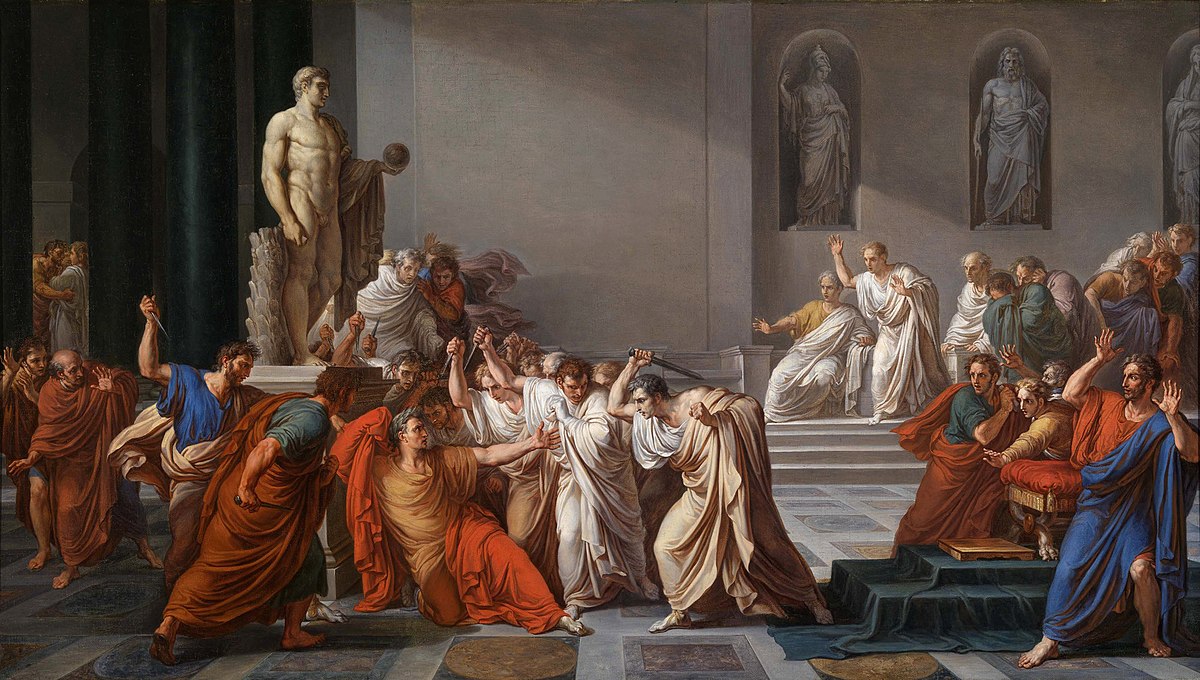
La morte di Cesare (The death of Caesar)
Oil painting by Vincenzo Camuccini between 1804 and 1805. via Wikimedia Commons.
In the opening scene of Shakespeare’s Julius Caesar (which is drawn from Plutarch’s Lives), the commoners of Rome are seen celebrating Caesar’s recent triumph over Pompey.
Two tribunes (elected officials), Flavius and Marullus, accost two of the commoners, asking them to name their trades and explain why they are out in their best attire rather than working.
The commoners respond to the tribunes’ condescension with indirect answers and puns that annoy the tribunes even more.
Eventually, Flavius and Marullus learn that the plebeians are cheering Caesar. The tribunes scorn them for doing this.
They tell the commoners that Pompey was a Roman too. So Caesar’s success was not truly a triumph for Rome.
Flavius later tells Marullus that they should remove the decorations from Caesar’s statues during Caesar’s parade.
Marullus questions this plan, stating that it also happens to be the Feast of Lupercal, a celebration of fertility.
But Flavius is adamant that they remove the ornaments, because the removal will help prevent Caesar from seeing himself as too great.
This first scene of Julius Caesar shows that the tribunes want to prevent the rise of a potential tyrant. But they themselves are more than willing to push the commoners around.
Later, two other prominent Romans — Brutus and Cassius — are likewise shown expressing their concerns about Caesar’s growing popularity.
Cassius asks Brutus how Caesar has any more right to greatness than Brutus or himself.
Cassius tells Brutus a story: When they were young, Cassius saved young Julius Caesar from drowning. Cassius always viewed himself as superior for rescuing Caesar. He is now aggravated that Caesar has risen above him.
Cassius decides to orchestrate Caesar’s assassination. Cassius gradually convinces other members of the Roman elite to help him carry out the conspiracy.
Meanwhile, Caesar himself, speaking privately with Mark Antony, expresses suspicions about Cassius:
CAESAR
Let me have men about me that are fat,
Sleek-headed men, and such as sleep a-nights.
Yond Cassius has a lean and hungry look.
He thinks too much. Such men are dangerous.
ANTONY
Fear him not, Caesar; he’s not dangerous.
He is a noble Roman, and well given.
CAESAR
Would he were fatter! But I fear him not.
Yet if my name were liable to fear,
I do not know the man I should avoid
So soon as that spare Cassius. He reads much,
He is a great observer, and he looks
Quite through the deeds of men. He loves no plays,
As thou dost, Antony; he hears no music;
Seldom he smiles, and smiles in such a sort
As if he mocked himself and scorned his spirit
That could be moved to smile at anything.
Such men as he be never at heart’s ease
Whiles they behold a greater than themselves,
And therefore are they very dangerous.
I rather tell thee what is to be feared
Than what I fear; for always I am Caesar.
Come on my right hand, for this ear is deaf,
And tell me truly what thou think’st of him.Caesar is saying all men are hungry, either for food, entertainment (“he loves no plays … he hears no music”), or power. If prosperous men aren’t tempted by food and entertainment, then they crave power. Thus, prosperous men who are lean are dangerous.
Mark Antony dismisses Caesar’s concerns about Cassius, because Cassius is a “noble Roman”. But as events unfold, we see that Antony was misguided.
Caesar was correct in his judgment of Cassius.
The eminent literary critic (and my former professor) Harold Bloom has stated that Caesar’s “estimate of Cassius shows him to be the best analyst of another human being in all of Shakespeare”.
Bloom goes on to characterize Cassius as embodying a “spirit of resentment, unhappy as he is at contemplating greatness beyond him”.
Cassius secretly arranges to have fake notes sent to Brutus, who is fooled into thinking the notes have been written by ordinary Roman citizens who want the Roman elites to stand up against Caesar.
When persuading the other conspirators to help him carry out the assassination plot, Cassius’s stresses his concern for the future of Rome.
But Cassius’s story to Brutus indicates that the assassination was in part fueled by his resentment that Caesar grew into someone more powerful than himself, thus upending their former status disparity.
Comments Off on “Yond Cassius has a lean and hungry look; He thinks too much: such men are dangerous“
Rowan Atkinson & Hugh Laurie – Shakespeare and Hamlet (1989)
Nathaniel Brechtmann
Published 1 Sep 2011A sketch called “A Small Rewrite”, performed by Hugh Laurie (aka House) as Shakespeare and Rowan Atkinson (aka Mr Bean) as the editor.
Comments Off on Rowan Atkinson & Hugh Laurie – Shakespeare and Hamlet (1989)
QotD: Napoleon Bonaparte, the Great Man’s Great Man
That’s because Napoleon was a Great Man, possibly the Great Man — a singularly talented genius, preternaturally lucky, whose very particular set of skills so perfectly matched the needs of the moment. There’s no “social” explanation for Napoleon, and that’s why nobody mentions him — the French Revolution ends with the Concert of Europe, and in between was mumble mumble something War and Peace. The hour really did call forth the man, in large part, I argue, because the Directory was full of men who were philosophically opposed to the very idea of elitism, and couldn’t bear to face the fact that they themselves were the elite.
Since our elite can’t produce able leaders of itself, it will be replaced by one that can. When our hour comes — and it is coming, far faster than we realize — what kind of man will it call forth?
Severian, “The Man of the Hour”, Rotten Chestnuts, 2019-05-22.
Comments Off on QotD: Napoleon Bonaparte, the Great Man’s Great Man
July 24, 2022
After a Victory at Kursk, The Soviets Attack Everywhere – WW2 – 204 – July 23, 1943
World War Two
Published 23 Jul 2022The Allied invasion of Italy powers on and puts the future of a key axis power at play. In the USSR, the Soviets have learnt to deal with German offensives, as the Wehrmacht struggles to make a dent.
(more…)
Comments Off on After a Victory at Kursk, The Soviets Attack Everywhere – WW2 – 204 – July 23, 1943
QotD: British armour from BAOR to the first Gulf War
To that end generations of British soldiers were stationed there training for a war that they hoped would never come. To this day there are still serving Cold War veterans who even into the late 1980s knew where they would deploy to, and the likely exact spot in the field or woods where they would dig their trenches and realistically be killed.
This force though was essentially a static one, designed to operate defensively and underpinned by an enormous static logistical and support network stretching from the Inner German Border all the way back to Antwerp and then the UK. The British Army was able to sustain armour in large numbers in part because it had the threat to face, the space to operate and the support network in place to enable this to occur. To this day the subject of how well supported BAOR was through the extensive rear communications zone efforts, and the widespread workshops (such as in Belgium) designed to repair and support UK units is not widely known or told, but deserves much greater recognition.
This matters because when people look back to the size of the British Army in 1990 and look at how many tanks we had then compared to now, they forget that the Army’s MBT capability was essentially a static garrison force waiting to conduct a defensive campaign against a peer threat where it expected to take heavy losses and probably operate very quickly in an NBC environment. It was not intended to be a deployable force capable of operating across the planet on an enduring basis.
This is why when people talk about how many tanks were deployed in 1991 to the Gulf War (some 220 Challenger 1’s were deployed) they forget that this was the first time since Suez that the UK had operated heavy armour overseas. It took many months to get this force into place, and it came at the cost of gutting the operational capability of the remaining BAOR units, who found their logistical support chains hammered in order to support the forces assigned to GRANBY.
The harsh, and perhaps slightly uncomfortable reality for the UK is that OP GRANBY required nearly 6 months of build up at the cost of gutting wider armoured warfare capability – proving that away from home, having 900 tanks is irrelevant if you are operating outside normal parameters and are having to effectively cannibalise or mothball most of them to keep 220 in the Gulf.
By contrast OP TELIC saw over 100 tanks deployed, but a significantly shorter lead in time for the deployment – testament to the significant investments made in the intervening period in logistical capabilities.
Sir Humphrey, “Tanks for nothing — Why it does not matter if the British Army has fewer tanks than Cambodia”, Thin Pinstriped Line, 2019-04-24.
Comments Off on QotD: British armour from BAOR to the first Gulf War
July 23, 2022
Still living, still breathing, still walking around … but “legally dead”
I missed this from Alistair Dabbs last weekend, but it’s still just as concerning as it was then:
Zombies walk among us – until they need a nice sit-down, of course. It can be tiring to be undead. No wonder they drag their feet around and do all that moaning.
One such moaner is 58-year-old Michel from Montpellier. He has never stopped complaining since the postman delivered a letter one morning in June to offer him condolences on his recent death.
It was, as you might imagine, an administrative error: someone had probably clicked in the wrong checkbox or filed a request in the wrong folder. It was unlikely to be the result of a concerted Kafka-esque conspiracy to erase Michel from existence. Uncheck that box, drag the file out of the folder. It should be easy enough.
Evidently not. Once you’ve been declared dead, it sets in motion a sequence of automated digital-only procedures that sprint towards completion with alarming rapidity. You may have heard of France’s notoriety for officious paperwork and the snail-pace of its bureaucracy when you are living and breathing. But once you’re a stiff, it’s the fast lane electrons all the way.
Michel discovered that his bank accounts had already been frozen. His social security file had been closed immediately. His national health ID card was no longer valid and his top-up health insurance was cancelled.
He nipped over to his local social security office to see if they could put the brakes on the process but apparently it was too late: everything had already been done to kill him off, bar physically shoving him in a box and inviting friends and relatives around for beer and sandwiches.
Surely there’s a rollback option?
Ah now, it’s not that simple. The system architect that designed the automated process did not think of making [Alive] and [Dead] a pair of either-or radio buttons. They did not envisage a situation in which death, our ultimate existential destination, could be reversed by choosing Edit > Undo. There are no second- or third-life Power-Ups IRL. Instead, the system architect not unreasonably assumed that dying would be a one-way trip from which nobody is expected to return.
The system is not a complete disaster, though. The woman at the desk of the social security office was able to use it to find that a French national with exactly the same name and birthdate as Michel had died – albeit 4,500km (c 2,800 miles) away in Israel – and the two strangers’ records had probably been mixed up by a poorly trained official. So the error has been located. Good. Can it be corrected, please?
Yes, she said, before booking him in for a meeting to discuss it in two weeks’ time. No doubt he was also asked to bring documents that explicitly state when he didn’t die.
Comments Off on Still living, still breathing, still walking around … but “legally dead”
Barbarian Europe: Part 3 – Barbarism and Christianity
seangabb
Published 1 May 2021In 400 AD, the Roman Empire covered roughly the same area as it had in 100 AD. By 500 AD, all the Western Provinces of the Empire had been overrun by barbarians. Between April and July 2021, Sean Gabb explored this transformation with his students. Here is one of his lectures. All student contributions have been removed.
(more…)
Comments Off on Barbarian Europe: Part 3 – Barbarism and Christianity
Some of the events that lead to the Dutch farmers’ revolt
In UnHerd, Senay Boztas provides a useful chronology of how the Netherlands government managed to piss off so many Dutch farmers, leading to the protests we are still seeing (even if the legacy media is doing their best to ignore it):
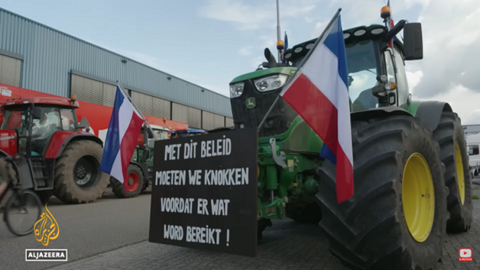
“For many farmers it’s the end of their business and they will fight until the last. Sometimes these farms go back generations, they were built by hand, and people feel farmers heart and soul. This is all being taken away.”
Jan Brok, vice chairman of the BoerBurgerBeweging (BBB) party, understands why Netherlands farmers have spent the past month blockading food distribution centres, roads and ministers’ driveways. They are horrified by a new environmental policy that will mean a likely 30% reduction in livestock.
The Netherlands is a country of four million cattle, 13 million pigs, 104 million chickens, and just over 17 million people. It is Europe’s biggest meat exporter with a total area of just over 41,000 square kilometres, and a fifth of this is water. It is one of the world’s most densely populated countries, with the EU’s highest density of livestock.
But there is a significant cost to this abundance: the local environmental impact. Such intensive agriculture, and livestock farming in particular, creates harmful pollution. Manure and urine mix to produce ammonia, and together with run-off from nitrogen-rich fertiliser on fields ends up in lakes and streams, where it can promote excessive algae that smothers other life. Manure here is not a vital fertiliser but a problem waste product.
For decades, this success in trade and agriculture has been accompanied by high emissions of harmful nitrogen compounds, including nitrogen oxides emitted by industry and transport. Levels were dropping, and in 2015, the Dutch introduced a “trading scheme” known as the Programmatische Aanpak Stikstof (PAS) to try to reduce the pollution.
But a Council of State court ruling in 2019 — on a case brought by two local environmental organisations against various farms — ruled that this offsetting scheme was invalid. Permission could not be granted for polluting projects or farm expansion in exchange for promised nitrogen-related reductions in the future: the reductions needed to come first.
The government panicked: national shutdowns were put in place, building projects were put on hold and traffic speeds reduced to 100 kph in the daytime on major roads; it was also obvious that farming was a problem — something needed to be done about all ammonia, nitrogen oxide and nitrous oxide emissions.
Then, in January, the conservative-liberal-Christian coalition pledged to halve nitrogen production by 2030, with a €25 billion budget to back it up. That money was the loud part. The quiet part included the possibility of expropriation, of the government forcibly purchasing farmland. Plans drawn up by civil servants include slashing livestock numbers by 30%. More than €500 million is being brought forward for regional government to buy out farmers this year and next.
Leading the charge among the coalition partners are the Democrats 66 (D66) party. They insisted on “real action for the climate” in their last manifesto. Tjeerd de Groot, the D66 nature and farming spokesman, pointed out that the Netherlands is Europe’s biggest nitrogen emitter, followed by Belgium and Germany. He told a current affairs programme last week: “It is absolutely essential — but also painful — that the plans go through.”
In June, the government published two documents. One: a map showing the areas that need to reduce emissions by between 12% and 95%. The second was a statement that aimed to help farmers — which De Groot admits failed spectacularly. Farmers saw ruin, not a pair of documents. They looked at the percentage reduction figures next to their farms, and began interpreting how many cattle they would need to cull. It was an enormous blow. Many of them had made huge, expensive investments in new equipment to reduce the environmental impact of their herds.
Hence the massive uprising.
Comments Off on Some of the events that lead to the Dutch farmers’ revolt


