
seangabb
Published 7 Dec 2022Between 330 AD and 1453, Constantinople (modern Istanbul) was the capital of the Roman Empire, otherwise known as the Later Roman Empire, the Eastern Roman Empire, the Mediaeval Roman Empire, or the Byzantine Empire. For most of this time, it was the largest and richest city in Christendom. The territories of which it was the central capital enjoyed better protections of life, liberty and property, and a higher standard of living, than any other Christian territory, and usually compared favourably with the neighbouring and rival Islamic empires.
The purpose of this course is to give an overview of Byzantine history, from the refoundation of the City by Constantine the Great to its final capture by the Turks.
Here is a series of lectures given by Sean Gabb in late 2021, in which he discusses and tries to explain the history of Byzantium. For reasons of politeness and data protection, all student contributions have been removed.
(more…)
September 16, 2022
The Byzantine Empire: Part 3 – The Age of Justinian – Cashing in the Gains of the Fifth Century
Look at Life — East of Suez (1966)
PauliosVids
Published 20 Nov 2018More than 50,000 British soldiers, sailors and airmen police the rivers and jungles of Borneo.
September 15, 2022
Italy Switches Sides in World War Two – WAH 077 – September 11, 1943
World War Two
Published 14 Sep 2022When Italy leaves WW2, The Nazi German Reich immediately begins occupying the country, and the occupied nations it has held until now.
(more…)
Lahti L-35: Finland’s First Domestic Service Automatic Pistol
Forgotten Weapons
Published 23 Apr 2018When Finland decided to replace the Luger as its service handgun, they turned to Finland’s most famous arms designer, Aimo Lahti. After a few iterations, Lahti devised a short recoil semiautomatic pistol with a vertically traveling locking block, not too different from a Bergmann 1910 or Type 94 Nambu. It was adopted in 1935, but production did not really begin in earnest until 1939 at the VKT rifle factory. Several variations were made as elements of the gun were simplified to speed up production, and the design was also licensed to the Swedish Husqvarna company, which manufactured nearly 10 times as many of the pistols as VKT eventually did.
In today’s video we will look at each of the variations, including one with an original shoulder stock and the early and late military guns as well as the post-war commercial guns marked Valmet instead of VKT.
(more…)
September 14, 2022
Whisky – Scotland’s Water of Life
Tasting History with Max Miller
Published 13 Sep 2022
“Americans, particularly the kind of Very Serious people who make up our intelligentsia, are desperate for a good war”
Freddie deBoer thinks he’s sussed out the reason so many Americans are so very, very pro-Ukraine in the ongoing fighting between the Russian invaders and the Ukrainian defenders (beyond the normal desire to “root for the underdog”):
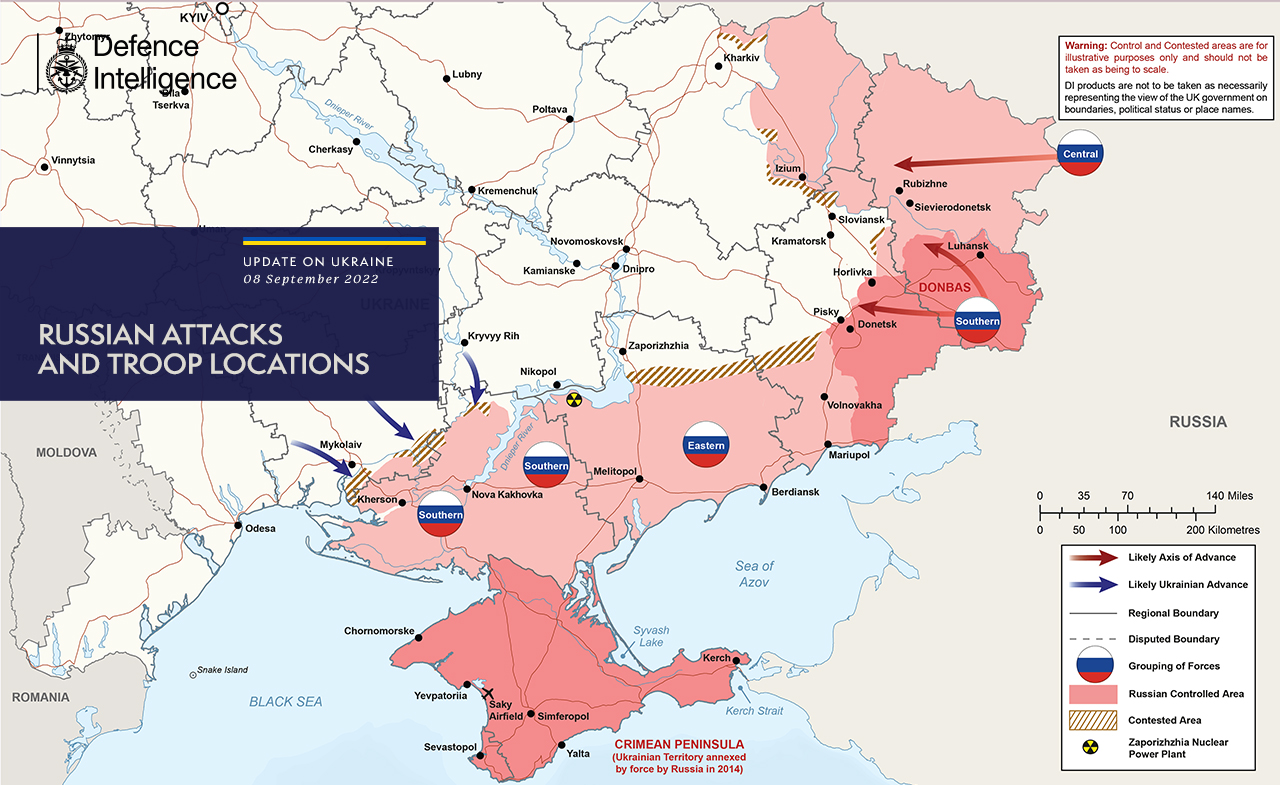
Approximate front-line positions just before the Ukrainian counter-attack east of Kharkiv in early September 2022.
It was not until I was an adult that I realized that the absurd fervor for Desert Storm was in fact about Vietnam. Fifteen years earlier, American helicopters had fled in humiliation from Saigon, and nothing had happened to take the sour taste out of the mouth of Americans since. There was plenty of power projection in that decade and a half, but no great good wars for the United States to win in grand and glorious fashion, unless you worked really hard to talk yourself into Grenada. America had been badly stung by losing a war to a vastly poorer and less technologically-advanced force. Americans had been nursing their wounds all those years. So when Saddam Hussein invaded Kuwait, and the “international community” rose to expel him, the country was ready. We were ready for another righteous combat of the Goodies vs. the Baddies. We were ready for the good guys to be the winners again.
This dynamic, I’m certain, is the source of American bloodlust over Ukraine.
We have now spent twenty years without good, noble wars against the Baddies ourselves. Afghanistan was a war effort undertaken in rage and terror, and was accordingly never intelligently conceptualized at the most basic level. The war aim of finding and capturing bin Laden and destroying Al Qaeda gave way to a war on the Taliban that ensured an endless occupation. The Potemkin government we installed was never popular with the people of the country, entailed comical levels of corruption, and showed no ability to train a loyal and effective Afghan army. After 20 years our country tired of spending hundreds of billions on that failure, we left, the government collapsed almost without resistance, and the Taliban are in power again. In Iraq, the basic arguments for the war (WMDs and a Hussein-al Qaeda connection) were swiftly revealed to be bullshit. Saddam’s army fell quickly and he was dispatched after a show trial, but a persistent insurgency inflicted thousands of American casualties. The chaos enabled the rise of ISIS and its various horrors. The new Iraqi government we’ve installed is impossibly corrupt and scores a 31/100 on Freedom House’s ratings of a country’s dedication to political rights and civil liberties. That’s what the United States has gotten for $8 trillion spent on warmaking since 9/11.
America loves a winner, and will not tolerate a loser. So I once heard. Americans, particularly the kind of Very Serious people who make up our intelligentsia, are desperate for a good war. A just war. A war where we win. They’re sick of wars that feel morally complicated, sick of wars that they have to feel queasy about, sick of wars that aren’t just Goodies and Baddies. They are very, very hungry for good war. I think Ukraine is the Desert Storm a lot of people have been waiting for: a war with (they insist) perfectly simplistic moral stakes, an impossibly noble (they assume) set of Goodies, a marauding and senseless (they demand) set of Baddies. All they’re waiting on is victory. And it’s for this reason, this view of war as one big cope, that the pro-Ukraine position is the single most rigidly enforced consensus in our country since 9/11. There is no other issue on which the majority has more vociferously demanded total consensus or more viciously attacked any who dissent or even ask questions. Because America needs a win. People need to believe in a Goodies and Baddies world again.
There are, of course, all manner of hard questions that we could ask, even if we were supportive of Ukraine in this war. That this is a conflict that has constantly inspired left-leaning people to literally say “well, yes, there’s Nazis, but …” might be seen as a matter of some concern. Perhaps, we might just say, isn’t that a little disturbing? But not in this discursive environment. Or we might consider that a total loss for Russia could be one of the most dangerous outcomes for the world even if you support Ukraine. What do you think happens, with a wounded and isolated Russia? Let’s say people get what they want and Putin is deposed. What do you think happens next? We finally get that shining city on a hill in Moscow that we were promised with the collapse of the Soviet Union? That we’ll get the world leader we expected Bagdhad to be in 2003, that a foreign country with foreign people and foreign concerns will suddenly become a docile member of the liberal-capitalist order? Maybe the best post-Putin outcome would be for a similar corrupt autocrat to take his place; at least then there might be stability. A far more likely and more frightening outcome is that leadership is splintered, you have in effect a set of rival warlords squabbling over the spoils, and the world’s largest nuclear arsenal is exposed in a terrifying way. Seems like something to worry about.
But, no. To a degree that genuinely shocks me, hard questions have been forbidden. Complications have been denied. Comparisons to previous conflicts have been forsaken. And this from Democrat and Republican, liberal and leftist, neocon and Never Trumper. It’s constant, everpresent, and relentless, the denial of any complication in the case of Ukraine and Russia. The glee and the gloating and the urge to ridicule anyone who takes even a single step outside of the consensus is remarkable, unlike anything I’ve ever really encountered before. And I find that I can’t even get people to have a conversation about that, a meta-conversation about why the debate on Ukraine is not a debate, about why there are many people who will consider any political position except one that troubles the moral question of Russia’s invasion, about why so many people who learned to speak with care and equivocation during Iraq now insist that there is no complication at hand with this issue at all. I can’t even get a conversation about the conversation going. People get too mad.
Marmite Dynamite Limited Edition — Tasting (Also Re-Tasting The Others, With A Spoon)
Atomic Shrimp
Published 20 Mar 2021More Marmite – I couldn’t get hold of a jar of this for the group tasting last week, but here it is now!
Here’s the previous video: https://youtu.be/MjrBTcnnK6c
QotD: The Wars of Religion and the (eventual) Peace of Westphalia
Thomas Hobbes blamed the English Civil War on “ghostly authority”. Where the Bible is unclear, the crowd of simple believers will follow the most charismatic preacher. This means that religious wars are both inevitable, and impossible to end. Hobbes was born in 1588 — right in the middle of the Period of the Wars of Religion — and lived another 30 years after the Peace of Westphalia, so he knew what he was talking about.
There’s simply no possible compromise with an opponent who thinks you’re in league with the Devil, if not the literal Antichrist. Nothing Charles I could have done would’ve satisfied the Puritans sufficient for him to remain their king, because even if he did everything they demanded — divorced his Catholic wife, basically turned the Church of England into the Presbyterian Kirk, gave up all but his personal feudal revenues — the very act of doing these things would’ve made his “kingship” meaningless. No English king can turn over one of the fundamental duties of state to Scottish churchwardens and still remain King of England.
This was the basic problem confronting all the combatants in the various Wars of Religion, from the Peasants’ War to the Thirty Years’ War. No matter what the guy with the crown does, he’s illegitimate. It took an entirely new theory of state power, developed over more than 100 years, to finally end the Wars of Religion. In case your Early Modern history is a little rusty, that was the Peace of Westphalia (1648), and it established the modern(-ish) sovereign nation-state. The king is the king because he’s the king; matters of religious conscience are not a sufficient casus belli between states, or for rebellion within states. Cuius regio, eius religio, as the Peace of Augsburg put it — the prince’s religion is the official state religion — and if you don’t like it, move. But since the Peace of Westphalia also made heads of state responsible for the actions of their nationals abroad, the prince had a vested interest in keeping private consciences private.
I wrote “a new theory of state power”, and it’s true, the philosophy behind the Peace of Westphalia was new, but that’s not what ended the violence. What did, quite simply, was exhaustion. The Thirty Years’ War was as devastating to “Germany” as World War I, and all combatants in all nations took tremendous losses. Sweden’s king died in combat, France got huge swathes of its territory devastated (after entering the war on the Protestant side), Spain’s power was permanently broken, and the Holy Roman Empire all but ceased to exist. In short, it was one of the most devastating conflicts in human history. They didn’t stop fighting because they finally wised up; they stopped fighting because they were physically incapable of continuing.
The problem, though, is that the idea of cuius regio, eius religio was never repudiated. European powers didn’t fight each other over different strands of Christianity anymore, but they replaced it with an even more virulent religion, nationalism.
Severian, <--–>”Arguing with God”, Rotten Chestnuts, 2020-01-20.
September 13, 2022
The Greatest Escapes of World War Two – WW2 Special
World War Two
Published 12 Sep 2022This is an intimate story inspired by real events (notably inspired by the story of a member of the Danish resistance and grandmother of Hans von Knut Skovfoged, Head of Development at PortaPlay. A story told not on the front line, but in the intimate setting of a small Danish village.
(more…)
Down the Line – A look into the legacy of the cuts made to the rail network by Doctor Beeching (2008)
Kevin Birch
Published 29 Jul 2013Joe Crowley meets the people who battled to save their local railway lines in the South of England in the 1960’s.
First aired on BBC One 26th October 2008
QotD: J.R.R. Tolkien’s childhood and schooling
For a time, the fatherless Tolkien enjoyed a happy childhood, devouring children’s classics and exploring the local countryside. But in 1904 his mother died of diabetes, leaving the 12-year-old an orphan. Now he and his brother went to live with an aunt in Edgbaston, near what is now Birmingham’s Five Ways roundabout. In effect, he had moved from the city’s rural fringes to its industrial heart: when he looked out of the window, he saw not trees and hills, but “almost unbroken rooftops with the factory chimneys beyond”. No wonder that from the moment he put pen to paper, his fiction was dominated by a heartfelt nostalgia.
Nostalgia was in the air anyway in the 1890s and 1900s, part of a wider reaction against industrial, urban, capitalist modernity. As a boy, Tolkien was addicted to the imperial adventure stories of H. Rider Haggard, and it’s easy to see The Lord of the Rings as a belated Boy’s Own adventure. An even bigger influence, though, was that Victorian one-man industry, William Morris, inspiration for generations of wallpaper salesmen. Tolkien first read him at King Edward’s, the Birmingham boys’ school that had previously educated Morris’s friend Edward Burne-Jones. And what Tolkien and his friends adored in Morris was the same thing you see in Burne-Jones’s paintings: a fantasy of a lost medieval paradise, a world of chivalry and romance that threw the harsh realities of industrial Britain into stark relief.
It was through Morris that Tolkien first encountered the Icelandic sagas, which the Victorian textile-fancier had adapted into an epic poem in 1876. And while other boys grew out of their obsession with the legends of the North, Tolkien’s fascination only deepened. After going up to Oxford in 1911, he began writing his own version of the Finnish national epic, the Kalevala. When his college, Exeter, awarded him a prize, he spent the money on a pile of Morris books, such as the proto-fantasy novel The House of the Wolfings and his translation of the Icelandic Volsunga Saga. And for the rest of his life, Tolkien wrote in a style heavily influenced by Morris, deliberately imitating the vocabulary and rhythms of the medieval epic.
Dominic Sandbrook, “This is Tolkien’s world”, UnHerd.com, 2021-12-10.
September 12, 2022
QotD: On the nature of our evidence of the ancient world
So let’s take a look at the sort of sources an ancient historian has to work with and what their limits are and what that means for what it is possible to know and what must be merely guessed.
The most important body of sources are what we term literary sources, which is to say long-form written texts. While rarely these sorts of texts survive on tablets or preserved papyrus, for most of the ancient world these texts survive because they were laboriously copied over the centuries. As an aside, it is common for students to fault this or that later society (mostly medieval Europe) for failing to copy this or that work, but given the vast labor and expense of copying and preserving ancient literature, it is better to be glad that we have any of it at all (as we’ll see, the evidence situation for societies that did not benefit from such copying and preservation is much worse!).
The big problem with literary evidence is that for the most part, for most ancient societies, it represents a closed corpus: we have about as much of it as we ever will. And what we have isn’t much. The entire corpus of Greek and Latin literature fits in just 523 small volumes. You may find various pictures of libraries and even individuals showing off, for instance, their complete set of Loebs on just a few bookshelves, which represents nearly the entire corpus of ancient Greek and Latin literature (including facing English translation!). While every so often a new papyrus find might add a couple of fragments or very rarely a significant chunk to this corpus, such additions are very rare. The last really full work (although it has gaps) to be added to the canon was Aristotle’s Athenaion Politeia (“Constitution of the Athenians”) discovered on papyrus in 1879 (other smaller but still important finds, like fragments of Sappho, have turned up as recently as the last decade, but these are often very short fragments).
In practice that means that, if you have a research question, the literary corpus is what it is. You are not likely to benefit from a new fragment or other text “turning up” to help you. The tricky thing is, for a lot of research questions, it is in essence literary evidence or bust. […] for a lot of the things people want to know, our other forms of evidence just aren’t very good at filling in the gaps. Most information about discrete events – battles, wars, individual biographies – are (with some exceptions) literary-or-bust. Likewise, charting complex political systems generally requires literary evidence, as does understanding the philosophy or social values of past societies.
Now in a lot of cases, these are topics where, if you have literary evidence, then you can supplement that evidence with other forms […], but if you do not have the literary evidence, the other kinds of evidence often become difficult or impossible to interpret. And since we’re not getting new texts generally, if it isn’t there, it isn’t there. This is why I keep stressing in posts how difficult it can be to talk about topics that our (mostly elite male) authors didn’t care about; if they didn’t write it down, for the most part, we don’t have it.
Bret Devereaux, “Fireside Friday: March 26, 2021 (On the Nature of Ancient Evidence”, A Collection of Unmitigated Pedantry, 2021-03-26.
The Lord of the Rings and Ancient Rome (with Bret Devereaux)
toldinstone
Published 10 Sep 2022In this episode, Dr. Bret Devereaux (the blogger behind “A Collection of Unmitigated Pedantry”) discusses the relationships between fantasy and ancient history – and why historical accuracy matters, even in fiction.
(more…)
The art of the constitutional monarchy
At The Ruffian, Ian Leslie considers the form of government nobody set out to design, but has proven to be one of the most stable forms of government we’ve had:
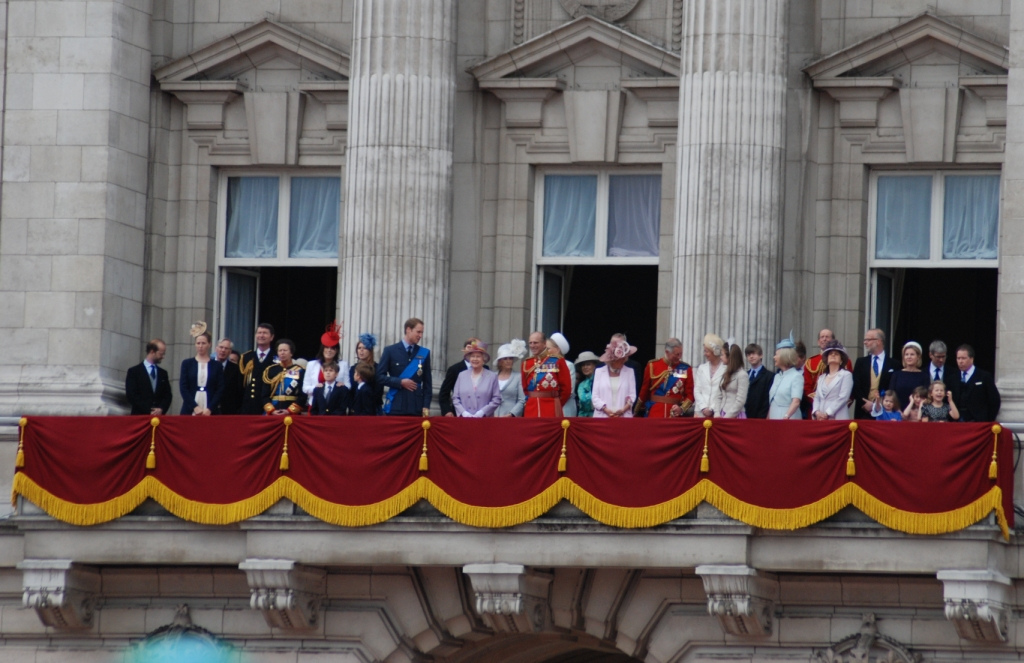
The royal family at Buckingham Palace for the Trooping of the Colour, 30 June, 2015.
Photo by Robert Payne via Wikimedia Commons.
When I said that nobody would design this system, that is not a criticism. Evolved systems tend to work better than designed ones, even if they can seem maddeningly irrational to those who presume to know better. Yesterday somebody posted extracts from an essay by Clement Attlee. As a socialist, Attlee might have been expected to oppose or at least be sceptical of constitutional monarchy, but he was a strong believer in it. Attlee was writing in 1952, a year after the end of his term as Prime Minister, and the same year that Queen Elizabeth came to the throne. When he refers to the monarch, he refers to her – one of those examples of how the Queen’s longevity stretches our perception of time. “You will find the greatest enthusiasm for the monarch in the meanest streets,” he writes. After qualifying as a lawyer, Attlee ran a club in the East End of London for teenage boys raised in dire poverty. He remembers one of them saying, “Some people say as how the King and Queen are different from us. They aren’t. The only difference is that they can have a relish with their tea every day.”
Attlee notes that Norway, Sweden, and Denmark — countries in which there is “the highest equality of well-being” — have royal families. That’s still true and we might add the Netherlands to that list. While it’s impossible to disentangle the many historical factors that make for a decent and successful society, it is at the very least tough to make the case, on evidence alone, that democratic monarchies are inherently bad. Indeed, they seem to work pretty well versus other forms of government. As the left-wing American blogger Matt Yglesias remarked yesterday, “It’s hard to defend constitutional monarchy in terms of first principles, but the empirical track record seems good.”
If this is so, I’m interested in why (let’s agree, by the way, that there isn’t one definitively superior way of running a country, and that every system has flaws). My guess is that it’s because constitutional monarchies do a better job than more “rational” forms of government of accommodating the full spectrum of human nature. They speak to the heart as well as the head. Attlee puts it succinctly: “The monarchy attracts to itself the kind of sentimental loyalty which otherwise might to the leader of a faction. There is, therefore, far less danger under a constitutional monarchy of the people being carried away by a Hitler, a Mussolini or even a de Gaulle.” (I need hardly add that for Attlee, these were not merely historical figures.) Martin Amis, in the closing paragraph of his 2002 piece about the Queen for the New Yorker, expresses the same idea with characteristic flair:
“A princely marriage is the brilliant edition of a universal fact,” Bagehot wrote, “and as such, it rivets mankind.” The same could be said of a princely funeral — or, nowadays, of a princely divorce. The Royal Family is just a family, writ inordinately large. They are the glory, not the power; and it would clearly be far more grownup to do without them. But riveted mankind is hopelessly addicted to the irrational, with reliably disastrous results, planetwide. The monarchy allows us to take a holiday from reason; and on that holiday we do no harm.
Yes, there is something deeply sentimental and even loopy about placing a family at the centre of national life, and ritually celebrating them, not for what they’ve done but for who they are. But here’s the thing: humans are sentimental and yes, a bit loopy. Constitutional monarchies accept this, and separate the locus of sentiment from the locus of power. They divert our loopiness into a safe space.
In republics, the sentimentality doesn’t go away but becomes fused with politics, often to dangerous effect. Russia, despite having killed off its monarchy long ago, retains an ever more desperate hankering after grandeur, the consequences of which are now being suffered by the Ukrainians. America’s more “rational” system has given us President Donald Trump, and I don’t think it’s a coincidence that their political culture is more viciously, irrationally polarised than ours.
Monarchy, in its democratic form, can also be a conduit for our better natures. It gives people a way to express their affection for the people with whom they share a country, by proxy. Think about that boy in Limehouse: it’s not that he wouldn’t have preferred to have relish with his tea – to be rich, or at least richer. But he recognised that, as different as human lives can be, they are always in some fundamental ways the same. People have mothers and fathers (present or absent, kind or cruel), brothers and sisters, hopes, fears, joys and anxieties. That’s why one family can stand in for all of us, even if that family lives in a very privileged and singular manner.
History Summarized: Classical Warfare (Feat. Shadiversity!)
Overly Sarcastic Productions
Published 22 Jul 2017How did people fight in ancient times? Well that’s a good question! Step right up and I’ll learn you a thing or two about history.
(more…)


