
World War Two
Published 10 Sep 2022Dwight Eisenhower publicly announces the secret armistice signed last week, and Italy is now officially out of the war. The Italian fleet sails for Malta and Allied captivity. The Allies have landed in force in Southern Italy and they do face some heavy opposition from German forces — who have no intention of giving up Italy. In the USSR, though, the Soviets continue liberating territory all over Ukraine as they force the Germans back to the Dnieper River.
(more…)
September 11, 2022
The Allies’ Latest Victory – WW2 – 211 – September 10, 1943
Comments Off on The Allies’ Latest Victory – WW2 – 211 – September 10, 1943
MAS-36: The Backup Rifle is Called to Action
Forgotten Weapons
Published 25 Sep 2017There is a common assumption that the MAS-36 was a fool’s errand from the outset — why would a country develop a brand new bolt-action rifle in the mid 1930s, when obviously semiautomatic combat rifles were just on the cusp of widespread adoption? Well, the answer is a simple one — the French were developing a semiautomatic rifle at the same time, and the MAS-36 was only intended to go to rear echelon and reserve troops. It would serve as a measure of economy, reducing the number of the more complex and expensive self-loaders necessary, while still providing sufficient arms to equip the whole reserve in case of a mobilization.
Well, the plan didn’t quite work out that way, because Germany invaded France before the semiauto rifle was ready for production (it was, at that point, the MAS-40 and was in trials). Not until 1949 would the self-loader go into mass production with the MAS-49 (discounting the short-lived MAS-44). With this in mind, the MAS-36 suddenly makes much more sense. It is a simple, economical, and entirely adequate rifle without extraneous niceties. In a word, it is a Russian rifle rather than a Swiss one.
Production began in the fall of 1937, and by the time of the German invasion there were about 205,000 in French stockpiles. They saw extensive use in the Battle of France, along with M34 Berthiers in 7.5x54mm. Some would escape to serve the Free French forces worldwide through the war, and others would be captured and used by German garrisons in France and along the Atlantic Wall. Production resumed upon the liberation of St Etienne in 1944, and by 1957 about 1.1 million had been made. They basically fall into two varieties, with several pre-war milled components changed to more economical stamped designs after the war.
(more…)
Comments Off on MAS-36: The Backup Rifle is Called to Action
September 10, 2022
In a stormy and uncertain world, at least the New York Times remains consistent
Ed West on hearing the news that the Queen had died:
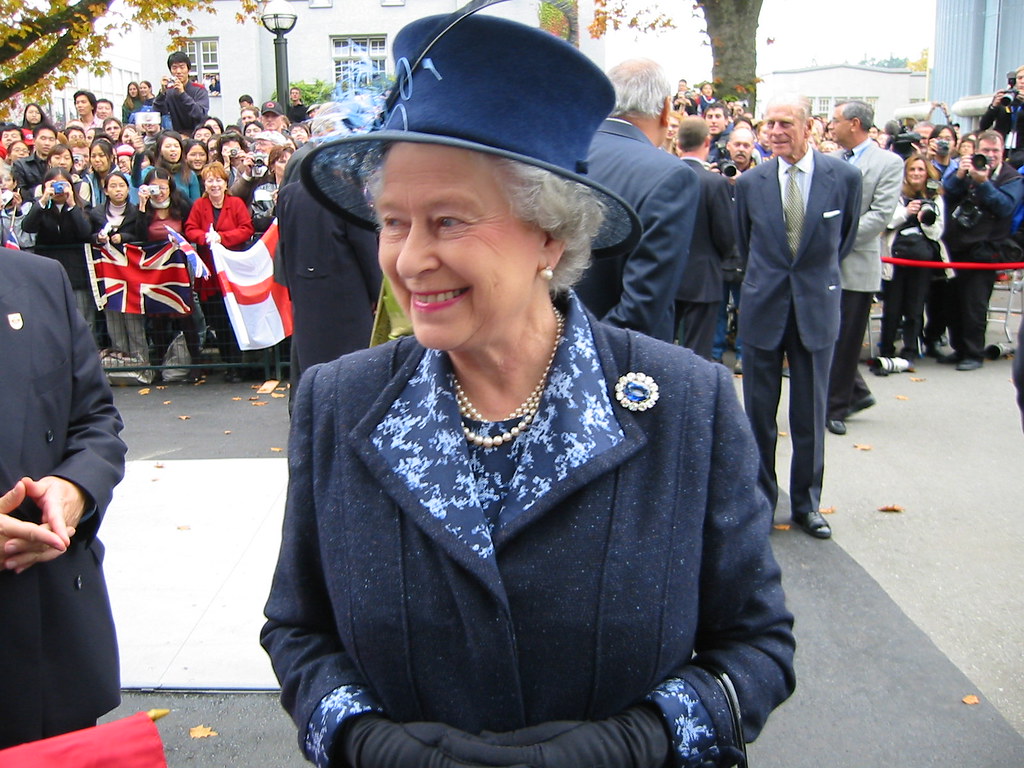
“Her Majesty Queen Elizabeth II” by Tinker Sailor Soldier Spy is licensed under CC BY-NC-ND 2.0 


 .
.
Unusually for me, being a cold-blooded Englishman whose emotional range is somewhere between Peter Cushing in Star Wars and Tywin Lannister, I found myself crying over the news yesterday evening. I cry more as I get older – presumably it’s all the testosterone draining away – and I shed tears for the Queen.
Her Majesty’s death was announced around 6.30 GMT. Soon after 9pm the New York Times pops up on Twitter, in its usual sanctimonious, scolding told, telling us that “We should not romanticize her era”, because, according to a Harvard professor “The queen helped obscure a bloody history of decolonization whose proportions and legacies have yet to be adequately acknowledged.”
Our Queen has died, a deeply-loved, politically-neutral figure who many saw as being like another grandmother. She was someone we all knew throughout our lives, who felt like a protective figure, associated with the political stability that our island has enjoyed for so long.
Yet for some inexplicable reason, the voice of America’s progressive establishment thought it appropriate to immediately publish this article, with the headline “Mourn the Queen, Not Her Empire”, something literally no one even considered or thought about. The British Empire may be long dead but it lives on, timeless and immortal, in the minds of New York Times editors.
Much has been written about the changing social mores of the Queen’s reign, but I think it’s still generally accepted that you wait until a person is buried before launching criticisms of their legacy; at the very least a couple of days. Yet while even the Kremlin managed to send some kind words on Queen Elizabeth’s passing, the New York Times went straight in with the yes-she-will-be-mourned-but.
As head of the Commonwealth, the Queen “put a stolid traditionalist front over decades of violent upheaval. As such, the queen helped obscure a bloody history of decolonization whose proportions and legacies have yet to be adequately acknowledged.”
“We may never learn what the queen did or didn’t know about the crimes committed in her name,” the historian concludes, but “xenophobia and racism have been rising, fueled by the toxic politics of Brexit. Picking up on a longstanding investment in the Commonwealth among Euroskeptics (both left and right) as a British-led alternative to European integration, Mr. Johnson’s government (with the now-Prime Minister Liz Truss as its foreign secretary) leaned into a vision of ‘Global Britain’ steeped in half-truths and imperial nostalgia.”
Andrew Sullivan found himself similarly moved at the news (after a bit of mandatory Trump-bashing to start the column):
[In the 2016 TV show The Crown] I found myself watching the life of an entirely different head of state: a young, somewhat shy woman suddenly elevated to immense responsibilities and duties in her twenties, hemmed in by protocol, rigidified by discipline. The new president could barely get through the day without some provocation, insult, threat or lie. Elizabeth Windsor was tasked as a twenty-something with a job that required her to say or do nothing that could be misconstrued, controversial, or even interestingly human — for the rest of her life.
The immense difficulty of this is proven by the failure of almost every other member of her family — including her husband — to pull it off. We know her son King Charles III’s views on a host of different subjects, many admirable, some cringe-inducing. We know so much of the psychological struggles of Diana; the reactionary outbursts of Philip; the trauma of Harry; the depravity of Andrew; the agonies of Margaret. We still know nothing like that about the Queen. Because whatever else her life was about, it was not about her.
Part of the hard-to-explain grief I feel today is related to how staggeringly rare that level of self-restraint is today. Narcissism is everywhere. Every feeling we have is bound to be expressed. Self-revelation, transparency, authenticity — these are our values. The idea that we are firstly humans with duties to others that will require and demand the suppression of our own needs and feelings seems archaic. Elizabeth kept it alive simply by example.
With her death, it’s hard not to fear that so much she exemplified — restraint, duty, grace, reticence, persistence — are disappearing from the world. As long as she was there, they were at the center of an idea of Britishness that helped define the culture at its best. Perhaps the most famous woman in the world, she remained a sphinx, hard to decipher, impossible to label. She was not particularly beautiful or dashing or inspiring. She said nothing surprising. She was simply the Queen. She showed up. She got on with it. She was there. She was always there.
Whatever else happened to the other royals, she stayed the same. And whatever else happened in Britain — from the end of Empire to Brexit — she stayed the same. This is an achievement of nearly inhuman proportions, requiring discipline beyond most mortals. Think of a year, 1992, in which one son, Andrew, divorced, a daughter-in-law, Sarah Ferguson was seen cavorting nude in the tabloids, a daughter, Anne, separated, another son’s famously failed marriage, Charles’, dominated the headlines, and your house burns down. Here is how Her Majesty “vented”:
1992 is not a year on which I shall look back with undiluted pleasure. In the words of one of my more sympathetic correspondents, it has turned out to be an “Annus Horribilis“.
Dry, understated, with the only vivid phrase ascribed to a correspondent. Flawless.
She was an icon, but not an idol. An idol requires the vivid expression of virtues, personality, style. Diana was an idol — fusing a compelling and vulnerable temperament with Hollywood glamor. And Diana, of course, was in her time loved far more intensely than her mother-in-law; connected emotionally with ordinary people like a rockstar; only eventually to face the longterm consequences of that exposure and crumble under the murderous spotlight of it all.
Elizabeth never rode those tides of acclaim or celebrity. She never pressed the easy buttons of conventional popularity. She didn’t even become known for her caustic wit like the Queen Mother, or her compulsively social sorties like Margaret. The gays of Britain could turn both of these queens into camp divas. But not her. In private as in public, she had the kind of integrity no one can mock successfully.
Comments Off on In a stormy and uncertain world, at least the New York Times remains consistent
The Land Rover Defender Story
Big Car
Published 27 Dec 2019The Land Rover is Britain’s bullet-proof off-roader born out of Rover’s post-war desperation and became the indispensable go-anywhere vehicle. Like its famed bullet-proof ruggedness, Land Rover production kept going, and going, and going. But with a brief gap of 4 years, the Land Rover is still with us and looks like it’s not going away any time soon.
(more…)
Comments Off on The Land Rover Defender Story
QotD: “Working toward the Führer“
Sir Ian Kershaw was broadly right about how the Third Reich operated. He says Nazi functionaries were “working towards the Führer“. In other words, the Führer — the idealized, mythologized leader, not Adolf Hitler the individual — made it known that “National Socialism stands for X“. Hitler was famously averse to giving direct orders, so that’s often the only thing big, important parts of the government had to work from — the Führer‘s* pronouncement that “National Socialism means X“. It was up to them to put it into practice as best they could.
This had several big advantages. First, it’s in line with Nazi philosophy. The Nazis were Social Darwinists. Social Darwinists hold that “survival of the fittest” applies not only to humans as a whole, but to human social groups as well. Any given organization, then, must exist to do something, to advance some cause, to reach some goal. Ruthless competition between groups, and inside each group, is how the goal works itself out (you should be hearing echoes of Hegel here). The struggle refines and clarifies what the group’s goal is, even as the individual group members compete to reach it. The end result gets forced back up the system to the Führer, such that, dialectically (again, Hegel), “National Socialism means X” now encompasses the result of the previous struggle.
[…]
As with philosophy, “working towards the Führer” fit well with German military culture. Auftragstaktik is a fun word that means “mission-type tactics.” In practice, it delegates authority to the lowest possible level. Each subordinate commander is given an objective, a force, and a due date. High command doesn’t care how the objective gets taken; it only cares that the objective gets taken. Done right, it’s a wonderfully efficient system. It’s the reason the Wehrmacht could keep fighting for so long, and so well, despite being overpowered in every conceivable way by the Allies. The Allies, too, were constantly flabbergasted by their opponents’ low rank — corporals and sergeants in the Wehrmacht were doing the work of an entire Allied company command staff (and often doing it better).
Consider the career of Adolf Eichmann. In the deepest, darkest part of the war, this man pretty much ran the Reich’s rail network. Say what you will about the Nazi’s plate-of-spaghetti org chart, that’s some serious power. He was a lieutenant colonel.
The final great advantage of “working towards the Führer” is “plausible deniability”. Let’s stipulate Atrocity X. Let’s further stipulate that we’re in the professional historian’s fantasy world, where every conceivable document exists, and they’re all clear and unambiguous. It’s a piece of cake to pin Atrocity X on someone … and that someone would, in all probability, be a corporal or a sergeant. Maybe a lieutenant. What you wouldn’t be able to do is trace it up the chain any higher. Everyone from the captain to Hitler himself could / would give you the “Who, me?” routine. “I didn’t tell Sergeant Schultz to execute those prisoners. All I said was to go secure that objective / defeat that army / that National Socialism means fighting with an iron will.”
*I’m deliberately conflating them here — to make it clearer how confusing this could be — but in talking about this stuff the terminology is crucial. Adolf Hitler, the man, played the role of The Führer. What Hitler the man wanted was often in line with what the Führer role required, of course, but not always. This is one of the footholds Holocaust deniers have. Did Hitler-the-man actually put his name to a liquidation order? No. Did Hitler-the-man actually want it to happen? Unquestionably yes, but like all men, Hitler-the-man vacillated, had second thoughts, doubted himself, etc., and you can find documented instances of that. But The Führer very obviously wanted it to happen, and it was The Führer that motivated the rank-and-file. The man created the role, but very soon the role started playing the man …
Severian, “Working Towards the Deep State”, Rotten Chestnuts, 2020-01-06.
Comments Off on QotD: “Working toward the Führer“
September 9, 2022
“Far from fighting against the establishment, the woke are the establishment”
In Spiked, Andrew Doyle discusses the reactions to his announcement that he was writing a book about the ongoing culture wars:

“Titania McGrath” and Andrew Doyle
My new book is about intolerance. I am fascinated by those who prefer only to associate with people who share their own identical worldview, and who interpret the slightest point of political disagreement as evidence of evil. The new religion of group identity and “social justice” has driven once rational people into a state of frenzied bigotry. I want to understand why.
So, back in May, when I announced I was working on a book called The New Puritans, I wasn’t all that surprised to see so many self-proclaimed advocates of “social justice” rush to demonstrate the very phenomenon that I was attempting to explore. Some suggested that they would acquire copies only to burn them. One said that he intended to kick it under the bookshop shelf “so that it could rot in darkness”. Another simply declared that I was “pure scum”. Were any of these people aware that they were proving my point?
Byline Times even claimed that I was waging “a perpetual battle against social justice – fighting against a contrived present world of aggressive ‘woke snowflakes’ in order to return to an imagined past”. This was news to me, given that my book is a defence of progressive and liberal values, and it explicitly criticises those who resort to the “snowflake” slur. I particularly enjoyed the suggestion that my book was an example of someone imagining enemies into existence in order to fight them. It takes some chutzpah to make such a claim of a book you haven’t actually read.
It would seem that the title alone – The New Puritans: How the Religion of Social Justice Captured the Western World – was enough to stir the ire of these culture warriors. In a sense, this is unsurprising. One of the key aspects of this ideological movement is that its adherents treat all challenges as a form of heresy that must be quashed. For all that they like to smear their detractors as “bigots”, they forget that the main definition of the word – “a person who is utterly intolerant of any differing creed, belief or opinion” – applies most accurately to themselves.
Why is it, for instance, that JK Rowling can be so routinely monstered as “hateful” and “transphobic” despite having never said anything hateful or transphobic? Only this week, the Harry Potter author found herself in an exasperating Twitter exchange with someone claiming she had been “outwardly hateful of an entire community”. Rowling quite rightly asked for evidence, to which her detractor replied: “I don’t know where you said it, but I bet you do.” For those taking part in the witch-hunt, the total lack of evidence is simply an inconvenience to be brushed aside.
This is why my book draws comparisons between the hysteria of the “woke” movement and the witch hunts of Salem in the late 17th century. In a burst of collective madness that lasted a little over a year (from February 1692 to May 1693), 20 people were executed for witchcraft on the basis of the testimony of local girls. All of the prosecutions were secured on the basis of “spectral evidence” – what today we might call “lived experience”. The girls simply declared that they had seen these innocent people sign the devil’s book, or that they had been “sending out their spirits” to torment people. This was their “truth”, and so it had to be believed.
Comments Off on “Far from fighting against the establishment, the woke are the establishment”
The Byzantine Empire: Part 2 – Survival and Growth
seangabb
Published 15 Oct 2021Between 330 AD and 1453, Constantinople (modern Istanbul) was the capital of the Roman Empire, otherwise known as the Later Roman Empire, the Eastern Roman Empire, the Mediaeval Roman Empire, or The Byzantine Empire. For most of this time, it was the largest and richest city in Christendom. The territories of which it was the central capital enjoyed better protections of life, liberty and property, and a higher standard of living, than any other Christian territory, and usually compared favourably with the neighbouring and rival Islamic empires.
The purpose of this course is to give an overview of Byzantine history, from the refoundation of the City by Constantine the Great to its final capture by the Turks.
Here is a series of lectures given by Sean Gabb in late 2021, in which he discusses and tries to explain the history of Byzantium. For reasons of politeness and data protection, all student contributions have been removed.
(more…)
Comments Off on The Byzantine Empire: Part 2 – Survival and Growth
Britain’s “Lord of Misrule” at the end of the “Borisarchy”
In Quillette, John Lloyd considers the parts of Boris Johnson’s personality that allowed him to achieve the premiership but not to retain it:
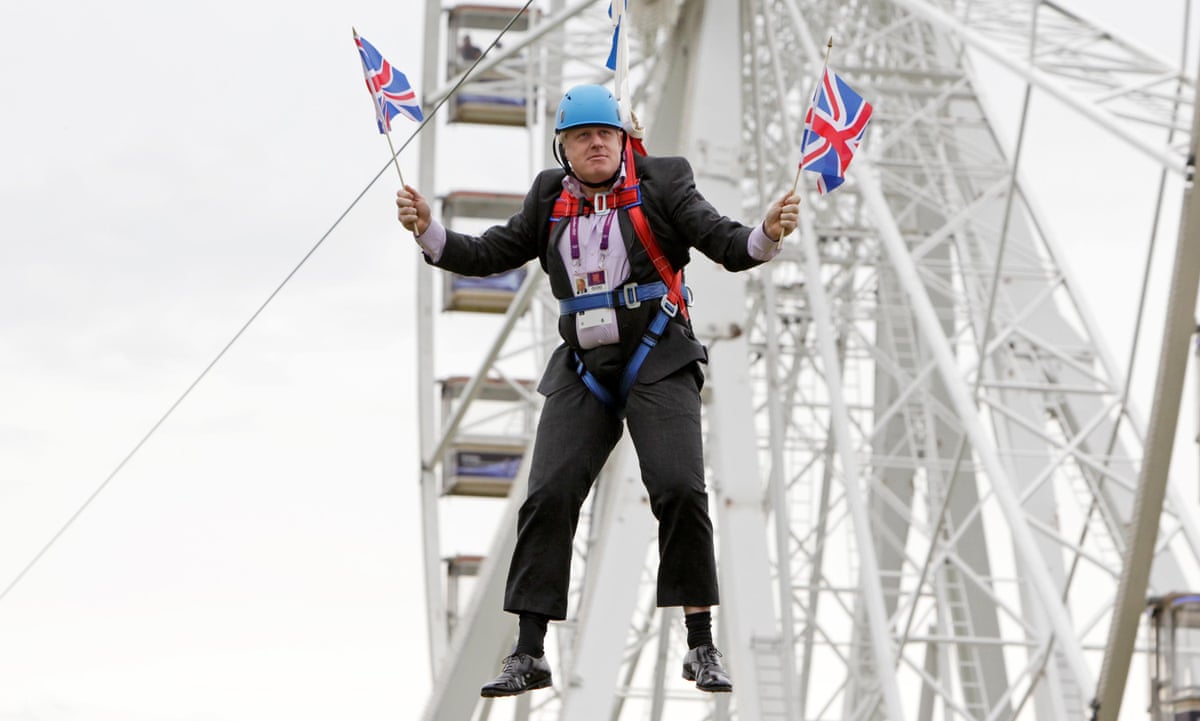
The respectable consensus on Boris Johnson’s resignation is that the Lord of Misrule was an opportunist who rose to power amid the mayhem of Brexit that he’d helped to create, but that his fecklessness finally caught up with him. There’s something in that, but more in what’s not. Although his critics will refuse to admit it, what’s mostly missing is the laughter, which is now a more important factor in British public life than before.
Much of public and media life in the UK — and it isn’t unique in this — is a search for laugh lines, and Johnson — instinctively but also with calculation — played heartily into this. He always had. In a largely affectionate biography, Andrew Gimson, Johnson’s former colleague at the Spectator and the Daily Telegraph, writes that, “To make people enjoy being led by him was an aspect of leadership which Boris mastered at a very young age. He made people helpless with laughter, and so great was their enjoyment that they scarcely cared what he did with their support, as long as he kept on amusing them.”
With the laughter came Johnson’s inchoate libertarianism — a strong aversion to condemning activities in which others like to indulge, especially those in which he likes to indulge himself, such as adultery. He is fond of telling the story of when Churchill, Johnson’s lodestar as a public figure, was taken aside during his second administration (1951–55) by his chief whip and told that a cabinet minister had been discovered having sex with a guardsman in Hyde Park at 3am on a freezing morning in February. The press had found out, which the whip advised, meant the minister would have to resign. “Caught with a guardsman?” Churchill asked. “Yes Prime Minister.” “In Hyde Park?” “Yes Prime Minister.” “On a park bench?” “That’s right, Prime Minister.” “At three o’clock in the morning?” “That’s correct, Prime Minister.” “In this weather! Good God man, it makes you proud to be British!”
To Johnson, this is evidence of Churchill’s goodhearted tolerance and defiance of narrow prejudice (this was a time when homosexual acts were quite severely punished), which are matched only by his own in generosity and wit. To be generous and broadminded in his speech (he is said to be quite mean with his money) is attractive to the many sinners among us. We see in the Prime Minister a person with the moral outlook of Casanova and yet (or, and so) finds attractive women willing to dally with him — a cheering thought. As one of these, Allegra Mostyn-Owen, who became his first wife, later admitted, “at least he made me laugh.”
[…]
Accustomed to lying to wriggle out of embarrassments like the discovery of an adultery, he continued to mislead when he joined aides for impromptu parties at No. 10, when the strictest lockdowns and prohibitions on the public were in force. How could a man of such intelligence fail to realise that his bluster would unravel almost as soon as they were uttered? He had, it seemed, an inbuilt arrogance — a conviction that he was able to avoid consequences that brought others down, but which only made him stronger.
In the end, he ran out of that road. Ironically, what finished him was denying that he knew that a government whip, Chris Pincher, had a history of groping other men. Johnson refused to take the scandal seriously enough to fire Pincher, as his senior colleagues pressed him to do — an echo of the Churchill joke he liked to tell, and a reaction which accorded with his libertarian instincts. However, his colleagues finally wearied of delivering statements to the media that made them look ridiculous within days or even hours. It was the last straw.
When Lord Dannatt, a former head of the British Army, was confronted with the (admittedly faint) possibility that Johnson would be considered for the post of NATO Secretary General, he was quoted as saying: “There is no doubt that [Johnson] has done a lot of good, and our full support for Ukraine is just fantastic. But I am afraid that these are personal things, a lack of integrity, a lack of trust. Frankly, we do not want to put Boris Johnson on the international stage for further ridicule. He is a disgrace to the nation.”
Comments Off on Britain’s “Lord of Misrule” at the end of the “Borisarchy”
QotD: The BBC behind-the-scenes in 1983
I was in the studio next door, which had been transformed into a vast Green Room, tables stacked high with food and booze. Us trainees had been brought in to help organise the guests and manage the hospitality.
And that party was only getting started. As the night wore on and the politicians, academics and journalists came and went, but mostly came and stayed, the whole place, and the labyrinth of corridors, scenery docks and stage lifts surrounding it, began to resemble something between a University May Ball and the last days of Rome.
People were being sick in corridors, being discovered “in flagrante” in lifts or sneaking off into unlocked offices. Some, bearing an uncanny resemblance to their Spitting Image puppets, became far too slurry and unsteady on their feet to go before Dimbleby and co at the appointed time.
Back then, juniors like me were often sent to pick up politicians and other public figures, because if they were not physically guided they’d forget to turn up altogether or go to the wrong place. We’d arrive rather sheepishly outside clubs, parties and private homes — sometimes not the private homes that they were supposed to be living in. We’d gently lead them away from whatever drunken dinner they were at and take them to the studio where more free alcohol was always available. And everyone was smoking.
For politicians and journalists alike, it was an especially louche time. And secrets, by and large, were kept along an arc of tolerated misbehaviour that ran from Westminster through St James’ to Notting Hill and White City. Albertines Wine Bar and Julie’s restaurant both had booths you could dissolve into during lunches that slipped toward early evening, and the “cinq a sept” trade in the local hotels was always healthy.
There was a BBC chauffeur driving company run by a man called Niven, and a late night “Niven Car” was the ultimate perk when the White City and Lime Grove bars finally closed. I’m not the only BBC veteran who’ll remember when a certain public figure left an item of intimate female clothing on the back seat of her “Niven” after an over-enthusiastic snog on her way home. It was duly recovered, popped into a plastic bag and discreetly couriered back to its proper owner.
I’m making it sound more fun than it was. There was a lot of awful behaviour that went unremarked and unpunished, especially the leering, groping and grabbing that my female colleagues had to put up with endlessly, some of which would today rightly be called sexual assault. And, of course, this permissive culture was the ideal environment for celebratory predators, the Jimmy Savilles, Stuart Halls and Cyril Smiths (one of David Dimbleby’s guests that very election night). We all heard the gossip, but nobody made a challenge.
But if I could have any part of that world back it would be this: we didn’t expect, need or want our MPs, ministers or their shadows to be plaster saints.
Phil Craig, “I’m done with po faced politicians”, The Critic, 2022-05-18.
Comments Off on QotD: The BBC behind-the-scenes in 1983
September 8, 2022
Queen Elizabeth II (21 April, 1926 – 8 September, 2022)
It was inevitable that the Queen would die, yet the news was still an unwelcome surprise and a shock. I shared the news on social media, and as you’d expect, the very first response was from someone clearly looking for a fight over the monarchy and the bugaboos of his current obsessions. Thank goodness for the “mute” function. Prince Charles is now the King, although I understand he plans to choose a different regnal name.
In The Critic, Ben Sixsmith looks at the Queen’s reign in retrospect:
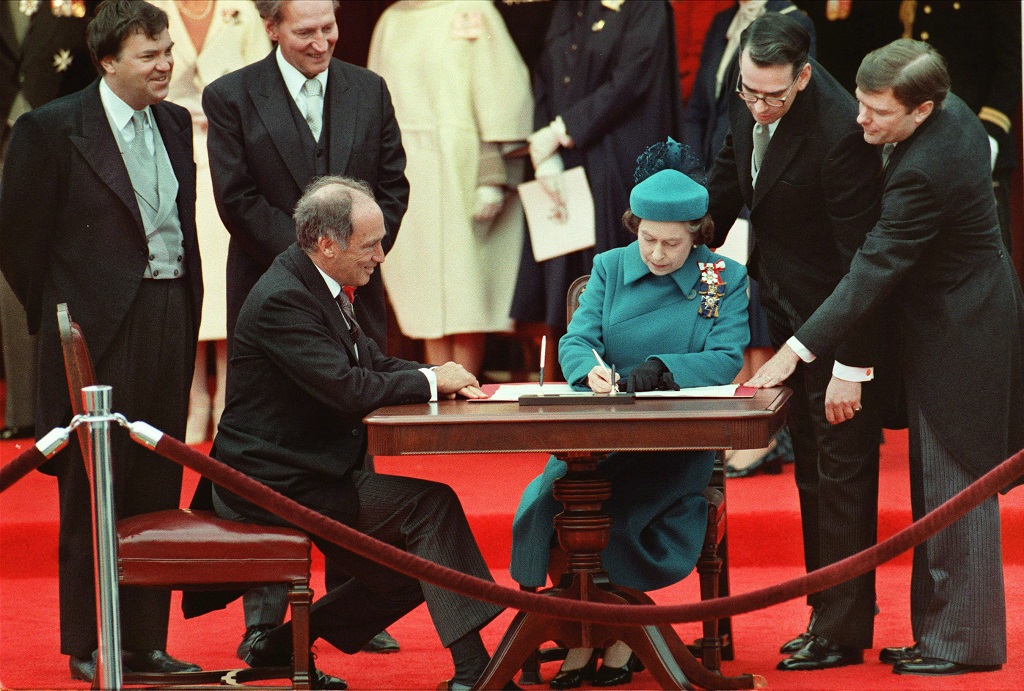
Queen Elizabeth II signs Canada’s constitutional proclamation in Ottawa on April 17, 1982 as Prime Minister Pierre Trudeau looks on.
The Canadian Press/Stf-Ron Poling
For years, Queen Elizabeth II was a link to another age — an age of tradition, and respect, and restraint. Did that age ever exist in an ideal form? Of course not. But we still admire its echoes, which surrounded our conception of the Queen.
She was crowned in 1953, looking rather vulnerable at the age of 25. Winston Churchill was Prime Minister. Man had only just reached the top of Everest and was more than fifteen years away from reaching the Moon.
The Empire was crumbling but the young, elegant, stoical Queen kept alive a sense of British importance and stability. Her personal calmness and courage as she toured dangerous regions was noted (and would be later tested when Michael Fagan, a disturbed socialist, snuck into her bedroom).
Her popularity never faltered. Governments, institutions, actors, athletes et cetera have risen and fallen in their popular esteem but Her Majesty was always loved. Was this in part because our exposure to her was so limited? Of course. But there is something special in that. She never imposed herself upon the public. She was committed to the tiring, traditional, constitutional, life-affirming, often rather modest and unheralded duties that she had inherited. The monarchy is a lot more than one person, of course, but it took a special person to embody it.
All the way back in the 1950s, Malcolm Muggeridge warned that elevating royals to the status of celebrities would kill the institution. Who could deny that he was onto something? Princess Diana was drowned in prurience and sentimentality, and some of the Queen’s own descendants have disgraced themselves, to greater and lesser degrees, by embracing the sordid lifestyles and the haughty status of the rich and the famous. Throughout it all, Queen Elizabeth maintained her dignity and grace, and her focus on her own responsibility.
The CBC posted an obituary for Her Majesty as soon as the news was confirmed:
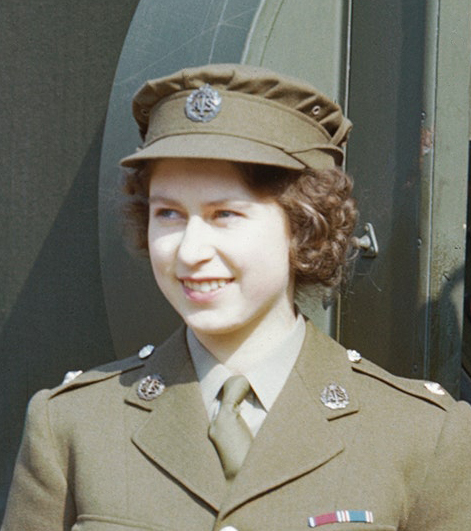
HRH Princess Elizabeth as a junior officer in the Auxiliary Territorial Service in April 1945.
Queen Elizabeth, Canada’s head of state and the longest-reigning British monarch, has died.
She died on Thursday afternoon at Balmoral Castle in Scotland, Buckingham Palace said in a short statement. She was 96.
“The Queen died peacefully at Balmoral this afternoon. The King and The Queen Consort will remain at Balmoral this evening and will return to London tomorrow,” the palace said, in reference to the Queen’s son Charles, who automatically became king upon her death, and his wife, Camilla.
Her husband, Prince Philip, died in April 2021.
Elizabeth became Queen in 1952, at the relatively tender age of 25, and presided over the country and the Commonwealth, including Canada, for seven decades. Those 70 years as monarch were recognized during this year’s Platinum Jubilee events, which reached their height in London in early June.
In her time as monarch, Elizabeth bore witness to profound changes at home and abroad, including the decline of the British Empire and decolonization of many African and Caribbean countries, along with the end of hostilities with Irish republicans.
As one of the most famous women in the world, she was also under great public scrutiny during some of the most painful moments of her life, including the death of her father, King George VI, the marriage breakups of three of her four children and the death of her former daughter-in-law, Diana, Princess of Wales.
But Elizabeth always had a keen sense of her role.
“I cannot lead you into battle, I do not give you laws or administer justice,” she said during her first televised Christmas address in 1957. “But I can do something else: I can give you my heart and my devotion to these old islands and to all the peoples of our brotherhood of nations.”
In the National Post, Araminta Wordsworth points out the Queen’s fondness for Canada during her reign:
“Her Majesty Queen Elizabeth II” by Tinker Sailor Soldier Spy is licensed under CC BY-NC-ND 2.0 .
After a record-breaking reign of 70 years Her Majesty Queen Elizabeth died on Sept. 8, 2022.
She was the longest-ruling British monarch, outpacing her great-great-grandmother, Queen Victoria. However, Louis XIV of France still holds the absolute record, with 72 years, 100 days.
For most Canadians, the 96-year-old is the only sovereign they have ever known, but whether the country will sustain the connection after her death remains to be seen.
Certainly, Canada was the country she chose to visit most often. She was also here at one of the pivotal moments in our history when then-prime minister Pierre Elliott Trudeau brought home the Constitution in 1982. As sovereign, she signed the document in a rain-spattered and windy ceremony on Parliament Hill in Ottawa, the capital chosen by Queen Victoria.
But her connection to Canada had begun decades earlier. In 1939, Princess Elizabeth was reportedly the first British royal to make a transatlantic phone call: the recipients were her parents, then the Duke and Duchess of York, who were on a North American tour.
In 1951, the princess spent almost five weeks in Canada, filling in for her ailing father, George VI.
Winston Churchill, then in opposition, had wanted the princess and her husband, Prince Philip, the Duke of Edinburgh, to travel by boat, arguing air travel was unsafe.
But he was overruled and the royal couple became the first to embark on such a tour by air. With an action-packed schedule, they crossed the country from the Atlantic to the Pacific, including a side trip to Washington, D.C., greeted all the way by rapturous crowds. The royal pair square-danced, attended a hockey game and accepted countless bouquets.
Comments Off on Queen Elizabeth II (21 April, 1926 – 8 September, 2022)
Surprise! Liz Truss can successfully locate Canada on a map!
In UnHerd, Marshall Auerback details some of the Canadian connections of Britain’s new PM:

British Prime Minister Liz Truss, 1 May 2022.
Official portrait via Wikimedia Commons.
Faced with soaring costs of living, increased collateral damage from the war in Ukraine, and widening national inequality, Liz Truss seemed curiously optimistic in her first speech as Prime Minister. What could possibly be driving such bullishness? Absent any sign of a coherent plan of action, we might find her motivation in an Instagram post from 2018, where Truss cited the time she spent in Canada as a teenager as “the year that changed my outlook on life … #pioneercounty #optimism #maplespirit”.
As profound an impact as that year might have had on Truss’s optimistic psyche, she would do well to look more closely at Canada’s faltering “success story” in recent years. Today, the country is no longer the land of milk and honey (even if it does still produce a fair amount of maple syrup), but suffers many of the same problems as the UK, and a number that are significantly worse: rising inflation, profound income inequality, the challenges posed by climate change, and an increasing host of social problems — not least the mass stabbing spree last weekend in Saskatchewan that left 10 people dead.
However, to the extent that the Trudeau Administration has attempted to remedy some of these problems, there are clear lessons for Truss. Unlike in the UK, many of Canada’s energy problems are largely self-inflicted, a result of a progressive government ignoring its comparatively resource-rich environment, even as its European allies (including the UK) suffer severe consequences of being cut off from Russian gas supplies and the corresponding rise in energy prices.
A few weeks ago, German Chancellor Olaf Scholz visited Canada to secure more gas for his country. This being Canada, the German Chancellor was treated politely, but the underlying plea for Ottawa to increase liquefied natural gas (LNG) production to offset the loss of Russian gas was given short shrift. The Canadian government, one of the biggest producers of natural gas in the world, has misgivings about whether becoming an even bigger producer and exporter would actually be profitable.
Leaving aside the broader debate as to whether the dangers of man-made climate change have been confounded with natural weather and climate variability, natural gas, although a fossil fuel, emits roughly half the amount of carbon dioxide when combusted in a new, efficient natural gas power plant. This would suggest that Canada’s absolutist stance is not only a major geopolitical mistake, but also an economic own goal. The country is foregoing a major growth opportunity, which would both alleviate global inflationary pressures by increasing the supply of natural gas to the global markets, while simultaneously enhancing the prospect for a plethora of new high-paying jobs that would buttress Canada’s declining middle class.
Canada is also home to substantial supplies of copper, nickel, lithium, and cobalt — all of which will be essential to producing the infrastructure required to transition from fossil fuels to greener sources of energy, such as wind and solar. But mining itself remains a “brown” industry, one that creates substantial carbon emissions and environmental degradation. It seems conceivable, then, that the Trudeau government’s green energy purity could soon discourage the increased mining activity needed to facilitate this energy transition.
[…]
Yet in many respects, Canada’s problems are more easily resolved, given that so many are self-inflicted. And not only are there ample natural resources to offset the current energy crisis, but also broad institutional mechanisms to alleviate regional inequalities. Canada, then, cannot provide all the solutions that Truss needs. For all her boosterism, Britain remains a country fatigued by her party’s ongoing political churn and the non-stop travails still emanating from Brexit. If she is to succeed, Truss must begin by removing her rose-tinted view of Canada. The Great White North can certainly serve as an inspiration — but that is all. Canada may have changed Truss’s “outlook on life”. But if Britain is to “ride out the storm”, as she suggested yesterday, an entirely new approach is needed.
Comments Off on Surprise! Liz Truss can successfully locate Canada on a map!
Liz Truss replaces Boris Johnson
In Spiked, Brendan O’Neill looks at some of the many, many tasks already piled on new British PM Liz Truss’s desk in the wake of Boris and the pandemic:
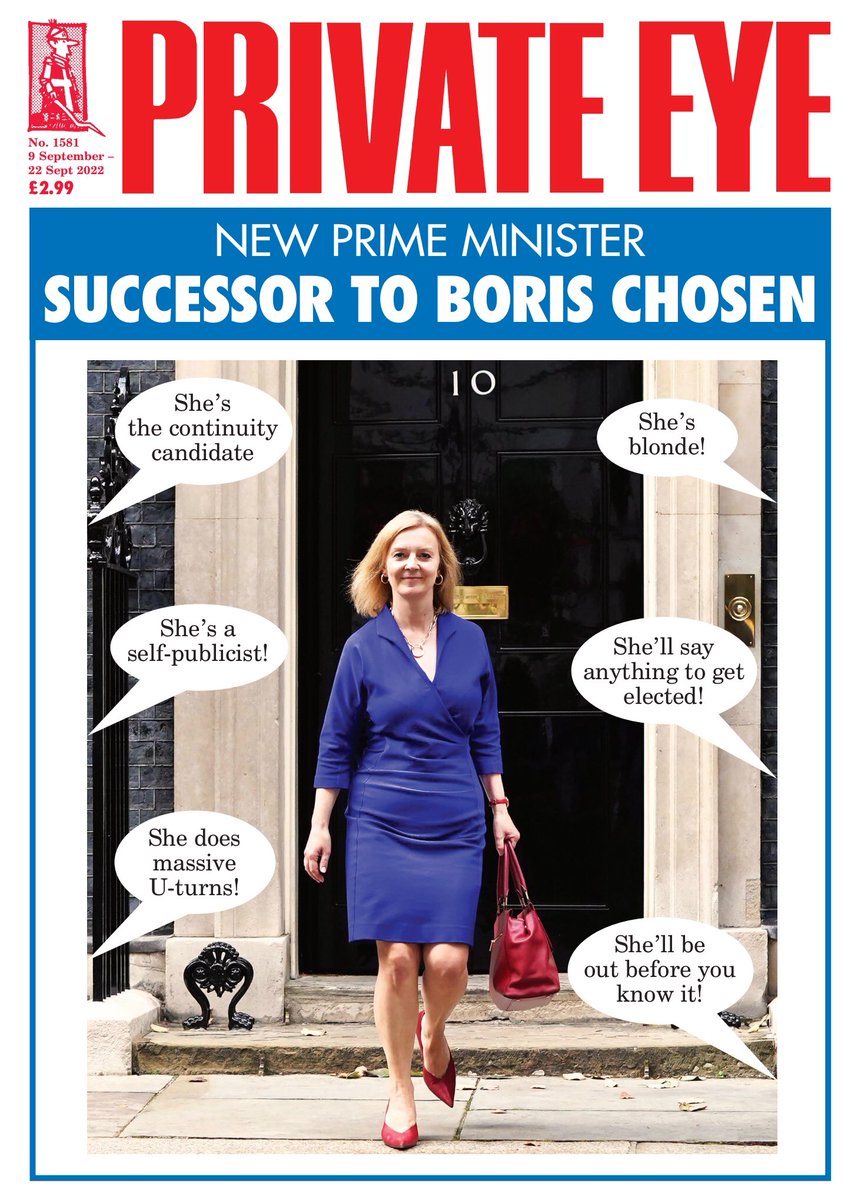
So it’s prime minister Truss. No big surprise there. What we need next, though, is something that would be very surprising, almost unfathomably so. We need a PM who can buck the crisis of political will and take clear, firm action to save the country from economic collapse and existential malaise. Is that Truss? I’m sceptical, but we shall see.
At first glance, Truss would seem to be singularly unsuited to the task at hand. That task is nothing less than a revolution of will, a rediscovery of the political mettle that has been glaringly absent in Britain these past few decades. We live under a political class that is cautious, bereft of daring; which is hyper short-termist, more concerned with dodging controversy in the present than laying out a plan for the future. The energy crisis is the bastard offspring of this evacuation of vision from politics.
And in Truss we seem to have a leader who is more technocratic than visionary, more given to following the political consensus than to shaking things up. As the Telegraph put it, Truss has been a “dutiful servant”. Despite being something of a Tory party outsider – considered by many insiders to be “a bit odd” – Truss has always “diligently backed the consensus within the party”. She seems overly media-oriented, too. She’s clearly had her gauche edges smoothed by media training and she devotes a lot of energy to “savvy social-media use”. A politician who prefers consensual calm to bold action, and who is more concerned with virtual likes than real-world impact, is not what crisis-ridden Britain needs.
And yet, Truss is far from alone in lacking political audacity, in seeming to prefer the small bureaucratic task of managing public life rather than overhauling it. In this, she’s fairly typical of today’s managerial elites. Also, Truss’s political clarity seemed to improve during the leadership contest. She even became a little more daring in what she said – for instance, by bristling against Net Zero policies. No, this doesn’t prove she’s the leader we need, but it is a reminder that politicians often find themselves, and their cojones, in the heat of battle. Will the pressures of the crisis similarly bring out Truss’s slightly edgier side? We should hope so.
On that crisis, let us be clear: it is incredibly serious. It is the most serious crisis Britain has faced in decades. The political and media elites seem unwilling to acknowledge just how deep and menacing the crisis is. Even their focus on households’ rising energy bills suggests they do not appreciate the enormity of what is unfolding. Yes, millions are worried about how to keep the lights on this winter, but the impact of the energy crisis on business and industry will be graver still. Numerous businesses look set to go under, precipitating economic collapse and mass unemployment. Choosing between heating and eating will be a luxurious memory in the event of the joblessness and poverty that would follow such a calamity in British capitalism.
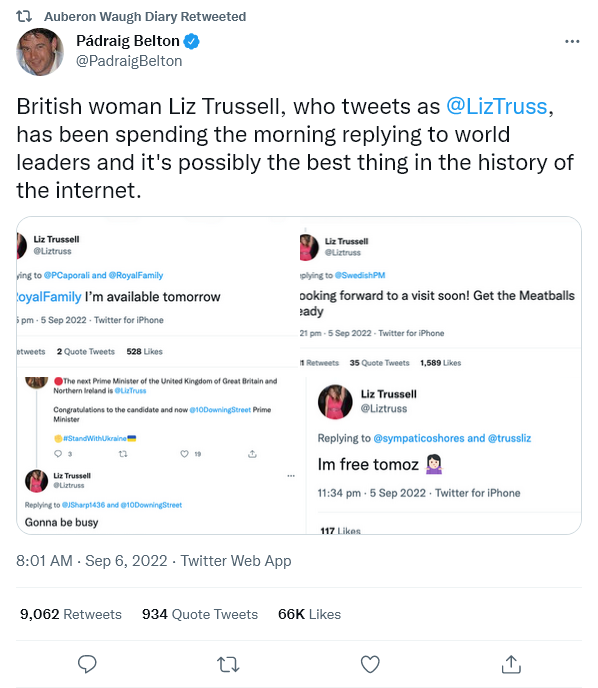
On a somewhat lighter note, it turns out that Liz Truss isn’t the same person as @LizTruss on Twitter:
Comments Off on Liz Truss replaces Boris Johnson
September 7, 2022
The Original Caesar Salad from Mexico
Tasting History with Max Miller
Published 6 Sep 2022
(more…)
Comments Off on The Original Caesar Salad from Mexico
September 6, 2022
Add the traditional English pub to the endangered list
There is nothing to match the warm, cozy comfort of a proper English pub*, especially on those cold, wet days as evening falls. Traditional pubs have been struggling for some time as British preferences in entertainment, drinking, and dining have become more cosmopolitan over the years. The raw numbers of pubs has declined year-over-year for decades, but it’s looking like the winter of 2022/23 may be the worst time for pubs in living memory:
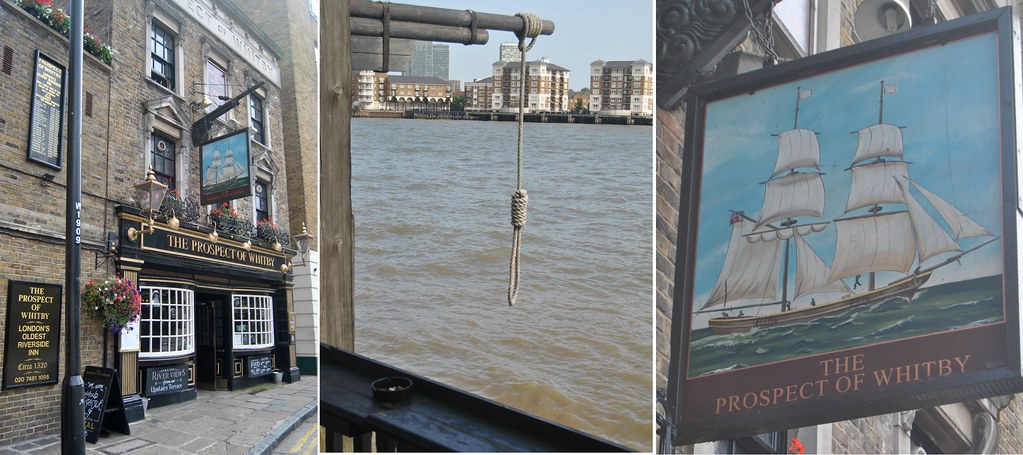
“The Prospect of Whitby ; Pub London” by Loco Steve is licensed under CC BY-SA 2.0  .
.
Simon Pegg’s wise counsel in Shaun of the Dead – “Go to the Winchester, have a nice, cold pint, and wait for all this to blow over” – has long been shared in GIF form whenever a new crisis springs into view.
Chillingly, this time next year, that may no longer be an option. To the Great British pub, the winter energy crisis represents an existential threat. And on the back of two years drifting in purgatory under lockdown, many pubs are facing a war of extermination.
The trade publication for pubs, the Morning Advertiser, makes for especially grim reading at the moment. Its pages are dominated by the energy crisis. It suggests that without urgent government intervention, more than 70 per cent of existing licensed premises will not survive the winter.
One “wet-led” pub – that is, a pub-pub (one that relies on the sale of alcohol to remain viable, rather than on burger stacks and artisan chips served on a slate hubcap) – illustrates this plight all too clearly. Until this summer, it had been paying 14p per electricity unit on a fixed energy contract. But it has now been quoted 83p a unit. It is hard to imagine any cost that could rise so vertically without dealing a mortal blow to a business balanced on the edge of viability. And it’s not as if heating and energy are optional extras during the winter. This is not a thriller, this is a snuff movie.
Pubs have always faced challenges, of course, going right back to the Civil War and the mirthless interregnum. Thanks to Cromwell’s war on harmless pastimes – such as bear-baiting, whoring and dice – you will rarely see him honoured on pub signs in the way you see a Royal Oak or a King’s Arms.
The First World War famously saw the introduction of last orders. This was to keep munitions workers working. It was one of those temporary, emergency measures that, like income tax, proved oddly barbed once in the flesh of the state. As the 20th century wore on, rationing and oil shocks tightened belts. And then, under Thatcher, the rise of restaurants, wine bars and other sub-pub drinking options diffused the economic benefit of those re-loosened belts.
Drink-driving legislation and smoking bans delivered a slow-motion one-two that left many well-established premises, especially in rural locations, reeling. And in the background, the steady drip-drip of anti-drinking propaganda from bodies such as Public Health England (now rebranded as the Health Security Agency) has done its damage, too. The public-health lobby sees drinking only in terms of abuse, while ignoring the social benefits, the knitting-together, the public mental health of England that the public house affords.
* The Scots and the Welsh may have issues with this, but based on my experiences of drinking and dining in pubs in all three countries, it’s the English pub by a country mile. Welsh pubs can be pleasant, but Scottish pubs outside Edinburgh remind me of grim old Ontario bars back when Ontario was still just emerging from the post-Prohibition no-fun-on-Sunday Orange Lodge era (“We’ll let you drink, but you must be made to feel guilty for it!”).
Comments Off on Add the traditional English pub to the endangered list
Scotland’s AMAZING Jacobite Steam Train
Dylan’s Travel Reports
Published 4 Dec 2020An amazing day out on West Coast Railways’ iconic Jacobite steam train from Fort William to Mallaig and back, part of the stunning West Highland Line!
Date of Travel: 21 October 2020
Class of Travel: First Class
Rolling Stock: LMS Stanier Class 5 4-6-0/Mk1
Cost of Ticket: £133.75 ($176.10, €150; price for 2 people)
Origin: Fort William, United Kingdom (Scotland)
Destination: Mallaig, United Kingdom (Scotland)
*Currency conversions correct as of 09/11/2020 to nearest $/€0.05
(more…)
Comments Off on Scotland’s AMAZING Jacobite Steam Train


